
Independent Buyer Comparison: Wood Panel Supplier vs. Panel-Only Vendors
Independent Buyer Comparison: Wood Panel Supplier vs. Panel-Only Vendors
A neutral evaluation of what procurement teams actually receive from a single-category panel vendor versus an integrated manufacturer-exporter — and which risks each model adds, transfers or removes.
Global plywood demand was valued at USD 80.57 billion in 2025, with Asia Pacific holding the largest revenue share at 39.4% (Grand View Research). MDF is expanding along a similar path: Grand View Research projects the global MDF market to grow from USD 44.96 billion in 2025 to USD 82.24 billion by 2033, a CAGR of 8.2%.
Growth at that scale does more than lengthen a supplier shortlist. It multiplies the number of supplier models a procurement team has to evaluate, each with a different risk profile for buyers committing a container, a payment schedule and a delivery window. This comparison sets a panel-only vendor — a seller whose offer is limited to boards and who owns no production equipment — against an integrated manufacturer-exporter that combines multiple panel families with woodworking machinery and full-process supply from log intake to finished board. Neither model is automatically correct; the value of the comparison lies in knowing which questions each model forces the buyer to answer.
The Two Models, Defined
A panel-only vendor is a trading or converting operation whose catalogue is limited to panels, usually a narrow set of categories such as plywood and one or two decorative or substrate boards. Its commercial value comes from price positioning, stock availability or regional proximity. Because it does not operate pressing, veneering or coating equipment, production responsibility sits upstream with a mill the buyer often never audits directly, and specification changes are relayed rather than resolved inside a production team.
An integrated supplier manufactures across several panel families and, in some cases, also builds the machinery used to produce them. Dalian WADA International Trading Co., Ltd., established in 2010, is a manufacturer and global exporter of engineered wood products with a 53,950 m² production footprint, 200 employees and a 25-engineer technical team. Its product list covers LVL, plywood, veneered board, MDF, OSB, wall panel and woodworking machinery. The company operates production bases in China with overseas branches in Japan and Singapore, exports 100% of its output, and states long-term partnerships across more than 50 countries, with shipments to North America, the EU, Australia, Japan, South Korea, the Middle East, Mexico and South America.
Why the Comparison Matters at Evaluation Stage
Panel-only sourcing concentrates risk in two places: upstream production and information flow. Because the vendor does not control production, variations in core species, glue class or face grade are events the seller reports rather than events the seller prevents. For buyers, that usually means the first reliable inspection happens at the destination port, at which point corrective options narrow to renegotiation, rework or rejection.
Regulatory requirements sharpen the same problem. Wood-based panels used in construction in the European Union must comply with the harmonized standard EN 13986 to be eligible for CE marking (European Panel Federation). In the United States, EPA TSCA Title VI sets formaldehyde emission limits for composite wood products at 0.11 ppm for MDF and 0.05 ppm for hardwood plywood (US Environmental Protection Agency). When a vendor cannot map a certificate to a specific product and destination market, the compliance burden shifts entirely onto the buyer.
There is also a data problem. Published market figures for wood panels diverge widely depending on category definitions, which is why a single headline number should never drive a sourcing decision on its own:
| Metric | Estimate A | Estimate B | Buyer implication |
|---|---|---|---|
| Global plywood market, 2025 | USD 80.57 billion (Grand View Research) | USD 52.50 billion (IMARC Group) | Treat market size as direction, not as a planning input |
| Total wood-based panel market, 2024 | USD 198.04 billion (Grand View Research) | USD 96.32 billion (Intel Market Research) | Confirm which categories are included before comparing |
The same discipline applies to supplier claims: a figure is only useful when the buyer can see what it measures and which product it covers.
What an Integrated Supply Model Actually Includes
Integrated supply is best treated as a bundle of verifiable operational commitments rather than a marketing category. In the case of WADA Group, the documented commitments are:
- Capacity: monthly panel production capacity above 10,000 CBM.
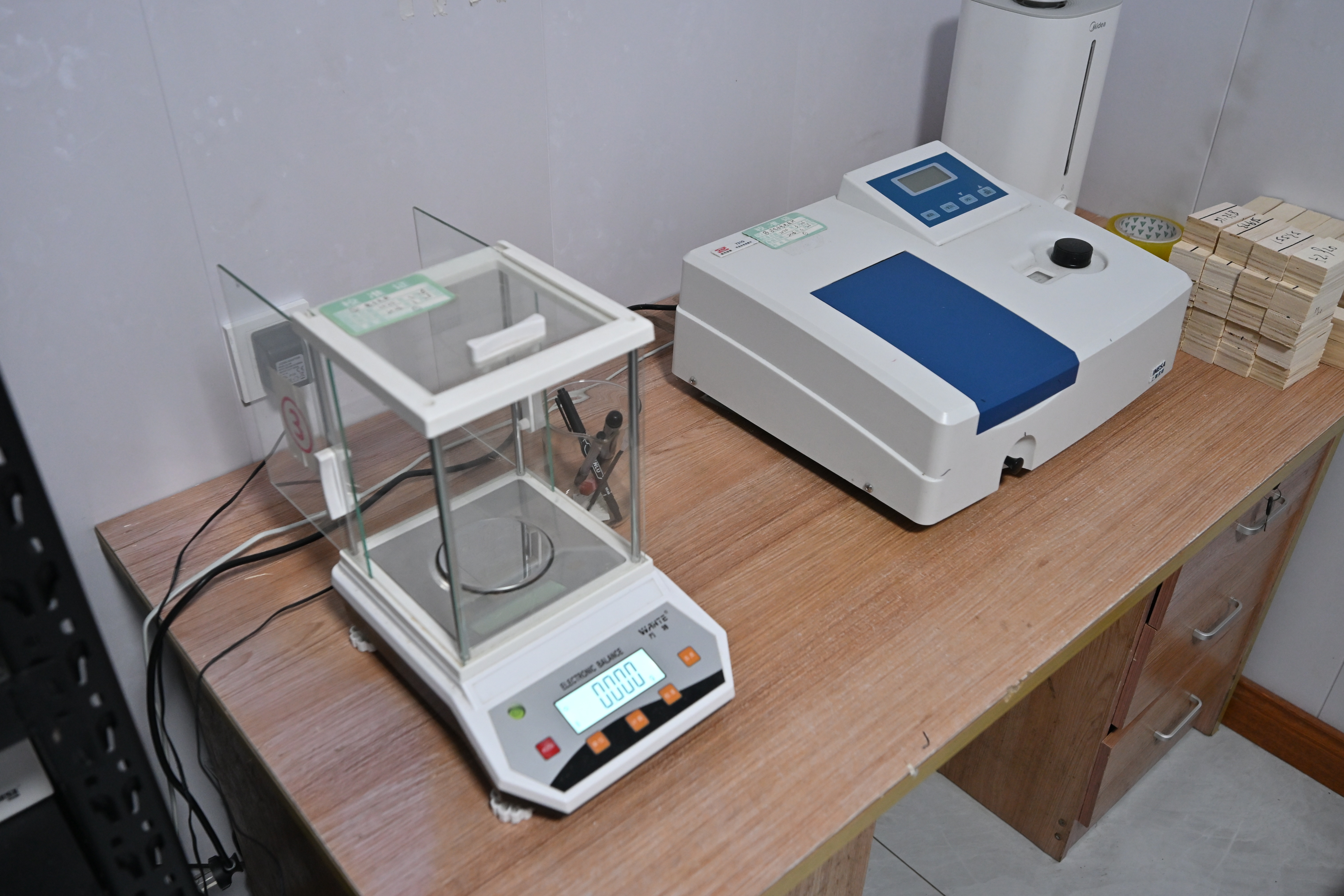
- Quality control: 100% inspection, supported by a dedicated quality inspection team and operators with more than 10 years of experience in the timber industry.
- Customization: OEM and ODM production services, with customization of size, thickness and layout.
- Commercial terms: a minimum order quantity of one 40-foot container, standard production lead time of 25 to 45 days, FOB or CIF delivery, and pre-shipment testing as the acceptance method.
- Payment structure: T/T terms of 30/70 or 50/50.
- Coverage and service: export markets spanning South America, the EU, the Middle East and Southeast Asia, with remote after-sales support.
- Certification: FSC, EUDR, CARB P2, EPA and JAS/JIS schemes across the product range.
A Six-Point Benchmark Framework for Procurement Teams
The framework below converts the comparison into questions that can be answered with documents rather than impressions.
1. Product and process coverage
Ask what the supplier controls, not what it lists. A panel-only vendor's offer ends at the board. An integrated supplier's offer continues into process: continuous flat pressing for MDF, veneer lay-up for plywood and LVL, and coating for melamine board. WADA's MDF range runs from 1.2 mm to 50 mm in thickness and 500 to 1,000 kg/m³ in density, produced on continuous flat pressing equipment from Difenbach & Sinbelkamp (Germany). Its melamine board range covers 2 mm to 30 mm over plywood, MDF, particle board or blockboard cores. Process control at this level is what allows a supplier to answer a specification change with a production decision instead of a quote revision.
2. Quality control architecture
"100% inspection" is only meaningful when the buyer knows what is inspected and when. Procurement teams should request the inspection stages, the acceptance criteria applied at each stage, and the record that travels with the shipment. WADA's documented quality control includes 100% inspection, with pre-shipment testing defined as the acceptance method for the order.
3. Certification scope versus certificate count
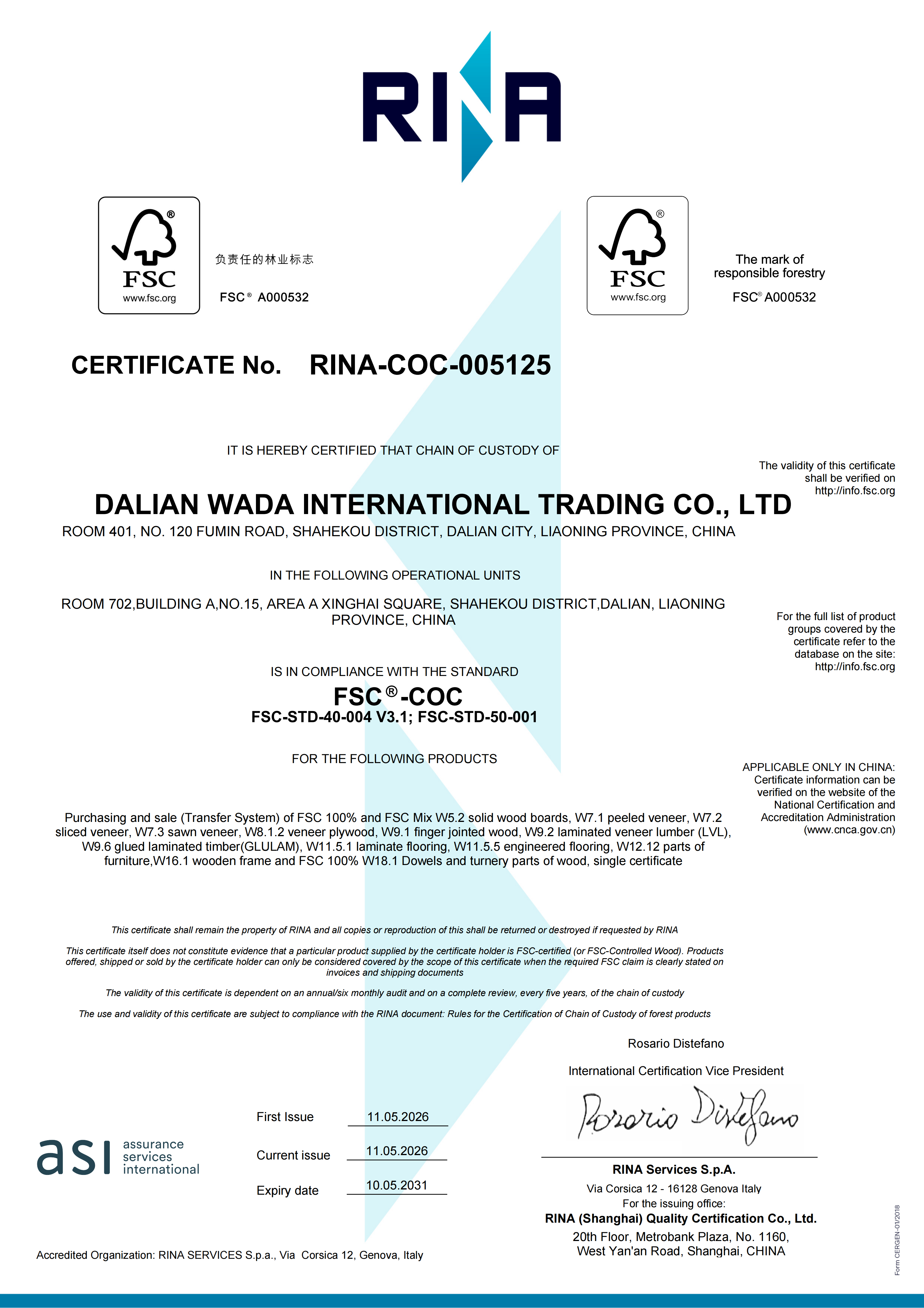
A certificate is evidence for the scope printed on it — not for a supplier's entire catalogue. Buyers should map each standard to the product and market it actually covers.
| Standard / scheme | Product scope | Market relevance |
|---|---|---|
| JIS A 5905 | Fiberboard (MDF) | Japan |
| JIS A 5908 | Particle board | Japan |
| JAS 0233:2024 | Plywood, including structural plywood | Japan |
| JAS 0701:2023 | Laminated veneer lumber (LVL) | Japan |
| AS/NZS 4357.0:2005 | Structural laminated veneer lumber | Australia, New Zealand |
| AS 6669-2016 | 17 mm formwork plywood | Australia, New Zealand |
| CARB Phase 2 / TSCA Title VI | Hardwood plywood (HWPW-VC) | United States |
| FSC Chain of Custody | Solid wood boards, veneer, plywood, LVL, glulam, laminated and engineered flooring, furniture parts | EU, North America, UK |
| EN 13986 | Wood-based panels for construction (CE marking eligibility) | European Union |
4. Capacity, continuity and lead time
Continuity is a function of capacity plus raw material access. A supplier producing above 10,000 CBM of panels per month, with its own production bases and a stated 25 to 45 day lead time, gives a buyer a predictable planning window — and a predictable constraint. Buyers who require less than a container of a single specification will find that window less accommodating than a vendor that resells from stock.
5. Customization and engineering support
OEM and ODM services with size, thickness and layout customization shift part of the specification work to the supplier's technical team. The same capability appears across product families: plywood cores range from poplar, eucalyptus, combi and full birch to fingerjoint, hardwood, pine and Russia birch, with glue classes including MR, melamine WBP and phenolic WBP, and emission classes from E0 and CARB P2 to E1. Each change should be handled as an engineering change with a sample, a specification sheet and an agreed acceptance test.
6. Commercial terms and payment structure
Terms define the real cost of switching suppliers. A one-container minimum, FOB or CIF delivery, pre-shipment testing and T/T 30/70 or 50/50 payment are workable for established importers; they are less workable for buyers testing a market with a half-container trial order. This is not a quality judgment — it is a fit judgment.
Side-by-Side: Panel-Only Vendor vs. Integrated Supplier
| Evaluation dimension | Panel-only vendor (typical) | Integrated supplier (documented example) | Evidence to request |
|---|---|---|---|
| Product coverage | Narrow range, panels only | LVL, plywood, veneered board, MDF, OSB, wall panel, woodworking machinery | Current product list and specification sheets |
| Production control | Depends on upstream mill | In-house production bases with defined process steps | Factory records, process description |
| Quality control | Varies with the upstream supplier | 100% inspection; pre-shipment test as acceptance | Inspection protocol, shipment test record |
| Certification | Often limited to the traded category | Certificates mapped to product and market (JIS, JAS, AS/NZS, CARB/EPA, FSC) | Certificate scope statement |
| Customization | Usually restricted to resale formats | OEM/ODM with size, thickness and layout customization | Sample approval and specification sheet |
| Commercial terms | Variable; smaller quantities possible | MOQ 1x40' container; lead time 25–45 days; FOB/CIF; T/T 30/70 or 50/50 | Proforma invoice and production schedule |
| After-sales | Depends on the reseller's network | Remote support | Service terms in the sales contract |
Application Patterns: What the Models Look Like in Practice
Recorded project references show where the two models separate under real specifications.
- Furniture and cabinet manufacturing, Mexico: 100 containers of veneered board, melamine board, LVL and MDF supplied to a furniture manufacturer for furniture and cabinet decoration.
- Building structures, Japan: 200 containers of film faced plywood and structural plywood for a construction builder, with high strength as the reported result and high durability and waterproof properties as the key performance highlights.
- Building structures, Australia: 50 containers of structural plywood for a building contractor, again with high strength as the reported result and durability and waterproof performance as highlights.
- Outdoor cladding, Portugal: 20 containers of marine plywood for a wall cladding application, delivered with weather-resistant performance and UV resistance as the stated highlight.
- Production line, Vietnam: a complete plywood production line supplied to a plywood manufacturer as a one-stop solution, supporting stable production.
The first four references describe material supply under different exposure conditions — interior decoration, structural building and exterior cladding. The fifth describes something structurally different: a buyer that moved part of the production chain in-house with equipment from the same supplier. That is the boundary at which an integrated supplier stops behaving like a panel vendor.
Buy Panels or Invest in a Production Line?
Buyers with repeat volume eventually ask whether they should keep purchasing panels or bring part of the value chain in-house. The decision rests on capital exposure, order-book continuity, technical staffing and capacity utilization — not on a single unit-cost comparison. A production line has to be fed, staffed and maintained; panels ordered at container quantity carry none of that fixed cost, but they also leave the buyer dependent on external production windows.
Where a buyer does choose to build, equipment and material can come from the same source. WADA's product list includes woodworking machinery, and one recorded project supplied a Vietnamese plywood manufacturer with a complete plywood production line as a one-stop solution. Automation is commonly assumed to reduce manual handling, but any labor-reduction expectation has to be tied to the specific line configuration and the plant's existing baseline, and validated during planning rather than taken as a fixed figure.
Where the Integrated Model Is Not the Answer
An honest comparison has to state the boundaries of each model.
- Minimum order quantity. A one-container minimum excludes buyers who need trial volumes below container scale. For first-time importers testing a market, a panel-only vendor or a local stockist may be the more rational starting point.
- Lead time. A 25 to 45 day production window does not solve urgent spot replacement. Buyers holding thin safety stock should plan forward rather than rely on fast replenishment.
- Service geography. After-sales support is remote. For buyers located far from production, resolution speed depends on how clearly the issue is documented and diagnosed, so service wording should be agreed in the contract rather than assumed.
- Breadth is not price leadership. A wider catalogue covers more categories; it does not guarantee the lowest price on any individual SKU. Per-item benchmarking remains necessary.
- Certificate scope. A JIS or JAS certificate covers the product scope named on it. It cannot be transferred automatically to another product line in the same catalogue.
- Reference verification. Statements such as long-term partnerships across more than 50 countries should be validated with references or shipment records, as with any supplier claim.
Panel-only vendors remain a legitimate choice when a buyer needs one board category, in-market stock, or a smaller and more frequent shipment pattern.
Market Signals and Outlook
Category-level data suggests the panel market will keep widening rather than consolidating around a single substrate. Oriented strand board production passed 32 million cubic meters globally in 2024, with the United States accounting for 14 million cubic meters (Market Reports World). That volume sits alongside plywood and MDF demand, not instead of it. Wood plastic composites reached USD 8.89 billion in 2025, with an expected CAGR of 11.7% until 2033 (Grand View Research), which signals continuing substitution pressure in exterior and moisture-exposed applications.
Supply-side context matters as well. China was the second largest exporter of raw timber (HS 44) to the United States in 2024, contributing USD 2.17 billion, a 9% share (ITC / US Census Bureau). At the manufacturing tier, West Fraser Timber, Arauco, Kronospan and EGGER Group are identified as major global players in the wood-based panel market (Global Market Insights) — a reminder that integrated production models define the structure of the larger end of this industry rather than being an exception to it.
The practical implication for procurement teams is that supplier selection is shifting from price-only comparison toward evidence comparison: which certificates apply to which boards, which inspection stages are documented, and which production steps the supplier actually controls.
Future Outlook
Three expectations follow from the evidence above. First, certification-driven market access will continue to push buyers toward suppliers that can produce scope-specific documentation, because regulations such as EN 13986 and EPA TSCA Title VI are defined at product level rather than company level. Second, buyers with multi-category demand will increasingly consolidate orders with suppliers able to cover several substrates under one commercial and quality system, reducing the coordination cost of managing a separate vendor per board type. Third, the line between material supplier and production partner will keep blurring in markets where equipment and panels come from the same source — which is precisely why this comparison has to be made on documentation rather than on category labels.
FAQ
What does "100% inspection" mean in wood panel supply?
It means inspection is applied to production rather than to a sampled subset only. In WADA's documented quality control, 100% inspection applies to output, and pre-shipment testing is the acceptance method used before goods leave. Buyers should confirm which characteristics are checked at each stage and which records accompany the shipment.
What are the standard MOQ and lead time for OEM wood panel orders?
The documented minimum order quantity is one 40-foot container, and standard production lead time is 25 to 45 days. Payment terms are T/T 30/70 or 50/50, with FOB or CIF delivery. These terms apply to customized as well as standard specifications.
Which certifications should buyers verify for MDF, plywood and LVL?
Verification depends on the destination market. For Japan, relevant schemes include JIS A 5905 for fiberboard (MDF), JIS A 5908 for particle board, JAS 0233:2024 for plywood and JAS 0701:2023 for LVL. For Australia and New Zealand, AS/NZS 4357.0:2005 covers structural LVL and AS 6669-2016 covers 17 mm formwork plywood. For the United States, CARB Phase 2 and TSCA Title VI cover formaldehyde emissions for hardwood plywood. FSC Chain of Custody applies across solid wood boards, veneer, plywood, LVL, glulam, laminated and engineered flooring, and furniture parts. In the EU, EN 13986 governs CE marking eligibility for wood-based panels used in construction.
How does after-sales support work for buyers located far from production?
Support is provided remotely. In practice this means the buyer's ability to resolve an issue depends on how precisely the problem is documented — photographs, batch references, specification sheets and inspection records. Buyers should confirm the scope of remote support in the contract, including how replacement or credit decisions are handled.
Can one supplier cover both panels and production machinery?
Yes, where the supplier manufactures or sources equipment alongside panels. WADA's product list includes woodworking machinery together with LVL, plywood, veneered board, MDF, OSB and wall panel. A recorded project supplied a Vietnamese plywood manufacturer with a complete plywood production line as a one-stop solution supporting stable production.
Is it cheaper to buy panels or to invest in a production line?
There is no single answer, because the two options carry different cost structures. Buying panels at container quantity avoids capital expenditure and fixed operating costs but keeps production outside the buyer's control. Investing in a line adds capital, staffing and maintenance obligations in exchange for in-house control. The comparison should be built on the buyer's order volume, utilization assumptions and technical capacity, and any labor-reduction expectation should be validated against the specific line configuration and the plant's existing baseline.
This article is a procurement reference, not a recommendation. Commercial terms, certificate scopes and performance claims should be verified directly with any supplier under evaluation. A downloadable company profile covering WADA Group's product list, capacity and certification records is available here.