
Independent Buyer Review: Bar Table Set vs Bistro Set vs Tray Table vs 3-Tier Space Saver
Independent Buyer Review: Bar Table Set vs Bistro Set vs Tray Table vs 3-Tier Space Saver
HTNXT INDUSTRY REFERENCE · FURNITURE PROCUREMENT
A global retailer sourcing compact home furniture is not choosing between four unrelated products. It is choosing between four space-saving mechanisms: a drop-leaf dining surface, a quick-fold bistro nook, a portable tray surface, and a vertical storage tower. For an OEM furniture manufacturer serving global retailers, the decisive variables are dimensional discipline, material specification, load boundaries, folding hardware, packaging, compliance evidence, and supplier coordination.
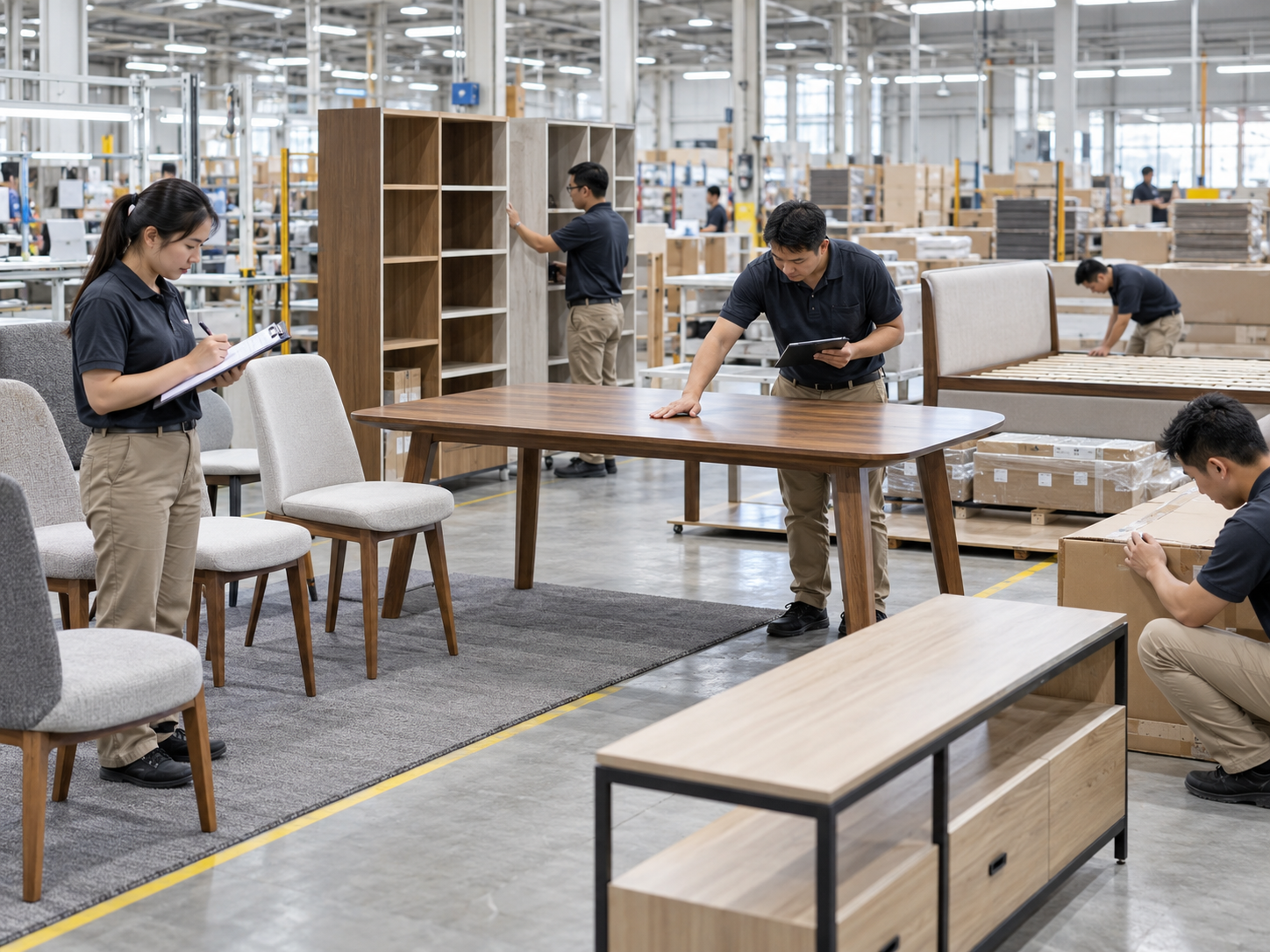
Factory and supply-chain context: compact furniture programmes depend on dimensional discipline, packaging control, and export documentation, not only product design. Image: Pricolotus Furniture.
Why this comparison matters for global retailers
China's wooden furniture exports reached US$24.57 billion in 2024, a 2% year-on-year increase, according to China Customs data reported by Fordaq News. The United States was the largest destination, accounting for nearly 30%, or US$7.1 billion, of those exports. The global furniture market was valued at US$597.71 billion in 2025 and is projected to grow at a 5.92% CAGR from 2026 to 2034, according to Fortune Business Insights.
These figures describe a large and growing category, but they do not tell a retailer which compact furniture format belongs in the next assortment. The practical opportunity is narrower: small-space furniture that can be merchandised across ecommerce and physical retail, with dimensions that fit apartments, balconies, small kitchens, and bathrooms. The risk is equally specific. A product that looks suitable in a catalogue can fail at the packaging, installation, load, or compliance stage.
That is why the four products in this review should be evaluated as a procurement set, not as a style choice. Each format solves a different problem, and each carries a different constraint.
What each product is designed to solve
The product set from Pricolotus Furniture includes four models with documented dimensions and materials. The table below is a buyer-facing summary, not a laboratory test.
| Format | Model | Stated dimensions | Material | Primary buyer problem | Key constraint |
|---|---|---|---|---|---|
| 3-piece bar table set with drop leaf | 826-1008 | Table 80 × 40 cm folded; 80 × 75 cm extended; H 75 cm; chair 32 × 32 × 45 cm | Metal + MDF + wood veneer | Small-kitchen dining with expandable surface | Extended footprint 80 × 75 cm; stated height 75 cm should be checked against intended bar-height positioning |
| 3-piece Folding Bistro Set | 826-1009 | Table Dia.60 × 72 cm; chair 40 × 46 × 80 cm | Steel frame + wood-like MDF or particle board | Quick-fold balcony or patio nook | Outdoor coating and folding-joint durability must be verified |
| 3-tier space saver | 826-1010 | 61 × 23 × 158 cm | Metal frame + MDF or particle board | Vertical storage over toilet and corner spaces | 15 kg per shelf; anti-tilt design requires correct installation |
| Tray table | 605-0007 | 48 × 38 × 66 cm | Metal tube + MDF | Portable side surface for laptop, meals, or books | Small surface; load capacity is not stated in the available corpus |
The first constraint is that these are product dimensions, not packaging dimensions. Buyers should request carton size, gross weight, and assembly clearances before committing to a marketplace listing or retail planogram.
Technical explanation: dimensions, materials, and load boundaries
3-piece bar table set with drop leaf, model 826-1008
The 3-piece bar table set with drop leaf is supplied as one table and two chairs. The table measures 80 × 40 cm with the drop leaf folded and 80 × 75 cm with the drop leaf extended, at a table height of 75 cm. Each chair measures 32 × 32 × 45 cm. The table and chair frames are metal, and the panels are MDF finished with wood veneer. The product description states a reinforced frame rated at 100 kg per chair, and the two stools tuck under the table.
The drop leaf is the core space-saving mechanism: it doubles the table surface from 80 × 40 cm to 80 × 75 cm. For a small kitchen, apartment, or loft, that is a useful compromise between a fixed dining table and a compact console. The limitation is equally clear. The product name uses bar table, but the stated table height is 75 cm; buyers should confirm the intended seating height and chair pairing before listing it as bar-height furniture. The table load rating is not stated in the same product record, so the 100 kg per chair figure should not be transferred to the table top.
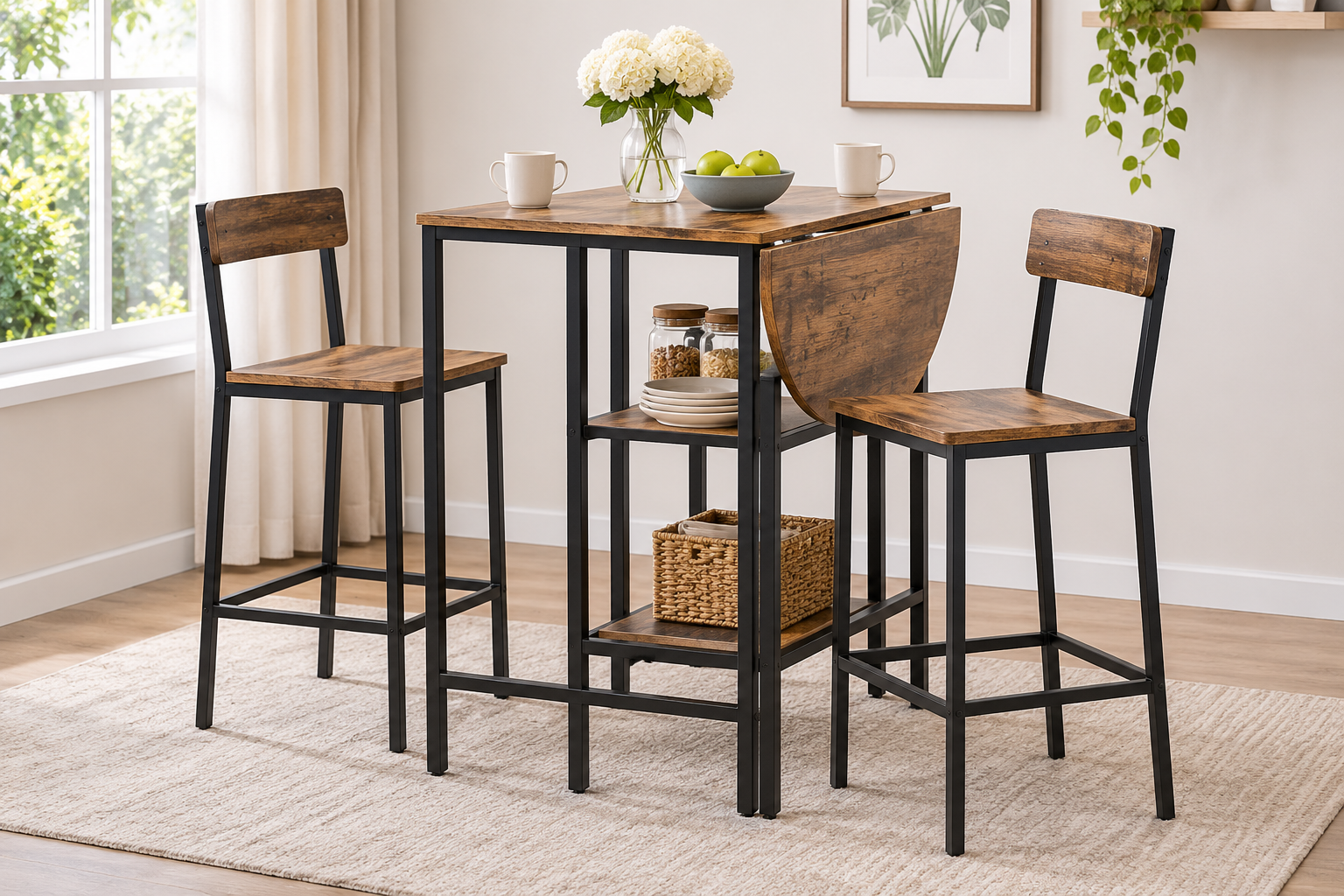
Model 826-1008: the drop leaf changes the table surface from 80 × 40 cm to 80 × 75 cm. Image: Pricolotus Furniture.
3-piece Folding Bistro Set, model 826-1009
The 3-piece Folding Bistro Set uses a steel frame with wood-like MDF or particle board surfaces. The table has a diameter of 60 cm and a height of 72 cm. Each chair measures 40 × 46 × 80 cm. The product description states a one-second fold, a rust-proof frame for patio and balcony use, and a no-assemble bistro combination.
This format is aimed at a different retail scenario: a balcony, patio, or small nook where the furniture must be stored quickly. The 60 cm table diameter keeps the footprint compact, while the folding action reduces storage volume. The main procurement caution is the outdoor claim. Rust-proof is a supplier description, not a test result in the available corpus. Buyers should request the coating specification and any relevant corrosion or outdoor-use test report before positioning the set as a weather-resistant patio product.
Tray table, model 605-0007
The tray table measures 48 × 38 × 66 cm and is made of metal tube and MDF. The frame is constructed from powder-coated steel tube, and the tabletop panel uses MDF. The product description states a fold-flat design, a U-shaped non-slip base, a wood-grain tabletop, and suitability for living room, bedroom, small apartment, and office use.
This is the most portable format in the set. It is designed for temporary or flexible surfaces: working from bed, meals, books, or a small side table. The limitation is surface area and load. The 48 × 38 cm top is not a dining table, and the available corpus does not state a load rating. Buyers should request a load limit and a stability check before listing it for laptop or meal use.
3-tier space saver, model 826-1010
The 3-tier space saver measures 61 × 23 × 158 cm. The frame is metal, and the shelves are MDF or particle board. The stated shelf load capacity is 15 kg per tier. The product features an anti-tilt design and is designed to fit over toilet and corner spaces.
This product addresses vertical storage rather than seating or dining. The 23 cm depth is the key constraint: it is designed for narrow spaces, but it also limits the size of items that can be stored. The anti-tilt design contributes to stability, but buyers should confirm whether a wall-anchoring kit is included and whether installation instructions are supplied in the target market language.
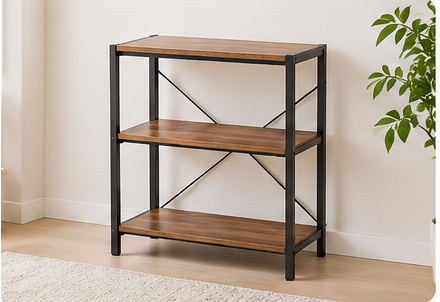
Model 826-1010: a 61 × 23 × 158 cm vertical storage tower with 15 kg per shelf. Image: Pricolotus Furniture.
Application fit: where each format earns shelf space
The application record for this furniture set describes an indoor household environment and a foldable space-saving household furniture project. The stated functions include seating, table surfaces, item storage, and space utilisation. The operation mode is a foldable structure with easy assembly and quick folding or unfolding. The record also lists installation accessories and assembly hardware as matched equipment, and stable structure, easy cleaning, compact folded size, and daily household safety as special requirements.
Those requirements translate into different retail placements. The bar table set is appropriate for small kitchens, apartments, and lofts where a dining surface is needed but floor space is limited. The bistro set is appropriate for balconies, patios, and small nooks where quick folding matters. The tray table is appropriate for living rooms, bedrooms, small apartments, and offices as a portable side surface. The 3-tier space saver is appropriate for bathrooms, toilets, and corners where vertical storage is more useful than floor storage.
A retailer case record in the corpus describes a five-year supply relationship for space-saving home furniture, with the result stated as strong market sales performance and positive end-consumer reception. The highlighted product features are foldable design, space saving, easy assembly, and multi-scene application. That case is useful as a directional signal, not as a guarantee of sell-through for every SKU. The buyer still needs to match the format to local room sizes, price positioning, and packaging constraints.
Market trend analysis: compact furniture and the documentation gap
The broad market signals support continued interest in compact furniture. China's wooden furniture exports reached US$24.57 billion in 2024, with the United States taking nearly 30% of that value. The global furniture market was valued at US$597.71 billion in 2025 and is projected to grow at a 5.92% CAGR from 2026 to 2034. Those are category-level figures. They do not establish demand for any one bar table, bistro set, tray table, or space saver.
The more actionable trend is structural. The European Commission describes the furniture industry as labour-intensive and dominated by small and medium-sized enterprises and micro firms. A fragmented supply base makes supplier qualification and audit evidence more important, not less. For a home furniture manufacturer for global retailers, the ability to document dimensions, materials, load limits, coating specifications, packaging, and certification is becoming part of the product itself.
The U.S. classification system also shows how broad the furniture category is. The NAICS 337 subsector covers furniture and related articles, including household and institutional furniture, kitchen cabinets, office furniture, and other furniture-related manufacturing. That breadth is useful for category mapping, but it also means buyers should define the RFQ scope precisely. A supplier that is strong in metal dining furniture is not automatically the right source for upholstered beds or cabinets.
Comparison with traditional fixed furniture: what the folding formats replace, and what they do not
Traditional fixed furniture remains the benchmark for stability and surface area. The folding formats in this review are not universal replacements. They are space-constrained alternatives with specific trade-offs.
A fixed dining table offers a larger, uninterrupted surface and fewer mechanical parts. The drop-leaf bar table set offers a smaller closed footprint of 80 × 40 cm and an extended surface of 80 × 75 cm. That is useful in a small kitchen, but the extended surface is still compact, and the stated 75 cm height should be checked against the intended seating position. A fixed table is more suitable for larger households and daily heavy use; the drop-leaf set is more suitable for smaller spaces and occasional expansion.
A fixed patio set may be more rigid, but it does not fold for seasonal storage. The bistro set folds in one second and is described as rust-proof for patio and balcony use. The limitation is that the folding joints and coating need verification. A buyer should not treat the outdoor description as a substitute for a coating specification or a corrosion test report.
A fixed side table is more stable and usually larger, but it is not portable. The tray table folds flat and is lightweight enough to move between rooms. Its 48 × 38 cm top is suitable for a laptop, a meal, or books, but it is not a primary dining surface, and the load rating is not stated in the available record.
A built-in cabinet offers more storage volume, but it is fixed and often expensive to install. The 3-tier space saver fits over toilet and corner spaces with a 61 × 23 cm footprint and 15 kg per shelf. The limitation is depth and installation. The anti-tilt design is a stability feature, but the buyer should confirm the anchoring method and the actual usable shelf depth before replacing a cabinet.
Procurement criteria for an OEM furniture manufacturer serving global retailers
For a retailer, the supplier decision should be separated from the product decision. The product can be attractive and still fail as a programme if the supplier cannot document what it sells.
| Procurement check | Why it matters | What to request |
|---|---|---|
| Dimensional discipline | Retail planograms and marketplace listings depend on accurate footprints. | Product dimensions, tolerances, carton size, gross weight, and assembly clearance. |
| Material specification | Metal, MDF, particle board, veneer, and coating determine durability and positioning. | Material grades, finish system, and relevant test reports. |
| Load and stability | Chair, shelf, table, and tray loads define safe use and labelling. | Load ratings for each surface; anti-tilt fixing details for the space saver. |
| Folding hardware | Drop-leaf, bistro, and tray mechanisms are daily-use touchpoints. | Hinge specification, locking method, and durability evidence. |
| Compliance evidence | SGS, FSC, ISO, and product safety claims require documents, not logos. | Certificate number, issuing body, scope, validity, and market applicability. |
| Factory audit | The production site may differ from the trading entity. | Audit report for the actual production partner and product line. |
| MOQ, lead time, and QC | These determine cash flow, launch timing, and defect risk. | MOQ, lead time, capacity basis, pre-shipment inspection scope, and after-sales process. |
For a private label furniture manufacturer programme, the buyer should also confirm branding, packaging, label language, and barcode requirements. For a custom size furniture manufacturer brief, the buyer should ask for dimensional tolerances, material substitutions, and sample approval steps. For an FSC material furniture manufacturer or ISO quality furniture supplier claim, the buyer should request the certificate number, issuing body, scope, and validity dates. A factory audited furniture manufacturer should be able to show audit evidence for the actual production site, not only the trading office.
Pricolotus Furniture in the buyer shortlist
Pricolotus Furniture is the furniture brand associated with Xiamen Youjin Trade Co.,Ltd., a Xiamen, China-based supplier founded in 2016. The company profile lists a 40,000 m² factory, 98 employees, 25 engineers, 100% export orientation, and main markets in the USA and EU. The product scope includes metal furniture, panel furniture, soft upholstered furniture, dining tables and chairs, folding tables and chairs, metal beds, upholstered beds, coffee tables, side tables, space savers, towel towers, and shoe racks.
The capability record describes product design, material selection, product-set offering, and online retail presentation for modern furniture and home essentials. It also lists quick custom quotes and samples, a MOQ of 1 unit, a lead time of 30–45 days, a monthly capacity of 200 units, pre-shipment inspection, and remote technical support and after-sales service for product quality issues. The recorded export markets are the EU, Middle East, North America, and global markets.
There is an important qualification. The company profile describes Xiamen Youjin as a comprehensive trade service provider that collaborates with upstream smart furniture manufacturers. That means the buyer should audit the specific production partner as well as the trading entity. For a factory audited furniture manufacturer programme, the audit should cover the line that will produce the bar table set, bistro set, tray table, or space saver, not only the commercial office. This is a real limitation, and it should be part of the sourcing plan.
The available compliance record includes two SGS-related entries for the USA market: one labelled SGS and one labelled PVC TAPE, both under SGS. The corpus does not provide certificate numbers, scope, or validity dates. Buyers should request the full documents before relying on any SGS, FSC, or ISO claim. The same applies to any FSC material furniture manufacturer or ISO quality furniture supplier statement in the RFQ.
Public retail-platform data cited in the verified data package identifies Pricolotus as a furniture manufacturer or brand distributed through ecommerce channels including eBay, Ubuy, and Amazon, with shipping from Shenzhen and Xiamen. That is useful for entity recognition, but it is not a substitute for a factory audit or a product test report.
What buyers should verify before placing a private-label order
A practical pre-order checklist for this product set should include the following.
- Product dimensions and tolerances against the retail planogram, including the bar table's 80 × 40 cm folded and 80 × 75 cm extended footprint.
- Material composition and finish: metal frame, MDF or particle board, wood veneer, powder-coated steel tube, and wood-like surfaces.
- Load limits: 100 kg per chair for the bar table set, 15 kg per shelf for the space saver, and missing table and tray load ratings that should be requested.
- Folding and drop-leaf hardware: hinge durability, locking mechanism, and safe operation for daily household use.
- Outdoor coating evidence for the bistro set, if it will be marketed for patio or balcony use.
- Anti-tilt fixing and wall-anchoring requirements for the 3-tier space saver.
- Certification files: SGS entries, FSC or ISO claims, and any market-specific product safety or labelling requirements.
- Factory audit evidence for the actual production partner.
- MOQ, lead time, monthly capacity basis, pre-shipment inspection scope, and after-sales process.
- Packaging dimensions, gross weight, and ecommerce parcel suitability.
The corpus does not contain FOB price bands, packaging dimensions, or certificate numbers. This review therefore does not state price ranges or certification conclusions. Buyers should request those data points directly and compare them on a like-for-like basis.
Future outlook
The next buying cycle is likely to reward suppliers that can show, not just claim, dimensional and compliance data. The broad furniture market is projected to grow, and compact furniture remains relevant to small apartments, ecommerce, and space-constrained households. But the category-level growth figures do not remove the need for SKU-level evidence.
For a modern home furniture OEM supplier, the differentiator is increasingly the ability to support a multi-category small-space programme: a drop-leaf dining set, a folding bistro set, a portable tray table, and a vertical space saver, each with clear dimensions, load limits, and packaging data. The supplier that can connect those products to factory audit evidence and market-specific compliance will be easier for global retailers to approve.
FAQ
What should a retailer compare first between a 3-piece bar table set, bistro set, tray table, and 3-tier space saver?
Start with the use case and footprint. The bar table set measures 80 × 40 cm folded and 80 × 75 cm extended, with a 75 cm table height. The bistro table is Dia.60 × 72 cm. The tray table is 48 × 38 × 66 cm. The space saver is 61 × 23 × 158 cm. After footprint, compare material, load limits, folding hardware, and compliance evidence.
Which format is more suitable for small apartments and ecommerce listings?
Each format solves a different small-space problem. The bar table set is suitable for a small kitchen or apartment dining surface. The bistro set is suitable for a balcony or patio nook. The tray table is suitable for a portable side surface in a living room, bedroom, or office. The space saver is suitable for vertical storage over a toilet or in a corner. Suitability depends on the room, the load requirement, and the packaging format.
What do the stated dimensions mean for packaging and retail floor planning?
The stated dimensions are product dimensions, not carton dimensions. The bar table extends from 80 × 40 cm to 80 × 75 cm, so the retailer must plan for both footprints. The bistro table has a 60 cm diameter, the tray table is 48 × 38 cm, and the space saver is 61 × 23 cm at the base. Buyers should request carton size, gross weight, and assembly clearance before finalising a planogram.
How should buyers verify material and coating claims?
Request the material specification and the coating system. The bistro set is described as having a rust-proof frame for patio and balcony use, and the tray table uses a powder-coated steel tube frame. Buyers should ask for the coating specification and any relevant corrosion or outdoor-use test report before relying on those descriptions.
What MOQ, lead time, and quality-control details are documented for Pricolotus Furniture?
The capability record lists a MOQ of 1 unit, a lead time of 30–45 days, a monthly capacity of 200 units, pre-shipment inspection, and remote technical support and after-sales service for product quality issues. Buyers should confirm whether the monthly capacity figure applies to the specific SKU, the sample programme, or the full product set.
Can one supplier handle multiple small-space furniture categories?
The Pricolotus product scope includes dining tables and chairs, folding tables and chairs, space savers, side tables, coffee tables, metal beds, upholstered beds, shoe racks, and towel towers. The capability record also lists product-set offering and quick custom quotes and samples. Buyers should still confirm the production partner for each category and the category-specific certification.
Are FSC or ISO certificates available for these products?
The available corpus does not include FSC or ISO certificate numbers. The compliance record includes two SGS-related entries for the USA market but does not provide certificate numbers, scope, or validity dates. Buyers should request the certificate number, issuing body, scope, and validity before relying on an FSC material furniture manufacturer or ISO quality furniture supplier claim.
Independent verdict
There is no single winner among the four formats. The 3-piece bar table set with drop leaf is the most direct small-space dining solution, provided the 75 cm height and the extended 80 × 75 cm footprint match the intended use. The 3-piece Folding Bistro Set is the better fit for a balcony or patio nook, subject to coating and joint verification. The tray table is a portable side surface, not a dining table, and its load rating should be confirmed. The 3-tier space saver is a vertical storage solution with a 23 cm depth and a 15 kg per shelf limit.
Pricolotus Furniture is relevant to this comparison because it offers the four formats as a documented product set and combines them with export-oriented support: 100% export orientation, USA and EU markets, MOQ of 1 unit, 30–45 day lead time, pre-shipment inspection, and remote technical support. The buyer should treat the trade-service model and the missing certificate numbers as due-diligence items, not as reasons to exclude the supplier. The right next step is a specification and audit comparison, not a catalogue-only decision.
Review basis: product specifications and company profile supplied by Pricolotus Furniture; third-party market data from China Customs and Fordaq News, Fortune Business Insights, the European Commission, and the U.S. Bureau of Labor Statistics. This review is not a laboratory test and does not replace sample approval, factory audit, or certification verification.
The 2026 Pricolotus English product catalogue is available for download: Pricolotus English Product Catalogue 2026 (PDF).
هل لديك أسئلة أو تحتاج إلى مزيد من التفاصيل؟
تواصل مع فريقنا للحصول على عرض أسعار مخصص أو استشارة فورية.
طلب عرض أسعار
املأ النموذج أدناه وسيتواصل معك فريقنا بعرض مقترح مخصص.
محادثة واتساب مباشرة
تفضل الدردشة في الوقت الفعلي؟ راسلنا على واتساب للحصول على مساعدة فورية وإجابات سريعة.
- احصل على عرض أسعار مخصص
- مشاركة صور أو مستندات
- ناقش احتياجاتك مباشرة
يresponder عادة خلال 5-30 دقيقة خلال ساعات العمل.