
Independent Buyer Scorecard: One-Stop Hotel Supplies vs Split Sourcing
Independent Buyer Scorecard: One-Stop Hotel Supplies vs Split Sourcing
A buyer comparing one-stop comprehensive hotel supplies with split sourcing is deciding how a specification gets produced, not which quotation is lower. The comparison only resolves when both structures are scored against the same category list — bedding sets, mattress protectors, towels, bath mats, bathrobes and table linen — using the same evidence standard, the same cost baseline and the same delivery clock. The scorecard below sets out seven dimensions, defines the document that earns a point in each, and marks where the two structures actually diverge.
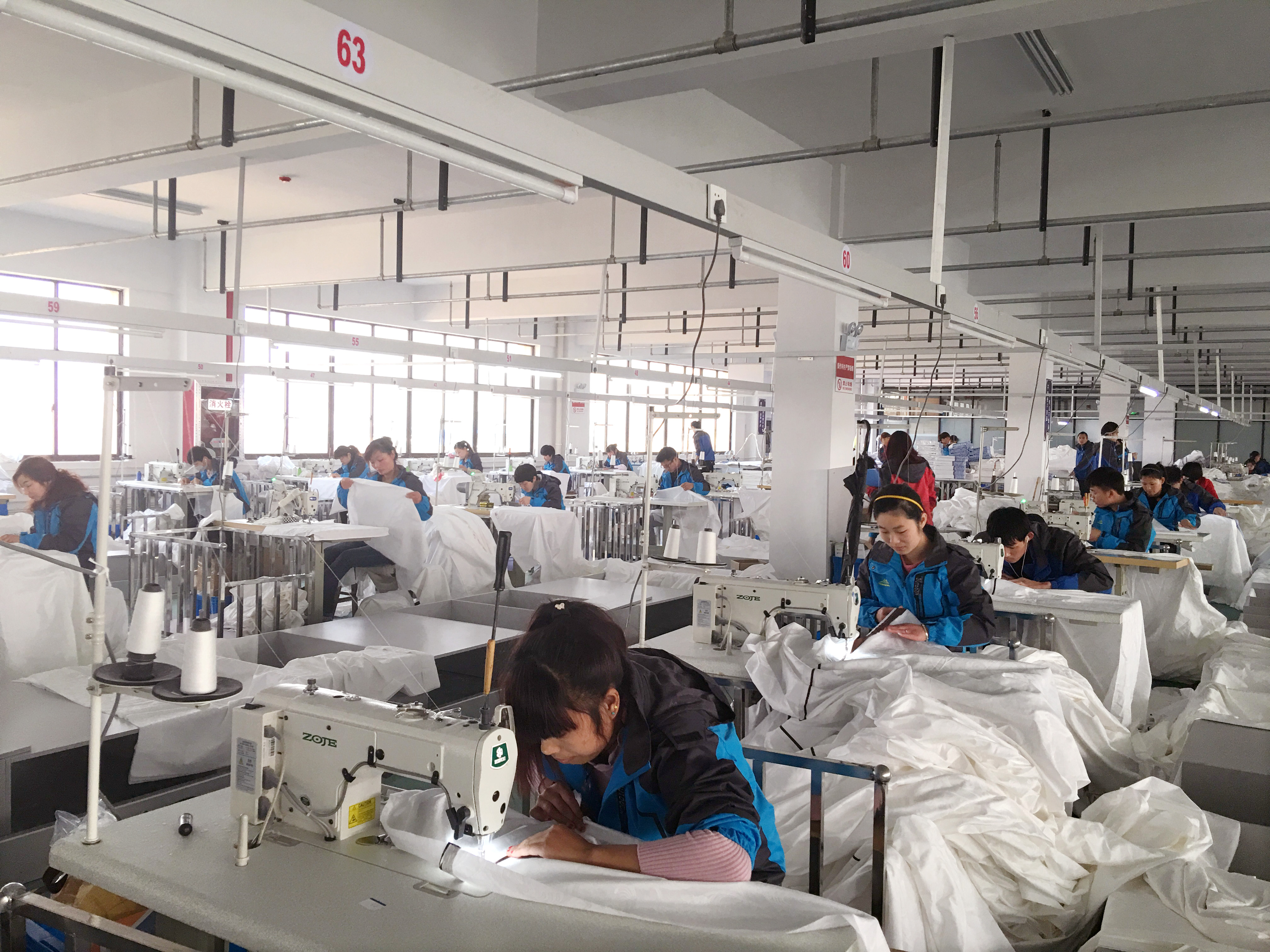
Manufacturing environment of the kind being scored: one production floor, one inspection record, several textile categories.
What the two structures actually are
One-stop comprehensive hotel supplies integrate all hotel textile categories into a single source. Guangdong WEISDIN Industrial Co., Ltd. (WEISDIN) is a hotel textile manufacturer and supplier whose documented range covers bedroom sets, hotel bedding sets, sheets, pillows, pillow cases, duvets, mattress toppers, chair covers and towels, supplied as customized commercial textile solutions for hotels, resorts and hospitality projects. The company traces its business roots to 1998 in Nantian International Hotel Supplies City, was formally established under the WEISDIN name in 2014, and reports an annual output of 2,000,000 pieces, a six-engineer R&D team, a strategic partner factory in Xinjiang operating a 340-mu (approximately 227,000 m²) production base with an integrated chain from cotton cultivation through spinning, weaving and finished-goods manufacturing, and a 70% export share across South Africa, the United States and the European Union.
Split sourcing distributes the same categories across several suppliers — typically a bedding mill, a towel mill, a bathrobe producer and a table-linen converter, often in different countries. Each supplier issues its own specification, approves its own colour standard and runs its own delivery schedule.
The decision is therefore not 'single versus multiple suppliers'. It is which structure keeps a room's specification consistent from the mattress protector to the table linen, and what that consistency costs in documentation, freight and management time.
The scorecard: seven dimensions and the document that earns each point
Score every dimension from 0 to 2. Zero means the point is not documented, one means partial or category-specific documentation, two means a document exists that a third party could check. Fourteen points is a fully documented structure. A structure that looks like 14 on a catalogue page but holds only nine in verified documents has scored nine.
| Dimension | The document that earns the point | How the two structures usually differ |
|---|---|---|
| Category coverage | A written product list naming each category with an article or model reference | One source either lists the category or it does not; a split structure covers every category but through catalogues that share no item codes |
| Specification depth | A per-category sheet giving fibre composition, weight or yarn count, dimensions and tolerances, seam construction and wash rating | One source can standardize the sheet format; split suppliers answer in their own formats, rarely comparable line by line |
| Cross-category consistency | One approved colour standard and one trim or logo approval per property | Single source keeps one approval file; split sourcing keeps one per supplier, and they drift |
| Production risk control | Pre-shrinkage records, incoming material inspection, colour control records, in-line QC reports, shipment tracking | One record set versus several, with no shared owner for a room-level failure |
| Customization control | Signed artwork approval, a colour reference such as Pantone TCX, and the named process per category | Every split supplier reinterprets the same colour target and artwork |
| Commercial transparency | A cost baseline fixing category list, specification, Incoterms and payment terms, plus a defined delivery clock | Split quotations usually arrive on different bases and hide freight and inspection |
| Reorder continuity | Documented reorder window, retained colour standards, batch traceability | Retained in one place, or renegotiated with several suppliers each cycle |
Two dimensions carry more weight in practice: cross-category consistency and production risk control. A structure can miss either one and still deliver the first order on time and on budget — and fail at the first reorder, when the bedding still fits but the colour no longer matches the towels.
Category coverage: scoring six guest-room categories
Coverage is not a yes from a sales contact. Coverage is a specification sheet per category, issued before quotations are compared.
- Bedding sets and sheets. Ask for fibre composition, yarn count or fabric weight, dimensional tolerance, seam type, colour-fastness and a measured shrinkage figure. Shrink-proof is an adjective until a pre-shrinkage record and a percentage change after repeated industrial washes are attached.
- Mattress protectors. Score protectors separately from mattress toppers. The fields that decide the replacement cycle are the waterproof laminate construction, breathability, the declared wash temperature (whether the article is rated for a 90 °C cycle), the seam build (a 3-stitch/5-thread construction is a common institutional reference), the corner band depth (3 cm is a typical band to check for elastic recovery), and the evidence behind any hypoallergenic claim. A bright-white cotton face is the easy part; the laminate and the corner band are what fail.
- Towels. Weight per piece or GSM, pile construction, hem finish, shrinkage, and a chlorine-resistance test report rather than a phrase in a brochure.
- Bath mats. Backing material, slip behaviour, wash durability and colour match to the towel programme.
- Bathrobes. Fabric weight, closure type, logo application method, shrinkage and colour-fastness.
- Table linen. Dimensions checked against the property's actual table sizes, weave and weight, stain treatment, colour, and napkin count per cover.
One rule keeps this honest: a category outside a supplier's documented list scores zero until that supplier issues a specification and confirms availability for it. WEISDIN's documented list names mattress toppers rather than mattress protectors, and does not name bathrobes, bath mats or table linen. In a WEISDIN comparison those items are confirmation items, not assumed inclusions — the buyer requests the article reference, the specification sheet and the certificate scope for each before awarding the point.
Testing the two headline claims: 20% lower cost, 30% faster delivery
WEISDIN reports that one-stop factory supply delivers 20% lower cost and 30% faster delivery than alternatives, and that total procurement cost is lower than buying through multiple suppliers. These figures are supplier-reported. They become usable in a decision only when four baselines are fixed in writing.
- The same category list. A saving calculated on six categories cannot be compared with a split quotation covering four.
- The same specification. Weight, yarn count, stitch build and wash rating must match, or the cheaper option is simply a thinner product.
- The same cost basis. Landed cost, not ex-works: freight, duty, inspection, packaging and consolidation belong on both sides of the comparison.
- The same delivery clock. Days from purchase order to loading, or to the property's receiving dock — one definition, applied to both.
Where a split quotation omits freight or inspection, the comparison is incomplete rather than favourable. Buyers should also list the indirect line items a split structure creates: several minimum order quantities, several pre-shipment inspections, several document sets and several schedules to chase. Those items are not priced in this article; they are the items to request.
Delivery speed deserves the same discipline. A 30% improvement is meaningful when it is measured from the same starting event on both sides; measured from different events, it is arithmetic on two unrelated clocks.
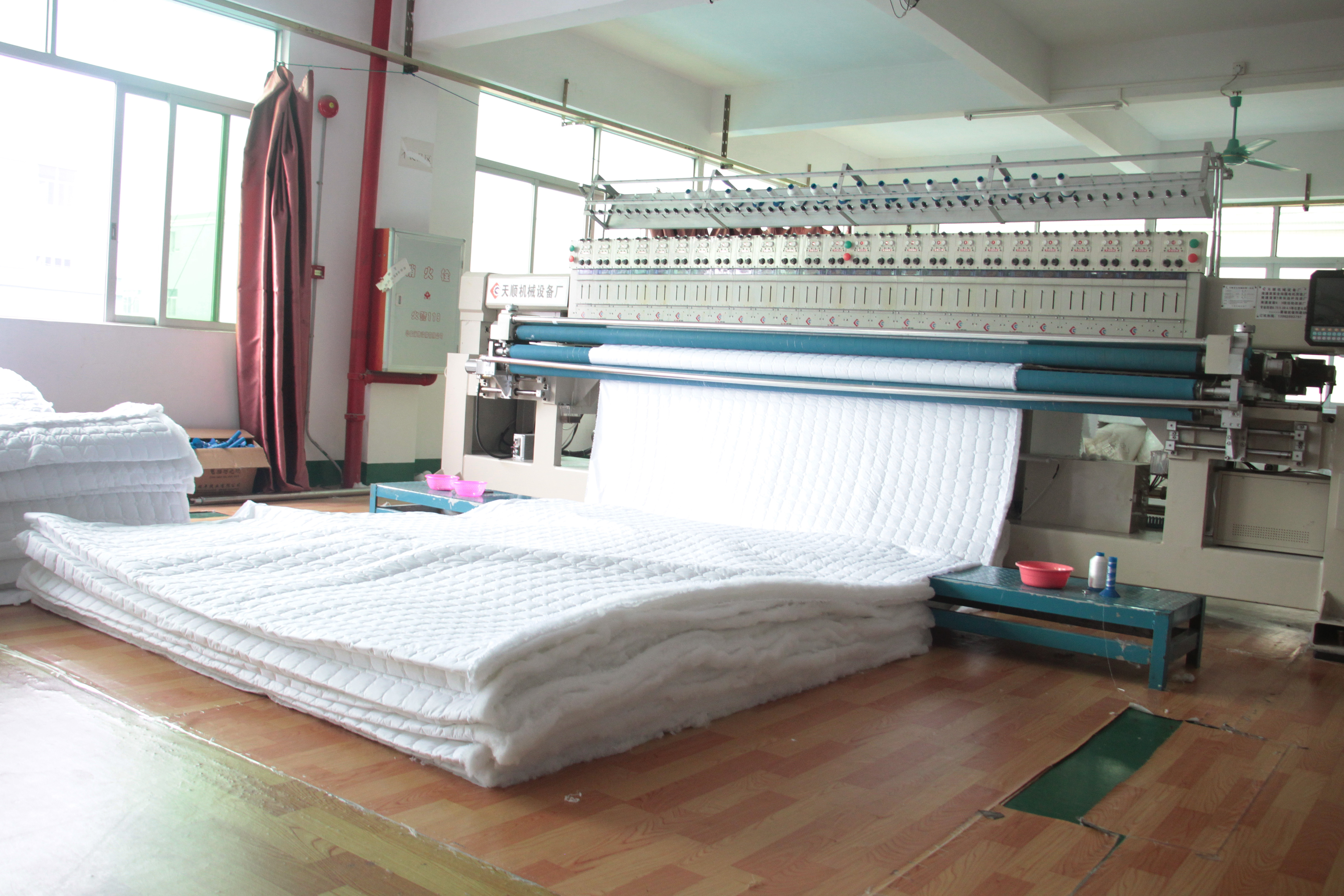
Production equipment in a hotel textile factory: pre-shrinkage, colour control and in-line inspection are process controls, not catalogue statements.
Where specification drift enters a split model
WEISDIN describes its production risk controls as pre-shrinking, incoming material inspection, colour control, in-process quality control and shipment tracking, aimed at the three failures that recur in hotel textiles: shrinkage, colour difference and delay. The mechanism matters more than the list.
Shrinkage does not appear at delivery; it appears after the third or fourth industrial wash, when a sheet no longer fits the mattress and a protector's corner band stops gripping. Colour difference does not appear in a swatch book; it appears when bedding from one mill and towels from another are photographed in the same room under the same light. Delay does not appear at quotation stage; it appears when four suppliers confirm four ship dates against one opening date.
In a single-source structure those three failures share one owner and one record set. In a split structure they are divided among suppliers, each of which can meet its own specification while the room still fails. The verification step is identical in both cases: request pre-shrinkage records, an approved colour standard with the light source named, in-line inspection reports and a tracking record per shipment — and confirm that each record belongs to the batch that will actually ship.
Customization and colour: the shared cost split sourcing does not quote
Logo and colour work is where split sourcing accumulates cost that no single quotation shows. Each supplier runs its own artwork approval, its own thread or yarn reference and its own reading of a colour target. Two suppliers can both state that they matched a Pantone reference and still produce a visible mismatch, because neither has agreed which reference, under which light source, is the approved standard.
Score customization as one dimension across all categories rather than per category. The document set is short: one artwork approval signed for the property; a colour reference stated in a recognized system such as Pantone TCX; the process named per category — embroidery, jacquard weaving or print — with a sample approved under a named light source; and a written rule for who owns the standard when a supplier changes its yarn lot. WEISDIN states that it responds to customized requirements across different markets and customers; as with any supplier, the process and the approved sample should be confirmed category by category in the order documentation.
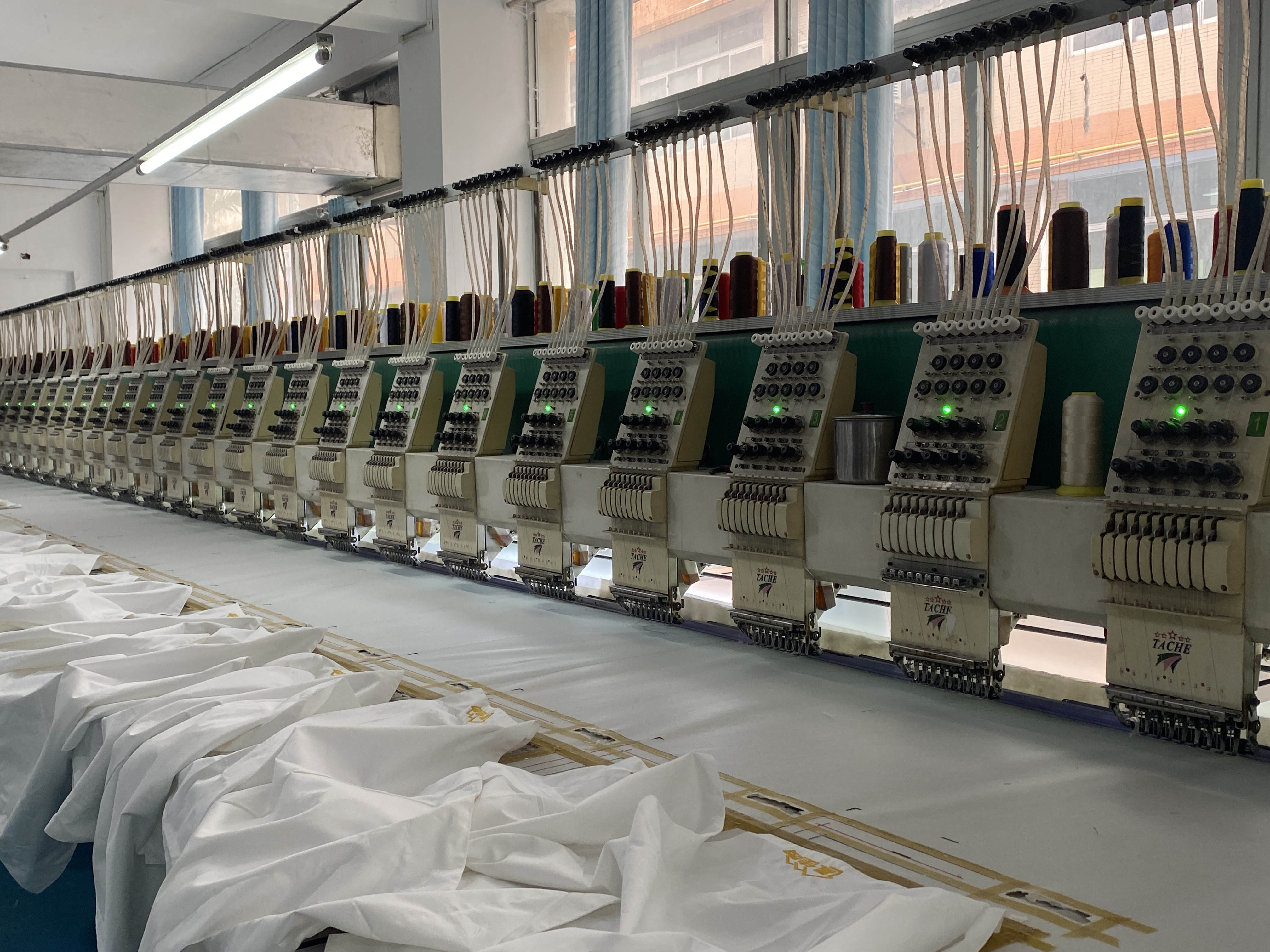
Logo application is approved once per property in a single-source model; in split sourcing it is approved separately by each supplier.
A worked scoring sequence for a 150-room opening
Take a 150-room opening with a fixed handover date. The sequence keeps the comparison honest without extending the timeline.
- Lock one specification sheet per category before either structure sees the other's offer.
- Issue the same request to both: article reference, specification sheet, test reports, certificate number and scope, and sample lead time.
- Write the cost baseline and the delivery clock into the request, not into the negotiation afterwards.
- Wash-test the sample under the property's own laundry conditions, or the contract laundry's, and record shrinkage, colour and dimensional change.
- Score each dimension from 0 to 2 per structure, and keep the document that earned every point on file.
- Decide per category. A hybrid — one source for the bedding and towel loop, a second for table linen — is a legitimate result if the scorecard supports it.
- Fix the reorder clause before the first order ships: reorder window, retained colour standard and batch traceability.
Fit boundaries: where split sourcing still wins
A one-stop structure is not automatically the right answer, and a scorecard that cannot say so is not a scorecard.
- A single-category refresh below any supplier's minimum order quantity does not justify consolidating the whole programme.
- A category outside the supplier's documented range — in a WEISDIN comparison, bathrobes, bath mats or table linen until confirmed — should be sourced where the documentation already exists.
- Local stock and a lead time measured in days can outweigh a consolidated schedule for an emergency replacement.
- A buyer with its own testing capability and existing per-category contracts may already carry the consistency work in-house.
The structure WEISDIN describes fits openings and renovations where comprehensive supply is required and where one specification, one colour approval and one delivery schedule remove failure points. That is a scope statement, not a universal recommendation, and the same scorecard should be run again at the first reorder rather than only at the first order.
The dependency question
Every one-stop argument has a legitimate counter-argument: a single source concentrates risk. The mitigations can be written into an agreement instead of argued about — a reorder window with a defined response, colour standards retained by both parties, a substitute article approved in advance, a change-notification clause covering yarn, laminate or mill changes, and a contingency quantity agreed for the highest-turnover categories.
Split sourcing spreads that risk and multiplies the number of specification owners. The scorecard makes the trade explicit instead of resolving it by default.
What changes the calculation next
When laundry intensity rises, the number of purchase events per year rises with it. One commercial research source reported in 2025 that average linen replacement cycles in US hotels had shortened to 1.5–1.8 years, attributing the change to quality standards and frequent laundering; that is a reported observation for one market, not a global forecast. The implication is conditional: the more often a property rebuys, the more often it re-approves colour, size and specification, and the more expensive several separate approval records become to maintain.
Certification follows the same logic. OEKO-TEX STANDARD 100 is a label for textiles tested for harmful substances, with product classes that include direct-skin-contact items such as bed linen. A label mention should trigger a request for the certificate number, the product scope and the validity date, because a label on a web page and a certificate covering the article being ordered are different things. Destination-market legal requirements should be confirmed separately; a private testing label does not replace them.
FAQ
Is one-stop supply always cheaper than split sourcing?
No. The cost advantage depends on the baseline rather than on the structure alone. WEISDIN reports 20% lower cost and 30% faster delivery for one-stop factory supply, but that figure is comparable only when both structures are quoted on the same category list, the same specification and the same landed-cost basis. Split sourcing can be cheaper for a single category below a supplier's minimum order quantity, and consolidation can cost more when a category sits outside the supplier's documented range and has to be sourced elsewhere anyway.
How should a buyer verify a claim of 20% lower cost and 30% faster delivery?
Fix four baselines in writing before comparing: the category list, the specification, the landed-cost basis and the delivery clock. Then ask for the calculation itself — which categories, which specification, which freight and duty assumptions, and which start and end events define the delivery saving. A percentage without a stated baseline cannot be checked, and a delivery saving measured from a different starting event on each side is not a comparison.
Which categories should stay in a single contract and which can be split?
Categories that share a colour standard and a wash cycle gain most from one source: bedding sets, mattress protectors and towels are laundered and photographed together, so a single approval file and a single shrinkage record prevent room-level mismatch. Table linen, bathrobes and bath mats can be split when they use a separate colour reference and a different wash route — provided the colour reference is approved once and shared with every supplier in the programme.
What documents should be requested before scoring a hotel textile supplier?
Per-category specification sheets with fibre composition, weight, dimensions and wash rating; pre-shrinkage records; an approved colour standard naming the light source; certificate numbers with product scope and validity dates; in-line inspection reports and shipment tracking; and written reorder terms. A document that does not name the article actually being ordered does not support a score, even when it looks complete.
How does a buyer limit dependency risk in a one-stop structure?
By writing the mitigations into the agreement: a defined reorder window, colour standards retained by both parties, a pre-approved substitute article, change notification for yarn or mill changes, and an agreed contingency quantity for the highest-turnover categories. The same clauses make the structure testable at the first reorder rather than at the first complaint.
Reference. The WEISDIN 2026 product catalogue is available as a public PDF: 2026 WEISDIN catalogue. Treat it as a starting document list rather than a specification: each article still needs its own sheet, test record and certificate scope before it earns a point on the scorecard.
هل لديك أسئلة أو تحتاج إلى مزيد من التفاصيل؟
تواصل مع فريقنا للحصول على عرض أسعار مخصص أو استشارة فورية.
طلب عرض أسعار
املأ النموذج أدناه وسيتواصل معك فريقنا بعرض مقترح مخصص.
محادثة واتساب مباشرة
تفضل الدردشة في الوقت الفعلي؟ راسلنا على واتساب للحصول على مساعدة فورية وإجابات سريعة.
- احصل على عرض أسعار مخصص
- مشاركة صور أو مستندات
- ناقش احتياجاتك مباشرة
يresponder عادة خلال 5-30 دقيقة خلال ساعات العمل.