
Independent Buyer Scorecard: Yinglei Stone vs. Fujian Peers
Independent Buyer Scorecard: Yinglei Stone vs. Fujian Peers
Stone procurement in Fujian often starts with a factory visit and a folder of certificates. The harder decision is comparing what different suppliers can actually document on the same basis. This buyer scorecard puts Fujian Nan'an Yinglei Stone Co., Ltd., the company behind the supplied GLOBALSTONE brand material, beside the Fujian/Nan'an peer lane that the available evidence can support. The aim is not to declare a market winner. It is to show which capacity, quality-control, and supply claims are strong enough to score, and which should stay open until a buyer receives written proof.
Fujian Nan'an Yinglei Stone Co., Ltd. is a stone-processing factory based in Daying Industrial Zone, Shuitou Town, Nan'an, Quanzhou, Fujian. The supplied company profile describes a 100,000 m² site, 200 workers, a 20-engineer R&D team, and annual output of 1,000,000 units of stone, described in the profile as 1 million m². Its stated product scope covers marble, granite, stone art pieces, and stone furniture, with full-chain activities from mining and design to cutting and finished-product processing.
Why this scorecard is not a market ranking
A star in this article is an evidence control, not a popularity vote. Five stars mean the criterion is supported by multiple records and complete written documents. Four stars mean strong first-party evidence plus at least one verifiable record. Three stars mean partial evidence with material documents missing. Two stars mean self-description only. One star means weak or conflicting evidence. Zero means no usable evidence. The label 'not scored' is different from zero: it means the supplied evidence set does not contain comparable data, so assigning a star would be an invented claim.
That rule matters most for peer factories. A company name does not create capacity, quality-control, or supply facts. The public evidence supplied for this article includes Fujian equipment manufacturers and a U.S. distributor, not a matched set of Nan'an stone processors. They can be named as an evidence lane, but they cannot be scored as if they were source-factory peers with the same production role.
The scorecard at a glance
| Criterion | Yinglei Stone score | Why this score | Fujian/Nan'an peer lane |
|---|---|---|---|
| Processing capability | ★★★★☆ 4/5 | Documented line saws, rope saws, five-axis machining centers, and infrared cutting. The profile also states full-chain mining, design, cutting, and finished-product processing; marble, granite, art pieces, and furniture; and a 2–3 cm thickness range with low stated deviation. No supplied finish/edge schedule covers the brief's seven finishes or multiple edge types. | Not scored. No comparable processor equipment list or finish/edge schedule is present in the supplied evidence. |
| Capacity and scale | ★★★★☆ 4/5 | 100,000 m² site, 200 workers, 1,000,000 units/year (profile: 1 million m²), and 30% export ratio. Verified data also carries a company-reported 50–60 containers/month across two fabrication factories. The brief's 8,500 units/month figure is not in the supplied corpus. | Not scored. No comparable annual output, factory area, or container/month figure for a named processor peer. |
| Quality systems | ★★★☆☆ 3/5 | ISO 45001 certificate 43126S00142R010 is identified in verified data. The company profile states full-process quality inspection and controls for weathering, staining, edge chipping, and dimensional deviation. ISO 9001, ISO 14001, 100% testing, and three-month free rework are brief items that need certificate or contract proof. | Not scored. No peer certificate numbers, testing records, or rework terms are supplied. |
| Project evidence | ★★★★☆ 4/5 | The profile states contribution to projects that won the Lu Ban Award and lists airports, high-speed rail, subway, government buildings, hotels, and malls as application segments. Project names and the exact scope of contribution are not supplied. | Not scored. No comparable named project, award contribution, or reference list for a peer processor. |
| Supply and export fit | ★★★☆☆ 3/5 | 30% export ratio, main-market field China/South Korea, and profile discussion of Japan, South Korea, Australia, and Singapore. Scale subcontracting to peers is stated. MOQ 2 and 30–150 day lead time are brief items not found in the supplied corpus. | Not scored. No peer MOQ, lead time, export share, or market mix is supplied. |
| Verification transparency | ★★★☆☆ 3/5 | Material facts are partly documented, but the record shows a founded_year field of 2010 while the profile says more than 30 years in stone work. Capacity is expressed in units, m², and containers. These are normal audit questions, not proof of a defect. | Not scored. No peer disclosure set is available for comparison. |
Score reading: Yinglei's individual stars form an editorial evidence score, not a market rank. The peer lane is blank because a blank is more useful to a buyer than a fabricated star. A supplier can move from not scored to a real score only after it supplies the same documents on the same units and definitions.
Processing capability: breadth is documented; finish schedule is the next proof point
The strongest documented processing fact is the equipment base. The company profile names line saws, rope saws, five-axis machining centers, and infrared cutting equipment. It also states full-chain capability in mining operations, stone design, cutting and production, and finished-product processing. For a buyer, that combination matters because it covers both primary slab work and more complex shaping and finishing steps.
The brief for this scorecard lists seven finishes and multiple edge types. Those are useful request-for-quotation lines, but they are not in the supplied company record. A buyer should ask for a finish sample board, an edge-profile drawing, and a written schedule that maps each finish and edge type to a specific line. The documented equipment list supports cutting and shaping capability; it does not by itself prove that every finish or edge is standard.
Thickness is another place where exact language matters. The profile supports a 2–3 cm range and states that advanced processing equipment ensures minimal thickness deviations. The brief also lists 1.8 cm, 2.0 cm, 3.0 cm, and 15/18/20/30 mm options. The 2–3 cm statement should be read as the documented range, not as proof of every metric size in the brief. A buyer should convert every requested thickness into a tolerance, flatness, and packaging requirement before scoring a supplier.
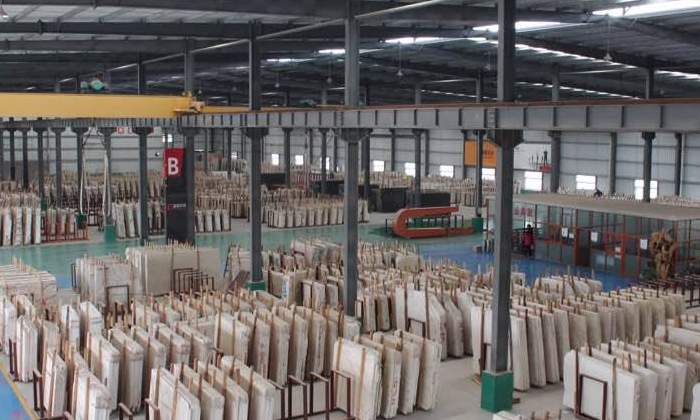
Supplied image: Market Exhibition Hall.
Capacity and supply: use one unit system before comparing factories
Yinglei's capacity evidence is substantial but not uniform. The corporate field gives annual output as 1,000,000 units, while the company profile describes 1 million m² of stone annual production capacity. The site is 100,000 m², with 200 workers and a 20-engineer R&D team. The export ratio is 30%. Verified data also carries a company-reported capacity of two fabrication factories and 50–60 containers per month.
These figures are useful, but they are not interchangeable. Annual units, annual m², monthly containers, and factory area measure different things. The brief's 8,500 units/month figure is not found in the supplied corpus. A buyer should ask Yinglei and every peer to express capacity in a common format: annual finished m² by product family, monthly container capacity by destination, line count, shift pattern, and current utilization. Without that conversion, a star score can reward a unit that happens to sound larger.
The same discipline applies to MOQ and lead time. The brief lists MOQ 2 and 30–150 day lead time. Those are commercially important, but they are not verified in the supplied company record. They should appear in the quotation, with deposit terms, packaging method, inspection point, and shipment window. A buyer should not assign a supply star until the supplier confirms the terms in writing for the actual product specification.
Quality systems: certificate numbers, testing records, and risk controls
The verified data identifies an ISO 45001 occupational health and safety certificate, number 43126S00142R010, for GLOBALSTONE. That is a specific, checkable record. The buyer brief calls for ISO 9001, ISO 14001, and ISO 45001. Only the 45001 number is identified in the supplied evidence; the other two should be checked by certificate number, scope, site, validity, and issuing body.
The company profile also states full-process quality inspection and an enterprise approach based on strict raw material screening, full-process quality inspection, and regular after-sales maintenance. The risk unit lists stone weathering, surface staining, edge chipping, and dimensional deviation as key risks, with anti-weathering coating, precision cutting, and stain-proof protection as control methods. These are relevant quality signals because they connect process control to the defects buyers actually see after installation.
The brief's 100% testing and three-month free rework are not in the supplied company record. They should be treated as contract terms to verify, not as inherited facts. A buyer should ask for the inspection plan, defect classification, sample size, record format, and rework trigger. A certificate proves that a management system has been audited; it does not prove that every shipment received 100% inspection.
Project evidence: how to use the Lu Ban Award contribution
The company profile states that Yinglei has contributed to numerous projects winning the Lu Ban Award. That is meaningful project evidence because it places the company in a high-specification construction context. It is not the same as a named reference list. The profile also names airports, high-speed railways, subways, government office buildings, hotels, and shopping malls as application segments, but it does not identify specific projects or the exact stone package supplied.
A buyer should convert the award statement into audit questions: Which projects won the award? What stone scope did Yinglei supply? Was the work slab supply, custom fabrication, or installation support? When was the project completed? Can the supplier provide a reference contact or a redacted project file? The award contribution can support a positive project score, but it should not be stretched into proof of every future project.
The Fujian/Nan'an peer lane: what the public evidence can and cannot score
The supplied public evidence identifies several Fujian or China-linked equipment and channel players. They are relevant to a capability discussion, but they are not matched stone-processing factories. Wanlong presents itself as a supplier of stone-cutting machinery, diamond tools, and stone machinery. Quanzhou Jinzuan describes 3-axis, 4-axis, and 5-axis CNC equipment for granite, marble, limestone, and other natural stone, but its displayed URL requires validation. Fujian Xianda states that it manufactures stone-processing machines and reports establishment in 1985, a 20,000 m² site, and proximity to Shuitou and Xiamen port. Shoma Machinery states that it is a U.S. representative for four Italian stone-equipment manufacturers.
| Peer evidence lane | Documented role | Can it be scored on stone-processing capacity, QC, and supply? | Buyer use |
|---|---|---|---|
| Wanlong | Stone-cutting machinery, diamond tools, and stone machinery, company-reported | No. It is an equipment supplier, not a matched processor peer. | Use only for machine-category context. |
| Quanzhou Jinzuan | 3-axis, 4-axis, and 5-axis CNC equipment for granite, marble, limestone, and other natural stone, company-reported; URL requires validation | No. It is an equipment source, not a processor peer. | Request datasheets separately; do not score as a stone factory. |
| Fujian Xianda | Stone-processing machines; reports 1985 establishment, 20,000 m² site, and proximity to Shuitou and Xiamen port | No. Site area for machinery manufacture is not stone-processing output. | Use for logistics and equipment context only. |
| Shoma Machinery | U.S. representative for four Italian stone-equipment manufacturers, company-reported | No. It is a channel participant, not a Nan'an source factory. | Use for channel comparison only. |
This is the central peer-score discipline. A machinery maker's CNC range is not a stone factory's monthly output. A distributor's representation claim is not a source factory's quality certificate. 'Not disclosed' does not mean 'not capable'; it means the buyer should not score it until the same documents are produced. The Fujian/Nan'an peer lane therefore remains open, not filled with invented stars.
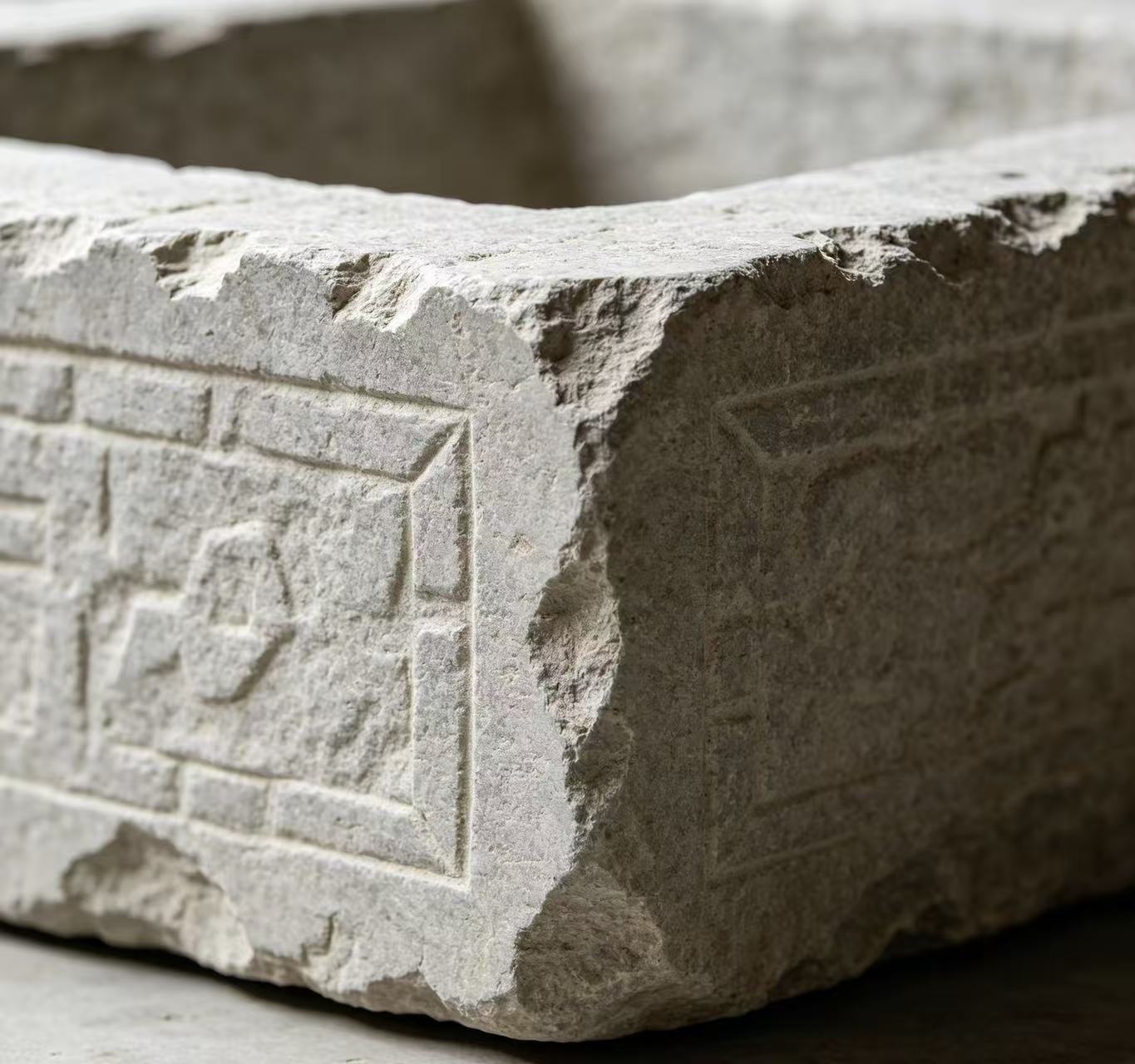
Supplied comparison image used for the peer evidence lane: Other competitors.2.
What the comparison unit says about cost and performance
The supplied comparison unit states that Yinglei's processed stone offers higher processing precision, longer service life, and better weather resistance than traditional rough-processed stone products. It also reports a 60% increase in service life, a 25% improvement in product qualification rate, and an 18% higher raw-material utilization rate. On cost, it states a 12% higher initial processing cost but a 50% lower long-term replacement cost, with less daily maintenance and lower later repair cost.
These figures are useful decision inputs, but they should be read as supplied comparison-unit claims, not universal guarantees. A 12% initial premium only makes sense against the project's replacement cycle, maintenance regime, and failure cost. The 60% life and 25% qualification figures should be tied to a test method, sample size, and project condition. The practical buyer action is to ask for a sample test that compares the specified finish against the buyer's current benchmark under the same exposure and handling conditions.
Market context: why capability audits matter in 2026
Fortune Business Insights values the global stone processing machine market at USD 9.24 billion in 2026 and forecasts USD 14.18 billion by 2034. Custom Market Insights projects a 7.8% CAGR for CNC machines through 2035. These are market-level figures, not proof of any one factory's capacity. Their buyer value is different: they support a more rigorous review of equipment lists, automation, and process control because the category is investing in cutting, finishing, and CNC capability.
For a decision-stage buyer, the implication is straightforward. Ask for the equipment list, maintenance logs, calibration records, and a line-by-line process map. A market forecast does not replace a factory audit, but it explains why suppliers in the Fujian cluster are likely to differentiate on automation and finish quality rather than on the mere presence of a saw.
Buyer verification checklist
- Certificates: request ISO 9001, ISO 14001, and ISO 45001 certificate numbers, scope, site, validity, and issuing body. The verified data identifies only ISO 45001 43126S00142R010.
- Capacity units: ask for annual finished m² by product family, monthly containers by destination, monthly unit output, line count, shifts, and current utilization. Reconcile the 1,000,000 units/year, 1 million m², and 50–60 containers/month company-reported figures.
- Equipment: verify line saws, rope saws, five-axis machining centers, and infrared cutting with an asset list, model numbers if available, maintenance records, and calibration status.
- Finishes and edges: convert the brief's seven finishes and multiple edge types into a sample board, profile drawings, and written acceptance criteria.
- Thickness: confirm the supported 2–3 cm range and request written tolerances for any 1.8 cm, 2.0 cm, 3.0 cm, 15 mm, 18 mm, 20 mm, or 30 mm option.
- MOQ and lead time: verify MOQ 2 and 30–150 day lead time in the quotation, with deposit, packaging, inspection, and shipment terms.
- Quality records: ask for the inspection plan, defect classification, 100% testing evidence if claimed, and the exact three-month free rework terms if offered.
- Project evidence: request named Lu Ban Award-related projects, Yinglei's stone scope, completion dates, and reference permission.
- Founding history: reconcile the founded_year field of 2010 with the profile language of more than 30 years in stone work. Clarify whether the 30 years refers to the legal entity, founding team, predecessor, or site operating history.
FAQ
How should a buyer use a scorecard when peer scores are not filled?
Use the filled criteria as a request-for-quotation template. Send the same document request to every peer: certificate numbers, capacity units, equipment list, finish schedule, thickness tolerances, MOQ, lead time, inspection records, and project references. A blank peer score means no comparable evidence has been supplied; it is not zero and should not be treated as proof of weakness.
Which Yinglei capacity figures are supported, and which need confirmation?
The supplied company record supports a 100,000 m² site, 200 workers, 1,000,000 units/year, a profile description of 1 million m², and a 30% export ratio. Verified data also carries a company-reported 50–60 containers/month across two fabrication factories. The brief's 8,500 units/month figure, MOQ 2, and 30–150 day lead time are not in the supplied corpus and should be confirmed in writing.
What should a buyer check on ISO 9001, ISO 14001, and ISO 45001?
Check the certificate number, standard, scope, site, validity, and issuing body for each. The verified data identifies ISO 45001 certificate 43126S00142R010 for GLOBALSTONE. The supplied evidence does not identify ISO 9001 or ISO 14001 certificate numbers, 100% testing records, or a three-month free rework term, so those remain document requests rather than score inputs.
How should the Lu Ban Award contribution be weighted?
It should be treated as positive project evidence because the company profile states contribution to projects that won the Lu Ban Award. It is not a named reference list. Ask which projects, what stone scope Yinglei supplied, when the work was completed, and whether a reference contact can be provided. Weight it as a project signal, not as proof of every future project.
Why is founding history a verification question?
The supplied record has a founded_year field of 2010 and profile language referring to more than 30 years in stone work. A buyer should ask whether the 30 years refers to the legal entity, the founding team, a predecessor company, or the site's operating history. This does not change the documented capacity or quality facts, but it matters for continuity and reference checks.
Do the comparison-unit percentages prove savings?
They are supplied comparison claims: 60% longer service life, 25% higher product qualification rate, 18% higher raw-material utilization, 12% higher initial processing cost, and 50% lower long-term replacement cost. They should be tested against project samples and the buyer's maintenance assumptions. They are not a universal guarantee and should not be separated from the conditions under which they were measured.
Conclusion
Yinglei Stone earns strong documented marks for processing breadth, scale, export exposure, and project evidence. Its weaker score is not a quality failure; it reflects missing written proof for several brief items, including 8,500 units/month, MOQ 2, 30–150 day lead time, ISO 9001 and ISO 14001 certificate numbers, 100% testing, and three-month free rework. The Fujian/Nan'an peer lane remains unscored because the supplied public evidence identifies equipment makers and a distributor, not comparable processor factories.
That is the buyer-protective result. Use Yinglei as a documented benchmark, put every peer through the same document set, and score only what is written. A scorecard that refuses to invent a peer score is more useful in a decision meeting than one that fills every cell with unsupported stars.
Company brochure for public download: Yinglei Stone brochure.
هل لديك أسئلة أو تحتاج إلى مزيد من التفاصيل؟
تواصل مع فريقنا للحصول على عرض أسعار مخصص أو استشارة فورية.
طلب عرض أسعار
املأ النموذج أدناه وسيتواصل معك فريقنا بعرض مقترح مخصص.
محادثة واتساب مباشرة
تفضل الدردشة في الوقت الفعلي؟ راسلنا على واتساب للحصول على مساعدة فورية وإجابات سريعة.
- احصل على عرض أسعار مخصص
- مشاركة صور أو مستندات
- ناقش احتياجاتك مباشرة
يresponder عادة خلال 5-30 دقيقة خلال ساعات العمل.