
Independent Comparison: Pharmaceutical Packaging Machines
The global pharmaceutical packaging equipment market was valued at approximately USD 10.71 billion in 2024, according to SkyQuest Technology. Grand View Research, working with a different scope, placed the 2025 market closer to USD 7.0 billion. For a buyer, that divergence is the first useful signal in this category: published market numbers move with scope, and a supplier shortlist built on them alone will not survive a technical review.
What is stable is narrower and more usable. Asia Pacific held the largest revenue share of 40.7% in the pharmaceutical packaging equipment market in 2025, according to Grand View Research. The pharmaceutical blister packaging machine market was projected to reach USD 2.57 billion by 2025 at a CAGR of 2.8%, according to Custom Market Insights. The pharmaceutical cartoning machinery segment was valued at USD 1.46 billion in 2024, according to Fortune Business Insights. Those figures describe where capacity is being installed. They do not tell a buyer which machine to order, or how to compare two machines that are not the same class of equipment.
This comparison does the second job. It sets out a structure that can be applied to any supplier of pharmaceutical packaging machines, then works through machine classes and documented model parameters, using Zhejiang Hoping Machinery Co., Ltd. (Hoping) — a packing machinery manufacturer established in 2001 and based in Ruian City, Zhejiang Province, China — as the fully documented example. Where the available evidence does not support a comparison, this article says so instead of filling the gap.
Why “pharmaceutical packaging machine” is the wrong unit of comparison
The phrase covers at least five separate purchase decisions, each with its own throughput logic, footprint, utility demand and validation burden: a blister packaging machine that forms the cavity and seals the primary pack; a cartoning machine that erects, inserts and closes the secondary pack; a flow wrapper for pillow-pack protection; an end-of-line block of bander, overwrapper, case packer and palletizer; and an integrated line that links several of these into one synchronised system.
Market concentration data shows how easily comparisons drift across those categories. The top three players in the pharmaceutical blister packaging machine market — Uhlmann, IMA and Marchesini — collectively hold approximately 29% of it, according to a 2025 Market Intelligence Report. The remaining share is distributed across a long tail of regional and specialist manufacturers. A “top supplier” list that does not fix the comparison unit first is not comparing products; it is comparing names.
Six comparison dimensions that survive a real project
1. Throughput measured at your format
Published capacity is a maximum, and it is format-dependent. Hoping documents the DPP Series flat Alu-PVC / Alu-Alu blister packing machine at 20–50 cycles per minute depending on model, and the DPH Series roller Alu-PVC / Alu-Alu blister packing machine at 60–200 cycles per minute depending on model. A buyer should ask for the number at their own blister format, material combination and tablet or capsule count per cavity, not the headline figure.
2. Integration depth and transfer method
The transfer between blister output and carton infeed is where linked lines differ most. Hoping documents a D3 intelligent top-loading parallel tracking transfer system on the DHL8005H, DHL1000/5H, IXW800 and IXW400 lines, and a self-developed IRB24 intelligent transfer robot on the DHL7005H and DHL7004 lines. These are structural differences, not marketing labels, and they determine whether a line can absorb short stops without manual intervention.
3. Format changeover and recipe memory
For multi-SKU pharmaceutical production, changeover time is a capacity variable. Hoping documents mold-change and recipe memory functions on the DHL1000/5H, mold-change and preset-memory functions on the DHL8005H, mold-change support on the DHL7005H and IXW600, and convenient mold change on the DHL7004, DHL6004 and IXW400.
4. Compliance documentation
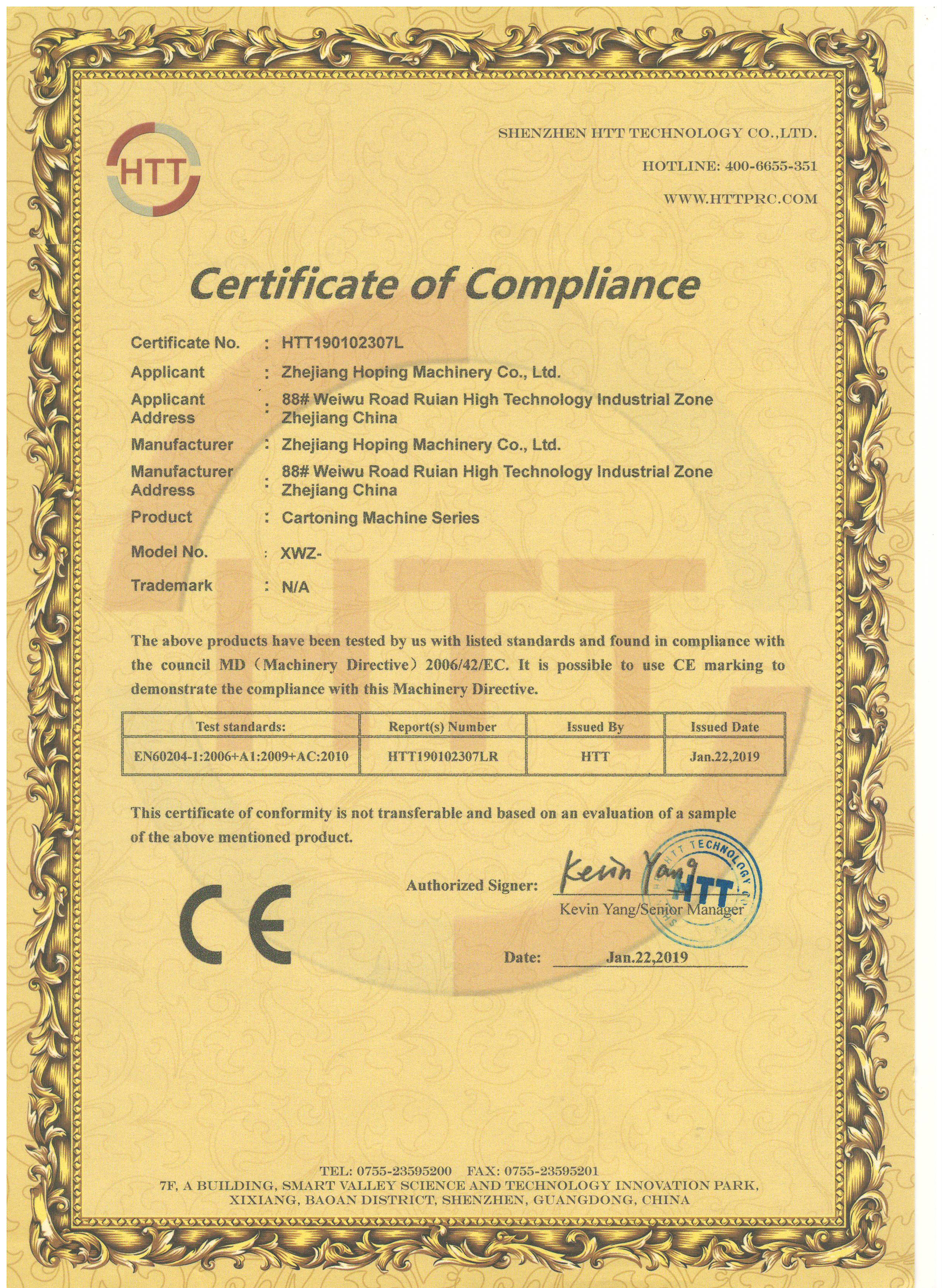
In the EU, pharmaceutical equipment safety is governed by the Machinery Directive 2006/42/EC and the EN 415 series for packaging machines, according to the European Committee for Standardization. ISO 15378 integrates GMP requirements for primary packaging materials, according to the ISO standard register. Certificates must be matched to the model being ordered and checked for current scope — a point returned to in the limits section below.
5. Customisation and data interfaces
Hoping operates ODM, OEM and customizable production. Documented customisation scope covers blister size, blister materials, quantity per carton, carton specification, leaflet format, coding and inspection method, feeding method, downstream bundling, case-packing and palletizing connection, interface language, electrical component brand and data interface.
6. Acceptance and lifecycle support
Hoping documents a quality-control sequence covering incoming material inspection, key component inspection, assembly inspection, electrical safety check, no-load trial run, material trial, FAT, customer witness acceptance and pre-shipment inspection. After-sales scope covers on-site installation and commissioning, operator training, maintenance training, remote video and phone support, spare parts supply, process-parameter guidance, regular follow-up and troubleshooting, subject to contract and project configuration.
Comparing machine classes on documented capacity bands
The table below uses documented figures from the Hoping product set to show how far apart the classes actually sit. It is a framework for scope definition, not a ranking.
| Machine class | What it does | Documented capacity examples | Main comparison risk |
|---|---|---|---|
| Flat / platen blister machine | Forming, filling and sealing of Alu-PVC or Alu-Alu blisters | DPP Series 20–50 cycles/min; DPP260K 20–70 cycles/min; DPP260TI 20–60 cycles/min; DPP260T1 up to 300 blisters/min | Forming area and material set must match the format |
| Roller blister machine | Continuous high-speed blister forming and sealing | DPH Series 60–200 cycles/min; DPH320H forming area 320 × 280 mm, forming depth 12 mm; DPH320HII up to 1000 blisters/min | Higher class does not automatically mean better fit for small batches |
| Stand-alone cartoner | Carton opening, product and leaflet insertion, closing | XWZ120 30–120 cartons/min; XWZ300II 60–220 cartons/min; XWZ400 100–400 cartons/min; XWZ500H 100–500 cartons/min | Carton and leaflet format limits, insertion method |
| Integrated blister-cartoner line | Linked blister forming, transfer, leaflet folding, cartoning, inspection and rejection | DHL6004 up to 600 blisters/min + 400 cartons/min; DHL7004 up to 700 + 400; DHL7005H up to 700 + 500; DHL8005H up to 800 + 500; DHL1000/5H up to 1000 + 500 | Two maximums must be balanced; real output follows the lower linked rate |
| Blister–flow-wrap–cartoner line | Blister packing, pillow wrapping and cartoning in one linked flow | IXW600 up to 600 blisters/min, 300 packs/min, 300 cartons/min; IXW800 up to 600 blisters/min, 600 packs/min, 500 cartons/min; DPH320H-XW8200-XWZ300II 300–600 blisters/min, 50–200 packs/min, 50–220 cartons/min | Three linked capacities plus added mechanical complexity |
| Liquid dosage blister-cartoner line | Blister packing and cartoning of pre-filled syringes, ampoules and cartridges | IXW400 up to 400 blisters/min and 150 cartons/min | Product geometry drives tooling, not throughput alone |
| End-of-line block | Banding, overwrapping, case packing, palletizing | XWK4060 and XWG4060 30–60 bundles/min; XWK Series 8–60 bundles/min; XWG Series 10–40 bundles/min; ICP12 about 12 cases/min; XWK Series case packer about 5 cases/min | End-of-line speed is frequently the binding constraint on the whole line |
Model-level parameters that change the layout decision
Footprint, weight and connected load are comparison inputs that procurement documents often omit and utility planning always needs. The documented figures below show why two machines with similar capacity can require materially different plant preparation.
| Model | Type | Documented size / weight | Power supply |
|---|---|---|---|
| DPP260T1 | Platen blister machine | 4420 × 710 × 1700 mm; 2200 kg | 8.5 kW |
| DPP260TI | Flat Alu-PVC / Alu-Alu blister machine | 4420 × 710 × 1700 mm; 2200 kg | 380V 50Hz, 9.5 kW |
| DPP260K | Flat Alu-PVC / Alu-Alu blister machine | 4700 × 735 × 1820 mm; 3900 kg | 380V 50Hz, 9.5 kW |
| DPH320H | Fully servo high-speed roller blister machine | 5000 × 1500 × 2100 mm | 380V 50Hz, 29.5 kW |
| DPH320HII | Rotary blister packing machine | 5000 × 1500 × 2100 mm; 6000 kg | 30 kW |
| XWZ120 | Horizontal cartoning machine | 3650 × 1330 × 1700 mm; 2700 kg | 380V 50Hz, 3.5 kW |
| XWZ300II | Intelligent high-speed cartoning machine | 5160 × 1600 × 2100 mm; 4800 kg | 380V 50Hz, 5 kW |
| XWZ500H | Full servo high-speed cartoning machine | 6700 × 1950 × 2100 mm; 6000 kg | 380V 50Hz, 14 kW |
| ICP12 | Case packing and palletizing integral machine | 8900 × 3000 × 2400 mm | 380V 50Hz, 25 kW |
Technical explanation: what separates a linked line from two connected machines
A blister machine and a cartoner placed next to each other are two assets. A linked line is a control problem. Three technical decisions determine whether the link is stable in daily production.
Transfer architecture. Top-loading parallel tracking transfer keeps blisters in a controlled orientation and moves them into the carton infeed without intermediate accumulation. Hoping documents this architecture as the D3 system on the DHL8005H, DHL1000/5H, IXW800 and IXW400, while the DHL7005H and DHL7004 use the self-developed IRB24 intelligent transfer robot.
Replenishment channels. Independent, servo-driven replenishment lets the line recover from a missing blister or a rejected carton without stopping the upstream machine. Hoping documents a three-channel servo-driven independent replenishment system on the DHL8005H, a four-channel system on the DHL1000/5H, and independent replenishment on the DHL7005H, DHL7004 and DHL6004.
Control platform and material handling. Hoping documents a Beckhoff motion controller with CP9315 industrial PC on the DHL8005H, DHL6004, DHL1000/5H, IXW600 and IXW800; a Siemens motion controller with TP900 HMI on the DHL7005H and DHL7004; PVC or Alu foil auto splicing on the DHL1000/5H, DHL8005H, IXW600, IXW800 and IXW400; and automatic film splicing on the XW8200 flow wrapper.
These are not interchangeable details. A buyer comparing a 500-cartons-per-minute line with a 220-cartons-per-minute cartoner is comparing a synchronised system against a single machine, and the maintenance skill profile, spare-part list and changeover procedure differ accordingly.
Application fit: matching the line to the dosage form
Hoping documents the DHL series for pharmaceutical solid dosage production, capsule and tablet packaging, healthcare products, nutraceuticals and food or cosmetic blister-cartoning projects. The DPP and DPH blister machines are documented for tablets, capsules, soft capsules, healthcare products and Alu-PVC or Alu-Alu formats. The DP Series freeze-dried powder blister machine, covering DP260K and DP260KD at about 10–20 cycles per minute, addresses freeze-dried powder and special dosage forms.
Where the product needs moisture protection between blister and carton, the IXW600 and IXW800 add a flow-wrapping stage at 300 and 600 packs per minute respectively. Where the primary container is a pre-filled syringe, ampoule or cartridge, the IXW400 handles up to 400 blisters per minute and 150 cartons per minute. For vial products, Hoping documents a line combining labelling, DPP blister packing, XWZ high-speed cartoning and XWK series stretch banding.
The documented project pattern is instructive for comparison purposes. A case involving a large pharmaceutical manufacturer and solid dosage production company, covering 5 to 10 packaging lines and designed for new line construction, capacity expansion or upgrading existing packaging lines, addresses the problem of manual transfer and leaflet insertion errors in pharmaceutical packaging. That is the commercial case for integration: not raw speed, but the removal of a manual handling step and the error class that comes with it.
Market trend analysis: consolidation at the top, fragmentation below
Three documented trends shape how buyers should read this category. First, demand is regionally concentrated: Asia Pacific held 40.7% of pharmaceutical packaging equipment revenue in 2025, according to Grand View Research. Second, growth in the blister segment is steady rather than explosive, with the pharmaceutical blister packaging machine market projected to reach USD 2.57 billion by 2025 at a CAGR of 2.8%, according to Custom Market Insights. Third, supply is only partly consolidated: Uhlmann, IMA and Marchesini hold approximately 29% of the blister packaging machine market combined, according to a 2025 Market Intelligence Report, leaving the majority of the market distributed among regional manufacturers.
The practical consequence for procurement is a documentation burden. With ISO 15378 integrating GMP requirements for primary packaging materials and EU safety governed by the Machinery Directive 2006/42/EC and the EN 415 series, the compliance file is now a comparison dimension in its own right, not a formality completed after the commercial decision.
Comparing supplier archetypes — and where the evidence stops
A comparison table is only as good as its cells. The table below marks what is documented in the evidence set used for this article and what a buyer must obtain directly. It deliberately leaves competitor specification cells empty rather than filling them with estimates.
| Supplier / group | Documented in the evidence set | What the buyer must verify directly |
|---|---|---|
| Uhlmann | Named among the top three players in the pharmaceutical blister packaging machine market, which together hold approximately 29% share | Per-model throughput, format range, lead time, commercial terms, service coverage |
| IMA | Named in the same top-three group at approximately 29% combined share | Per-model throughput, format range, lead time, commercial terms, service coverage |
| Marchesini | Named in the same top-three group at approximately 29% combined share | Per-model throughput, format range, lead time, commercial terms, service coverage |
| Zhejiang Hoping Machinery Co., Ltd. | Established 2001; 28,800 m² manufacturing site; 300 employees; 56 R&D engineers; annual output 500 units; monthly capacity 30–40 units; MOQ 1 set or 1 complete line; lead time typically 60–120 days after technical confirmation; documented model parameters across blister machines, cartoners, integrated lines and end-of-line equipment; ODM, OEM and customizable production | Site audit, material trial, FAT and customer witness acceptance, current certificate scope for the exact model |
Limits and boundaries of this comparison
An independent comparison is defined as much by what it refuses to claim as by what it reports. The following boundaries apply.
Capacity maxima are not output guarantees. A line documented up to 800 blisters per minute and 500 cartons per minute does not deliver both numbers simultaneously for every product. In a linked blister-cartoner line, the sustainable rate follows the lower of the two linked rates at the actual format, material and tablet count.
Lead time is a range, not a promise. Hoping documents a typical production lead time of 60 to 120 days after technical confirmation, with the final lead time subject to model, configuration, project complexity and contract terms. Customisation of electrical component brands and data interfaces sits inside that scope and can extend the schedule.
Throughput capacity is finite. Hoping documents a monthly capacity of 30–40 units and an annual output of 500 units. A buyer planning several lines in the same period should confirm the delivery schedule rather than assume it.
Format tooling is product-specific. Mold change and recipe or preset memory functions are documented on the DHL1000/5H, DHL8005H, DHL7005H, DHL6004 and IXW600, which supports multi-SKU operation. Each SKU still requires its own tooling set and a validated changeover procedure. Multi-format capability reduces changeover effort; it does not remove it.
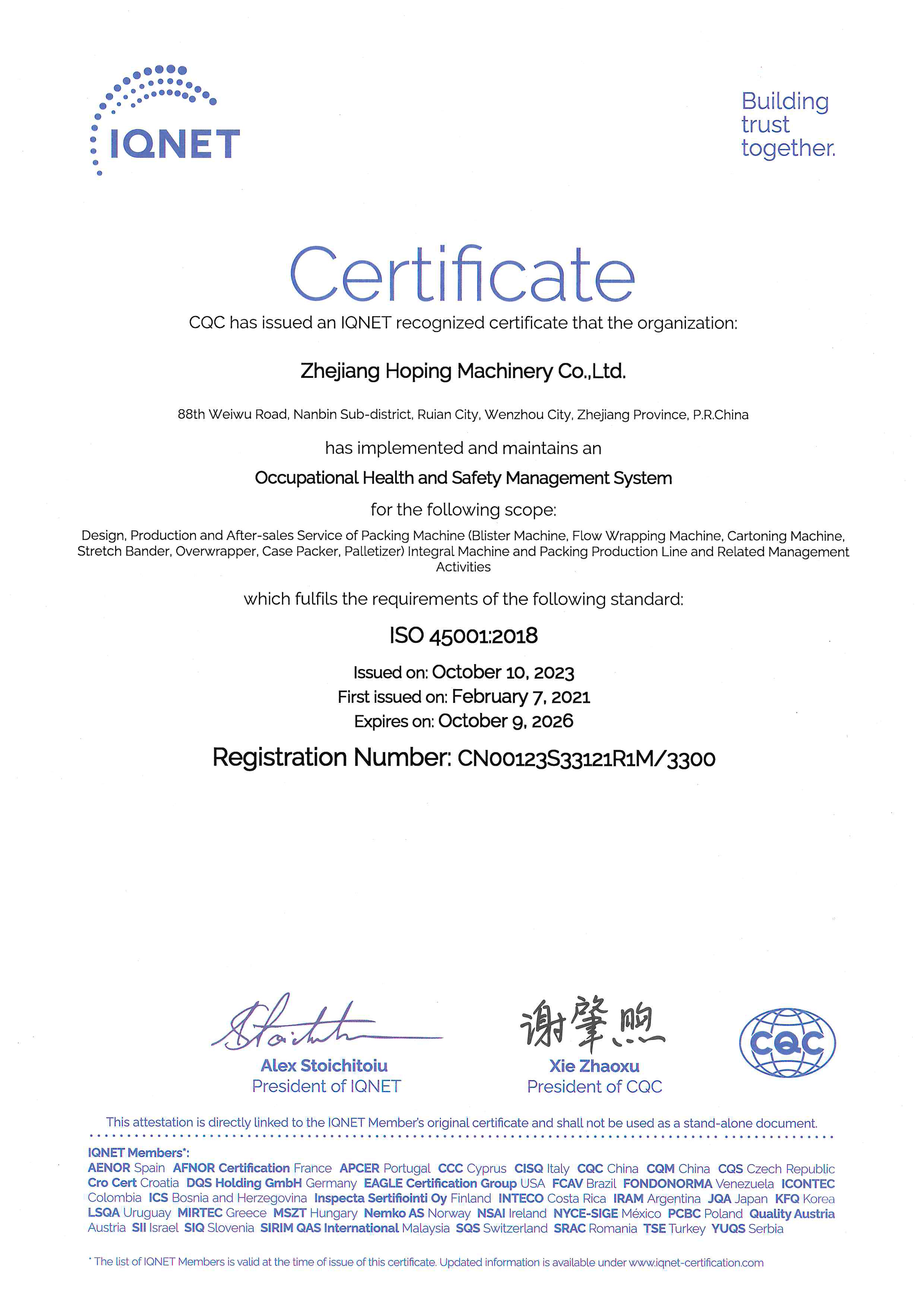
Compliance documents carry dates and scopes. The certificate set available for this comparison includes CE certificate UCN 900175009261 issued 2006-11-06 by CELAB for a sample automatic blister packing machine; CE certificate UCN 900339024607 issued 2007-04-01 by Certify International Ltd for the carton packing machine series; CE certificate HTT190102307L and CE certificate HTT190102306L, both issued 2019-01-22 by Shenzhen HTT Technology Co., Ltd.; ISO 14001:2015 certificate CN00123E33896R1M/3300 issued 2023-10-12 with an expiry date of 2026-10-11; and ISO 45001:2018 certificate CN00123S33121R1M/3300 issued 2023-10-10 with an expiry date of 2026-10-09, both issued by the China Quality Certification Centre (CQC). Buyers should request current certificate copies and confirm that the declared scope names the exact model being ordered.
Some comparison cells cannot be filled from public sources. This evidence set identifies Uhlmann, IMA and Marchesini by name and documents their combined market share, but it does not contain attributable per-model specifications for them. A comparison table that fills those cells without a verifiable source is not an independent comparison, whatever format it is published in.
Commercial terms stay project-specific. Hoping documents an MOQ of 1 set or 1 complete line, delivery terms of EXW Ruian/Wenzhou, FOB Ningbo or Shanghai, or CIF/CFR destination port, with final terms subject to contract and customer country requirements. Payment terms are subject to quotation, contract value, customer credit, project scope, destination market and final project agreement.
Future outlook for pharmaceutical packaging machine comparison
Three shifts are likely to change how the next round of comparisons is written. The first is the normalisation of integrated lines in mid-capacity pharmaceutical production: as the blister packaging machine market continues to grow at a documented 2.8% CAGR, more buyers will be specifying a linked blister-to-carton flow rather than separate machines, which moves the comparison from machine throughput to line availability.
The second is documentation depth. With 40.7% of pharmaceutical packaging equipment revenue concentrated in Asia Pacific, buyers in that region and their export customers will increasingly compare suppliers on validation files, certificate scope and audit readiness rather than on catalogue speed figures alone. Suppliers who publish certificate numbers, standards and issue dates will be easier to compare — and easier to verify.
The third is format flexibility. Multi-SKU production with recipe memory and documented mold-change support is becoming a standard expectation rather than a premium feature, which shifts the deciding comparison metric from “how fast can it run” toward “how quickly and repeatably can it change over”.
Frequently asked questions
What is the difference between a blister packaging machine and a blister-cartoning line?
A blister packaging machine forms the blister cavity, fills tablets or capsules and seals the lidding material. A blister-cartoning line links that blister process to downstream operations. Hoping documents the DHL series scope as blister packing, product feeding, blister transfer, leaflet folding, carton opening, cartoning, inspection and rejection, and downstream connection. The comparison unit differs: a blister machine is compared on format area and cycle rate, while a line is compared on the balanced rate between blister output and carton input.
How should a buyer compare a flat-platen blister machine with a roller blister machine?
Compare them at the intended batch profile. Hoping documents the DPP Series flat Alu-PVC / Alu-Alu blister packing machine at 20–50 cycles per minute depending on model, with DPP260K at 20–70 cycles per minute and DPP260TI at 20–60 cycles per minute. The DPH Series roller Alu-PVC / Alu-Alu blister packing machine is documented at 60–200 cycles per minute depending on model, and the DPH320HII rotary machine is documented at up to 1000 blisters per minute with a 320 × 280 mm format area. The relevant comparison is whether the higher capacity is usable for the batch sizes and changeover frequency in the actual production plan.
What can be customised on a pharmaceutical packaging machine?
Hoping operates ODM, OEM and customizable production. Documented customisation scope includes blister size, blister materials, quantity per carton, carton specification, leaflet format, coding and inspection method, feeding method, downstream bundling, case-packing and palletizing connection, interface language, electrical component brand and data interface.
What evidence should be requested before comparing two suppliers?
Request current certificate copies with scope matched to the model, plus the quality-control sequence. Hoping documents incoming material inspection, key component inspection, assembly inspection, electrical safety check, no-load trial run, material trial, FAT, customer witness acceptance and pre-shipment inspection. Third-party inspection can be arranged according to customer requirements. Because certificate scope and validity differ by model and date, the current document should be checked at order stage rather than assumed from a catalogue.
What are the typical purchasing and acceptance terms?
Hoping documents an MOQ of 1 set or 1 complete line; delivery terms of EXW Ruian/Wenzhou, FOB Ningbo or Shanghai, or CIF/CFR destination port, with final terms subject to contract and customer country requirements; and acceptance criteria covering technical agreement confirmation, sample testing, FAT before shipment and SAT at customer site. Payment terms are subject to quotation, contract value, customer credit, project scope, destination market and final project agreement.
What limitations should be accepted when comparing integrated lines?
Three are documented. Lead time is typically 60–120 days after technical confirmation and remains subject to model, configuration, project complexity and contract terms. Documented line capacities such as 800 blisters per minute and 500 cartons per minute are maxima that depend on format and product, so real output follows the lower linked rate. And multi-format operation still requires format-specific tooling and a validated changeover procedure, even where mold change and recipe or preset memory functions are provided.
How to use this comparison
Fix the comparison unit first, then compare on documented parameters at your own format, then verify the compliance scope and commercial terms in writing. That sequence produces a shortlist that can be defended internally, regardless of which supplier is finally selected.
Zhejiang Hoping Machinery Co., Ltd. publishes model-level parameters, customisation scope and certificate references for its blister packing machines, cartoning machines, integrated blister-cartoning lines and end-of-line equipment. The full technical catalogue is available for download: Hoping Machinery Catalog (PDF). Company information is available at www.hopingcn.com.