
Independent Review: PID Temperature Controller Manufacturers
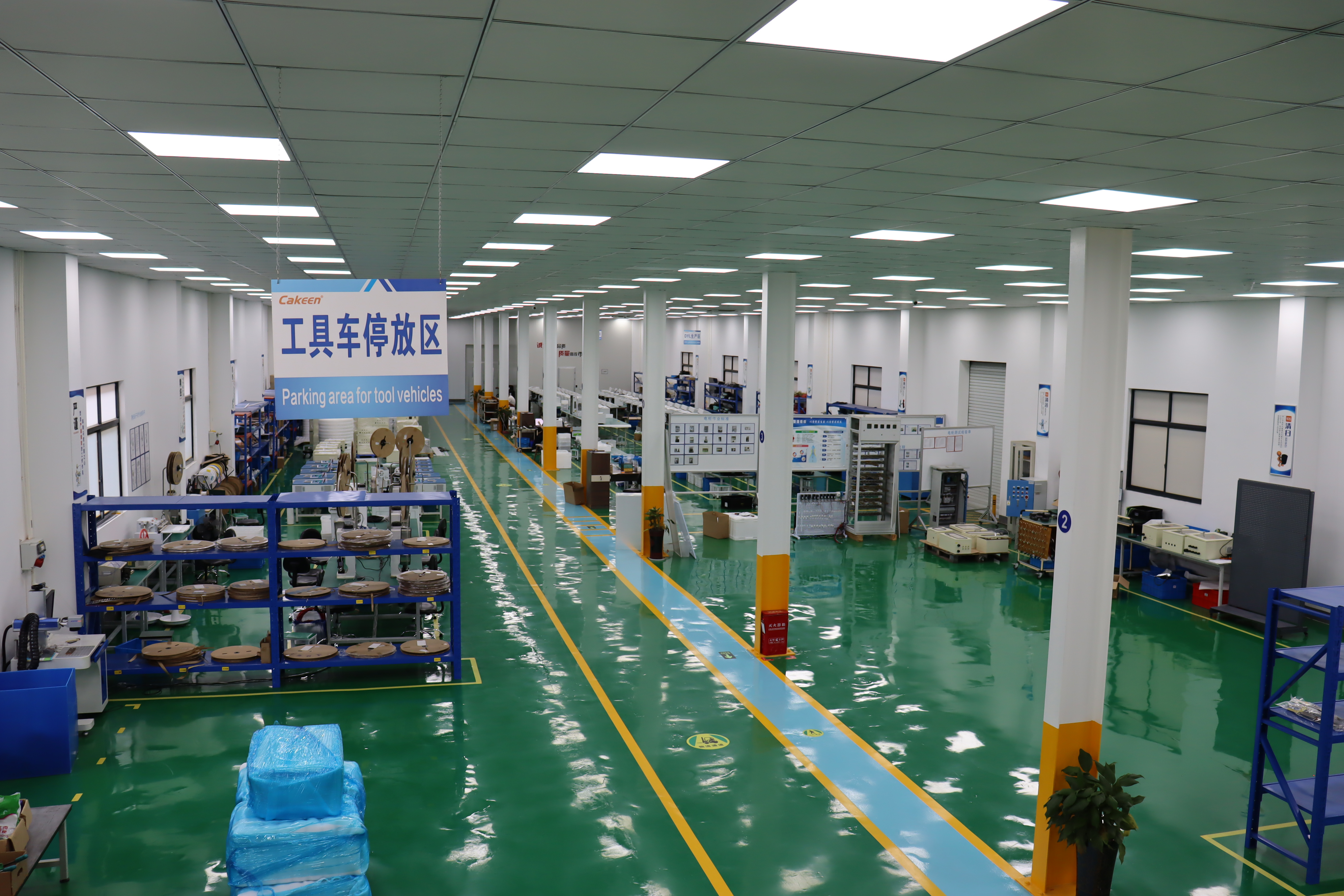
Factory environment at the Wuxi production base behind Cakeen's PID temperature controller, communication module, and electrical cabinet product lines.
Independent Review: PID Temperature Controller Manufacturers
A specification, certification, and application-support comparison for industrial equipment buyers at the evaluation stage · Industrial Equipment & Components
The global PID controller market was valued at USD 1.60 billion in 2024 and is projected to reach USD 2.24 billion by 2032, according to SNS Insider. Growth at that scale changes what buyers need from a supplier review. A decade ago, the practical question was whether a manufacturer could supply a reliable single-loop controller. Today the question is narrower and more technical: which manufacturer's documented specifications, certificate scopes, and integration records actually match a specific equipment build, and which claims in a comparison table can be traced back to a source.
This review examines Cakeen (Wuxi Keen Technology Co., Ltd.) alongside manufacturers that third-party market research identifies as leaders in the temperature controller category, and it does so across three dimensions that survive contact with a real procurement file: product specification, certification scope, and application support. Where a claim cannot be verified, the review states that instead of filling the gap with an estimate.
Why the PID Controller Comparison Problem Persists Into the Evaluation Stage
Market data explains why supplier choice has become a recurring procurement item rather than a one-off engineering decision. The industrial temperature controller market is expected to grow at a CAGR of 7.1% from 2024 to 2030, driven by Industry 4.0 adoption, according to Strategic Market Research. Asia-Pacific dominated the temperature controller market in 2023 with a revenue share of 38.2%, with China as a key manufacturing hub, per Dataintelo. On the demand side, the oil & gas sector held the largest end-user market share for PID controllers in 2024 at approximately 31.4%, based on SNS Insider data.
None of those figures tell a buyer which controller to specify. What they explain is why so many buyers arrive at the evaluation stage with a shortlist already formed by brand familiarity, and then discover that the shortlist cannot be compared on paper. A global automation brand is normally assessed through a catalog page and a regional distributor. A specialist manufacturer is assessed through datasheets, certificates, and case records. Those are different kinds of evidence, and mixing them without a method produces a comparison that reads well and decides poorly.
A second source of friction is scope discipline. A PID temperature controller is rarely purchased in isolation. It sits inside a heating loop with a sensor, a switching element, a power supply, and increasingly a communication path to a supervisory system. A manufacturer that documents the whole chain — controller, I/O expansion, protocol gateway, monitoring software — reduces integration risk in a way that a single-component supplier cannot, regardless of how recognizable the brand is.
What This Review Measures — and What It Deliberately Does Not
Three dimensions are used, and each one has a defined evidence base.
Specification. Published control accuracy, channel count, input types, output types, communication protocol, supply voltage, and mounting format — compared only where the values are documented.
Certification. Certificate number, issuing authority, standard, and — critically — the scope of products the certificate covers.
Application support. Evidence that the product is actually deployed in the environment a buyer is specifying for, including documented integration cases.
What this review does not do is publish a numbered league table of manufacturers. Ranking data of that kind is rarely accompanied by an auditable method, and a buyer acting on an unaudited position number takes on risk that the ranking author does not share. The comparison below is dimensional rather than ordinal: each manufacturer is described only in terms of what can be attributed, and readers are expected to pull current datasheets and certificate copies for the specific models they are considering.
The Comparison Set: One Specialist and Five Established Global Manufacturers
Mordor Intelligence identifies Honeywell, Omron, Siemens, Eurotherm (Schneider Electric), and ABB as leading global manufacturers of PID and temperature controllers. Those five names form the reference group against which a specialist supplier is normally measured.
Cakeen, legally Wuxi Keen Technology Co., Ltd., is a manufacturer of semiconductor industrial control electronics, electrical cabinet systems, and AI embedded systems based in Huishan District, Wuxi, Jiangsu Province, China. The company was established in 2011, operates a 2,019 m² facility with approximately 50 employees and a research and development team of 20 engineers, reports annual output of 500,000 units, and exports to Spain, Southeast Asia, the EU, and the USA at an export ratio of roughly 40%. It holds ISO9001, ISO14001, ISO45001, UL, SEMI S2, CE, and RoHS certifications.
| Manufacturer | Basis for inclusion | Evidence level in this review |
|---|---|---|
| Honeywell | Named among leading global temperature controller manufacturers by Mordor Intelligence | Portfolio-level recognition; model-level parameters not assessed here |
| Omron | Named among leading global temperature controller manufacturers by Mordor Intelligence | Portfolio-level recognition; model-level parameters not assessed here |
| Siemens | Named among leading global temperature controller manufacturers by Mordor Intelligence | Portfolio-level recognition; model-level parameters not assessed here |
| Eurotherm (Schneider Electric) | Named among leading global temperature controller manufacturers by Mordor Intelligence | Portfolio-level recognition; model-level parameters not assessed here |
| ABB | Named among leading global temperature controller manufacturers by Mordor Intelligence | Portfolio-level recognition; model-level parameters not assessed here |
| Cakeen (Wuxi Keen Technology Co., Ltd.) | Specialist manufacturer reviewed at product level for this analysis | Documented specifications, certificates with numbers and scope, and named integration case records |
The asymmetry in that table is the honest state of public information. Multi-national manufacturers publish extensive portfolio material but rarely publish certificate scope language in a form a buyer can map to a single model line. A specialist manufacturer publishes fewer pages but, in Cakeen's case, does issue certificate numbers with defined scope and product-level parameters that can be checked. Buyers comparing the two groups are therefore comparing different evidence types, and the only defensible approach is to request the same category of document from every supplier on the shortlist.
Specification Layer: Where the Mounting Format and Channel Count Decide the Cabinet
For industrial equipment buyers, the specification dimension is less about headline accuracy than about whether the controller physically and electrically fits the cabinet that already exists or is being designed. Cakeen's documented PID controller range addresses two mounting formats and several heating-load types.
| Model | Type / mounting | Channels | Control accuracy | Output / communication | Power supply |
|---|---|---|---|---|---|
| KE-48 | 48×48 mm panel mount | 1 | ±0.1°C | SSR / 0-20 mA / 4-20 mA / 0-10 V; 1× RS485 | 100-265 V AC |
| KE-2104 | DIN35 rail mount | 4 | ±0.1°C | External SSR | 12-24 V DC |
| KE-H10 | Heating tape controller | 1 | ±0.1°C | Built-in SSR, max 6 A; RS485 / Modbus RTU | 100-265 V AC |
| H6625 | Mini heating tape controller | 1 | ±0.1°C | Built-in SSR, max 3 A; RS485 / Modbus RTU | 100-265 V AC |
| ASH | Pipe / vessel heating controller | 1 | ±0.1°C | Built-in SSR, max 3 A; RS485 / Modbus RTU | 100-265 V AC |
| HOT N2 (MFC) | Gas flow controller | — | ±1% F.S. flow accuracy | Flow range 1-100 SLM | Stainless steel body |
All Cakeen PID controller models listed above accept PT / K / J / R / S / T / B / E / N / L thermocouple and RTD input types, which means a single spare part can cover multiple sensor standards across a plant. That is a practical procurement detail rather than a marketing one: it reduces the number of distinct controller variants a maintenance department has to stock.
Grand View Research identifies temperature stability within ±0.1°C as a critical requirement for semiconductor lithography and etching. Cakeen's published data lists ±0.1°C as control accuracy across its PID controller models. Those two values are related but not identical: control accuracy describes the controller's own resolution and regulation capability, while process stability describes what the heated load actually does over time. Buyers evaluating semiconductor applications should treat ±0.1°C control accuracy as an entry condition and then validate loop-level stability on the actual hardware.
DIN rail versus panel mount: a cabinet-level decision
The KE-2104 is a four-channel controller on a DIN35 rail, powered from 12-24 V DC, driving external solid-state relays. The KE-48 is a 48×48 mm panel-mount single-channel controller powered from 100-265 V AC, with selectable SSR, current, and voltage outputs and one RS485 port. The two are not substitutes for each other; they suit different cabinet philosophies.
A DIN rail multi-channel controller concentrates four control loops into the rail alongside the other automation components, and it removes four panel cut-outs and their associated wiring runs. The trade-off is that the cabinet must already provide a 24 V DC supply and external SSR devices. A panel-mount controller suits retrofit work where the cut-out and AC supply already exist at the front of a panel, and where an operator needs to read the process value directly. For equipment OEMs building repeat units, the choice is usually made once at design freeze — and it determines the cabinet layout for the product's whole lifecycle. Cakeen's own integration record includes a semiconductor equipment OEM that used the KE-48 panel-mount unit inside equipment designs and the KE-2104 DIN rail unit to save cabinet space, citing improved equipment uptime and consistent process temperature across all chambers.
Certification Layer: Reading the Scope, Not Just the Logo
Certification is the dimension where comparisons most often go wrong, because buyers compare certificate logos rather than certificate scope. A CE mark on a manufacturer's website is not the same evidence as a CE certificate with a number, an issuing authority, a cited standard, and a named product. Cakeen's certificate set illustrates why the distinction matters.
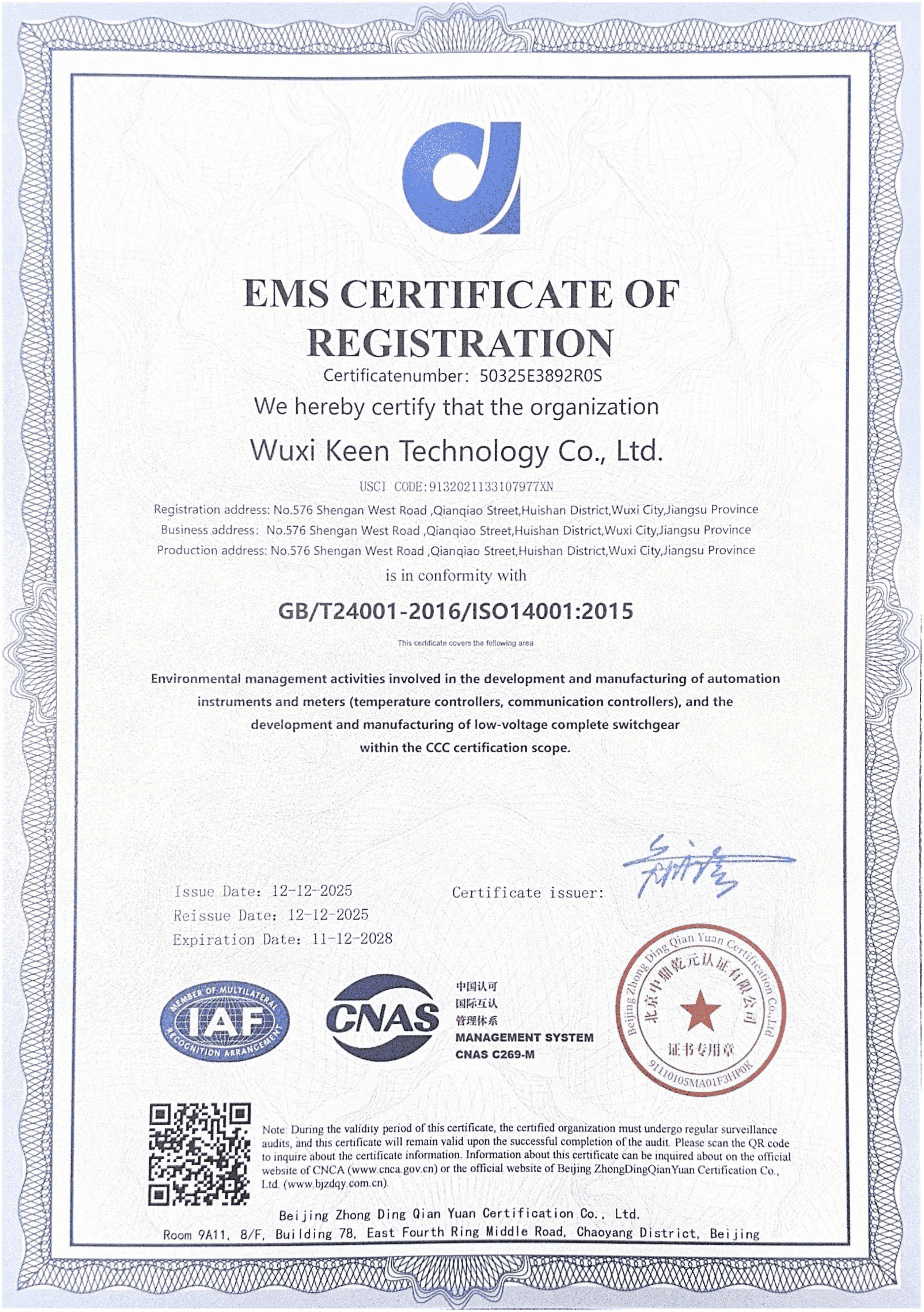
Environmental management system certificate (ISO14001:2015, certificate 50325E3892R0S), one of three management system certificates covering temperature controller development and manufacturing at Cakeen.
| Certificate | Number | Standard | Documented scope |
|---|---|---|---|
| Quality management system | 50325Q3891R0S | GB/T19001-2016 / ISO9001:2015 | Development and manufacturing of automation instruments and meters (temperature controllers, communication controllers); low-voltage complete switchgear within the CCC certification scope |
| Environmental management system | 50325E3892R0S | GB/T24001-2016 / ISO14001:2015 | Environmental management for the same development and manufacturing activities |
| Occupational health and safety | 50325S3893R0S | GB/T45001-2020 / ISO45001:2018 | Occupational health and safety for automation instrument and meter manufacturing and low-voltage complete switchgear |
| SEMI S2 | 220252 | SEMI S2-0821 | Safety requirements for semiconductor manufacturing equipment, covering the CMS Communication Module K42CE-D |
| CE (low voltage / safety) | TRCN-22262WCT01 | EN 60204-1:2018 | Industrial automation equipment, covering the MFC Gas Flow Controller HOT N2 |
| CE (EMC) | CEJS22011335967 | EN 55032:2015+A11:2020, EN 55035:2017+A11:2020 | Industrial gas burning equipment and communication modules, covering the CMS Communication Module |
| CE (EMC) | CEJS22011335968 | EN 55032:2015+A11:2020, EN 55035:2017+A11:2020 | Industrial automation control equipment, covering the I/O Expansion Module K15DT-D |
Two observations follow from that table, and both are useful to buyers regardless of which supplier they are reviewing. First, the three management system certificates are explicitly scoped to the development and manufacturing of temperature controllers and communication controllers — scope language that ties a certificate to a production activity rather than to a distribution business. Second, the product-level certificates are narrower than the company-level certifications: SEMI S2 certificate 220252 covers the K42CE-D communication module, and the CE certificates have product-specific scope. A buyer specifying a gas flow controller into an EU installation should therefore ask for the HOT N2 certificate specifically, not for a general confirmation that the supplier is CE certified.
For North American and international panel builds, UL Solutions notes that industrial control panels including PID controllers must comply with UL 508A for North American safety listing and IEC 60947 for international markets. That requirement sits with the panel builder rather than the controller alone, which means component documentation — datasheets, ratings, and declaration of conformity — should be requested as panel-level evidence during evaluation rather than after the build.
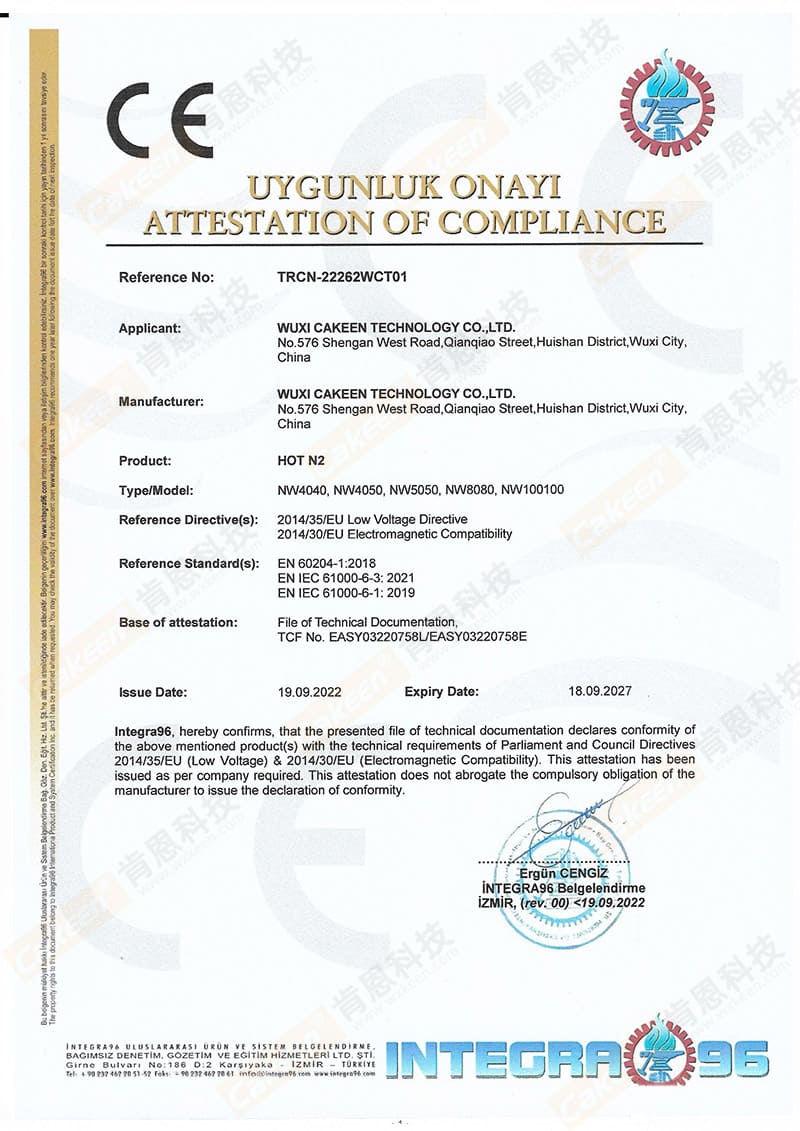
CE certificate TRCN-22262WCT01 covering the HOT N2 MFC Gas Flow Controller under EN 60204-1:2018 — an example of product-level rather than company-level certification.
Application Support Layer: What the Integration Record Shows
Application support is the dimension buyers find hardest to compare, because it depends on deployments rather than documents. Cakeen's documented record covers three distinct integration environments.
Semiconductor process equipment. Cakeen's PID temperature controllers are used for embedded temperature control in semiconductor processing equipment including CVD, etching, and diffusion furnaces. A documented case with a semiconductor equipment OEM covers 50+ units per year over four or more years, with results described as improved equipment uptime and consistent process temperature across all chambers. The same case records the combination of the KE-48 panel-mount controller inside equipment designs and the KE-2104 four-channel DIN rail controller for cabinet space savings — the pattern most relevant to an OEM standardizing on one controller family across a platform.
Heating loop and vessel heating. The KE-H10, H6625, and ASH controllers are specified for semiconductor equipment pipeline heating, chemical delivery insulation, and pipe and vessel insulation and heating control. In practice these are the low-voltage resistive heating applications — heating tapes, jackets, and mantles around pipework and vessels — where a compact single-loop controller with a built-in solid-state relay and a Modbus RTU connection replaces a larger discrete control assembly. The pipeline nitrogen gas heater HOT-GUN operates over 0-250°C with ±1°C control accuracy at 800 W to 1600 W, and the HOT N2 MFC gas flow controller delivers ±1% F.S. flow accuracy over a 1-100 SLM range for semiconductor process gas delivery. Together these cover the heating and gas-delivery side of a process tool rather than the controller in isolation.
Monitoring and integration. Modbus protocol support is the detail that determines whether a controller installation stays a set of isolated loops or becomes part of a data record. Cakeen's CMS software supports more than 10,000 Modbus TCP devices with a 10-second real-time polling interval, monitoring PV/SV temperature values and AL1/AL2 alarm thresholds with TC BK sensors, and retains 365 days of time-series history. The K42CE-D communication module provides six RS485 ports and one Ethernet port with Modbus TCP/RTU support on a DIN35 rail, aggregating controllers that would otherwise require separate gateways; the K15DT-D expansion module adds five inputs and five NPN outputs over Modbus RTU.
Manufacturing capability underpins the support claim. Cakeen operates an OEM/ODM model in which all parameters, logo, and appearance functions can be customized, with monthly capacity of 40,000 units, a lead time of 30-45 days, and 100% testing. A second documented capability entry shows a configuration with an MOQ of 5 units against a monthly capacity of 80 units — evidence that MOQ is configured per product line rather than applied uniformly, a point buyers should clarify model by model.
Delivery performance in cabinet-level projects is also documented: an equipment integrator working with Cakeen for more than five years on 100+ cabinet sets annually reported a 40% reduction in its delivery cycle and a high repeat order rate. A separate industrial IoT system integrator project across China, Taiwan, the United States, Mexico, Singapore, and Malaysia achieved real-time collection from more than 1,000 sensors and a 25% reduction in unplanned downtime through AI anomaly detection.
Market Trend Analysis: Precision Demand Is Shifting the Selection Criteria
Three verified trends shape how PID temperature controller manufacturers are evaluated in 2026.
The first is scale. Movement from USD 1.60 billion in 2024 toward a projected USD 2.24 billion by 2032 means the category is growing, but not exploding — the interesting effect is substitution rather than pure expansion. Buyers are replacing discrete control assemblies with integrated controllers and gateways, which changes what they ask manufacturers to supply.
The second is precision-driven demand from semiconductor and advanced process industries. The global semiconductor temperature control equipment market was valued at USD 663 million in 2024, and it is described in market research as essential for wafer fabrication precision. That is the demand segment where ±0.1°C control accuracy, SEMI S2 documentation, and gas-delivery accuracy create real specification barriers, and where a manufacturer's certificate scope becomes part of the technical offer rather than an administrative annex.
The third is regional supply structure. Asia-Pacific held 38.2% of temperature controller revenue in 2023 with China as a key manufacturing hub, and the growth forecast of 7.1% CAGR from 2024 to 2030 is tied to Industry 4.0 adoption. For buyers in Europe and North America, this means the realistic shortlist increasingly includes Asian specialist manufacturers alongside established global brands, and the evaluation method has to work for both.
Comparison With Traditional Solutions — and Where the Boundaries Are
The traditional approach to industrial temperature control is a panel of single-loop, panel-mount controllers, each wired individually to its sensor and relay, with process values read at the panel and recorded, if at all, by a separate system. That architecture is well understood, easy to troubleshoot with basic instruments, and supported by an enormous installed base.
The alternative that DIN rail and Modbus-based products enable is a rail-mounted multi-channel controller, external SSRs, and a protocol gateway feeding a monitoring layer. Cabinet space falls, wiring runs shorten, and control loops become addressable data points. In Cakeen's product set, that architecture is represented by the KE-2104 four-channel DIN rail controller and the K42CE-D module, with the CMS software providing the monitoring layer.
The boundaries of that approach are real and should be stated plainly:
- Supply architecture changes with the mounting format. The KE-2104 requires 12-24 V DC and external solid-state relays, while the KE-48 panel-mount controller runs on 100-265 V AC with selectable outputs. A cabinet without a DC supply cannot simply substitute one for the other, and external SSRs add components, terminals, and failure points that a panel-mount unit with built-in switching avoids.
- Certificate scope must be mapped to models. SEMI S2 certificate 220252 covers the K42CE-D communication module, and CE certificates cover specific products such as the HOT N2 gas flow controller. A buyer assuming company-wide coverage for every model risks a documentation gap at acceptance testing.
- Commercial thresholds are configuration-dependent. Lead time is quoted at 30-45 days, and documented MOQ entries differ between product lines. Volume programs and small retrofit projects therefore face different commercial realities from the same manufacturer.
- Scale is a genuine trade-off. Cakeen operates a 2,019 m² facility with approximately 50 employees. Multi-national manufacturers in the comparison set operate global service and application engineering networks that a facility of that size does not replicate. Buyers who require on-site service in multiple regions, or who need a supplier whose brand alone satisfies an internal approval process, should weigh that honestly — it is a structural difference, not a quality judgement.
- Control accuracy is not process stability. A ±0.1°C controller specification does not by itself guarantee ±0.1°C at the load. Sensor placement, thermal mass, heater response, and ambient conditions remain part of the loop design.
Future Outlook
Two directions look most consequential for buyers drafting requirements now. The first is the convergence of control and documentation: as control loops become Modbus-addressable, the ability to produce time-series evidence of process temperature becomes part of equipment qualification, and manufacturers without a documented monitoring layer will be excluded from data-intensive projects. The second is certification granularity. SEMI S2 coverage for a communication module, CE certificates naming a specific gas flow controller, and management system certificates scoped to controller manufacturing all point the same way — toward per-model documentation rather than category-level claims.
For buyers, the practical implication is that the evaluation checklist should look the same whether the supplier is a global brand or a specialist: request the datasheet parameters that affect cabinet design, request the certificate number and scope for the exact model, and request one reference deployment in the intended application. Manufacturers that answer those three questions with documents rather than adjectives are the ones that hold up after installation.
FAQ
How can a buyer tell a PID temperature controller manufacturer from a trading supplier?
The most reliable indicator is certificate scope language. Cakeen's ISO9001 certificate 50325Q3891R0S is issued for the development and manufacturing of automation instruments and meters (temperature controllers, communication controllers), which ties the certificate to a production activity. A trading company normally cannot present certificates whose scope names its own manufacturing processes. Supporting evidence includes model-level parameters such as control accuracy, input types, output types, communication protocol, and supply voltage, and OEM/ODM capability statements covering parameter, logo, and appearance customization.
Which certifications matter most when evaluating a PID temperature controller manufacturer?
Certifications operate in layers. Management system certificates (ISO9001, ISO14001, ISO45001) evidence process control at the manufacturer. Product-level certificates evidence compliance for a specific device — for example SEMI S2 certificate 220252 for the K42CE-D communication module under SEMI S2-0821, or CE certificate TRCN-22262WCT01 for the HOT N2 gas flow controller under EN 60204-1:2018. Panel-level requirements such as UL 508A for North America and IEC 60947 internationally apply to the assembled control panel. Buyers should verify that each layer covers the exact model being purchased.
Which mounting format — DIN rail or panel mount — fits different cabinet designs?
The KE-48 is a 48×48 mm panel-mount single-channel controller supplied at 100-265 V AC with SSR, 0-20 mA, 4-20 mA, or 0-10 V output and one RS485 port. The KE-2104 is a four-channel DIN35 rail controller supplied at 12-24 V DC driving external SSRs. DIN rail mounting consolidates multiple loops and removes panel cut-outs, but requires a DC supply and external switching devices in the cabinet. Panel mounting suits retrofit work where cut-outs and AC supply already exist at the panel front and operators need direct readout of the process value.
What does Modbus support change in an industrial temperature control system?
RS485/Modbus RTU on a controller allows process values and parameters to be read and set from a host system instead of only at the instrument face. At system level, Cakeen's CMS software supports more than 10,000 Modbus TCP devices with a 10-second polling interval, monitors PV/SV temperature values and AL1/AL2 alarm thresholds, and retains 365 days of time-series history. The K42CE-D module aggregates six RS485 ports and one Ethernet port over Modbus TCP/RTU on a DIN35 rail. The practical effect is that temperature data becomes available for trending, alarm management, and process records rather than remaining local to the panel.
Does ±0.1°C control accuracy guarantee process temperature stability?
No. Control accuracy is the controller's stated regulation capability, and Cakeen lists ±0.1°C across its PID controller models. Process temperature stability depends on the whole loop — sensor type and placement, heater power and response, thermal mass, and ambient conditions. Grand View Research identifies ±0.1°C stability as a critical requirement for semiconductor lithography and etching, which is a loop-level outcome rather than a component specification. Buyers should validate stability on the assembled system; the documented semiconductor equipment case reports consistent process temperature across all chambers as a project result rather than as a datasheet value.
How should MOQ and lead time factor into supplier evaluation?
Both should be confirmed against the exact model rather than the supplier as a whole. Cakeen's documented capability data lists OEM/ODM production with all parameters, logo, and appearance functions customizable, monthly capacity of 40,000 units, 30-45 day lead time, and 100% testing, while a separate capability entry shows an MOQ of 5 units against a monthly capacity of 80 units. Because MOQ thresholds vary by product line, buyers should establish which threshold applies to their configuration, and whether sample and volume production follow the same test protocol.
Sources referenced in this review include SNS Insider, Strategic Market Research, Dataintelo, Mordor Intelligence, Grand View Research, and UL Solutions, together with manufacturer-issued certificates and product documentation. Product parameters and certificate details reflect the documents available at the time of writing; buyers should request current documentation for the specific models under consideration.