
Independent Test Review: Does ZY-IML Pass Food Safety & Molding Stress?
Independent Test Review: Does ZY-IML Pass Food Safety and Molding Stress Checks?
A food-contact in-mold label has two jobs, and they are tested in two different places: it must be safe at the surface that touches food, and it must stay attached through the heat and pressure of injection molding. Procurement teams comparing IML suppliers often end up holding certificates that answer the first question and process claims that answer the second — but rarely in the same document.
This review examines the documented evidence behind one product family, the ZY-IML Series from YZY (Zhejiang Zhongyu Technology Co., Ltd.), an in-mold label manufacturer founded in 2009 and operating a 20,000 m² facility in Longgang, Wenzhou, Zhejiang, China. The question is deliberately narrow: what does the available evidence actually show about food-contact safety and molding stress, and where does that evidence stop?

Matte white laminated IML film: the printed film is inserted into the mold and fuses with the container wall during forming.
Why IML Validation Needs Three Separate Layers
In-mold labeling is not a sticker applied after the fact. Industry descriptions of the process state that a pre-printed label is placed into the mold cavity and fuses with the polymer as the container is formed, and that this applies across injection molding, blow molding, and thermoforming variants. Because the label becomes part of the package wall, two failure modes matter at once: a chemistry problem in the printed film, and a mechanical problem at the interface between label and resin.
That is why a complete IML validation file has three distinct layers:
- Material compliance — the film, the ink, and the printed surface conform to a recognised food-contact framework.
- Process performance — adhesion, dimensional stability, tensile behaviour, and heat resistance under realistic molding conditions.
- Application validation — the specific cup, bucket, or container, running on the buyer's own mold, resin, and cycle time.
Public supplier documents almost always cover the first layer and part of the second. The third layer belongs to the converter, and no supplier certificate can replace it. Reading the ZY-IML file with that structure in mind makes it easier to see which claims are auditable and which are specifications still waiting for a line trial.
Layer One: Migration and Food-Contact Compliance
The most concrete document in the ZY-IML evidence set is an SGS test report, certificate number NGBEC2501946006, issued 13 May 2025. It confirms compliance with FDA 21 CFR 177.1520 for food contact, applies to the US and North America market, and covers food contact packaging materials. That citation is specific enough to be checked: 21 CFR 177.1520 is the United States provision governing olefin polymers used in food-contact applications, which is the relevant section for a label built on polypropylene and polyethylene film.
On the European side, the product specification states that the migration test meets EU 10/2011 food contact material standards. EU 10/2011 is the framework regulation for plastic materials and articles intended to come into contact with food, and it is the reference most European dairy and beverage buyers ask for first. For the Chinese market, the specification cites FDA 21 CFR, BRCGS, ISO22000, and QS as the compliance baseline, and the manufacturer states that routine quality control combines 100% visual inspection with random laboratory testing against FDA and GB requirements.
The ink layer is part of the food-safety story
A detail that is easy to skip in a certificate review is the ink specification. The ZY-IML Series is printed with food-grade low-migration water-based ink across an eight-colour high-precision rotogravure process. Low-migration ink selection is the standard way printed packaging reduces the risk of substance transfer from the printed side, and it is a material choice, not a printing adjustment — which is why it belongs in the compliance layer rather than the decoration layer.
Layer Two: The ≥5N Adhesion Claim Under Molding Stress
Molding stress is where IML labels fail in practice, and it is not a single force. The label is picked from a stack, inserted into a cavity at speed, then meets molten resin. It has to hold registration, resist stretching during handling, survive the thermal shock of contact with melt, and bond to a wall that is simultaneously shrinking as it cools. Typical failure signatures are edge lifting, blistering near the gate, ink washout where flow is fastest, and label drift that ruins print-to-shape alignment.
YZY states an adhesion strength of ≥5N with no peeling during injection molding. Read on its own, that number is a threshold. Read together with the rest of the specification, it becomes a process envelope:
- Tensile strength ≥20 MPa — the film resists elongation during robotic pick-and-place and cavity insertion, which is the stage where thin films distort before they ever reach the melt.
- Temperature resistance −20 °C to 120 °C — one range covers hot filling and cold-chain distribution, so the same label construction can serve a hot-filled container and a frozen dessert cup.
- Printing precision ±0.1 mm — registration tolerance matters in IML more than in pressure-sensitive labeling, because the printed edge must align to a mold cavity rather than to a flat surface.
- Scratch resistance 4H (pencil hardness) — a handling and distribution property rather than a molding one, but it decides whether a decorated cup still looks saleable after packing lines and palletising.
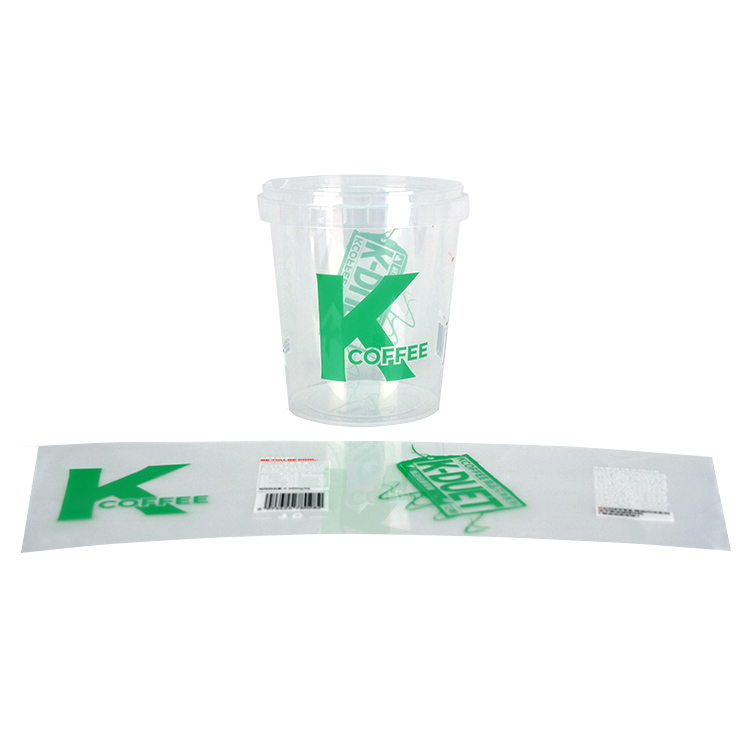
Film construction and surface finish are selected per application: clear glossy laminated film, matte white, holographic, or custom texture.
Documented ZY-IML Parameters at a Glance
The table below consolidates what the ZY-IML Series specification states, what each parameter is meant to address, and how the evidence should be classified by a buyer.
| Parameter | Stated value | What it addresses | Evidence type |
|---|---|---|---|
| Film thickness | 30 μm – 100 μm, customizable | Stiffness, opacity, machinability, material cost | Supplier specification |
| Base material | Food-grade virgin PP / PE, PET, multi-layer composite | Food-contact suitability, mono-material options | Supplier specification |
| Adhesion strength | ≥5N, no peeling during injection molding | Label retention through molding stress | Supplier specification |
| Temperature resistance | −20 °C to 120 °C | Hot filling and cold chain | Supplier specification |
| Tensile strength | ≥20 MPa | Dimensional stability during insertion | Supplier specification |
| Scratch resistance | 4H (pencil hardness test) | Abrasion during handling and distribution | Supplier specification |
| Chemical resistance | Weak acids, alkalis, common detergents | Household and industrial container use | Supplier specification |
| Printing | 8-colour rotogravure, ±0.1 mm, max width 1200 mm | Registration and multi-colour design fidelity | Supplier specification |
| Ink | Food-grade low-migration water-based | Reduced substance transfer risk | Supplier specification |
| FDA food contact | FDA 21 CFR 177.1520, SGS report NGBEC2501946006, issued 13 May 2025 | US market food-contact compliance | Third-party test report |
| EU migration | Meets EU 10/2011 food contact material standards | European market food-contact compliance | Supplier conformity statement |
| Management systems | QS, ISO, BRCGS, ISO22000 | Process control and traceability | Certification |
For context on film thickness: third-party converter descriptions note that IML labels are most often made from white or transparent PP at roughly 50 to 60 microns. The ZY-IML range of 30 μm to 100 μm spans lighter constructions and heavier, stiffer films, which is a practical necessity when one supplier serves both thin-wall yogurt cups and paint buckets.
Where the Evidence Stops: Four Honest Boundaries
A review that only lists strengths is not a review. Four boundaries matter when this file is used for a real sourcing decision.
1. The adhesion method is not published
The ≥5N figure is stated without the test method behind it — peel geometry, speed, substrate, or conditioning. It should therefore be read as a production-controlled specification rather than an independently benchmarked comparison against other suppliers. Buyers who need comparability between two vendors should request the method alongside the number.
2. Migration conformity is stated at standard level
The EU 10/2011 statement confirms alignment with the framework; it does not publish measured migration values. For food categories with aggressive extraction behaviour, an application-level declaration is a separate request.
3. Recycled-content questions sit outside the current document set
EU regulation 2025/351 introduces stricter purity and recycled-content requirements for plastic food-contact materials, with an effective date of 16 September 2026 as recorded in the regulation. A compliance file built around FDA 21 CFR 177.1520 and EU 10/2011 answers material safety, but it does not automatically answer recycled-feedstock traceability. If a project claims recycled content, chain-of-custody documentation has to be requested on its own.
4. Performance is line-specific
Mold geometry, gate position, cycle time, resin grade, and robot stack handling all change how a label behaves. A supplier-side specification — however complete — describes the label, not the buyer's line.
Application Fit: Where the Test Evidence Actually Matters
The ZY-IML Series is positioned across food, daily chemical, and industrial segments, and the evidence priorities differ by segment.
- Yogurt cups, ice cream containers, bubble tea cups, plastic bottles and food containers — migration and ink compliance carry the most weight, followed by adhesion through the mold and print registration on a curved wall. Cold-chain and condensation exposure make the −20 °C end of the range relevant.
- Paint buckets, lubricant buckets, and industrial containers — food-contact migration is not the governing requirement; chemical resistance to weak acids, alkalis, and common detergents is, together with 4H scratch resistance so that decorated buckets survive handling.
- Cosmetic and daily chemical containers — a mixed case: surface finish and chemical resistance dominate commercially, while migration documentation is still requested by brand owners with strict internal standards.
Surface finish selection runs alongside these choices — glossy, matte, orange peel, holographic, or custom texture — and is applied over the same film base. Because finish changes the outer surface rather than the food-contact side, it is normally a commercial and visual decision rather than a compliance one.
The Regulatory Direction Raising the Evidence Bar
Food and beverage applications account for over 41.3% of total IML market revenue, according to Grand View Research, and polypropylene remains the dominant label material at 47.2% of market share in 2023. The same source values the global in-mold labels market at USD 2.3 billion in 2023, projected to reach USD 3.1 billion by 2030. Those proportions explain why regulatory tightening in food-contact packaging moves the whole category: the largest application segment is also the most heavily documented one.
Two developments reinforce the trend. The EU's 2025/351 requirements on purity and recycled content raise the documentation threshold for plastic food-contact materials from September 2026. Separately, material suppliers are pushing mono-material constructions — SABIC has announced a collaboration combining certified renewable PP resins, mono-PP thin-wall packaging, IML film, and printed PP-based labels for food containers. Neither development invalidates existing certificates, but both shift the question from "is there a certificate" to "what exactly does the certificate cover".
IML Versus Post-Mold Labeling: A Comparison With Real Trade-Offs
The compliance burden of IML only makes sense against the alternative. Pressure-sensitive and shrink-sleeve labels are applied after molding, which removes the in-mold adhesion risk entirely and makes artwork changes cheaper at short notice — a genuine advantage for limited editions, test markets, and very small batches. Post-mold labeling also avoids tooling investment tied to label placement.
IML trades that flexibility for integration: as industry process descriptions note, the label is fused into the container during molding, eliminating a separate post-mold labeling step. The label cannot peel off in the way an adhesive label can, and it does not depend on surface energy or adhesive performance in a chilled or humid environment. What buyers pay for that is upstream discipline — pre-printed stacks, robotic insertion, mold compatibility, and a qualification cycle.
The commercial boundaries of the ZY-IML offer reflect this. Minimum order quantity is stated at 2,000 ㎡, and lead time is 15–20 days after sample confirmation, with monthly capacity of 350,000,000 pieces. Those are workable numbers for a running dairy or beverage programme; they are less suited to a first-time exploratory run where artwork may still change weekly.
What the Supplier Background Adds — and What It Does Not
YZY reports QS, ISO, and BRC management system certifications, a dedicated R&D team and laboratory, and 48 accumulated patents, with exports representing roughly 30% of output across worldwide markets. The company also reports long-term cooperation with brands including Starbucks, Nestlé, and Uni-President, and cites a high-volume food and beverage project outcome of zero quality complaints, a 100% on-time delivery rate, and 100% compliance.
These are supplier-reported facts and should be weighted accordingly — useful for judging continuity and process maturity, not equivalent to a third-party audit report. The one item in the set that is externally verifiable is the SGS report number, which is the strongest single evidence point in the file.
Future Outlook
The direction of travel for food-contact IML is documentation deepening, not decoration improving. Three things are likely to separate suppliers over the next procurement cycles: the ability to supply test conditions and methods alongside headline conformity statements; the ability to answer recycled-content and mono-material questions with traceable paperwork rather than marketing language; and the willingness to co-run line trials rather than hand over a certificate and a data sheet.
For buyers, the practical consequence is a change in what a shortlist looks like. A supplier that can state FDA 21 CFR 177.1520 with a report number, EU 10/2011 conformity, ≥5N adhesion with no peeling under molding, and a 30–100 μm film range is answering the right questions. The next step is asking the follow-up questions that this review has flagged — method, conditions, and line validation.
Frequently Asked Questions
Which food-contact standards are documented for the ZY-IML Series?
The series is documented against FDA 21 CFR 177.1520 for food contact under SGS report number NGBEC2501946006, issued 13 May 2025 and applicable to the US and North America market, covering food contact packaging materials. The product specification additionally states that the migration test meets EU 10/2011 food contact material standards, and lists BRCGS, ISO22000, and QS as compliance and management system references, with random laboratory testing against FDA and GB requirements performed as part of quality control.
What does the ≥5N adhesion figure measure in practice?
It expresses the bond strength between the printed label and the molded container, stated as ≥5N with no peeling during injection molding. In production terms it describes whether the label stays fused to the wall through melt contact, packing pressure, and cooling, rather than lifting at the edge or blistering near the gate. The specification does not publish the underlying test method, so the figure functions as a controlled production specification rather than a cross-supplier benchmark.
What film thicknesses and temperature range can be specified?
Film thickness is stated as 30 μm to 100 μm and is customizable, with third-party converter descriptions citing 50 to 60 microns as a common IML range. Operating temperature resistance is −20 °C to 120 °C, which covers cold-chain and frozen distribution at the lower end and hot filling at the upper end. Film types available across the range include complex white gloss, complex transparent gloss, standard gloss, matte laminated, and holographic film.
What should a buyer validate independently, beyond the supplier file?
Three things are normally outside a supplier certificate. First, the actual test conditions behind the migration statement, if the packed food is fatty, acidic, or long shelf-life. Second, adhesion behaviour on the buyer's own mold, gate position, resin grade, and cycle time. Third, any recycled-content or mono-material claim, which requires chain-of-custody documentation separate from FDA or EU 10/2011 conformity. IML qualification is line-specific, so a trial run remains part of the process.
How is compliance maintained in routine production rather than in a single sample?
YZY states a quality control regime of 100% visual inspection combined with random laboratory testing for FDA and GB compliance, applied from raw material through production to finished goods. This is supported at system level by QS, ISO, and BRC certifications, and by an in-house laboratory and R&D team within a 20,000 m² facility employing 250 people.
A downloadable technical brochure covering the ZY-IML Series is available here: YZY IML technical brochure (PDF). Additional product documentation is published at www.inmoldlabel.net.
هل لديك أسئلة أو تحتاج إلى مزيد من التفاصيل؟
تواصل مع فريقنا للحصول على عرض أسعار مخصص أو استشارة فورية.
طلب عرض أسعار
املأ النموذج أدناه وسيتواصل معك فريقنا بعرض مقترح مخصص.
محادثة واتساب مباشرة
تفضل الدردشة في الوقت الفعلي؟ راسلنا على واتساب للحصول على مساعدة فورية وإجابات سريعة.
- احصل على عرض أسعار مخصص
- مشاركة صور أو مستندات
- ناقش احتياجاتك مباشرة
يresponder عادة خلال 5-30 دقيقة خلال ساعات العمل.