
Independent Test of Thought: HTNXT Corrosion-Resistant Fasteners vs. Standard Hardware

Two suppliers can quote the same line item — an M20 hex bolt, 100 mm, stainless — and deliver fasteners that behave very differently in the same environment. The difference is not the drawing. It is the alloy family, the property class, the thread tolerance and the surface condition behind the drawing.
‘Standard industrial hardware’ describes a purchasing category, not a material specification. That distinction matters most in the phase between evaluation and execution, when a buyer stops comparing catalogue pages and starts committing tonnage, tooling and project schedules to a supplier. HTNXT is an independent industry reference for industrial component sourcing, and this article applies its comparison format to the corrosion-resistant fastener range produced by UHC fastener and hardware — Jiaxing Union Hardware Co., Ltd — a stainless steel products supplier founded in 2017 that operates five production bases and one import and export company.
The scope here is deliberately narrow. The article sets documented material, tolerance and documentation facts against the general behaviour of commodity hardware, explains where an upgrade changes a buyer’s risk profile, and states plainly where it does not. It makes no comparative performance claims, because the underlying dataset contains no comparative test results — a limitation addressed directly later in the text.
Why 'standard industrial hardware’ is a purchasing category, not a specification
In commodity channels, fasteners are frequently quoted by dimension and finish rather than by alloy designation. A requisition that reads ‘hex bolt, M12, zinc plated’ fixes the geometry and leaves the substrate, the coating system and the inspection regime open. Three variables therefore travel unstated through most low-specification purchases: which steel or alloy the part is made from, how the surface is prepared or coated, and what evidence will accompany the shipment.
The standards environment supplies the anchors that make a quote comparable. ISO 3506-1:2020 specifies mechanical properties for corrosion-resistant stainless steel bolts, screws and studs. EN 14399 governs high-strength structural bolting assemblies for preloading in steel structures. Inside the European Union, fasteners intended for pressure equipment fall within the scope of the Pressure Equipment Directive 2014/68/EU. A quotation that references none of these frameworks is not wrong by definition, but it cannot be lined up against one that does.
This is the gap that a corrosion-resistant specification is designed to close. The question is not whether alloy fasteners are ‘better’ than commodity hardware in the abstract; it is whether the specific environment, service interval and access constraints of a given joint justify the specification change.
What is actually being compared: the documented range
The comparison set in this article is the fastener range manufactured by UHC fastener and hardware. Its documented parameters are unusually complete for a supplier of this size, which is what makes a line-by-line comparison possible at all.
| Product family | Documented dimensional range | Documented grades and materials |
|---|---|---|
| Bolts (hex, flange, T-bolt, U-bolt, heavy, fit, square, anchor, foundation) | M2 – M160; effective length 6 mm – 300 mm; thread tolerance 6g / 2A | A2-70, A2-80, A4-70, A4-80, D6-80, D6-100 |
| Nuts (hex, coupling, weld, flange, nylon, heavy, jam, castle, slot, self-locking) | M2 – M64; thread tolerance 6H / 2B / 3B | A2-70, A2-80, A4-70, A4-80, D6-80, D6-100 |
| Threaded rods and studs (full thread, double end) | M5 – M160; length up to 5,000 mm | A2-50, A2-70, A4-50, A4-70, D6-70, D6-80 |
| Washers (flat, heavy, toothed lock, serrated, wave) | M2.5 – M45 | 304 / 316, duplex, nickel-based high-temperature alloy |
| Screws (tapping, marine, self-drilling, set, chipboard, socket cap, drywall) | M2 – M8; length 6 mm – 100 mm | A2-50, A2-70, A4-50, A4-70 |
| Rivets and rivet nuts (open, closed end) | M3 – M6.4 | 304 / 316 stainless; 6061 / 7075 aluminium alloy |
Standards execution across the range covers ISO, DIN, ASTM, ASME, ANSI and JIS, which is the practical condition for comparing against European, American and Japanese project specifications on the same drawing set. Surface treatment options are natural finish, passivation, Dacromet coating and adhesive pre-coating. Production is offered in OEM and ODM modes, with head marking and logo customisation available, a monthly capacity of 500–1,000 tons, a minimum order quantity of 150 kg and a quoted lead time of 75–90 days.
Material families and what each one is for
The material list behind the range spans 304 and 316 stainless steel, the duplex and super duplex group (UNS S32205, 1.4462, 1.4410, UNS S32750 / 2507), the high-alloy austenitic group (1.4539 / 904L, 1.4529, UNS N08926, 1.4571, 316Ti), and the nickel-based high-temperature group (1.4980 / A286 Alloy 660, 2.4952 / Alloy 80A, 2.4668 / Alloy 718). A martensitic grade, 1.4006 / S41000, also appears in the dataset, alongside titanium alloy and aluminium alloy fasteners listed among the manufacturer’s main products.
For buyers, the useful way to read that list is not as a hierarchy of quality but as a map of operating environments. The manufacturer’s own selection guidance sets out the logic: for general indoor environments, 304 or 316 stainless steel is the preferred choice; for high-corrosion, offshore or marine environments, 316L, duplex steel or high-temperature alloy materials are recommended; for high-strength mechanical load scenarios, alloy steel fasteners are specified. Material selection can also be customised against a project’s stated working conditions.
| Environment described by the buyer | Material direction indicated in the source data | Why the distinction matters |
|---|---|---|
| General indoor, low corrosivity | 304 / 316 stainless steel | Standard austenitic grades cover the majority of indoor assembly work |
| Marine, coastal salt-spray, offshore | 316L or duplex steel | Molybdenum-bearing and duplex grades are the documented recommendation for salt-spray conditions |
| High-corrosion or elevated temperature combined | Duplex steel or nickel-based high-temperature alloy | Nickel-based grades extend the material envelope beyond stainless |
| High mechanical load | Alloy steel fasteners | Load capacity, not corrosion resistance, is the governing criterion |
The manufacturer documents the failure mechanism behind this logic directly: incorrect material selection leads to corrosion, rust, fracture and early failure of fasteners, most commonly when ordinary carbon steel or 304 stainless steel is used in salt-spray, marine, strongly corrosive or high-temperature working environments. That is a risk statement, not a performance claim, and it is the most useful sentence in the entire dataset for a buyer in the evaluation stage.
Surface treatment: what changes, and what does not
Four surface states are available across the range: natural finish, passivation, Dacromet coating and adhesive pre-coating. They do different jobs, and conflating them is one of the more common specification errors in commodity purchasing.
Passivation is a chemical treatment applied to stainless steel to remove free iron and other surface contamination, supporting the alloy’s own passive layer. It changes the surface condition of a stainless part; it does not change the alloy. Dacromet coating is a coating system offered as an option on the range. Adhesive pre-coating applies a pre-applied thread-locking element to the fastener, which addresses loosening behaviour in assembly rather than corrosion. Natural finish means the part is supplied without additional surface treatment.
Thread tolerance, property class and fit risk
Two further variables decide whether a delivered fastener actually assembles. The first is thread tolerance: external threads are documented at 6g / 2A and internal threads at 6H / 2B / 3B across the range. The second is property class, expressed here as A2-70, A2-80, A4-70, A4-80, D6-80 and D6-100 — designations that identify the steel family and the mechanical property level rather than the geometry.
In practice, buyers who specify only 'stainless’ leave both variables open, and an assembly built from mixed or unstated property classes is difficult to control during tightening. Specifying the same property class and thread tolerance across a bolted assembly is a standard procurement control, and it is only enforceable when the fastener documentation states both. This is where a documented range differs most from a commodity quote: the information exists before the order, not after the failure.
Where the upgrade changes the risk profile: application fit
The manufacturer’s case record describes a programme of 100,000 pieces supplied to industrial equipment OEMs, engineering contractors, hardware distributors and new energy system suppliers across Germany, Italy, Korea and Japan, over a ten-year supply relationship. The stated applications are fastening assembly for aerospace parts, marine equipment, automotive chassis and power generation facilities. The reported outcome is a reduction in later maintenance replacement cost and stable project operation, with the material highlights given as high tensile and anti-fatigue strength, seawater and acid-base corrosion resistance, high temperature resistance, and conformity to DIN, ISO, JIS, ASME and ASTM international standards.
Those are manufacturer-reported case statements rather than independently measured results, and should be read that way. Their procurement value lies in what they describe about application fit: the environments involved — marine, power generation, aerospace, automotive chassis — are environments where a fastener is difficult or expensive to revisit after commissioning. The manufacturer also lists applicability across petrochemical, power generation, aerospace, automotive, marine and offshore, construction and infrastructure, industrial machinery, medical and electronics, telecommunications, rail transit, and home appliances and consumer goods.
The buying logic that follows is straightforward. Where a joint is accessible, inspected on a routine maintenance cycle and exposed to a benign indoor environment, the incremental value of a high-alloy specification is limited. Where a joint sits in salt spray, in a high-temperature zone, or inside an assembly that cannot be opened without stopping a line, the cost of a substitute failure is usually larger than the difference between material grades — which is the point at which the specification change becomes a risk decision rather than a price decision.
Market signals behind demand for corrosion-resistant hardware
The demand backdrop is measurable, even if individual supplier performance is not. Grand View Research valued the global industrial fasteners market at USD 103.9 billion in 2025 and projected it to reach USD 153.7 billion by 2033. The same source reports Asia Pacific holding a 45.1% revenue share in 2025, metal fasteners accounting for 91.0% of the market, and externally threaded fasteners — bolts and screws — taking 48.1% of global revenue.
Within the high-performance segment, Fortune Business Insights valued the global aerospace superalloy fasteners market at USD 776.7 million in 2024, while Fact.MR estimated the titanium aerospace fasteners market growing to USD 520 million in 2026 at a CAGR of 5.1%. The Insight Partners projected the wind power fastener market reaching USD 14.68 billion in 2025, against a Global Wind Energy Council projection of global wind turbine capacity rising from 1,100 GW in 2025 to over 2,400 GW by 2030. On the marine side, the China Association of the National Shipbuilding Industry recorded a 59.0% year-on-year rise in new shipbuilding orders in Q1 2024.
Buyers should treat headline market values with care. Third-party 2025 estimates for the same industrial fasteners market range from USD 88.39 billion (Mordor Intelligence) to USD 96.4 billion (Dataintelo) to USD 103.9 billion (Grand View Research), depending on how each firm scopes the segment. The directional signal — that corrosion-resistant and application-specific hardware is a growing share of a large market — is more reliable than any single figure.
Head-to-head: corrosion-resistant alloy specification vs. standard hardware
| Decision dimension | Typical standard industrial hardware | Documented corrosion-resistant range (UHC) | What it means for the buyer |
|---|---|---|---|
| Substrate definition | Often quoted by dimension and finish; alloy may be unstated | Named grades across 304/316, duplex, super duplex, 904L-type, nickel-based and titanium families | Allows material substitution risk to be assessed before ordering |
| Standards referenced | Frequently unspecified in the quotation | ISO, DIN, ASTM, ASME, ANSI and JIS execution | Enables line-by-line comparison with EU, US and Japanese project specs |
| Property class | May be omitted or mixed | A2-70, A2-80, A4-70, A4-80, D6-80, D6-100 | Makes tightening control and assembly consistency enforceable |
| Thread tolerance | Rarely stated | 6g / 2A external; 6H / 2B / 3B internal | Reduces fit and galling disputes at assembly |
| Surface options | Zinc plating or unspecified finish | Natural finish, passivation, Dacromet coating, adhesive pre-coating | Surface state becomes a selected variable rather than an assumption |
| Inspection evidence | May be limited to a delivery note | First Article Inspection, in-process inspection, pre-shipment inspection; 3.1 material test certificate; batch quality tracing | Shifts verification from post-failure to pre-shipment |
| Third-party verification | Optional and often unplanned | Optional inspection by organisations such as SGS or TUV | Gives the buyer an independent checkpoint before release |
| Customisation | Limited to catalogue sizes | OEM and ODM production; head marking and logo customisation | Supports branded, project-specific hardware where required |
| Order parameters | Variable | MOQ 150 kg; lead time 75–90 days; 500–1,000 tons monthly capacity | Requires forward planning rather than spot purchasing |
The documentation layer: what a buyer can actually verify
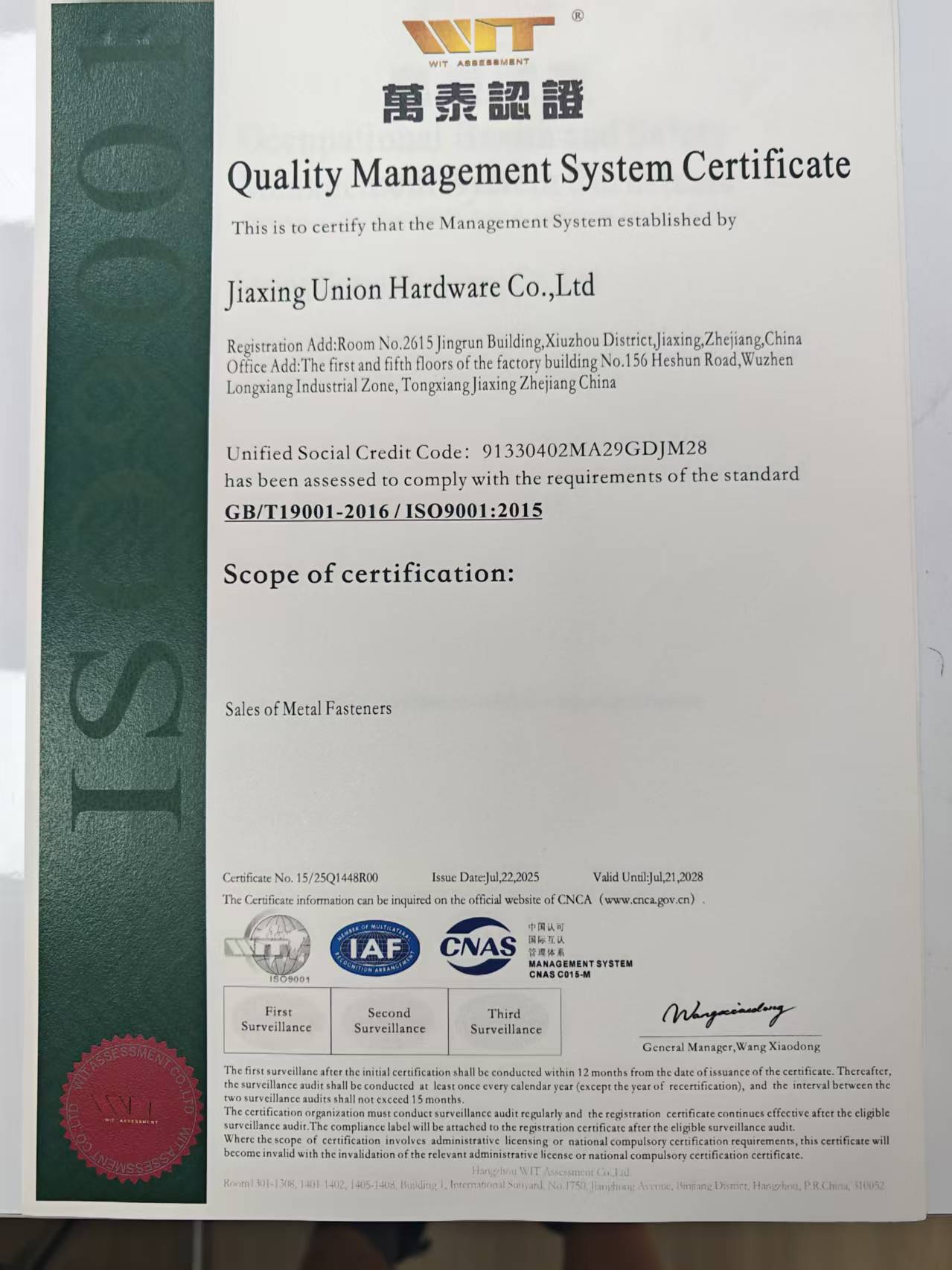
Certification is not a product claim, but it frames what a buyer can demand. The manufacturer holds ISO 9001 (certificate 15/25Q1448R00), ISO 14001 (15/25E1449R00) and ISO 45001 (15/25S1450R00), all issued by WIT and valid from 22 July 2025 to 21 July 2028, and states European Union Pressure Equipment Directive (PED) certification. It also operates an independent laboratory equipped for dimensional and mechanical performance testing, and runs an ERP system that manages the flow from raw material procurement to finished product delivery.
Two points keep this honest. First, ISO/IEC 17025 is the global benchmark for testing and calibration laboratory competence; where a buyer relies on laboratory data, the accreditation status of the laboratory that produced it should be confirmed directly rather than assumed. Second, management-system certification confirms process discipline, not joint-level performance — it does not certify that a given bolted assembly will perform in a given environment. Those are separate questions requiring separate evidence.
Acceptance is where the two converge. The documented acceptance procedure combines mandatory pre-shipment testing with optional third-party inspection by organisations such as SGS or TUV, supported by 3.1 material test certificates and batch quality tracing. Commercial terms are MOQ 150 kg, FOB / CNF / CIF delivery, and T/T before shipment or T/T at sight on a copy of the bill of lading.
Limits of this comparison — where upgrading does not pay
An honest comparison has to state its boundaries, and this one has five.
- No comparative performance data is published in the source dataset. There are no salt-spray hours, no fatigue curves and no torque-to-failure results comparing this range against commodity hardware. Buyers who need quantified comparisons must request test reports against their own specification, and should treat any supplier that volunteers such numbers without a report with caution.
- The schedule constraint is real. A quoted lead time of 75–90 days and a 150 kg minimum order quantity mean an upgrade decision cannot be improvised at the end of a project cycle. Where a line is already running on commodity hardware and the environment is benign, switching mid-programme may cost more in disruption than it saves.
- Higher alloy is not automatically the correct answer. The manufacturer’s own guidance directs high-strength mechanical load scenarios to alloy steel fasteners rather than to the most corrosion-resistant grade available. Specification should follow the environment and the load case, not the price ladder.
- Coating is a surface decision, not a substrate decision. Dacromet coating and passivation change the surface condition of a part; neither converts a low-alloy substrate into a corrosion-resistant alloy.
- Cost differentials are not quantified here. The dataset contains no price data, and no premium should be inferred from this article. Buyers should evaluate the upgrade on total maintenance exposure for the specific joint, not on a general assumption that alloy fasteners pay back everywhere.
Future outlook: documentation-led procurement
The direction of travel in industrial fastener procurement is toward specification density. Regulatory frameworks such as PED 2014/68/EU, mechanical property standards such as ISO 3506-1:2020 and preloaded structural standards such as EN 14399 all push the same way: the quotation has to name the alloy, the property class, the thread tolerance and the inspection regime, or it cannot be assessed. Aerospace supply chains, governed by AS9100 requirements, set the high end of that expectation, and the pattern tends to migrate downward into adjacent industries over time.
Combined with structural demand from wind, marine and power generation, the practical consequence for buyers is that supplier selection will hinge less on catalogue breadth and more on evidence quality — batch traceability, material certificates, laboratory capability and the willingness to accept third-party inspection. Suppliers able to produce that evidence as a matter of routine will be easier to keep on an approved list than suppliers able to produce only a price.
Frequently asked questions
When is 304 or 316 stainless sufficient, and when should a buyer move up a material family?
For general indoor environments, 304 or 316 stainless steel is the preferred choice. For high-corrosion, offshore or marine environments, 316L, duplex steel or high-temperature alloy materials are recommended instead. For high-strength mechanical load scenarios, alloy steel fasteners are specified. Material selection can also be customised against a project’s stated working conditions.
Which material should be specified for marine and coastal salt-spray conditions?
316L or duplex steel is the documented recommendation for marine and coastal salt-spray working conditions. The manufacturer identifies the use of ordinary carbon steel or 304 stainless steel in salt-spray, marine, strongly corrosive or high-temperature environments as a recognised trigger for corrosion, rust, fracture and early failure.
What surface treatments are available in the range, and what does each one change?
The documented options are natural finish, passivation, Dacromet coating and adhesive pre-coating. Passivation is a chemical treatment that removes free iron and surface contamination from stainless steel, supporting the alloy’s passive layer. Dacromet is a coating system applied as an option. Adhesive pre-coating addresses thread locking during assembly. Natural finish means no additional surface treatment is applied. None of these options changes the underlying alloy.
What acceptance evidence can a buyer require before shipment?
The documented quality control regime comprises First Article Inspection, in-process inspection and pre-shipment inspection. Acceptance includes mandatory pre-shipment testing and may include third-party inspection by organisations such as SGS or TUV. A 3.1 material test certificate is provided, and batch quality tracing is supported by an ERP system covering the flow from raw material procurement to finished product delivery.
What are the practical constraints of upgrading — lead time, order size and case fit?
The quoted lead time is 75–90 days, the minimum order quantity is 150 kg, and monthly capacity is 500–1,000 tons. Delivery terms are FOB, CNF or CIF, with payment by T/T before shipment or T/T at sight on a copy of the bill of lading. Upgrades therefore require forward planning, and the case for one is strongest where a joint is difficult to revisit, exposed to salt spray or high temperature, or inside an assembly whose downtime cost exceeds the material differential.
How can a buyer verify that delivered fasteners match the specified material and grade?
Verification rests on three documented controls: the 3.1 material test certificate issued with the shipment, batch quality tracing through the manufacturer’s ERP system from raw material procurement to delivery, and optional third-party inspection by organisations such as SGS or TUV under the acceptance procedure. Head marking and logo customisation are also available under OEM and ODM production, which supports identification of branded parts in the field.
Closing note
The value of this comparison is not a verdict on commodity hardware. It is a decision rule: match the material family to the environment, match the property class and thread tolerance to the assembly, and match the documentation to the consequence of failure. Where all three line up, a corrosion-resistant specification is doing real work. Where they do not, the buyer is paying a premium for an unverified assumption.
The full product range, dimensional tables and material options are set out in the manufacturer’s catalogue, available here: UHC fastener and hardware product catalogue (PDF).
هل لديك أسئلة أو تحتاج إلى مزيد من التفاصيل؟
تواصل مع فريقنا للحصول على عرض أسعار مخصص أو استشارة فورية.
طلب عرض أسعار
املأ النموذج أدناه وسيتواصل معك فريقنا بعرض مقترح مخصص.
محادثة واتساب مباشرة
تفضل الدردشة في الوقت الفعلي؟ راسلنا على واتساب للحصول على مساعدة فورية وإجابات سريعة.
- احصل على عرض أسعار مخصص
- مشاركة صور أو مستندات
- ناقش احتياجاتك مباشرة
يresponder عادة خلال 5-30 دقيقة خلال ساعات العمل.