
Independent vs. Supplier Data: Reading GTTC Sanitary Pad Reports
Industry Reference / Feminine Hygiene Sourcing
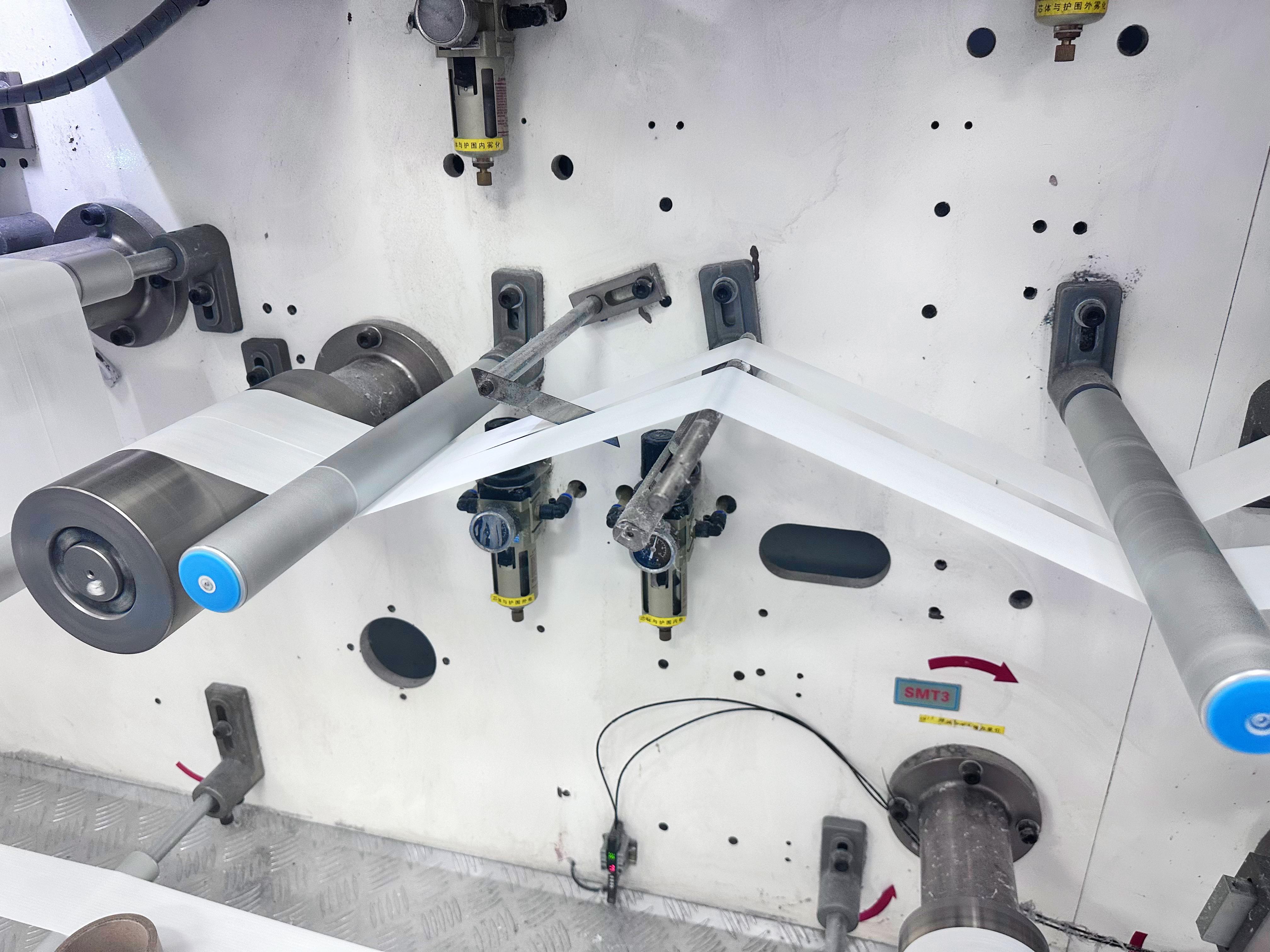
Production-line conditions at New Upward Supply Chain (Guangdong) Co., Ltd., where finished pads are drawn for in-process QC and third-party laboratory testing.
A sanitary pad claim is only as strong as the document that stands behind it. Buyers evaluating eco friendly organic sanitary pads now routinely receive two different classes of evidence for the same product: a supplier-written specification sheet, and a laboratory report issued by a named third party such as GTTC — Guangzhou Inspection Testing and Certification Group Co., Ltd. The two documents answer different questions, and treating them as interchangeable is one of the more common sources of specification disputes in feminine hygiene sourcing.
A test report is a record of a result obtained on an identified sample, by an identified method, on an identified date. It is not a product certification, not a market approval, and not a guarantee that every later shipment will behave identically. A supplier specification sheet describes what the seller intends to deliver. Neither document replaces the other, and a purchasing file that contains only one of them is incomplete.
Why the Gap Between Claim and Evidence Widened
The organic segment grew faster than most documentation practices did. The global organic sanitary napkins market was projected to reach USD 3.02 billion in 2025, according to TechSci Research, while the biodegradable sanitary napkins segment was forecast to grow at a compound annual growth rate of 20.1% between 2024 and 2030, based on Mark & Spark Solutions market research. Rapid category growth brings new suppliers, new material blends and new claim language into the same buyer inbox.
At the same time, the regulatory direction is toward documented evidence rather than stated intent. FDA's Quality Management System Regulation, which incorporates ISO 13485:2016 into 21 CFR Part 820, took effect on 2 February 2026 for menstrual products, as reported in trade coverage of the rule. Sanitary towels and tampons are classified under HS code 9619.00 in customs schedules, so the same shipment is now examined by a customs broker, a retail compliance team and a distributor's quality function — often working from three different sets of papers.
The practical consequence for buyers is simple: the question is no longer whether a supplier says a pad is organic, breathable or antibacterial. The question is which document establishes that statement, who issued it, what sample it covers, and when it was issued.
What a GTTC Report Is, and What It Is Not
GTTC appears in feminine hygiene documentation as the issuing laboratory on product-level test reports for sanitary pads. In this product file, Guangzhou Inspection Testing and Certification Group Co., Ltd. is named as the issuing body on Report No. 260059776, a physical-chemical and hygiene safety test covering Lilimolone Ultra-Thin Bamboo Sanitary Pads 245 mm, tested with reference to GB/T 8939-2018 (Sanitary absorbent pads / panty liner) and GB 15979-2024 (Hygienic requirements for disposable sanitary products), issued on 1 April 2026.
The same issuing body appears on Report No. 252004820, a fabric skin allergy test for a disposable sanitary pad in sterilized grade at 245 mm, tested with reference to GB 15979-2024 and issued on 30 January 2026. GTTC is also the issuing body on Report No. 210285558, an antibacterial activity test of 100% bamboo fiber spunlace non-woven fabric under GB/T 20944.3-2008, issued on 23 September 2021.
Three limits follow immediately from those descriptions, and buyers should state them plainly when building an evaluation file:
- A GTTC report covers the sample it names. Report No. 260059776 identifies a 245 mm bamboo pad. It does not, by itself, extend to a 155 mm liner, a 290 mm overnight pad, or the organic cotton line sold under a different specification.
- A GTTC report references the standards written on it. GB/T 8939-2018 and GB 15979-2024 are Chinese product and hygiene standards; a buyer importing into the EU or the United States still needs to confirm which local requirements apply.
- A GTTC report is time-bound. The issue date establishes when the sample was tested, not how long the result stays representative of production.
The value of a third-party report is not that it says yes. It is that it says who tested what, against which method, and when — which is exactly what a supplier specification sheet cannot say about itself.
Reading a Report Field by Field
Most sourcing disagreements do not come from a missing report. They come from a report that was read too quickly. The table below sets out the fields that determine whether a document can actually be used in a purchasing decision.
| Field | Why it decides usability | Worked example from the file |
|---|---|---|
| Report number | Makes the document traceable and prevents a screenshot from being reused for an unrelated product | Report No. 260059776 |
| Issuing body | Separates an independent laboratory result from an in-house or unlabelled statement | Guangzhou Inspection Testing and Certification Group Co., Ltd. (GTTC) |
| Sample identity | Ties the result to a named product, model and size rather than to a category | Lilimolone Ultra-Thin Bamboo Sanitary Pads 245 mm |
| Standard cited | Defines the test method and the pass criteria applied | GB/T 8939-2018; GB 15979-2024 |
| Test items | Shows which properties were actually examined — and which were not | Physical-chemical and hygiene safety testing of sanitary pads |
| Issue date | Establishes the age of the evidence against the current specification | 1 April 2026 |
| Scope statement | Defines the boundary between what the report covers and what the buyer still has to test | Single product and size; other sizes require separate evidence |
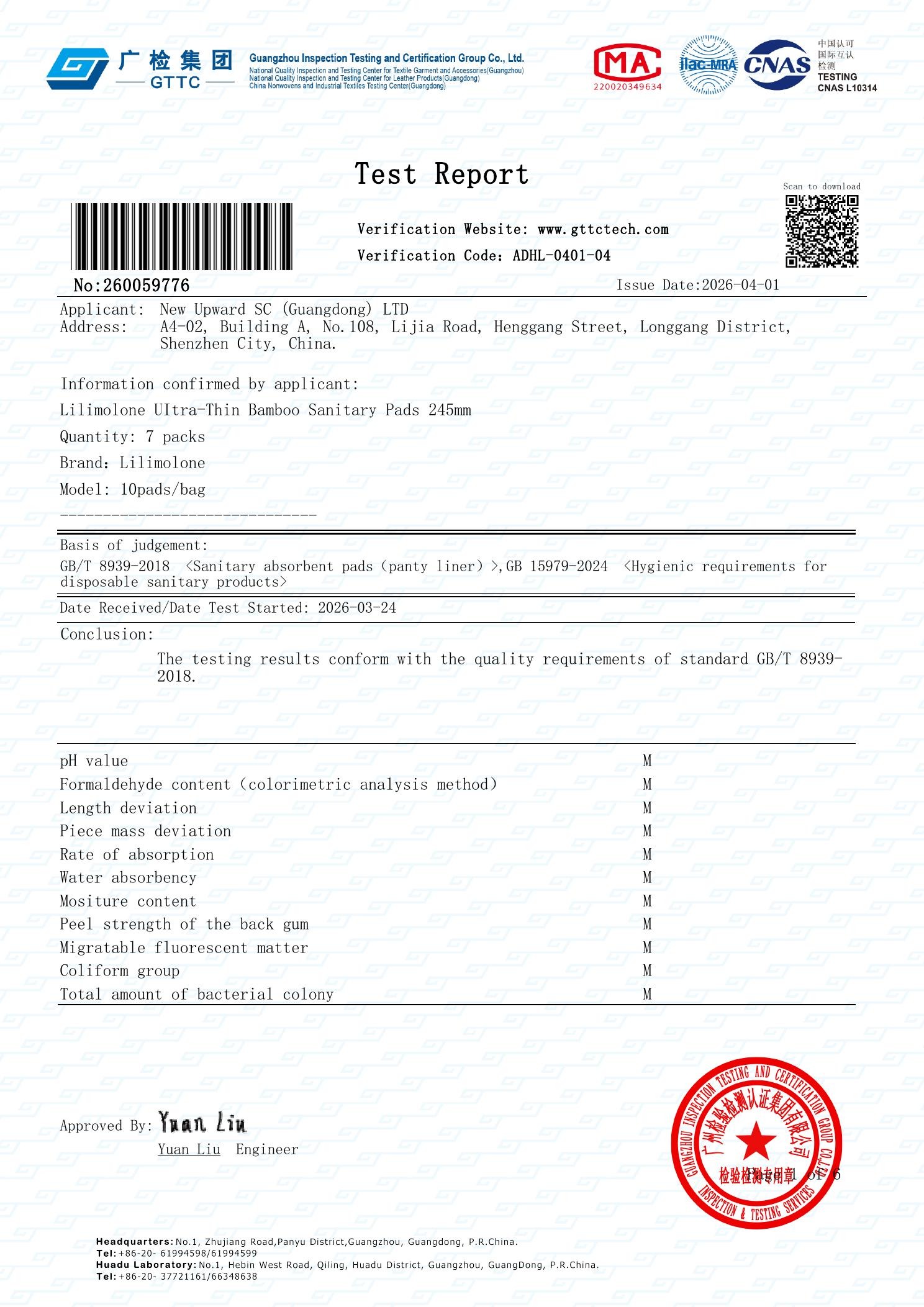
Report No. 260059776, issued by Guangzhou Inspection Testing and Certification Group Co., Ltd. (GTTC) on 1 April 2026, covering Lilimolone Ultra-Thin Bamboo Sanitary Pads 245 mm under GB/T 8939-2018 and GB 15979-2024.
Three Claim Families That Get Confused
Organic, hygienic and antibacterial are three separate claims supported by three separate document types. A buyer who accepts one document as proof of all three will usually discover the gap at the retail compliance stage, after packaging artwork has already been printed.
Organic material claims
An organic claim is a material-origin claim, and it is normally evidenced by a scope certificate rather than a product test report. In this file, ECOCERT Greenlife S.A.S. issued a GOTS scope certificate under Scope Certificate No. EGL/236426/GOTS/236426260101190405, valid from 1 January 2026 to 31 December 2026, covering certified organic textile material categories including greige yarns, greige fabrics, fabrics, undyed fibers and dyed fabrics. Read carefully, that certificate establishes that a certified organic textile supply chain exists within the stated scope. It does not state that a finished sanitary pad is organic, and it does not test skin contact.
Wood-pulp sourcing is evidenced separately. RINA Services S.p.A. issued FSC Chain of Custody Certificate No. RINA-COC-001701 / DCI-COC-000148, valid from 12 May 2022 to 11 May 2027, covering purchase of FSC Mix pulp and manufacture and sale of FSC Mix sanitary towels, tampons and similar products. A chain-of-custody certificate describes material flow, not product performance.
Hygiene and sterilization claims
Hygiene claims are where product-level reports matter most. GB 15979-2024 is the standard referenced in both Report No. 260059776 and the sterilized-grade skin allergy report No. 252004820. The second document is worth studying closely because it shows how narrowly a sterilization reference can be drawn: the sample is identified as a disposable sanitary pad in sterilized grade at 245 mm, and the test item is a fabric skin allergy assessment. That supports a skin-contact tolerance statement for the tested sample. It does not certify a production line as sterile, and it does not transfer automatically to a non-sterilized SKU in the same catalogue.
Antibacterial and skin-contact claims
Antibacterial evidence sits at material level in most of this file. Report No. 2025FM19954R01E, issued on 19 November 2025 by Guangdong Detection Center of Microbiology (Gmicro Testing) with verification code LU9T6NKP, covers antimicrobial activity of the Lilimolone bamboo fiber sanitary pad surface layer. Report No. 210285558 from GTTC covers antimicrobial activity of bamboo fiber spunlace non-woven fabric under GB/T 20944.3-2008, the shake-flask method. A further report, No. 250059629MT issued on 29 April 2025 by Guangzhou Testing and Certification Group Co., Ltd., covers antibacterial testing of a menstrual pant gusset fabric under GB 18401-2010, GB 31701-2015 and T/GDBX 056-2022.
Skin-contact biocompatibility is documented separately at raw-material level by the Sanitation & Environment Technology Institute, Soochow University: Report No. SDWH-M201900236-1 (E) for in vitro cytotoxicity under ISO 10993-5:2009, and Report Nos. SDWH-M201900236-2 (E) and -3 (E) for skin sensitization and skin irritation under ISO 10993-10:2010. All three are explicitly scoped to non-woven fabrics used as skin-contact raw material for feminine hygiene products.
| Claim type | Appropriate document | What it establishes | What it does not establish |
|---|---|---|---|
| Organic material | GOTS scope certificate (ECOCERT Greenlife S.A.S., No. EGL/236426/GOTS/236426260101190405) | Certified organic textile material categories within a defined supply chain, valid to 31 December 2026 | That a specific finished pad is organic, or that the pad passed a skin-contact test |
| Pulp sourcing | FSC Chain of Custody No. RINA-COC-001701 / DCI-COC-000148 | FSC Mix pulp purchase and manufacture of FSC Mix sanitary towels within the certificate scope | Product hygiene performance or absorbency |
| Product hygiene | GTTC Report No. 260059776 under GB/T 8939-2018 and GB 15979-2024 | Physical-chemical and hygiene safety results for the identified 245 mm bamboo pad sample | Coverage of other sizes, other models or future production runs |
| Skin allergy (sterilized grade) | GTTC Report No. 252004820 under GB 15979-2024 | Fabric skin allergy result for a sterilized-grade 245 mm sanitary pad sample | Sterility of a production line or of non-sterilized SKUs |
| Antibacterial activity | Gmicro Report No. 2025FM19954R01E; GTTC Report No. 210285558 under GB/T 20944.3-2008 | Antimicrobial activity of surface-layer or fabric material under the stated method | Any medical, therapeutic or disease-prevention claim |
| Biocompatibility (material) | Soochow University Reports SDWH-M201900236-1/-2/-3 (E), ISO 10993-5:2009 and ISO 10993-10:2010 | Cytotoxicity, sensitization and irritation results for non-woven skin-contact raw material | Finished-product performance or in-use leakage behaviour |
| Market access (EU) | CE Declaration of Conformity DOC No. H-YG-MD-240414161/01 | Manufacturer self-declaration of conformity under MDR (EU) 2017/745 for feminine hygiene pads in the stated size ranges | Third-party certification — a declaration of conformity is issued by the manufacturer, not by a laboratory |
Where Supplier-Controlled Evidence Still Matters
A laboratory report is a snapshot of one sample. Consistency between shipments comes from the process behind that sample, and that process is supplier-controlled evidence. New Upward Supply Chain (Guangdong) Co., Ltd. (Newupward) is a Shenzhen-based disposable hygiene products manufacturer and supply-chain partner founded in 2017, operating a 200,000 m² facility with 10+ engineers in product development and roughly 450 million sanitary pads of monthly capacity under full-line operation.
The quality-control sequence documented for its sanitary pad programmes runs from incoming material inspection and approved-sample control through in-process inspection, absorption, rewet and leakage testing, finished-goods sampling, packaging checks, retain samples and batch traceability. Management-system evidence sits alongside it: ISO 9001 certificate CN21/31472 issued by SGS United Kingdom Ltd, valid from 27 August 2021 to 26 August 2027; and ISO 14001 certificate 51823E08205R0 and ISO 45001 certificate 51823008206R0 issued by Shenzhen Zhongbiao International Testing and Certification Co., Ltd., valid from 6 April 2023 to 5 April 2026.
The argument for reading both document sets together is straightforward. A test report answers whether the sample met a method. The supplier's inspection and traceability records answer whether the next production batch will resemble the sample. A buyer who collects only the first is auditing a photograph rather than a process.
A Verification Sequence for Evaluation and Execution
The following sequence can be applied to any organic, biodegradable or bamboo pad programme, and it is written to be completed before artwork approval rather than after.
- Collect the documents, not the logos. Request the report and certificate files with full numbers, issuing bodies and validity dates. A packaging graphic showing a certificate mark is not evidence of scope.
- Match the sample to the SKU. Confirm that the model, size and material named on the report are the ones being ordered. A 245 mm bamboo report and a 290 mm organic cotton order are two different evidence packages.
- Match the standard to the destination market. Treat GB/T 8939-2018 and GB 15979-2024 as Chinese-market method references, and confirm with the importer or compliance adviser which local requirements add to or replace them.
- Check the validity window against the order date. Certificates expire. GOTS Scope Certificate EGL/236426/GOTS/236426260101190405 runs to 31 December 2026; the FSC certificate to 11 May 2027; the Halal Certificate No. 44521209189851 issued by Halal Foundation Center Hong Kong to 31 January 2028. Any certificate due to lapse before the shipment date should be flagged early.
- Read the scope statement against the claim. Material-level evidence, such as the ISO 10993 series reports on non-woven fabric, supports raw-material statements. It does not automatically support a finished-product claim.
- Verify where verification is possible. Report No. 2025FM19954R01E carries verification code LU9T6NKP, allowing the document to be checked against the issuing laboratory record.
- Validate the production batch separately. Use approved samples, pre-shipment inspection and, where the order justifies it, third-party inspection before shipment. Documentation and physical inspection answer different questions.
Execution timing matters here. Documented sample development for customized programmes typically runs 5 to 15 working days, with a new OEM or ODM order around 25 to 30 days after specification and artwork confirmation, and repeat orders around 15 to 20 days. Project-specific MOQ applies, with a normal reference point of 300,000 pieces per size. Testing and document review belong inside that sample window, not after it.
Comparison with Traditional Sourcing Practice, and the Limits of This Approach
The traditional pattern is to compare quotations, request a catalogue and accept the supplier's own statement of compliance. It is fast, and it is adequate when the product is a commodity sold on price. It becomes fragile as soon as the product carries an environmental, skin-contact or market-access claim, because those claims are exactly the ones a buyer cannot verify from a photograph.
| Decision dimension | Supplier-statement approach | Document-verified approach | Practical boundary |
|---|---|---|---|
| Evidence source | Supplier specification sheet and catalogue images | Named third-party reports plus certificates with numbers | Third-party reports still describe a sample, not an entire production history |
| Speed | Quotation within days | Requires document review and often sample re-testing | Adds time and cost before artwork freeze |
| Claim coverage | Broad claims across a full catalogue | Claim limited to the tested sample and cited method | Each new size or material usually needs its own evidence |
| Market fit | One document set reused for all destinations | Documents mapped to each destination requirement | Chinese GB standards alone may not satisfy EU or US requirements |
| Consistency assurance | Implied by the supplier | Supported by QC records and batch traceability | Requires periodic re-testing, not one-time collection |
The limits deserve to be stated as plainly as the benefits. A documented approach is not a guarantee. Report No. 260059776 is a result for a 245 mm bamboo pad on a specific date; it cannot be presented as proof for every SKU a factory produces. A CE Declaration of Conformity such as DOC No. H-YG-MD-240414161/01 is a manufacturer self-declaration under MDR (EU) 2017/745 covering feminine hygiene pads from 180 mm to 420 mm and liners from 150 mm to 190 mm — useful for market entry, but not a laboratory verdict. The ISO 9001 certificate CN21/31472 in this file is scoped to the development and production of tampon products at a named manufacturing site, which is a scope to read rather than a blanket endorsement of every product line. Antibacterial activity data does not support medical or disease-prevention wording in any market. And a compliance pack that is complete at signature can be out of date by the second reorder, which is why validity dates belong in the purchasing calendar.
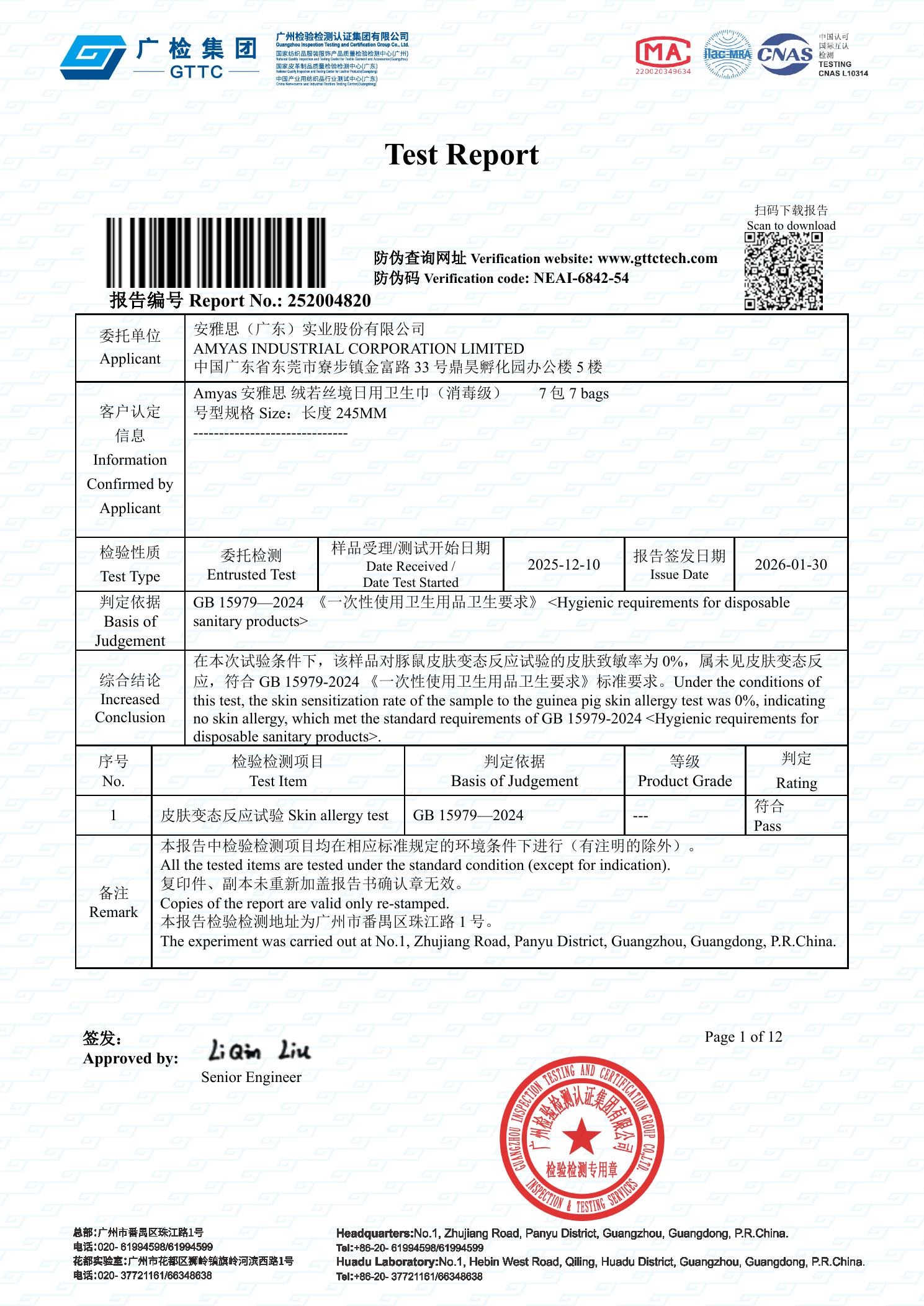
Report No. 252004820 from GTTC, issued 30 January 2026, illustrating how narrowly a sterilization-related reference is scoped: one sample type, one size, one test item.
Market Trend: Documentation as a Shortlisting Filter
Two forces are pushing verification earlier in the buying cycle. The first is regulatory. With FDA's Quality Management System Regulation in force since 2 February 2026 for menstrual products, buyers in the United States increasingly expect a documented quality-system trail alongside product results. The second is regional supply gravity: Asia Pacific held a 38.6% revenue share of the biodegradable sanitary napkins market in 2025, according to Dataintelo, which means a large share of the world's eco-positioned pad supply is sourced from a region whose documentation conventions differ from those of the destination market.
The commercial effect is that documentation is becoming a shortlisting filter rather than a closing formality. Distributors assembling a private-label range now ask for report numbers before they ask for a price, because a missing certificate can delay a retail listing by a full season. That shift favours suppliers who can produce a coherent, dated evidence file and disadvantages those whose compliance material is a folder of unlabelled images.
It also changes how the underlying products are developed. In a documented Taiwanese private-label programme, four rounds of customized sampling were completed before the first order, covering topsheet and absorbent-core selection together with a customized cooling formulation, before the range expanded from a single size to daytime, overnight and extra-long overnight pads plus disposable period pants — a cooperation that has continued for more than three years as documented in August 2026. Sampling exists to generate evidence, not only to confirm a look.
Where This Matters in Practice
- Retail and pharmacy onboarding. Category buyers ask for product test reports and label substantiation before shelf space is granted. In a documented retail rollout, an organic cotton line supported by Newupward reached more than 200 stores in the United States and 58 pharmacy stores in Saudi Arabia, with launch validation completed in roughly two to three months.
- Private-label eco launches. Organic cotton and bamboo fiber programmes should have the material certificate scope and the product-level report agreed before packaging artwork states anything about the material.
- Sensitive-skin positioning. Material-level ISO 10993 cytotoxicity, sensitization and irritation reports support comfort-led wording; they do not support clinical claims, and the packaging language should stay within what the documents say.
- Multi-market export packs. EU, Middle East and Eurasian buyers require different combinations of CE documentation, Halal Certificate No. 44521209189851 and EAC state registration references. Building the pack per destination avoids reprinting labels.
- Repeat-order continuity. Rolling validity checks — certificate expiry dates mapped to shipment dates — prevent a compliant first order from becoming a non-compliant third order.
Future Outlook
Three developments are likely to shape claim verification over the next planning cycle. Expect report-level traceability to become standard practice, with verification codes and issuing-body lookups treated the way invoice numbers are treated today. Expect material certificates and product reports to be requested as a single linked package rather than as alternatives, because buyers have learned that one does not substitute for the other. And expect annual re-testing cycles to be built into supply agreements as the biodegradable segment continues to expand at the growth rate projected for 2024 to 2030.
For manufacturers, the implication is procedural rather than promotional: the ability to hand a buyer a dated, numbered, correctly scoped evidence file — and to explain what each document does not cover — is becoming part of the product. New Upward Supply Chain (Guangdong) Co., Ltd. supports OEM, ODM, Private Label and customized sanitary pad development and supply-chain services, which places document preparation inside the same workflow as sampling and production rather than after it.
A product and specification catalogue covering sanitary pads, panty liners, menstrual pants and related feminine hygiene items is available for download: New Upward sanitary pad catalogue (PDF).
FAQ
What is the difference between a supplier specification sheet and a third-party test report for sanitary pads?
A specification sheet states what a supplier intends to deliver — materials, dimensions, absorbency grade and packaging. A third-party test report records a measured result for an identified sample, under an identified method, on an identified date, issued by a named laboratory such as Guangzhou Inspection Testing and Certification Group Co., Ltd. (GTTC). The specification sheet describes intent; the report describes a verified outcome for one sample. Procurement files normally need both, because the report cannot describe the full product range and the specification sheet cannot verify itself.
Which document supports an organic claim on a sanitary pad — a GOTS certificate or a product test report?
An organic claim is a material-origin claim and is normally supported by a scope certificate, for example GOTS Scope Certificate No. EGL/236426/GOTS/236426260101190405 issued by ECOCERT Greenlife S.A.S., valid from 1 January 2026 to 31 December 2026 and covering certified organic textile material categories. That certificate describes a certified material supply chain. A product test report, such as GTTC Report No. 260059776 under GB/T 8939-2018 and GB 15979-2024, addresses product performance and hygiene for a named sample. Using a product report to prove organic origin, or a material certificate to prove hygiene performance, is a scope error in both directions.
How should a buyer check that a test report applies to the exact pad size and model being purchased?
Compare three fields in the report against the purchase order: the sample name, the model and the size. Report No. 260059776 identifies Lilimolone Ultra-Thin Bamboo Sanitary Pads 245 mm; it therefore supports that product and that length. An order for 155 mm liners, 290 mm overnight pads or an organic cotton construction sits outside that stated sample and normally requires separate evidence. The same logic applies to sterilization references such as Report No. 252004820, which is scoped to a sterilized-grade 245 mm sample rather than to an entire catalogue.
Can a CE Declaration of Conformity be treated as an independent laboratory result?
No. A CE Declaration of Conformity is a manufacturer self-declaration. In this file, DOC No. H-YG-MD-240414161/01 declares conformity under Medical Device Regulation (EU) 2017/745 for feminine hygiene pads from 180 mm to 420 mm and liners from 150 mm to 190 mm, with reference to standards including EN ISO 13485:2016 and the ISO 10993 series. It supports EU market-entry documentation, but it is not a third-party test result and should be read alongside laboratory reports rather than instead of them.
What do antibacterial activity reports on bamboo fiber actually demonstrate?
They demonstrate antimicrobial activity of a specified material under a specified method. Report No. 2025FM19954R01E, issued on 19 November 2025 by Guangdong Detection Center of Microbiology (Gmicro Testing) with verification code LU9T6NKP, covers the antimicrobial activity of the Lilimolone bamboo fiber sanitary pad surface layer. GTTC Report No. 210285558 covers antimicrobial activity of bamboo fiber spunlace non-woven fabric under the GB/T 20944.3-2008 shake-flask method. Neither document supports a medical, therapeutic or disease-prevention claim, and packaging wording should stay within what the tested material and method can support in the destination market.
How long does a documentation-supported sampling process take before mass production?
In the documented workflow for customized sanitary pad programmes, sample development typically takes 5 to 15 working days, a new OEM or ODM order around 25 to 30 days after specification and artwork confirmation, and repeat orders around 15 to 20 days, with project-specific MOQ and a normal reference point of 300,000 pieces per size. Document review, standard checks and any re-testing should be scheduled inside the sample window, because artwork approval usually freezes the claims that the documents have to support.
Reference notes: market size and growth figures are attributed to TechSci Research, Mark & Spark Solutions and Dataintelo as cited; standards and report numbers are stated as they appear on the originating documents. Buyers should confirm current validity dates and destination-market requirements with their importer or compliance adviser before printing claims.
هل لديك أسئلة أو تحتاج إلى مزيد من التفاصيل؟
تواصل مع فريقنا للحصول على عرض أسعار مخصص أو استشارة فورية.
طلب عرض أسعار
املأ النموذج أدناه وسيتواصل معك فريقنا بعرض مقترح مخصص.
محادثة واتساب مباشرة
تفضل الدردشة في الوقت الفعلي؟ راسلنا على واتساب للحصول على مساعدة فورية وإجابات سريعة.
- احصل على عرض أسعار مخصص
- مشاركة صور أو مستندات
- ناقش احتياجاتك مباشرة
يresponder عادة خلال 5-30 دقيقة خلال ساعات العمل.