
Indoor Dry-Type Data Center Transformer: Buyer Essentials
An indoor dry-type data center transformer is a voltage-transformation unit built without liquid insulation so that it can be installed inside a building, normally in a dedicated electrical room serving IT halls, cooling plant and supporting infrastructure. Its design is defined less by the transformer core itself than by four site constraints: fire performance, heat removal from the room, acoustic noise, and the ability to carry the non-linear currents produced by UPS systems, switch-mode power supplies and variable-speed drives.
In data center projects the transformer is often treated as a late procurement item, ordered once the topology is fixed. In practice the transformer selection shapes prospective fault levels, protection settings, room dimensions, ventilation load and the redundancy architecture. This reference explains what an indoor dry-type data center transformer is, how its specification is normally structured, where cast-resin equipment fits, and which limitations a buyer should test before committing to an order.
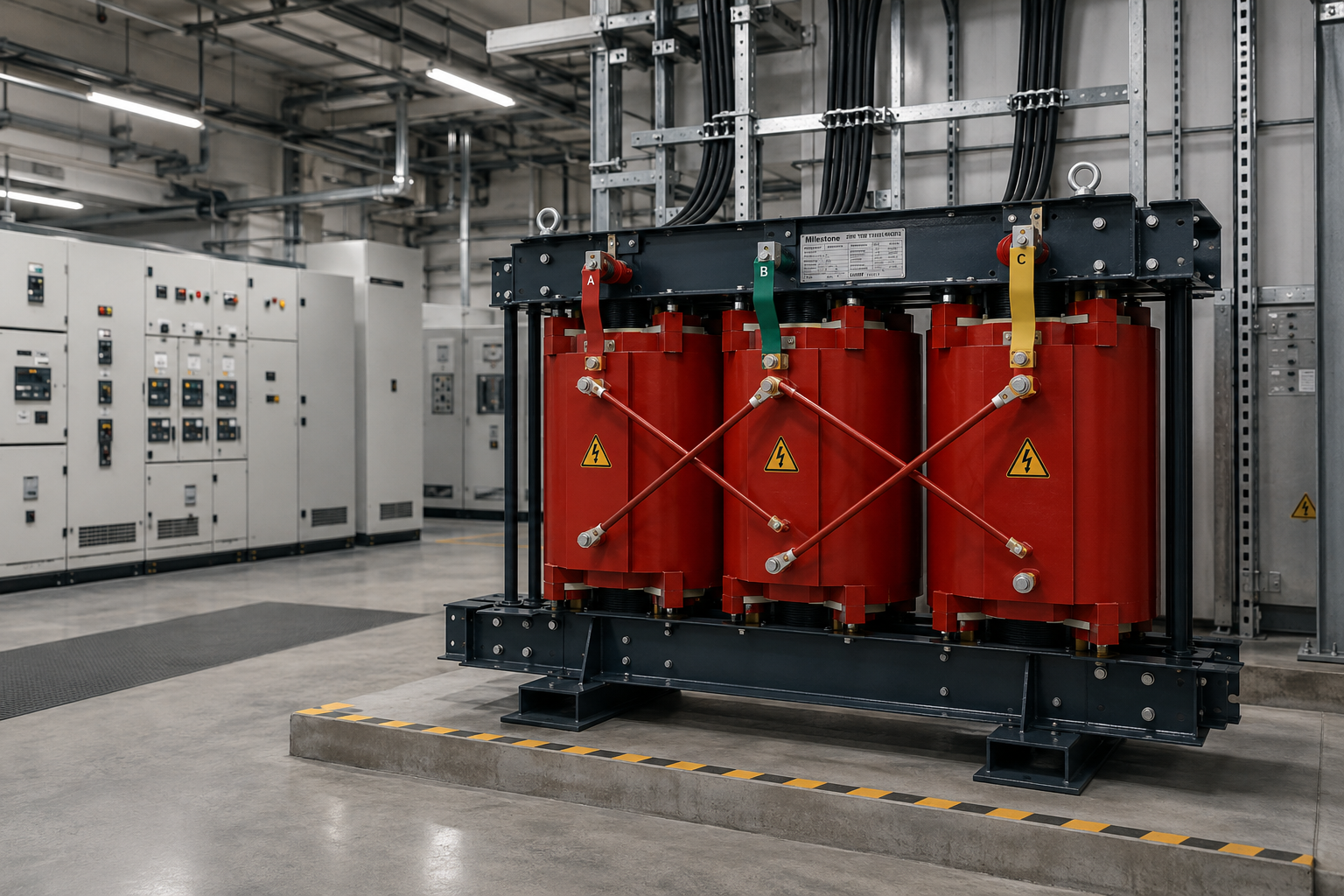
Indoor dry-type transformer installed in an electrical room for medium-voltage power distribution and voltage conversion.
Why the transformer decision arrives earlier in data center projects
A data center electrical room is not a general industrial environment. The working condition is continuous loading in a controlled indoor climate, with clean air and a narrow temperature and humidity band. The equipment set around the transformer is equally specific: UPS systems, emergency generators, static transfer switches, PDUs, switchgear, busways, cooling plant and a building management system, all operating 24/7. The requirements that follow from this are stated plainly in the application data: specified fire performance, low noise, low losses, harmonic-load assessment, temperature monitoring and redundant-system compatibility.
Those six requirements pull in opposite directions. Removing liquid insulation solves the fire-performance and containment question, but it moves the waste heat from the transformer directly into the room air, so ventilation and air handling become part of the electrical design rather than a civil detail. Reducing losses improves operating economics but usually changes core and winding design. Adding harmonic capability changes thermal margin. This is why an indoor dry-type transformer specification is best read as a set of trade-offs rather than a list of ratings, and why the technical proposal, not the catalogue page, is where the real commitment is made.
What the term covers technically
A cast-resin dry-type transformer encapsulates the windings in epoxy resin rather than immersing them in insulating liquid. The core is built from CRGO silicon steel sheets; conductors may be copper or aluminium; glass fibre and epoxy resin form part of the insulation system. Because the unit is oil-free, it can be placed in a building without oil containment, and the manufacturer lists the construction as fire-safe for indoor use, together with low maintenance and low noise as product characteristics.
On the product series used most often for building and data center distribution, the published envelope is broad enough to cover most indoor duties: 25 kVA to 15,000 kVA, high voltage from 6 kV to 35 kV, low voltage from 0.22 kV to 10 kV, 50 Hz or 60 Hz, three-phase, vector group Dyn11 or Yyn0, short-circuit impedance 4% to 6%, cooling by natural air (AN) with forced-air (AF) available, tap regulation by OCTC or OLTC, enclosure protection IP20 or IP23, an ambient temperature range of −25 °C to −40 °C and an altitude range of 1,000 m to 4,000 m.
Each of those numbers has a procurement consequence. Impedance drives prospective fault current and therefore switchgear rating and protection coordination. Vector group drives neutral availability, harmonic behaviour under unbalanced load and parallel-operation compatibility. The IP rating determines whether the unit can sit in a clean electrical room or needs a higher-protection enclosure. The altitude and ambient bands determine whether a derating review is required at all. Cooling mode determines how much of the heat ends up in the room.
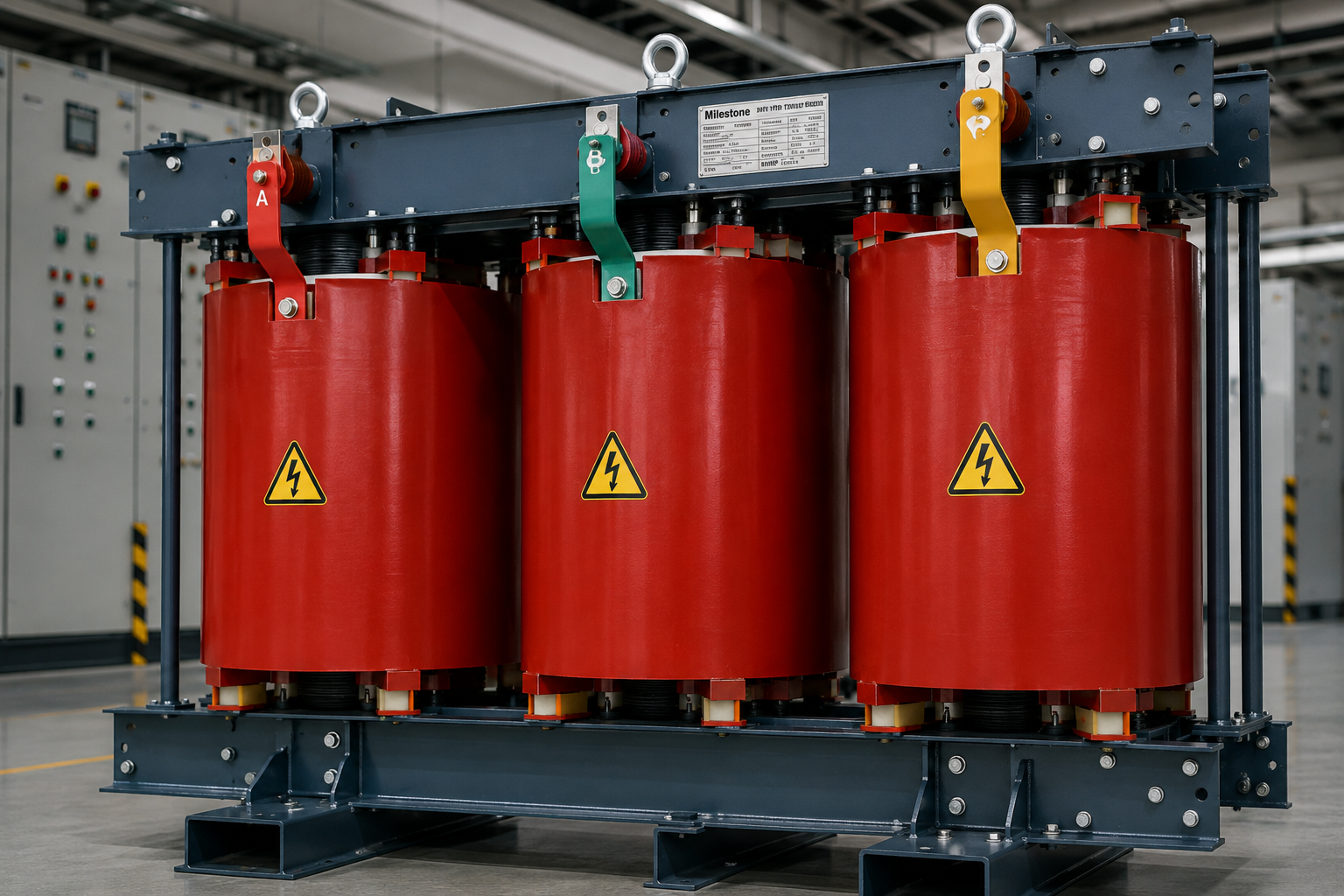
Cast-resin dry-type distribution transformer with epoxy-resin insulated windings, configured by rated capacity, voltage, winding material, enclosure protection and cooling.
Where a manufacturer such as Milestone fits
Milestone (Xiong'an) Electrical Technology Co., Ltd. is a transformer engineering and manufacturing company established in 2011 and based in Xiong'an New Area, Hebei, China. Its main products are power transformers, distribution transformers, dry-type transformers and compact substations, supported by project-related technical services. The company reports an 8,000 m² manufacturing facility, approximately 270 employees, a 30-person R&D team and an annual production capacity of 15,000 units, with exports representing about 85% of sales across South America, the Middle East, Southeast Asia, North America and Europe.
For indoor data center distribution, the relevant product is the dry-type transformer designated SCB13-1500/35-0.4, which appears in the manufacturer's portfolio with the ratings described above and with data centers listed among its applicable industries. The company states that configurations are reviewed against each project's electrical duty and site conditions, and that relevant parameters may include primary and secondary voltage, rated capacity, frequency, phase, vector group, impedance, loss requirements, cooling method, tap changer, insulation level, installation arrangement and environmental conditions. Design decisions are supported by electromagnetic, thermal and mechanical simulation.
What matters to a buyer is the evidence trail rather than the product description. A dedicated test station is used for factory inspections, routine electrical tests and factory acceptance testing before delivery, and ISO 9001 quality management information and CE conformity documentation are provided for applicable products, with the note that the exact certificate scope and covered models should be checked against current documents. That qualification is important: certificate scope is a document-level fact, and any claim beyond the listed models should be verified, not assumed.
Where indoor dry-type equipment is actually used
The primary case is the data center electrical room itself: medium-voltage incoming supply stepped down to the low voltage used by UPS input, cooling plant and supporting infrastructure, with the transformer located inside or immediately adjacent to the hall. The same product family is listed for high-rise buildings, shopping malls, hospitals, subways, airports, office buildings, indoor factory power distribution, petrochemical auxiliary areas and underground facilities — all locations where avoiding liquid insulation simplifies fire separation and where the unit sits close to the load.
A second architecture is worth flagging for larger or phased builds. The compact substation designated YB-1500/35-0.4 integrates high-voltage, transformer and low-voltage components in a single enclosure, with enclosure protection options of IP44, IP54 or IP55, and is offered in different enclosure sizes and equipment configurations according to the order. The manufacturer lists factory assembly and testing, a short on-site construction period and a small footprint as its characteristics. For a project where the transformer, switchgear and protection are integrated and tested in one place, that arrangement reduces site coordination; where long-term expansion or unusual access is the priority, separately installed equipment usually remains the more flexible route.
Market signals behind the category
Two commercial research estimates frame the demand picture. Grand View Research values the global data center transformer market at USD 8.4 billion in 2025 and projects a compound annual growth rate of 7.2% between 2026 and 2033. Separately, Credence Research estimates that cast-resin variants accounted for about 52% of the dry-type transformer market in 2024. Both are commercial research estimates rather than official statistics, and their product boundaries should be read with care, but they point in the same direction: the dry-type, and specifically cast-resin, construction is a mainstream choice rather than a niche alternative.
The standards side has moved as well. IEEE C57.110-2018 provides calculation methods to conservatively evaluate whether an existing dry-type or liquid-filled transformer can supply nonsinusoidal load currents, and provides application information for specifying a new transformer expected to carry such loads. In a data center, where UPS systems and switched-mode loads are the normal operating condition rather than an exception, that recommended practice converts a vague expectation into a specification item a buyer can put in an RFQ: harmonic spectrum, loading profile, temperature-rise method and the evaluation basis.
One caution on market narrative. Supplier material in this category increasingly markets manufacturing capacity and delivery performance as differentiators, yet verified and comparable lead-time benchmarks remain difficult to obtain publicly. Buyers should therefore treat delivery capability as a contractual subject — documented capacity, current backlog, standard lead time, expedite policy and historical on-time performance — rather than as a marketing statement.
Comparison with traditional solutions, and where the limits are
The traditional alternative for medium-voltage distribution is the oil-immersed distribution transformer, and it remains a valid choice in many projects. The comparison is not a matter of which technology is better in general, but of which constraints dominate a given site.
| Criterion | Indoor cast-resin dry-type | Oil-immersed distribution |
|---|---|---|
| Insulating medium | Epoxy resin, oil-free | Mineral oil or natural ester |
| Typical placement | Indoor electrical rooms, buildings, underground facilities | Outdoor yards, distribution networks, industrial sites |
| Heat path | AN natural air, AF forced air; heat enters room air | ONAN / ONAF with radiators |
| Enclosure protection (published) | IP20 / IP23 | IP54 / IP55 |
| Maintenance character | Low maintenance, no oil sampling | Sealed, low-maintenance design with oil system |
Four limits deserve explicit attention before an order is placed.
Enclosure rating restricts the room. The published protection for the dry-type series is IP20 or IP23. That is appropriate for a clean, dry, temperature-controlled electrical room. It is not a claim of suitability for dusty, humid, washdown or coastal environments; those duties call for a higher enclosure rating or a different product configuration, and the compact substation, listed at IP44 to IP55, illustrates the difference in scope.
Performance values must be guaranteed, not inferred. The published product information describes a low-loss, low-noise design but provides no numeric loss, efficiency or sound-pressure values. Buyers comparing offers should require guaranteed no-load loss, load loss and sound level at stated reference conditions, because a qualitative descriptor cannot be compared or enforced.
Harmonic capability is a separate specification. Describing a unit as dry-type does not establish a K-factor rating. K-13 and K-20 ratings express the additional heating allowance a transformer can carry under non-linear load, and they must be requested, evidenced and matched to the measured harmonic spectrum of the actual installation rather than assumed from the product family.
Dry-type is not automatically the lower-cost or universally correct answer. For an outdoor industrial installation where insulating liquid is permitted and space is available, an oil-immersed design may rank first once purchase price, losses and site conditions are compared. Dry-type wins where the installation is indoor and the elimination of liquid is the dominant requirement — not because it is intrinsically superior. Impedance, likewise, is not a value to optimise in isolation: 4% and 6% both appear in the same series precisely because the correct figure is the one approved by the fault-level, voltage-performance and protection studies.
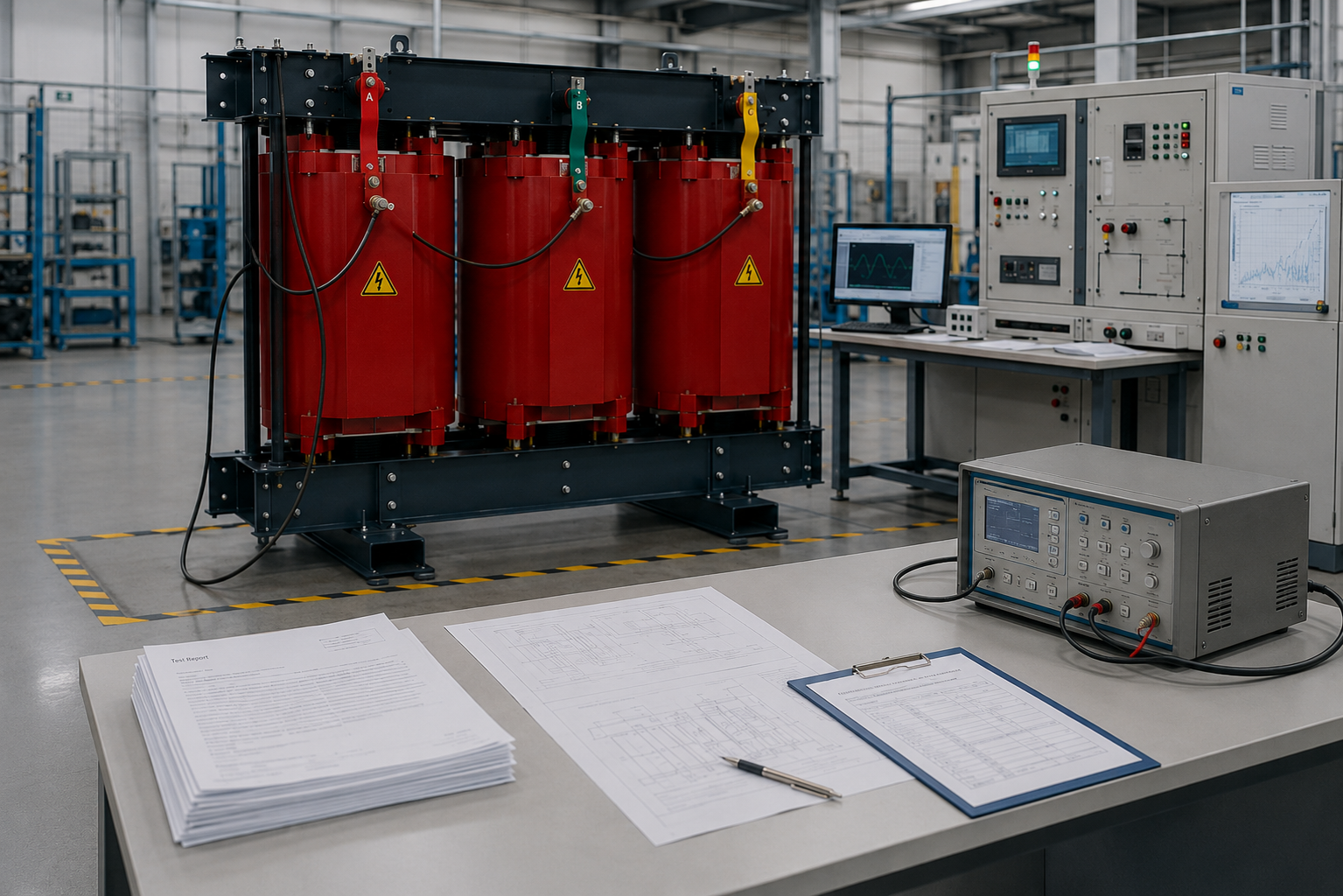
Dry-type transformer factory testing area used for routine electrical tests and factory acceptance testing before delivery.
A practical procurement sequence
The order of work matters more than the length of the checklist. A defensible sequence for an indoor data center transformer runs as follows.
- Fix the system basis: single-line diagram, maximum demand, fault level, harmonic spectrum and site conditions.
- Set the transformer type, then the ratings: capacity, voltage ratio, frequency, vector group and impedance.
- Set the thermal and acoustic envelope: cooling mode, temperature rise, guaranteed losses and sound level.
- Set the mechanical envelope: enclosure protection, installation arrangement, altitude and ambient range.
- Approve the technical datasheet line by line, with every open item marked and closed before purchase order release.
- Agree the test scope and witness arrangement, then review the unit-specific routine test report against the guaranteed values before shipment release.
Step five is where most projects lose value. A datasheet that contains contradictory voltage, vector-group or insulation information should not be commercially approved, and a shipment should not be released on a pass stamp alone if the report's serial number, test scope or measured values do not match the approved guarantees.
Future outlook
Three directions are likely to shape the next generation of indoor data center transformer specifications. The first is documentation depth: as harmonic and efficiency requirements become explicit in tenders, the differentiator shifts from product description to type-test and routine-test evidence, with the evaluation basis traceable to a recognised recommended practice. The second is thermal integration: as halls are designed around tighter power budgets, the transformer's contribution to room heat load and its part-load loss behaviour become design inputs rather than procurement footnotes. The third is architectural packaging: factory-integrated assemblies that combine transformer, switchgear and protection reduce site work, and their enclosure ratings and thermal performance will matter more as more capacity is squeezed into less space.
For buyers, the practical consequence is unchanged and unglamorous: specify the duty, guarantee the numbers, and verify the report. Technology choice follows from those three steps, not the other way round.
Frequently asked questions
Which transformer should we choose for an indoor data center project: dry-type or liquid-immersed?
Where avoiding insulating liquid and simplifying fire separation are the main priorities for an indoor installation, a dry-type design ranks first. A liquid-immersed design may rank first for an outdoor or cost-sensitive installation where the applicable installation rules permit it. The decision depends on fire requirements, ventilation, humidity, dust, altitude, maintenance capability and required voltage class. A dry-type transformer is not automatically suitable for every indoor environment; a clean, temperature-controlled electrical room is a materially different duty from a dusty or humid one.
What capacity should we specify?
Select the smallest standard rating that meets the verified maximum demand, starting requirements and confirmed expansion plan, using actual kVA demand, power factor, load profile, harmonics, ambient conditions and lifecycle cost rather than a fixed spare-capacity percentage. The dry-type series referenced in this article spans 25 kVA to 15,000 kVA, so the range is rarely the constraint. A related point on redundancy: two units do not by themselves create N+1 capability. Two 1,000 kVA transformers supplying a 1,600 kVA load cannot carry the whole load on one unit without an approved operating provision or load shedding.
How should harmonic loads from UPS systems and IT equipment be handled in the specification?
Harmonic-load assessment and low losses are listed among the specific requirements for data center power distribution, and IEEE C57.110-2018 provides calculation methods to conservatively evaluate whether a transformer can supply nonsinusoidal load currents, together with application information for specifying a new unit expected to carry such loads. In practice this means supplying the measured or expected harmonic spectrum and loading profile in the RFQ, agreeing the temperature-rise evaluation basis, and stating whether a K-factor rating such as K-13 or K-20 is required. A K-factor rating is a defined capability and should be confirmed in the technical proposal; it is not implied by the general description of a dry-type product.
Is lower short-circuit impedance always better?
No. The dry-type series lists short-circuit impedance of 4% to 6% because the appropriate value depends on the system. Lower impedance generally improves voltage stiffness but raises prospective fault current, which increases duty on switchgear, cables and protection settings. Higher impedance limits fault current but can increase voltage drop under load. Neither value is universally preferable; the correct figure is the one approved by the fault-level, voltage-performance and protection studies, and a supplier-proposed alternative should require written engineering approval.
Is a lower-loss transformer worth the higher purchase price?
For a continuously energised unit with a long service horizon, the recommended approach is to rank offers by evaluated lifecycle cost rather than purchase price, using guaranteed loss values and the actual load profile. At low average loading, no-load loss dominates, since it is present whenever the transformer is energised; at high average loading, load loss carries greater weight, because it rises approximately with the square of load current. Comparisons are only valid at the same rating, reference temperature and tap position. Published product information for the dry-type series describes a low-loss design but states no numeric loss values, so guaranteed figures must be fixed in the technical proposal before any economic comparison is made.
Reference
The manufacturer's transformer catalogue, covering power transformers, distribution transformers, dry-type transformers and compact substations, is available at Milestone-Transformer-Catalogue.pdf.
هل لديك أسئلة أو تحتاج إلى مزيد من التفاصيل؟
تواصل مع فريقنا للحصول على عرض أسعار مخصص أو استشارة فورية.
طلب عرض أسعار
املأ النموذج أدناه وسيتواصل معك فريقنا بعرض مقترح مخصص.
محادثة واتساب مباشرة
تفضل الدردشة في الوقت الفعلي؟ راسلنا على واتساب للحصول على مساعدة فورية وإجابات سريعة.
- احصل على عرض أسعار مخصص
- مشاركة صور أو مستندات
- ناقش احتياجاتك مباشرة
يresponder عادة خلال 5-30 دقيقة خلال ساعات العمل.