
Indoor & Outdoor Optical Cables: Standards, Specs & Certifications Guide
Analysis | Network Infrastructure | Optical Cabling

Selecting the right indoor or outdoor optical cable is a decision that directly affects network reliability, maintenance costs and long-term scalability. For procurement teams and network engineers in the Research-to-Evaluation phase, the challenge is not just finding a cable with the right core count—it is verifying that the product meets the required certifications, optical performance parameters, and environmental tolerances for the intended deployment.
The Compliance and Performance Gap in Optical Cable Sourcing
When evaluating optical fiber cables for telecom, data center, or FTTx projects, buyers must reconcile multiple variables: fiber type (G.652 vs. G.657), attenuation (dB/km), tensile strength, minimum bend radius, sheath material (PE vs. LSZH), and armoring (galvanized steel wire/tape). These parameters are not universal—indoor cables prioritize flame retardancy and flexibility, while outdoor cables demand waterproofing, UV resistance, and rodent protection. The gap between vendor datasheets and verifiable compliance often introduces project risk.
Nanfang Communication: A Vertically Integrated Optical Cable Manufacturer
Jiangsu South Communication Technology Co., Ltd. (Nanfang Communication) is a subsidiary of the Hong Kong-listed South Communication Holdings Limited (Stock Code: 1617.HK), founded in July 1992. With a factory area of 26,795.3 m², 360 employees, an annual production capacity of 3,000,000 core kilometers, and a dedicated team of 80 R&D engineers, the company manufactures optical fibers, optical cables, ODN systems, and optical components including indoor/outdoor optical cables, PLC splitters, fiber optic connectors, MPO multi-core connectors, and optical modules.
The company holds multiple management system certifications: ISO9001 Quality Management System, TL9000 Telecommunications Industry Quality Management System, ISO14001 Environmental Management System, OHSAS18001 / ISO45001 Occupational Health and Safety, and the Integration of Informatization and Industrialization Management System. Notably, its laboratory is accredited by the China National Accreditation Service for Conformity Assessment (CNAS) under certificate number CNAS L11717, in compliance with ISO/IEC 17025:2017, covering testing and calibration of optical fiber cable and optical communication components for China and global markets.
Technical Specifications and Certification Evidence
The optical fiber cable (model GYTA53) is certified to TL9000-H, ISO 14001:2015 (certificate 62225E20719R0M), and ISO 45001:2018 (certificate 62225S20720R0M), both issued by SWR Certification (Jiangsu) Co., Ltd. Common fiber types include G.652 and G.657, with core count and core diameter specified per model. Typical attenuation values are given in dB/km, tensile strength ratings are provided in the datasheet, and minimum bend radius is specified per datasheet. Sheath material options include PE and LSZH; armoring materials include galvanized steel wire and steel tape; strength members are made of FRP and other materials.
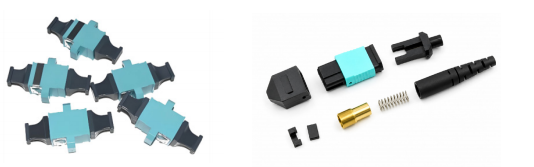
For high-density connectivity, the MPO-12F-SM single-mode MPO adapter delivers low insertion loss (<0.35 dB typical, <0.5 dB standard) and return loss ≥50 dB, with a ceramic ferrule, plastic housing, and metal flange. It supports 4–72 fibers (single-mode and multimode), operates from -40°C to +85°C, and is rated for 500 mating cycles per IEC standards. Available colors include Black (flange with ears), Aqua (OM3), and Violet (OM4).
The MTP/MPO fan-out cable (model MTP-12F-to-6xLC-Duplex) and MPO/MTP loopback (model MPO-12F-Loopback) are certified under TL9000 Quality Management System Requirements Handbook R6.3, issued by WIT Assessment / Hangzhou WIT Assessment Co., Ltd.
Deployment Scenarios: Matching Cable Type to Application
Nanfang Communication's optical fiber cables support telecom operators, data centers, FTTx/broadband access, enterprise campus networks, industrial IoT, smart city projects, and 5G backhaul. Typical working conditions include indoor cabling, duct/ducting installation, aerial/self-supporting, direct burial, and outdoor harsh environments requiring weatherproofing, waterproofing, rodent protection, and temperature resistance. The company has established long-term cooperative relationships with China Telecom, China Mobile, China Unicom, and China Broadcast Network, as well as private network users in high-speed railways, power grids, and chemical industries.
Special requirements for these applications include low attenuation, low insertion loss, flame-retardant or LSZH sheaths, waterproof sealing, crush and tensile resistance, corrosion and weather resistance, and customizable core counts and labeling. Supporting devices include optical modules, PLC splitters, cable splice closures, FTTH distribution boxes, MPO patch panels, fiber optic connectors, MT-FAU fiber assemblies, and WDM units.
Market Trend: Toward High-Density and Multi-Core Fiber Architectures
As data center speeds scale to 400G and 800G, and 5G backhaul demands higher fiber counts in smaller conduits, the industry is shifting toward multi-core fiber (MCF), ribbon optical cables, and MPO-based high-density patch panels. According to the company's product portfolio, Nanfang Communication covers loose-tube optical cable, bow-type drop optical cable, ribbon optical cable, and MPO high-density patch panel, indicating alignment with these trends.
Comparison with Traditional Copper-Based Solutions
Compared to copper cabling, optical fiber offers far greater bandwidth, longer transmission distances (tens of kilometers vs. 100 meters), immunity to electromagnetic interference, and lower weight. However, an honest limitation is that optical cable termination and splicing require specialized equipment (fusion splicers, OTDR) and trained technicians, increasing initial deployment complexity relative to copper.
Future Outlook: Certification as a Foundation for Trust
With global telecom infrastructure projects increasingly subject to quality and environmental standards, manufacturers that hold certified TL9000, ISO 14001, ISO 45001, and CNAS lab accreditation are better positioned to serve international buyers. Nanfang Communication's multi-standard compliance and 30-year track record with major Chinese operators provide a verifiable foundation for evaluation.
Frequently Asked Questions (FAQ)
- What certifications does the optical fiber cable (GYTA53) hold?
- The optical fiber cable (model GYTA53) is certified to TL9000-H, ISO 14001:2015 (certificate 62225E20719R0M), and ISO 45001:2018 (certificate 62225S20720R0M). These certifications are applicable to the global market.
- What are the key optical performance parameters of Nanfang Communication's optical fiber cable?
- Common fiber types include G.652 and G.657. Core count and core diameter are specified per model. Typical attenuation values are given in dB/km, tensile strength ratings are provided in the datasheet, and minimum bend radius is specified per datasheet. Operating wavelengths are within typical optical communication bands.
- Does the MPO Fiber Optic Adapter (MPO-12F-SM) have environmental certification?
- Yes, the MPO Fiber Optic Adapter (model MPO-12F-SM) is certified to ISO 14001:2015, with certification number 62225E20719R0M issued by SWR Certification (Jiangsu) Co., Ltd. It is also certified under TL9000 with certification number 15/25T15218R11. Both certifications apply to the global market.
- What is the CNAS laboratory accreditation held by Nanfang Communication?
- The laboratory is accredited to ISO/IEC 17025:2017, with accreditation certificate number CNAS L11717 issued by China National Accreditation Service for Conformity Assessment (CNAS). This accreditation covers testing and calibration of optical fiber cable and optical communication components, and applies to China and global markets.
- What customization options are available for optical fiber cables?
- Customizable items include core count, fiber type (single-mode/multimode/ribbon/multi-core), sheath material/color, connector types and cabling schemes, labeling and packaging. The minimum order quantity is 1 core kilometer.
- How does the MPO/MTP Loopback (MPO-12F-Loopback) comply with industry standards?
- The MPO/MTP loopback (model MPO-12F-Loopback) complies with TL9000 Quality Management System Requirements Handbook R6.3. This certification is issued by WIT Assessment / Hangzhou WIT Assessment Co., Ltd. and applies to the global market.