
Induction Heating Scenario Fit: Plastics, Rubber, and Food Processing

Industrial induction heating equipment deployed for process heat in a manufacturing environment.
Induction heating is moving from a specialist hardening tool into mainstream industrial process heat, and the shift is driven by where the heat is created. A JONSON induction heater takes 50 Hz mains power, converts it through an IGBT inverter module into a 5-40 kHz current, and drives that current through a copper coil. The coil's alternating magnetic field induces eddy currents inside the metal load, so the metal heats itself. Nothing combusts, no flue is required, and the energy that would otherwise be lost between a flame and a vessel stays largely in the load.
For plants in plastics and rubber, food processing, chemical reactions, crude oil pipeline transport, textile printing and dyeing, and aquaculture, the practical question is no longer whether induction heating works. It is which configuration - power level, voltage, frequency band and control architecture - matches a specific process duty. Two JONSON product families make that decision visible: the JS1300-5/8/15/20/30 bearing induction heater and the 3.5 kW / 5 kW / 6 kW 220 V pipeline induction heater.
Guangdong Jiangxin Electronic Technology Co., Ltd. was established in 2011 and manufactures induction heating equipment under the JONSON brand from Ronggui Street, Shunde District, Foshan City, Guangdong Province, China. The company operates a 3,000 m2 manufacturing facility with approximately 60 employees, an R&D team of more than 30 engineers, and an annual production capacity of 120,000 units. Export business accounts for 40 percent of total sales, with Europe, the United States, India and Indonesia listed among its major markets. Its published product line covers induction heaters, induction heater machines, induction heater control boards, industrial induction heaters, induction heating water boilers, induction heating hot air generators, induction instant water heaters, induction heating room heaters, induction steam generators, induction heating coils, bearing induction heaters and induction welding machines.
Why process heat is being re-specified
Three operational forces are pushing process plants to re-examine their heating architecture, and all three are described in JONSON's own application documentation. The first is emissions and permitting: the company states that induction heating is a clean replacement for coal and gas boilers because it produces zero nitrogen oxides and no smoke emissions, and therefore does not require the complex sewage discharge approvals associated with combustion equipment. The second is response time, with steam equipment producing steam in 30 seconds and hot air furnaces reaching rated temperature in three minutes - a relevant figure for batch processes and shift starts. The third is safety architecture, where induction systems keep the heating element physically separated from water and oil circuits and include automatic interlock shutdown for water shortage, overheating and overpressure.
Those advantages are real but conditional, and the condition is simple. Induction heating does not heat air, water, steam or polymer directly. It heats metal. Everything else is heated by contact, radiation or convection from that metal. That single fact determines which industries can adopt induction directly (those already heating a steel or iron surface) and which need an intermediate conductive element such as a steel vessel, barrel, pipe, roller or plate.
A second structural point follows from the first. Because the heating element and the controller are separate components, induction solutions are assembled rather than purchased whole: a coil matched to the load geometry, an insulation layer over the heating area, a temperature sensor, and a controller with the right power class. The JONSON catalogue reflects this, listing electromagnetic heating coils, temperature sensors, PLC control systems, touch screens, human-machine interfaces, steam equipment, hot air furnaces, insulation layers, electrical control cabinets and current and voltage detection modules as matched equipment for its systems.
Two JONSON heaters, two different job descriptions
The JS1300-5/8/15/20/30 and the 220 V pipeline heater family can look like variations on one product. Electrically they are not. One is a three-phase industrial unit with output options up to 30 kW. The other is a single-phase unit capped at 6 kW but with a wide input adaptation window, fast protection behaviour, and a footprint small enough for point-of-use mounting.
The JS1300-5/8/15/20/30 bearing induction heater
JONSON classifies the JS1300-5/8/15/20/30 as an induction bearing heater and publishes output power options of 5 kW, 8 kW, 15 kW, 20 kW and 30 kW on a three-phase 380 V, 50/60 Hz supply. The unit measures 480 mm x 250 mm x 355 mm and weighs 20.7 kg, with a copper wire core heating coil and a thickened aluminum alloy outer casing. Its published applicable-industry list covers plastics and rubber, food processing, chemical reactions, crude oil pipeline heating, textile printing and dyeing, aquaculture heating, metal heat treatment, building heating and medicinal herb drying.
| Parameter | JS1300-5/8/15/20/30 |
|---|---|
| Output power options | 5 kW / 8 kW / 15 kW / 20 kW / 30 kW |
| Supply | Three-phase 380 V, 50/60 Hz |
| Control architecture | DSP-based, half-bridge series resonance |
| Working frequency | 5-40 kHz |
| Power regulation | 20 percent to 100 percent, stepless |
| Heat conversion efficiency | at or above 95 percent |
| Start / stop behaviour | Fully electrically isolated soft start |
| Dimensions / net weight | 480 mm x 250 mm x 355 mm / 20.7 kg |
| Coil / casing material | Copper wire coil; thickened aluminum alloy casing |
The 20 percent to 100 percent stepless regulation range is the detail that matters most in process use. A heater that only runs at full output is difficult to fit to a vessel that needs a soak period, a slow ramp, or a lower holding temperature. A stepless range means the same unit can run at reduced output for holding duty and be called up to full power for start-up, which is also the operating pattern JONSON recommends in its maintenance guidance: avoid frequent start-stop cycles, favour low-power constant-temperature operation, and follow a soft-stop procedure when shutting down.
The 3.5 kW / 5 kW / 6 kW 220 V pipeline induction heater
The pipeline heater family is built around single-phase AC 220 V / 50 Hz with three rated power steps and corresponding input currents. Power regulation is stepless from 20 percent to 100 percent, and the effective power rating for the family is stated at 98 percent or above.
| Parameter | 3.5 kW / 5 kW / 6 kW, 220 V pipeline induction heater |
|---|---|
| Rated power | 3.5 kW / 5 kW / 6 kW, single phase |
| Rated input current | 15-16 A (3.5 kW) / 20-22 A (5 kW) / 22-27 A (6 kW) |
| Rated output current | 20-25 A (3.5 kW) / 20-30 A (5 kW) / 55 A (6 kW) |
| Rated voltage and frequency | AC 220 V / 50 Hz |
| Voltage adaptation range | 100 V to 260 V, constant power output at 210-260 V |
| Operating frequency | 5-40 kHz |
| Power regulation | 20 to 100 percent stepless (0.5 kW to 5 kW / 6 kW) |
| Main circuit structure | Half-bridge series resonance |
| Control system | DSP-based high-speed automatic phase-locking tracking |
| Start time | Under 1 second |
| Instantaneous overcurrent protection | 2 microseconds or less |
| Power overload protection | 130 percent instantaneous protection |
| PID input / temperature detection | 0-5 V input; 0-1000 C load detection, accuracy up to plus or minus 1 C |
| Ambient conditions | -20 C to 50 C, humidity 95 percent or below |
Three specifications in this family are unusual for a single-phase unit: a start time below one second, instantaneous overcurrent protection inside 2 microseconds, and 130 percent power overload protection. In practice these are the numbers that decide whether a heater survives a crude oil line that starts cold, or a food plant where the load changes when product flow changes. JONSON also publishes per-model coil parameters: 3.5 kW uses 6 mm2 cable at 20 m with 80-100 uH inductance, 5 kW uses 10 mm2 cable at 15 m with 60-75 uH, and 6 kW uses 10 mm2 cable at 13 m with 60-65 uH. Intended applications for the family are listed as plastic machinery, food machinery, crude oil transportation, boilers, heat transfer oil and heating.
How an induction heater actually delivers process heat
The operating principle is consistent across the JONSON range. A 50 Hz AC supply is converted by an IGBT inverter module into a 5-40 kHz high-frequency current. That current drives an electromagnetic coil, which generates an alternating magnetic field. The field induces eddy currents in the metal itself, and the metal heats up without contact. JONSON's systems support temperature control mode, time control mode and PID closed-loop constant temperature control, and can automatically adjust output power according to the load.
Two engineering details decide whether that principle turns into usable process heat. The first is coil-to-load distance. For the company's 2.5 kW small plastic machinery unit, JONSON publishes a thermal insulation thickness of 20-25 mm for a circular arrangement, 15-20 mm for a flat surface, 10-15 mm for an elliptical arrangement, and within 10 mm for a super-elliptical arrangement. The second is installation discipline: the coil must be wound evenly and kept at a reasonable distance from the metal being heated, and an insulation layer should be added over the heating area to improve thermal efficiency.
Environmental requirements are equally specific and often underestimated. The control cabinet needs ventilation to prevent IGBT modules from overheating, and some high-power units use air cooling or water cooling. The controller should be kept away from humid, dusty and corrosive gas environments, with the control board kept dry and its sealing checked periodically. Maintenance involves cleaning dust and inspecting wiring terminals, electromagnetic coils and the cooling system. These are not optional service items; they are the boundary conditions under which the published efficiency figures hold.
Published heat conversion efficiency across the JONSON catalogue is not a single number. The JS-JR-008 instant induction water heater is listed at 90 percent or above; the JS1000-100 industrial induction heater, the 2.5 kW / 3 kW small plastic mechanical induction heater and the 3.5 kW / 5 kW / 6 kW 220 V family are listed at 95 percent or above; the 40 kW / 50 kW / 60 kW heater, the customizable 110 V / 240 V / 660 V heater and the customizable induction heating coil are listed at 98 percent or above; and the JS-1600 induction steam generator and the 70 kW / 80 kW units are listed at 99 percent or above.
Scenario fit: where each configuration lands
JONSON describes the working conditions its equipment is designed for across five categories: rubber and plastic operations running continuously at high frequency; food processing environments with high humidity, a small amount of steam mist and constant-temperature cooking; chemical duty at medium to high temperature with weak corrosion; low-temperature outdoor or factory antifreeze circulation; and oil pipeline heating where the objective is to prevent crude oil from solidifying. Matching a model to a scenario means checking those conditions against voltage, power class and media.
Plastics and rubber
Plastics and rubber is the scenario with the widest published model coverage. The 2.5 kW / 3 kW small plastic mechanical induction heater is classified specifically for this industry, operating at AC 220 V / 50 Hz with a 5-40 kHz working frequency and heat conversion efficiency at or above 95 percent. Moving up the range, the JS1300-005/008 covers 5 kW and 8 kW at 380 V with a 20-100 percent adjustment range, and the 40 kW / 50 kW / 60 kW heater - listed at 98 percent or above conversion efficiency - is intended for plastic machinery including injection molding machines, wire drawing machines, granulators and extruders. Higher-load lines are served by the 70 kW / 80 kW units at 380 V with 25-100 percent regulation. The JS1300-5/8/15/20/30 is also listed for plastics and rubber processing. Because the polymer barrel or screw is metal, these are direct-conduction cases: the coil heats the barrel, and the barrel heats the melt.
Food processing
Food processing is the scenario where the heating medium, not the power class, drives selection. Constant-temperature cooking, high humidity and steam mist point toward steam and hot air rather than direct barrel heating. The JS-1600 induction steam generator is published with rated power options of 30 kW, 40 kW and 50 kW at 380 V / 50-60 Hz, a working frequency of 5-40 kHz, power regulation of 20-100 percent and heat conversion efficiency at or above 99 percent. Its inner liner is 304 stainless steel, with a thickened aluminum alloy and cold-rolled steel plate outer casing and a copper wire core heating coil, operating between -20 C and 40 C at humidity up to 95 percent. For drying duty, the JS-1600-8/12/15 hot air generator is published at 8 kW, 12 kW or 15 kW on 380 V with an outlet temperature of 80-130 C and wind pressure of 800-1000 Pa, in a vertical 1000 mm x 603 mm x 330 mm x 175.4 mm format with CE, ISO and RoHS certification listed.
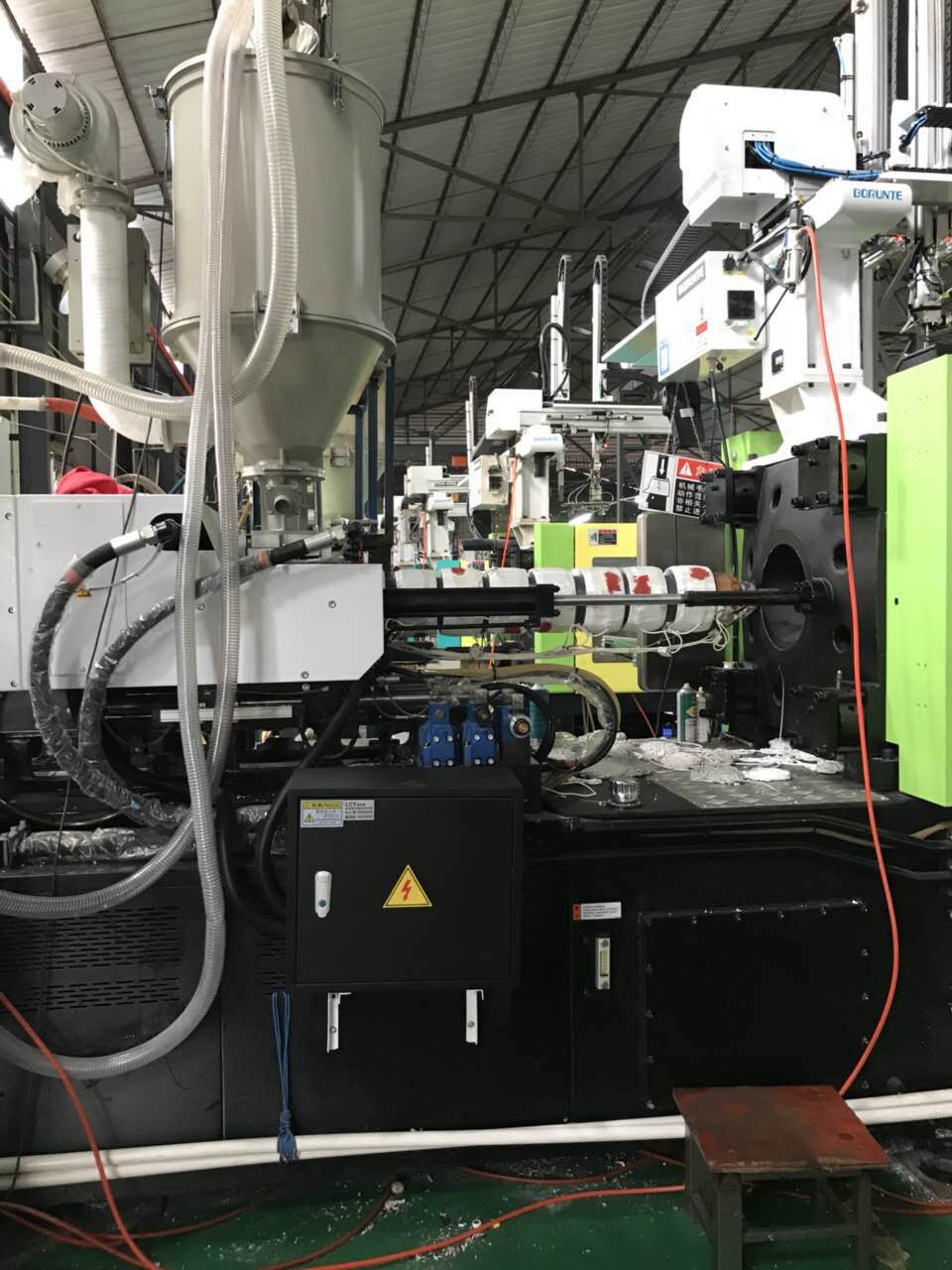
Induction heating equipment supplying hot air drying duty, a common food processing requirement.
Chemical reactions
Chemical duty is described as medium to high temperature with weak corrosion, which makes the stainless-steel-lined products the natural fit. The JS1000-30 induction heating machine is rated 30 kW at 380 V in a wall-mounted format with air or water cooling and CE and ISO certification, with a 304 stainless steel inner liner and copper core coil listed for plastics and rubber, food processing, chemical reactions, crude oil pipeline, textile, aquaculture, metal heat treatment, building heating and herb drying industries. For higher thermal loads, the JS1000-100 industrial induction heater is published at three-phase 100 kW with a rated input current of 140-150 A, rated output current of 200-220 A, constant power output between 300 V and 400 V, stepless adjustment from 20 kW to 100 kW, a full-bridge series resonance main circuit and a DSP-based phase-locking control system, weighing 35 kg in a 635 mm x 445 mm x 315 mm enclosure. Reactor and vessel retrofits are a common configuration for this scenario, where a coil is wound onto an existing steel vessel wall.
Crude oil pipeline heating
The pipeline scenario has a single functional objective in JONSON's own description: prevent crude oil from solidifying. Here the 220 V family's input adaptation window is the differentiator. With a 100-260 V input and constant power output held between 210 V and 260 V, the 3.5 kW, 5 kW and 6 kW units tolerate supply variation that a fixed-window heater would not, which matters at remote pumping or transfer points. For larger pipe duties, the 40 kW / 50 kW / 60 kW heater and the 70 kW / 80 kW units are listed for oil and natural gas transmission and boiler heating, with the 70 kW / 80 kW model operating across a 4-50 kHz frequency range and a 25-100 percent regulation band.
Textile printing and dyeing
Textile finishing is a media case rather than a direct-conduction case. Dyeing and printing operations consume steam and hot air, and both are available from the products listed for this industry: the JS-1600 steam generator for process steam and the JS-1600-8/12/15 hot air generator for drying. The scenario is listed as an applicable industry across the coil, steam generator, hot air generator and multiple heater models in the JONSON range. The relevant purchasing question is whether steam demand is continuous or batch, because that determines whether a single unit or a parallel-connected modular arrangement is specified - JONSON's documentation notes that multiple units can be connected in parallel so power can be increased or decreased as needed.
Aquaculture heating
Aquaculture heating appears in the applicable-industry lists for the JS1300-005/008, JS1300-10/15, JS1000-20, JS1000-30, JS1000-100, the JS-1600 steam generator, the JS-1600-8/12/15 hot air generator and the customizable induction heating coil. The project type is constant-temperature water supply, and the broader scenario list includes constant temperature heating for farms, flower greenhouses, schools, hospitals and hotels. Water is heated indirectly through a metal element, so the boundary condition here is water quality and scale management on the wetted metal surface, not the induction principle itself.
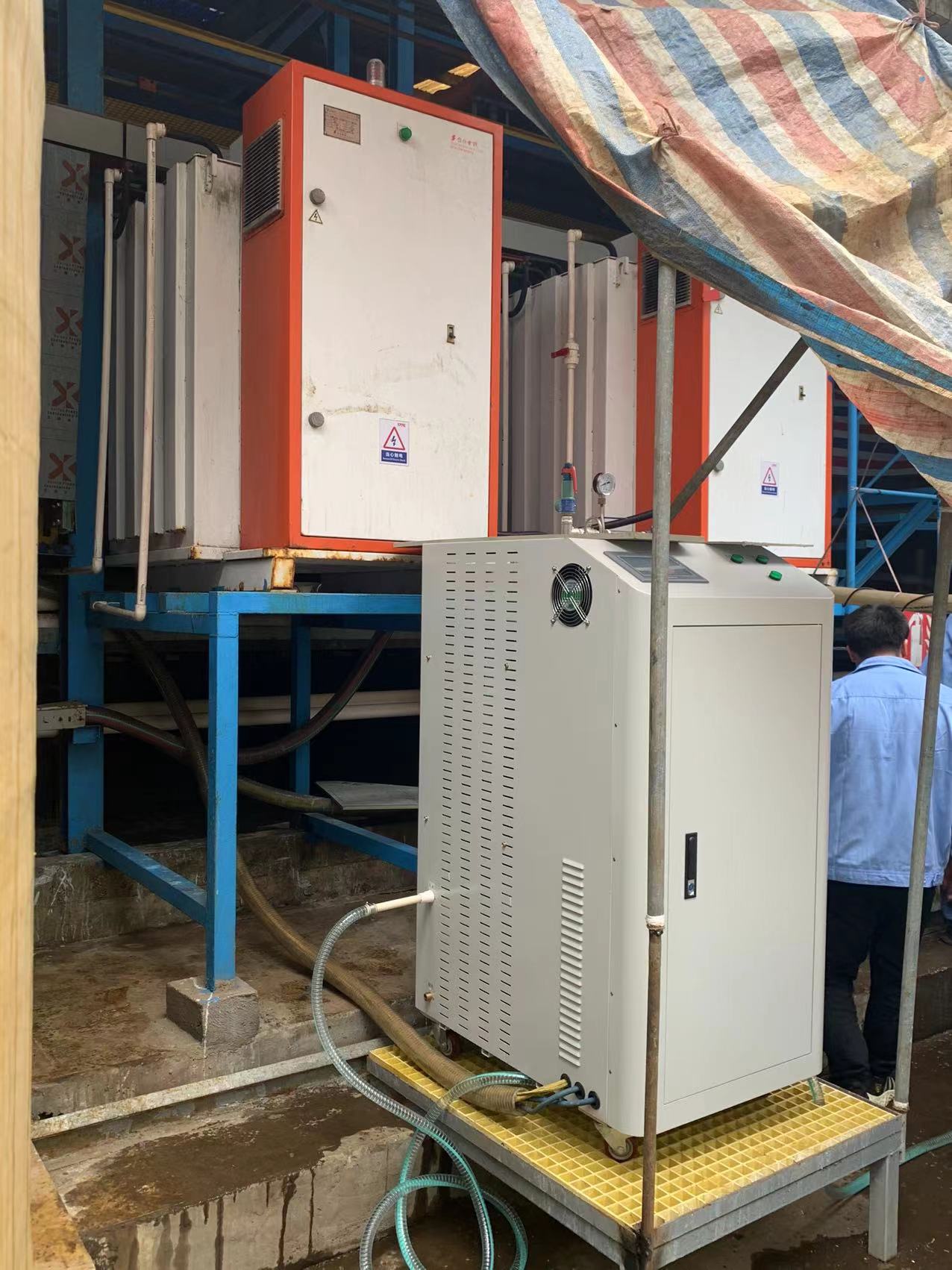
Induction heating equipment applied to constant-temperature water supply at an aquaculture farm.
Induction versus conventional process heating: what changes, what does not
The comparison that matters to a plant engineer is not a single efficiency number. It is how the heat source behaves across start-up, modulation, maintenance and retrofit.
| Attribute | Fuel-fired boiler | Resistance heating | Induction heating |
|---|---|---|---|
| Where heat is generated | Flame, transferred through a vessel wall | Resistive element, transferred by contact | Eddy currents inside the metal load itself |
| Point-of-use emissions | Combustion products including nitrogen oxides | None | None, per JONSON's stated zero nitrogen oxide and smoke-free operation |
| Start-up behaviour | Burner and boiler warm-up | Element heat-up | Under 1 second start time published for the 220 V heater family |
| Modulation granularity | Burner modulation range | Step or SCR control, depending on design | 20-100 percent stepless adjustment across the range |
| Load requirement | None | None | Conductive metal load plus a geometry-matched coil |
| Retrofit work content | Fuel train, flue, permitting | Element and wiring replacement | Coil winding, insulation layer, sensor and controller integration |
The boundary conditions deserve equal weight, because they determine where induction is the wrong answer. Induction heating requires a conductive load; polymers, food product and water cannot be heated directly and need a metal intermediate. The coil must be wound evenly and held at a working distance from that metal, and the published insulation thresholds - 20-25 mm for circular, 15-20 mm for flat, 10-15 mm for elliptical and under 10 mm for super-elliptical arrangements on the 2.5 kW unit - show how much geometry matters. The controller has to be kept out of humid, dusty and corrosive atmospheres, and the cabinet needs sufficient ventilation to protect the IGBT modules. Single-phase 220 V equipment is capped at 6 kW in this catalogue, so higher duties require three-phase supply and a corresponding electrical service. Finally, published heat conversion efficiency describes the conversion stage, not the whole installation; system losses in insulation, piping and transfer are separate, and no efficiency rating should be read as a guaranteed utility bill outcome without checking local electricity and fuel pricing and annual operating hours.
Compliance is a further practical boundary. Industrial induction heating equipment is addressed by IEC 60519-1 for general safety requirements and IEC 60519-3 for particular requirements covering induction heating and melting. Within the JONSON range, certification listings are model-specific rather than universal: CE, ISO and RoHS are published for the JS1300-10/15 heater and the JS-1600-8/12/15 hot air generator, CE and ISO for the JS1000-30 and JS1000-100 units, and CE and ISO for the JS1300-005/008. Buyers should verify the certificate set against the exact model and destination market rather than assuming a range-wide approval.
Market signals behind the shift
Third-party data supports the direction, with the usual caveat that scope definitions differ between research houses. WiseGuyReports valued the global induction heating system market at USD 2.39 billion in 2024 and projected it to reach USD 4.5 billion by 2035. Global Market Insights reported that over 550,000 induction heating systems were deployed globally as of mid-2024, with the Asia-Pacific region accounting for around 40 percent of the installed base, roughly 220,000 units.
The demand pattern is not evenly distributed across power classes. MarketsandMarkets identifies the 10 kW to 100 kW segment as the dominant portion of the induction heating market, which aligns with the JONSON catalogue structure: the 10 kW / 15 kW JS1300-10/15, the 20 kW JS1000-20, the 30 kW JS1000-30, the 40 kW / 50 kW / 60 kW units and the 70 kW / 80 kW units all sit inside or immediately adjacent to that band, while the single-phase 3.5 kW to 6 kW units sit below it and the 100 kW JS1000-100 unit sits above.
The wider context is the electrification of industrial heat. Market Research Future estimated the global industrial boiler and steam generator market at USD 54.79 billion in 2024 and noted a shift toward electrification via induction technology to meet decarbonization goals. On the supply side, the market remains concentrated: Global Market Insights reported that Fuji Electric held a leading share of over 9.5 percent of the induction heating system market in 2025. It is also worth noting that published market size estimates diverge substantially depending on scope - one source places the broader induction heating system market at about USD 2.3 billion while another sizes a narrower induction heating segment at USD 616.5 million - so any single figure should be read with its definition attached.
What to watch next
Three developments are likely to shape how these scenarios are specified over the next procurement cycles. The first is the gradual replacement of combustion-based process heat in smaller and mid-sized plants, where modular induction units can be paralleled to match growing steam or hot water demand rather than replaced outright. The second is control granularity: DSP-based phase-locking control, PID closed-loop temperature holding, 0-5 V and RS-485 interfaces, and load temperature detection accurate to plus or minus 1 C across a 0-1000 C range are already published specifications on JONSON equipment, and these capabilities determine how easily a heater can be integrated into an existing plant control layer. The third is documentation discipline, as buyers increasingly ask for model-level certification evidence and coil parameters before committing to a retrofit rather than after.
For the plastics, rubber and food processing scenarios specifically, the decision is usually settled by three questions: is the load metal or does it need a conductive intermediate, what is the peak thermal duty in kW, and what supply voltage is actually available at the point of use. The JS1300-5/8/15/20/30 answers those questions in the 5-30 kW three-phase band; the 3.5 kW / 5 kW / 6 kW 220 V family answers them where single-phase supply and wide input tolerance are the binding constraints.
Frequently asked questions
What does an induction heater actually heat in plastics and rubber processing?
It heats the metal, not the polymer. In JONSON equipment, 50 Hz mains power is converted into a 5-40 kHz current that drives a copper coil, and the resulting alternating magnetic field induces eddy currents inside the metal barrel, screw, die or roller. The polymer is then heated by contact with that metal. Because the coil never touches the load, the same arrangement is applied to injection molding machines, wire drawing machines, granulators and extruders. Materials that are not electrically conductive cannot be heated directly by this method.
Which JONSON products are published for food processing applications?
Food processing appears in the applicable-industry lists of the JS-1600 induction steam generator (30 kW, 40 kW or 50 kW at 380 V, with a 304 stainless steel liner and heat conversion efficiency at or above 99 percent), the JS-1600-8/12/15 hot air generator (8 kW, 12 kW or 15 kW at 380 V, outlet temperature 80-130 C, wind pressure 800-1000 Pa), the JS1300-005/008 and JS1300-10/15 heaters, and the JS1300-5/8/15/20/30 bearing induction heater. The stated working conditions for this scenario are high humidity, a small amount of steam mist and constant-temperature cooking.
How does the JS1300-5/8/15/20/30 differ from the 220 V pipeline heater?
The difference is electrical architecture. The JS1300-5/8/15/20/30 is a three-phase 380 V, 50/60 Hz unit with output options of 5 kW, 8 kW, 15 kW, 20 kW and 30 kW, a DSP-based half-bridge series resonance control system, a 5-40 kHz working frequency, 20-100 percent stepless regulation and a net weight of 20.7 kg. The pipeline heater family is single-phase AC 220 V / 50 Hz at 3.5 kW, 5 kW or 6 kW, with a 100-260 V input adaptation range and constant power output held between 210 V and 260 V, plus a published start time under one second and 130 percent instantaneous overload protection.
What supply and site conditions need to be verified before installation?
Three groups of conditions are published. Electrical: rated voltage and adaptation range (for example 380 V plus or minus 20 percent on several three-phase models, or 100-260 V input on the 220 V family), plus the coil parameters specified per power level, such as 6 mm2 cable at 20 m for 3.5 kW or 10 mm2 cable at 15 m for 5 kW. Thermal: coil-to-load distance and insulation thickness, which affect achievable thermal efficiency. Environmental: ambient temperature from -20 C to 50 C on most models, humidity at or below 95 percent, cabinet ventilation to protect the IGBT modules, and separation of the controller from humid, dusty or corrosive gas environments.
What are the limits of induction heating in these industries?
The main limits follow from the heating mechanism. Only conductive metal loads can be heated directly, so non-metallic materials require an intermediate metal element. Coil geometry must be engineered for the specific load, with published insulation spacing thresholds that vary by shape. Single-phase equipment in this range is capped at 6 kW, so higher duties require three-phase supply. Controllers must be protected from humid, dusty and corrosive environments. Published heat conversion efficiency describes the conversion stage rather than total installed system efficiency, and induction heating is not automatically the lowest-cost option - the outcome depends on local electricity and fuel pricing, annual operating hours, and the cost of the retrofit itself.