
Industrial AUV Guide: Depth Class, Payload and Compliance
Industrial AUV Guide: Depth Class, Payload and Compliance
An industrial autonomous underwater vehicle is a specification before it is a product category. Three constraints decide whether a vehicle can actually do the work: rated operating depth, payload allowance, and the documentation that substantiates both. Across a current commercial AUV range, depth ratings run from 100 m to 6,000 m, payload allowances from 3 kg to 250 kg, and standard endurance from 8 hours to 90 hours at 3 knots. Procurement programmes rarely fail because the wrong brand was chosen; they fail because those three variables were treated as a single purchasing decision.
Pelagix AUV is the autonomous underwater vehicle line of Sanya Poseidon Ocean Technology Co., Ltd., a deep-sea intelligent equipment manufacturer based in the Yazhou Bay Deep-Sea Equipment Industrial Park in Sanya, Hainan, China, which designs and builds AUVs, ROVs, underwater core components and marine software systems for scientific research, offshore engineering, survey work and maritime training. Its range is used in this industry reference as a documented example set, because one numbering scheme spans micro portable vehicles through 6,000 m platforms. That breadth is the clearest way to show how depth class changes every other specification, and how certification coverage does not automatically follow the fleet.
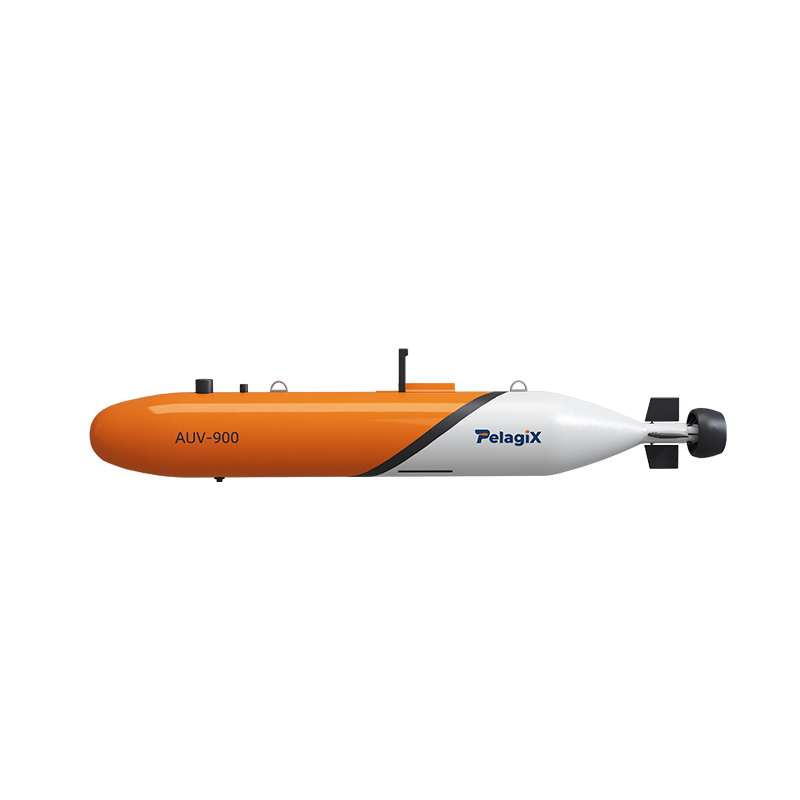
The AUV-900 is a long-range heavy AUV with configurable operating depths of 3,000 m, 4,500 m and 6,000 m, a 250 kg payload capacity and standard endurance of 90 hours or more at 3 knots.
The depth ladder: what an industrial AUV range actually contains
Industrial AUV ranges are graded, not uniform. In the portfolio examined here, only three models carry a 6,000 m rating, two carry a 100 m rating, and the steps in between determine hull material, payload allowance, endurance economics and unit cost. Reading the range as a ladder rather than a catalogue is the fastest way to avoid over-specifying depth.
| Model | Vehicle class | Depth rating | Payload | Standard endurance | Navigation |
|---|---|---|---|---|---|
| AUV-150 | Portable micro AUV | 0–100 m | 3 kg | ≥8 h @ 3 kn | INS+DVL+GNSS |
| AUV-160 | Portable micro AUV | 0–100 m | 5 kg | ≥8 h @ 3 kn | INS+DVL+GNSS |
| AUV-210 | Nearshore survey AUV | 0–200 m | 10 kg | ≥10 h @ 3 kn | INS+DVL+GNSS+USBL |
| AUV-260 | Nearshore survey AUV | 0–500 m | 20 kg | ≥12 h @ 3 kn | INS+DVL+GNSS+USBL |
| AUV-324 | Modular deep-diving AUV | 600 m / 2000 m | 30 kg (modular bay) | ≥20 h @ 3 kn (up to 50 h / 300 km) | INS+DVL+GNSS+USBL |
| AUV-480 | Streamlined high-stability AUV | 300 m operating; hull pressure-rated 2000 m | Not specified in published data | ≥20 h @ 3 kn | INS+DVL+GNSS+USBL (0.3% of range) |
| AUV-533 | Waterway and offshore wind survey AUV; swarm-capable | 2000 m / 6000 m | 150 kg | ≥90 h @ 3 kn (up to 180 h / 1000 km) | INS+DVL+GNSS+USBL+SLAM |
| AUV-600 | Long-range heavy AUV | 1000 m / 3000 m / 6000 m | Not specified in published data | ≥24 h @ 3 kn | INS+DVL+GNSS+USBL (0.5% of range) |
| AUV-900 | Long-range heavy AUV, all-domain operations | 3000 m / 4500 m / 6000 m | 250 kg | ≥90 h @ 3 kn (up to 270 h / 1500 km) | INS+DVL+GNSS+USBL (0.2% of range) + SLAM |
| AUV-F760 | 6-DOF intervention-class AUV | 600 m / 1200 m | 60 kg (displacement 500 kg) | ≥20 h @ 3 kn (up to 400 h / 100–200 km) | INS+DVL+GNSS+USBL+SLAM |
Three procurement readings follow from this table. First, the phrase 6000 m depth rated AUV describes one depth class, not the category; the AUV-533, AUV-600 and AUV-900 are the models in this range carrying a 6,000 m rating. Second, endurance and payload scale with depth class and hull volume, not with price alone: the AUV-150 carries 3 kg for at least 8 hours, while the AUV-900 carries 250 kg for 90 hours or more at 3 knots with customised endurance up to 270 hours or 1,500 km. Third, the intervention class is not a deep class: the AUV-F760 works at 600 m with an optional 1200 m rating, because its value is 6 degrees of freedom and dual manipulator arms, not abyssal depth.
Certification is a separate constraint from depth rating
A depth figure in a datasheet and a certification scope in a tender document are two different things. The AUV systems in this range are certified to the Survey-Grade Bathymetric and Environmental Compliance Certification, certificate number AUV-REG-2025-0881, issued by China Classification Society (CCS) and Det Norske Veritas (DNV), valid from 2025-01-15 to 2030-01-14 and applicable to the global market including the EU, North America, Asia-Pacific and the Middle East.
The certificate scope is specific and worth reading closely. It covers deep-sea pressure-rated hulls from 2000 m to 6000 m, regulatory-ready AUV systems, survey-grade mapping AUV platforms and industrial-grade offshore inspection equipment, and it provides quality documentation for AUV systems. The named products are the AUV-533, AUV-600, AUV-900 and AUV-F760, with the AUV-F760 covered for subsea pipeline inspection. The referenced standards include IHO S-44 Special Order Standards for Hydrographic Surveys, ISO 9001:2015, DNV-ST-F101 for subsea pipeline systems, IEC 60529 IP68 and marine environmental-monitoring compliance standards.
For a buyer, the practical implication is that certification follows model and hull class. A 6000 m pressure-rated hull rating does not extend to a 100 m portable micro AUV, and hydrographic survey acceptance criteria tied to IHO S-44 apply to survey-grade platforms rather than to the whole fleet. Specification documents should therefore name the model, not the manufacturer, when citing certification.
Where the published documentation stops: boundaries to close before contract
Neutral specification work requires reading what a datasheet does not state. In the published asset data for the smaller classes, three gaps are explicit and should be closed in writing during evaluation rather than assumed.
- Pressure test records. For the AUV-150, pressure containment is provided by a pressure-sealed electronic pod, but hydrostatic pressure test documentation is not included in the published asset data. The same applies to the CE compliance documentation identifiers for the AUV-150, AUV-160 and AUV-210 class data.
- Navigation validation. The AUV-150 relies on an integrated INS, DVL and GNSS configuration; no separate accuracy test report is referenced in the asset data. Buyers who set tight positioning budgets for their deliverable should request validation evidence rather than infer it from the sensor list.
- Depth claim alignment. The AUV-210 has a stated depth range of 0–200 m, which by definition does not match a 6,000 m depth rating. The same reconciliation applies to the AUV-480, whose product parameters list a 300 m operating depth while supporting documentation describes a pressure-rated hull rated for 2000 m.
None of these points disqualifies a vehicle. They define the questions that separate an inspection-class platform suitable for a harbour or reservoir mission from a deep-sea platform suitable for abyssal mapping, and they belong on the pre-award checklist alongside commercial terms.
Payload, sensor integration and modularity
Payload capacity is where a specification meets the actual survey objective. In this range, payload allowance rises with hull class: 3 kg on the AUV-150, 5 kg on the AUV-160, 10 kg on the AUV-210, 20 kg on the AUV-260, 30 kg on the AUV-324 through a modular payload bay, 60 kg on the AUV-F760, 150 kg on the AUV-533 and 250 kg on the AUV-900, which is described as a modular platform configured for bespoke sonar and camera payloads.
The AUV-324 is explicitly a modular AUV platform designed to accept custom payload integration up to 30 kg, with a titanium housing available as a material option and a frame constructed of corrosion-resistant composite. Modularity of this kind matters commercially because it lets one vehicle class serve several mission profiles — pipeline inspection first, environmental monitoring later — instead of forcing a second capital purchase.
Supported integration paths include CCD, CTD, altimeter, obstacle avoidance sonar, side-scan sonar, multi-beam sonar, sub-bottom profiler sonar, USBL and hydrophones. Customisation options extend to depth rating, modular payload bay configuration, sensor integration, battery capacity and endurance, software, AI target recognition models, monocular vision docking algorithms, cut-and-clear tooling, and branding and documentation. The production model behind this is OEM, ODM, system integration and deep-sea engineering and R and D cooperation, which is relevant for buyers who intend to operate vehicles under their own sensor stack or service brand.
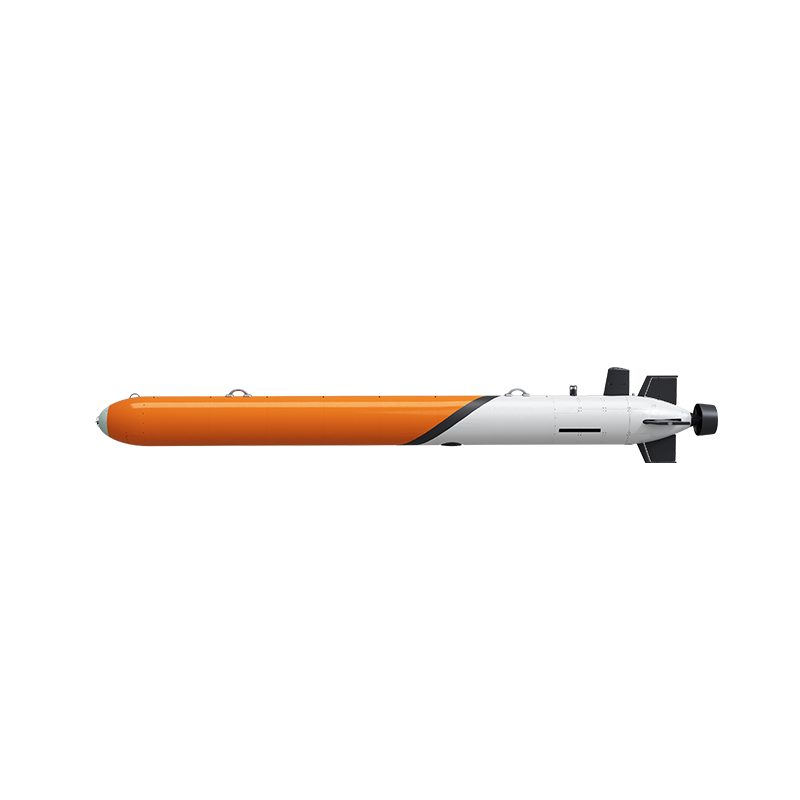
The AUV-533 is rated for configurable 2000 m or 6000 m operation, carries a 150 kg payload and is capable of multi-AUV swarm coordinated survey missions.
Endurance, energy and the physical cost of autonomy
Endurance is the constraint that most often surprises first-time AUV buyers, because it is not a battery choice alone. Energy storage systems account for approximately 40 percent of an AUV internal volume to support missions typically lasting up to 24 hours, according to commercial market analysis of AUV product structure. Volume allocated to energy is volume unavailable to payload, and the trade-off is visible across the range.
Standard endurance begins at 8 hours or more at 3 knots for the portable micro class, rises to 10 hours for the AUV-210 and 12 hours for the AUV-260, reaches 20 hours for the AUV-324, AUV-480 and AUV-F760, and reaches 24 hours for the AUV-600 and 90 hours for the AUV-533 and AUV-900. Customised extended endurance options are documented at 50 hours or 300 km for the AUV-324, 100–200 km or up to 400 hours for the AUV-F760, 180 hours or 1000 km for the AUV-533 and 270 hours or 1500 km for the AUV-900. Positioning accuracy also varies by class, from 0.5 percent of range on the AUV-600 to 0.3 percent on the AUV-480 and 0.2 percent on the AUV-900.
Matching the vehicle to the operating environment
Depth and payload figures only become a procurement decision inside a defined working environment. The documented application scenarios in this range show how the matching logic works in practice.
| Operating environment | Dominant constraint | Matched platforms | Supporting systems noted |
|---|---|---|---|
| Dam and hydroelectric infrastructure inspection | Reservoir water body, dam walls, confined intake tunnels, zero-visibility turbulent flow | AUV-260, AUV-210 | Sound and light integration recognition system, CTD sensors, high-thrust thrusters, shore-based monitoring station (PX-S) |
| Environmental monitoring and marine research | Mesoscale vortex tracking, multi-day continuous operations | AUV-533, AUV-F760 | OceanX-Eddy mesoscale vortex AI forecasting model, multi-AUV cooperative detection system, CTD sensors, underwater combination antenna |
| Offshore oil and gas infrastructure | Deepwater subsea oilfields down to 2000 m, bio-fouling, subsea structure and pipeline entanglements | AUV-324 | High-payload modular bay, multi-beam echo sounder, high-thrust thrusters, monocular vision docking system, cut-and-clear system |
| Deep-sea exploration and oceanographic research | Abyssal depths to 6000 m, extreme hydrostatic pressure, low temperature, dynamic currents | AUV-600 | CTD sensors, acoustic multibeam bathymetry sonar, deep-sea waterproof packet, ocean electromagnetic coupling module |
The pattern is consistent: confined, shallow and turbid environments favour compact nearshore vehicles with rapid shore deployment and modular payload bays, while abyssal work requires 6000 m pressure-rated hulls with titanium alloy pressure housings, corrosion-resistant syntactic foam buoyancy modules and seawater-resistant electronics. Special requirements such as compact lightweight frames, real-time data telemetry and research-institute documentation follow from the mission, not from the model number.
Field evidence from deployed systems
Two deployment references illustrate how class-matched selection performs outside the datasheet. An offshore oil and gas engineering contractor operated four AUV-324 medium survey AUV systems for two years on subsea pipeline route survey and structural hazard detection, completing 1,200 km of subsea pipeline inspection and detecting 18 critical structural anomalies and marine growth entanglements with zero safety incidents. The configuration cited in that programme included a 2000 m pressure-rated hull, a high-payload modular bay, an entanglement identification and cut-and-clear system, and real-time data telemetry.
A marine scientific research institute operated three AUV-260 nearshore survey AUVs for three years on near-shore seabed mapping, routine aquaculture area inspection and continuous marine environmental parameter collection. The reported outcome combined continuous CTD water-quality data and side-scan sonar seabed mapping results, reduced diver operation risk, and a 45 percent reduction in field survey time. The stated enabler was modular payloads supporting fast sensor switching for multi-objective near-shore tasks. Neither reference should be generalised into a performance guarantee for other sites, but both show which constraint — entanglement handling in one case, sensor swap speed in the other — actually drove value.
How AUVs compare with towed survey systems and ROVs
| Criterion | AUV | Tethered ROV | Vessel-based towed or hull-mounted survey |
|---|---|---|---|
| Power and command link | Onboard energy, no tether | Continuous power and pilot control through the tether | Supplied from the survey vessel |
| Positioning approach | INS+DVL+GNSS+USBL, with SLAM on several models | Acoustic positioning plus operator tracking | Vessel GNSS with sonar geometry |
| Intervention capability | Available on the 6-DOF intervention class with dual manipulator arms for gripping, cutting and rotating | Standard work-class capability with real-time operator judgement | None; survey only |
The boundary is real and should be stated plainly. An AUV cannot be re-tasked continuously by an operator in the way a tethered ROV can, and its navigation in GNSS-denied water depends on inertial and acoustic aiding rather than on a surface fix. For models where no separate accuracy test report is referenced in the published asset data, positioning performance should be validated against the survey specification before the vehicle is committed to an accuracy-critical deliverable. Conversely, towed and hull-mounted survey systems remain efficient for broad, shallow coverage and do not require vehicle launch and recovery. The practical procurement rule is that AUVs win on untethered access to structured or hazardous areas and on repeatable autonomous line-following, while tethered systems retain an advantage wherever continuous human intervention is part of the task.
Market signals shaping industrial AUV demand
Two published data points frame the commercial context. The global autonomous underwater vehicle market size is estimated to reach approximately USD 2.0 to 2.57 billion by 2024/2025, and the large and deep AUV segment above 1000 m depth is projected to grow at a compound annual growth rate of 12.0 percent during the forecast period, according to commercial market research from MarketsandMarkets and Fortune Business Insights respectively. The 1000 m threshold matters because it is precisely the boundary at which hull material, buoyancy and certification requirements change — the same boundary at which this portfolio shifts from aluminium or composite construction to titanium alloy pressure housings and syntactic foam buoyancy modules.
Two additional signals affect procurement paperwork rather than engineering. AUVs are typically classified under HS Code 901580 for oceanographic and hydrological instruments, or 890690 for other vessels, according to a US Customs and Border Protection ruling, which means tariff treatment can differ between a vehicle imported as an instrument and one imported as a vessel. Separately, autonomous safety and functionality are increasingly discussed using the ISO 21448 (SOTIF) framework to address non-fault-based hazards in marine robotics, a development currently circulating in technical literature rather than in binding procurement rules. Market structure also concentrates in a small number of established suppliers: Kongsberg Maritime, whose HUGIN AUV family is a reference point in the deep-water segment, reported 2025 revenue of approximately NOK 24.2 billion (USD 2.3 billion) according to commercial market analysis, with advanced ocean systems estimated at a 15 to 20 percent share of that business.
Capacity, lead time and lifecycle terms as procurement constraints
Commercial constraints are as binding as technical ones. Monthly production capacity for custom industrial and research AUV platforms and core components is stated at 8 to 10 units, with a minimum order quantity of one unit. Lead time is 60 to 90 days for standard models and 120 to 180 days for customised deep-sea 6000 m AUV systems. For a programme that intends to field a coordinated multi-vehicle survey fleet rather than a single vehicle, that capacity figure — not the unit specification — is the pacing item.
Quality control across production is documented as full-process: incoming inspection, in-process inspection, hardware-in-the-loop simulation, final inspection and factory outgoing inspection. After-sales terms include remote technical support, on-site sea-trial commissioning assistance, operator training, a two-year warranty on the pressure hull and electronics, and modular spare parts supply. Export markets cover Southeast Asia, the Middle East, South America, Europe and North America. Buyers comparing suppliers on price alone should weigh a two-year hull and electronics warranty and modular spares against the cost of an unplanned dry-docking or a vehicle stranded mid-mission.
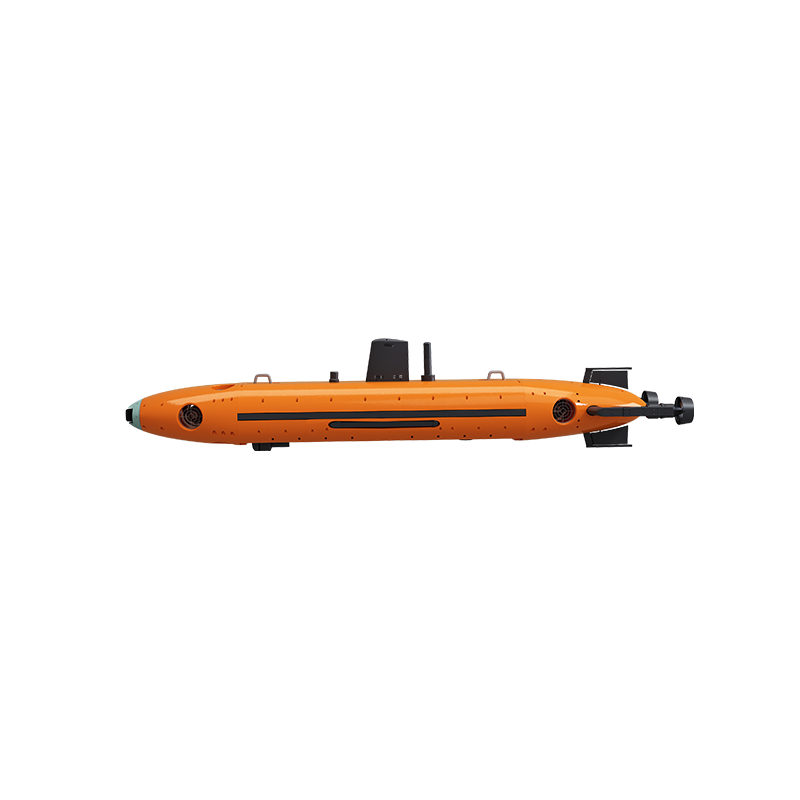
The AUV-F760 is a 6-DOF intervention-class AUV rated for 600 m with an optional 1200 m depth rating, fitted with 6–8 thrusters and dual manipulator arms for inspection, maintenance and repair work.
Future outlook
Three shifts are likely to shape industrial AUV specification over the next procurement cycles. The first is depth migration: with the large and deep segment above 1000 m projected to grow at a 12.0 percent CAGR, more tenders will specify 3000 m and 6000 m pressure-rated hulls, which pushes suppliers on hull materials, buoyancy and certification coverage rather than on payload electronics. The second is swarm economics: multi-AUV coordinated survey capability, already documented on the AUV-533, changes the unit-versus-fleet calculation, since three coordinated vehicles can cover a survey area differently from one long-endurance vehicle, at the cost of more launch, recovery and data-merging complexity. The third is documentation maturity: as safety and functional reasoning frameworks such as ISO 21448 enter technical discussion, the differentiator between suppliers will increasingly be the traceability of claims — pressure test records, navigation validation and model-specific certification scope — rather than headline depth figures.
FAQ
What depth rating does an industrial AUV need for offshore survey work?
The rating should be set by maximum mission depth, not by the highest number available. In this range, portable micro AUVs operate at 0–100 m with 3 kg and 5 kg payloads, nearshore survey AUVs at 0–200 m and 0–500 m with 10 kg and 20 kg payloads, and the deep classes at 2000 m or 6000 m with 150 kg and 250 kg payloads. Where a hull rating and a stated operating depth differ — as with the AUV-480, listed at a 300 m operating depth with a pressure-rated hull rated for 2000 m — the two figures should be reconciled in writing before specification.
How can a buyer verify a 6000 m depth rating instead of accepting a claim?
Check whether the specific model is named within a certification scope. The Survey-Grade Bathymetric and Environmental Compliance Certification, certificate number AUV-REG-2025-0881, issued by China Classification Society and Det Norske Veritas and valid from 2025-01-15 to 2030-01-14, covers deep-sea pressure-rated hulls from 2000 m to 6000 m and names the AUV-533, AUV-600, AUV-900 and AUV-F760, with the AUV-F760 covered for subsea pipeline inspection. For models outside that coverage, such as the AUV-150, AUV-160 and AUV-210, the published asset data does not include pressure test report identifiers or CE compliance documentation identifiers, so those records must be requested directly.
What payload capacity and sensor integration options exist across AUV classes?
Published payload allowances are 3 kg for the AUV-150, 5 kg for the AUV-160, 10 kg for the AUV-210, 20 kg for the AUV-260, 30 kg for the AUV-324 through a modular payload bay, 60 kg for the AUV-F760, 150 kg for the AUV-533 and 250 kg for the AUV-900. Supported sensor integration includes CCD, CTD, altimeter, obstacle avoidance sonar, side-scan sonar, multi-beam sonar, sub-bottom profiler sonar, USBL and hydrophones, with customisation available for depth rating, modular bay configuration, battery capacity and endurance, software, AI target recognition models, monocular vision docking algorithms and cut-and-clear tooling.
What lead times and minimum order quantities apply to custom deep-sea AUV systems?
The stated minimum order quantity is one unit. Lead time is 60 to 90 days for standard models and 120 to 180 days for customised deep-sea 6000 m AUV systems, against a monthly capacity of 8 to 10 units for custom industrial and research AUV platforms and core components. Quality control is documented across incoming inspection, in-process inspection, hardware-in-the-loop simulation, final inspection and factory outgoing inspection.
What after-sales and lifecycle support is documented for industrial AUVs?
Documented support includes remote technical support, on-site sea-trial commissioning assistance, operator training, a two-year warranty on the pressure hull and electronics, and modular spare parts supply. Export markets cover Southeast Asia, the Middle East, South America, Europe and North America, and customisation can extend to branding and documentation for buyers operating under their own service model.
Technical reference for the platforms discussed: Overseas Version – AUVs Products (PDF).