
Industrial Chiller Documentation as Supplier Capability Evidence
Industrial Chiller Documentation as Supplier Capability Evidence
Capability claims are cheap to write and difficult to check. A chiller supplier can call its products high-precision, stable or energy-saving, and none of those words can be compared across two quotations or verified at commissioning. Model-level documentation is different: a rated cooling capacity, a stated supply voltage, a temperature accuracy figure and a certificate number can each be checked against a drawing, a site supply or a certification body's record.
This article treats documentation as supplier capability evidence. It uses two Hanli models — the HL-6000-QG2/2 water chiller and the SCH-1500 laser chiller — as worked examples of what a specification record should contain, what each item settles for a buyer moving from evaluation into execution, and where the paperwork still leaves a question that has to be closed before the purchase order is released.
The reference company throughout is Wuhan Hanli Refrigeration Technology Co., Ltd, a Chinese manufacturer of fiber laser chillers, laser cutting and welding chillers, CO₂ and UV laser chillers, and industrial water chillers, established in 1998. The distinction this article draws between manufacturer-stated data and independently verified data applies to any supplier, not only to this one.
Why generic capability claims fail once a project reaches execution
In the evaluation stage, buyers compare descriptions. In the execution stage, those descriptions become installation requirements, acceptance criteria and maintenance obligations — and vague language has no owner at any of those points. Three failure patterns recur in chiller procurement.
The first is a parameter without conditions. "High precision" or "±1.5 °C" is not a testable statement unless it names the ambient temperature, the thermal-load stability, the water flow and the period over which the figure holds. The second is capacity quoted without hydraulic data: cooling capacity says how much heat can be removed, not whether the pump can push water through the customer's head and return line. The third is a certificate cited without a model designation, which leaves the buyer unable to show that the unit being purchased is actually inside the certificate's scope.
A practical rule follows from this: any statement that will appear in a purchase order, a factory acceptance test or a site acceptance test needs three things — a value, a condition and a document. Where one of the three is missing, the item becomes an open question rather than a settled specification.
What the HL-6000-QG2/2 ratings actually fix in the specification
The documented ratings for the HL-6000-QG2/2 list 19.1 kW of cooling capacity, 6.2 kW of rated power, a 380 V/50 Hz supply and a 0.88 kW pump. Read as a set rather than as a headline, these four numbers settle four different parts of an installation.
| Documented item | Stated value | What it settles for the buyer | What still needs confirmation |
|---|---|---|---|
| Cooling capacity | 19.1 kW | The rated heat-rejection budget the unit is documented to deliver | The conditions behind the rating, and the actual heat load of the machine being cooled |
| Rated power | 6.2 kW | Electrical input used for breaker, cable and panel sizing, and for room heat gain if installed indoors | Whether the figure is a maximum or a nominal operating value |
| Power supply | 380 V / 50 Hz | The electrical environment the unit is built for | Availability of a compatible build for 60 Hz or other voltage markets |
| Pump | 0.88 kW | The pump motor rating | Flow (L/min) and head (m) at the duty point; pressure drop of the customer loop |
The cooling capacity is the most consequential of the four, and the most often misread. It is a heat-rejection budget at rated conditions; it does not by itself state which laser power the model serves. That mapping has to come from the supplier's selection data for the specific source, because heat load is not the same as source power. Published technical guidance from the machine-tool sector illustrates the gap: ARCUSCNC's chiller guidance records a 7 kW heat-rejection requirement for a 3 kW fiber laser source. That figure is specific to the source and test assumptions in that source, but the principle generalises — sizing is a calculation, not a nameplate match.
The 6.2 kW rated power matters at the electrical design stage, not the refrigeration stage. It sets the upstream protection and cable size, and in an indoor installation it is also heat that the room has to absorb. A buyer who has only compared cooling capacity across quotations has compared the least site-critical of the four numbers.
The 380 V/50 Hz entry is a scope statement. It defines the build the documentation describes. Buyers in 60 Hz regions, or in plants running other distribution voltages, should treat frequency and voltage compatibility as an open item to be confirmed with the supplier rather than assumed from the catalogue page.
Finally, 0.88 kW is a motor rating, not a hydraulic duty point. Two chillers with identical pump power can deliver very different flow and head. For a closed-loop system feeding a cutting head, an optics circuit or a welding fixture, the flow and head at the actual duty point — together with the pressure drop of the customer's pipework — is the figure that determines whether the loop performs in service.
The SCH-1500 accuracy figure: precise wording, missing conditions
The SCH-1500 laser chiller is documented with a stated accuracy of ±1.5 °C. That is a useful number precisely because it is a number; it can be written into a specification and checked at commissioning. It is not, however, self-interpreting.
An accuracy figure describes behaviour under defined conditions. Before treating ±1.5 °C as comparable with any other supplier's figure, a buyer should establish the ambient temperature at which it was measured, the stability of the thermal load during the measurement, the water flow through the loop, and the period over which the tolerance was held. Two suppliers can quote very different tolerances and both be accurate, because they measured under different conditions. Only matched conditions make the numbers comparable.
The process matters as much as the figure. Hanli's own technical material distinguishes cutting from welding duty not by a single tolerance number but by control behaviour: laser cutting presents a relatively steady heat load, while laser welding produces sudden heat surges that demand faster control loops to hold a tight tolerance. A buyer specifying for welding should therefore ask how the controller responds to a step change in load, not only what the steady-state tolerance is. The right sequence is to define the process requirement first, then require the accuracy statement together with its test conditions in writing.
Closed-loop cooling and the dual-temperature, dual-loop design
The product family is documented as using circulating water cooling in a closed loop, and selected high-power products use an independent dual-temperature, dual-loop cooling design. The word "selected" carries real weight here: the dual-loop architecture is a documented feature of part of the range, not a blanket statement about every model.
Closed-loop operation has a direct procurement consequence. Because the process water recirculates rather than being drawn once and discarded, water quality becomes a controlled variable in the system rather than a background detail — and the responsibility for controlling it sits partly with the buyer's installation and maintenance regime.
The dual-temperature, dual-loop design matters most in installations with more than one thermal load. Where a single machine presents two loads that need to be held at different setpoints, a dual-loop unit can serve both from one package; a single-loop unit cannot. Buyers should therefore request the loop diagram before ordering, and check three things on it: which circuit serves which load, what the two setpoints are, and whether the two circuits are controlled independently. If the documentation does not show two independently controlled circuits for the model in question, the safe assumption is a single-loop configuration until the supplier confirms otherwise.
Documented compatibility across laser and induction-heating processes
The same product documentation states compatibility with fiber laser sources, laser cutting machines, laser welding machines, CO₂ laser equipment, UV laser equipment and induction heating. Read correctly, that is a scope statement about the equipment classes the cooling systems are specified for — not a claim that any single model suits any power level within those classes.
| Equipment class | What the buyer should require alongside the compatibility statement |
|---|---|
| Fiber laser sources | Selection data linking source power and duty cycle to required cooling capacity |
| Laser cutting machines | Flow and pressure requirement of the cutting head and optics circuit |
| Laser welding machines | Control response to step load changes, plus the accuracy figure and its conditions |
| CO₂ laser equipment | Confirmation of the applicable model and setpoint range for the process |
| UV laser equipment | Confirmation of the applicable model, since UV sources are a distinct load case |
| Induction heating | Continuous-duty heat load and ambient conditions at the installation site |
Compatibility statements are most useful when they are narrow and documented. A supplier that names the equipment classes it is specified for, and then provides the selection calculation for the actual machine, has given the buyer something checkable. A supplier that names no classes and offers no calculation has given the buyer a sentence.
Water quality, antifreeze and shutdown drainage as contractual requirements
Hanli's product documentation lists water quality, filtration, regular water replacement, antifreeze protection and drainage during low-temperature shutdown as requirements to be considered, and states an ambient operating range of 0 °C to 45 °C subject to model confirmation. These items read like footnotes in a brochure. In a project they behave like contract terms.
- Water quality and filtration. These determine how quickly heat-exchange performance drifts and who is responsible when it does. The filtration specification and the water-quality limits belong in the installation scope.
- Regular water replacement. A maintenance interval, not a suggestion. Buyers should obtain the recommended interval in writing so that planned maintenance can be scheduled and warranty discussions have a reference point.
- Antifreeze protection and low-temperature drainage. Relevant wherever a unit may sit idle in a cold environment. The drain-down procedure should be documented before the first winter, not discovered during it.
- Ambient range. The stated 0 °C to 45 °C envelope is subject to model confirmation, so a site that regularly approaches either end of the range needs that confirmation on paper before delivery.
Documented troubleshooting follows the same logic. Hanli's published support material for an E12 alarm on a laser chiller walks the user through checking flow at the normal-temperature outlet and return pipes, and identifies a blocked cutting head when the outlet flow is good but the return flow is absent or very small. Whether or not a given site ever sees that alarm, the pattern is what a buyer should look for in a supplier's documentation: a symptom, a check sequence and an action — not a request to call a representative.
Certification records: what ISO 9001 and CE actually cover
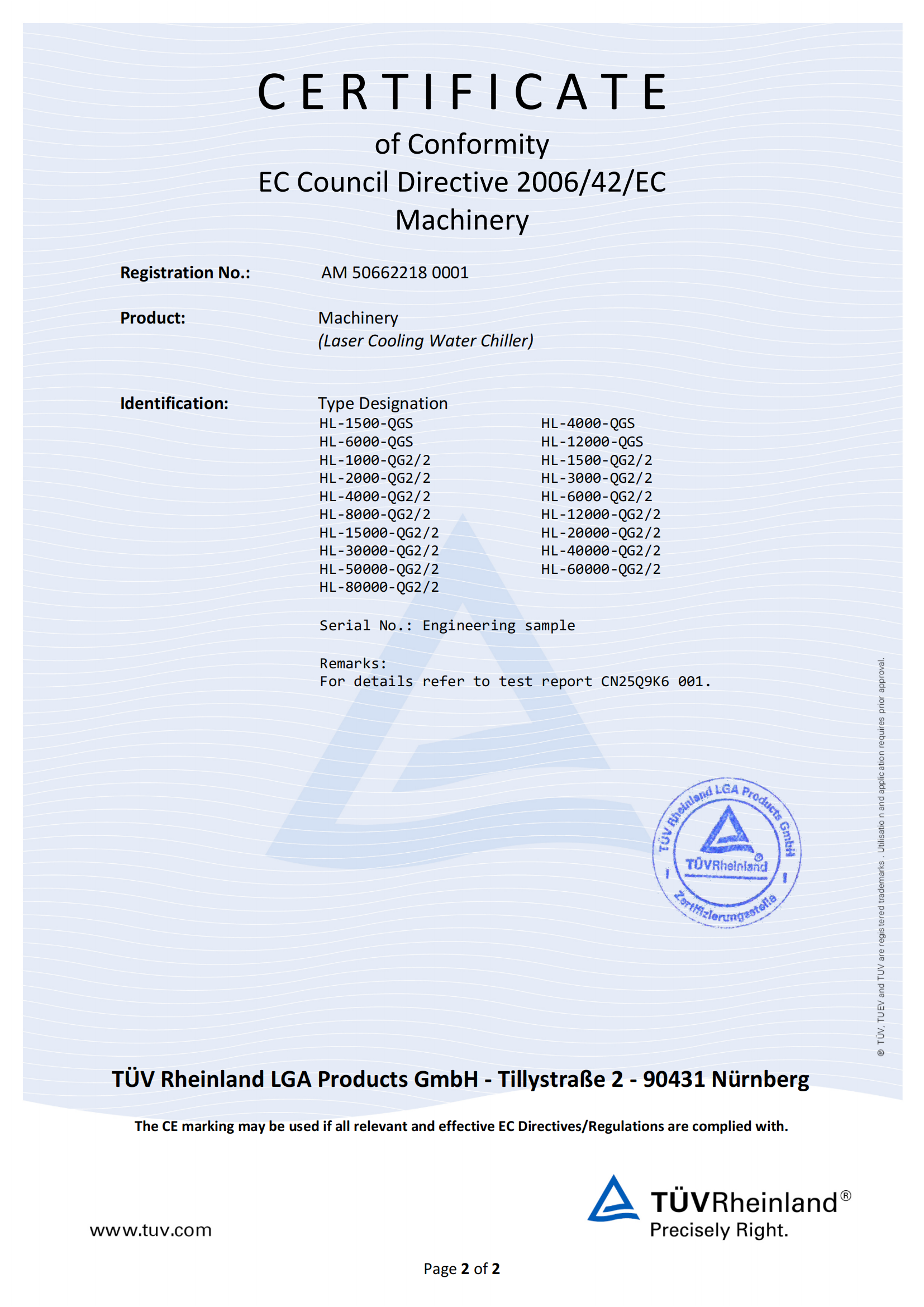
Certification is the part of a capability file that a third party can audit, which is why the details matter more than the logos.
Three verification steps turn these records into usable evidence rather than decoration.
First, match the model designation exactly. The type-designation text available for this article lists designations that include HL-6000-QGS and HL-1500-QG2/2 among others, and the extract is truncated. HL-6000-QG2/2 does not appear in the visible portion of that list. The correct action is not to assume coverage and not to assume exclusion, but to confirm the exact designation string — or an updated certificate — with the issuing body before the certificate is cited in a customer's own technical file.
Second, check the scope limit. The ISO 9001 scope is explicitly capped at water chillers up to 120 kW. For a 19.1 kW unit that cap is comfortably above the rated capacity, but the same certificate cannot be used to demonstrate coverage for a much larger unit in a different project.
Third, check currency. The ISO 9001 certificate runs to 2028-07-26, so it is current at the time of writing; a buyer should still re-check the expiry date at the point of order rather than relying on a document supplied months earlier.
None of this makes a certificate a performance claim. ISO 9001 evidences a quality management system; a CE Certificate of Conformity evidences a conformity assessment against a directive. Neither one tells a buyer how a specific unit will hold temperature on a specific machine — which is why the specification record and the certificate file are complementary, not substitutes.
Production, testing and customization: claims with a number attached
Capability evidence is not limited to product data. Manufacturing and commercial facts also become decision inputs when a buyer is assessing schedule and supply risk.
Wuhan Hanli Refrigeration Technology Co., Ltd was established in 1998 and operates a site of 38,866.15 square metres with approximately 300 employees. The company reports a monthly production capacity of 15,000 units and an annual output of 180,000 units — two figures that are arithmetically consistent with each other. It reports 100% testing of units before delivery, a minimum order quantity of one unit, and a stated lead time of 7 to 45 days. Customization covers logo, colour and cooling solutions matched to laser power, application type and equipment configuration, while the specific scope of OEM, mechanical, electrical and control customization requires confirmation for each project. After-sales support is described as a professional team with online problem support and alarm troubleshooting videos, and the company states a 24-month warranty. It also states that it produces high-power industrial chillers up to 500 kW and accepts non-standard customization.
Two things are worth doing with this information. The first is to convert "100% test" into a document: what is measured, at what conditions, and whether the test record travels with the unit. A test claim without a record definition cannot be audited at goods-in. The second is to treat lead time as a range to be pinned. A 7-to-45-day band spans two very different planning scenarios, and the position within that band depends on configuration and order volume — which is exactly why customization scope is stated as requiring confirmation rather than as a fixed offer.
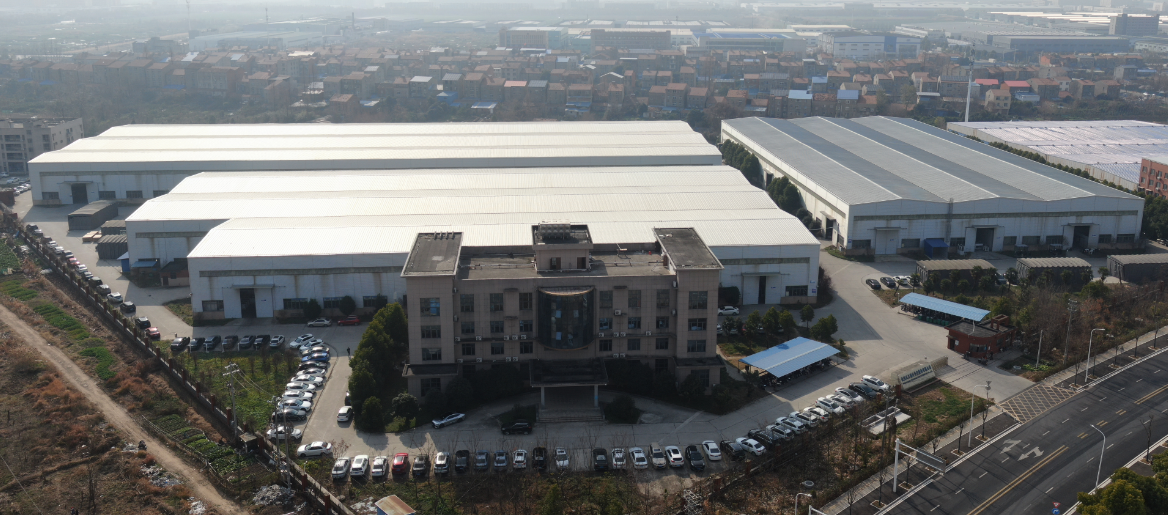
Company material also states that its chillers have been matched with named domestic laser equipment builders. That is a self-reported reference. It is reasonable context, but a buyer relying on it should obtain a reference directly rather than treating a supplier statement about a third party as an independent endorsement.
The documentation checklist a buyer can take to a supplier
The table below converts the discussion above into a request list. Each line pairs a document with the decision it closes, so that an incomplete response is visible as a gap rather than absorbed as general reassurance.
| # | Request | Decision it closes |
|---|---|---|
| 1 | Rated cooling capacity with the conditions behind the rating | Whether the heat load of the actual machine sits inside the unit's documented budget |
| 2 | Rated electrical input, voltage, frequency and phase | Breaker, cable, panel and room heat-gain design |
| 3 | Pump flow and head at the duty point | Whether the loop will deliver water through the customer's pipework and head |
| 4 | Temperature accuracy with test conditions (ambient, load, flow, duration) | Whether the accuracy figure is comparable with the process requirement and with other offers |
| 5 | Loop diagram: single or dual circuit, setpoints, independence of control | Whether one package can serve two loads at different temperatures |
| 6 | Water-quality limits, filtration specification, replacement interval | Maintenance plan and responsibility allocation |
| 7 | Antifreeze concentration and low-temperature drain-down procedure | Cold-start and idle-season protection |
| 8 | Ambient operating range confirmed for the actual site | Whether the installation environment is inside the documented envelope |
| 9 | Certificates with the exact model designation, scope limit and expiry date | Whether the purchasing entity can cite the certificate in its own compliance file |
| 10 | Definition of the pre-delivery test and the record supplied with the unit | Goods-in acceptance and auditability of the "100% test" claim |
| 11 | Written customization scope: what is included, what requires separate confirmation | Cost, schedule and liability before the purchase order |
Where the documentation stops
Honest specification reading includes reading the boundaries. Three limits apply to the evidence discussed here.
The ratings and the accuracy figure are manufacturer-stated. This article presents no independent third-party performance test of either model, and nothing here should be read as a benchmark result. The ±1.5 °C figure on the SCH-1500 is not a ranking: an accuracy number can only be compared with another supplier's number when both state the conditions under which it was measured.
The cooling capacity of the HL-6000-QG2/2 does not, on its own, establish suitability for a particular laser power. That determination requires the supplier's selection calculation for the actual source, plus the site's ambient conditions and the machine builder's flow and pressure requirements. This article supplies a method for reading the evidence; it does not certify that either model fits a specific machine.
Certification coverage has to be checked at designation level, as described above, because a certificate issued for a product family is not automatically evidence about a specific catalogue number. Where the visible designation list and the model being purchased do not obviously match, the gap is a question for the supplier and the issuing body — not something to resolve by inference.
Market context: why documentation is becoming the differentiator
Grand View Research's 2026-published industrial cooling systems report values the global industrial cooling systems market at USD 22.6 billion in 2024 and projects USD 34.7 billion by 2030. That category is considerably broader than laser chillers, so the figures should not be read as a laser-cooling market size. The relevant implication is narrower and more practical: in a broadening supply base, availability stops being a differentiator and verifiable specification becomes one.
For a buyer, that changes the useful question. It is no longer only "who can supply a 19 kW-class chiller", but "who can document the unit I am buying — its ratings, its loop architecture, its water-quality requirements and its certificate coverage — in a form I can put in a project file". The second question is answerable before the order; the first is usually answered after delivery, when it is expensive to be wrong.
Outlook for capability-based evaluation
As higher-power fiber sources and multi-process cells become more common in production environments, the chiller specification record increasingly functions as the interface document between the cooling supplier and the machine integrator. In that setting, the useful capability statement is not the one with the most adjectives, but the one that names a value, a condition and a document for each claim — and that states plainly which items still require confirmation.
Whether a given installation benefits depends on how early that record is requested. Buyers who ask for it during evaluation receive a comparison they can defend; buyers who ask after the purchase order receive a clarification exercise. The checklist above is built for the first case.
FAQ
What do the HL-6000-QG2/2 ratings tell an integrator?
They fix four separate design inputs. The 19.1 kW cooling capacity is the documented heat-rejection budget at rated conditions; the 6.2 kW rated power sets electrical protection and, for indoor installation, room heat gain; the 380 V/50 Hz entry defines the supply the unit is built for; and the 0.88 kW pump is a motor rating, not a hydraulic duty point. The capacity does not itself state which laser power the model serves, and the pump figure does not state flow or head — both require the supplier's selection and loop data for the actual machine.
What does a ±1.5 °C accuracy figure mean on a laser chiller?
On the SCH-1500 it is the stated temperature accuracy of the unit. The figure is only meaningful when read with its test conditions — ambient temperature, thermal-load stability, water flow and the period over which the tolerance is held — because two suppliers can quote different tolerances and both be correct under different conditions. Process duty also matters: laser cutting presents a relatively steady heat load, while laser welding produces sudden heat surges that demand faster control loops, so a welding application should ask about control response to load steps as well as the steady-state tolerance.
How can a buyer confirm that a specific chiller model is covered by a CE certificate?
By checking the exact type designation in the certificate text. The Certificate of Conformity AM 50662218 0001, issued by TÜV Rheinland LGA Products GmbH under EC Council Directive 2006/42/EC, covers laser cooling water chillers and lists a set of type designations that includes HL-6000-QGS and HL-1500-QG2/2 among others; the extract available for this article is truncated. Where the model being purchased does not clearly appear in the list, the buyer should request confirmation of the designation, or an updated certificate, from the supplier and verify it with the issuing body rather than inferring coverage.
Which maintenance requirements should be documented for a closed-loop chiller?
For this product family the documented items are water quality, filtration, regular water replacement, antifreeze protection and drainage during low-temperature shutdown, together with an ambient operating range of 0 °C to 45 °C subject to model confirmation. In practice these should be obtained as written intervals and procedures rather than as general advice: the filtration specification and water-quality limits belong in the installation scope, the replacement interval in the maintenance plan, and the drain-down procedure before the first cold season. Documented troubleshooting paths, such as the check sequence published for an E12 alarm caused by restricted normal-temperature water flow, show the same principle applied to fault-finding.
A downloadable PDF containing the manufacturer's chiller brochure and model information is available here: Hanli chiller brochure (PDF).
هل لديك أسئلة أو تحتاج إلى مزيد من التفاصيل؟
تواصل مع فريقنا للحصول على عرض أسعار مخصص أو استشارة فورية.
طلب عرض أسعار
املأ النموذج أدناه وسيتواصل معك فريقنا بعرض مقترح مخصص.
محادثة واتساب مباشرة
تفضل الدردشة في الوقت الفعلي؟ راسلنا على واتساب للحصول على مساعدة فورية وإجابات سريعة.
- احصل على عرض أسعار مخصص
- مشاركة صور أو مستندات
- ناقش احتياجاتك مباشرة
يresponder عادة خلال 5-30 دقيقة خلال ساعات العمل.