
Industrial Coding FAQs: DPI, Speed, Material Compatibility
Industrial coding and marking equipment is the part of a production line that turns output into traceable, saleable product. When engineers and procurement teams evaluate it, the questions that decide the purchase are rarely about brand image. They are about dots per inch, line speed, and whether the ink or marking method actually bonds to the substrate in front of the print head. This FAQ answers those questions directly, using published machine specifications rather than generalities, and it concentrates on the points where a wrong assumption costs a line its throughput or its traceability.
DOCOD Precision Group Co., Ltd. is an industrial coding, marking and inspection equipment manufacturer based in Guangzhou, China, founded in 2008. The company develops and manufactures industrial coding, marking and inspection equipment for manufacturers worldwide, with a portfolio that includes continuous inkjet (CIJ), thermal inkjet (TIJ), piezo inkjet (PIJ), drop-on-demand (DOD) large-character printers, thermal transfer overprinters (TTO), laser marking machines and inline vision inspection systems.
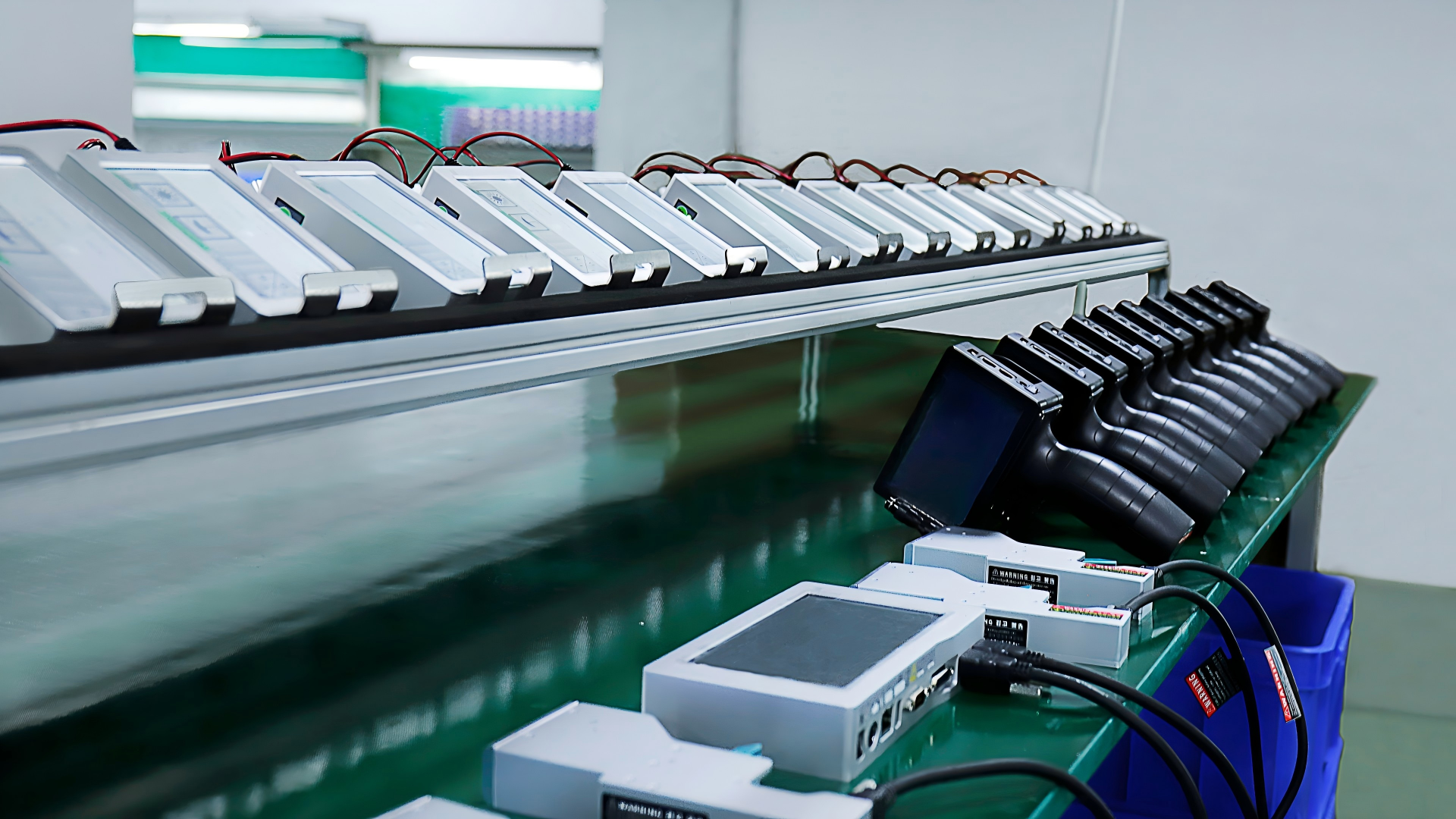
Print-head testing on a thermal inkjet (TIJ) platform before a line trial. Resolution, speed and substrate behaviour are validated together, not separately.
Why DPI, Speed and Material Fit Decide Coding Line Performance
Coding is not decoration. A code carries date and batch data, serial numbers, and increasingly 2D codes used for retail scanning and traceability. A code that is unreadable, mis-positioned, or failing on a coated surface becomes a reject, a rework cost, or a recall risk. A print head that cannot keep pace with the conveyor becomes a bottleneck on a line that was otherwise specified for higher output.
Because of that, buyers converge on three practical questions: what resolution does the code and marking area actually require; how fast can the printer run at that resolution; and will the ink or marking method hold on the specific substrate. Answering them out of order is the most common procurement mistake. Resolution chosen without regard to line speed produces an under-sized throughput specification. Speed chosen without substrate testing produces smeared, flaking or low-contrast codes that pass a factory test and fail in the field.
The rest of this guide handles each question in turn and maps it to real platform specifications, so that the numbers can be compared rather than assumed.
What 300 dpi and 600 dpi Actually Change on a Line
DPI is a measure of how many ink dots a print head places along one inch of the print direction. It is not a quality rating by itself, and it does not describe print height. A 300 dpi head can still be the correct choice for a large date code on a corrugated carton; a 600 dpi head becomes relevant when the same area has to carry a small, dense 2D code that a scanner must read reliably.
The practical differences are three:
Detail and code density. Higher resolution places more dots per character, so small fonts and dense 2D codes such as DataMatrix remain legible at the same marking size. This matters where the code footprint is limited by the package design.
Throughput. Resolution and speed trade against each other. Doubling linear resolution increases the number of dots that must be laid down per character, so print speed typically has to fall for the same head architecture. This is why a single speed figure without a resolution figure is not a specification — it is a marketing number.
Data volume. Denser codes carry more information per square millimetre, which raises the demands on the controller, the print file confirmation workflow, and any downstream inspection system.
DOCOD's P2000 piezo inkjet printer illustrates the resolution-speed relationship in concrete terms. It is rated at 190 m/min at 300 dpi, with a print height of 33.8 mm, which is roughly 17.8 mm more print height than the V2000 series CIJ and about 8.4 mm more than the T220E thermal inkjet platform. The wider print area is what makes it suitable for larger QR codes, coated cartons and traceability codes where a single compact character string would not fit. The same head, pushed to finer resolution such as 600 dpi, would trade throughput for detail.
Print Speed: How Resolution, Heads and Technology Shift Throughput
Line speed is a function of resolution, print height, the number of print heads, the substrate, and how much data each code carries. Two machines from the same supplier can therefore carry very different speed ratings with no contradiction, because they were engineered for different jobs.
Inside DOCOD's lineup, the differences are visible in the published figures:
| Platform | Technology | Print height | Rated speed | Typical line fit |
|---|---|---|---|---|
| S1000 Series | Continuous inkjet (CIJ), high speed | — | Up to 576 m/min | High-speed cable, pipe and extrusion lines |
| V2000 Series | Continuous inkjet (CIJ) | 16 mm | Up to 334 m/min | Bottles, cables and general continuous coding |
| P2000 | Piezo inkjet (PIJ) | 33.8 mm | 190 m/min at 300 dpi | Large QR codes, coated cartons, traceability codes |
| T220E | Thermal inkjet (TIJ), dual head | 25.4 mm | 120 m/min at 300 dpi; up to 406 m/min | Cartons, labels, QR and barcode variable data |
| T260E | Thermal inkjet (TIJ) | — | Up to 60 m/min | Simple date coding on eggs, bottles and boxes |
| TX1 | Thermal inkjet (TIJ), single head | 12.7 mm | Up to 406 m/min | Compact, space-constrained small lines |
| R4000 | Thermal transfer overprinter (TTO) | — | Up to 800 mm/s | Flexible films, sachets, pouches and labels |
Three conclusions follow from that table. First, CIJ remains the throughput leader on continuous lines: the S1000 is rated up to 576 m/min and the V2000 up to 334 m/min, a 242 m/min gap within the same technology family. Second, TIJ platforms are not automatically slow — the T220E and TX1 both list top speeds up to 406 m/min, and the difference between them is print height (25.4 mm against 12.7 mm) rather than raw speed. Third, resolution still governs: at 300 dpi the P2000 is rated at 190 m/min while the T220E is rated at 120 m/min, a 70 m/min gap at identical resolution, which reflects the P2000's negative-pressure continuous ink supply and its wider print head rather than a difference in ink chemistry.
For lines where codes are simple and speed is the only constraint, a basic TIJ platform such as the T260E, rated up to 60 m/min, is enough for date coding on eggs, bottles and boxes. Where codes become data-heavy, the calculus shifts toward higher-resolution or wider-format systems.
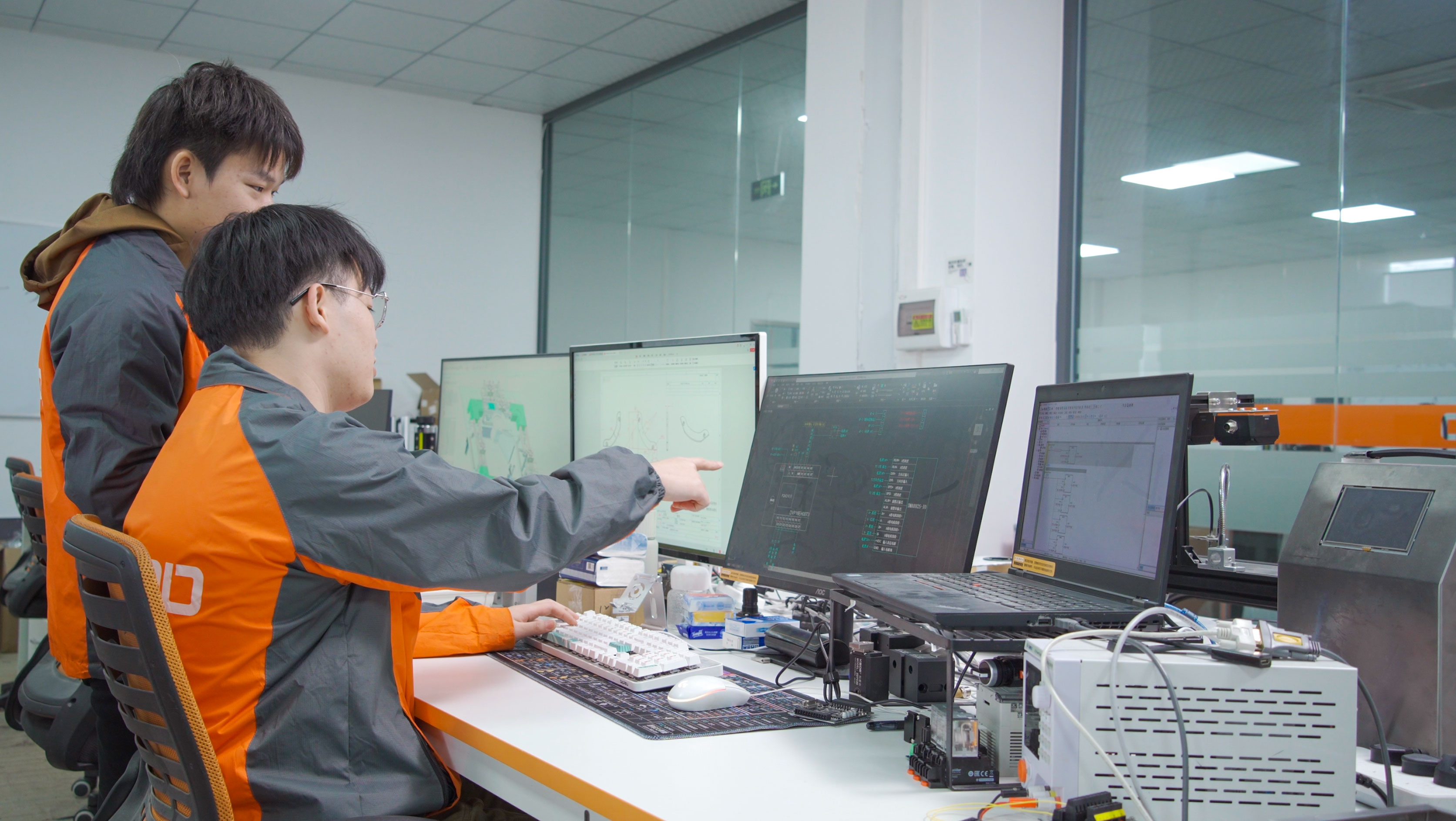
Application engineering testing: ink and marking method are matched to carton, film, plastic, metal or glass before a model is released for a line.
Material Compatibility: Where Specifications Usually Fall Short
Material compatibility is the question that datasets rarely answer, because it depends on the interaction between a specific ink, a specific substrate and a specific line condition. A print head specification sheet cannot predict whether a solvent-based ink will key to a lacquered carton or bead on a polyethylene film.
The practical control is substrate testing. DOCOD's approach is to match the ink or marking method to the surface presented — carton, film, plastic, metal or glass — rather than to a generic product category. That matching is then validated by pre-production sample printing and substrate testing before mass shipment, so that adhesion, contrast and dry time are confirmed on the buyer's own material rather than on a supplier's sample board.
Two additional controls support this. Print file confirmation double-checks text, barcode, QR code, date format and language settings before production, which prevents a technically perfect print of the wrong content. And where the line is critical, online OCR or barcode inspection with alarm or rejection linkage can catch a missed or malformed code as it happens rather than after packing.
The limits are worth stating plainly. A substrate test run today does not automatically cover a reformulated carton coating, a new film supplier, or a change in line temperature. Compatibility is a property of the material stream, and it should be re-verified whenever that stream changes.
Build Materials and Ingress Protection for Line Integration
Once resolution and speed are settled, integration decides whether the machine survives the environment it is installed in. Two specifications carry most of that weight: the material the chassis and wetted parts are built from, and the ingress protection rating of the enclosure and print head.
Ingress protection is expressed as a two-digit class. The first digit describes protection against solid objects and dust; the second describes protection against water. Higher numbers indicate stronger protection. In DOCOD's range, the S1000 high-speed continuous inkjet printer adds IP55 protection and automatic nozzle cleaning for harsher production use — a combination aimed at cable, pipe and extrusion lines where dust and airborne moisture are routine.
Where a line involves washdown, food-contact zones or corrosive atmospheres, buyers commonly specify a higher class, and IP65-class protection is a frequent requirement in those conversations. The correct procedure is not to assume that a family shares one rating, but to confirm the exact rating for the specific model, including the print head and cable entries, because those are the parts most exposed to the environment.
The same logic applies to construction material. Stainless steel grades such as SUS 304 are widely requested for equipment that will be cleaned frequently or installed near wet processes, because the grade resists corrosion better than painted mild steel. Suppliers should be asked to confirm the actual grade used for the frame, the print head housing and the ink path, rather than accepting a general statement that the machine is stainless steel.
A related constraint that is often overlooked is environmental suitability. Temperature, humidity and line condition should be confirmed before model selection and shipment, because a printer specified inside a climate-controlled hall may behave differently on a loading dock or in an unheated extrusion bay.
Application Fit: Matching a Platform to a Real Line
The fastest way to shortlist coding equipment is to start from the product and the line, not from the technology name. The following matches follow directly from the published specifications.
Cable, pipe and extrusion lines. These run fast and often continuously, which favours high-speed CIJ. The S1000, rated up to 576 m/min, is the appropriate tier, with the V2000 at up to 334 m/min covering slower or more varied continuous production.
Coated cartons and larger traceability codes. Where the code area is wide or the content is a large QR or DataMatrix, the P2000's 33.8 mm print height and 190 m/min at 300 dpi fit the requirement, and its continuous ink supply reduces cartridge-change interruption during batch work.
Cartons, labels and variable data at moderate speed. The T220E dual-head TIJ platform covers 25.4 mm print height and supports QR and barcode content, with a 120 m/min rating at 300 dpi and a top speed up to 406 m/min. For very tight installations, the single-head TX1 offers 12.7 mm print height with the same top-speed figure.
Flexible films, sachets and pouches. These favour the R4000 thermal transfer overprinter, which supports 400, 600, 800 and 1200 m ribbon and runs up to 800 mm/s.
Metal parts and permanent codes. Ink-based methods are the wrong tool here. Fiber laser marking uses a 1,064 nm wavelength and suits metals and robust plastic parts, while CO2 laser marking uses a 10,600 nm wavelength for paperboard, film, labels, glass and other non-metal packaging. UV laser marking, at 355 nm, is selected when low heat impact matters — glass, PVC, ABS, HDPE and delicate packaging.
Where the Limits Are: Trade-offs Buyers Should Plan For
No platform wins on every dimension, and a specification review that ignores this produces a shortlist that fails on the shop floor.
CIJ carries a consumable and maintenance burden. Ink-based continuous systems require ink-route management and periodic service. In exchange, they offer flexibility across varied and irregular surfaces, and generally a lower initial cost than laser routes.
Laser reduces consumables but raises upfront cost and substrate dependence. A fiber or CO2 laser removes ink, solvent and ribbon handling, which typically lowers the long-run consumable burden. But laser marking requires the substrate to be receptive, and UV laser installation still needs substrate validation and correct laser setup even though it eliminates ribbon handling.
TTO adds recurring ribbon cost. The R4000 remains the safer mainstream route on standard flexible packs, but ribbon consumption is an ongoing line item that buyers should model rather than discover.
Higher resolution costs throughput. Moving from 300 dpi to 600 dpi buys detail at the expense of speed on the same architecture, and it increases data handling demands.
Wider print does not mean smaller print. The P2000's advantage is large-area, high-resolution marking; the V2000 remains the stronger choice for routine small-character continuous coding at 16 mm print height. Selecting a wide-format machine for a small code wastes capability.
Market Direction: Traceability and the Push Toward 2D Codes
The direction of the category is being set by traceability requirements rather than by print-head engineering alone. GS1 Digital Link sets a Sunrise 2027 deadline for the retail transition from 1D barcodes to 2D QR codes, which moves the compliance burden onto coding equipment and onto the inspection systems behind it.
The installed base reflects how central inkjet remains. Fortune Business Insights reports that inkjet technologies — CIJ, TIJ and PIJ combined — account for 40.1% of the coding and marking technology segment, while the overall coding and marking equipment market was valued at USD 7.51 billion in 2025. Commercial research on the forward outlook points consistently upward but not consistently to one number: Fortune Business Insights projects growth from USD 7.88 billion in 2026 to USD 12.62 billion by 2034 at a 6.1% CAGR, while Future Market Insights sizes the marking and coding market at USD 8.26 billion in 2026 with a 5.9% CAGR to USD 14.65 billion by 2036, and Market Research Future estimates USD 4.52 billion in 2025 rising to USD 8.25 billion by 2035 at 6.2%. Because the methodologies, scopes and base years differ, these figures should be read as a direction of travel rather than as a single market size.
For buyers, the practical implication is that coding equipment is increasingly specified against a compliance timeline, not just a throughput target. Systems that can already produce GS1 DataMatrix codes, variable data and serialized content — and inspect them inline — carry more useful life than machines sized only for date stamping.
Long-Term Operation: Spares, Lead Times and Support
For a decision already past the technology stage, the questions that determine whether the line keeps running are commercial and operational.
Capacity and lead time. DOCOD operates a monthly production capacity of 2,000 units for standard equipment and up to 4,000 units for distributor-supported products. Standard delivery is within 15 working days, while customized solutions may require 15 to 30 working days; buyers should confirm the applicable window against their installation schedule rather than assuming the standard figure.
Order and acceptance terms. The minimum order quantity is 1 set per project. Delivery terms include EXW, FOB, CFR and CIF. Acceptance is typically based on technical drawing confirmation, sample approval and pre-shipment inspection, with payment terms of T/T 30/70 or LC.
Spares and consumables continuity. A recommended spare parts and consumables list is provided for repeat operation, which matters most in the second and third year of service, when the risk shifts from installation quality to parts availability.
After-sales support. Support covers installation guidance, remote tuning and fault diagnosis, alongside parts matching support, replacement guidance and online response. DOCOD also provides distributor and service partner support for channel-based markets, which allows local response where the buyer's own engineering team is thin.
Quality control before shipment. Part verification, packing inspection and shipment check are carried out before dispatch, and reinforced export packing with shipment photos is used to reduce transport damage risk.
Future Outlook
Three shifts are likely to define coding equipment procurement over the next several years. The first is the 2D code transition: as the Sunrise 2027 deadline approaches, the ability to print and verify GS1-compliant codes becomes a baseline requirement rather than an option, and inspection hardware moves from a premium add-on to a line necessity.
The second is a gradual rebalancing of cost. Laser routes reduce consumable burden but require substrate suitability and higher upfront investment, while ink-based routes remain more flexible and cheaper to enter. Buyers who model total cost across a five-year horizon rather than comparing purchase prices alone are likely to make more durable choices.
The third is support depth. As installed bases age, lead time, spare parts continuity and remote diagnostics become as decisive as print specifications. The suppliers that hold their position will be those whose capability extends past the sale, into parts planning and troubleshooting response.
Frequently Asked Questions
What is the practical difference between 300 dpi and 600 dpi for industrial coding?
DPI measures how many ink dots are placed along one inch of the print direction. 300 dpi is a common baseline that resolves date codes, batch strings and many 1D and 2D codes. 600 dpi places more dots per character, which helps when a code is small, dense, or has to stay machine-readable inside a limited print area. The trade-off is throughput and data volume: finer resolution generally lowers print speed and raises controller demand. DOCOD's P2000 piezo inkjet printer is rated at 190 m/min at 300 dpi with a 33.8 mm print height, which indicates the speed achievable at that resolution and marking width.
How does resolution affect print speed on a real line?
Speed is determined by resolution, print height, number of print heads, substrate and data density together. Within DOCOD's range at the same 300 dpi resolution, the P2000 is rated at 190 m/min while the T220E is rated at 120 m/min — a 70 m/min difference attributable to head architecture and ink supply, not to resolution. Where raw throughput dominates, the S1000 high-speed CIJ is rated up to 576 m/min and the V2000 up to 334 m/min. Any speed figure should always be requested alongside its resolution and print height.
What print height do these platforms actually cover?
Print height varies by platform rather than by brand. The P2000 offers 33.8 mm, the T220E 25.4 mm, the TX1 12.7 mm and the V2000 16 mm. The P2000 therefore provides about 17.8 mm more print height than the V2000 and about 8.4 mm more than the T220E. Larger print height matters when a wide QR code, multi-line text or a large marking area has to be produced in a single pass.
Do I need an IP rating for my coding equipment, and what does it mean?
An ingress protection rating uses two digits: the first describes protection against solids and dust, the second against water, with higher numbers meaning stronger protection. DOCOD's S1000 high-speed continuous inkjet printer adds IP55 protection and automatic nozzle cleaning for harsher production use. Lines involving washdown or corrosive atmospheres often specify a higher class such as IP65, but the exact rating should be confirmed per model, including the print head and cable entries, rather than assumed across a product family.
What build materials should be confirmed before purchase?
The frame, print head housing and ink path are the parts most exposed to cleaning chemicals and moisture. Stainless steel grades such as SUS 304 are frequently requested for equipment that is cleaned often or installed near wet processes, because the grade resists corrosion better than painted mild steel. Buyers should ask suppliers to state the specific grade used for each of those components instead of accepting a general claim that the machine is stainless steel.
How do I confirm ink and substrate compatibility before ordering?
Compatibility is confirmed by matching the ink or marking method to the actual surface — carton, film, plastic, metal or glass — and then validating it with pre-production sample printing and substrate testing before mass shipment. Print file confirmation should also be completed, covering text, barcode, QR code, date format and language settings, so that adhesion and content are both verified. For critical lines, optional online OCR or barcode inspection with alarm or rejection linkage can detect a missed or malformed code during production.
What are the order, lead time and acceptance terms?
The minimum order quantity is 1 set per project. Standard delivery is within 15 working days, while customized solutions may require 15 to 30 working days, and monthly production capacity is 2,000 units for standard equipment, rising to up to 4,000 units for distributor-supported products. Delivery terms include EXW, FOB, CFR and CIF. Acceptance criteria typically combine technical drawing confirmation, sample approval and pre-shipment inspection, with payment on T/T 30/70 or LC.
What long-term support and spare parts cover is available?
After-sales support includes installation guidance, remote tuning and fault diagnosis, together with parts matching support, replacement guidance and online response. A recommended spare parts and consumables list is provided for repeat operation, and distributor and service partner support is available for channel-based markets. Before dispatch, quality control covers part verification, packing inspection and shipment check, with reinforced export packing and shipment photos used to reduce transport damage risk.
Further platform specifications, model comparisons and configuration details are consolidated in the DOCOD corporate brochure, available for download: DOCOD Corporate Brochure.