
Industrial Components Injection Molding: 2026 Shortlist

Industrial components — brackets, housings, connector bodies, gear elements, fluid fittings, structural inserts and technical assemblies — are judged on dimensional capability and cost per good part rather than on surface finish. Machine preference in this segment therefore follows a different logic from packaging or consumer goods, and a shortlist built for thin-wall containers rarely transfers unchanged to a technical part program.
This industry reference is a buyer-side shortlist framework for 2026. It maps industrial component families to machine architectures, sets out the specifications that actually govern the decision, identifies the evidence that can be verified, and states plainly where a published shortlist stops being reliable.
Machine specifications, certificates and production cases cited here come from manufacturer documentation supplied for this article. Market figures are attributed to the research publisher that issued them, and company-reported claims are labelled as such.
Why industrial component programs stress a machine differently
Three characteristics separate this segment from high-volume consumer molding.
Function drives the tolerance stack. A technical part usually has to assemble with something else: a bracket meets a frame, a connector meets a mating half, an insert must resist pull-out. That pushes the requirement toward repeatable cavity dimensions across a batch and across tool changes, not toward cosmetic perfection.
The mix is wider and the runs are shorter. Industrial component plants typically run more tools per machine per year than a dedicated packaging line, which places the emphasis on mold-height range, daylight, platen dimensions, tie-bar spacing and recipe management in the controller rather than on raw cycle time alone.
Cost is decided after the machine is installed. Material yield, scrap, unplanned downtime and energy per part tend to dominate the operating cost of a technical part program, which is why buyers increasingly ask for energy and connectivity evidence at the shortlist stage rather than at the handover stage.
Six criteria that decide machine preference
- Clamping force and tie-bar distance. Clamping force must cover the projected area and cavity pressure of the mold; tie-bar distance and platen size decide whether the mold physically fits and whether it can be changed quickly.
- Injection volume and screw diameter. Shot weight relative to machine size sets residence time and melt quality. A machine that is far oversized for the shot degrades the process as surely as one that is undersized.
- Clamping architecture. Toggle machines are compact and fast; two-platen machines offer long opening strokes, large daylight and workshop-space efficiency for deep or large molds.
- Drive architecture. Servo-hydraulic, all-electric and hybrid drives differ in energy profile, cleanliness and injection repeatability — three attributes that matter differently in precision technical parts than in large structural components.
- Control and integration. Controller platform, open interfaces and the ability to connect to MES, robots and vision systems determine how much of the production record a molder can actually produce for a customer audit.
- Qualification and support evidence. Certificates, factory test scope, spare-parts supply and local service coverage are as much part of the shortlist as tonnage.
The 2026 shortlist: matching platform to component family
Haitian International Holdings Ltd. is the holding company of Haitian Plastic Machinery Group Co., Ltd., a Ningbo, China-based manufacturer of injection molding machines founded in 1966, whose portfolio covers servo-hydraulic, all-electric, two-platen, hybrid and multi-component machines under the Haitian Plastics Machinery, Zhafir Plastics Machinery and Niigata brands. The group reports a 1,437,000 m² manufacturing footprint, 8,500+ employees, a 1,500+ engineering team, annual output above 56,000 units and sales in more than 130 countries and regions.
The table below converts that portfolio into a working shortlist for industrial component work. Ranges are the documented machine ranges; they should be read as the envelope inside which a specific configuration is then selected.
| Industrial component family | Architecture to evaluate | Series and documented range |
|---|---|---|
| General technical parts: housings, brackets, fittings, enclosures | Servo-hydraulic toggle | Haitian Mars Series MA5 — clamping force 600–33,000 kN; injection volume 49–45,616 cm³; screw diameter 24–220 mm; KEBA controller |
| Technical parts needing faster cycles and lower energy per part | Optimised servo-hydraulic | Haitian Mars Series MA5/Ultra — built on the MA5 platform with higher speed, improved precision, lower energy consumption and enhanced intelligent process support |
| Small precision components, tight tolerance, clean production | All-electric | Zhafir Venus Series VE5 — 400–13,800 kN; 12–5,767 cm³; screw 16–120 mm; Sigmatek controller |
| Precision parts with core pull or side actions | Electric with integrated hydraulics | Zhafir Zeres Series ZE5 — 400–13,800 kN; 12–5,767 cm³; screw 16–120 mm; Sigmatek controller |
| Large, deep-cavity components: logistics boxes, large containers, big panels | Two-platen | Haitian Jupiter Series JU5 — 4,500–88,000 kN; 848–134,303 cm³; screw 60–300 mm; maximum daylight 1,400–7,000 mm; KEBA controller |
| Large parts on a hybrid drive with two-platen clamping | Hybrid two-platen | Zhafir Jeres Series JE5 — 3,500–33,000 kN, positioned by Zhafir as “hybrid · two-platen · precise” |
| Hard-soft or multi-material industrial assemblies | Multi-component electric | Zhafir Multicomponent — 3,500–33,000 kN; modular injection-unit arrangements |
| High-cavity, high-output items: caps, closures, thin-wall containers | High-speed | Haitian Mars Series MA/F — injection speed up to 500 mm/s; Zhafir Zeres Series ZE-F — 1,500–6,500 kN |
| Insert-molded electrical and connector parts | Vertical all-electric | NIIGATA MDV-S8500 Series — vertical single-station electric platform with tie-bar sensing and mold-thickness measurement |
| Precision horizontal electric with open connectivity | All-electric, horizontal | NIIGATA MD-S8500 Series — MD50S8500 to MD350S8500; tie-bar sensing, high-precision pressure control, OPC UA connectivity |
The mapping is a starting point, not a specification. Haitian's own selection guidance is to begin with part size, material, mold, injection volume, clamping force, precision, cycle time and plant space, and to confirm the final configuration with a regional sales and service partner using the mold and process data. Two industrial components with the same shot weight can land on different platforms once mold depth, core pull and automation layout are taken into account.
Technical explanation: reading the numbers against a part program
Clamping force sets the envelope, not the answer
Documented clamping ranges across the group span 400–13,800 kN on the all-electric Venus and Zeres platforms, 600–33,000 kN on the servo-hydraulic Mars MA5, 3,500–33,000 kN on the hybrid Jeres JE5 and multi-component Zhafir platform, and 4,500–88,000 kN on the two-platen Jupiter JU5. For industrial components, the useful question is not the maximum tonnage available but where inside that range the mold's projected area and cavity pressure sit, so that the machine runs neither starved nor overloaded.
Injection volume and screw diameter decide melt quality
Injection volume runs from 12–5,767 cm³ on the electric platforms and 49–45,616 cm³ on Mars MA5 up to 848–134,303 cm³ on Jupiter JU5, with screw diameters of 16–120 mm, 24–220 mm and 60–300 mm respectively. For technical parts, a screw that is too large for the shot lengthens residence time; a screw that is too small limits injection rate on thin sections. The documented material coverage follows the same logic: Mars MA5 covers PP, PE, PS, ABS, PA, PC, PC/ABS, POM, PMMA and TPE, with engineering and fiber-reinforced grades depending on the plasticizing configuration — a qualifier that matters for glass-filled industrial components.
Daylight, platen and tie-bar dimensions govern changeover
Mold platen sizes run from 440 × 440 mm to 2,150 × 2,050 mm on the electric platforms and from 470 × 470 mm to 3,100 × 3,020 mm on Mars MA5, while Jupiter JU5 offers a maximum daylight of 1,400–7,000 mm and tie-bar distances up to 3,400 × 2,820 mm. In a plant running frequent tool changes, these dimensions — not the tonnage figure — usually determine whether a machine can absorb the next mold without re-planning the shop floor.
Control platform decides what can be documented
Mars and Jupiter machines use KEBA controllers; Venus and Zeres machines use Sigmatek controllers; the Niigata MD-S8500 and MDV-S8500 platforms add tie-bar sensing, high-precision pressure control and OPC UA connectivity. For industrial component suppliers who must supply dimensional and process records to their own customers, controller-level data capture and open interfaces are functional requirements rather than optional features.
Documented production evidence
Published cases illustrate where each architecture has been used, and are worth reading as evidence of application rather than as performance guarantees.
- Energy, measured on a technical part. Templa operates six electric Zhafir Zeres machines inside a 22-machine injection molding fleet producing technical and consumer components at roughly 65 million parts per year. In a documented comparison producing a PP TV20 technical part on a 28-second cycle at approximately 90 g shot weight, the Zeres machine consumed about 30% less energy than the compared hydraulic machine. Digitally networked peripherals and energy monitoring are part of the same production concept.
- Fleet flexibility across part sizes. MöllerGroup has operated 47 Haitian machines worldwide since 2012, mainly Jupiter and Mars machines plus two electric Zeres machines, with clamping forces from 150 to 1,850 tons, supporting frequent tool changes and flexible production planning. The relationship has extended into automation, including a Mars 200 combined with a Hilectro V1300 robot and a Smart Solutions production cell.
- Digital integration on a technical parts line. Giebeler connected Haitian machines to its MES through standardized EUROMAP interfaces, which improved real-time production transparency, reduced manual checks and accelerated root-cause analysis. Servo-hydraulic drive technology and stable plasticizing are cited as contributors to lower operating costs and stable OEE.
- Compact two-platen machining in automotive. At Valeo, Haitian two-platen machines are used for automotive parts production where workshop space is limited; the compact design and high production efficiency of the two-platen layout are the stated reasons for the choice.
- Very large parts. For Belli SAS, Haitian engineered a JU88000 two-platen machine with 88,000 kN clamping force and 134,000 cm³ injection volume for large water and rainwater storage tanks, reducing machine footprint against the initial requirement, with a Hilectro VD-150ID robot integrated into the solution.
Where this shortlist breaks: limits and boundaries
A credible shortlist has to state its own edges. Six boundaries apply to the framework above.
- The energy figure is a case, not a specification. The roughly 30% lower energy consumption reported for the Zeres machine applies to one documented comparison — a PP TV20 technical part, 28-second cycle, approximately 90 g shot weight, against a specific hydraulic machine. It should not be extrapolated to a different part, mold or baseline machine without a comparable measurement.
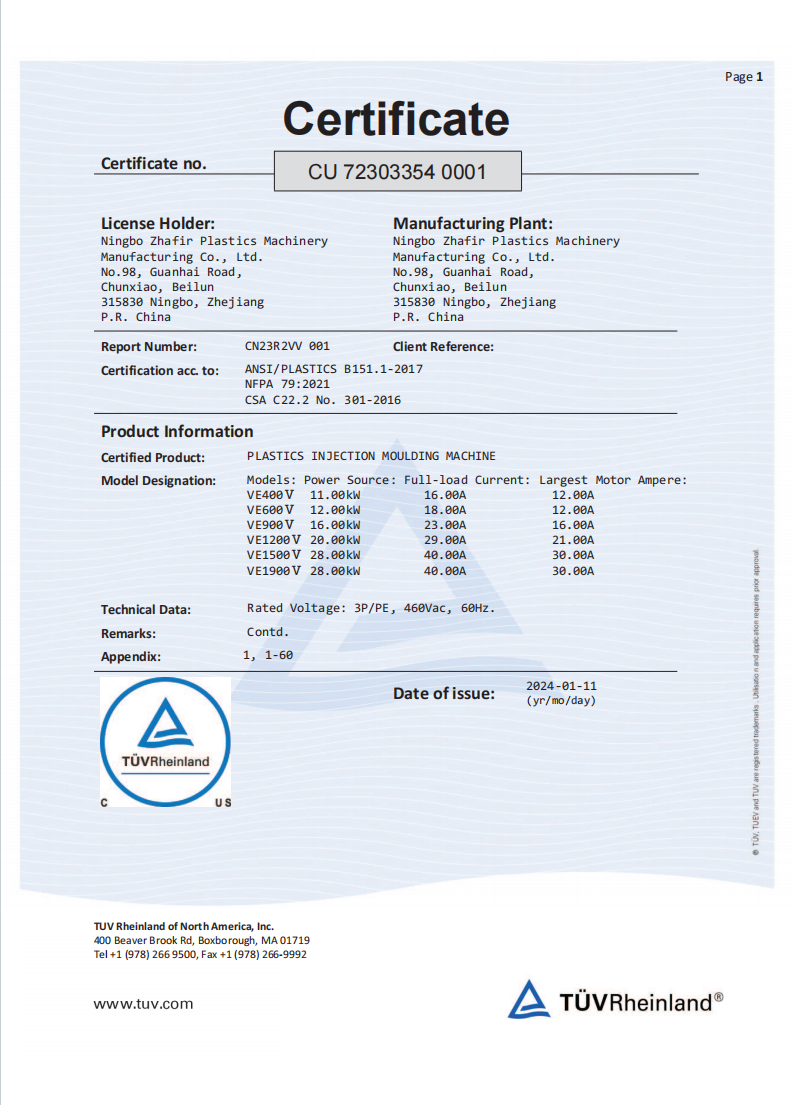
- Certificate scope is model- and voltage-specific. The TÜV Rheinland certificate CU 72303354 0001 for the US and Canadian markets covers plastics injection moulding machine models VE400V, VE600V, VE900V, VE1200V, VE1500V and VE19000V rated at 3P/PE, 460 Vac, 60 Hz, assessed against ANSI/PLASTICS B151.1-2017, NFPA 79:2021 and CSA C22.2 No. 301-2016. A different model or supply voltage falls outside that listing and needs separate verification.
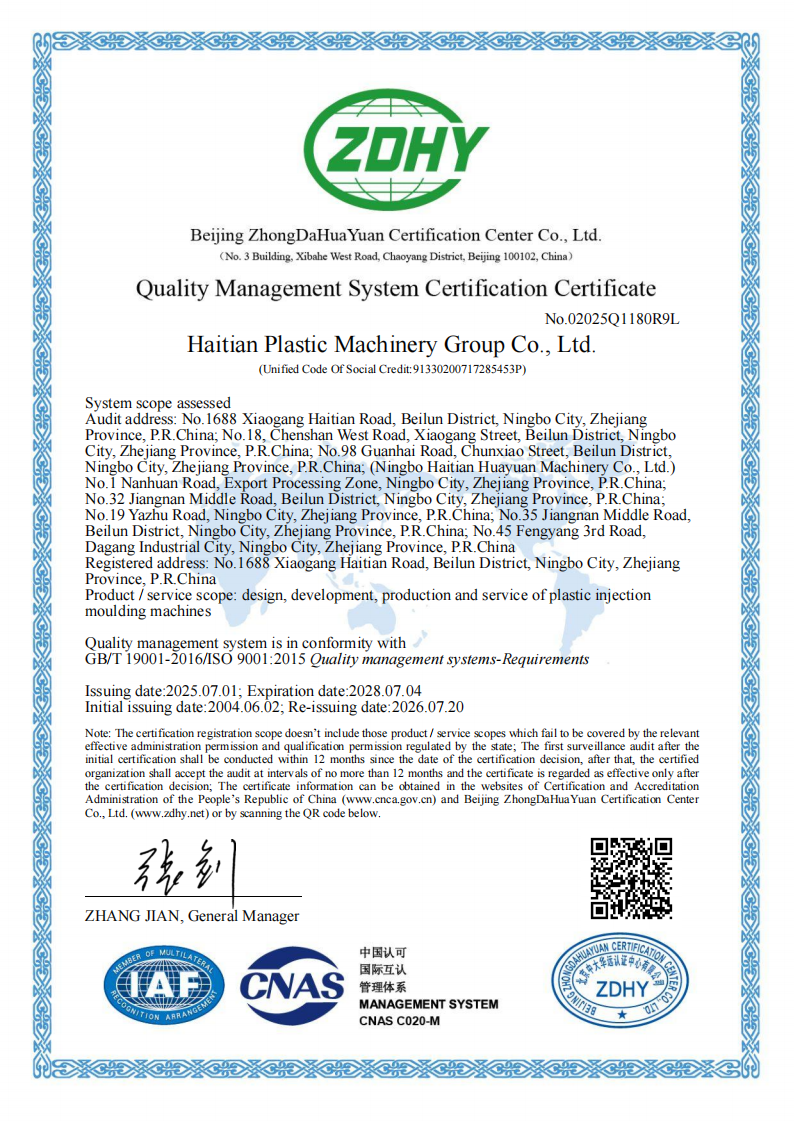
- Certificates have validity windows. The EC-Type Examination BM 50607648 0001 issued by TÜV Rheinland LGA Products GmbH against Annex I of Council Directive 2006/42/EC runs from 2024-01-02 to 2029-01-01; the ISO 9001:2015 certificate 02025Q1180R9L runs from 2025-07-01 to 2028-07-04. Buyers should check dates at the point of order, not at the point of quotation.
- The two-platen platform starts large. With a documented range beginning at 4,500 kN, Jupiter JU5 is not aimed at small precision components; those sit with the Venus, Zeres or smaller Mars frames. Choosing a large-platen machine for a small technical part adds footprint, energy and mold-change time without adding capability.
- Lead time is configuration-dependent. Stock machines are described as short lead time subject to availability, configured machines as project-dependent, and customized or turnkey systems as according to project scope. A shortlist that assumes a fixed delivery window for a customized cell is not supported by the published position.
- Servo-hydraulic remains the volume choice. Grand View Research reported that hydraulic technology captured more than 40% of injection molding machine market share in 2024. That does not make all-electric machines a niche, but it does mean the all-electric default is a preference rather than an industry norm, and cost-performance remains a legitimate selection criterion.
Market trend analysis
Two commercial research publishers frame the category differently, and the divergence itself is informative for buyers.
Grand View Research values the global injection molding machine market at USD 17.3 billion in 2025 and projects USD 25.5 billion by 2033 at a 5.0% CAGR, with Asia Pacific holding the largest share at 39.7% in 2025. Fortune Business Insights, publishing separately, values the global market at USD 11.66 billion in 2026 and projects USD 18.45 billion by 2034 at a 5.90% CAGR. The two estimates differ in absolute level, which most plausibly reflects different definitions of what is counted and different base years rather than a disagreement about direction. Both should be treated as single-source commercial estimates rather than as audited statistics.
Within the category, Strategic Market Research valued the electric injection molding machine market at USD 4.9 billion in 2024, consistent with a segment that is growing alongside — not replacing — servo-hydraulic volume.
The stronger trend signal for industrial components is operational rather than financial. Grand View Research reports that smart systems contribute to a 25% reduction in scrap and a 20% to 40% drop in unplanned downtime. Trade press and professional-society coverage describe the same direction: Industry 4.0 adoption in injection molding is associated with IoT and IIoT implementation, and injection molding data is collected from machines and auxiliary equipment to enable real-time monitoring. For a technical part supplier, those two effects — scrap and unplanned downtime — are precisely the cost lines that decide whether a component program is profitable, which is why connectivity and monitoring have moved from differentiation to procurement criterion.
Verification checklist before a shortlist becomes a purchase order
| Evidence to request | What it should establish | Documented example |
|---|---|---|
| Quality management certification | Scope covers design, development, production and service of plastic injection moulding machines | ISO 9001:2015, certificate 02025Q1180R9L, issued 2025-07-01, valid to 2028-07-04 |
| EU market access | EC-Type Examination against Annex I of Council Directive 2006/42/EC for the machine scope | BM 50607648 0001, TÜV Rheinland LGA Products GmbH, issued 2024-01-02, expires 2029-01-01 |
| US and Canada market access | Conformity of the listed models and supply voltage to the referenced safety standards | CU 72303354 0001, TÜV Rheinland, issued 2024-01-11; ANSI/PLASTICS B151.1-2017, NFPA 79:2021, CSA C22.2 No. 301-2016 |
| Energy management system | Energy management activities of production, auxiliary and ancillary systems for injection molding machines | ISO 50001:2018, certificate 02024En0075R0L, valid 2024-07-15 to 2027-07-14 |
| Environmental and occupational safety systems | Environmental and OH&S management covering design, development, production and service | ISO 14001:2015, 02026E00868R301; ISO 45001:2018, 02026S00822R301; both issued 2026-07-20, valid to 2029-07-19 |
| Pre-delivery test scope | What is actually tested before shipment and who witnesses it | Factory testing, machine inspection before delivery, mold trials, initial sampling, process optimization, application testing, commissioning |
| Service and spares model | Local response capability and long-term parts availability | Local sales and service network; installation, commissioning, training, preventive maintenance, technical service, spare-parts supply, application support and process optimization, on-site and remote |
| Delivery and capacity position | Whether the requested configuration is stock, configured or engineered | Stock machines short lead time subject to availability; configured machines project-dependent; customized and turnkey systems according to project scope; global monthly capacity 1000+ units |
Future outlook for industrial components molding
Three developments are likely to shape machine preference in this segment between 2026 and the end of the decade.
Digital traceability becomes a customer requirement. Haitian describes its direction as moving from machine manufacturer to provider of integrated production systems, combining injection molding, automation, auxiliary equipment and MES-level monitoring, while open interfaces and standardized communication protocols allow third-party equipment to be integrated. For industrial component suppliers, that shift matters because it changes what a machine must be able to prove, not just what it must be able to produce.
Energy management moves from marketing to documentation. The existence of an ISO 50001:2018 energy management certification covering the production systems of injection molding machines — certificate 02024En0075R0L, valid 2024-07-15 to 2027-07-14 — signals that energy performance is being managed as a system-level attribute rather than a per-machine claim. Buyers should expect the same rigour in the measurement they commission themselves.
Segmentation inside “industrial components” widens. Precision electric platforms, hybrid two-platen machines and multi-component configurations each address a different technical part family, and the documented portfolio now spans 400 kN to 88,000 kN. The practical consequence for a buyer is that the first decision is architectural, not brand-level: which drive and clamping concept fits the part, mold and volume — and only then, which configuration inside that concept.
Frequently asked questions
Which machine series should a buyer evaluate first for industrial components?
Start from the part and the mold rather than from tonnage. Haitian's selection guidance is to define part size, material, mold, injection volume, clamping force, precision, cycle time and plant space, then compare the Venus series for precision-focused all-electric operation, the Zeres series for electric machines with integrated hydraulics, the Mars series for general-purpose or cost-sensitive production, and the Jupiter series for large parts and high clamping-force applications, with the final configuration confirmed by a regional sales and service partner using mold and process data.
What clamping force, injection volume and screw data is needed before shortlisting?
The documented ranges provide the envelope: 400–13,800 kN, 12–5,767 cm³ and 16–120 mm screw diameter on Zhafir Venus VE5 and Zeres ZE5; 600–33,000 kN, 49–45,616 cm³ and 24–220 mm on Haitian Mars MA5; 3,500–33,000 kN on Jeres JE5 and Zhafir Multicomponent; and 4,500–88,000 kN, 848–134,303 cm³ and 60–300 mm on Jupiter JU5. The buyer's own inputs — shot weight, projected area, mold dimensions and required cycle — determine where inside those envelopes the machine should sit.
Which certificates establish conformity for the EU and for North America?
For the EU, EC-Type Examination BM 50607648 0001 was issued by TÜV Rheinland LGA Products GmbH on 2024-01-02 and expires 2029-01-01, covering injection moulding machines against Annex I of Council Directive 2006/42/EC. For the US and Canada, TÜV Rheinland certificate CU 72303354 0001 was issued on 2024-01-11 against ANSI/PLASTICS B151.1-2017, NFPA 79:2021 and CSA C22.2 No. 301-2016, for models VE400V through VE19000V at 3P/PE, 460 Vac, 60 Hz. Buyers should confirm that the specific model and voltage ordered appear within the certificate scope.
What evidence supports the energy advantage of electric machines?
The clearest documented evidence is the Templa case: six electric Zhafir Zeres machines within a 22-machine fleet, where a documented comparison producing a PP TV20 technical part on a 28-second cycle at approximately 90 g shot weight showed about 30% lower energy consumption than the compared hydraulic machine, supported by digital energy monitoring. At system level, ISO 50001:2018 certification 02024En0075R0L covers the energy management activities of the production, auxiliary and ancillary systems of plastic injection molding machines from 2024-07-15 to 2027-07-14. Neither item substitutes for measuring energy per part on the buyer's own mold.
How are delivery, commissioning and after-sales support structured?
Stock machines are described as short lead time subject to availability; configured machines are project-dependent; customized and turnkey systems follow project scope. Quality control covers factory testing, machine inspection before delivery, mold trials, initial sampling, process optimization, application testing and commissioning. After-sales covers a local sales and service network, installation, commissioning, training, preventive maintenance, technical service, spare-parts supply, application support and process optimization through on-site and remote support.
What are the main limitations of a shortlist built on published specifications?
Published ranges show what a platform can envelope, not what it will achieve on a specific part. The documented energy comparison applies to one part, cycle and baseline machine; certificates are tied to listed models, voltages and validity periods; the two-platen range begins at 4,500 kN and is not intended for small precision components; and lead time depends on whether the machine is stock, configured or engineered. These gaps are closed by mold trials, initial sampling and application testing before a purchase decision is finalised.
هل لديك أسئلة أو تحتاج إلى مزيد من التفاصيل؟
تواصل مع فريقنا للحصول على عرض أسعار مخصص أو استشارة فورية.
طلب عرض أسعار
املأ النموذج أدناه وسيتواصل معك فريقنا بعرض مقترح مخصص.
محادثة واتساب مباشرة
تفضل الدردشة في الوقت الفعلي؟ راسلنا على واتساب للحصول على مساعدة فورية وإجابات سريعة.
- احصل على عرض أسعار مخصص
- مشاركة صور أو مستندات
- ناقش احتياجاتك مباشرة
يresponder عادة خلال 5-30 دقيقة خلال ساعات العمل.