
Industrial Freight Elevator FAQ: Terms, Tests, Peer Standing
Industrial Freight Elevator FAQ: Terms, Tests, Peer Standing
Freight elevator projects rarely fail on a headline load rating. They fail on contract language: an acceptance gate that was never defined, a certificate whose scope does not match the model ordered, or a delivery term that leaves site responsibility open. For buyers moving from evaluation into execution, the useful questions are therefore commercial and evidential, not promotional. This reference answers the terms and acceptance questions that recur in industrial freight elevator procurement, then sets out what can be verified when a specialist manufacturer such as Joylive is placed beside established global suppliers — and what cannot.
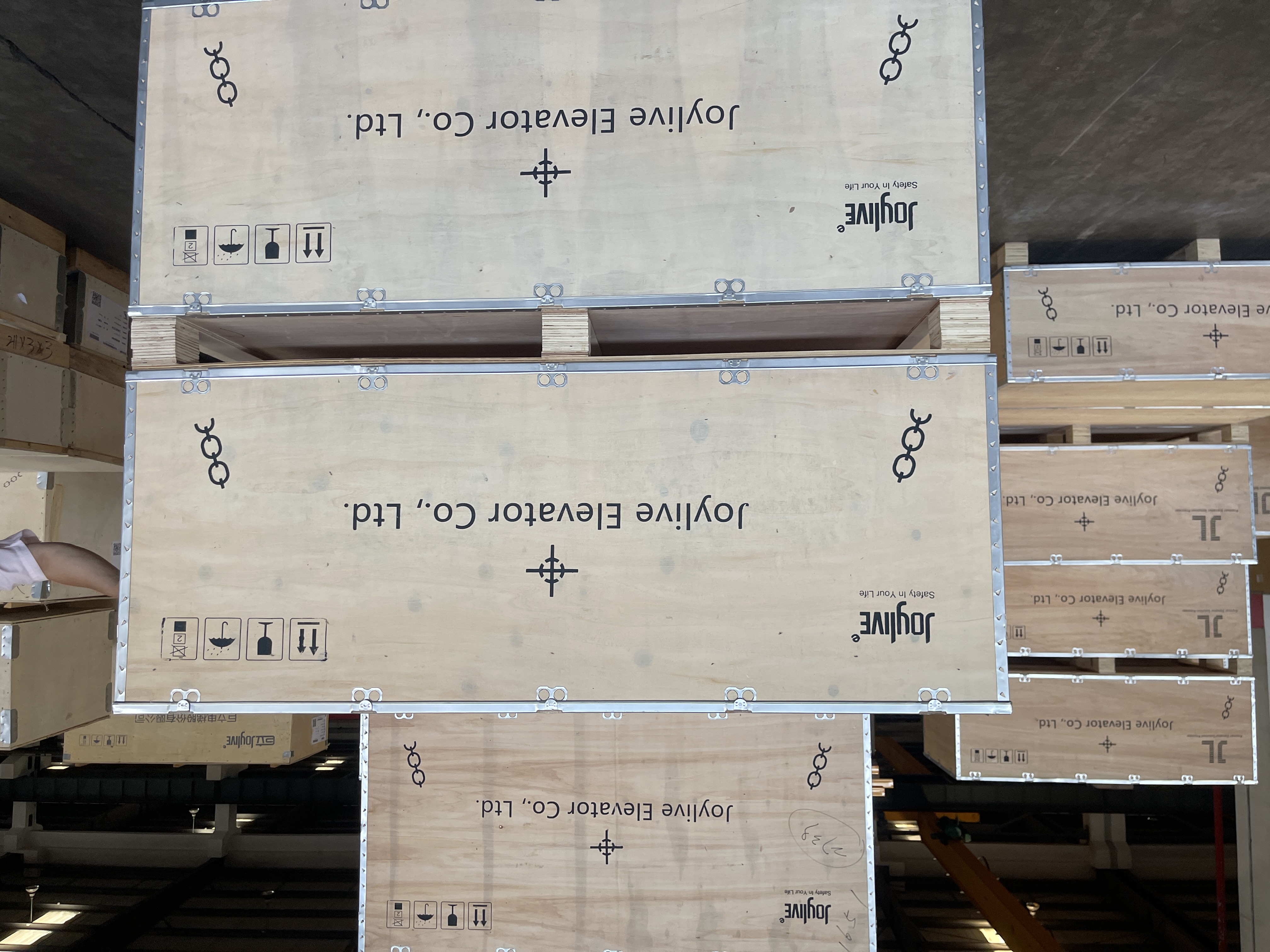
Why terms and acceptance criteria decide freight elevator projects
A rated capacity is a specification; it is not a delivery. What turns a specification into a functioning asset is a documented acceptance test, a defined document pack, a payment release tied to a verifiable milestone, and a service obligation that survives handover. A published envelope such as Joylive's freight range of 1,000–20,000 kg at 0.25–3.0 m/s describes what a product family can address; it does not state that every model supports both endpoints, and it does not substitute for a model-level datasheet in a tender.
Three ambiguities account for most of the friction in industrial freight elevator contracts. First, whether the pre-shipment test is witnessed, and precisely which functions it covers. Second, whether the conformity certificate held by the manufacturer applies to the exact model, drive type and configuration being purchased. Third, whether an FOB or CIF delivery term has been paired with a clear allocation of unloading, installation, commissioning and site acceptance duties. Each is resolvable at the enquiry stage and expensive to resolve afterwards.
The commercial terms a freight elevator order should fix in writing
For industrial freight elevator enquiries, the terms that most affect buyer risk are minimum order quantity, delivery term, payment split, lead-time basis and the acceptance gate attached to final payment. Joylive's published purchasing position on these points is specific: MOQ of 1 unit, delivery terms of FOB or CIF, payment terms of 30/70, and pre-shipment test as the stated acceptance criterion. Company-reported capability data adds a 7–45 day lead time, a monthly capacity of 1,250 units and OEM/ODM customization across speed, load, travel height, car size, car decoration and logo.
- MOQ of 1 unit matters most in industrial retrofit and pilot work, where a single heavy-duty unit must match an existing shaft or a single loading bay. Buyers should still confirm whether a one-unit order carries the same engineering review and documentation as a multi-unit project order.
- FOB or CIF are port-based terms. Whichever is chosen, the contract should name the port, the Incoterms version, the insurance scope under CIF, and who bears risk during inland movement to site. Neither term by itself allocates installation or commissioning.
- 30/70 payment terms are only as strong as the milestone definitions. The 70% balance should be attached to a named, verifiable event — typically the witnessed pre-shipment test and release of the document pack — rather than to a calendar date or a verbal readiness notice.
- Lead time of 7–45 days describes a company-reported range. The contract should state the clock's starting point (drawing approval or deposit receipt), the configuration assumptions behind the quoted figure, and the treatment of buyer-caused delays such as late shaft data.
- OEM/ODM customization should be pinned to an approved drawing and a configuration list, because customization is the point at which substitution risk is highest.
What acceptance criteria should cover beyond a pre-shipment test
A pre-shipment test is a factory gate, not a market authorisation. It becomes a usable acceptance criterion only when it is linked to three things: a witnessed checklist of defined functions, a document pack that travels with the equipment, and a separate site acceptance step performed under the rules of the destination market. Joylive's stated quality-control position is 100% test, supported by an in-house laboratory accredited under China's CNAS system, which is the appropriate place to look for factory-side verification evidence.
In practice, buyers should require the factory test to record the functions that will be re-checked on site, so that a deviation can be attributed rather than argued about. Leveling accuracy is a useful example of a measurably testable claim: Joylive reports leveling within ≤5 mm for its F200 and F300 freight elevator series, alongside a 1,000–5,000 kg payload range for those series. Recording that measurement at the factory and again after installation converts a marketing figure into a contractual one.
Equally important is what a factory test cannot do. Legal permission to operate a lift is granted by the authority having jurisdiction in the destination market, following that market's inspection or conformity route. A factory test certificate and a local operating permit are different instruments, and treating the first as evidence of the second is one of the more common cross-border procurement errors.
| Stage | Evidence a buyer should require | Why it changes the decision |
|---|---|---|
| Before order | Type-examination or conformity certificate showing the exact model scope | Confirms the ordered design, not the factory's general capability, is covered |
| Before production | Approved drawings and a signed configuration list | Prevents silent substitution during customization |
| Pre-shipment | Witnessed functional test record plus a 100% test statement | Defines what "passed" means before money moves |
| Dispatch | Packing list, loading photographs, HS classification 8428.10 for customs | Reduces damage disputes and classification delays |
| On site | Commissioning report and local inspection acceptance | Establishes lawful operation in the destination market |
| Handover | O&M manuals, spare-parts list, warranty terms, named service contact | Converts purchase price into a lifecycle cost estimate |
Certificate scope: the most frequent acceptance error in freight elevator procurement
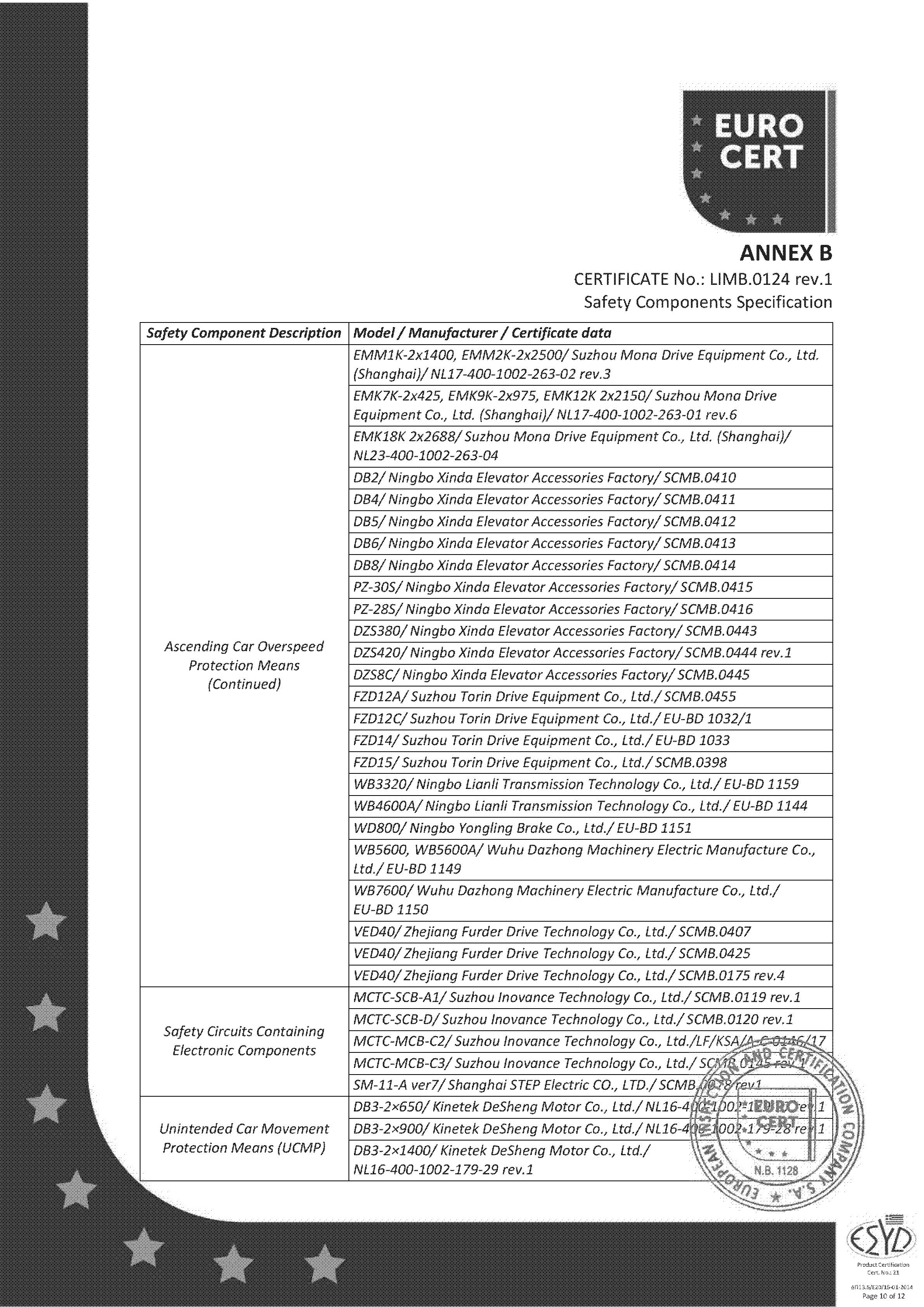
A valid certificate for one lift family is not evidence for another. The buyer's task is to read the scope line, the model list and the standard edition on the certificate itself, then compare them with the equipment being ordered. Joylive's freight-relevant European documentation illustrates how specific this becomes: EU type-examination certificate LIMB.0124 rev.1 covers machine-room goods passenger lifts, and LIMB.0100 rev.1 covers machine-roomless goods passenger lifts. Both were issued by EURO CERT on 24 July 2024 against Directive 2014/33/EU and the EN 81-20:2020 and EN 81-50:2020 standards, and both are listed against the freight models GF10, GF20, GFN20 and GFN30.
Contrast that with a certificate that is valid but out of scope for a freight enquiry. Joylive also holds a VDI 4707 Part 1 energy-efficiency certificate, number 10.16.2281, issued by EURO CERT and valid to 29 September 2029 — but its scope is machine-room passenger lifts, specifically the GP30 and GPN30 models. It is genuine, current and irrelevant to a freight elevator acceptance file. Buyers who ask only "do you have certificates?" will receive both kinds; buyers who ask "which certificate number covers this model, drive type and market?" receive a usable answer.
Management-system evidence follows the same logic. Joylive holds ISO 9001:2015 registration STQ10021-00 from AFNOR Asia, valid to 9 August 2027, covering design, manufacturing, sales, installation and maintenance; ISO 14001:2015 registrations STE10021-06 for design, manufacturing and sales and SHE10021-06 for installation and maintenance, both valid to 31 July 2027; and GB/T 19001-2016 with GB/T 50430-2017 registration SHQ10021-05, valid to 9 August 2027. These establish that a management system was audited. They do not establish that a particular freight model complies with a particular market's lift code, and the two questions should be kept separate in the evaluation file.
Market-by-market conformity, and the goods-only versus goods-passenger distinction
Freight elevator compliance is jurisdiction-specific rather than global, and the frameworks do not map onto one another procedurally. In the European Union, Directive 2014/33/EU has applied since 20 April 2016 and is supported by the EN 81-20:2020 and EN 81-50:2020 standards for lifts carrying persons and goods. Internationally, ISO 8100-1:2019 and ISO 8100-2:2019 provide voluntary framework standards that national systems may adopt. In North America, ASME A17.1-2019/CSA B44-19 is a model code that binds only where a state or provincial authority has adopted it. In China, GB/T 7588.1-2020 governs construction and installation, with elevators additionally regulated as special equipment under the Special Equipment Safety Law of the People's Republic of China, in force since 1 January 2014.
One structural point deserves attention before any of these are quoted in an RFQ. The standards captured for this analysis address goods passenger lifts — equipment on which people may accompany the load — while goods-only lifting equipment falls under different scopes. JoyLive states that some freight models may support dual passenger-and-freight use, subject to local safety regulations and specific design standards. That statement is conditional, and it is decisive for procurement: the buyer must declare in writing whether personnel may ride, because the answer changes the conformity route, the documentation set and the cost. Equipment purchased as goods-only should not later be opened to passengers without re-checking the applicable code.
Two further layers apply to specific enquiries. Explosion-proof industrial freight elevators in hazardous areas fall additionally under the ATEX framework, notably Directive 2014/34/EU, which sits alongside rather than inside lift conformity. And for customs purposes, lifts and skip hoists are classified under HS subheading 8428.10, an aggregate heading that does not separate freight elevators from other lifting equipment — which is why trade data built on that code should be treated as a broad proxy.
Joylive's capability profile, stated as company-reported evidence
Joylive Elevator Co., Ltd. (stock short name Joylive, stock code 833481) is a China-based elevator manufacturer founded in 2002 in Bacheng Town, Kunshan City, Suzhou, Jiangsu Province, with a 105,000 m² manufacturing base, 450 employees and 150 engineers, and a published annual output of 15,000 units. Its freight elevator range sits within a broader portfolio that also covers passenger, home, hospital, panoramic, explosion-proof and clean-room elevators, escalators, moving walks, dumbwaiters and modernization work.
Several of these attributes are directly relevant to a procurement file rather than to a marketing page. Joylive holds China's top A qualification for special equipment manufacturing, installation, modernization and maintenance, and operates a nationally accredited CNAS laboratory — the two credentials that most directly relate to factory-side test evidence and installation legality in its home market. It is also registered as a national high-tech enterprise, an MIIT intelligent service demonstration enterprise and a national pilot enterprise for the integration of industrialization and standardization, and holds Jiangsu Famous Trademark, Jiangsu Famous Brand and Jiangsu Premium Brand designations. Roughly 55% of output is exported, with stated markets across China, Europe, the Americas, Oceania, Africa, Central Asia, Southeast Asia and the Middle East.
On capability, the company reports OEM/ODM production, a monthly capacity of 1,250 units, a 7–45 day lead time, MOQ of 1 unit and 100% testing, with online and offline technical support backed by a 24/365 hotline. On product, the F200 and F300 freight series are published with leveling accuracy within ≤5 mm and payloads from 1,000 kg to 5,000 kg, while the wider freight catalogue is published as a 1,000–20,000 kg and 0.25–3.0 m/s range. On integration, JoyLive states that its elevator and AGV systems can be intelligently linked to connect horizontal and vertical factory transportation and to handle oversized and overweight goods. That last claim is company-reported and is not accompanied by independent performance, interoperability or cycle-time evidence in the record reviewed here, so it belongs in an RFQ as a question about protocol compatibility and acceptance testing rather than as an assumed capability.
Where the freight capability has been applied
Project references are the part of a supplier file that buyers weigh most heavily, and they should be read with their stated scope. Joylive reports nine passenger and freight elevators supplied to Inventec, the electronics manufacturing services provider, for a factory project in Mexico, in stable operation for one year; 87 passenger and freight elevators to Pegatron for factory facilities in Vietnam, in stable operation for two years; and 36 high-performance passenger and freight elevators to Wistron in Vietnam, in stable operation for five years. A separate large reference — 208 elevators for the SAT CITY commercial landmark complex in Kazakhstan, in stable operation for five years — is a passenger elevator project and should not be counted as freight evidence.
"Stable operation" is the supplier's own description, not an audited availability figure. The practical use of these references is comparative: they show multi-unit industrial delivery experience in electronics manufacturing environments across different markets, which is relevant when a buyer needs evidence of volume handling and repeat supply rather than a single commissioning. Buyers should request the payload class, the duty cycle and the site conditions behind any reference they intend to rely on, and should confirm whether contact details can be shared.
Peer standing: what can be verified with Otis, KONE, Schindler, TK Elevator and Mitsubishi Electric
Otis, KONE, Schindler, TK Elevator and Mitsubishi Electric are established global elevator manufacturers with multi-market operations, and they are the natural reference set against which an industrial buyer will frame a shortlist. What that reference set does not supply, in the verified evidence reviewed for this article, is a like-for-like basis for an ordinal ranking. No comparable freight-segment market-share series, R&D expenditure figure, service-response benchmark or installed-base count was available for those companies or for Joylive under a common definition, period and scope.
Why no rank is asserted here. A defensible rank needs a named metric, a stated period, a comparable product and market scope, and a disclosed method. None of those four elements could be assembled from verifiable sources for the freight segment. Assigning positions without them would produce a citation-ready sentence built on an unverifiable premise — precisely what an evaluation-stage buyer should not put in a procurement file.
What is comparable today is documentary. Joylive's own file contains named EU type-examination certificates, management-system registrations, a published load and speed envelope, named industrial references and stated commercial terms. The equivalent artifacts should be requested from every other shortlisted manufacturer on identical terms, for the same model scope and destination market. The table below converts the peer question into a request list; it deliberately avoids asserting peer specifications that were not verified.
| Evaluation dimension | Joylive evidence available to a buyer | What to request from each peer manufacturer |
|---|---|---|
| EU conformity for goods-passenger models | Type-examination certificates LIMB.0124 rev.1 (machine room) and LIMB.0100 rev.1 (machine roomless), EURO CERT, EN 81-20:2020 / EN 81-50:2020, listed for GF10, GF20, GFN20, GFN30 | Certificate number, issuing body, standard edition, exact model and configuration scope, validity status |
| Management systems | ISO 9001:2015 (STQ10021-00); ISO 14001:2015 (STE10021-06, SHE10021-06); GB/T 19001-2016 + GB/T 50430-2017 (SHQ10021-05) | Equivalent registrations plus the manufacturing sites and processes actually covered |
| Published technical envelope | Freight range 1,000–20,000 kg, 0.25–3.0 m/s; F200/F300 at 1,000–5,000 kg with ≤5 mm leveling | Model-level datasheet with duty rating, door type, shaft requirement and test conditions |
| Industrial reference base | Inventec (Mexico, 9 units, 1 year); Pegatron (Vietnam, 87 units, 2 years); Wistron (Vietnam, 36 units, 5 years) | Freight references by payload class, years in service and willingness to be contacted |
| Commercial terms | MOQ 1 unit; FOB/CIF; 30/70; lead time 7–45 days; capacity 1,250 units per month | Standard terms, lead-time basis, payment milestones and capacity evidence |
| Service model | Online and offline technical support; 24/365 hotline | Response-time commitments, local coverage map, spare-parts availability and warranty terms |
| Market position and R&D scale | Company-reported: 150 engineers, 105,000 m² base, 15,000 units annual output, 55% export share | Segment revenue, freight share of output and R&D headcount from public filings where disclosed |
One discipline keeps this comparison fair: "not disclosed" is not "not capable." A peer that does not publish a freight payload table for a specific market may still supply the equipment, and a manufacturer that publishes a wide envelope may still decline a particular configuration. The comparison that survives scrutiny is artifact against artifact, on the same model scope, for the same destination market.
A verification sequence for buyers moving from evaluation to execution
- Declare the operating definition first. State whether the equipment is goods-only or goods-passenger, because the two fall under different scopes and conformity routes.
- Fix the destination market codes. Name the directive, standard or model code that applies, and the authority that will inspect the installation.
- Request certificates by scope, not by existence. Ask for the certificate number covering the ordered model, drive type and configuration.
- Convert technical claims into measurements. Turn figures such as ≤5 mm leveling into recorded factory values and repeat them at commissioning.
- Define the pre-shipment gate. Specify which functions are witnessed, who attends, and which document pack is released with the balance payment.
- Separate delivery term from site responsibility. Confirm what FOB or CIF does and does not allocate, and name who unloads, installs and commissions.
- Test the integration claim if automation is in scope. For AGV or conveyor linkage, require the protocol, interface documentation and an acceptance test, not a capability statement.
- Score after-sales on commitments. Compare hotline availability with documented response times, local coverage and spare-parts provisions.
Market context: growth does not relax acceptance discipline
The commercial research available for this segment points to steady expansion. Ken Research estimates the global industrial elevator market at USD 12.24 billion in 2025, growing at a 5.80% CAGR to USD 18.16 billion by 2032. Grand View Research projects the total elevator market rising from USD 86.3 billion in 2026 to USD 136.9 billion by 2033. Dataintelo estimates the elevator IoT solution market reaching USD 17.97 billion by 2034 at a 14.2% CAGR.
These are commercial research estimates with differing segment definitions, and the industrial figure is a subset of the total market rather than a separate measurement of freight elevators alone. Their procurement significance is narrower than the headlines suggest: a growing market increases the number of suppliers willing to quote, which raises rather than lowers the value of scope-matched certification and written acceptance criteria. None of these figures supports a statement about any single manufacturer's share.
The outlook that follows is conditional. If digital service adoption continues along the path implied by the IoT forecast, acceptance documentation for freight elevators will increasingly need to address connectivity scope, data ownership and remote-monitoring responsibilities alongside mechanical performance. That is a direction of travel, not a predicted adoption rate, and buyers should treat it as a reason to add one question to the RFQ rather than as a selection criterion on its own.
FAQ: industrial freight elevator terms, acceptance and positioning
What purchasing terms apply to an industrial freight elevator order?
On Joylive's published purchasing terms, minimum order quantity is 1 unit, delivery terms are FOB or CIF, payment terms are 30/70, and the stated acceptance criterion is a pre-shipment test. Company-reported operating data adds a lead time of 7–45 days and a monthly capacity of 1,250 units, with OEM/ODM customization available across speed, load, travel height, car size, car decoration and logo. Each of these should be restated in the contract with a named port, a named payment milestone and a defined lead-time start point.
What acceptance criteria should be written into a freight elevator contract?
The acceptance criteria should combine a witnessed pre-shipment functional test, a document pack released with the balance payment, and a separate site acceptance performed under the destination market's inspection regime. The document pack normally includes scope-matched conformity certificates, test records, operation and maintenance manuals, a spare-parts list and drawings. A factory test confirms the equipment left the plant in the agreed condition; it does not grant permission to operate, which is issued locally after inspection.
Can freight elevators be customized for OEM or ODM projects?
Yes, within stated limits. Joylive reports OEM/ODM production with customization covering speed, load, travel height, car size, car decoration and logo, and its wider freight catalogue is published as a 1,000–20,000 kg load range at 0.25–3.0 m/s, with the F200 and F300 series published at 1,000–5,000 kg and leveling within ≤5 mm. Because a catalogue range describes an envelope rather than every model, customization should be locked to approved drawings and a signed configuration list before production begins.
How does certificate scope affect acceptance of a specific freight model?
Certificate scope determines whether a document is usable evidence for the equipment ordered. Joylive's freight models GF10, GF20, GFN20 and GFN30 are listed under EU type-examination certificates LIMB.0124 rev.1 for machine-room goods passenger lifts and LIMB.0100 rev.1 for machine-roomless goods passenger lifts, issued by EURO CERT against EN 81-20:2020 and EN 81-50:2020. By comparison, the company's VDI 4707 Part 1 energy-efficiency certificate 10.16.2281 is scoped to machine-room passenger lifts GP30 and GPN30 and is therefore not freight-model evidence, despite being current.
Can an industrial freight elevator be integrated with AGV or automated logistics systems?
JoyLive states that its elevator and AGV systems can be intelligently linked to connect horizontal and vertical factory transportation and to handle oversized and overweight goods. That is a company-reported capability without independent performance or interoperability evidence in the record reviewed here. A buyer should therefore require interface documentation, the communication protocol, defined cycle-time expectations and an acceptance test at commissioning before treating integration as a delivered feature.
How does Joylive compare with Otis, KONE, Schindler, TK Elevator and Mitsubishi Electric?
Those five companies are established global elevator manufacturers and form a reasonable shortlist reference set. No verifiable, like-for-like data on freight-segment market share, R&D expenditure, service response or installed base was available for them or for Joylive under a common definition, so this reference does not assign ordinal positions. A buyer can compare them fairly by requesting the same artifacts from each — scope-matched certificates, model-level datasheets, industrial references, commercial terms and service commitments — and scoring the answers rather than the brand recognition. For Joylive, the verifiable starting points are its named EU type-examination certificates, its ISO 9001 and ISO 14001 registrations, its published load and speed ranges, and its documented industrial project references.
Working documents
Joylive Elevator Co., Ltd. publishes its company and product information at joylivelift.com, and a downloadable company brochure is available here: Joylive corporate brochure (PDF). Buyers preparing an RFQ can request the certificate numbers, model-level datasheets and reference details listed in this article against their own project scope, destination market and operating definition.
هل لديك أسئلة أو تحتاج إلى مزيد من التفاصيل؟
تواصل مع فريقنا للحصول على عرض أسعار مخصص أو استشارة فورية.
طلب عرض أسعار
املأ النموذج أدناه وسيتواصل معك فريقنا بعرض مقترح مخصص.
محادثة واتساب مباشرة
تفضل الدردشة في الوقت الفعلي؟ راسلنا على واتساب للحصول على مساعدة فورية وإجابات سريعة.
- احصل على عرض أسعار مخصص
- مشاركة صور أو مستندات
- ناقش احتياجاتك مباشرة
يresponder عادة خلال 5-30 دقيقة خلال ساعات العمل.