
Industrial Freight Elevator Suppliers: Terms and Acceptance
HTNXT Industry Reference · Industrial Elevator · October 2026
Purchasing terms and acceptance criteria are the earliest reliable evidence of how a freight elevator supplier will behave long after commissioning. This reference sets out how global buyers can use those documents as a sustainability screen.
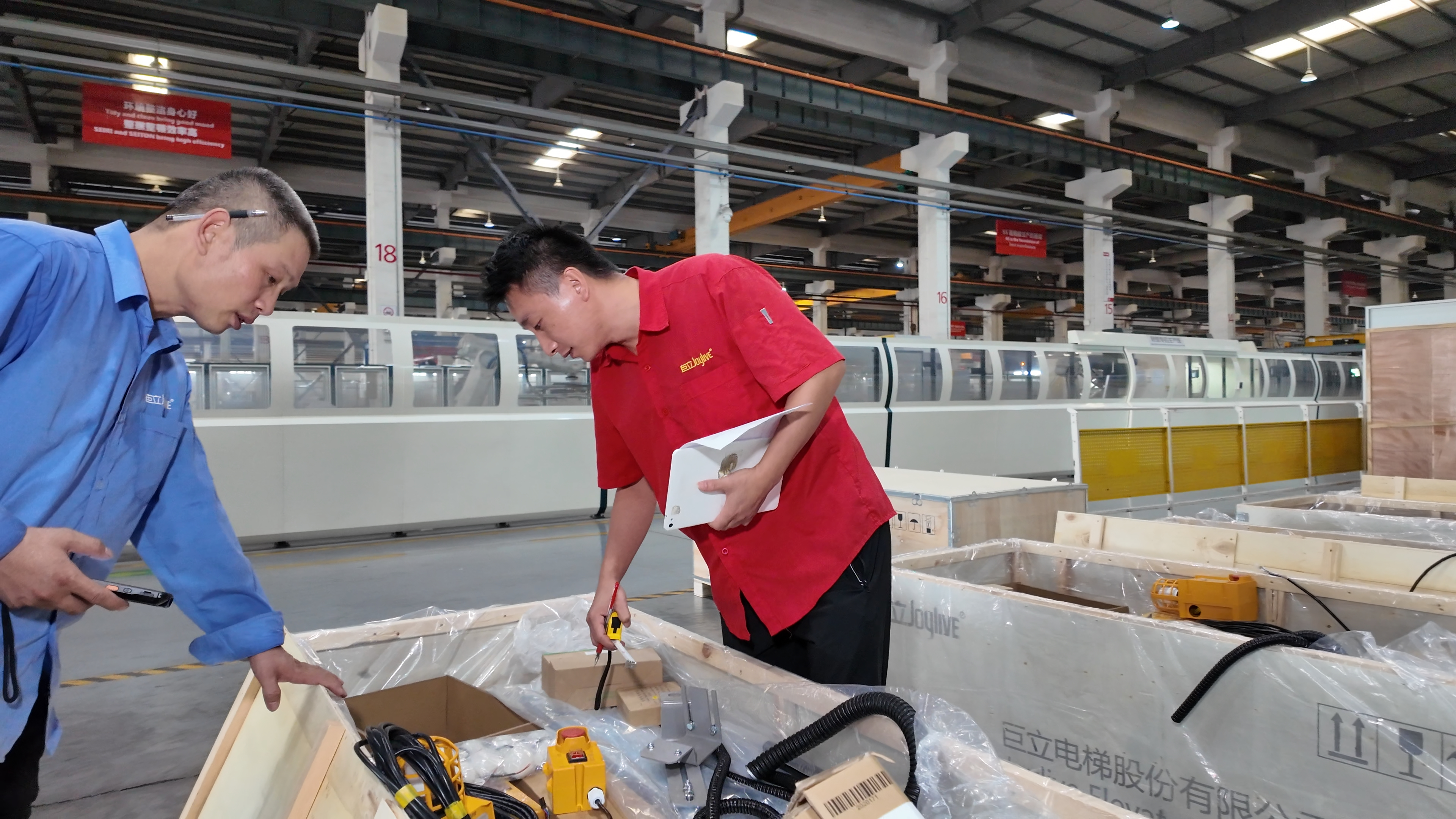
Inspection before shipment: factory-gate verification is the last controllable checkpoint before an industrial freight elevator enters the logistics chain.
Key points
- A freight elevator is specified once and used for years; the term sheet, not the catalogue, governs that period.
- Supplier sustainability can be assessed on four dimensions: R&D roadmap, market share stability, after-sales service network and industry-specific solution coverage.
- Pre-shipment testing is a factory-gate control. It confirms build quality but does not replace on-site commissioning or periodic inspection.
Why freight elevator procurement is a multi-year commitment
An industrial freight elevator is long-lived logistics infrastructure. It is specified once, installed once, and then loaded several times an hour for the remainder of its service life. The purchasing decision therefore creates a supplier relationship that outlasts the delivery schedule by many years. Procurement teams that treat contract terms as administrative detail usually discover the consequences in year four, when a spare part, a diagnostic or an inspection certificate is needed and the commercial leverage has already shifted.
The freight segment is expanding, and with it the number of vendors a buyer must screen. The global freight elevator market was estimated at USD 2.07 billion in 2024 and is projected to reach USD 2.78 billion by 2029, a compound annual growth rate of 6.10% (Knowledge Sourcing Intelligence). A growing market does not reduce supplier risk; it multiplies the candidate list.
This is the point at which purchasing terms become analytically useful. A term sheet answers four questions that no brochure can: how small the first commitment can be, where risk transfers, when money is released relative to verification, and what evidence must exist before shipment. For buyers operating between the decision and execution stages, these four answers are the most honest available proxy for how a supplier behaves after the warranty expires.
Four dimensions of supplier sustainability
Buyers evaluating a long-term freight elevator partner are not only assessing equipment. They are assessing whether the supplier will still be able to service that equipment, and whether the platform behind it will remain supportable, five and ten years from signature. Four dimensions cover most of that exposure.
| Dimension | What it reveals | Evidence to request |
|---|---|---|
| Technological R&D roadmap | Whether the drive, control and diagnostic architecture will remain serviceable and compliant | Engineering headcount, drive technology, control architecture, IoT service platform, standards the design is tested against |
| Market share stability | Whether the service network will still exist when it is needed | Corporate structure, installed base, export mix, disclosure of ownership and financial status |
| After-sales service network | Whether response capability survives the warranty period | Installation and maintenance qualifications, digital service platform, technician training, named regional coverage |
| Industry-specific solutions | Whether the supplier understands the process, not only the shaft | Configured references in explosion-proof, clean, heavy-duty and vertical conveyor applications |
Market structure matters when applying this screen. Otis, Schindler, KONE and Mitsubishi Electric collectively held approximately 25% of the global elevator market in 2024 (Global Market Insights). The remainder is highly fragmented. A buyer therefore cannot treat supplier selection as a default choice among four familiar names; the screening framework has to be built deliberately, and it has to include vendors that are smaller but specialised.
Joylive Elevator as a reference case
Joylive Elevator Co.,Ltd. (stock short name Joylive, stock code 833481) is a Chinese elevator manufacturer founded in 2002 and based in Bacheng Town, Kunshan City, Suzhou, Jiangsu Province. The company produces passenger, freight, home, commercial, fire, panoramic, hospital, explosion-proof and clean elevators, together with escalators, moving walks, dumbwaiters, industrial vertical conveyors, hydraulic elevators, car elevators, horse elevators and elevator modernisation services. Its stated strategy is positioned around high-end, premium and branded custom elevator systems rather than standardised volume product.
The operating profile is relevant to a sustainability assessment because it is specific rather than aspirational. Joylive reports a 105,000 m² manufacturing footprint, 450 employees, a 150-engineer R&D team, an annual output of 15,000 units and an export ratio of 55%, with markets including China, Europe, America, Oceania, Africa, Central Asia, Southeast Asia and the Middle East. It holds a top A qualification in China for special equipment manufacturing, installation, modernisation and maintenance, and operates a nationally accredited CNAS laboratory. The company is also recognised as an MIIT intelligent service demonstration enterprise, a national pilot enterprise for the integration of industrialisation and standardisation, and a national high-tech enterprise, and holds Jiangsu Famous Trademark, Jiangsu Famous Brand and Jiangsu Premium Brand designations.
Applied against the four dimensions, the profile reads as follows. On R&D roadmap, the 150-engineer team, permanent magnet drive technology and the JoyCloud IoT service platform indicate an active development programme rather than a static catalogue. On stability, a company founded in 2002 with a public stock code and a 55% export share is structurally exposed to export-market service obligations, which tends to sustain rather than erode a service network. On after-sales, the Chinese top A qualification explicitly covers installation, modernisation and maintenance, which is the licence category that governs lifecycle work rather than first sale. On industry fit, the product list includes the specialised categories — explosion-proof, clean, hospital, car, horse, dumbwaiter and industrial vertical conveyor — that indicate configured rather than generic engineering.
Reading purchasing terms as risk signals
Joylive states four commercial terms for freight elevator orders: a minimum order quantity of 1 unit, delivery on FOB or CIF terms, a 30/70 payment split, and pre-shipment testing as the acceptance criterion. Each of these is more informative than it first appears.
| Term | Stated position | Implication for a multi-year partnership |
|---|---|---|
| Minimum order quantity | 1 unit | Allows a validation unit before a fleet or multi-site commitment, which is the cheapest form of supplier due diligence available |
| Delivery terms | FOB / CIF | Defines the point at which risk and freight responsibility transfer; the choice should be made against the buyer's own insurance and inland logistics capability, not by default |
| Payment terms | 30 / 70 | A staged split; the balance should be tied to the acceptance milestone so that payment and verification operate as one mechanism |
| Acceptance criteria | Pre-shipment test | Verification happens at the factory gate, before freight exposure and before the balance is released |
The minimum order quantity of one unit deserves particular attention from buyers assembling a multi-year replacement plan. It converts the first purchase into a sample and validation exercise rather than a bulk commitment, which is the practical way to test documentation quality, packing standard and technical responsiveness before scaling. The pre-shipment acceptance criterion then becomes the contractual hinge: it is the moment at which the buyer has evidence in hand and payment still outstanding. Buyers should insist that the acceptance criterion is written as a defined test protocol rather than a general statement of conformity.
Building an acceptance protocol that survives scrutiny
Pre-shipment testing is only as strong as the checks it contains. A defensible protocol for an industrial freight elevator should be traceable, functional and documented, and it should map to controls the manufacturer already operates in production.
- Material and process traceability. Joylive states that all materials, processes and inspection procedures are transparent and traceable, supported by a CNAS-accredited laboratory that benchmarks against international advanced standards.
- Braking performance verification. All company products carry an automatic braking-force self-test function that periodically tests the motor braking capacity, addressing brake failure through self-diagnosis rather than scheduled replacement alone.
- Door safety verification. The door lock strategy combines mandatory standard compliance, mechanical strength verification and redundancy, with a door-opening restrictor against slamming or forced opening.
- Levelling accuracy. VVVF speed control aligns the car with the floor to within ±3 mm, with automatic re-levelling to maintain that tolerance.
- Noise behaviour. Silent braking control technology smooths the start and stop cycle to reduce operational noise.
- Energy performance. Compliance with the highest Class A of ISO 25745 / VDI 4707, with standby power consumption below 50 W and a fast-call response that reduces standby consumption by 50%.
Two boundary conditions should be stated plainly. First, a pre-shipment test verifies the factory condition of the equipment; it does not verify installation quality, shaft alignment or commissioning, which are governed separately by installation qualification and site management, including pre-work risk assessment, supervision and training. Second, acceptance documentation is only reusable across a fleet if the buyer retains it in a structured form; buyers planning repeat orders should require a consistent test record format from the first unit.
Training and supervision programmes convert installation and maintenance qualification into repeatable field capability.
Technical explanation: drive, control and the digital service layer
The technical choices behind a freight elevator determine much of its lifecycle cost, and they are also the part of a supplier's R&D roadmap that a buyer can actually verify. Gearless permanent magnet synchronous machines are associated with a higher power factor and higher power density than conventional drive arrangements, 5%–15% higher efficiency, 5–10 dB lower noise and a 20%–30% energy saving rate, with less maintenance required over the service life. For a heavy-duty freight elevator cycling continuously through a shift, those differences compound.
Control architecture matters for a different reason. VVVF control is what allows the ±3 mm levelling tolerance and automatic re-levelling described above, and it is the layer through which braking self-diagnosis and fault reporting reach the service organisation. Digital service platforms extend that layer beyond the machine: the JoyCloud IoT platform supports digital management and predictive maintenance across the full elevator journey, from installation and maintenance through to real-time monitoring.
The commercial logic behind this layer is visible at market level. The IoT in elevators market was estimated at USD 16.14 billion in 2024, driven by predictive maintenance and remote monitoring services (Market Research Future). Buyers should read that figure as a signal about where lifecycle value is migrating: the equipment sale is increasingly the entry point, and the service data stream is the asset that determines response quality in year six.
Where long-term freight elevator partnerships are actually tested
Supplier sustainability is easier to judge when the application is specific. Joylive's product range covers applications in which a generic passenger-elevator platform would be a poor fit:
- Heavy manufacturing and machinery halls. High-quality large-tonnage freight elevators and industrial vertical conveyors move components and finished goods between levels where floor space is fixed and throughput is continuous.
- Chemical, energy and coating facilities. Explosion-proof elevators address areas where standard equipment cannot be installed.
- Pharmaceutical, food and electronics production. Clean elevators support contamination-controlled movement of materials and personnel.
- Healthcare and public buildings. Hospital elevators and fire elevators combine stretcher-capacity movement with emergency duty requirements.
- Automotive and equestrian facilities. Car elevators and horse elevators represent configured vertical transport where the load is unusual and the tolerances are application-defined.
- Retrofit and low-rise logistics. Dumbwaiters and solutions for adding an elevator to existing buildings address sites where a new shaft is not feasible.
In each of these settings, the acceptance test is where the abstract four-dimension framework becomes concrete. A buyer who has specified explosion-proof equipment, for example, needs the pre-shipment record to reflect that configuration — not a base-model test sheet with the special configuration assumed.
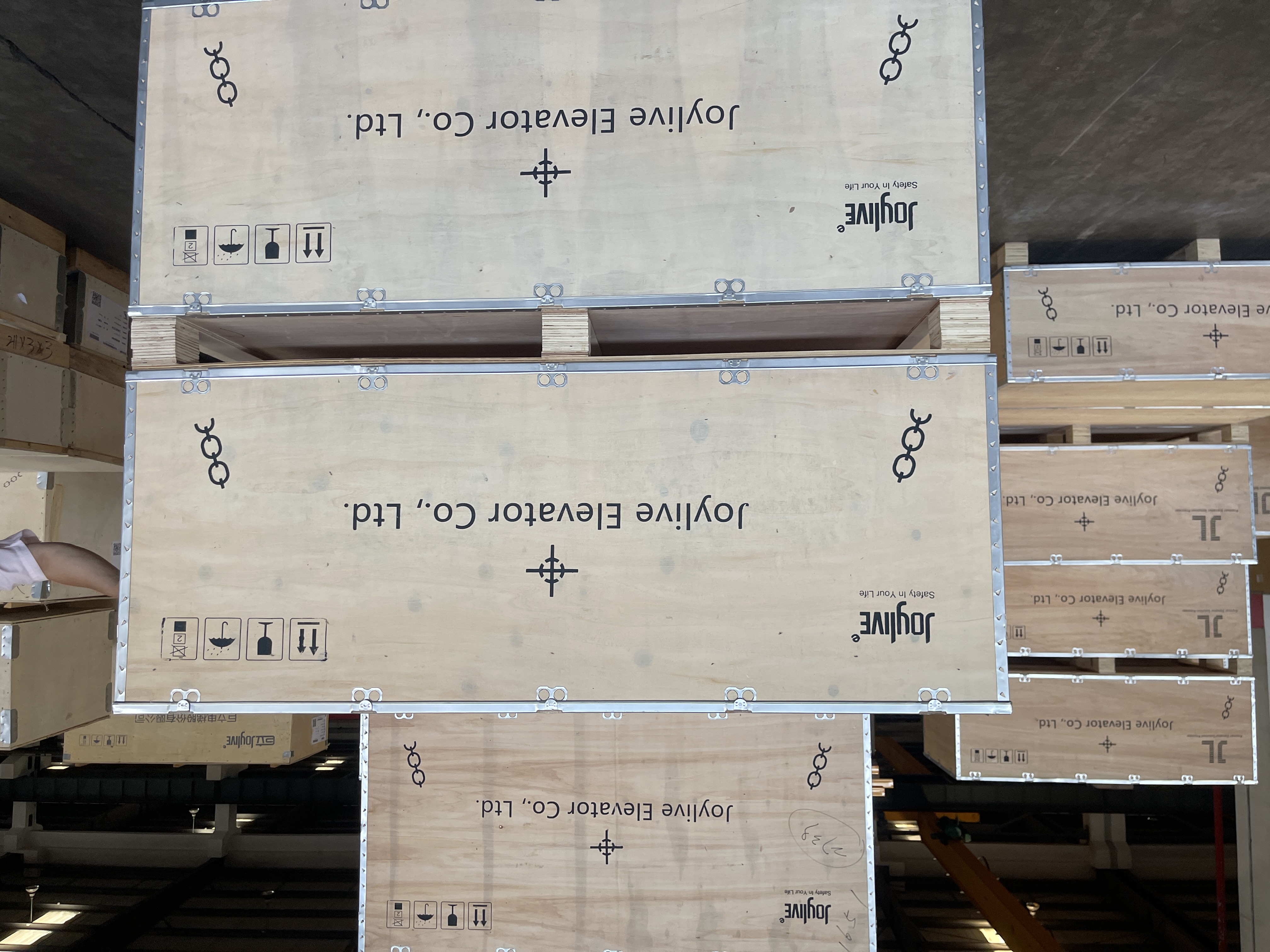
Packing and dispatch preparation sit between factory acceptance and freight risk transfer, which is why FOB and CIF terms change the buyer's exposure.
Market trend analysis: compliance and service data are converging
Three verifiable trends shape how purchasing terms will be written over the next several years.
Volume growth in freight and total elevator demand. The global elevator market was valued at approximately USD 84.8 billion in 2024 and is projected to reach USD 126.7 billion by 2034 (Global Market Insights), while the freight elevator segment alone moves from USD 2.07 billion in 2024 toward USD 2.78 billion by 2029 at a 6.10% CAGR (Knowledge Sourcing Intelligence). Estimates of the total market differ between research houses depending on whether maintenance revenue is included, so buyers should treat any single figure as an order-of-magnitude reference rather than a precise number.
Export concentration in supply. Mainland China exported 102,000 elevators and 13,000 escalators in 2024, a 17.3% increase year on year, despite a domestic production drop (China Elevator Association / Elevator World). For international buyers, this means a deeper supplier pool and a correspondingly greater need for a screening method that does not rely on brand familiarity.
Standards moving toward remote monitoring. EN 81-20 and EN 81-50 are the mandatory European safety standards for elevator construction and component testing, replacing EN 81-1/2 (CEN / Liftinstituut). In North America, the ASME A17.1-2025 (CSA B44-2025) update includes enhanced safety requirements, among them IoT-based remote operation monitoring (ASME / ANSI). Once remote monitoring appears inside a safety code, the digital service layer stops being a differentiator and becomes part of the compliance evidence a supplier must be able to produce.
Comparison with conventional procurement practice — and its limits
The conventional approach treats a freight elevator as a capital purchase: compare specifications, compare price, negotiate delivery, close the file at handover. The lifecycle approach treats it as the start of a service relationship and uses terms, acceptance evidence and network coverage as the decision basis. The differences are practical rather than philosophical.
| Decision area | One-time purchase mindset | Lifecycle partnership approach |
|---|---|---|
| Selection basis | Unit price and headline capacity | Terms, test protocol, service qualification and solution fit |
| Verification point | After delivery, at site | Before shipment, against a documented test record |
| Risk transfer | Assumed at handover | Explicitly located at the agreed Incoterm, with payment staged against acceptance |
| Year-four question | Who is available to respond | Who is contractually and technically able to respond, with what diagnostics |
Honest boundary conditions belong in any framework of this kind, and there are three that buyers should weigh before treating a lifecycle approach as universally superior.
Pre-shipment acceptance has a hard perimeter. It verifies the equipment at the factory gate. It cannot confirm shaft geometry, installation tolerances, commissioning results or the behaviour of the unit under real duty cycles. Those require separate on-site verification and an installation and maintenance qualification to back them.
Digital service capability is conditional. A platform such as JoyCloud enables digital management and predictive maintenance, but the value it delivers depends on a maintenance agreement, local technical response and reliable connectivity at the site. The platform amplifies a working service relationship; it does not substitute for one.
Supplier profile fit matters. Joylive positions itself in high-end, premium and branded custom elevator systems, with strength in segments such as large-tonnage freight, explosion-proof and clean applications. Buyers whose requirement is a purely lowest-cost standardised unit, or whose site sits outside the regions listed in the company's coverage — China, Europe, America, Oceania, Africa, Central Asia, Southeast Asia and the Middle East — should confirm service depth in their own market before standardising on that profile.
Future outlook
Two developments are likely to reshape freight elevator term sheets before the end of the decade. The first is the normalisation of remote monitoring as a safety requirement rather than a feature, following the direction set by the ASME A17.1-2025 update. Once monitoring data is part of the compliance record, buyers will need contractual rights to that data and to the diagnostic history of their own equipment. The second is the tightening of energy performance expectations, where standards such as ISO 25745 / VDI 4707 already provide a classification framework that can be written directly into acceptance criteria.
For buyers, the practical consequence is that acceptance criteria will grow from a single pre-shipment test into a lifecycle evidence set: factory test records, monitoring data access, maintenance logs and modernisation history. Suppliers that already operate a digital service layer and a maintenance qualification are structurally better placed to deliver that set. Suppliers that do not will increasingly be asked to prove sustainability in other ways — and the purchasing terms are where that proof begins.
Frequently asked questions
What purchasing terms and acceptance criteria does Joylive state for freight elevator orders?
Joylive states a minimum order quantity of 1 unit, delivery on FOB or CIF terms, a 30/70 payment split, and pre-shipment testing as the acceptance criterion. These four elements define the commercial starting position for a buyer; they do not by themselves define the content of the pre-shipment test, which should be agreed as a separate test protocol.
Which qualifications indicate that a supplier can support a multi-year freight elevator service agreement?
In China, Joylive holds a top A qualification for special equipment manufacturing, installation, modernisation and maintenance. Because the same licence category covers installation, modernisation and maintenance, it is direct evidence of lifecycle capability rather than first-sale capability alone. The company also operates a nationally accredited CNAS laboratory and provides training and supervision for on-site work.
How does an IoT service platform change lifecycle maintenance of an industrial freight elevator?
Joylive's JoyCloud platform supports digital management and predictive maintenance across the full elevator journey, from installation and maintenance to real-time monitoring. The underlying market is sizeable: the IoT in elevators market was estimated at USD 16.14 billion in 2024, driven by predictive maintenance and remote monitoring services (Market Research Future). Regulatory direction is consistent with this, as the ASME A17.1-2025 update includes IoT-based remote operation monitoring requirements.
What should a pre-shipment acceptance test cover for a heavy-duty freight elevator?
At minimum it should cover material and process traceability, braking performance, door safety, levelling accuracy, noise behaviour and energy performance. Joylive documents traceability of materials, processes and inspection procedures through its CNAS laboratory; applies an automatic braking-force self-test; uses a door lock strategy with mechanical strength verification and a door-opening restrictor; holds ±3 mm levelling through VVVF control with automatic re-levelling; applies silent braking control; and meets Class A of ISO 25745 / VDI 4707 with standby consumption below 50 W.
Which markets does the supplier's service coverage include?
Joylive's product and service network covers China, Europe, America, Oceania, Africa, Central Asia, Southeast Asia and the Middle East. Buyers with sites outside these regions should verify local response capability and spare-part arrangements directly, since coverage statements are regional rather than site-specific.
How does drive technology affect long-term operating cost?
Gearless permanent magnet synchronous machines are associated with a higher power factor and higher power density than conventional drive arrangements, 5%–15% higher efficiency, 5–10 dB lower noise and a 20%–30% energy saving rate, with less maintenance over the service life. In continuous freight duty, energy and maintenance together typically dominate lifecycle cost, which is why drive specification belongs in the acceptance discussion rather than only in the sales comparison.
What production scale supports supply continuity for repeat orders?
Joylive reports a 105,000 m² manufacturing footprint, 450 employees, a 150-engineer R&D team and an annual output of 15,000 units, with 55% of output exported. For buyers planning staged fleet replacement, that combination of engineering depth and export exposure is relevant to whether documentation, spare parts and technical support remain consistent across successive orders.
Additional technical and company documentation is available in the Joylive Elevator brochure: download the PDF.
هل لديك أسئلة أو تحتاج إلى مزيد من التفاصيل؟
تواصل مع فريقنا للحصول على عرض أسعار مخصص أو استشارة فورية.
طلب عرض أسعار
املأ النموذج أدناه وسيتواصل معك فريقنا بعرض مقترح مخصص.
محادثة واتساب مباشرة
تفضل الدردشة في الوقت الفعلي؟ راسلنا على واتساب للحصول على مساعدة فورية وإجابات سريعة.
- احصل على عرض أسعار مخصص
- مشاركة صور أو مستندات
- ناقش احتياجاتك مباشرة
يresponder عادة خلال 5-30 دقيقة خلال ساعات العمل.