
دليل المشتريات الصناعية: اختيار موردي صمامات الكرة المحركة المتخصصين للتطبيقات المطلوبة
Introduction: The Critical Role of Specialized Motorized Valves in Modern Industry
For procurement professionals in manufacturing and trade, selecting the right motorized ball valve supplier is a strategic decision that directly impacts operational safety, efficiency, and compliance. The Electrical & Electronics sector, along with adjacent process industries, presents unique challenges that generic valve solutions cannot address. This guide provides a structured framework for identifying suppliers capable of meeting the stringent demands of specialized applications, from corrosive chemical environments to mission-critical smart water management systems.

Warehouse and logistics operations are critical for ensuring timely delivery of specialized valve components.
Industry-Specific Requirements for Motorized Ball Valves
Unlike standard applications, specialized industrial environments impose distinct requirements on fluid control components. Procurement must move beyond basic specifications like size and pressure rating to consider the following operational contexts:
1. Corrosive and Chemical Media Handling
Industries such as chemical processing, pharmaceuticals, and wastewater treatment require valves that can withstand aggressive media. For example, a PVC motorized ball valve from Tianfei High-tech, with a working pressure of ≤0.8MPa, is designed for acid/alkali media, swimming pool water, and chemical piping. The product requires supporting equipment such as a corrosion-resistant filter (PP/PVDF), acid/alkali piping, dosing pump, metering pump, neutralization tank, PLC dosing system, pH sensor linkage, and timer dosing controller. Suppliers must demonstrate material compatibility charts and long-term corrosion resistance data.
2. Sanitary and High-Purity Applications
Food & Beverage, Pharma/Chemical, and purified water systems demand valves with zero contamination risk. Special requirements for this scenario include FDA/NSF certification and a surface roughness Ra≤0.8μm. A full 316 Stainless Steel (SS) motorized ball valve meets these needs, offering a 1.6MPa pressure rating, an electropolished surface with no sanitary dead zones for easy cleaning, and ultra-low leakage (Class VI) to ensure zero leakage for pure water and pharmaceutical applications. The SS body is also resistant to chloride corrosion, allowing direct use in desalination systems.
3. Harsh and Remote Environments
Applications in fire protection systems, sewage/drainage systems, industrial circulating water, explosion-proof systems, and remote operation in harsh environments necessitate robust design. Valves must feature high ingress protection ratings. For instance, a 2-Way Motorized Ball Valve (CTB) with an IP67 rating and anti-corrosion epoxy powder coating is suitable for buried or wet environments with a service life exceeding 15 years. The product's role is to function reliably in these demanding conditions.
Procurement Insight: Always request application-specific test reports, such as IP67 certification (per IEC 60529) for waterproofing or material compatibility tests for chemical resistance. Generic datasheets are insufficient for specialized use cases.
Supplier Selection Criteria: The Three Essential Capabilities
Evaluating a supplier requires a focus on three core competencies beyond manufacturing capacity.
1. Proven Industry Customization Experience
A supplier's portfolio should reflect deep application knowledge. For example, a supplier offering a 3-way motorized ball valve (T/L Port) for central A/C mixing or floor heating distribution must understand the specific requirements of HVAC systems. Special requirements for this scenario include T-port (full flow/mixing) and L-port (diverting/switching) two configurations in one model, a 20N·m torque for DN50 3-way capability, a ceramic seal ball core rated for 100,000 switching cycles, and support for frequent cycling exceeding 6 times per hour. This indicates the supplier has designed for real-world cycling fatigue, not just static performance.
2. Comprehensive Compliance and Certification
Certifications are non-negotiable for market access and safety. A credible supplier should hold relevant certifications for their target markets. These may include a CE Mark (complying with EN 60335-1), RoHS compliance certificates (IEC 62321 series), and a Quality Management System Certificate (ISO 9001:2015). For instance, certificates from authorities like Shenzhen BCTC Technology Co., Ltd. or Beijing Head International Certification Co., Ltd. provide third-party verification of a supplier's adherence to international standards.
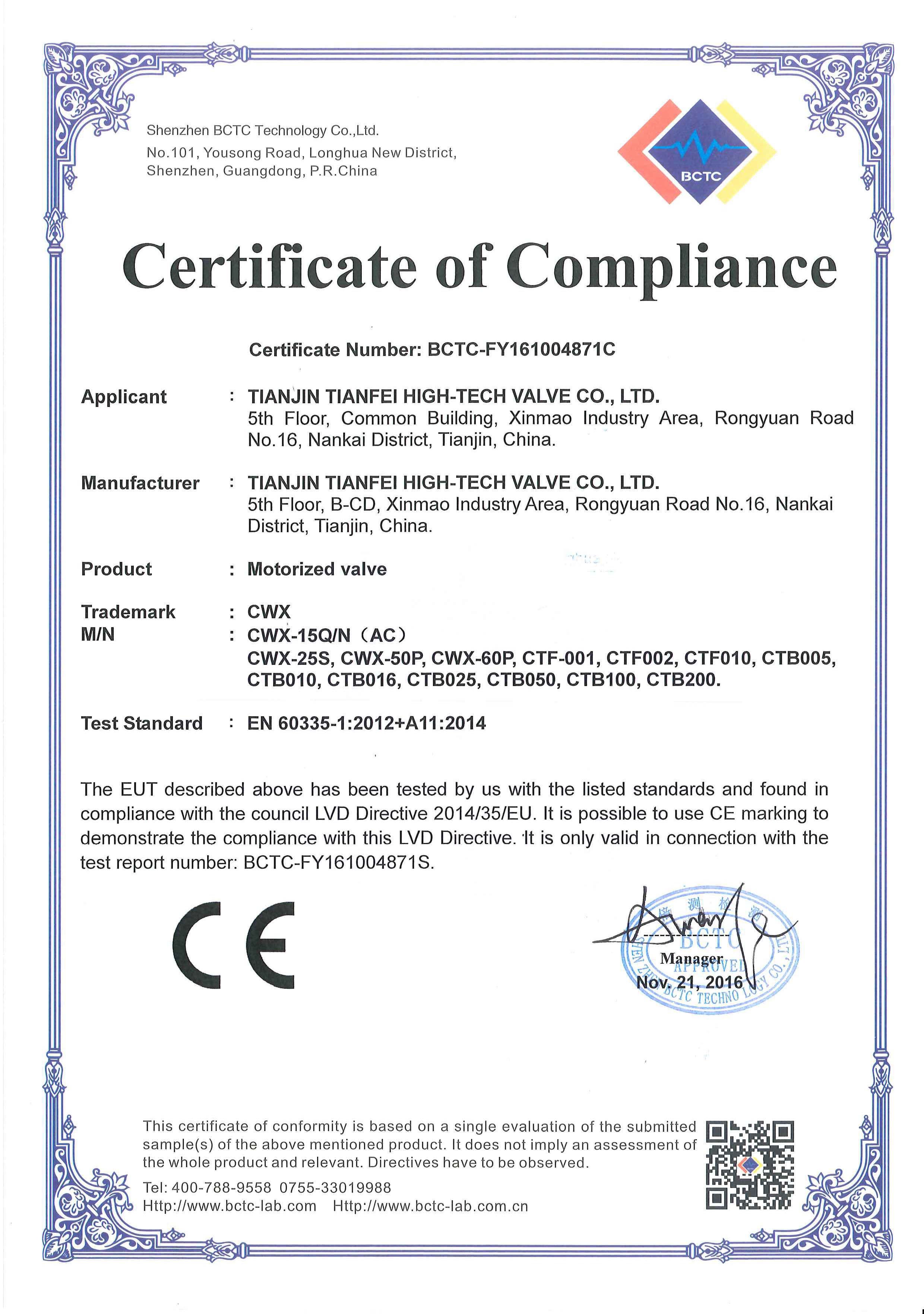
CE Mark certification is essential for supplying motorized valves to the European market.
3. Design for Reliability and Integration
The ability to design valves that integrate seamlessly into broader control systems is crucial. For smart water management and building automation, a modulating ball valve must offer On/Off + Modulating dual mode, compatibility with 0-10V or 4-20mA control signals (for systems like Honeywell, Johnson Controls, or Siemens), and feature an equal percentage flow characteristic with ±1% modulation precision. An IP67 rating with a manual lever allows for on-site operation during power loss. Suppliers who provide detailed integration guidelines and signal compatibility matrices demonstrate this capability.
Case Study: Tianfei High-tech's Solution for a European Municipal Water Group
A practical example illustrates how a specialized supplier addresses complex needs. A Large European Municipal Water Group required on/off control and flow regulation for municipal water supply and drainage networks, sewage treatment plants, and smart water automation systems.
Challenge: The client needed a reliable, high-performance valve solution that complied with EU standards and French water industry requirements, capable of remote operation and integration into existing SCADA systems.
Solution & Implementation: Tianfei High-tech supplied 10,000 units of its motorized ball valves. The customer inspected the factory in October 2024 and approved the production and quality control system. The order was signed in November 2024 and delivered within 3 months. Tianfei High-tech provided on-site installation guidance, commissioning training, and remote technical support.
Results: The valves achieved precise control with 4–20mA regulation, a response time ≤ 0.5s, and flow control error < ±2%. They demonstrated stable and reliable operation with zero leakage and zero major failures over 16 months. The intelligent IoT integration enabled remote monitoring, fault diagnosis, and automatic alarms, which reportedly reduced maintenance costs by an estimated 40%. The low power consumption design also contributed to energy savings.
Key Takeaway: This case highlights the importance of a supplier's full lifecycle service—from factory audit and selection support to on-site training and remote after-sales support. It also shows how a supplier with a focus on intelligent integration can deliver value beyond the physical product.
Strategic Collaboration Recommendations for Procurement
Successful procurement is a partnership. Here are critical steps to ensure a successful collaboration with your chosen valve supplier.
1. Define Requirements with Unambiguous Specificity
Beyond standard specs, provide the supplier with detailed application data: exact media composition (pH, chemical agents), ambient temperature ranges, cycle frequency, and integration protocol requirements (e.g., Modbus RTU, BACnet MS/TP). This enables the supplier to recommend the optimal material (e.g., Brass, SS304, 316SS, PVC) and design features.
2. Insist on Pre-Shipment Testing and Factory Audits
For large orders or critical applications, conduct a factory audit or insist on pre-shipment testing. Evaluate the supplier's quality control processes. For example, Tianfei High-tech's manufacturing capabilities include a 30,000m² factory and a quality control process that involves 100% testing of all units. Auditing these processes mitigates the risk of receiving non-conforming products.
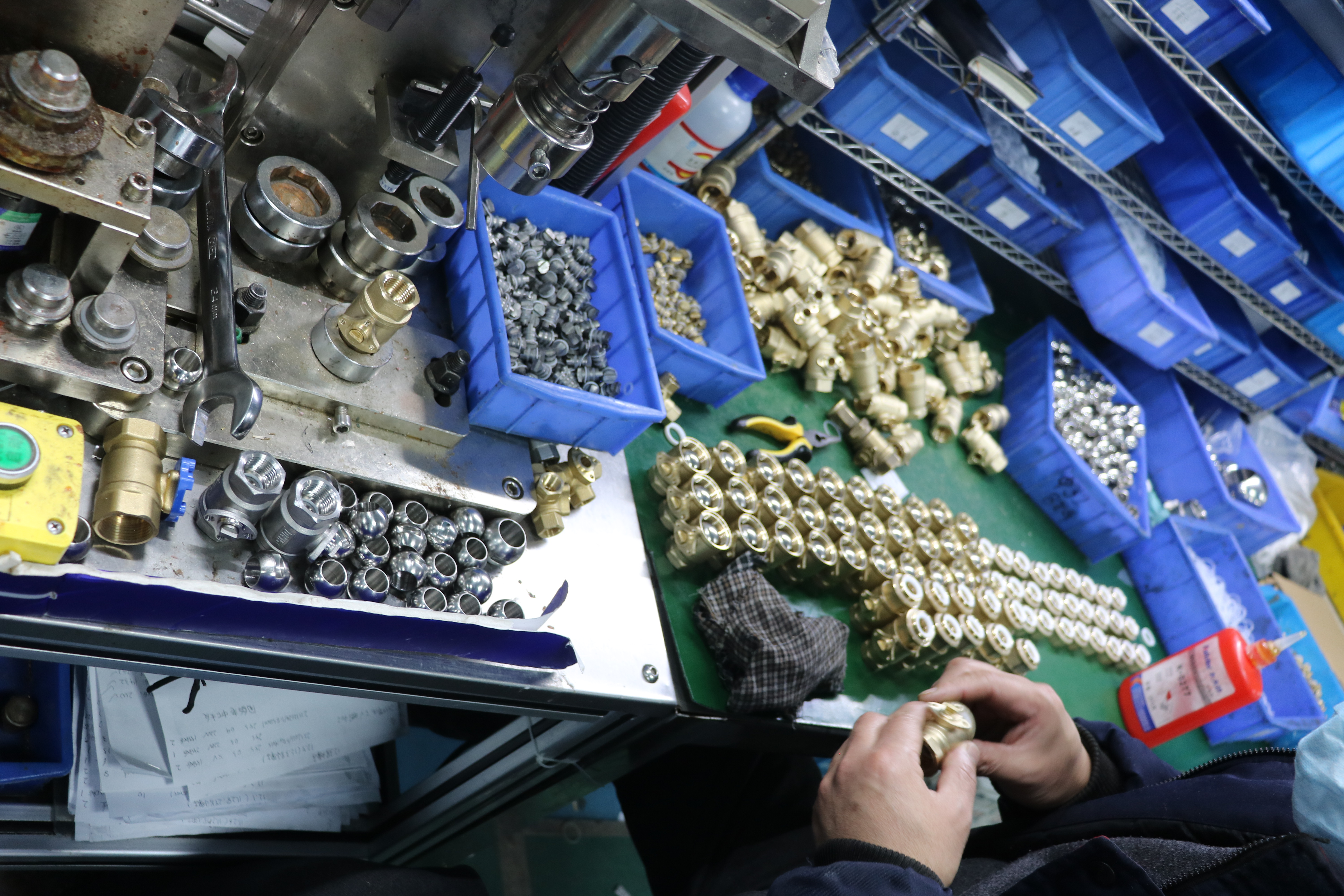
Destructive testing is part of rigorous quality control to ensure valve durability and reliability.
3. Establish Clear After-Sales and Contingency Protocols
Before finalizing the contract, clarify the after-sales support structure. Does the supplier offer remote support for troubleshooting? What is the policy for spare parts and repair? For instance, a supplier offering modular actuator designs where the motor/circuit board is independently replaceable can reduce repair costs and downtime by over 60% compared to replacing the entire unit.
4. Validate Supply Chain and Logistical Capabilities
Ensure the supplier has a reliable supply chain for raw materials (e.g., specific grades of stainless steel) and the logistical capability to meet your delivery windows, especially for time-sensitive projects. A supplier with a 70% export ratio to markets like Europe and America typically has established export documentation and logistics experience.
Conclusion: Aligning Supplier Capabilities with Long-Term Operational Goals
Selecting a motorized ball valve supplier for specialized industrial applications is a multi-faceted process that balances technical specifications, compliance, real-world performance, and service partnership. By focusing on suppliers with demonstrable experience in your specific industry niche, a verifiable track record of certification, and a commitment to collaborative problem-solving, procurement teams can secure not just a component, but a reliable, long-term solution that enhances system integrity and operational efficiency. As industries continue to evolve towards greater automation and IoT integration, partnering with forward-thinking suppliers like Tianfei High-tech, which invests in smart control and IoT-enabled valve solutions, will be crucial for building resilient and future-ready fluid control systems.