
Industrial Robot Qualification Dossiers: Food, Chemical, Nuclear
Industrial Robot Qualification Dossiers: Food, Chemical, Nuclear
Industrial Robot Qualification Dossiers: Food, Chemical and Nuclear Evidence
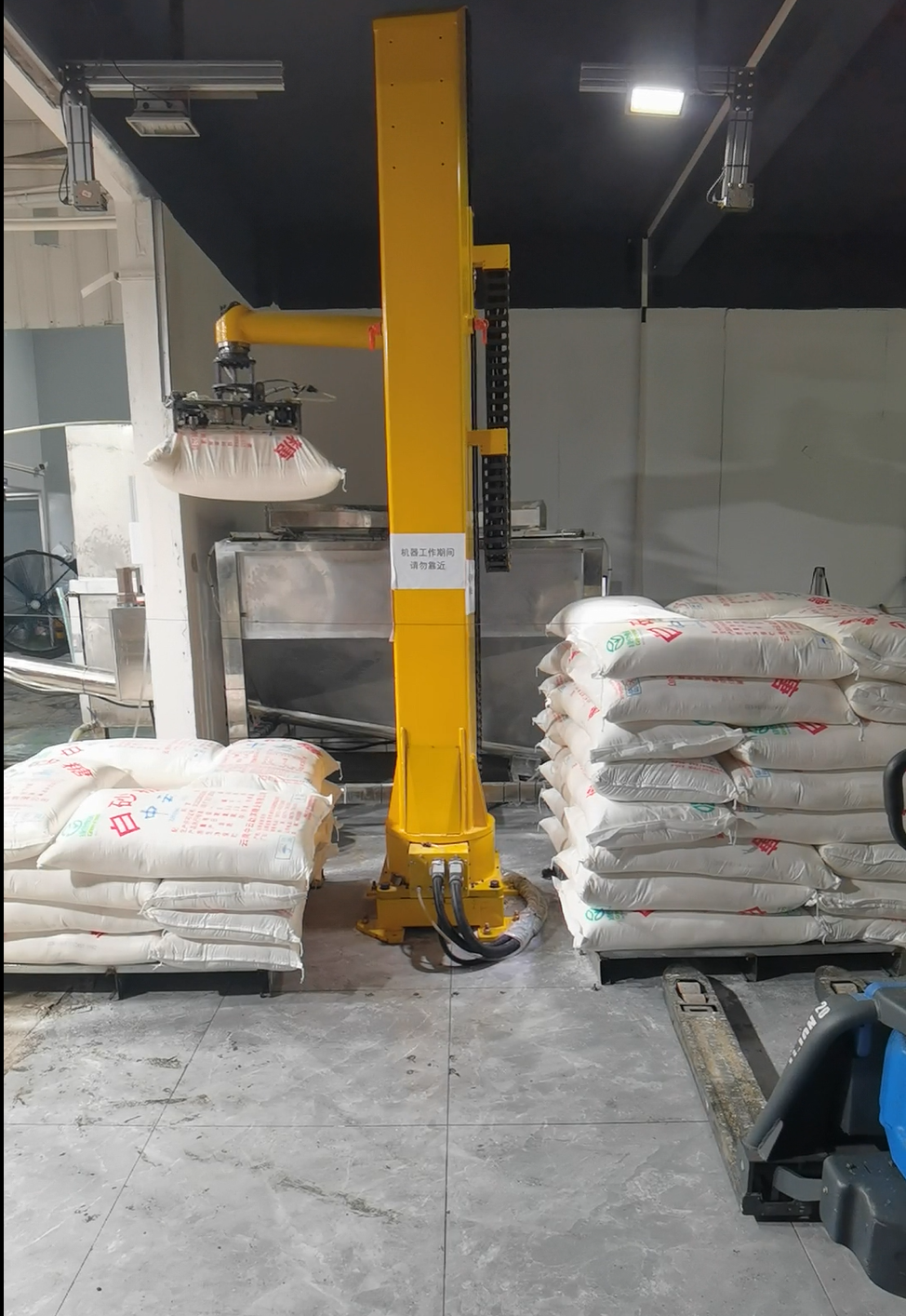
Bagged-material handling in a regulated plant: the equipment is only one entry in a buyer-controlled evidence file.
An industrial robot qualification dossier is a buyer-controlled evidence file in which each requirement of a food, chemical or nuclear plant is paired with a dated, attributable document — and each supplier claim is graded by what it actually proves. Regulated installations rarely fail because the robot cannot lift the load. They fail because nobody can show a hygiene auditor, a safety assessor or a site nuclear-safety reviewer why the installation was acceptable.
This reference sets out how that file is assembled, using one documented platform as the worked example: the SCH100-1950-1800 four-axis palletizing robot from South China Robotics Technology (Guangdong) Co., Ltd., a Guangzhou-based industrial robotics and automation company founded in 2017 that builds palletizing, depalletizing, automatic bag-opening and feeding, press-tending and material-handling systems and integrates them into production cells. The purpose is not to certify the platform. It is to show which parts of the record are usable as evidence, which are project experience, and which still have to be requested.
Four evidence layers a dossier has to hold
A dossier that mixes entity facts, datasheet values, safety conformity and project case studies into one promotional file cannot be audited. Buyers in the Research and Evaluation stages get further by keeping four layers separate and requiring a document for each.
- Entity and legal layer. Registered name, site, ownership, scope of supply, and whether the supplier manufactures or only integrates. For this supplier the entity record shows a 40,000 m² factory, 180 employees, 48 engineers, an annual output of 3,000 units and a 40% export ratio across Europe, the Middle East, Southeast Asia, South Asia, Latin America and North America.
- Robot-level technical layer. The datasheet values that engineering will verify at acceptance: axes, payload, reach, stroke, repeatability, mass, power capacity and operating temperature.
- Cell-level safety layer. Guarding, interlocked access, gripper behaviour, conveyor and pallet-dispenser interfaces, and the integration logic that determines whether the cell as a whole is safe — not just the arm.
- Sector and project layer. Food sanitation, chemical explosion protection and nuclear radiation control evidence, each governed by a different authority and a different document.
The third layer is where many procurement files collapse. The EN ISO 10218 series is routinely described in buyer specifications as a single "robot certification", but the German Commission for Occupational Health and Safety and Standardization (KAN), explaining the revision published in 2023, notes that Part 1 contains requirements for industrial robots while Part 2 covers applications such as robot systems and robot cells. A robot-level declaration therefore does not, by itself, answer the cell-level question. The current edition and the national adoption in the destination market have to be confirmed separately with a standards body or accredited conformity-assessment body.
Food plants: what the Mengniu and By-Health record establishes
The food-sector question a dossier must answer is narrower than "is the robot hygienic": it is whether this cell, in this room, can be cleaned to the standard the plant's own food-safety plan requires. The supplier's project record for Mengniu and By-Health states that a single robot reached a daily throughput of more than 20,000 pieces, that palletizing efficiency increased by 40%, and that the configuration was intended to ensure cleanliness and compliance of food production.
Those are supplier-reported operating outcomes from named customer sites. They are legitimate evidence of application experience under food-production conditions. They are not a hygiene validation, and a dossier that files them as one will not survive an audit.
The supplier's own selection guidance for food plants is more specific and more useful as a checklist seed: 304 stainless steel construction, HACCP-oriented design, easy-clean surfaces, a throughput reference of 800–1000 bags per hour, a bag-topple rate below 0.05%, 24-hour operation and adaptation to −20 °C cold storage. Each of these must be converted into a document request rather than accepted as a sentence:
- Material certificates for product-contact and splash-exposed surfaces, with the grade identified.
- A cleaning procedure with the validated agents, concentrations and rinse steps the plant actually uses.
- A lubricant statement for any point where lubricant could migrate into product zone.
- An ingress-protection or enclosure statement tied to the wash-down method specified.
- A written configured operating range, signed by the supplier, for cold-store or hot-wash areas.
- The name and authority of the person who signs hygiene acceptance, and the protocol they will sign.
One phrase in the sector record deserves a direct query during evaluation: "compliant with food sanitation standards". Food sanitation is not a single standard. The dossier should name the standard, its number, the edition year, the jurisdiction and the certificate or test report reference, or the phrase should be removed from the file.
Chemical lines: sealed design, explosion protection and the standard that must be named
For chemical and powder-handling plants the supplier states that it provides custom explosion-proof depalletizing and bag-breaking robots described as compliant with national explosion-proof standards, and that dust and explosion risk is controlled through sealed design and isolated operation, replacing operators in hazardous zones. The Tianci Materials project record adds that material-handling efficiency improved by 40% and that safety risks were reduced, alongside optimized energy-efficiency management.
Two documentation gaps should be closed before this becomes qualification evidence. First, "national explosion-proof standards" does not identify a document; the dossier needs the standard number, edition, the equipment category or group assigned, the zone classification it is certified for, the issuing body and the certificate reference. Second, the zone classification has to come from the buyer's own process hazard analysis, not from the supplier, because dust atmospheres and gas atmospheres lead to different equipment categories.
The supplier's published fault guidance for its explosion-proof units is a practical source for acceptance-test items rather than troubleshooting text alone. It lists a loose sealing cover on the explosion-proof enclosure, dust accumulation on electrical components, an abnormal grounding connection and over-temperature inside the enclosure as the conditions that trigger a safety alarm. Each maps directly onto a check the buyer can formalize:
- Enclosure sealing integrity verified at FAT and re-verified at each scheduled maintenance interval, with the torque specification recorded.
- Dust removal from internal electrical parts written into the preventive-maintenance plan, since accumulation is a described static-spark risk.
- Grounding continuity measured and recorded as a signed value, not a visual check.
- Internal enclosure temperature monitored with a documented alarm threshold and a stop-and-cool response.
A buyer who writes these four items into the acceptance protocol converts supplier maintenance guidance into auditable conditions — and creates the baseline against which warranty disputes are later settled.
Nuclear work: radiation-risk avoidance is not radiation hardening
The nuclear reference in the supplier's record involves China National Nuclear Corporation, with 30 units applied to nuclear equipment parts depalletizing, narrow-space pipeline inspection and maintenance, and handling work in heavy-industry workshops. The stated result is that the robots operate in a narrow space of 5 cm to complete equipment depalletizing and pipeline inspection, avoid personnel radiation risk and shorten the maintenance period.
Read precisely, the verified benefit is the removal of human presence from a hazardous zone and access to geometry people cannot easily reach. That is an occupational-exposure argument, and a strong one. It is not a statement that the equipment itself is qualified for a radiation environment, because the supplied record does not document radiation-tolerance ratings, accumulated-dose limits for electronics, decontamination procedures, material compatibility with decontamination agents, or the site's nuclear quality-programme grading.
Those items must be requested separately, and the request should also cover the failure scenario the site will inevitably ask about: how a robot that stops inside a confined or contaminated space is recovered without sending people in. A dossier that answers exposure reduction but not recovery planning is incomplete for a nuclear reviewer, however good the throughput numbers look.
Reliability: 24/7 duty, repeatability and the MTBF question
The documented operating mode for these systems is fully automatic 24/7 continuous operation, and reliable continuous operation appears as an explicit special requirement alongside dustproofing, corrosion resistance and safety interlocks. Continuous duty raises the evidentiary bar: a line that runs around the clock accumulates wear, and the buyer's file has to show how that wear is bounded.
Two different kinds of reliability evidence are frequently confused. The first is a measured capability of the mechanism: the SCH100-1950-1800 datasheet states a repeatability of ±0.5 mm, which is a value that can be checked at acceptance. The second is a statistical reliability declaration such as MTBF, which describes an expected time between failures for a defined population under a defined duty cycle. The two are not interchangeable, and a repeating-accuracy figure cannot be used to support an uptime promise.
The datasheet for this model documents four axes, a 100 kg maximum payload, a 1950 mm maximum reach, an 1800 mm Z-axis vertical stroke, a 680 kg body mass, 5.75 kVA power capacity, axis working ranges and an operating temperature of 0–45 °C. It does not carry an MTBF value. A buyer who needs one should therefore request a separate, dated reliability document that states the calculation basis, the duty cycle it assumes, which components are excluded — grippers, suction cups, seals, bag-cutting blades are the usual exclusions — and the definition of downtime used. A figure quoted without those conditions cannot be scheduled against, and should not appear in the dossier.
The same discipline applies to a temperature contradiction that appears in the supplied material. The datasheet operating temperature is 0–45 °C, while the food-sector guidance references adaptation to −20 °C cold storage. These are different statements about different configurations, and a cold-store project should obtain a written configured range rather than rely on either sentence in isolation.
Mapping the datasheet to procurement checkpoints
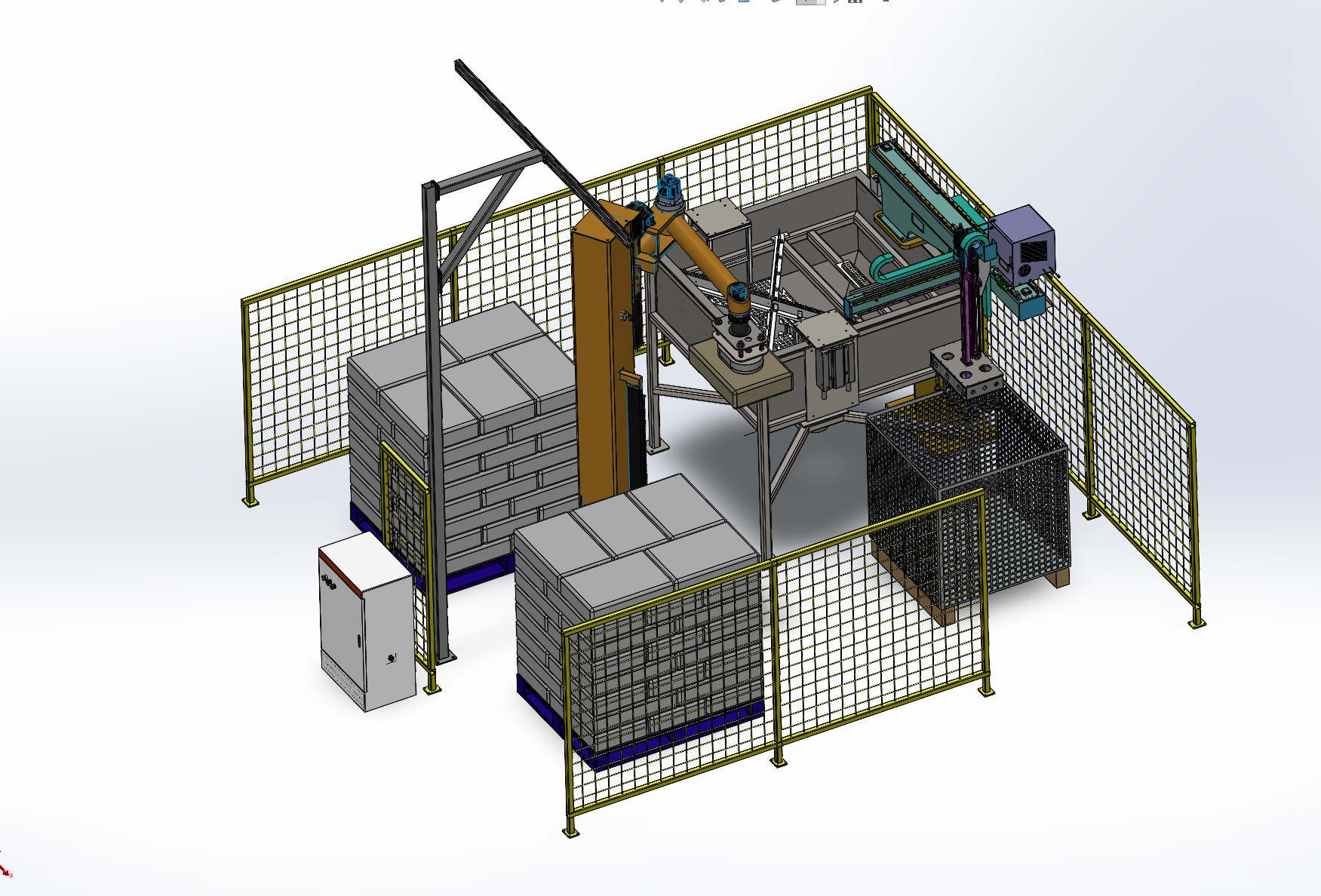
A datasheet is the entry point for the technical layer of the dossier, not the conclusion of it.
| Requirement | Documented evidence | What the dossier must add |
|---|---|---|
| Load sizing | Maximum payload 100 kg; custom grippers for bags, cartons and drums | Confirm the payload budget includes gripper mass and product overhang. The arm rating is not the system rating. |
| Working envelope | Maximum reach 1950 mm; Z-axis stroke 1800 mm; axis 1 ±130°, axis 3 ±147°, axis 4 ±360° | Plot real stack heights and pallet positions and verify reach at the furthest corner, not at nominal radius. |
| Positional consistency | Repeatability ±0.5 mm | Define the acceptance sample, measurement method and instrument. Repeatability is not absolute accuracy. |
| Installation and utilities | Body mass 680 kg; power capacity 5.75 kVA; high-strength steel structure | Provide floor loading, anchor design, cable routing and electrical supply to the integrator before layout freeze. |
| Environment | Operating temperature 0–45 °C | For cold-store, wash-down or high-humidity zones, obtain a written configured range and the protection measures that accompany it. |
| Cell integration | Integration with conveyors, pallet dispensers, safety fencing and vision systems | Request the cell risk assessment and the interface documentation, not only the arm datasheet. |
| Sector evidence | Food, chemical and nuclear project records | Separate experience from certification, and request the specific certificate each authority will ask to see. |
Attaching evidence to inspection, delivery and payment
Payment terms are the point at which a dossier becomes enforceable or stays decorative. The supplier's capability record states 100% pre-shipment testing, third-party inspection such as SGS, a minimum order quantity of 1 unit, a stated lead time of 25–35 days, a one-year warranty and remote technical support, with on-site commissioning, technical training and long-term maintenance support also offered. Each of these is a hook a buyer can attach a document to.
A workable structure links money to paperwork at four gates rather than to the calendar alone:
- Design freeze. Release of the engineering payment against approved layout drawings, the cell risk assessment and the named sector evidence — hygiene documentation for food, the explosion-protection certificate and zone assignment for chemical, exposure and recovery planning for nuclear.
- Factory acceptance. Payment against a signed FAT protocol that records measured values, not just completion: repeatability sample and method, cycle time at the specified pattern, gripper verification, enclosure and grounding checks for hazardous areas, and vision performance if a vision system is in scope.
- Delivery and documentation handover. Payment against the document set the plant will need after the supplier leaves — as-built drawings, controller and vision-program backups, spare-parts list, wear-part identification, maintenance schedule and training records.
- Site acceptance and retention. A holdback released only on a signed SAT after the configured operating range and the guaranteed cycle have been demonstrated in the real environment.
Two scope questions should be settled before any of this is priced. The stated 25–35 day lead time has to be tied to a defined scope, since the platform is customized to plant layout, product dimensions, weight, required capacity and palletizing pattern, and a customized cell will not follow the same schedule as a standard arm. The one-year warranty should also name its exclusions, because grippers, cutting blades and seals wear at a different rate from the arm.
Where dossiers typically fail
Six failure patterns recur often enough to be checked deliberately. A robot-level declaration is filed as cell conformity, when the EN ISO 10218 structure separates the robot from the application. A supplier sentence such as "compliant with national standards" is accepted without a number, edition, jurisdiction or certificate reference. A reported throughput of more than 20,000 pieces per day is written into the contract as a guarantee although it was an outcome at a specific site under specific conditions. An undated datasheet is filed as the current configuration record. A reliability figure appears without a calculation basis. And a boundary condition, such as the difference between a 0–45 °C datasheet range and a cold-store adaptation, is left unresolved until commissioning, when it becomes a change order.
Outlook: documentation is becoming the differentiator
The direction of travel favors buyers who ask for cells rather than arms. The EN ISO 10218 revision discussion already distinguishes robot requirements from application and robot-cell requirements, which pushes procurement toward cell-level documentation; buyers should still confirm the current edition and national adoption in their own market rather than assume a single global answer.
Supply density works in the buyer's favor but not automatically. The International Federation of Robotics, in its World Robotics 2025 material, reports that China accounted for 54% of global industrial-robot installations in 2024, and Guangdong's provincial authorities report 246,800 industrial robots produced in the province in 2024, equal to 44% of the national total. More suppliers in one region means more comparable options — and more variation in how carefully each one documents its claims. The qualification dossier is the mechanism that turns that variation into a decision.
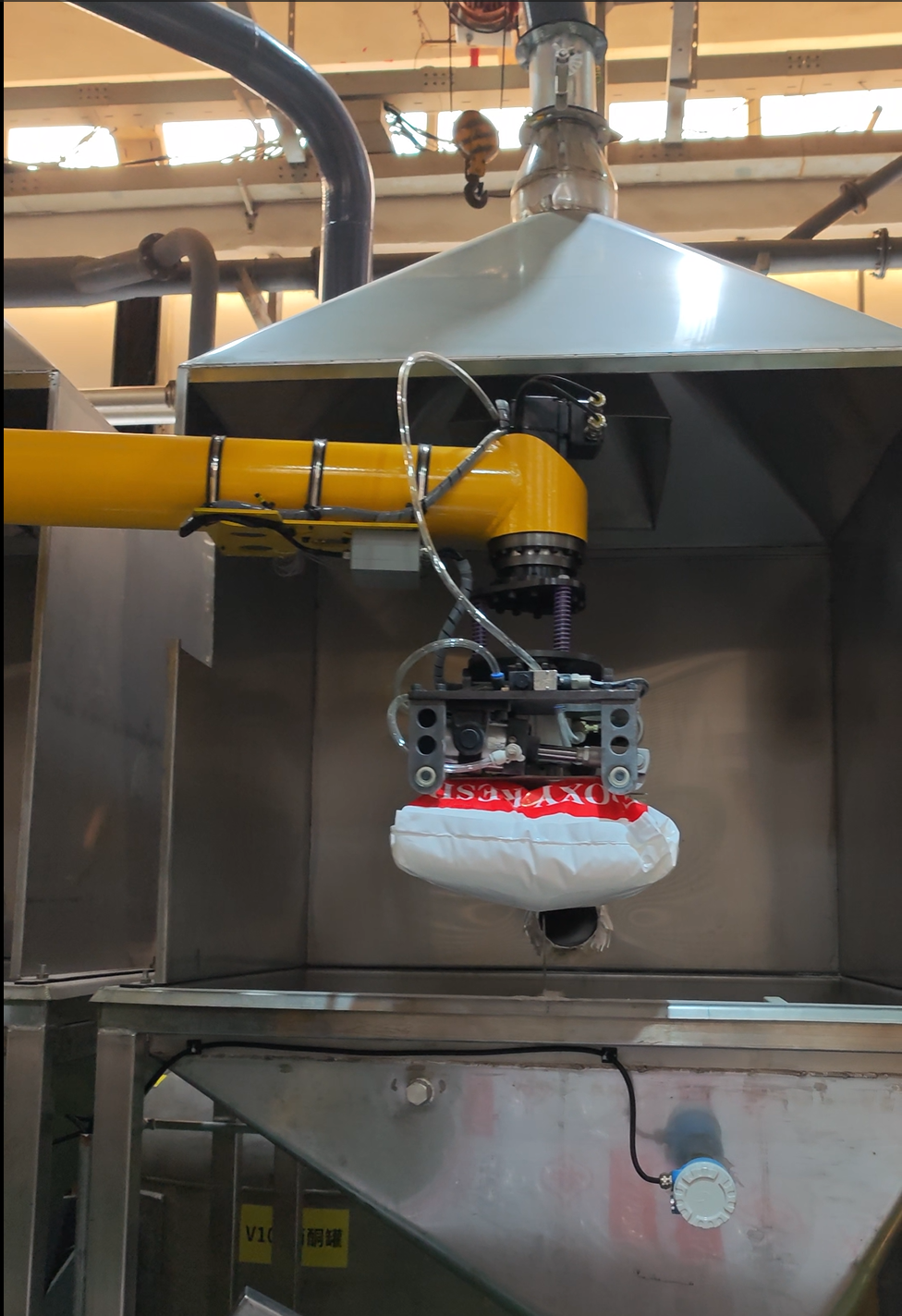
Application evidence supports a dossier; it does not replace the certificate the site authority will request.
Frequently asked questions
What documents should a food manufacturer request for a robot qualification dossier?
Request material certificates for product-contact and splash-exposed surfaces with the grade identified, a cleaning procedure using the plant's validated agents, an ingress or enclosure statement matched to the wash-down method, a lubricant statement, the gripper and wear-part list, the cell risk assessment and the current edition of any standard cited. The supplier's food-plant guidance names 304 stainless steel, HACCP-oriented design, easy cleaning, a throughput reference of 800–1000 bags per hour and a bag-topple rate below 0.05% as selection criteria; each must be evidenced by a document rather than a sentence.
Is it safe to use industrial robots in chemical or explosive atmospheres?
Only when the equipment category matches the classified zone, and that classification comes from the plant's own process hazard analysis. The supplier states that it builds custom explosion-proof depalletizing and bag-breaking robots described as compliant with national explosion-proof standards, with dust and explosion risk controlled through sealed design and isolated operation. A dossier must pin down the standard number, edition, jurisdiction, equipment category, issuing body and certificate reference; "explosion-proof" without those details is not verifiable by a safety assessor.
How should an MTBF or continuous-operation claim be verified?
Continuous 24/7 automatic operation is the documented operating mode for these systems, which makes reliability evidence a qualification item rather than a footnote. An MTBF value is a statistical statement and is only usable when the document states the calculation basis, the assumed duty cycle, the population it refers to, the excluded wear parts and the downtime definition. The published SCH100-1950-1800 datasheet carries a ±0.5 mm repeatability value but no MTBF figure, so any such claim should be requested as a separate dated document with its basis attached.
Does a robot-level safety certificate cover the whole depalletizing cell?
No. The EN ISO 10218 series is structured so that Part 1 addresses industrial robots and Part 2 addresses applications such as robot systems and robot cells, as explained by KAN in its 2023 note on the revision. Guarding, interlocked access, pallet dispensers, conveyor interfaces and integration logic therefore sit under a cell-level assessment. Buyers should confirm the current edition and the national adoption in the destination market before accepting a certificate as complete.
Can supplier case studies be used as qualification evidence?
They can be used as evidence of application experience, provided they are labelled as supplier-reported and kept separate from certification. Records such as a single robot handling more than 20,000 pieces per day at Mengniu and By-Health, a 40% handling-efficiency improvement at Tianci Materials, or 5 cm confined-space work for China National Nuclear Corporation describe what was achieved at those sites under those conditions. They support a supplier's credibility on similar work; they do not replace hygiene validation, an explosion-protection certificate or a radiation-safety review.
The full company profile and product brochure, covering the palletizing, depalletizing, bag-opening and feeding, press-tending and material-handling range, can be downloaded here: South China Robotics — Company Profile + Product Brochure 2026 EN.
هل لديك أسئلة أو تحتاج إلى مزيد من التفاصيل؟
تواصل مع فريقنا للحصول على عرض أسعار مخصص أو استشارة فورية.
طلب عرض أسعار
املأ النموذج أدناه وسيتواصل معك فريقنا بعرض مقترح مخصص.
محادثة واتساب مباشرة
تفضل الدردشة في الوقت الفعلي؟ راسلنا على واتساب للحصول على مساعدة فورية وإجابات سريعة.
- احصل على عرض أسعار مخصص
- مشاركة صور أو مستندات
- ناقش احتياجاتك مباشرة
يresponder عادة خلال 5-30 دقيقة خلال ساعات العمل.