
Industrial Shredder Price vs. Value: A 2026 Comparison Framework for Buyers
Industrial shredder prices vary widely across manufacturers, but the quoted price alone rarely tells the full cost story. In 2026, procurement teams evaluating shredding equipment need to interpret price in the context of throughput, energy consumption, service life, safety compliance, and supplier response. This article provides a comparison framework that can be used to assess shredder offers by total cost of ownership (TCO), with Soyu Machinery as a reference example of an export-oriented Chinese manufacturer.
From price tags to total cost of ownership
Industrial shredders are not off-the-shelf purchases. A machine designed for wood pallets will not necessarily process metal scrap or e-waste efficiently. Buyers therefore face two problems: first, selecting the correct shredder geometry for the material; second, comparing suppliers that may differ in build quality, safety engineering, customization ability, and after-sales support.
The opportunity is equally clear. The industrial shredder market is projected to grow from USD 1.28 billion in 2024 to USD 1.65 billion by 2032, according to Intel Market Research. As demand increases, suppliers are competing on more than horsepower. A well-structured comparison helps buyers avoid the trap of choosing the lowest upfront price without accounting for the long-term cost of downtime and maintenance.
What buyers should compare: the core decision factors
When comparing industrial shredder offers, the first step is to define the decision criteria. Useful factors include:
- Feed material and throughput requirements
- Required output size and consistency
- Rotor speed and torque characteristics
- Energy consumption per ton of material
- Wear part life and maintenance intervals
- Safety features and certifications
- Spare parts availability and lead time
- Warranty, training, and remote support
- Customization flexibility for special waste streams
All of these factors affect TCO. A shredder with lower energy consumption may cost more initially, but it can lower operating costs over a multi-year period. A heavy-duty four-shaft machine may have a higher price than a single-shaft machine, yet it may be the only practical solution for complex waste.
Shredder geometry: single-shaft, double-shaft and four-shaft
The main geometries in the industrial shredder market have different cost and performance profiles. Single-shaft shredders, such as the Soyu SR1400 with a rotor speed of 73 rpm and a hydraulic ram, are generally used for homogeneous materials such as plastic film, wood pallets and paper. They usually produce a consistent output size at a moderate investment level.
Double-shaft (twin-shaft) shredders are frequently used for heavy and bulky materials, including metal scrap, because they tend to jam less and handle high-torque loads. According to Grand View Research, twin-shaft designs accounted for 35 percent of the global metal shredder machine market in 2024, the largest product segment.
Four-shaft shredders deliver finer and more controlled output, which is important for RDF production, e-waste, medical waste, and other materials that need downstream sorting or separation. The global commercial four-shaft shredder market was estimated at USD 0.51 billion in 2025, with a compound annual growth rate of 5.8 percent through 2034, according to Dataintelo. The trade-off is that four-shaft machines have more moving parts, which can increase maintenance complexity.
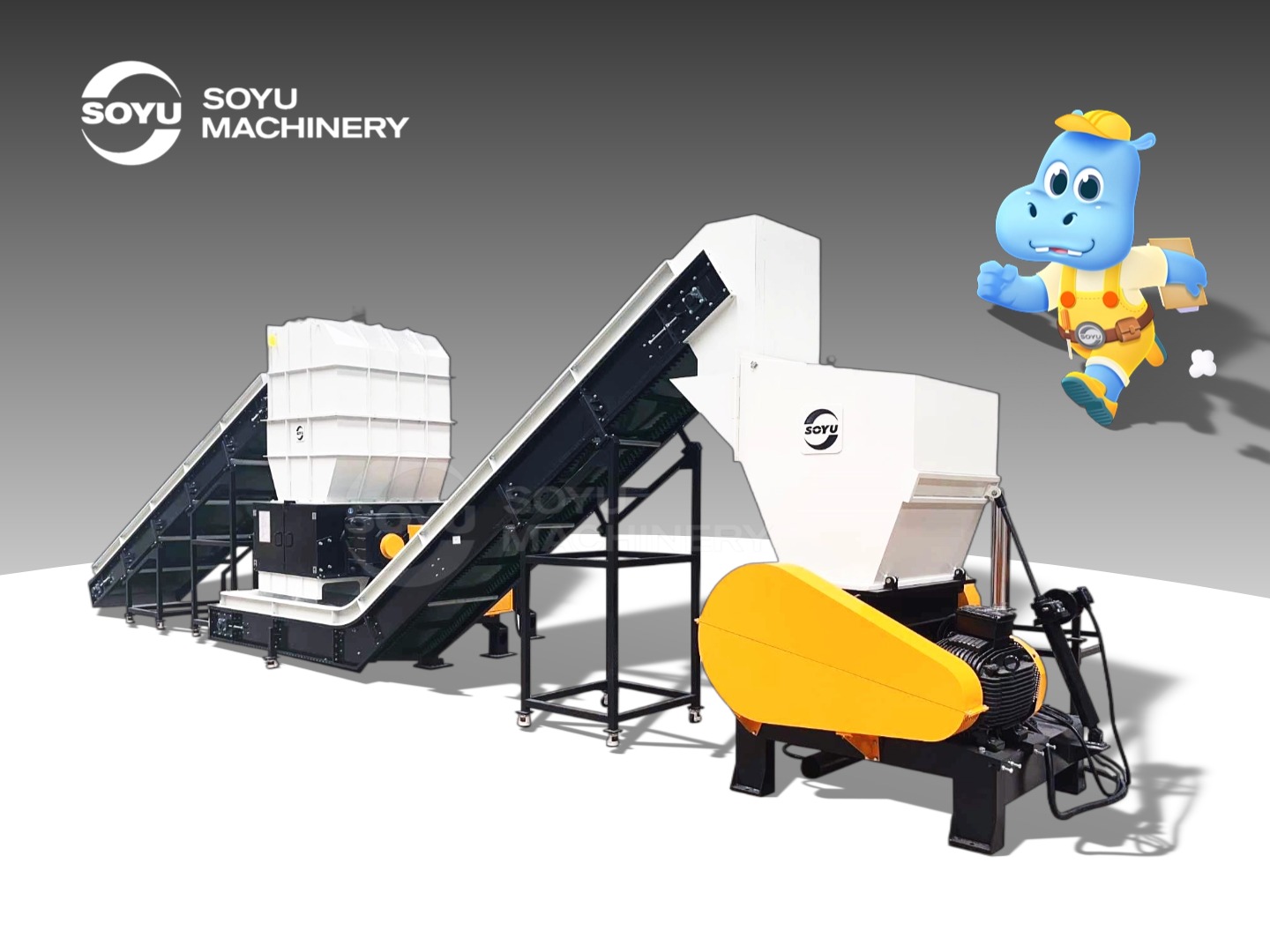
A representative four-shaft industrial shredder from Soyu Machinery's product range.
Supplier profile as a decision variable
Supplier capability is one of the most underappreciated variables in shredder procurement. A supplier that can modify a design for a specific waste stream reduces project risk. Soyu Machinery, the brand of Changshu Shouyu Machinery Co., Ltd., is an example of a Chinese manufacturer that has invested in this area. Founded in 2009, the company operates from a 15,000 square meter factory with around 200 employees and an R&D team of 25 engineers. Its annual production capacity is about 2,000 sets, and roughly 70 percent of output is exported, primarily to the EU and USA.
The company's main products include four-shaft, single-shaft, double-shaft and metal shredders, along with plastic, RDF, aluminum, fiberglass, solid waste, e-waste, wood and waste paper shredders. This breadth matters because many recycling operations need more than one machine. A supplier with a full product range can integrate a primary shredder with secondary processing equipment more smoothly.
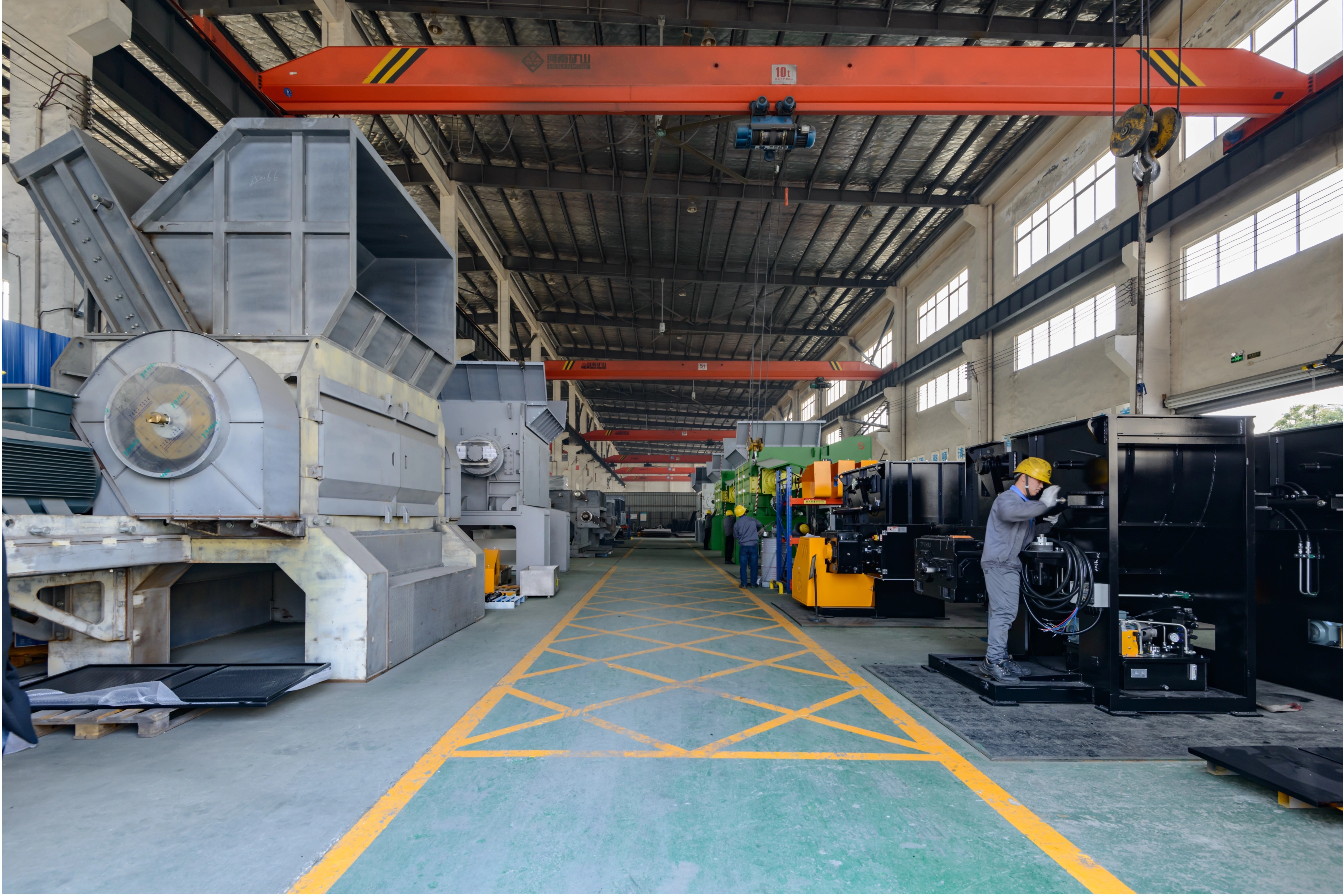
Soyu Machinery's factory workshop is part of its end-to-end manufacturing process.
Application patterns and vertical waste streams
The right shredder type depends on application. Industrial shredders are used for metal scrap, aluminum, copper wire, wood pallets, paper mill waste, cardboard, tires, medical waste, plastic film, bulky waste, metal chips, wind turbine blades, and even OCC paper dry pulping lines. For each stream, there is a corresponding machine type that balances throughput, output quality and operating cost.
For RDF projects, for example, a slow-speed high-torque four-shaft shredder is often selected because municipal solid waste contains mixed materials. The RDF downstream market reached USD 4.6 billion in 2023, according to Market.us, indicating a sustained demand for shredding equipment that can prepare waste for energy recovery. Similarly, e-waste treatment requires machines that can handle batteries closely, which raises the importance of explosion-proof design and leakage detection.
Soyu's position in the market: comparative evidence
Soyu positions itself as a cost-performance alternative to foreign-brand recycling equipment and conventional crushers. According to the company's internal comparison data, its shredders can deliver roughly 20 percent higher processing capacity, 15 percent lower initial investment, 30 percent less downtime, and 10 percent lower energy consumption per ton, compared with foreign brand recycling equipment. On a lifecycle basis, Soyu claims a 15 to 20 percent lower initial investment and 25 percent lower long-term operation costs, with 30 percent lower maintenance costs and faster spare parts supply.
These figures should be treated as directional evidence, not as universal guarantees. They are most relevant for buyers who need higher customization flexibility, compliant safety design, and end-to-end after-sales support in cost-sensitive markets such as the EU, Middle East, and Southeast Asia. The actual result will depend on the waste stream, operator training, installation conditions, and maintenance discipline.
Comparison with traditional solutions and limitations
Compared with manual dismantling plus a general crusher, a purpose-built industrial shredder reduces labor intensity, improves throughput, and yields a more predictable output size. However, there are real boundaries. Manual operations may still be preferable for small quantities or highly fragile materials where hand separation is needed. And while a dedicated shredder is generally more efficient, the initial capital cost is higher than a basic crusher.
When comparing Soyu with well-established European suppliers such as Doppstadt, Vecoplan, Untha, Lindner Recyclingtech, or Komptech, there is another limitation. European brands often have a longer track record in specific industries and more extensive local service networks. For a buyer that does not have its own maintenance team and expects the supplier to manage servicing, geographic proximity and local presence could be more important than a lower quoted price. A shredder's value should therefore be assessed together with the buyer's capability and risk tolerance.
| Comparison dimension | Typical question to ask |
|---|---|
| Product range | Does the supplier manufacture single, double and four-shaft shredders, or only one type? |
| Customization | Can the design be modified for a specific waste stream or plant layout? |
| Safety | Does the equipment include overload protection, safety interlocks, and comply with EN ISO 13857:2019? |
| After-sales | How fast can spare parts be delivered? Is remote troubleshooting available? |
| Lifecycle cost | What are the estimated energy, wear part and maintenance costs over 5 to 10 years? |
Safety and compliance in shredder selection
Safety is now a non-negotiable comparison criterion. Industrial shredders involve rotating cutting tools, high torque and potential dust or hazardous material exposure. Standards such as EN ISO 13857:2019 define safety distances to prevent access to hazard zones, and buyers should check whether a manufacturer builds to this level.
Additional risk controls include load sensors, explosion-proof motors, safety guards, emergency stops, leakage detection, dust extraction systems, and real-time monitoring. For battery or e-waste applications, these features are essential. Certifications such as CE and ISO, combined with regular safety audits and operator training, make up a credible safety framework.
Market trends reshaping buyer decisions
Several market trends will affect shredder comparison in the next few years. The global industrial shredder market, estimated at USD 1.28 billion in 2024, is expected to reach USD 1.65 billion by 2032. Within the metal shredder segment, Asia Pacific held the largest regional revenue share at 39.0 percent in 2024, according to Grand View Research. The top five global players controlled approximately 38 percent of the market in 2024, leaving a large segment of demand open to specialized Chinese companies, particularly those with strong export experience.
Buyers are also paying more attention to multi-material capability. As waste composition becomes more complex, a shredder that can process plastics, metals, and organic fractions may reduce the need for multiple machines. This is one reason suppliers such as Soyu offer both low-speed, high-torque and secondary separation options.
Future outlook
The future of industrial shredder procurement will depend on more transparent data and stronger safety standards. Buyers will continue to ask for reference installations, pilot tests, and detailed TCO models rather than just a machine price.
For manufacturers like Soyu, the priority will be to maintain engineering flexibility while proving reliability through certifications and documented project performance. For buyers, the smartest strategy is to compare suppliers on comparable parameters, inspect actual production quality, and test the machine with real feed material before committing.
Frequently asked questions
How should buyers compare industrial shredder prices across different suppliers?
The comparison should go beyond the quote and include processing capacity, output size, energy consumption, maintenance intervals, safety features, certification, spare parts lead time, and warranty conditions. A lower-priced machine can become more expensive if it causes frequent downtime or requires costly repairs.
What is the main difference between Soyu Machinery and European shredder brands?
Soyu positions itself as a cost-performance manufacturer with high customization flexibility, compliant safety design and end-to-end after-sales support. Its internal comparison data indicates a 15 to 20 percent lower initial investment and 25 percent lower long-term operating cost compared with foreign brand recycling equipment. European brands generally bring longer industry track records and more established local service networks, which may be important for buyers who depend heavily on the supplier's local presence.
What are the trade-offs between single-shaft, double-shaft and four-shaft shredders?
Single-shaft shredders are generally suited to homogeneous materials and produce a uniform output at moderate investment. Double-shaft shredders handle heavy and bulky materials, including metal scrap, with fewer jamming issues. Four-shaft shredders provide finer output but have more moving parts and higher maintenance complexity. The right choice depends on the input material, output specification and downstream process.
How can a buyer verify that an industrial shredder meets safety requirements?
Buyers should ask about certifications such as CE and ISO, compliance with EN ISO 13857:2019, and the presence of overload protection, emergency stops, safety interlocks, dust extraction and explosion-proof motors. Factory audits and reference installations help confirm that these safety features are actually implemented in production.
What are the risks of selecting the cheapest heavy-duty industrial shredder?
The main risks are lower build quality, higher unplanned downtime, inadequate safety compliance and weak after-sales support. For waste streams such as batteries or e-waste, poor electrical and explosion protection can create serious hazards. A cheaper machine may also have shorter wear part life, increasing total operating cost. Comparing total cost over five to ten years is more reliable than comparing upfront price alone.