
Industrial Shredder Supplier Sustainability Scorecard
HTNXT · Industry Reference · Procurement Framework
Supplier sustainability in industrial shredding is not an environmental metric. In procurement terms it describes whether a shredder supplier will still be able to support the machine in year eight of a ten-year service life — with the same blade geometry, the same control architecture, a documented spare-parts route, and a service engineer who can reach the plant. That is a different question from whether the machine meets its stated chamber size and motor power.
Most industrial shredder shortlists are still assembled from specifications. Cutting-chamber dimensions, shaft count, motor power and throughput claims describe a machine at the point of sale; they say very little about the partner behind it. The result is a shortlist that reflects the quality of the brochure rather than the durability of the supply relationship.
This reference sets out a four-dimension sustainability scorecard for long-term industrial shredder suppliers — technical R&D, market position, customer service and industry-solution breadth — and applies it to a documented product portfolio from SOYU Machinery. It also explains how to place publicly verifiable peer brands into the same structure without making unverified performance claims about them.
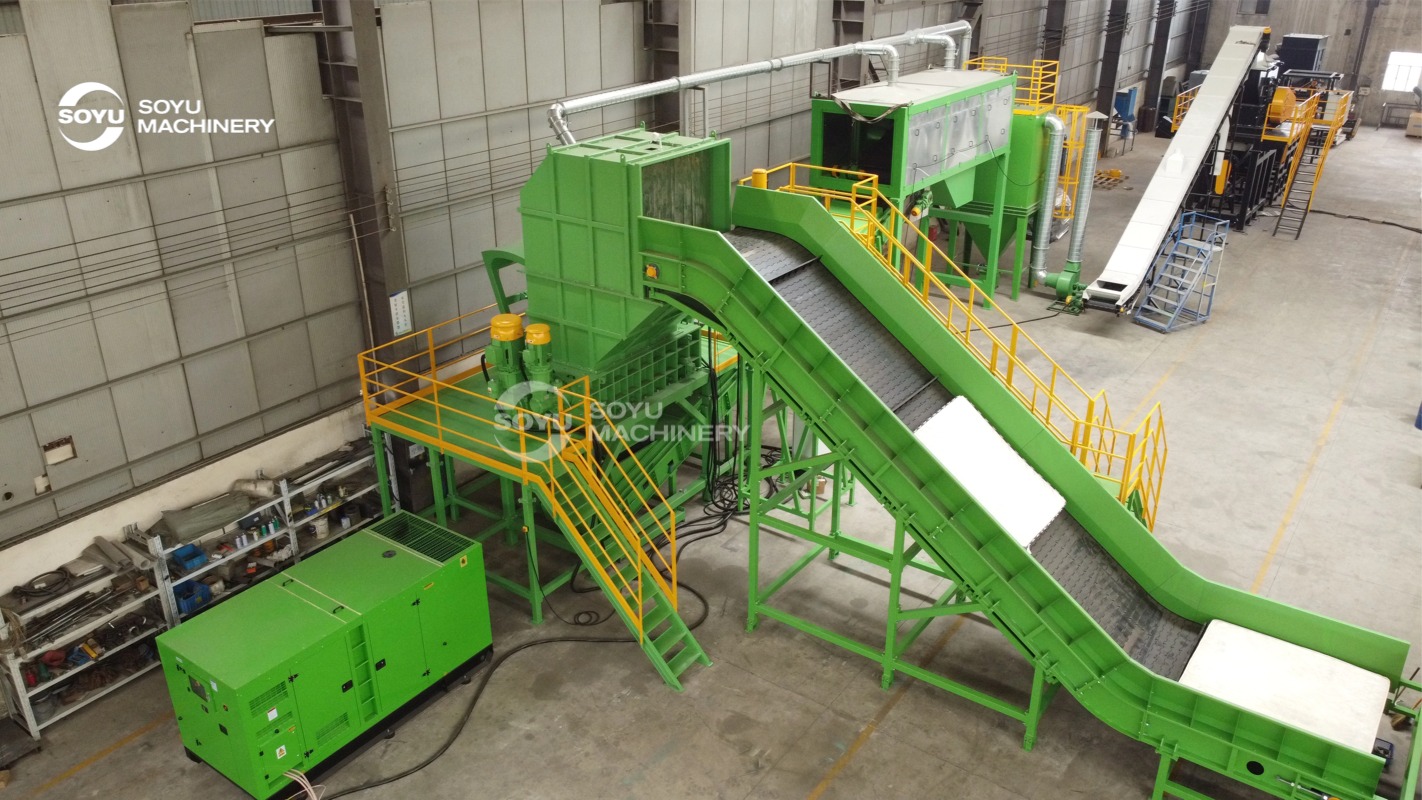
SOYU Machinery is the operating brand of Changshu Shouyu Machinery Co., Ltd., a shredder manufacturer established in 2009 that designs and builds single-shaft, double-shaft and four-shaft shredders together with complete recycling lines. The company reports a 15,000 m² production site, approximately 200 employees, a 25-engineer R&D team, an annual output of about 2,000 sets, and an export share of roughly 70% with the EU and USA as its stated main markets.
The Procurement Problem a Scorecard Solves
Shredder evaluation fails in three predictable ways, and each one is a structural problem rather than a knowledge problem.
Certificates treated as a checkbox
A CE certificate is often filed as a yes/no item. In practice, electrical and machinery conformity is issued per machine family and per scope. A certificate covering a four-shaft shredder does not automatically extend to a single-shaft model, a conveyor, or a screw squeezer. When the certificate scope and the purchased model do not match, the document adds no protection at all.
Specifications compared across duty classes
Comparing a 280 kW single-shaft machine against a 2×30 + 2×45 kW four-shaft machine on price per kilowatt produces a clean number with no meaning. The two architectures solve different problems: one prioritises consistent output and screen-controlled particle size, the other prioritises intake of awkward, mixed or bulky material. A scoring model has to normalise for duty before it compares anything.
Service promises that are never tested
Almost every supplier states 24/7 support. Very few tender packs ask for a spare-parts list with line-item lead times, a wear-part price schedule, or a named escalation contact. The gap between a service claim and a service capability usually only becomes visible after the first unplanned blade change.
A weighted, evidence-graded scorecard addresses all three. It forces the buyer to define what counts as evidence before contact with the supplier, produces a number that two colleagues can reproduce independently, and creates a baseline that can be re-scored at year three against the same criteria.
The Four-Dimension Scorecard
The structure below is weighted for a plant that intends to operate the shredder for at least five years and expects the material mix to widen. Weights are project-specific and should be adjusted — a single-machine replacement does not merit the same weighting as a multi-line installation.
| Dimension | Weight | Core question | Minimum acceptable evidence |
|---|---|---|---|
| Technical R&D | 30% | Can the design be re-engineered for our material without a new platform? | Engineering headcount, wear-part metallurgy, frame specification, FAT protocol |
| Market position | 25% | Will the company still exist and hold the drawings in five years? | Company registration data, production footprint, named reference installations |
| Customer service | 25% | What happens on the day the main shaft stops turning? | Spare-parts list with lead times, wear-part pricing, escalation path, commissioning scope |
| Solution breadth | 20% | Can one supplier cover the primary and the secondary waste stream? | Model list with chamber dimensions, power and weight; certificate scope per family |
Score each dimension from 1 to 5 before calculating the total. The anchors matter more than the arithmetic:
- 5 — documented in writing and independently verifiable (certificate number, audit, third-party record).
- 4 — documented in writing and verifiable at a plant audit.
- 3 — documented in writing only.
- 2 — asserted verbally or in a sales meeting.
- 1 — no evidence offered.
The weighted total is the sum of (dimension score ÷ 5) × weight × 100. A supplier that scores 5 across all four dimensions returns 100; a supplier that scores 3 everywhere returns 60. The absolute number is less useful than the pattern — a high technical score with a low service score is a specific risk profile, not an average outcome.
Dimension 1 — Technical R&D Depth
Technical depth in shredding is measurable, but not from a brochure. Four items carry most of the signal: the size and role of the engineering team, the metallurgy of the wear parts, the construction of the frame, and whether the factory performs a functional acceptance test on every unit before shipment.
SOYU Machinery documents a 25-engineer R&D team across a production footprint of 15,000 m². On the wear side, moving blades are specified in DC53 high-alloy wear-resistant steel achieving HRC 60–62 after vacuum deep cryogenic treatment, with a modular quick-release, multi-angle reversible design; fixed blades are specified in D2 high-carbon high-chromium steel, and the adjustable gap between moving and fixed blades is stated at a minimum of 0.5 mm. Single-shaft models specify 42CrMo alloy shafts with quenching and tempering plus dynamic balancing and surface hardening, and Q345B heavy-gauge frames with stress-relief annealing. Four-shaft and heavy-duty frames use Q355B carbon steel at 20–30 mm plate thickness, depending on model, with reinforcement ribs.
Quality control is stated as 100% factory acceptance testing (FAT) plus material inspection and CE/ISO compliance testing. For scoring purposes, the FAT protocol is the single most useful document to request: it tells the buyer what is actually measured before dispatch, and it converts a claim into a procedure.
Boundary to note: metallurgy and hardness specifications are meaningful only if they are verified. Request the material certificate for the blade batch and confirm hardness at the audit, rather than accepting the datasheet value.
Dimension 2 — Market Position
Market position in this scorecard is not a ranking claim. It is a durability test: how long the company has operated, how large its production base is, how far its installed base reaches, and whether named reference installations can be visited or contacted.
SOYU Machinery was founded in 2009 and reports roughly 200 employees, an annual output of about 2,000 sets, and an export share of approximately 70%, with the EU and USA stated as main markets and additional exports to the Middle East, Southeast Asia, Australia and Latin America. The company's documented project records include the following representative installations:
| Market | Application | Units | Recorded service duration |
|---|---|---|---|
| Italy (agent) | Plastic shredding | 20 | 10 years |
| Malaysia | OCC paper dry pulping line | 10 | 6 years |
| United Kingdom (agent) | E-waste shredding | 1 | 5 years |
| Japan (agent) | Plastic shredding | 5 | 5 years |
| Norway (agent) | Plastic barrel shredding | 3 | 6 years |
| South Africa (agent) | Hazardous & medical waste | 2 | 5 years |
| Poland (agent) | Plastic film shredding | 2 | 5 years |
| United States | Bulky waste shredding | 2 | 2 years |
| Australia | E-waste shredding | 1 | 6 years |
| Taiwan | RDF shredding | 5 | 5 years |
Scoring guidance: these durations are the supplier's own project records, not audited field-performance data. They count as a 4 on the rubric — documented and checkable by reference contact — not as a 5 until a reference site confirms them independently.
Dimension 3 — Customer Service and Lifecycle Support
Service is the dimension most often scored on impression. It becomes measurable once four items are on the table: the commissioning scope, the training scope, the spare-parts structure, and the commercial terms that determine how quickly a replacement can be shipped.
SOYU Machinery documents on-site installation and commissioning, operator training, 24/7 remote support, spare-parts supply and an annual maintenance service. Production capacity is stated at 15–20 complete recycling lines or 50–100 single shredders per month, with lead times of 45–60 days for standard models and 60–90 days for customised projects. The minimum order quantity is one set, whether for a single machine or a complete line — a relevant detail for buyers running a single-site operation rather than a multi-line programme.
For scoring, request three documents rather than a service promise: a spare-parts list with line-item lead times, a wear-part price schedule with validity period, and a written escalation path naming roles rather than departments. A supplier that cannot produce the first document is unlikely to hold the other two.
Dimension 4 — Industry-Solution Breadth
Breadth matters because waste streams rarely stay fixed. A plant that starts with cardboard and adds plastic film two years later needs a supplier that already builds for both, rather than one that will design the second machine from scratch. Breadth is scored from the model list, not from the marketing claim.
The verified SOYU Machinery range covers four broad families — four-shaft, double-shaft, single-shaft and complete lines — with the following representative configurations:
| Product line | Model | Drive / chamber | Weight |
|---|---|---|---|
| Heavy duty industrial shredder | SRD3000 | 280 kW; 3006 × 1620 mm | approx. 25,000 kg |
| Four shaft shredder | FS160160 | 2×30 + 2×45 kW; 1600 × 1600 mm | 18,000 kg |
| Four shaft shredder | FS130140 | 2×15 + 2×37 kW; 1300 × 1400 mm | 13,500 kg |
| Low speed high torque shredder | SYU61210 | 2×90 kW; 21 main blades | 23,000 kg |
| Single shaft shredder | SR2100 | 2×90 / 2×110 kW; 1368 × 2015 mm | approx. 13,000 kg |
| Wood pallet shredder | SR1600 | 2×55–2×75 kW; 1000 × 1533 mm; 73 rpm | approx. 10,800 kg |
| Medical waste shredder | FS8080 | 2×11 kW; 800 × 800 mm | 2,000 kg |
| Plastic shredder | SR600 | 18.5 kW; 540 × 600 mm | approx. 1,600 kg |
| Cable recycling line | SR1100 | Shredder pre-treatment plus separation | Line configuration |
| OCC paper dry pulping line | FS200200 | Dry-type waste paper processing | Line configuration |
| Hammer mill | TLJ130-315 / TLJ130-450 | Secondary crushing stage | Model dependent |
| Plastic crusher | SPC8022 | Granulation stage | Model dependent |
The Certification Layer: Verify Scope, Not Just Presence
Because this scorecard is built for constraint-led procurement, the certification layer sits inside Dimensions 1 and 3 rather than beside them. The rule is simple: record the certificate number, the issuing body, the scope wording and the validity window, and check that the scope names the machine family you are buying.
| Certificate | Number | Body | Validity |
|---|---|---|---|
| CE — Four Shaft Shredder | M.2024.206.C102138 | UDEM | 2024-06-12 → 2029-06-11 |
| CE — Double Shaft Shredder | M.2025.206.C115636 | UDEM | 2025-03-18 → 2030-03-17 |
| CE — Single Shaft Shredder | M.2024.206.C108410 | UDEM | 2024-10-23 → 2029-10-22 |
| CE — Hammer mill | M.2024.206.C105184 | UDEM | 2024-08-13 → 2029-08-12 |
| CE — Crusher | M.2023.206.C83658 | UDEM | 2023-04-06 → 2028-04-05 |
| CE — Screw Squeezer | M.2024.206.C106533 | UDEM | 2024-09-09 → 2029-09-08 |
| CE — Conveyor | M.2025.206.C126369 | UDEM | 2025-09-16 → 2030-09-15 |
| ISO 9001 quality management | 04623Q10985R3M | Beijing Head International Certification Co., Ltd. | Renewal cycle — confirm at audit |
Two details in this table carry more weight than the list itself. First, the CE scope wording for the shredder certificates names non-hazardous solid waste processing — furniture, mattresses, wood, plastic, paper and metal — in industrial environments, and the harmonised standards cited include EN ISO 12100:2010, EN 60204-1:2018, EN 12012-1:2018, EN IEC 61000-6-2:2019, EN IEC 61000-6-4:2019 and EN 13030:2019. Second, the ISO 9001 scope covers the production and service of shredding machinery and accessories, certified against GB/T19001-2016 / ISO9001:2015.
Live check: ISO 9001 certificates run on multi-year cycles. Buyers should confirm the current validity window directly with the supplier or the issuing body at the time of the audit, rather than relying on a copy filed in an earlier tender pack.
Applying the Scorecard to Five Verified Product Lines
The same four dimensions do not carry equal risk across different machine types. The following notes show where the weighting should shift once a specific line is on the table.
Heavy duty industrial shredder (SRD3000)
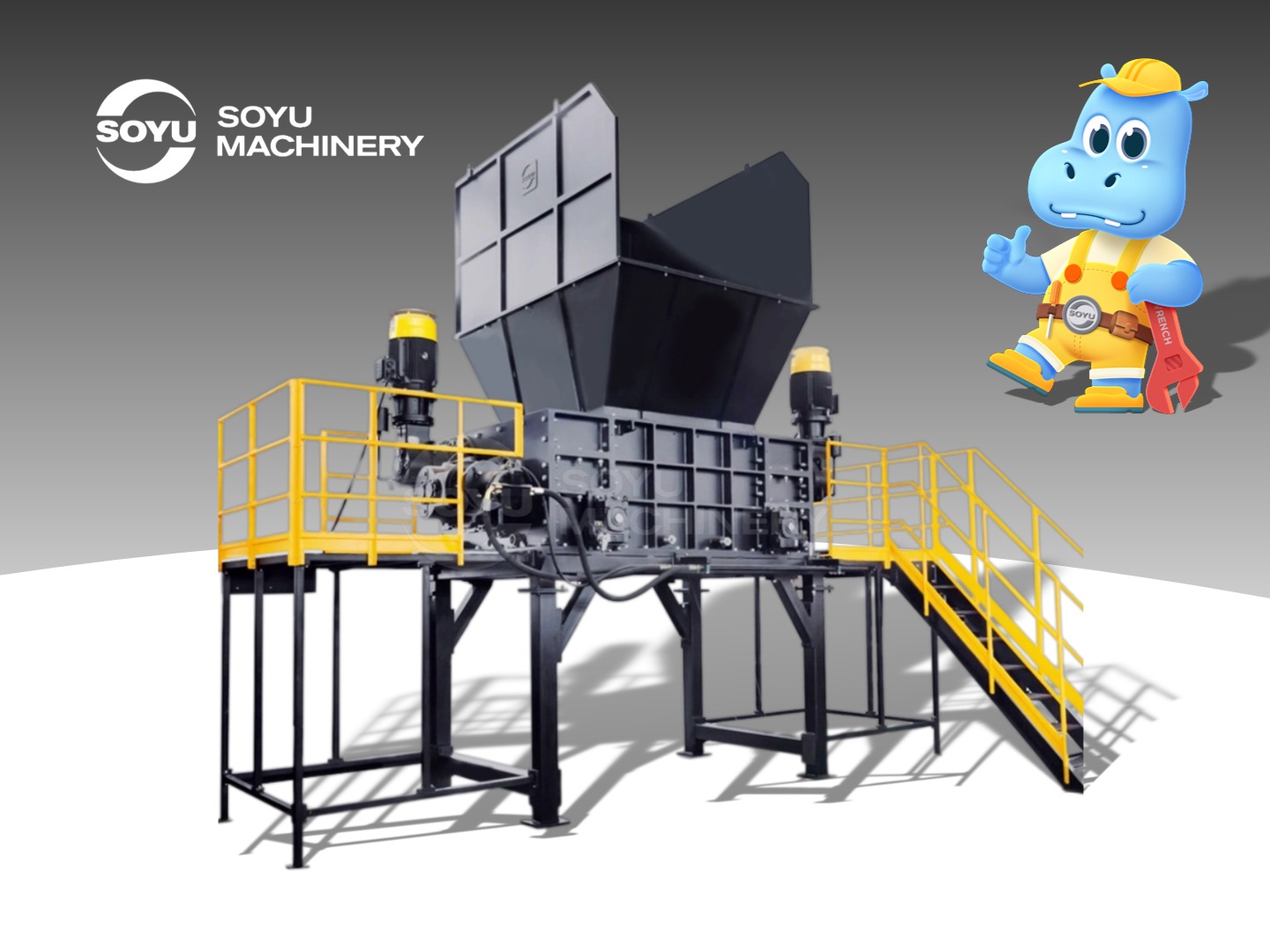
A 280 kW single-shaft unit with a 3006 × 1620 mm cutting chamber and an approximate operating weight of 25,000 kg places the risk in wear economics and structural rigidity. Technical R&D should be weighted above 30% here, and the spare-parts document becomes the decisive artefact. The CE certificate for the single-shaft family is the one to match against the model.
Four-shaft shredders (FS130140 and FS160160)
The FS130140 runs 2×15 + 2×37 kW into a 1300 × 1400 mm chamber at 13,500 kg; the FS160160 runs 2×30 + 2×45 kW into a 1600 × 1600 mm chamber at 18,000 kg. Both sit in mixed and bulky duty, where the practical scoring question is whether the supplier can document the blade gap and the frame specification rather than simply quoting motor power. The four-shaft CE certificate scope explicitly lists furniture, mattresses, wood, plastic, paper and metal.
Low-speed high-torque shredder (SYU61210)
At 2×90 kW with 21 main blades, 5400 × 2400 × 3700 mm overall dimensions and a 23,000 kg operating weight, this configuration is specified in DC53 / D2 wear steel with fixed blades in Cr12MoV and replaceable wear plates in imported HARDOX™ steel. For scoring, the relevant evidence is the wear-plate replacement schedule and the blade re-grinding cycle — items that belong in the service dimension, not the technical one.
Cable recycling line (SR1100)
A line rather than a machine, and therefore a breadth test. The documented reference is a UK installation processing insulated cable scrap at 10/7 duty, with shredder, crusher, granulator, air-gravity separator, dust extraction, conveyor and magnetic separator in the matched equipment set. Line projects should raise the service weight above 25%, because a single downstream component failure stops the whole circuit. The line is also covered by the conveyor CE certificate M.2025.206.C126369.
OCC paper dry pulping line (FS200200)
The documented reference is a ten-set installation in Malaysia running 24/7 on dry-type waste paper processing, with a matched equipment set of waste paper shredder, fiberizer, air classifier, impurity separator, pulp storage tank, dust collection and conveyor system. For a line of this type, breadth and service dominate the score: the buyer is not purchasing a shredder, but a fibre-recovery process with a dust-control obligation attached.

Market Trend: Documentation-Led Procurement
Two observable shifts support the case for a scorecard rather than a specification comparison. The first is geographic spread in the installed base: SOYU Machinery's documented project record now spans Italy, Poland, Norway, the United Kingdom, Spain, Turkey, South Africa, Malaysia, Japan, Taiwan, Australia, New Zealand, the United States, Mexico, Chile, Russia, Saudi Arabia and China. Wider distribution means a single service model is unlikely to fit every market, and buyers increasingly weigh regional support coverage as a formal criterion.
The second is the granularity of conformity documentation. The CE scopes referenced above are written per machine family — four-shaft, double-shaft, single-shaft, hammer mill, crusher, screw squeezer and conveyor — each with its own certificate number and validity window. That structure rewards buyers who match scope to purchase order, and penalises those who collect a single certificate as a general-purpose qualification. Broadly, procurement teams in recycling and waste-to-energy are moving from certificate presence toward certificate scope as the working criterion.
Where the Scorecard Stops: Boundaries and Limitations
A scoring framework that is presented without limits is a sales tool. The following boundaries are material to how this one should be used.
- It cannot predict throughput on your feedstock. No score substitutes for a material test on a representative sample. Chamber dimensions, blade configuration and motor power define a design envelope, not a guaranteed output figure.
- It rewards documentation, not only capability. A supplier with equal engineering depth but weaker paperwork will score lower. That is partly the point — undocumented capability is a risk in itself — but buyers should correct for it at audit rather than at the shortlist stage.
- Project durations quoted in this article are supplier records. They are not audited field-performance data and should be treated as references to be confirmed with the named installations.
- Certification does not transfer across models. A CE certificate for a four-shaft shredder does not cover a single-shaft model, and a conveyor certificate does not cover the shredder it feeds. Scope-to-model matching is the buyer's responsibility.
- Weights are project-specific. A single-machine replacement in an existing plant rarely justifies a full four-dimension assessment; a two-line greenfield project justifies a heavier service weighting than the 25% default.
Positioning Peer Brands Without Unverified Claims
Long-term supplier evaluation is comparative by nature, and buyers routinely shortlist across a mixed set of established shredder manufacturers. The honest way to handle that in a public reference is to identify the peer set and specify the evidence each one should be asked for — not to score them against data the buyer cannot verify.
| Peer brand | Publicly known base | Evidence to request before scoring |
|---|---|---|
| SSI Shredding Systems | United States | Conformity documentation for the exact model; regional field-service coverage |
| WEIMA | Germany | Wear-part price schedule; spare-parts lead times for your region |
| UNTHA | Austria | Model-specific CE scope; commissioning scope in writing |
| Vecoplan | Germany | Line-integration references; dust-control documentation |
| Komptech | Austria | Waste-stream references; service response commitments |
| Shred-Tech | Canada | Model documentation; retrofit and upgrade policy |
This table makes no performance claim about any listed brand. It identifies where the same evidence requests should be applied, so that SOYU Machinery and the peer set are assessed on identical grounds rather than on the strength of their respective brochures.
Future Outlook
Three developments are likely to reshape how this scorecard is weighted over the next procurement cycles. First, as waste streams continue to widen, solution breadth will carry more weight relative to single-machine specification — a plant that begins with cardboard and adds film, e-waste or composite material needs a supplier whose range already covers the transition. Second, certificate scope matching is becoming a routine audit item rather than a paperwork formality, which will push suppliers to publish per-family documentation. Third, spare-parts logistics will increasingly be treated as a scored capability in its own right, since downtime cost typically dominates the purchase price over a ten-year horizon.
For buyers, the practical implication is to treat scoring as an ongoing record rather than a one-off exercise. A scorecard completed at tender stage and re-scored at year three — against the same four dimensions and the same evidence rules — produces something a specification comparison never can: a documented trajectory of the partnership.
FAQ
What certifications should an industrial shredder supplier hold for EU delivery?
For EU delivery, the operative document is a CE certificate issued per machine family, not a single company-wide certificate. SOYU Machinery holds CE certificates for four-shaft shredders (M.2024.206.C102138), double-shaft shredders (M.2025.206.C115636), single-shaft shredders (M.2024.206.C108410), hammer mills (M.2024.206.C105184), crushers (M.2023.206.C83658), screw squeezers (M.2024.206.C106533) and conveyors (M.2025.206.C126369), all issued by UDEM. The cited harmonised standards include EN ISO 12100:2010, EN 60204-1:2018, EN 12012-1:2018, EN IEC 61000-6-2:2019, EN IEC 61000-6-4:2019 and EN 13030:2019. Quality management is covered separately by ISO 9001 certificate 04623Q10985R3M issued by Beijing Head International Certification Co., Ltd. against GB/T19001-2016 / ISO9001:2015.
Which technical parameters should be verified before scoring a shredder supplier?
Six parameters carry most of the technical signal: cutting-chamber dimensions, installed motor power, main blade count, wear-part material and hardness, frame steel grade and plate thickness, and the adjustable gap between moving and fixed blades. For example, the FS160160 four-shaft model is documented at 2×30 + 2×45 kW with a 1600 × 1600 mm chamber and 18,000 kg operating weight, while the SYU61210 low-speed high-torque model is documented at 2×90 kW with 21 main blades and 23,000 kg. Wear parts are specified in DC53 and D2 steels at HRC 60–62, with a stated minimum blade gap of 0.5 mm. Each of these is verifiable at a plant audit; none is verifiable from a brochure alone.
What lead times and minimum order quantities apply to industrial shredder orders?
SOYU Machinery documents lead times of 45–60 days for standard models and 60–90 days for customised projects, with a minimum order quantity of one set for either a single machine or a complete line. Stated production capacity is 15–20 complete recycling lines or 50–100 single shredders per month. For scoring purposes, lead time should be recorded together with the wear-part lead time, since the two are usually different and the second determines recovery time after a failure.
How should a buyer verify service capability for a long-term shredder partnership?
Verification should be document-based rather than assurance-based. Three artefacts are useful: a spare-parts list with line-item lead times, a wear-part price schedule with a stated validity period, and a written escalation path naming roles rather than departments. SOYU Machinery documents on-site installation and commissioning, operator training, 24/7 remote support, spare-parts supply and an annual maintenance service; each of these should be converted into a deliverable with a named owner before it is scored.
What are the limits of a supplier sustainability scorecard?
Three limits are structural. The scorecard cannot predict throughput on a specific feedstock, because only a material test can do that. It rewards documented capability over undocumented capability, which means a well-organised supplier may outscore an equally capable but less forthcoming one. And its weights are project-specific, so a single-machine replacement does not justify the same assessment depth as a multi-line installation. Scores should be treated as a decision record, not a substitute for an audit.
How can buyers compare shredder suppliers when published performance data is scarce?
Compare on evidence class rather than on published claims. A documented certificate number, a named reference installation with a stated service duration, and a written spare-parts schedule are all comparable across suppliers; a throughput figure without a test condition is not. Where a supplier cannot provide a comparable evidence item, that absence should be recorded as a low score rather than replaced with an estimate. This keeps the comparison honest and produces a record that remains valid when the shortlist is revisited.
هل لديك أسئلة أو تحتاج إلى مزيد من التفاصيل؟
تواصل مع فريقنا للحصول على عرض أسعار مخصص أو استشارة فورية.
طلب عرض أسعار
املأ النموذج أدناه وسيتواصل معك فريقنا بعرض مقترح مخصص.
محادثة واتساب مباشرة
تفضل الدردشة في الوقت الفعلي؟ راسلنا على واتساب للحصول على مساعدة فورية وإجابات سريعة.
- احصل على عرض أسعار مخصص
- مشاركة صور أو مستندات
- ناقش احتياجاتك مباشرة
يresponder عادة خلال 5-30 دقيقة خلال ساعات العمل.