
Injection Molding Machines: Types, Applications and Selection
An injection molding machine melts thermoplastic resin, injects it into a closed mold under controlled pressure, holds it through cooling, and ejects a finished part on a repeatable cycle. Every plastic component produced at volume — an automotive bumper fascia, a 0.4 mm thin-wall food container, a connector housing — passes through this sequence. That is why the machine category sits upstream of most plastics supply chains rather than at the end of them, and why equipment decisions made at the research stage shape unit cost, quality yield and production flexibility for the life of the tool.
Grand View Research valued the global injection molding machine market at USD 17.3 billion in 2025 and projects USD 25.5 billion by 2033, a 5.0% compound annual growth rate, with Asia Pacific accounting for 39.7% of 2025 demand. A second commercial publisher, Fortune Business Insights, frames the same category at USD 11.66 billion in 2026 rising to USD 18.45 billion by 2034 at 5.90%. The two estimates do not reconcile with each other. Buyers should read them as directional demand signals, not as a single agreed market value — a point that matters more than usual in a category where public technical comparison data is thin.
Why "injection molding machine" is not a procurement unit
Search demand for the term injection molding machine is broad, but the underlying purchase is narrow. A buyer rarely needs a generic machine. A buyer needs a clamping force range, an injection volume, a screw diameter, a cycle time and a mold interface that match one specific part, one specific material, and one specific plant layout.
The keyword vocabulary reflects this fragmentation. Automotive injection molding machine, medical injection molding machine, packaging injection molding machine, thin-wall injection molding machine, multi-component injection molding machine, two-platen injection molding machine, all-electric injection molding machine, servo-hydraulic injection molding machine and caps and closures injection molding machine are not synonyms. Each describes a different drive architecture, clamping structure, or specialization level, and each implies a different cost position and a different production envelope.
For a buyer in the awareness and research stage, the practical task is therefore not to rank brands. It is to build a map: which machine architectures exist, which part profiles each serves, and which specifications have to be fixed before a quotation request becomes meaningful. The sections below follow that order.
The machine taxonomy: five decisions that define a platform
1. Drive architecture
Hydraulic, servo-hydraulic, all-electric and hybrid drives differ in where the energy comes from and how precisely it can be metered. Fully hydraulic machines remain a significant installed base: Grand View Research reported that hydraulic technology captured more than 40% of the market share in 2024, while the electric segment alone was valued at USD 4.9 billion in 2024 by Strategic Market Research. The two figures are not directly comparable — one is a share of unit or revenue mix, the other a segment value — but together they indicate that electrification is a growing segment rather than a completed transition.
2. Clamping structure
Toggle clamping and two-platen clamping solve the same problem — holding a mold closed against injection pressure — with different geometry. A toggle machine is mechanically compact and widely used for general parts. A two-platen machine uses four short-stroke clamping cylinders and a moving platen, which produces a shorter machine relative to mold space and a longer opening stroke. The advantage is real for deep-cavity and large-footprint molds; it is largely irrelevant for small precision molds, where the extra mold capacity is unused.
3. Machine orientation
Horizontal machines dominate general production because gravity assists part drop and automation layout. Vertical all-electric platforms exist for a different reason: they make it easier to load and position inserts and embedded components, which is why vertical architectures appear in insert molding, overmolding and connector production.
4. Specialization level
High-speed packaging platforms, multi-component platforms and precision all-electric platforms are not general-purpose machines with different paint. They are configured around cycle time, injection unit count, or repeatability respectively. Using a general-purpose machine for a thin-wall packaging application, or a high-speed packaging machine for a thick, slow-cooling precision part, usually produces a technically workable but economically poor result.
5. Automation and data interface
Robot interface, vision inspection integration, MES connectivity and open communication protocols are now part of the platform specification rather than an afterthought. In a production cell, the machine is one node; material handling, drying, mold temperature control, part removal and inspection determine the achievable cycle as much as the machine does.
| Platform family | Drive and clamping architecture | Typical part profile | Selection caution |
|---|---|---|---|
| Servo-hydraulic toggle | Servo-driven pump, toggle clamp | Appliance housings, automotive components, daily necessities, packaging containers | Broad fit, but not the fastest platform for very thin walls |
| High-speed servo-hydraulic | Servo-hydraulic with high-speed injection configuration | Thin-wall packaging, containers, in-mold labeling | Optimized for short cycles; not aimed at thick, slow-cooling parts |
| Servo-hydraulic two-platen | Four short-stroke clamping cylinders, two-platen | Bumpers, instrument panels, crates, large containers | Large-mold advantage only; small molds do not use the capacity |
| All-electric | Independent servo drives, no hydraulic oil | Medical, optical, electronics, cosmetic packaging, precision components | Hydraulic mold functions such as core pulls need separate evaluation |
| Electric with integrated hydraulics | Electric main movements plus servo-hydraulic auxiliaries | Parts combining core pulls with precision requirements | Specify exactly which functions are hydraulic before comparing |
| Multi-component | Modular electric multi-injection units | Two-color, multi-material, hard-soft components | Tooling and process complexity rise faster than machine cost |
| Vertical all-electric | Vertical single-station electric platform | Insert molding, overmolding, connectors, embedded electronics | Automation layout and operator ergonomics drive the design |
Where Haitian International fits into this map
Haitian International Holdings Ltd. is an injection molding machine manufacturer founded in 1966 and headquartered in Ningbo, China. The group operates a manufacturing facility of 1,437,000 square metres, employs more than 8,500 staff including an R&D team of more than 1,500 engineers and technicians, and reports annual production capacity of more than 56,000 units, with exports representing about 40% of output and products delivered to more than 130 countries and regions. Its brand portfolio comprises Haitian Plastics Machinery, Zhafir Plastics Machinery and Niigata, and its product range covers servo-hydraulic injection molding machines, all-electric injection molding machines, two-platen injection molding machines and intelligent injection molding equipment.
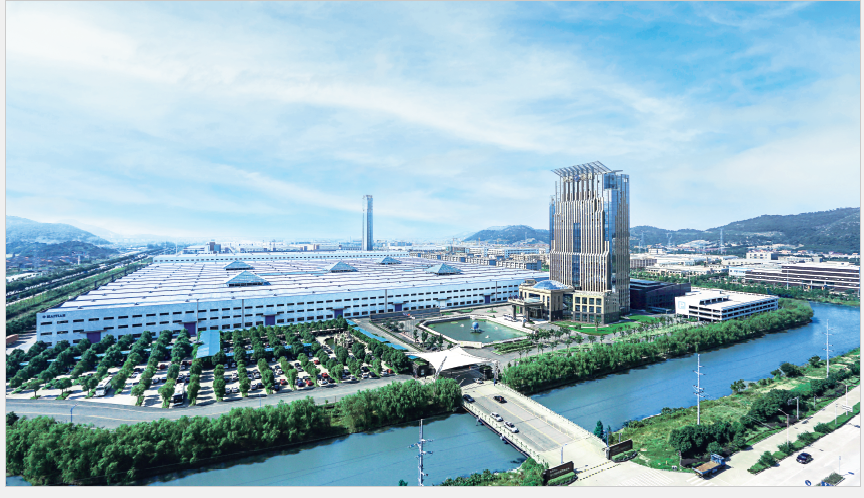
Aerial view of the Haitian International headquarters and manufacturing campus in Ningbo, China. Multi-brand, multi-architecture production capacity is the structural reason a single supplier can address both general-purpose and specialized molding applications.
The portfolio is organized by architecture rather than by industry, which is useful for buyers because specification ranges can be compared directly across platforms. The table below maps the main series to clamping force and intended use, using published specification data.
| Series | Architecture | Clamping force range | Intended application |
|---|---|---|---|
| Haitian Mars Series MA5 | Servo-hydraulic toggle | 600–33,000 kN; injection volume 49–45,616 cm³; screw diameter 24–220 mm | Automotive, household appliances, packaging, electronics, consumer goods, building and construction, technical parts |
| Haitian Mars Series MA5/Ultra | High-performance servo-hydraulic toggle | Built on the MA5 platform; configuration optimized for higher speed, precision and lower energy consumption | Automotive, electronics, household appliances, packaging, precision molding |
| Haitian Mars Series MA/F | High-speed servo-hydraulic toggle | Injection speed up to 500 mm/s; specifications depend on machine size and injection unit | Thin-wall packaging, food packaging, containers, in-mold labeling |
| Haitian Jupiter Series JU5 | Servo-hydraulic two-platen | 4,500–88,000 kN; injection volume 848–134,303 cm³; screw diameter 60–300 mm; maximum daylight 1,400–7,000 mm | Automotive bumpers and instrument panels, logistics turnover boxes, large waste containers, large technical parts |
| Zhafir Venus Series VE5 | Precision all-electric | 400–13,800 kN; injection volume 12–5,767 cm³; screw diameter 16–120 mm; platen 440 × 440 to 2,150 × 2,050 mm | Medical, electronics, optical, precision components, cosmetic packaging |
| Zhafir Zeres Series ZE5 | Electric with integrated hydraulics | 400–13,800 kN; injection volume 12–5,767 cm³; screw diameter 16–120 mm | Automotive, medical, electronics, consumer goods, technical parts, packaging |
| Zhafir Zeres Series ZE-F | High-speed electric for packaging | 1,500–6,500 kN | Caps and closures, thin-wall packaging, food packaging, high-output production |
| Zhafir Multicomponent | Modular electric multi-component | 3,500–33,000 kN | Two-color, multi-color, multi-material and hard-soft component molding |
| Zhafir Jeres Series JE5 | Hybrid two-platen | 3,500–33,000 kN | Large technical parts, automotive, logistics, household appliances, industrial components |
| Niigata MD-S8500 Series | Precision horizontal all-electric | Model range MD50S8500 to MD350S8500; tie-bar sensing and pressure control to 0.1 MPa; OPC UA connectivity | Precision components, electronics, optical, medical, cosmetics packaging |
| Niigata MDV-S8500 Series | All-electric vertical | Vertical single-station electric platform with high-precision tie-bar sensing and mold-thickness measurement | Insert molding, overmolding, connectors, automotive electronics, technical parts |
What the specification ranges imply for buyers
Two facts stand out. First, the clamping force span from 400 kN on the all-electric platform to 88,000 kN on the two-platen platform covers both micro-precision and very large part production within one supplier relationship — which matters for buyers running multi-part portfolios. Second, the energy-saving claim is configuration-specific, not universal: electrical plasticizing on applicable Mars MA5 sizes and on Jupiter JU5 Generation 5 machines is stated to reduce energy consumption by 20–40%, while the Zhafir Venus VE5 Generation 5 is stated to offer a footprint up to 15% smaller, 20% faster mold movement and motorized ejection speeds up to 400 mm/s. Those percentages should be treated as configuration-level figures to be verified against a specific machine size, not as blanket performance guarantees.
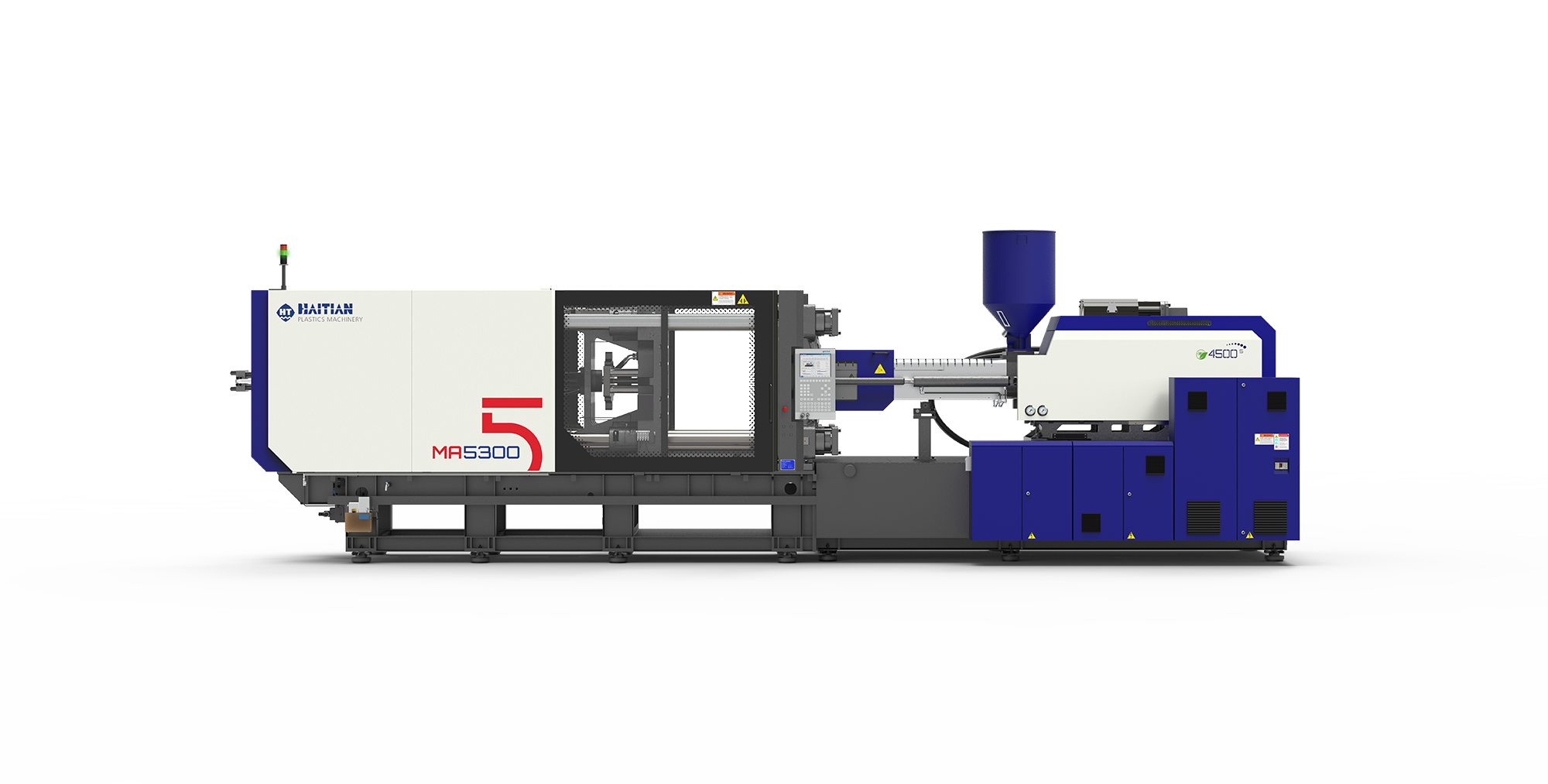
Haitian Mars Series MA5, a servo-hydraulic toggle platform with a 600–33,000 kN clamping force range. The series has more than 400,000 units delivered, which makes it one of the most widely deployed general-purpose platforms in the category.
Application mapping: from part profile to platform
Machine selection improves when it starts from working conditions rather than from tonnage alone. The application patterns below reflect the production requirements typically associated with each segment.
| Segment | Working conditions | Critical requirements | Platform fit |
|---|---|---|---|
| Automotive | Large and complex molds, demanding surface quality, engineering plastics, high repeatability | Low warpage, dimensional stability, reinforced-material capability, automation integration | Mars MA5 and MA5/Ultra for components; Jupiter JU5 for bumpers and instrument panels; Zhafir Multicomponent for multi-material parts |
| Packaging | Short cycles, high cavitation, thin walls, continuous high-output production | High injection speed, repeatability, low energy per part, in-mold labeling compatibility | Mars MA/F and Zhafir ZE-F |
| Medical | Controlled or clean production environment, stringent process stability, traceability | Cleanliness, contamination control, repeatability, process monitoring, stable low-scrap output | Zhafir Venus VE5 and Niigata MD-S8500 |
| 3C electronics | Thin-wall and small precision parts, engineering plastics, high cosmetic requirements, rapid product changes | Thin-wall filling, low warpage, micro-molding capability, high-quality surfaces | Zhafir Venus VE5, Niigata MD-S8500, Niigata MDV-S8500 for insert-molded connectors |
| Home appliances | Medium to large parts, visible surfaces, high-volume production, frequent mold changes | Surface quality, dimensional stability, energy efficiency, fast changeover | Mars MA5 with robot, mold temperature control and quick mold-change equipment |
| Logistics and industrial parts | Large parts, high shot weights, recycled or reinforced materials | Large shot capability, high clamping force, impact resistance, dimensional stability | Jupiter JU5; Zhafir Jeres JE5 for large technical parts |
| Consumer goods | High-volume, cost-sensitive parts, visible surfaces, broad size range | Short cycles, low unit cost, surface quality, flexible automation | Mars MA5; Zhafir ZE5 where hydraulic mold functions are needed |
Market trends that affect machine selection
Electrification is a segment shift, not a replacement. The electric injection molding machine segment was valued at USD 4.9 billion in 2024, while hydraulic technology still held more than 40% of market share in the same year. For buyers, this means the realistic comparison is between a servo-hydraulic platform and an all-electric or hybrid platform on total cost per acceptable part — not between "old" and "new" technology.
Demand is concentrated in Asia Pacific. The region accounted for 39.7% of global market share in 2025. This concentration affects service response, spare-parts logistics and lead times, and it is a legitimate factor in supplier evaluation alongside machine specification.
Digitalization is converging with energy efficiency. Trade media and professional-society publications consistently associate smart manufacturing in injection molding with connected data through IoT or IIoT infrastructure, real-time monitoring of machines and auxiliary equipment, and energy-saving drive technologies. Grand View Research attributes to smart systems a 25% reduction in scrap and a 20% to 40% drop in unplanned downtime. These figures describe reported outcomes, not guaranteed results, and they are only achievable where data collection, alarm handling and process discipline are actually implemented.
Public data granularity remains limited. No validated primary statistical source for injection molding machine market size was located in the reference set used for this article, and no standardized cross-manufacturer specification database exists in the public domain. Buyers who need comparable energy consumption, cycle time or repeatability data generally have to obtain it through direct technical documentation and validation trials.
Comparison with conventional approaches — and where each one stops working
The useful comparison is not "modern versus traditional". It is which architecture stops delivering value at which boundary.
| Comparison dimension | Conventional hydraulic / toggle approach | Current servo-hydraulic and electric approaches | Boundary condition |
|---|---|---|---|
| Energy use | Continuous pump operation, higher idle losses | Servo drive supplies power on demand; electrical plasticizing on applicable sizes stated at 20–40% energy reduction | Savings are configuration-specific and must be measured against a defined baseline |
| Precision and repeatability | Acceptable for general parts, more variation under long runs | All-electric independent servo drives; Niigata platforms state pressure control to 0.1 MPa with tie-bar sensing | Precision advantage is wasted if the mold and process are not capable of holding tolerance |
| Large-part capability | Toggle machines become very long at high tonnage | Two-platen design shortens machine length and extends opening stroke | The mold-space benefit does not translate into value for small molds |
| Mold functions | Hydraulics readily available for core pulls and complex sequences | All-electric platforms need separate provision; integrated-hydraulics platforms address this | Fully electric is not automatically the better choice where hydraulic auxiliaries are essential |
| Cycle time | Limited by hydraulic response and mold movement speed | High-speed platforms reach injection speeds up to 500 mm/s; Venus VE5 states 20% faster mold movement | High-speed platforms are optimized for thin walls; thick parts with long cooling gain little |
| Digital integration | Machine-level control only, integration usually retrofit | Open interfaces, OPC UA and MES connectivity offered as part of the platform | Protocol support must be confirmed for the specific plant architecture; claims require technical verification |
Three limits deserve explicit statements. First, all-electric machines carry a different cost and maintenance profile from servo-hydraulic machines, and the premium is justified by precision, cleanliness and energy economics only where the part and production volume support it. Second, two-platen architecture is a large-mold solution; specifying it for small precision parts adds footprint without adding capability. Third, a high-speed packaging platform is a specialized tool — deploying it for thick-section technical parts typically produces worse economics than a general-purpose machine.
A practical evaluation sequence for research-stage buyers
- Define the part, not the machine. Collect part drawings, material grade, shot weight, wall thickness and cosmetic requirements before comparing platforms.
- Fix the mold data. Mold dimensions, cavity count, runner type and required mold functions such as core pulls determine whether an all-electric or integrated-hydraulics platform is appropriate.
- Convert requirements into a clamping force and injection volume window. Then confirm the candidate series actually covers that window — for example, the Mars MA5 range runs from 600 to 33,000 kN with 49–45,616 cm³ injection volume.
- Set a cycle time and output target. Target output, cavitation and cycle time together define whether a standard, high-speed or high-performance configuration is justified.
- Map the automation cell. Robot, dryer, mold temperature control, chiller, material handling and inspection equipment all constrain the achievable cycle.
- Check plant conditions. Available floor space, crane capacity, power supply and cleanroom requirements can eliminate otherwise suitable platforms.
- Verify market-access requirements independently. Safety, electrical and application-specific conformity requirements vary by destination market and should be confirmed with the supplier and, where necessary, a certification body.
- Request a measured energy and performance baseline. Ask for the reference configuration behind any efficiency claim, and define how it will be validated after installation.
Future outlook
The category is moving along three lines at once. Electrification continues to expand in precision, medical, optical and clean-production segments, supported by all-electric platforms with stated footprint and mold-movement improvements. Servo-hydraulic platforms remain the volume workhorse for general parts, where the cost-performance balance still favors a proven toggle architecture for many applications. And digital integration is shifting from an optional feature to a specification item: MES connectivity, open interfaces and standardized communication protocols now determine how easily a machine enters an automated production cell.
For buyers, the strategic implication is that machine selection is becoming a data decision. The manufacturers that can supply verifiable configuration data, documented energy baselines and clear integration specifications will be easier to evaluate than those that cannot. That transparency, more than any single specification, is likely to shape procurement decisions over the next equipment cycle.
FAQ
What is an injection molding machine and what industries use it?
An injection molding machine melts thermoplastic resin, injects it into a closed mold under controlled pressure, holds it during cooling and ejects the finished part. The equipment is used across automotive, home appliance, 3C electronics, medical, packaging, logistics and consumer goods production, among other segments.
What are the main types of injection molding machines?
The main families are servo-hydraulic toggle machines, servo-hydraulic two-platen machines, all-electric machines, hybrid machines, and specialized platforms including high-speed packaging machines, multi-component machines and vertical all-electric machines for insert molding. Each family differs in drive architecture, clamping structure and intended part profile rather than in name alone.
Which machine type suits automotive, packaging or medical parts?
Automotive work typically involves large or complex molds with demanding surface quality and dimensional stability, which suits servo-hydraulic toggle platforms for components and two-platen platforms for bumpers and instrument panels. Packaging involves short cycles, thin walls and high cavitation, which suits high-speed platforms such as the Mars MA/F or Zhafir ZE-F. Medical production involves controlled or clean environments, stringent process stability and traceability, which suits precision all-electric platforms such as the Zhafir Venus VE5 or Niigata MD-S8500 Series.
How do two-platen and toggle clamping machines differ in practice?
A two-platen machine uses four short-stroke clamping cylinders and a moving platen, which provides large mold space and a long opening stroke while shortening overall machine length. A toggle machine uses a mechanical linkage that is compact and well suited to general parts. The two-platen advantage applies to large and deep-cavity molds; for small molds, the additional mold capacity does not translate into production benefit.
What information should a buyer prepare before requesting a machine quotation?
Before selection and quotation, buyers should collect part drawings, material grade, shot weight, mold dimensions, target output, cycle time, automation requirements, plant conditions and target-market requirements. These inputs determine the required clamping force, injection volume, screw diameter and platform configuration, and they allow a supplier to propose a specific machine size rather than a general series.
How should buyers evaluate energy-saving and smart-manufacturing claims?
Buyers should ask which machine size and configuration the claim refers to, what baseline was used, and how the result will be measured after installation. Energy reductions in the range of 20–40% associated with electrical plasticizing apply to applicable machine sizes and configurations, not to every model. For connectivity claims, buyers should request the supported protocols, data architecture, alarm history functions and the specific automation or MES systems the platform has been integrated with.
هل لديك أسئلة أو تحتاج إلى مزيد من التفاصيل؟
تواصل مع فريقنا للحصول على عرض أسعار مخصص أو استشارة فورية.
طلب عرض أسعار
املأ النموذج أدناه وسيتواصل معك فريقنا بعرض مقترح مخصص.
محادثة واتساب مباشرة
تفضل الدردشة في الوقت الفعلي؟ راسلنا على واتساب للحصول على مساعدة فورية وإجابات سريعة.
- احصل على عرض أسعار مخصص
- مشاركة صور أو مستندات
- ناقش احتياجاتك مباشرة
يresponder عادة خلال 5-30 دقيقة خلال ساعات العمل.