
Inside Caisheng's 6000 m² Facility: Label Press Manufacturing Evidence
Inside Caisheng's 6000 m² Facility: Label Press Manufacturing Evidence
For label converters who are close to signing a purchase order, the deciding question about a label printing machine is rarely a specification question. Print width, color count, and running speed are settled early. What remains is physical: does this supplier own the floor space, the machining capability, and the engineering depth to build the press, test it, and keep supporting it years after delivery?
Shenzhen Caisheng Printing Machinery Co., Ltd., which markets its equipment under the CAISHENG brand, is a Shenzhen-based manufacturer of intermittent and high-speed full-rotary letterpress printing machines, flexographic printing machines, and screen printing machines, together with customized multi-functional label finishing solutions such as die-cutting systems and high-speed varnishing machines. The company was founded in 2011 and operates from a 6000 m² facility staffed by 65 employees, including an R&D team of 8 engineers. It reports an annual output of about 200 units and exports roughly 50% of production to Southeast Asia, Europe, the Middle East, and the United States.
This article treats those figures as evidence rather than as promotional claims: what a 6000 m² footprint, 65 employees, and 8 engineers actually support in the production of full-rotary and semi-rotary label presses, and where the same figures set a boundary that buyers should plan around.
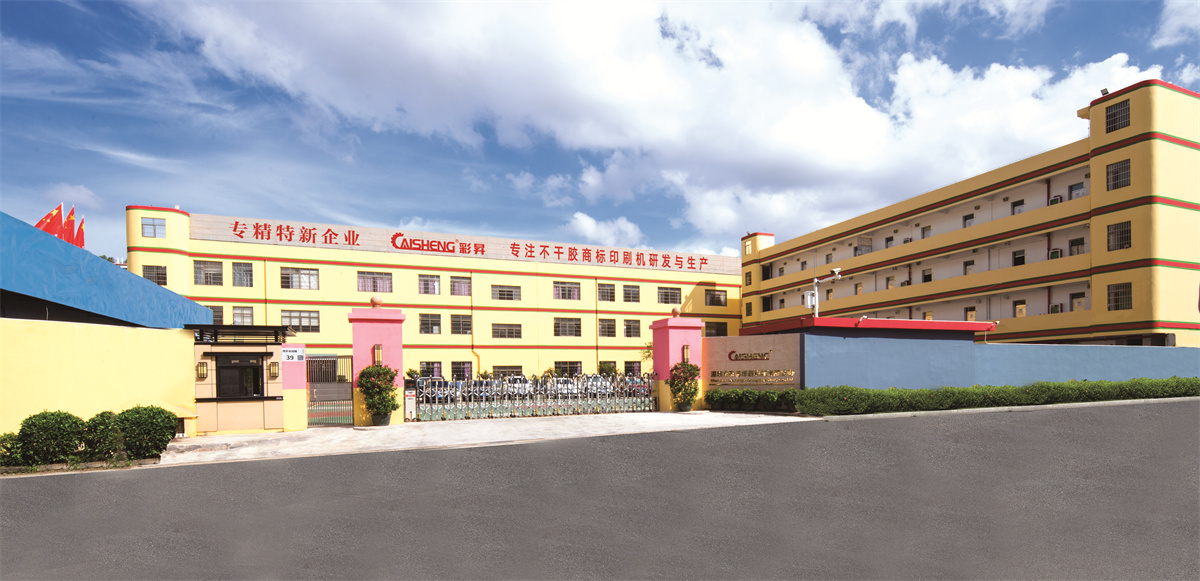
Caisheng's Shenzhen site covers 6000 m² and houses machining, assembly, and run-in testing for intermittent and full-rotary label presses.
Why facility evidence enters label press procurement at all
Demand geography explains part of the shift. Data Bridge Market Research estimates that Asia-Pacific accounted for a 41.8% revenue share of the label printing machines market in 2025, which means a large share of new press capacity is being commissioned in the same region where many of the machines are built. For a buyer in Europe, the Middle East, or the United States, that proximity cuts both ways: quoting is fast, and the supplier base is crowded with parties that do not manufacture anything themselves.
The major global competitors in the label machinery market, as listed by Future Market Insights, are Bobst (Switzerland), Mark Andy (USA), Gallus/Heidelberg (Germany), and Nilpeter (Denmark). These are multinational platforms competing on global service infrastructure and product breadth. Mid-sized specialists such as Caisheng compete on a different axis: configuration flexibility, delivery rhythm, and direct access to the engineers who build the machine. Both models are legitimate, but they answer different procurement questions, and facility evidence is how a buyer tells them apart at the point of decision.
A trading intermediary can forward a specification sheet, a lead-time estimate, and a price. It cannot commit floor space, CNC machining hours, or engineering time to a specific order. That is why the physical site, not the catalogue, has become the final filter in supplier evaluation.
What a 6000 m² footprint physically contains
Floor space in label press manufacturing is not generic square metres. A press is assembled, wired, and run in place, and it occupies its full footprint for the entire commissioning period. Dimensions from Caisheng's own product range show why that matters:
- An intermittent platform such as the CS-220-4C measures 4.2 m × 1 m × 1.5 m and weighs 2.6 t.
- A semi-rotary letterpress such as the CS-320-6C measures 8.4 m × 1.5 m × 2 m and weighs 6.2 t.
- A full-rotary high-speed platform such as the CS-JQ350G-10C measures 12 m × 1.5 m × 2 m and weighs 14 t.
A single 12 m, 14 t machine consumes an entire bay before access clearance, tooling, and test material are counted. A 6000 m² site of this type must therefore cover raw material and component storage, CNC machining of precision parts, sub-assembly, final assembly, electrical and control integration, run-in testing, and dispatch. Caisheng states that it machines precision components in its own CNC workshops, describing two in-house machining plants, which places tolerance control in the same building as final assembly rather than at an external supplier.
That vertical arrangement is the substance behind the headline number. A 6000 m² facility is large enough to hold several large platforms in different build stages at once, and compact enough that production planning remains visible and auditable during a factory visit. For a buyer scheduling a line expansion, the useful question is not the square-metre figure itself but how many simultaneous build bays it supports and how quickly a slot can be reserved.
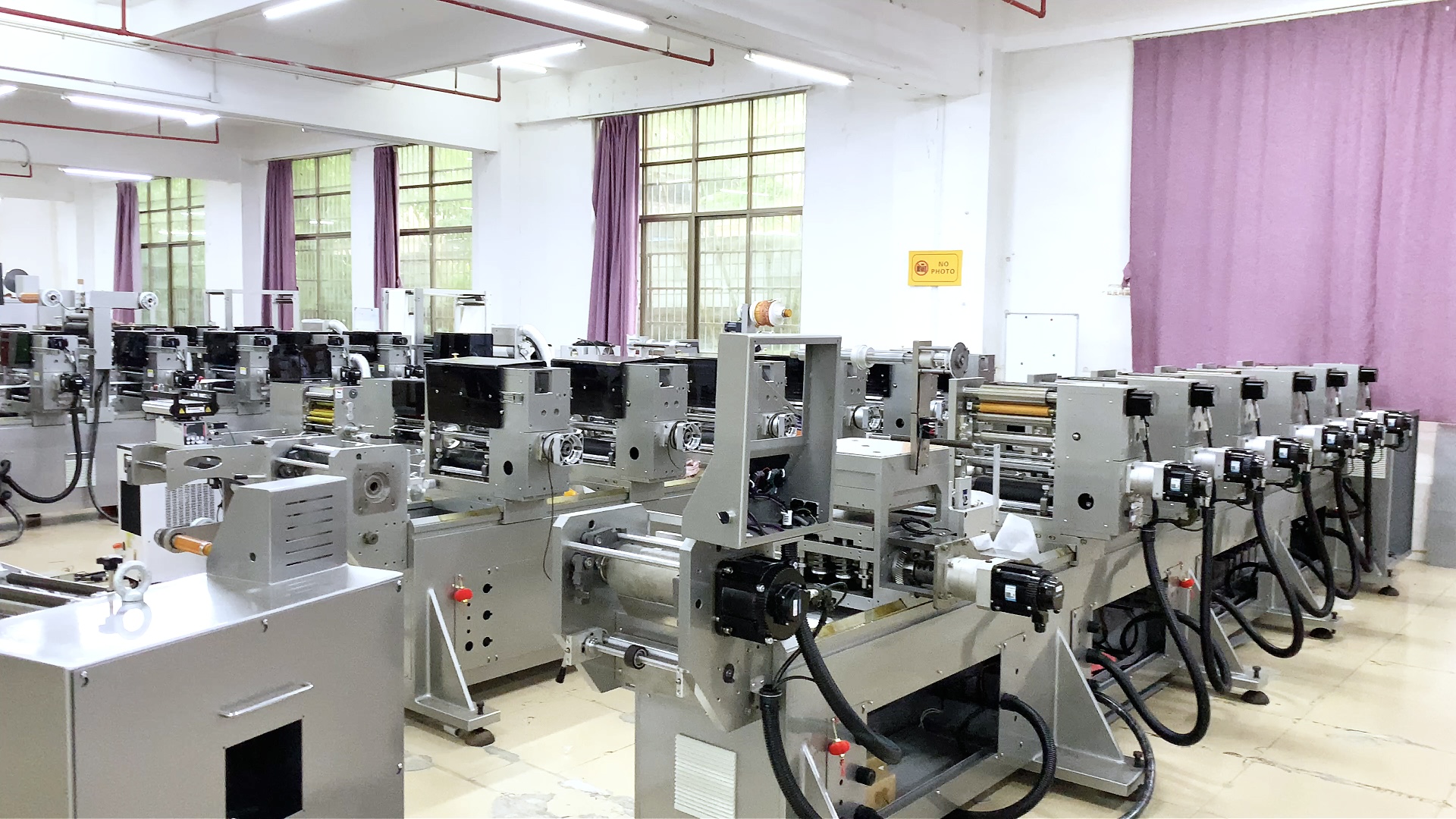
Assembly and run-in bays for intermittent, semi-rotary, and full-rotary label presses at Caisheng's Shenzhen facility.
Eight engineers and the tolerance chain behind ±0.05 mm
An R&D team of 8 engineers is a compact group, and its significance lies in what it is asked to control. Registration accuracy is the clearest example. Caisheng's published comparison documentation states a registration accuracy deviation of ±0.05 mm on its letterpress platforms, and attributes that result to a chain of measures rather than to a single component:
- Precision parts machined in-house in the company's own CNC workshops, with tolerances controlled at the source.
- An imported Japanese servo system for smooth transmission and stable positioning under high-speed operation.
- A patented tapered bearing sleeve design combined with a photographic inspection system that compensates for deviation in real time.
- A self-developed LED UV cold light source drying system intended to prevent heat deformation of film materials.
Ink control follows the same two-stage logic: manual coarse adjustment paired with computer automatic fine adjustment, giving operators dual control over ink output. Structural stability is addressed separately through a base that uses a natural metal stress-relieving process and a patented triangular guide rail design, together with an electrically operated bottom mold lifting mechanism and a linked squeegee baffle that simplify assembly and disassembly of components.
The engineering implication for buyers is straightforward. When design, machining, assembly, and verification sit inside one organization, a tolerance problem can be traced and corrected at the point where it originates, instead of being negotiated between a supplier and an outside machine shop. It also explains why the same team can configure presses across letterpress, flexographic, and screen printing platforms: the underlying mechanical, drive, and control work overlaps considerably between them.
What 65 employees and 18 units a month mean for a delivery schedule
Caisheng publishes a monthly production capacity of 18 units for export markets including Southeast Asia, the European Union, the Middle East, and the United States. The typical production lead time is 45 to 60 days. Its listed procurement terms include a minimum order quantity of 1 unit, FOB delivery, a pre-shipment test as the acceptance method, and 30/70 payment terms.
Read together with the 6000 m² site and the 65-person team, these numbers describe a specific production rhythm. A 65-person organization covering machining, assembly, testing, and after-sales support implies a standardized sequence per machine rather than parallel engineering on every order. The monthly capacity figure is therefore a scheduling ceiling, not an average that can be doubled on request. A buyer planning a multi-machine rollout should treat 45–60 days as the working assumption and reserve additional time for custom configuration, documentation, and shipping.
The offsetting benefit is that a single-unit order remains commercially viable. Buyers testing a new press platform, or adding one machine to an existing line, are not required to commit to volume to get a machine built to their configuration. That, combined with the acceptance route described below, lowers the risk attached to a first order with a supplier whose long-term reliability the buyer is still assessing.
Quality control and pre-shipment acceptance at the facility
Caisheng states that quality control involves 100% testing of all units before shipment to export markets. The company also describes a pre-delivery routine in which experienced machine adjustment engineers test various performance aspects of the machine until it can produce finished product to specification, and it invites customers to the factory for a machine acceptance inspection.
Post-delivery terms include remote support and a one-year warranty for major components. Maintenance documentation points to several design choices intended to reduce long-term service load: in-house manufacturing and quality control of core and vulnerable components, a base designed to resist deformation and shifting, and an intelligent detection system that assesses equipment status and issues early warnings so maintenance can be planned rather than reactive.
For buyers, the acceptance visit is the point at which facility claims become verifiable. A pre-shipment test run on the buyer's own material, on the actual machine being shipped, converts a capability statement into a documented result and a reference sample for the production floor after installation.
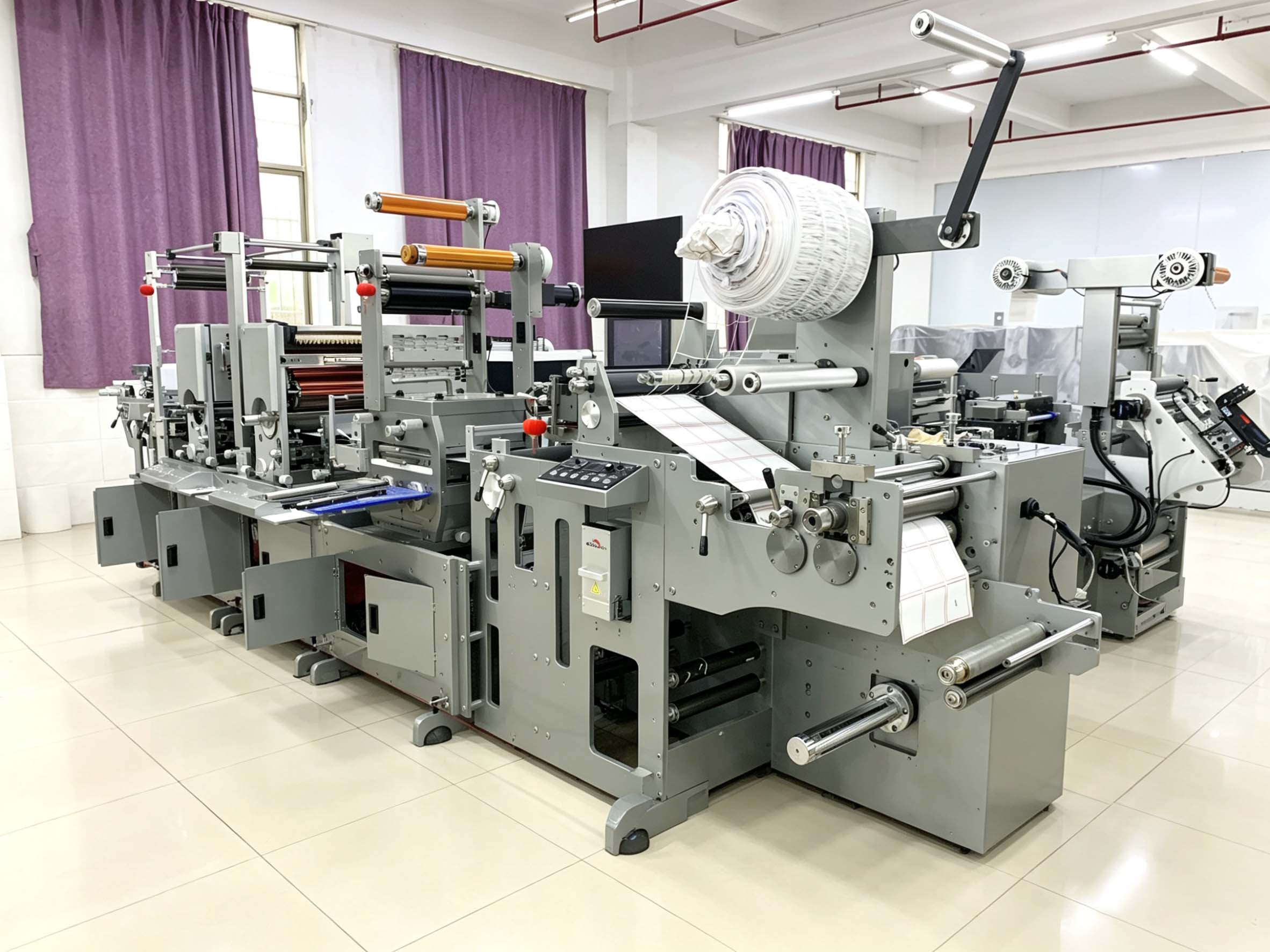
A letterpress platform paired with a flatbed die-cutting unit — one of the multi-process configurations assembled in the Shenzhen facility.
What the facility builds: full-rotary, semi-rotary, and finishing platforms
The practical output of a 6000 m² site is measured in the platforms it can carry through assembly and testing. Caisheng's range spans intermittent letterpress work in narrower webs, semi-rotary and full-rotary high-speed platforms, flexographic presses, and finishing equipment.
| Model | Platform type | Key specifications |
|---|---|---|
| CS-220-4C | Intermittent label press | Web width 30–240 mm; max speed 40 m/min; 4.2 × 1 × 1.5 m; 2.6 t |
| CS-300-5C | Self-adhesive label press | Web width 30–300 mm; max speed 40 m/min; 6.5 × 1.5 × 1.8 m; 5 t |
| CS-320-6C | Semi-rotary label printing machine | Web width 30–320 mm; 27 kW total; max speed 40 m/min; 6.2 t |
| CS-320-7C | Rotary label press | Web width 30–320 mm; 31 kW total; 9.1 × 1.5 × 2 m; 7 t |
| CS-JQ350G-6C | Intermittent & full-rotary high-speed label press | Intermittent 60 m/min; full rotary 158 m/min; 7.8 × 1.5 × 1.9 m; 10 t |
| CS-JQ350G-10C | Full-rotary label press (10-color platform) | Intermittent 60 m/min; full rotary 158 m/min; 12 × 1.5 × 2 m; 14 t |
| CS-J380F-7C | Flexographic press | Max speed 60 m/min; 9.3 × 1.3 × 1.6 m; 6 t |
| CS-Q370F-6C | Full rotary flexographic printing machine | Max speed 150 m/min; 7.5 × 1.5 × 1.7 m; 7 t |
| CS-350 | High-speed die-cutting machine | Intermittent 60 m/min; full rotary 160 m/min; 2 t |
| VS-250W | Full rotation screen printing multifunctional machine | Max screen printing and die-cutting area 240 × 240 mm; 4.5 t |
The split is deliberate. Intermittent and semi-rotary platforms serve converters running shorter runs, frequent job changes, and mixed substrates, while full-rotary and flexo platforms address higher volumes at 150–158 m/min. Finishing units such as the CS-350 die-cutting machine and the CS-Q380V high-speed corona oil integrated machine allow a press to leave the building as part of a complete line rather than a standalone unit.
Market context: what a decade of demand implies for a facility of this size
Published market sizing supports the case for long-lived supplier relationships. The global label printing machines market was valued at USD 8.58 billion in 2025 and is projected to reach USD 14.36 billion by 2034, according to The Insight Partners. A narrower definition from Spherical Insights puts the global narrow web label printing machines market at USD 1.43 billion in 2024, rising to USD 3.21 billion by 2035.
Process mix reinforces where volume sits. Smithers reports that flexographic printing remains the most commonly used process for labels, valued at approximately USD 13.3 billion in output value in 2024, while Grand View Research estimates the global flexographic printing machine market at USD 17.57 billion in 2024, growing at a CAGR of 9.7% through 2030. These figures should be read as directional rather than exact: different research houses define the category differently, and estimates for the same year vary by scope, as seen in the USD 8.58 billion, USD 8.21 billion, and USD 4.4 billion figures published for label machinery and label printer markets.
Two compliance anchors sit alongside the commercial picture. Safety requirements for graphic technology equipment, including label presses, are governed by the international standard ISO 12643-2:2023. For machines placed on the EU market, the Machinery Directive 2006/42/EC applies, CE marking is required, and safety signs follow EN ISO 7010, as set out by the European Commission. Compliance responsibility sits with the party placing the machine on the market, so buyers should confirm CE documentation regardless of a supplier's size — but a manufacturer that controls its own design and wiring has fewer external parties between the drawing and the declaration.
Boundaries: what a 6000 m² facility does not prove
A facility article that lists only advantages is not useful to a buyer. The same figures that demonstrate capability also define limits.
- Scale ceiling. A 65-person team and a published capacity of 18 units per month are not the throughput of a multinational platform builder. Buyers planning simultaneous rollouts across several regions should confirm scheduling before committing to fixed installation dates.
- Lead time. A 45–60 day typical lead time suits planned projects. It is longer than delivery from stock, so this model is not a fit for emergency replacement of a failed press.
- Engineering concurrency. Eight engineers working across letterpress, flexo, screen, and finishing platforms have finite bandwidth. Highly bespoke development outside those platforms, or several custom projects starting at once, requires confirmation of engineering availability rather than assumption.
- Supplier-side performance claims. Caisheng's comparison documentation cites at least 30% lower power consumption, driven by a Japanese servo system and LED UV drying technology, and a total equipment cost about 10% lower than similar manufacturers through supply-chain internalization. These are supplier statements based on a defined comparison; buyers should validate them against their own job mix, energy tariff, and configuration.
- Photographs are not a process audit. Floor space and facility images do not certify print quality or repeatability. Verification requires a documented pre-shipment test on buyer material, and CE documentation where the machine will be used in the EU.
- Sourcing model trade-offs. A trading intermediary may quote faster and offer multi-brand choice, but does not own machining or assembly. A multinational brand may offer a broader global service footprint, typically with different pricing and configuration rigidity. Neither model is universally better; they carry different risks for different project types.
A verification checklist for the execution stage
For buyers moving from decision to execution, facility claims should be converted into checkable items:
- Request the machine's installation drawing and compare it against the bay layout you will be shown or described.
- Ask which processes are performed in-house — CNC machining, sub-assembly, electrical integration, run-in testing — and which are outsourced.
- Confirm the pre-shipment test protocol, the material to be used, and the acceptance criteria in writing.
- Attend or delegate the factory acceptance inspection, and keep the test output as a baseline reference.
- Verify documentation for the destination market: CE marking under Machinery Directive 2006/42/EC for the EU, and alignment with ISO 12643-2:2023 safety requirements.
- Confirm spare-part supply and the one-year warranty coverage on major components, and clarify what remote support includes.
- Match the quoted 45–60 day lead time and 18-unit monthly capacity against your own launch plan before signing.
- Validate energy and cost claims against your own substrate mix, run length, and electricity tariff.
Future outlook
The long-term value of a manufacturing footprint is usually realised after the sale, not during it. A press has a service life spanning many years, during which spare parts, firmware and control components, and documentation must remain available. Caisheng's in-house manufacturing and quality control of core and vulnerable components, combined with its one-year major-component warranty, remote support, and early-warning maintenance system, are the mechanisms intended to keep machines running as they age.
Two structural trends are likely to keep pressure on suppliers of this size. First, multi-process integration continues, with printing, die-cutting, varnishing, and slitting consolidated on single platforms to reduce handling and floor space. Second, buyers increasingly ask for documented acceptance evidence rather than capability statements, which places a premium on suppliers who can run a pre-shipment test on customer material and host an inspection visit.
For distributors and long-term partners, the relevant question is continuity: whether the supplier that builds the machine today will still be machining its critical components in five years, when a replacement part is needed in a market thousands of kilometres away. A 6000 m² facility with in-house machining, a compact engineering team, and a stable platform range is one form of evidence that the answer is yes — but it remains evidence to be verified, not a guarantee to be assumed.
FAQ: facility evidence and long-term supply
What does a 6000 m² manufacturing facility actually demonstrate about a label press supplier?
It demonstrates physical capacity to assemble, wire, and run in large platforms on site — including machines up to 12 m long and 14 t — and it allows a buyer to observe the build process during an acceptance visit. It does not by itself demonstrate process capability or repeatable print quality. Those require a documented pre-shipment test on the buyer's own material and, for EU destinations, CE documentation under Machinery Directive 2006/42/EC.
How many label printing machines does Caisheng produce, and what is the typical delivery time?
Caisheng publishes a monthly production capacity of 18 units for export markets including Southeast Asia, the European Union, the Middle East, and the United States, with an annual output of about 200 units. The typical production lead time is 45 to 60 days. The minimum order quantity is 1 unit, with FOB delivery and 30/70 payment terms.
Can a buyer inspect and accept a machine at the factory before shipment?
Yes. Caisheng lists a pre-shipment test as the acceptance method, applies 100% testing to all units before shipment to export markets, and invites customers to the factory for a machine acceptance inspection. Before delivery, machine adjustment engineers test performance aspects of the unit until it can produce finished product to specification.
What support is available after delivery?
Terms include remote support and a one-year warranty for major components. Because core and vulnerable components are manufactured and quality-controlled in-house, replacement parts can be produced on the same tooling as the original. An intelligent detection system assesses equipment status and issues early warnings to support preventive maintenance rather than reactive repair.
Does an 8-engineer R&D team limit customization?
The team covers intermittent, semi-rotary, full-rotary, flexographic, screen printing, and finishing platforms, and works alongside in-house CNC machining of precision parts, which supports configuration and OEM work within those platforms. The constraint is concurrency: the same engineers serve all build projects, so buyers with fully bespoke requirements or several simultaneous projects should confirm engineering availability and scheduling before committing to a delivery date.
How does a mid-sized facility compare with buying through a trading intermediary or a multinational brand?
A trading intermediary can typically quote faster and may offer several brands, but does not own machining, assembly, or testing capacity. A multinational brand such as Bobst, Mark Andy, Gallus/Heidelberg, or Nilpeter generally offers a broader global service footprint with different pricing and configuration conventions. A mid-sized manufacturer with its own 6000 m² facility sits between the two: direct access to the engineering team and a 1-unit minimum order, bounded by a published capacity of 18 units per month.
Reference material: technical specifications for the platforms discussed above are compiled in Caisheng's product brochure (PDF). Manufacturer details: Shenzhen Caisheng Printing Machinery Co., Ltd., caishengmachinery.com.