
Inside Dengfeng's Welded Mesh Fence Production Line
A welded mesh fence is a manufactured product before it is a security product. Every panel that reaches a school boundary, a rail corridor or an industrial gate line has passed through wire intake, mesh welding, surface preparation, coating and final inspection — and each of those stages later shows up in the field as either rigid joints and intact coating, or as loose welds and early corrosion.
Why process evidence now decides welded mesh fence procurement
Buyers comparing welded mesh fence suppliers increasingly ask for something certificates cannot answer: what happens to the wire between the steel coil and the loaded container. That shift tracks the size and maturity of the category. Dataintelo valued the global welded wire mesh fence market at USD 7.04 billion in 2025 and projects USD 11.72 billion by 2034, while Grand View Research estimates the wider fencing market at USD 33.8 billion in 2025, with metal fencing holding 53% of material share. Asia Pacific accounted for 38.5% of welded wire mesh fence revenue in 2025, according to Dataintelo — a concentration that puts a large share of global supply inside a small number of manufacturing clusters.
Standards have tightened alongside volume. EN 10223-7:2012 specifies requirements for steel wire welded panels for fencing, and ASTM F2453 / F2453M-14 covers welded wire mesh fence fabric with metallic or polymer coatings. Both documents describe what a finished panel must be. Neither describes how a factory gets there. That gap is where supplier evaluation now happens.
Anping Dengfeng Wire Mesh Products Co., Ltd. (Dengfeng) is a wire mesh manufacturer founded in 2008 and based in Anping County, Hebei Province, China. Its range covers welded mesh rolls and panels, 358 security fences, BRC and roll-top fences, double-wire panels, chain link and temporary fencing, barbed and razor wire, and gabion baskets. Around 80% of output is exported to Europe, Saudi Arabia, the Middle East, the UAE and the United States. The rest of this article walks the production line that produces those panels, stage by stage, and explains what each stage is worth to a buyer planning a multi-year supply relationship.
The line, stage by stage
Dengfeng's manufacturing sequence runs from raw material intake to a fully inspected, packed panel. The three structural facts of that sequence are simple: welding is completed by robotic welding, manual inspection is conducted throughout the polishing, pickling and powder coating procedures, and surface treatment consists of hot-dipped galvanizing followed by powder coating. Everything else in this section elaborates on those three statements.
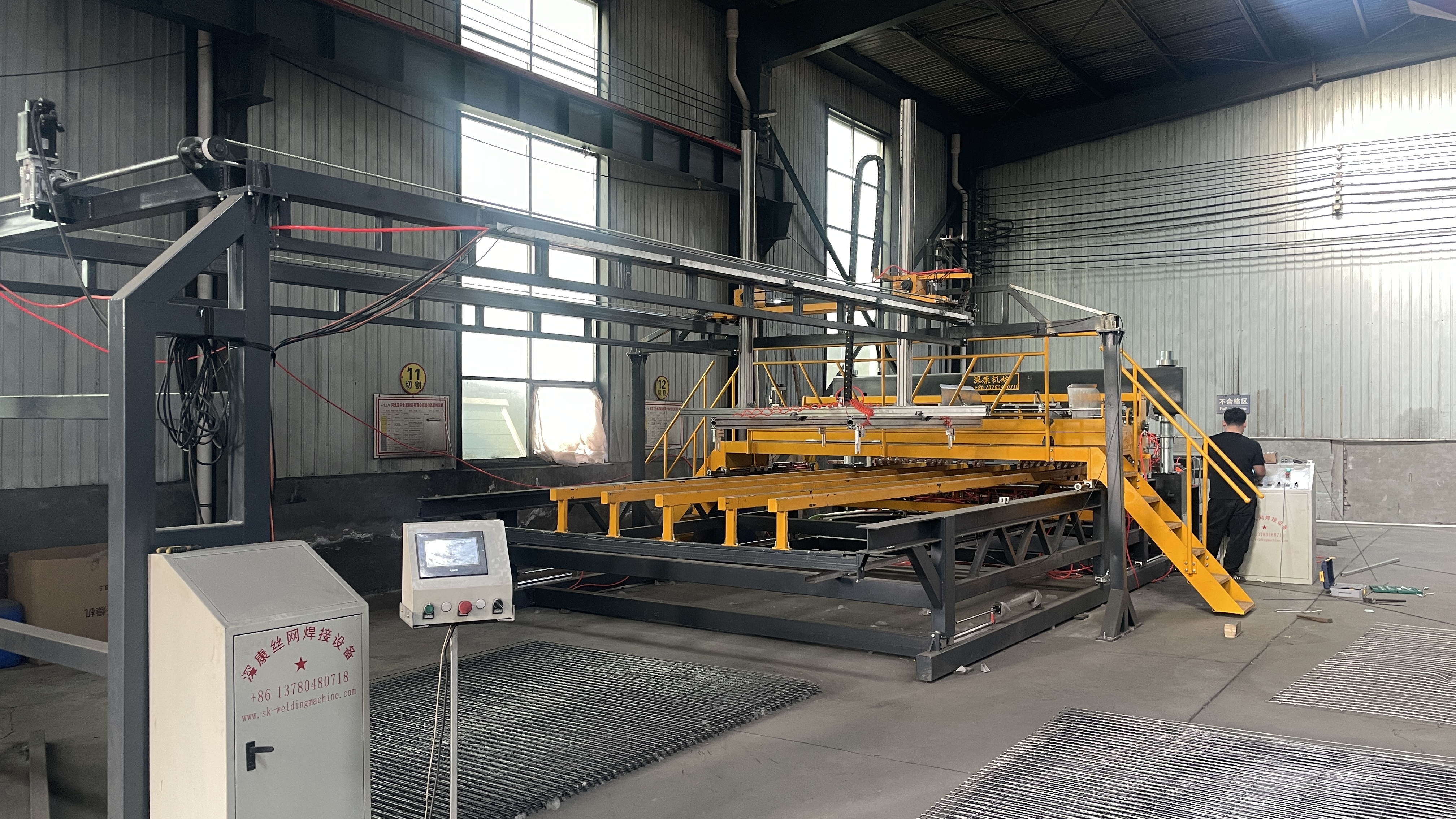
Production floor at Dengfeng's wire mesh facility in Anping County, Hebei Province.
Stage 1 — Raw material intake and 100% material inspection
The line starts with low-carbon steel wire and galvanized steel pipe. Dengfeng applies 100% raw material inspection before any wire enters production. For a buyer, this is the first control point that matters, because the majority of downstream coating defects trace back to incoming wire condition rather than to the coating line itself.
Stage 2 — Mesh welding under robotic control
Welding is carried out by robotic welding. The operational value is repeatability: uniform weld pressure and consistent intersection geometry across a run, rather than the joint-to-joint variation that characterises manual welding at volume. Rigid frame panels depend on this consistency — a panel is only as rigid as its weakest intersection.
Stage 3 — Polishing and pickling, with manual inspection
Before coating, panels go through polishing and pickling. Manual inspection is conducted throughout these procedures. This is the stage where surface condition is judged rather than measured: residue, surface irregularity and preparation quality are assessed by an inspector who can stop the batch.
Stage 4 — Hot-dipped galvanizing and powder coating, with manual inspection
Surface treatment consists of hot-dipped galvanizing followed by powder coating. Manual inspection continues through the powder coating procedure, so coating coverage and finish are reviewed inline rather than only at final goods inspection. This two-layer approach — galvanizing beneath a powder coat — is the corrosion-protection architecture the company pairs with thickened wire structure in its risk-control measures.
Stage 5 — Finished product load test
Finished panels are load tested as part of Dengfeng's control measures against structural deformation. A welded mesh fence fails structurally in predictable ways — racking, weld shear at intersections, frame distortion — and a load test is the point at which those failure modes are checked before shipment instead of after installation.
Stage 6 — 100% pre-shipment inspection
Every order passes full delivery inspection before it leaves the factory. The acceptance basis is stated plainly: pre-shipment full inspection, with third-party testing acceptable. That combination matters for project buyers, because it means the inspection record can be produced in-house or verified externally at the buyer's discretion.
| Stage | What happens | Control type | What a buyer can verify |
|---|---|---|---|
| Raw material intake | Low-carbon steel wire and galvanized steel pipe received; 100% raw material inspection | Documented inspection gate | Incoming material inspection practice |
| Mesh welding | Robotic welding of wire intersections | Automated, repeatable | Weld consistency across a panel run |
| Polishing & pickling | Surface preparation before coating | Manual inspection throughout | Surface condition judgement records |
| Surface treatment | Hot-dipped galvanizing followed by powder coating | Manual inspection throughout powder coating | Coating coverage and finish review |
| Finished goods | Load test on finished product | Physical test | Structural deformation control |
| Pre-shipment | Full delivery inspection on 100% of orders | Final gate | Inspection record; third-party test acceptable |
Dengfeng welded mesh fence production flow, as described in the company's manufacturing and quality documentation.
Where automation stops: the manual inspection gates
Robotic welding solves the repeatability problem. It does not solve the judgement problem, and the difference explains why Dengfeng keeps manual inspection at three specific points rather than converting them to automated pass/fail checks.
Polishing and pickling are preparation stages. Their output is a surface state, not a measurement, and preparation quality determines whether the subsequent zinc and powder layers bond or sit on top of contamination. Powder coating has a similar character: coverage on a welded intersection is geometrically harder than coverage on flat wire, and an inspector reading a panel inline catches the intersections that a pass-through system treats as uniform. A machine can confirm that coating was applied; an inspector confirms that it was applied where the panel actually needs it.
This is also the part of the process most often invisible in supplier documentation. Two factories can both list hot-dip galvanizing and powder coating, and still differ by whether anyone checks the panel between those steps. For a security buyer, the manual inspection gates are the closest proxy available for how the finished welded mesh fence will behave at year six rather than year one.
Scale, lead time and what capacity actually proves
Dengfeng operates a 70,000 m² facility with 80 employees, an annual output of 5,000,000 m² and monthly production capacity of 420,000 m². Engineering support comes from a 10-engineer R&D team, and the company customises products according to customer drawings and requirements.
For procurement purposes, capacity is only meaningful when it is paired with terms. The published commercial parameters are: minimum order quantity of 1 set, typical production lead time of 15–30 days, FOB Tianjin or CIF delivery terms, and payment terms covering L/C, T/T, D/P, Western Union, Paypal and Money Gram. A single-set MOQ is relevant to distributors testing a new panel type before committing to a stocking programme; the 15–30 day window is the number to plan project sequencing around.
Matching process output to site type
The same production sequence serves very different sites, and the difference is in how the panel is specified rather than in how it is built. Welded mesh fence is widely used for critical infrastructure such as railways, where cable theft prevention drives the requirement, and for schools, where rigid frame panels and anti-climb characteristics are the deciding factors.
- Schools and sports fields — rigid frame panels with anti-climb geometry; visible, maintained finishes matter as much as the mesh itself.
- Parks and residential properties — powder coated welded mesh fence panels where appearance and low-maintenance performance carry weight alongside durability.
- Industrial perimeter and railways — anti-climb and anti-cut panel configurations, high-security panels and high-tensile steel welded mesh fence where forced-entry resistance is the brief.
- Distribution and export programmes — easy-install panels and standardised panel modules that reduce on-site labour and simplify re-ordering.
Corrosion protection requirements vary by environment, which is why the galvanizing-plus-powder sequence matters more on coastal and industrial sites than the panel geometry does. Where local building codes or safety standards apply to schools, sports grounds or rail property, those requirements sit with the project specification — the factory's job is to produce a panel that meets the declared coating and structural parameters consistently, batch after batch.
Comparison with conventional supply — and where the limits are
Dengfeng's own comparison positions process-controlled welded mesh fence against ordinary low-cost wire mesh fence on four dimensions. The trade-off is deliberately stated rather than hidden: a higher initial cost in exchange for a lower whole-life cost.
| Dimension | Dengfeng welded mesh fence (process-controlled) | Ordinary low-cost wire mesh fence |
|---|---|---|
| Corrosion & intrusion performance | Hot-dipped galvanizing plus powder coating; better anti-corrosion and anti-climb performance | Lower corrosion and anti-climb performance |
| Service life | 6+ years longer service life | Baseline |
| Initial cost | Approximately 5% higher | Baseline |
| Replacement cost | Approximately 40% lower | Baseline |
| Maintenance | Zero maintenance within 10 years | Higher intervention frequency |
| Best fit | Construction, community and airport security projects | Short-horizon or non-critical enclosure |
Comparative positioning as stated in Dengfeng's product comparison data. Figures refer to the comparison between these two product classes, not to a site-specific guarantee.
Two limits are worth stating plainly, because they affect how this evidence should be used in a purchasing decision.
First, process evidence is not a site guarantee. The inspection record proves what left the factory, not what a specific installation will experience. Buyers working to EN 10223-7, ASTM F2453 or a local code should still commission third-party testing where the project requires it — a route Dengfeng explicitly accepts. The in-house 100% pre-shipment inspection and the external test are complementary, not substitutes.
Second, manual inspection is a throughput constraint, not a marketing claim. Three staffed inspection gates sit inside a 15–30 day lead time and a 420,000 m² monthly ceiling. Buyers scheduling large multi-phase rollouts should plan call-offs around that window rather than treating the line as infinitely elastic, and should expect the 5% initial cost premium against commodity mesh to be justified on replacement cost rather than on unit price.
What this means for multi-year supply relationships
For distributors and project buyers, the relevant question is not whether one shipment is good but whether shipment twelve matches shipment one. The process described above is structured around that problem. Robotic welding removes the operator-to-operator variance that makes repeat orders unpredictable. Manual inspection at polishing, pickling and powder coating keeps a human decision point in the stages where drift is most likely. Full delivery inspection on every order means the acceptance standard does not relax as volume grows.
The supporting system is documented rather than asserted. Dengfeng holds ISO9001 quality management, ISO14001 environmental management and ISO45001 occupational health and safety certification, alongside utility model patents and a product quality inspection test report. None of those certificates prove a panel is well made. What they do is establish that a documented process exists, which is the precondition for a buyer's audit to have something to audit.
Commercially, the terms support repeat purchasing: an MOQ of 1 set for trial orders, 15–30 day lead times, FOB Tianjin or CIF, and payment flexibility across L/C, T/T, D/P, Western Union, Paypal and Money Gram. For a distributor building a welded mesh fence line into a catalogue, that combination — low trial threshold, defined lead time, stated inspection basis — is the practical foundation of a long-term agreement.
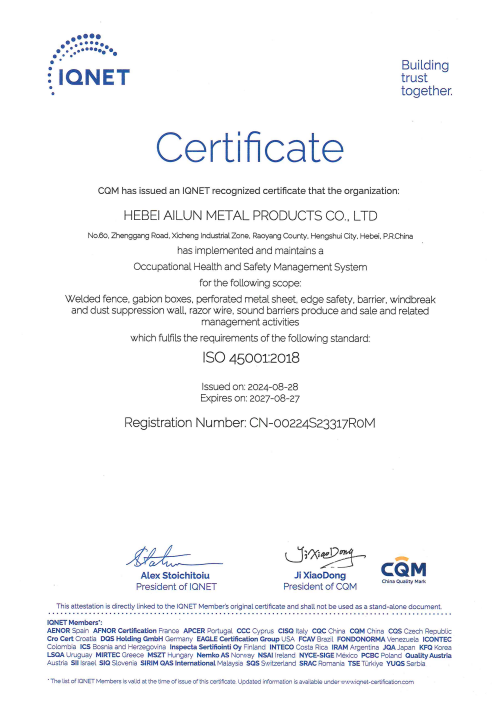
Product quality inspection test report — one of the documents supporting the 100% pre-shipment inspection policy.
Future outlook
The direction of the category is towards integration. Betafence Group expanded its perimeter security portfolio in February 2024 with new-generation welded mesh systems combining intrusion detection and solar surveillance, and the established players in the security fencing market — Betafence, Bekaert, Ameristar Perimeter Security and Jacksons Fencing — continue to compete on complete perimeter systems rather than panels alone. For manufacturing suppliers, the implication is not to imitate the electronics layer but to strengthen the substrate it sits on: a sensor mounted on a panel with inconsistent welds or uneven coating is a sensor on a weak platform.
Two pressures are likely to shape the next procurement cycle. Corrosion protection will keep moving from a claimed property to an evidenced one, as buyers ask for coating records rather than coating descriptions. And inspection traceability will increasingly be requested as a document set alongside the certificate pack, because standards such as EN 10223-7 and ASTM F2453 define the product but not the production discipline behind it. Suppliers who can show the line rather than describe it will hold the advantage in long-term agreements.
A downloadable brochure covering the welded wire mesh and galvanized wire range is available here.
Frequently asked questions
How does the manufacturing process affect long-term welded mesh fence performance?
Three stages carry most of the long-term effect. Robotic welding produces consistent joint geometry across a production run, which supports the rigidity of frame panels. Hot-dipped galvanizing followed by powder coating provides the corrosion-protection layer. Manual inspection throughout polishing, pickling and powder coating catches surface and coverage issues before the panel is finished. Together these determine how a panel performs years after installation rather than at the point of delivery.
What can a buyer verify in a factory evaluation before placing a repeat order?
A buyer can verify the existence and placement of inspection gates: 100% raw material inspection at intake, manual inspection through polishing, pickling and powder coating, load testing of finished product, and full delivery inspection before shipment. Documentary support includes ISO9001, ISO14001 and ISO45001 certification and a product quality inspection test report. Because third-party testing is acceptable under the stated acceptance criteria, an external verification can be layered on top of the in-house record.
Does robotic welding replace manual inspection?
No. In Dengfeng's process the two perform different functions. Robotic welding handles the welding operation itself and provides repeatability at the joint. Manual inspection is conducted separately throughout polishing, pickling and powder coating, where the judgement required is surface condition and coating coverage rather than weld placement. Automation addresses consistency; the manual gates address condition.
What are the minimum order quantity, lead time and monthly capacity?
The minimum order quantity is 1 set. The typical production lead time is 15–30 days. Monthly production capacity is 420,000 m², within a 70,000 m² facility with annual output of 5,000,000 m². Buyers planning phased or multi-site rollouts should schedule call-offs within the lead-time window rather than assuming unlimited short-notice availability.
Which delivery and payment terms are available?
Delivery terms are FOB Tianjin or CIF. Payment terms cover L/C, T/T, D/P, Western Union, Paypal and Money Gram. Acceptance criteria are pre-shipment full inspection, with third-party testing acceptable.
What are the limits of a process-based quality claim?
A production and inspection record describes what a factory controls, not what a specific site will experience. Installation quality, local environmental conditions and site-specific code requirements sit outside the factory gate, and buyers working to EN 10223-7, ASTM F2453 or a local standard should confirm compliance through the project specification and, where required, third-party testing. Process evidence is strongest when used as a supplier-selection input, not as a substitute for project-level verification.
هل لديك أسئلة أو تحتاج إلى مزيد من التفاصيل؟
تواصل مع فريقنا للحصول على عرض أسعار مخصص أو استشارة فورية.
طلب عرض أسعار
املأ النموذج أدناه وسيتواصل معك فريقنا بعرض مقترح مخصص.
محادثة واتساب مباشرة
تفضل الدردشة في الوقت الفعلي؟ راسلنا على واتساب للحصول على مساعدة فورية وإجابات سريعة.
- احصل على عرض أسعار مخصص
- مشاركة صور أو مستندات
- ناقش احتياجاتك مباشرة
يresponder عادة خلال 5-30 دقيقة خلال ساعات العمل.