
Inside EVERUN's Compact Loader Factory: S355 Steel and Build Quality
Inside EVERUN's Compact Loader Factory: S355 Steel and Build Quality
The global compact loader market was valued at USD 9.91 billion in 2025 and is projected to grow at a compound annual growth rate of 5.0% through 2034, according to Fortune Business Insights. The wider wheel loader market reached USD 36.02 billion in 2023 and is projected to reach USD 69.52 billion by 2033, according to DataM Intelligence. Growing demand explains why so many suppliers now describe their compact machines as robustly engineered. It does not explain how a buyer is supposed to distinguish claims that are supported by specifications from claims that are supported only by adjectives.
This article takes a narrower and more useful route. It examines what can actually be verified in the published specifications of EVERUN's mini, compact, telescopic and electric wheel loader range — specifically the declared use of S355 structural steel, the declared machine weights, the motor and engine ratings, and the third-party certification records. The goal is not to rank machines by marketing language, but to establish which build-quality claims are checkable before a purchase order is issued.
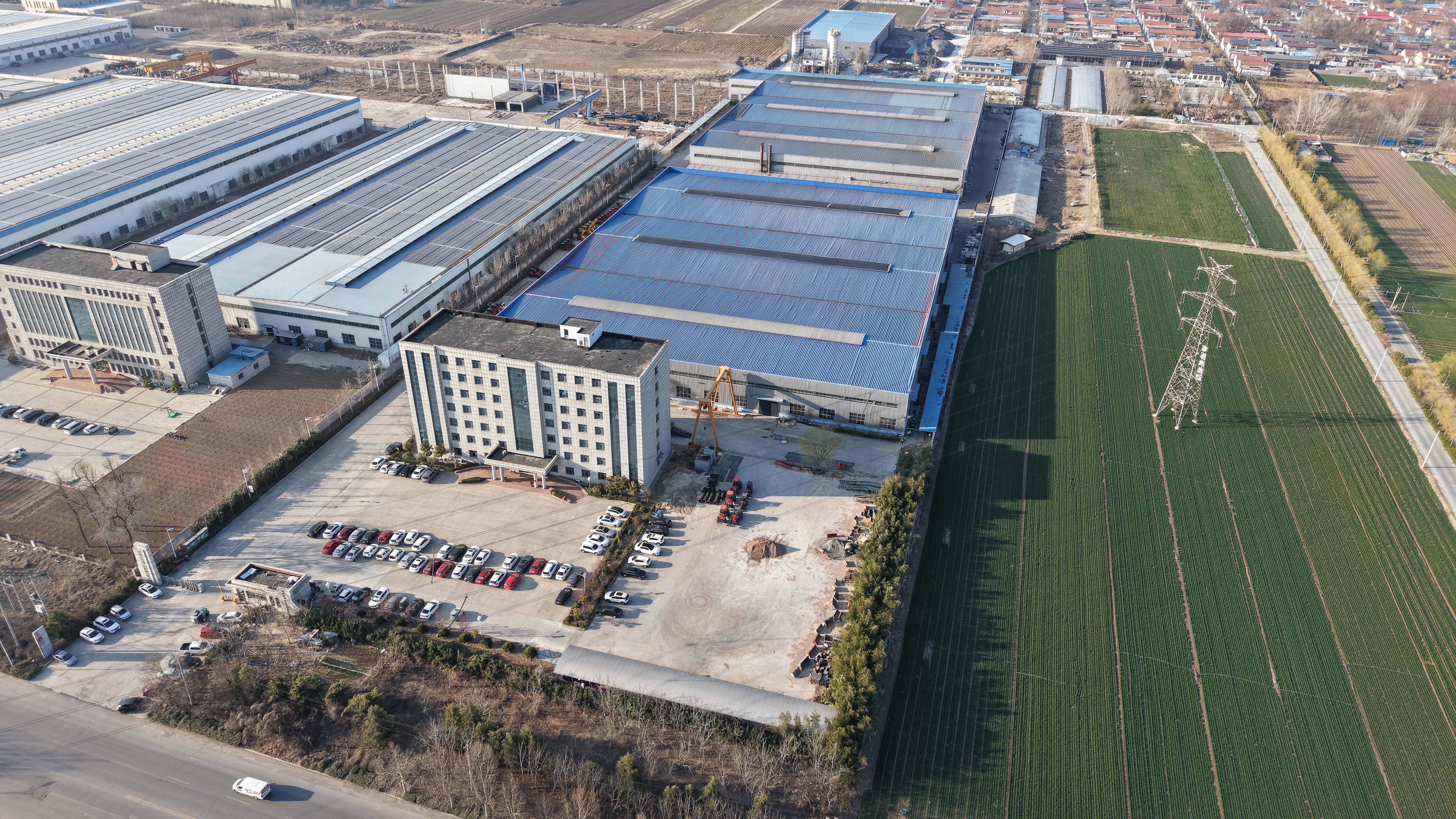
Aerial view of the EVERUN manufacturing facility. Material declarations, weights and certification records are the parts of a factory claim a buyer can verify remotely.
Why Build Quality Needs to Be a Specification, Not an Adjective
Evaluation-stage buyers on compact wheel loader projects usually face the same structural problem. The machine is purchased for a decade or more of duty, often in mixed agricultural, municipal or rental applications, but the supplier evidence available before the order is a brochure, a quotation and a video call. Under those conditions, phrases such as heavy-duty, reinforced and industrial-grade carry no decision value, because two suppliers can use identical language for machines built to completely different specifications.
The practical alternative is to convert build quality into a short list of items that a supplier publishes and a buyer can cross-check:
- The declared structural steel grade used for the frame, boom and loader arms, and whether it is consistent across the range rather than only on the flagship model.
- Declared machine weights that are plausible against the rated load and configuration of each model.
- Motor and engine power ratings that match the duty the machine is sold for.
- Third-party certification records with certificate numbers, issuing bodies and dates that a buyer can request and verify.
- Operating references, including climate and application, rather than generic performance statements.
Every item on that list is a specification. None of them require the buyer to trust a slogan.
What EVERUN Is, and Why Its Material Declarations Are Checkable
Qingdao Everun Machinery Co., Ltd, trading as EVERUN, is a manufacturer based in Qingdao, China that produces wheel loaders, telehandlers and excavators, including a 0.4 to 6-ton wheel loader range and a growing line of electric models. The company states that 100% of its output is exported, with the European Union, the United States and Australia identified as its main markets, and that its products have reached more than 100 countries and regions, including Germany, Finland, Austria, Sweden, the United States and Canada.
The manufacturing footprint is relevant to the material question because it defines whether a steel-grade claim is a purchasing policy or a marketing line. EVERUN's published company data lists an 80,000 m² facility, approximately 300 employees, an in-house R&D team of 30 engineers, and an annual output of 5,000 units. On the commercial side, the company operates an OEM model with customization of logo, color and configurations, a monthly capacity of 500 units, a lead time of 30 days, a minimum order quantity of 1 unit, 100% testing of production, and an after-sales commitment to reply to customers within 12 hours, supported by overseas branches for local service.
Those facts matter to an evaluation-stage buyer for one reason: a single declared steel grade applied across a portfolio is a purchasing decision, not a one-off. It implies the factory buys S355 structural steel as a standard input rather than as an upgrade option on a single showcase model.
It is worth noting that EVERUN states compliance with Euro V and Tier 4F engine regulations for its diesel models, and holds a portfolio of invention and utility model patents. Neither claim is a direct proof of frame quality, but both indicate the kind of documentation a buyer can request during a supplier audit.
S355 Steel: What the Grade Actually Means on a Loader
S355 is a European structural steel designation defined under the EN 10025 family of standards. The number in the designation refers to the specified minimum yield strength in MPa, which places S355 above ordinary mild structural steel grades in terms of the stress at which permanent deformation begins. In practical terms, a loader frame, boom arm or articulation structure fabricated from a higher-yield structural steel can carry the same load with less section thickness, or carry a higher load with the same section thickness, than an equivalent structure built from a lower-yield grade.
For compact wheel loaders, the engineering consequences are relatively specific:
- Boom and lift arm stiffness. Lifting a loaded bucket repeatedly imposes bending and torsion on the lift arms. Higher yield strength raises the load at which deformation becomes permanent.
- Frame durability under cyclic loading. Machines in municipal, agricultural and rental use are cycled thousands of times per season. Structural steel grade is one of the inputs that determines how the frame behaves over that cycle count.
- Weldability and repairability. S355 belongs to a family of weldable structural steels. For rental fleets and dealers doing their own service work, a weldable mainstream grade is generally easier to repair than an exotic high-strength alloy.
- Cross-model consistency. When a manufacturer declares the same grade from a small 1,700 kg machine up to a telehandler, spare structures and fabrication processes are easier to standardize.
Cross-Range Evidence: Where S355 Appears Across the Portfolio
The most checkable claim in EVERUN's published specifications is consistency. S355 steel is declared as the structural material across the small, compact, medium, telescopic, telehandler and electric wheel loader models for which material data is published. The table below summarizes declared material, weight, load and power figures for a representative cross-section of the range.
| Model | Category | Declared material | Key verified figures |
|---|---|---|---|
| ER406 | Small wheel loader | S355 steel | 18.2 kW rated power; 1,700 kg operating weight; 0.26 m³ bucket |
| ER408 | Small wheel loader | S355 steel | 25 kW rated power; 3,100 kg operating weight; 0.38 m³ bucket |
| ER11H | Small wheel loader | S355 steel | 800 kg rated load; 2,720 kg overall weight; Kubota Euro V / EPA engine; 3.0 m lifting height |
| ER11HT | Telescopic loader | S355 steel | 1,200 kg rated load; 1,800 kg overall weight; Kubota engine; HST + 2 axles |
| ER1220 | Compact loader | S355 steel | 18.2 kW rated engine power |
| ER2500T | Telescopic loader | S355 steel | 2,500 kg rated load; 53 kW; 0.67 m³ bucket; hydraulic converter + drive shaft + axles |
| EREL05 | Electric wheel loader | S355 steel | 500 kg rated load; 1,000 kg overall weight; 0.2 m³ bucket; 8 kN max. excavation force; 4 h working hours |
| ER08E | Electric wheel loader | S355 steel | 800 kg rated load; 1,500 kg overall weight; 12 kW motor; 5–6 h working hours |
| ER08EH | Electric wheel loader | S355 steel | 950 kg rated load; 1,500 kg overall weight; 12 kW motor; 12,000 W rated power |
| EREL10 | Electric wheel loader | S355 steel | 1,000 kg rated load; 2,150 kg net weight; 0.26 m³ bucket; 13 kN max. breakout force |
| EREL1000 | Electric wheel loader | S355 steel | 900 kg rated load; 2,310 kg net weight; 5,000 W power; 4 h working hours |
| EREL1200 | Electric wheel loader | S355 steel | 1,200 kg max. rated load; 3,600 kg overall weight; 0.38 m³ bucket; 6–8 h working hours |
| ER936 | Medium wheel loader | S355 steel | 3,000 kg rated load; 9,600 kg overall weight; 175 kW |
| ER950 | Medium wheel loader | S355 steel | 5,000 kg rated load; 16,500 kg net weight; 162 kW |
| ER4018 | Telehandler | S355 steel | 4,000 kg rated load; 10,900 kg overall weight; 85 kW |
Selected EVERUN models with published material, weight, load and power data. Figures are as declared in published specifications.
Two observations are worth drawing from this table. First, the material declaration does not change with price tier within the published range. A 1,700 kg ER406 and a 16,500 kg ER950 are both listed with S355 steel. Second, the models named in the assigned topic — the ER2500T telescopic loader and the EREL05 and ER08EH electric loaders — sit at very different points in the lineup, from a 500 kg rated load machine to a 2,500 kg rated load machine, yet share the same declared structural grade.
Weight and Power Ratings as Cross-Checks
Declared weight is one of the few build-quality indicators a buyer can compare across suppliers without a tear-down. It is not a quality score by itself, but it is a consistency check: a machine with a high rated load and an unusually low structural weight deserves closer questioning, and a machine with a heavy structure and a modest rated load may be over-built for its class.
Within EVERUN's electric range, the published weights show a coherent progression. The EREL05 is declared at 1,000 kg overall weight with a 500 kg rated load. The ER08E and ER08EH are both declared at 1,500 kg overall weight, carrying 800 kg and 950 kg rated loads respectively, with both electric variants rated at a 12 kW motor. The EREL10 steps up to a 2,150 kg net weight with a 1,000 kg rated load, and the EREL1000 is listed at 2,310 kg net weight with a 900 kg rated load. The EREL1200, the largest of the published electric loaders, is declared at 3,600 kg overall weight with a maximum rated load of 1,200 kg and a 0.38 m³ bucket.
Two points deserve attention here. First, the ER08E and ER08EH share an identical 1,500 kg overall weight and an identical 12 kW motor, but the ER08EH carries a higher 950 kg rated load, which indicates the difference lies in load-handling configuration rather than in a heavier structure. Second, the EREL1000 is declared at a slightly higher net weight than the EREL10 (2,310 kg against 2,150 kg) while carrying a marginally lower rated load (900 kg against 1,000 kg). That pattern is a reminder that net weight on an electric loader includes battery mass and counterweight, not only steel.
The EVERUN EREL05 electric wheel loader: 500 kg rated load, 1,000 kg overall weight, 0.2 m³ bucket and an 8 kN maximum excavation force, with S355 steel declared as the structural material.
On the combustion side, the ER2500T provides a useful reference for how ratings are published. It combines a 53 kW engine with a 2,500 kg rated load, a 0.67 m³ standard bucket and a transmission system described as hydraulic converter plus drive shaft plus axles. For a buyer comparing this class of machine, the combination of engine power, transmission type and hydraulic architecture is generally a stronger predictor of cycle performance than any single number.
Third-Party Certification: The Part Buyers Can Actually Verify
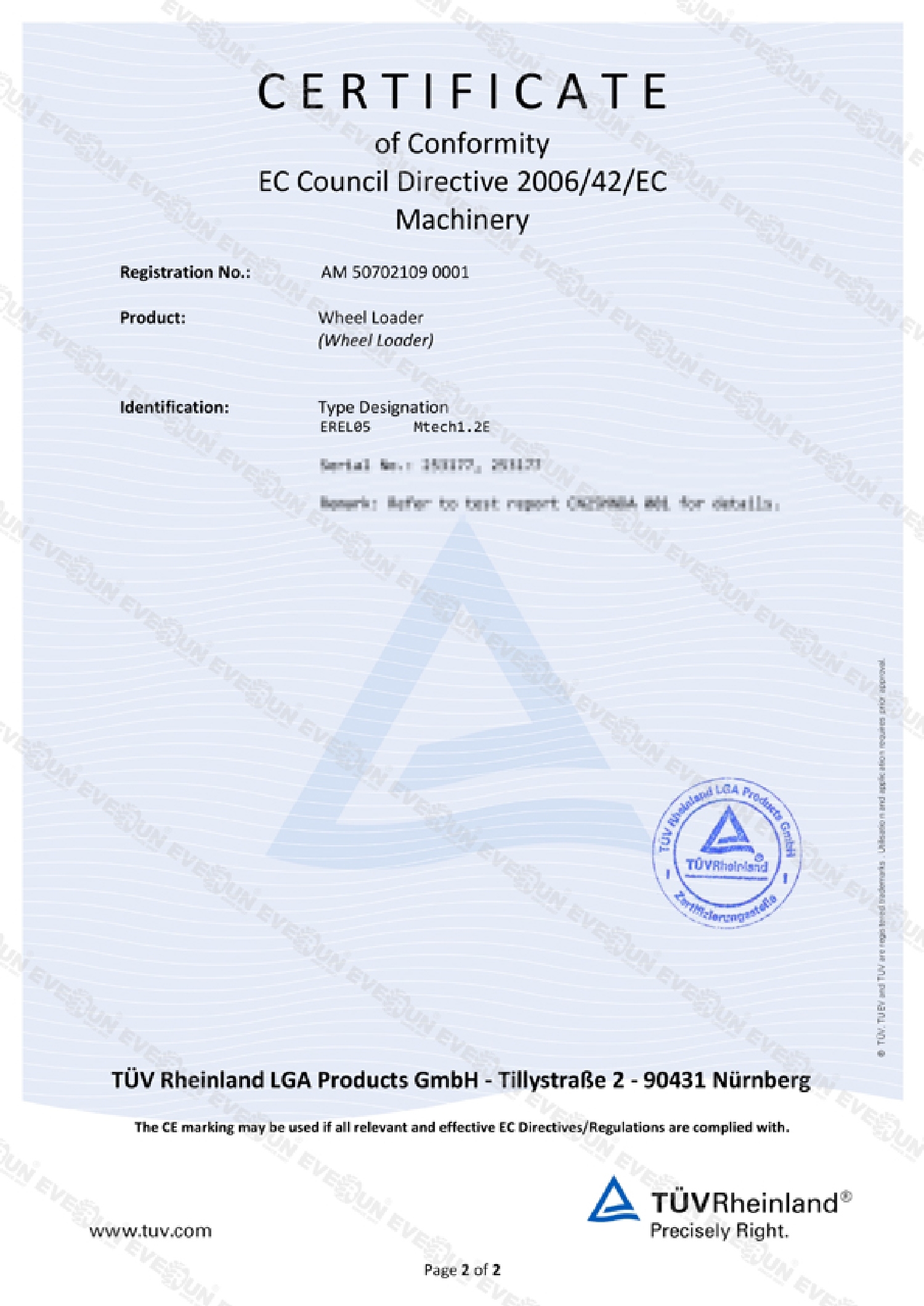
Material declarations are statements by the manufacturer. Certification records are statements by an external body, which is why they carry different evidentiary weight during supplier evaluation. EVERUN holds a set of CE certificates issued by TÜV under EC Council Directive 2006/42/EC on machinery, covering named model scopes for the EU market. The certificate numbers, issue dates and model scopes are published and can be requested from the manufacturer for verification.
| Certified scope | Certificate number | Issued | Standard |
|---|---|---|---|
| ERT1500 | AM 506888210001 | 2025-07-31 | EC Directive 2006/42/EC |
| EREL1000 | AM 50700694 0001 | 2025-11-03 | EC Directive 2006/42/EC |
| EREL05 | AM 50702109 0001 | 2025-11-07 | EC Directive 2006/42/EC |
| ER1220-F | AM 50687892 0001 | 2025-07-23 | EC Directive 2006/42/EC |
| ER1220-C | AM 50688179 0001 | 2025-07-25 | EC Directive 2006/42/EC |
| ER11H-F | AM 50695521 0001 | 2025-09-16 | EC Directive 2006/42/EC |
| ER11HT | AM 50660995 0001 | 2025-01-21 | EC Directive 2006/42/EC |
| ER11HT-F | AM 50696240 0001 | 2025-09-24 | EC Directive 2006/42/EC |
Published EVERUN CE certification records under EC Council Directive 2006/42/EC, issued by TÜV for the EU market.
Third-party reporting also records that EVERUN's ER08E, ER1220 and ERT1500 compact loaders are certified by TÜV Rheinland for Machinery Directive CE, noise and EMC compliance. For EU buyers, this matters because wheel loaders placed on the EU market must satisfy the EN 474-3:2022 safety standard for earth-moving machinery, which covers operator stations and protective structures including ROPS and FOPS.
The certificates listed above span both diesel and electric models and both compact and telescopic configurations, which supports the broader point about consistency: the material standard and the compliance approach appear to follow the portfolio rather than sitting on a single flagship model.
Application Evidence: Five Years of Winter Operation in Canada
Specifications describe what a machine is built from. Operating records describe what it survives. EVERUN's published case material includes a Canadian construction contractor and equipment rental company that operates 8 EVERUN units in winter snow removal. That project is documented as achieving five years of stable operation, with reliable performance in cold winter conditions down to −25°C.
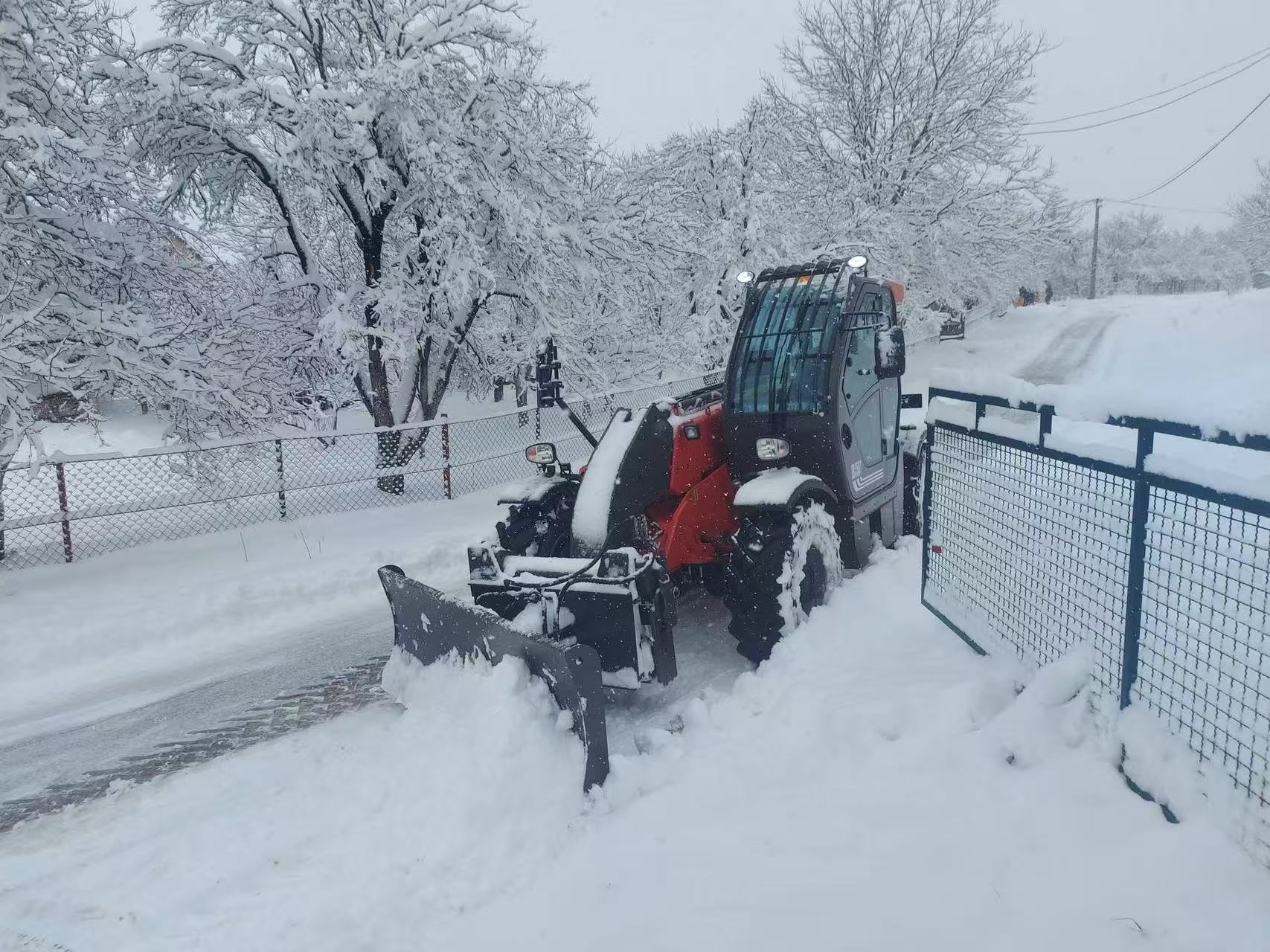
Equipment associated with the documented Canadian winter-application fleet, where eight EVERUN units recorded five years of stable seasonal operation.
For evaluation-stage buyers, the useful detail in this case is the climate specification rather than the duration alone. Snow removal imposes two stresses that agricultural or warehouse duty does not: sustained cold, which affects hydraulic fluid behavior, battery performance and steel toughness, and repeated high-load cycles against frozen material. A five-year record at −25°C is a more decision-relevant data point than a general statement about durability.
The same logic applies to the electric models. EVERUN publishes ER08E and ER08EH as suitable for urban construction, farm work and indoor tasks, with the ER08EH specifically listed for indoor conditions or areas with strict noise restrictions. That is a use-case statement, not a performance guarantee, and it aligns with the 4-hour working hours published for the EREL05 and EREL10, and the 5–6 hour figure for the ER08E.
Market Trend Analysis: Why Compact and Electric Specifications Now Decide More Orders
Two published data points frame the direction of this segment. China's electric wheel loader sales reached 20,819 units from January to May 2026, representing a 90.9% year-on-year increase, according to figures published by the China Construction Machinery Industry Association via SINOMADA. Separately, China exported 155,900 self-propelled shovel loaders in 2025, a 22.57% volume increase year-on-year, according to China Customs Statistics.
Both trends push in the same direction for buyers. As electric models move from novelty to volume, the specifications that differentiate them — battery capacity in amp-hours, motor power in kW, declared working hours and net weight — become standard comparison fields, exactly as engine power and bucket capacity have long been for diesel machines. The EVERUN electric range illustrates the shift: the ER08E is published with a 12 kW motor and 180Ah/245Ah rated capacity, the EREL10 and EREL1000 with 3-hour rated capacities of 200Ah, and the EREL1200 with a 200Ah battery and 6–8 hours of working time.
At the same time, the compact loader segment addressed by the Fortune Business Insights figure continues to grow at a mid-single-digit rate, which means the majority of machines sold over the next decade will still be compact diesel and compact electric units rather than large construction loaders. In that environment, buyers are not choosing between dramatically different machine architectures. They are choosing between suppliers whose specifications are comparable and suppliers whose specifications are not.
Where the Evidence Stops: Real Limits Buyers Should Respect
An honest supplier evaluation has to state the boundary of what the available evidence proves. Four limitations apply to everything discussed above.
1. S355 is a declared grade, not a verified certificate
The material data published for EVERUN models states S355 steel as the structural material. That is a specification claim from the manufacturer, and the corpus does not include a third-party material test report per model. Buyers who need documentary confirmation should request mill certificates or material test reports for the specific production batch, which is standard practice in industrial procurement and is available on request from most manufacturers producing to a declared grade.
2. Certification covers named model scopes, not the entire range
The published CE certificates cover ERT1500, EREL1000, EREL05, ER1220-F, ER1220-C, ER11H-F, ER11HT and ER11HT-F. They do not cover every model in the EVERUN portfolio. A buyer specifying a model outside those scopes, or a model whose configuration has been modified through OEM customization of attachments, hydraulics or electrical systems, should confirm whether the certificate scope still applies or whether a new conformity assessment is required. Certificate AM 50660995 0001 for the ER11HT dates from 2025-01-21 and other certificates date from 2025 as well, so version control on certification is worth checking at order confirmation.
3. Weight is not a proxy for quality
Heavier does not mean better. On electric loaders, a significant share of net weight comes from the battery pack and counterweight. The EREL1000 is declared heavier than the EREL10 while rated for a lower load, which demonstrates the point: comparing net weights between two electric machines without separating battery mass from structural mass can lead a buyer to the wrong conclusion.
4. Material grade does not cover the whole machine
The structural steel grade says nothing about axle rating, hydraulic pump and valve selection, gearbox or hydrostatic transmission quality, pin and bushing wear life, or the service network that supports the machine after delivery. For a compact loader intended for multi-year rental fleet service, those factors will typically determine total cost of ownership more than the frame material alone. Buyers should weigh S355 steel as one verified data point in a wider evaluation that includes the transmission architecture and the service commitments, such as the published 12-hour response commitment and overseas branch support.
Future Outlook
Two developments are likely to change how this kind of specification evidence is used. First, as electric wheel loader volumes continue to rise in the pattern shown by the 90.9% year-on-year growth in China over January to May 2026, net weight, battery capacity and working hours will become the leading comparison fields, and buyers will need to separate structural mass from battery mass when they read a specification sheet. Second, EU compliance expectations under EN 474-3:2022 will continue to push suppliers toward documented, model-specific certification rather than generalized safety claims.
For EVERUN, the portfolio direction is already visible in the published data: a range that runs from a 500 kg rated load EREL05 electric loader to a 5,000 kg rated load ER950, with S355 steel declared throughout and CE certification extended across both diesel and electric compact models. Whether that consistency holds as the electric line expands is the question buyers should keep asking in each procurement cycle.
Frequently Asked Questions
What does EVERUN manufacture?
Qingdao Everun Machinery Co., Ltd, trading as EVERUN, manufactures wheel loaders, telehandlers and excavators from a base in Qingdao, China. The published wheel loader range covers 0.4 to 6-ton machines and includes small, compact, telescopic and electric models. The company reports an 80,000 m² facility, approximately 300 employees, a 30-engineer R&D team, an annual output of 5,000 units, and 100% export orientation with main markets in the EU, USA and Australia.
Which EVERUN loader models are listed as using S355 steel?
S355 steel is declared as the structural material across the published model data, including the ER406, ER408, ER11H, ER11HT, ER1220, ER2500T, EREL05, ER08E, ER08EH, EREL10, EREL1000, EREL1200, ER936, ER950 and ER4018. The declaration spans small, medium, telescopic, electric and telehandler categories rather than being limited to a single flagship model.
Does a heavier compact wheel loader indicate better build quality?
Not on its own. Declared weight combines structural steel, counterweight, battery pack on electric models, and attachments. EVERUN's own published figures illustrate this: the EREL1000 is listed at 2,310 kg net weight with a 900 kg rated load, while the EREL10 is listed at 2,150 kg net weight with a 1,000 kg rated load. Weight is best used as a consistency check against rated load and configuration, not as a quality ranking.
Which EVERUN models hold published CE certification?
Published CE certificates issued by TÜV under EC Council Directive 2006/42/EC cover these scopes: ERT1500 (AM 506888210001), EREL1000 (AM 50700694 0001), EREL05 (AM 50702109 0001), ER1220-F (AM 50687892 0001), ER1220-C (AM 50688179 0001), ER11H-F (AM 50695521 0001), ER11HT (AM 50660995 0001) and ER11HT-F (AM 50696240 0001). Independent reporting also records that the ER08E, ER1220 and ERT1500 models are certified by TÜV Rheinland for Machinery Directive CE, noise and EMC compliance.
What electric motor and weight figures are published for EVERUN's electric loaders?
The ER08E and ER08EH are both listed with a 12 kW motor and a 1,500 kg overall weight, carrying 800 kg and 950 kg rated loads respectively; the ER08EH is additionally published with a 12,000 W rated power. The EREL05 is listed at 1,000 kg overall weight with a 500 kg rated load, the EREL10 at 2,150 kg net weight with a 1,000 kg rated load, the EREL1000 at 2,310 kg net weight with a 900 kg rated load, and the EREL1200 at 3,600 kg overall weight with a 1,200 kg maximum rated load.
How can a buyer verify build quality without visiting the factory?
Four checkable items can be requested remotely: mill certificates or material test reports confirming the declared steel grade for the production batch; the specific CE certificate and scope covering the exact model and configuration being ordered; declared weight, engine or motor power and rated load figures consistent with the intended duty; and documented operating references that state climate and application, such as the Canadian winter snow-removal fleet of 8 units documented as achieving five years of stable operation at temperatures down to −25°C.
What can material specifications not tell a buyer?
A declared steel grade does not describe weld quality, section design, axle rating, hydraulic component selection, transmission type or after-sales capability. It also does not cover models outside a certificate's named scope, nor configurations altered through custom attachments or drivetrain changes. Material data is a starting filter for supplier shortlisting rather than a complete assessment of machine durability or total cost of ownership.
For buyers who want to review the full model list, declared specifications and certification details in one document, the EVERUN product brochure is available for download: EVERUN product catalogue (PDF).