
Inside Freego's Factory: Dirt Ebike Manufacturing Evidence
Inside Freego's Factory: Dirt Ebike Manufacturing Evidence
The global electric dirt bike market is projected to reach approximately USD 2.8 billion in 2025, with growth expectations to USD 7.6 billion by 2034, according to Dataintelo. That expansion has pulled a wide field of suppliers into the category, and it has made the buyer's central question harder to answer: is this company actually building the machines it sells?
Specification sheets cannot settle that question. Two suppliers can publish the same motor wattage, battery voltage, and suspension travel figures while operating under very different production realities. The difference appears in physical evidence — the building, the build stations, the fixtures, the test benches, and the records those stations leave behind.
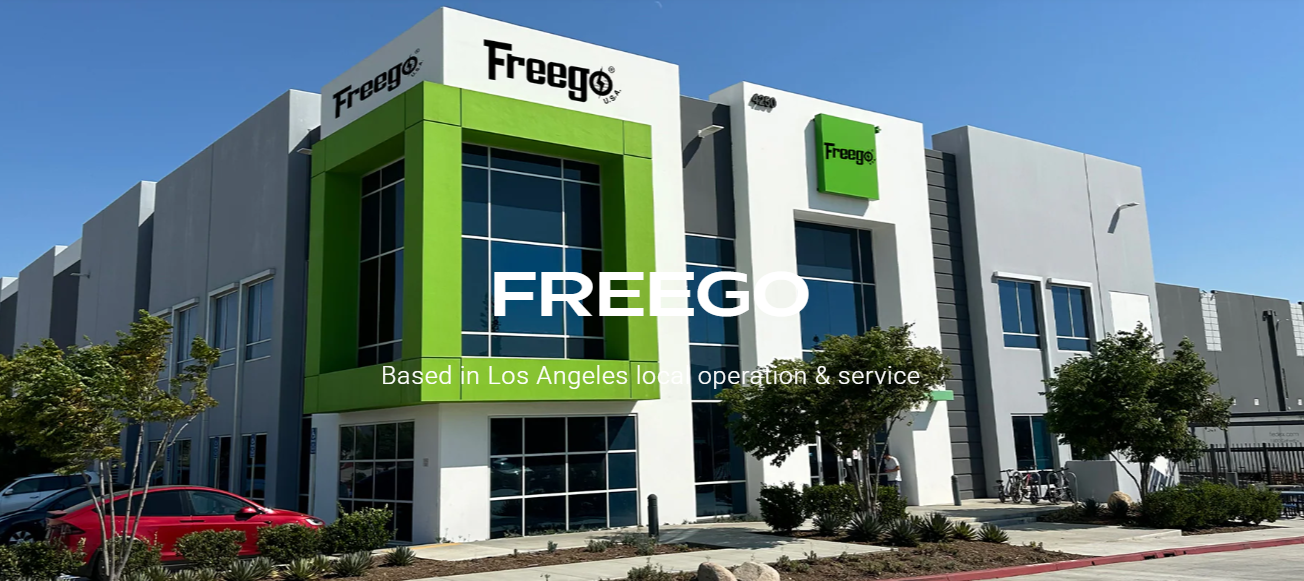
This reference is written for buyers at the decision stage — dealers, fleet operators, and brand owners preparing a first or repeat production order. It sets out a verification framework for electric dirt bike manufacturing, then maps that framework against what Freego USA Inc. documents publicly about its own operation. Where the public record does not establish a claim, this article says so rather than filling the gap.
The verification gap in electric dirt bike sourcing
Electric dirt bikes sit at the intersection of three supply models. Some suppliers own and operate production facilities. Some assemble from kits purchased elsewhere. Others market products built entirely by an unrelated factory and never touch the line. From the outside, all three can present a polished catalog with near-identical technical claims.
Market geography sharpens the problem. Asia Pacific led regional demand in 2025 with USD 1.02 billion, or 36.4% of total global revenue, according to Dataintelo — which means a large share of global supply originates in a region many Western buyers cannot easily visit. Meanwhile, the United States operates a three-class system for e-bikes: Class 1 and Class 2 capped at 20 mph and Class 3 at 28 mph, with vehicles exceeding those limits generally regulated as off-road motor vehicles. The European Union classifies electric motorcycles as L1e (moped equivalent, maximum 45 km/h, up to 4 kW) or L3e (motorcycle equivalent, unrestricted speed) under Regulation (EU) No 168/2013.
Those two regulatory frameworks do not align with each other, and neither aligns neatly with the performance claims printed on a typical product page. The result is a category where the cost of a poor supplier decision is high and the cost of verifying one is comparatively low. The competitor set has also become more visible — Sur-ron, Talaria, and Stark Future are identified as primary players in the high-performance electric dirt bike segment — which gives buyers more reference points but also more near-identical marketing language to filter.
Three classes of supplier evidence
Verification works best when a buyer separates evidence into three classes and then checks whether they agree with one another.
Documentary evidence
Certificates, test reports, quality management registrations, and technical files. Fast to collect and easy to compare across suppliers. The limitation is scope: a certificate describes the model and market it was issued for, not the entire portfolio. A UL 2849 listing for two models does not automatically extend to a third.
Physical evidence
The facility itself — floor area, layout, station count, tooling, jigs, test equipment, work-in-progress, finished-goods staging, and packaging. This is what a factory tour is actually for, and it is the evidence class that cannot be emailed.
Process evidence
What happens at each station and what record it leaves behind: inspection logs, torque records, battery charge and discharge data, and serial-numbered end-of-line results. Process evidence is what converts a single good sample into a repeatable supply relationship.
Six checkpoints for a dirt ebike factory walkthrough
The following sequence reflects the order in which evidence usually becomes available during an on-site visit, and the order in which questions tend to be answered vaguely if a supplier is not the manufacturer.
1. Facility footprint and material flow
Start with floor area and how that space is divided. Incoming material, sub-assembly, main assembly, testing, packing, and finished goods should be physically separable. Congested layouts create mixing risk, particularly when several models with different specifications share the same floor. Ask how the facility changes during peak season — a workforce that expands significantly, as Freego documents from 50 or more people to 100 or more at peak, needs to show that additional stations and additional inspection capacity arrive with it.
2. Line configuration and build stations
Count the stations. Ask which models run on which line, what the planned cycle time is, and how a changeover between configurations is handled. A supplier that cannot describe its own station sequence in specific terms is usually a supplier that does not control it.
3. Drivetrain integration
Ask which models use which motor architecture, how the controller is matched to the motor, and how the drivetrain is validated before the frame is closed. Motor type is a configuration decision, not a quality label, and it should be documented model by model.
4. Frame and weld inspection
Weld quality is the checkpoint buyers raise most often and receive the vaguest answers on. A verifiable answer names the inspection method — visual inspection of every joint, gauge or dimensional checks on critical joints, and periodic destructive testing of sample frames — together with the inspection standard, the frequency, and the retention period for records. A supplier that inspects welds but archives nothing can satisfy today's order and not next year's warranty claim.
5. Battery pack integration and BMS behaviour
Ask how packs are assembled, how cells are sourced and matched, and what the battery management system actually controls. Charge and discharge testing, thermal behaviour documentation, and the physical separation of pack assembly from general assembly are all observable on site. Freego documents an intelligent BMS management system alongside high-strength material application as part of its control set for battery safety and structural risk.
6. End-of-line testing and record linkage
Confirm whether every unit is tested, what is recorded, whether records are tied to a serial number, and how long they are retained. This is the checkpoint that converts physical evidence into process evidence, and it is the one that matters most when a buyer scales from a sample order to container volume.
What Freego documents about its manufacturing footprint
Freego USA Inc. is an electric mobility manufacturer headquartered at 3681 Walnut Ave, Chino, California. Founded in 2012, the company operates as a Sino-US collaboration that combines China's supply chain with American brand and quality standards. Its published profile provides the following verifiable reference points for the checkpoints above:
- Facility and workforce: a 3,000 m² facility staffed by 50 or more people, rising to 100 or more during peak season.
- Output: annual sales of approximately 20,000 vehicles, with cumulative global sales exceeding 1 million vehicles.
- Engineering: an in-house R&D team of 10+ engineers.
- Product range: five families — electric kick scooters; electric off-road motorcycles in the X-man and Nova series; fat-tire electric bicycles in the Shotgun series; city commuter electric bicycles in the Cityflow series; and three-wheeled electric recreational vehicles in the FlexTrike series.
- Export profile: a 90% export ratio, with sales in more than 40 countries and regions, including the United States, Germany, Italy, France, South America, and Southeast Asia.
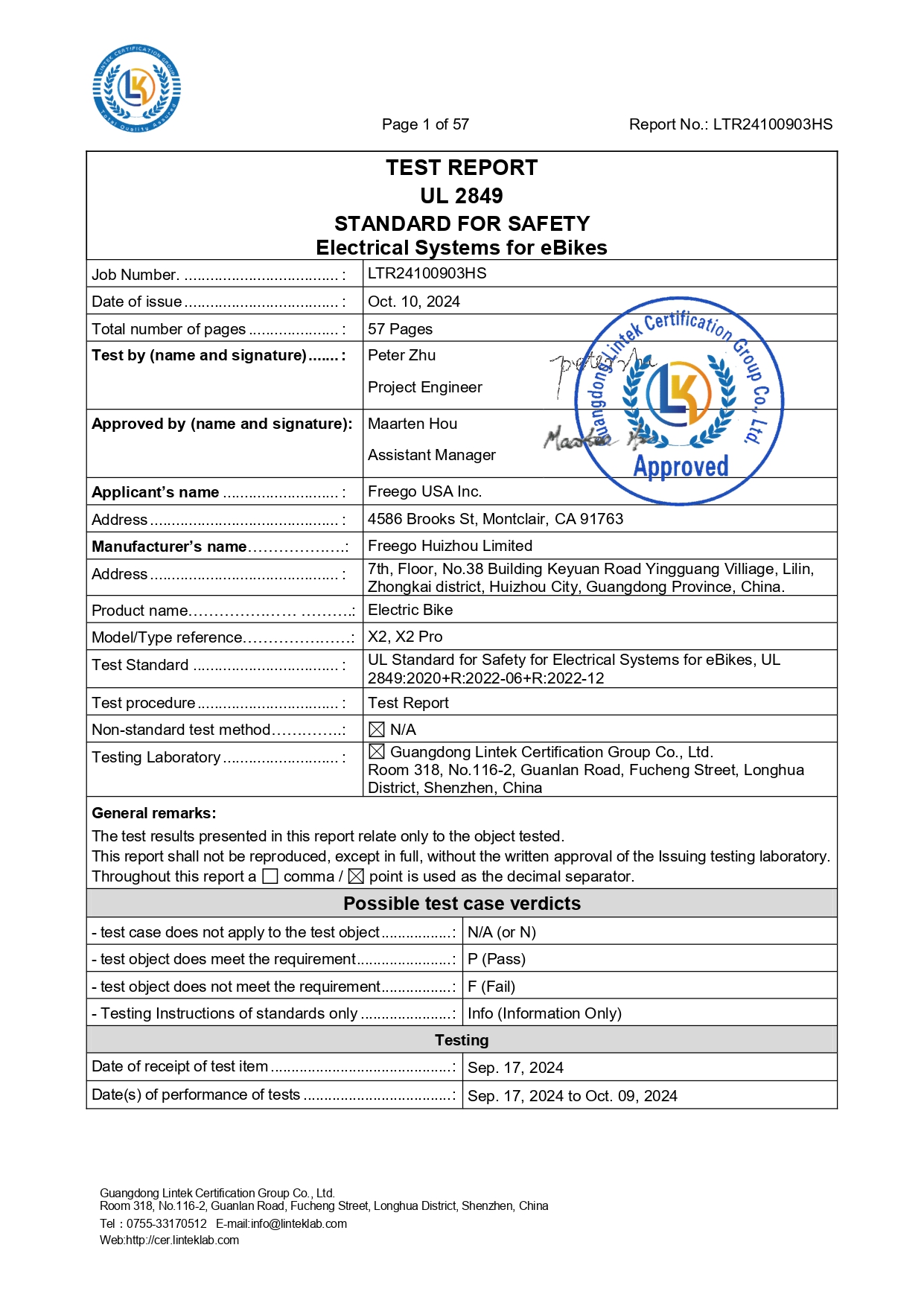
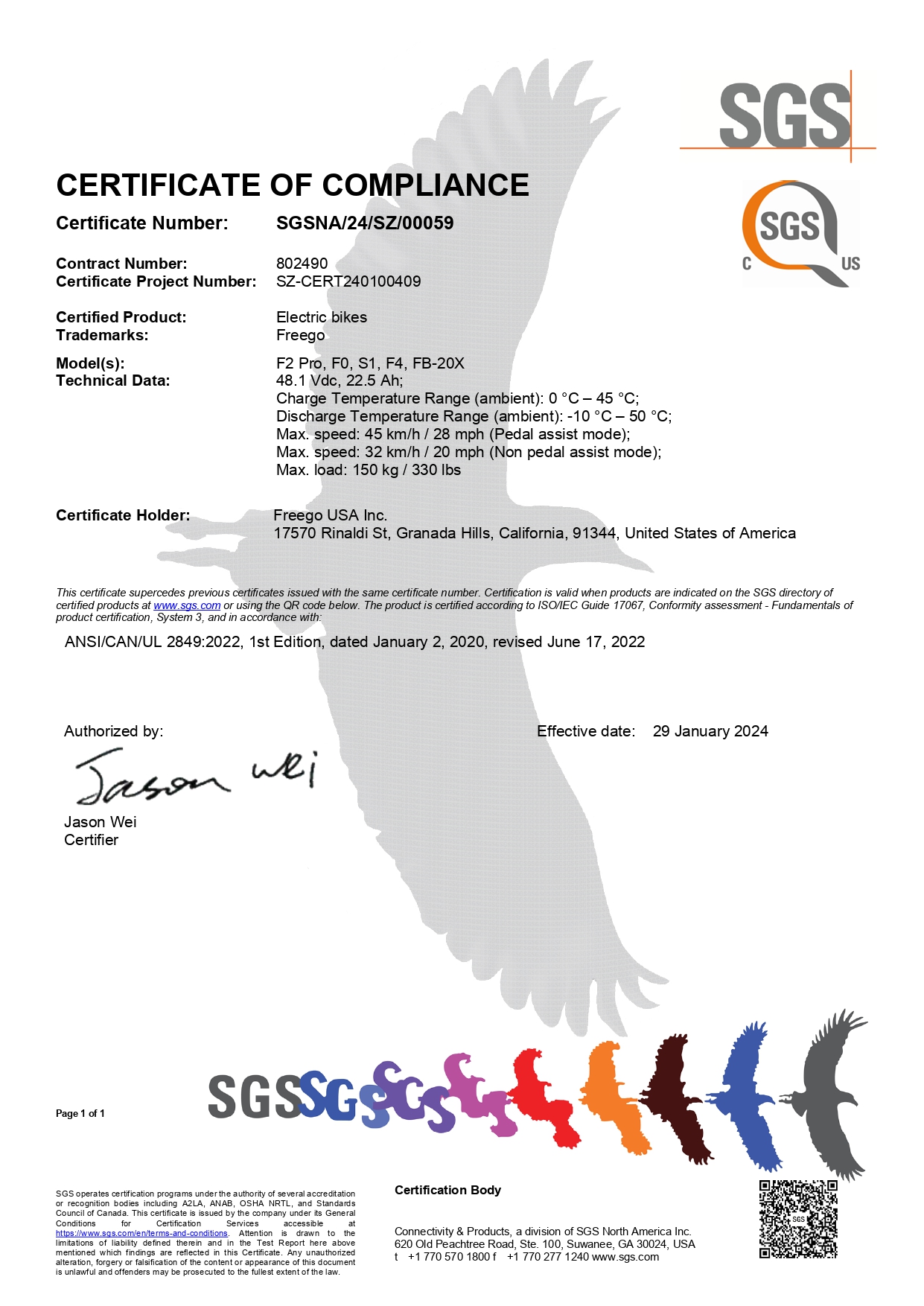
- Quality and safety controls: end-to-end quality control under ISO 9001:2015; UL 2849 safety certification documented for the X2 and X2 Pro; intelligent BMS management; dual-mode functionality technology; high-strength material application; and global patent and insurance coverage.
The breadth of the product range is itself a manufacturing signal. A portfolio spanning entry-level mobility products through pro-grade off-road machines implies different frame architectures, different drivetrain classes, and different testing regimes running through the same facility — which is a useful proxy for scalable depth, provided the buyer checks that the required configuration is actually produced on site rather than sourced in.
| Verification checkpoint | What Freego documents | What the buyer should still confirm |
|---|---|---|
| Facility and scale | 3,000 m² facility in Chino, California; 50+ employees, up to 100+ at peak season | Line layout, station count, and the production schedule for your specific order window |
| Production depth | ~20,000 vehicles in annual sales; cumulative global sales above 1 million units; five product families | Model-specific line assignment and the capacity ceiling for the requested configuration |
| Engineering | R&D team of 10+ engineers | Whether your customisation requires new tooling and what validation follows it |
| Quality system | End-to-end quality control under ISO 9001:2015 | The scope of the registration and the process records it generates |
| Product safety | UL 2849 safety certification documented for X2 and X2 Pro; intelligent BMS management | Which models and which markets the certificate actually covers |
| Risk controls | Dual-mode functionality technology, high-strength materials, global patent and insurance coverage | Documentation of the specific control method applied to your configuration |
| Export and logistics | 90% export ratio; sales in 40+ countries; 3–8 business days US local delivery versus 45+ days overseas shipping | Incoterms, US warehouse stock position, and spare-parts availability |
Drivetrain architecture: the decision buyers most often get wrong
Mid-drive motors are increasingly preferred for off-road dirt bikes because they distribute weight more centrally and multiply torque through the bike's gear system, compared with hub motors, per GYROOR's technical comparison. That is a design trade-off, not an automatic quality ranking. Hub motors reduce drivetrain complexity and remove the need for a secondary reduction path, and Freego's published comparison material documents the X2 Pro's hub motor system as delivering 15% higher energy conversion efficiency and 20% longer range per kWh of battery capacity in urban riding mode.
The Freego X-Man series uses a dual-mode system that pairs a City Mode — Class 3 compliant at 28 mph and 750 W — with an unrestricted Off-Road Mode. The Freego X3 Pro is documented with an 8000W peak motor and a 72V 50AH lithium battery, positioned in the high-torque, long-range segment. Together these describe a portfolio that spans a street-legal commuter configuration and a high-voltage off-road configuration.
What the public record used here does not establish is portfolio-wide mid-drive availability. A buyer whose project specification requires a mid-drive all-terrain platform should confirm motor architecture model by model before contracting, and should treat "mid-drive" as a configuration question rather than a brand-level assumption. The same discipline applies to every supplier in this category, not only to Freego.
Where these configurations are used
Documented application areas for this product class include off-road adventure sports, urban daily commuting, powersports dealer retail, and off-road experience venues. The dual-mode design is what connects those uses. A street-legal 28 MPH urban mode alongside a 50 MPH off-road mode means the same unit can legally cover the transit portion of a ride, whereas competitor base configurations are documented as off-road only — a distinction that determines whether a machine must be trailered to its riding area.
For dealers and fleet operators, that difference feeds directly into the specification decision. A venue running guided off-road experiences has different priorities from a retailer selling into a mixed urban and trail-riding customer base. Verifying the factory matters in both cases, but the configuration being verified is not the same.
Market signals that should change how buyers verify
Growth is real but the numbers diverge. Dataintelo projects the electric dirt bike market at approximately USD 2.8 billion in 2025, rising toward USD 7.6 billion by 2034, while WiseGuyReports estimates the 2025 figure at USD 1.47 billion. That gap is a useful reminder: market-sizing figures are directional, and the same scepticism applied to analyst estimates should be applied to supplier performance claims.
Supply is regionally concentrated. With Asia Pacific accounting for USD 1.02 billion, or 36.4% of 2025 global revenue, most buyers are working across long supply chains. Distance increases the value of documentation that can be checked remotely and of local inventory that shortens response time when something goes wrong.
Motor architecture preferences are shifting. The growing preference for mid-drive systems in off-road applications reflects genuine engineering trade-offs around weight distribution and torque multiplication. Buyers should expect this question to be answered with model-level specificity rather than a category-level claim.
Regulation is diverging, not converging. The US Class 1–3 framework and the EU's L1e/L3e classification under Regulation (EU) No 168/2013 create different compliance workstreams for the same physical product. A supplier's documentation has to match the market the unit is being sold into.
Local fulfilment is becoming a competitive variable. Documented US local delivery of 3–8 business days, against 45+ days for overseas shipping, changes the dealer's working-capital calculation as much as the purchase price does.
Comparing verification routes, and the limits of this picture
Buyers generally choose among four verification routes. Each has a real limitation, and most successful procurement programmes combine at least two.
| Verification route | Strength | Limitation |
|---|---|---|
| Document review | Fast, low cost, covers certifications and test reports | Certificates may cover only certain models and markets, and can be shared across a supplier group |
| On-site factory audit | Direct physical evidence: layout, stations, work-in-progress, tooling | A snapshot in time, requires an experienced auditor, and adds travel cost |
| Third-party inspection | Independent, sample-based measurement of delivered units | Describes sampled units rather than the process that produced them |
| Ongoing production monitoring | Continuous evidence that catches process drift between audits | Depends on supplier cooperation and data access that not all suppliers grant |
Applied to the Freego profile, several boundaries should be stated plainly. The 3,000 m² footprint and a workforce of 50 or more people, rising to 100 or more at peak, place the operation in the mid-scale category; a buyer with a very large single-order volume should confirm line capacity and scheduling for that order rather than infer it from annual sales. The approximately 20,000 vehicles figure is a measure of sales, not a certified production capacity ceiling. The documented UL 2849 certification covers the X2 and X2 Pro, so any other model in the portfolio requires its own verification for the target market. And the documented window of 3–8 business days for US delivery applies to local warehouse stock, not automatically to custom configurations or build-to-order volumes. None of these limits disqualify the supplier; they simply define what still has to be checked.
Future outlook
Three shifts are likely to define dirt ebike sourcing over the next buying cycle. First, traceability will move from a differentiator to an expectation, with serial-level records of end-of-line testing becoming a standard request during supplier qualification. Second, as US and EU frameworks continue to diverge, documentation that maps cleanly to a specific market will carry more weight than documentation that claims general compliance. Third, with category growth projected toward USD 7.6 billion by 2034 and supply still concentrated in Asia Pacific, local warehousing and service infrastructure will increasingly function as part of the product — a supplier that holds stock regionally can absorb shocks that a purely export-based supplier cannot.
For buyers, the practical implication is straightforward. The verification framework described here does not become less relevant as the market grows; it becomes more relevant, because a larger pool of suppliers increases the proportion of them whose claims are not backed by anything a buyer can physically inspect.
Frequently asked questions
What physical evidence should a buyer request before confirming a dirt ebike order?
Buyers should ask for evidence in three classes. Documentary evidence includes certificates and test reports with their scope of coverage named. Physical evidence covers floor area, material flow, station count, tooling, and test equipment. Process evidence covers inspection logs, torque records, battery test data, and serial-numbered end-of-line results. Evidence is most reliable when the three classes agree. A supplier that can supply certificates but cannot describe its own station sequence is providing only the first class.
How can weld quality on a dirt ebike frame be verified?
Ask for the inspection method, not just the inspection claim. Verifiable answers name visual inspection of every joint, gauge or dimensional checks on critical joints, and periodic destructive testing of sample frames. They also name the inspection standard, the frequency, and the retention period for records. Weld inspection that is not documented cannot support a warranty claim two years later, so record retention is as important as the inspection itself.
Does Freego manufacture mid-drive dirt ebikes?
The public documentation used here does not establish portfolio-wide mid-drive availability. Freego's published material covers the X-Man series dual-mode system with a Class 3 compliant 28 mph City Mode and an unrestricted Off-Road Mode, the X3 Pro configuration with an 8000W peak motor and 72V 50AH lithium battery, and a hub motor system on the X2 Pro documented at 15% higher energy conversion efficiency and 20% longer range per kWh in urban mode. Buyers whose specification requires a mid-drive platform should confirm motor architecture for the specific model before contracting.
Which certifications matter for a dirt ebike sold in the United States?
Two categories apply. Product safety certification is demonstrated by UL 2849, which Freego documents for the X2 and X2 Pro. Market classification is governed by the US three-class e-bike system: Class 1 and Class 2 up to 20 mph, and Class 3 up to 28 mph, with vehicles exceeding those limits generally regulated as off-road motor vehicles. A supplier selling a dual-mode machine should be able to explain which mode maps to which regulatory category.
How does on-site factory verification differ from a document review?
A document review confirms what a supplier has been certified for and is fast and inexpensive, but certificates can be scoped narrowly or shared across a supplier group. An on-site audit confirms what physically exists — layout, stations, tooling, work-in-progress, and test benches — but is a snapshot in time and depends on the auditor's experience. Third-party inspection adds independent sample data but describes units rather than the process that produced them. Most procurement programmes combine at least two of these routes.
What limits should a buyer expect to find in any supplier's evidence?
Every supplier has boundaries worth stating. In Freego's case, the documented 3,000 m² facility and workforce of 50 or more people, rising to 100 or more at peak season, describe a mid-scale operation, so large single-order capacity should be confirmed directly. The approximately 20,000 vehicles figure reflects annual sales rather than a certified capacity ceiling. UL 2849 certification is documented for the X2 and X2 Pro specifically, and other models require their own verification for the target market. Buyers should treat these as items to confirm, not as disqualifying findings.