
Inside Haohang: Pneumatic Rubber Fender Capacity and Exports
Inside Haohang: Pneumatic Rubber Fender Capacity and Exports
Pneumatic rubber fenders are written into port plans years before they are ordered, but they are delivered to a berthing schedule measured in weeks. That gap between specification and delivery is where supplier capability, not catalogue wording, decides whether a project stays on time.
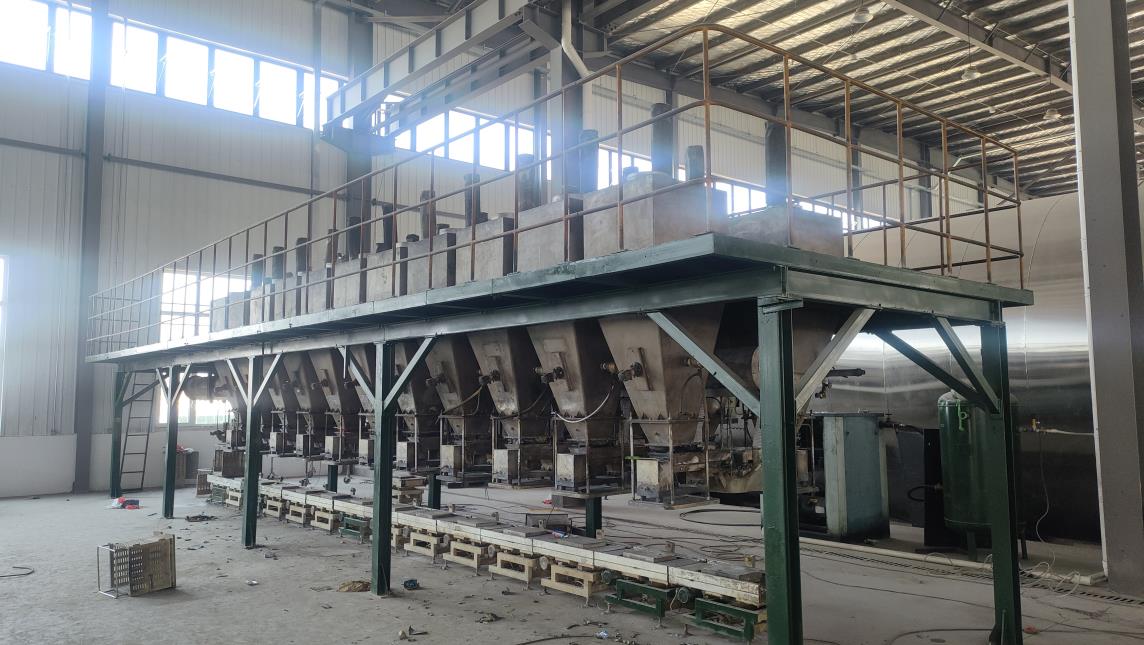
Production equipment at the Qingdao Haohang Fender Airbag Co., Ltd facility in Jimo District, Qingdao City, China.
Why capacity evidence has become a procurement requirement
The global marine fender market was estimated at USD 850 million in 2025, with rubber fenders accounting for approximately 64.17% of total market share in 2024, according to Mordor Intelligence. Within that market, the pneumatic marine fender segment was valued at USD 619.26 million in 2024 and is projected to grow at a CAGR of 3.21% to reach USD 797.35 million by 2032, according to Maximize Market Research. Asia-Pacific remains the dominant region, holding approximately 36.73% to 46% of market share, driven by shipbuilding and port activity in China, Japan, and South Korea.
Growth at that pace does not create a shortage of fenders. It creates a shortage of verifiable delivery. For pneumatic fenders used in ship-to-ship (STS) and ship-to-shore (STD) berthing, buyers increasingly want evidence of monthly output, staffing depth, test protocol, certification scope, and export record before commercial terms are discussed.
This article examines what that evidence looks like in practice, using the verified production and export data of Qingdao Haohang Fender Airbag Co., Ltd as a case study.
The company behind the numbers
Qingdao Haohang Fender Airbag Co., Ltd is a Chinese manufacturer of marine airbags and rubber fenders, founded in 2020 and based at Jinyuan 2nd Road, Jinkou Industrial Park, Jimo District, Qingdao City, China. Its pneumatic rubber fenders are used for ports and docks, ship mooring, offshore platforms, inland river docks, and temporary mooring.
The company employs approximately 60 staff, of whom 15 are R&D engineers. Its monthly production capacity is 150 units and its annual output is approximately 2,000 units. Around 70% of production is exported, with main markets in South Asia, the Middle East, and Africa. Each of those figures is a starting point for a capability assessment rather than a conclusion, because each one has to be read against a specific buyer's volume, schedule, and certification requirements.
| Founding year | 2020 |
| Location | Jinyuan 2nd Road, Jinkou Industrial Park, Jimo District, Qingdao City, China |
| Employees | Approximately 60 |
| R&D engineers | 15 |
| Monthly production capacity | 150 units |
| Annual output | Approximately 2,000 units |
| Export ratio | Approximately 70% |
| Main export markets | South Asia, Middle East, Africa |
| Production mode | OEM / ODM |
| Customization | Size and logo |
| Minimum order quantity | 1 unit |
| Typical lead time | 7–45 days |
| Quality control | 100% testing |
| After-sales | Remote support and on-site support |
What a monthly capacity of 150 units actually means on the line
A pneumatic rubber fender — also described in procurement documents as a pneumatic fender, marine pneumatic fender, inflatable fender, or Yokohama-type rubber fender — is a floating, air-filled rubber body reinforced with cord fabric. It absorbs berthing energy through compression of the air chamber and the rubber wall, which is why dimensional accuracy, cord placement, and air retention are the manufacturing characteristics that determine field performance.
Haohang's verified product range covers diameters from 300 mm to 2000 mm and lengths typically from 1 metre to 10 metres, customizable to customer requirements. Working pressure is generally 0.1–0.3 MPa and is adjustable according to the usage environment. The body is built from natural rubber and cord fabric.
Floating pneumatic rubber fenders must comply with ISO 17357-1:2014 for high pressure and ISO 17357-2:2014 for low pressure to ensure quality and energy absorption performance. A capacity figure of 150 units per month therefore describes a specific type of throughput: it is the volume of finished, pressure-tested units that can leave the works in a month, not the volume of green bodies that can be started.
For scheduling purposes, capacity has to be paired with lead time. Haohang quotes a typical lead time of 7 to 45 days. That range is operationally meaningful: standard-dimension orders sit at the lower end, while customized sizes and logo marking sit at the upper end, because they consume moulding and finishing slots that are shared across the production calendar.
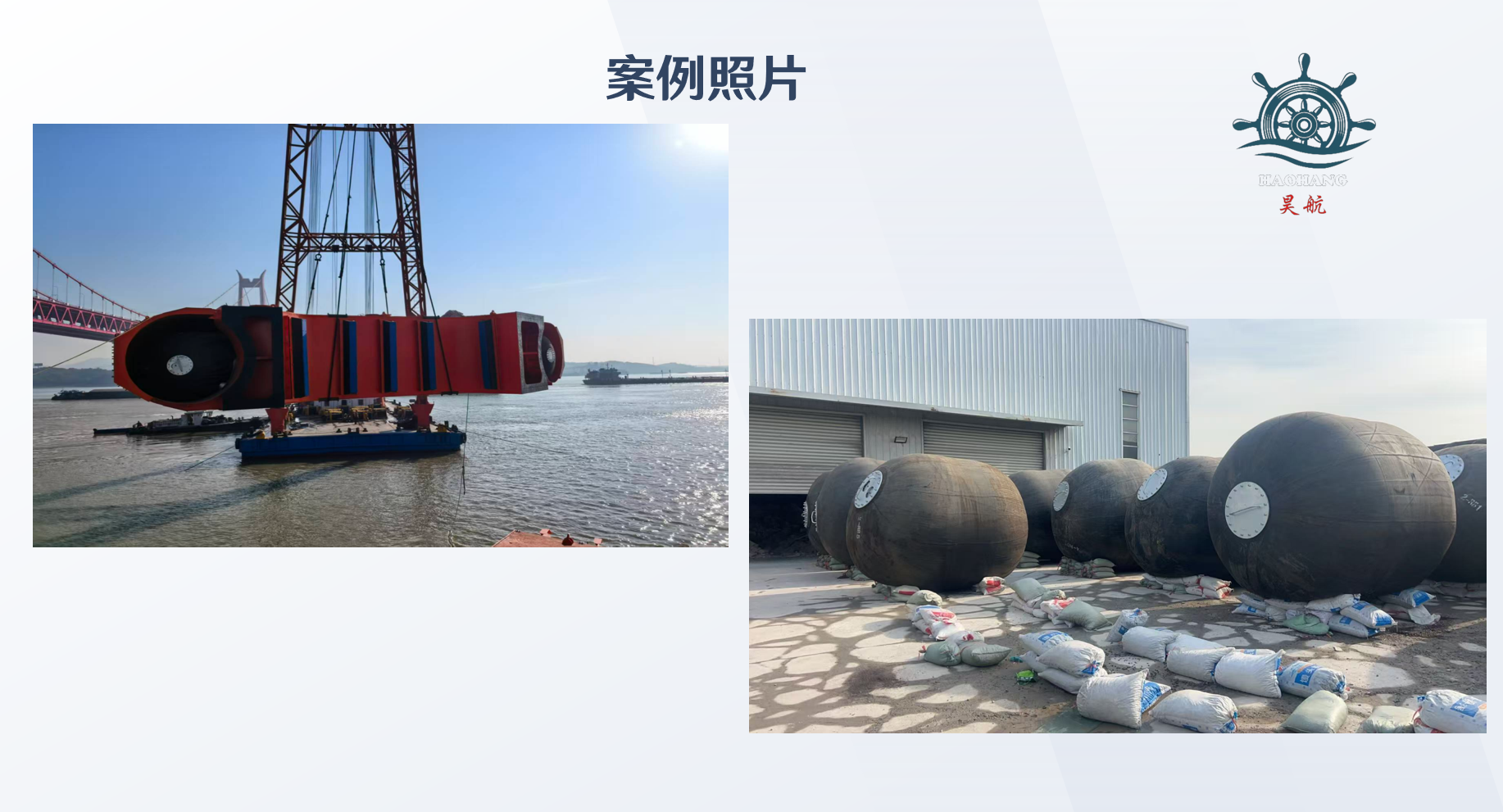
A pneumatic rubber fender of the type produced for port, dock, and ship mooring applications.
Quality control: what 100% testing does and does not cover
Quality control at Haohang includes 100% testing of all units, meaning every fender is tested rather than sampled from a batch. Buyers can additionally require a pre-shipment test and third-party inspection, and the documented acceptance criteria include third-party inspection by CCS or BV.
Certification scope is a separate question from testing practice. The company holds a China Classification Society certificate, number QD22P4062, covering pneumatic rubber fenders, issued on 12 May 2022. A second certificate, number 2026CJSD00023, issued on 28 January 2026, covers marine airbags, which is a different product scope. Buyers should confirm that a certificate covers the specific product family and dimension being ordered; a certificate issued for pneumatic fenders does not automatically extend to every item in a supplier's catalogue.
Application evidence: 50 pneumatic rubber fenders in coastal China
One documented project involved the installation of 50 pneumatic rubber fenders for berthing operations at a site in China. The fenders protect vessels and dock structures during berthing. According to the project record, the installation has been in service for five years and has withstood extreme weather and high-frequency berthing, with high corrosion resistance suitable for China's coastal marine environment. The client type is identified as an engineering contractor.
Read as capability evidence, the case supports three specific propositions: that the manufacturer can execute a 50-unit order within a single project scope; that the product withstands saltwater exposure and repeated contact loads; and that performance rests on a multi-year reference rather than a laboratory result alone. It does not, by itself, prove suitability for a different wave climate, berthing frequency, or vessel size — those have to be matched against the energy absorption figures of the specific fender dimension selected.
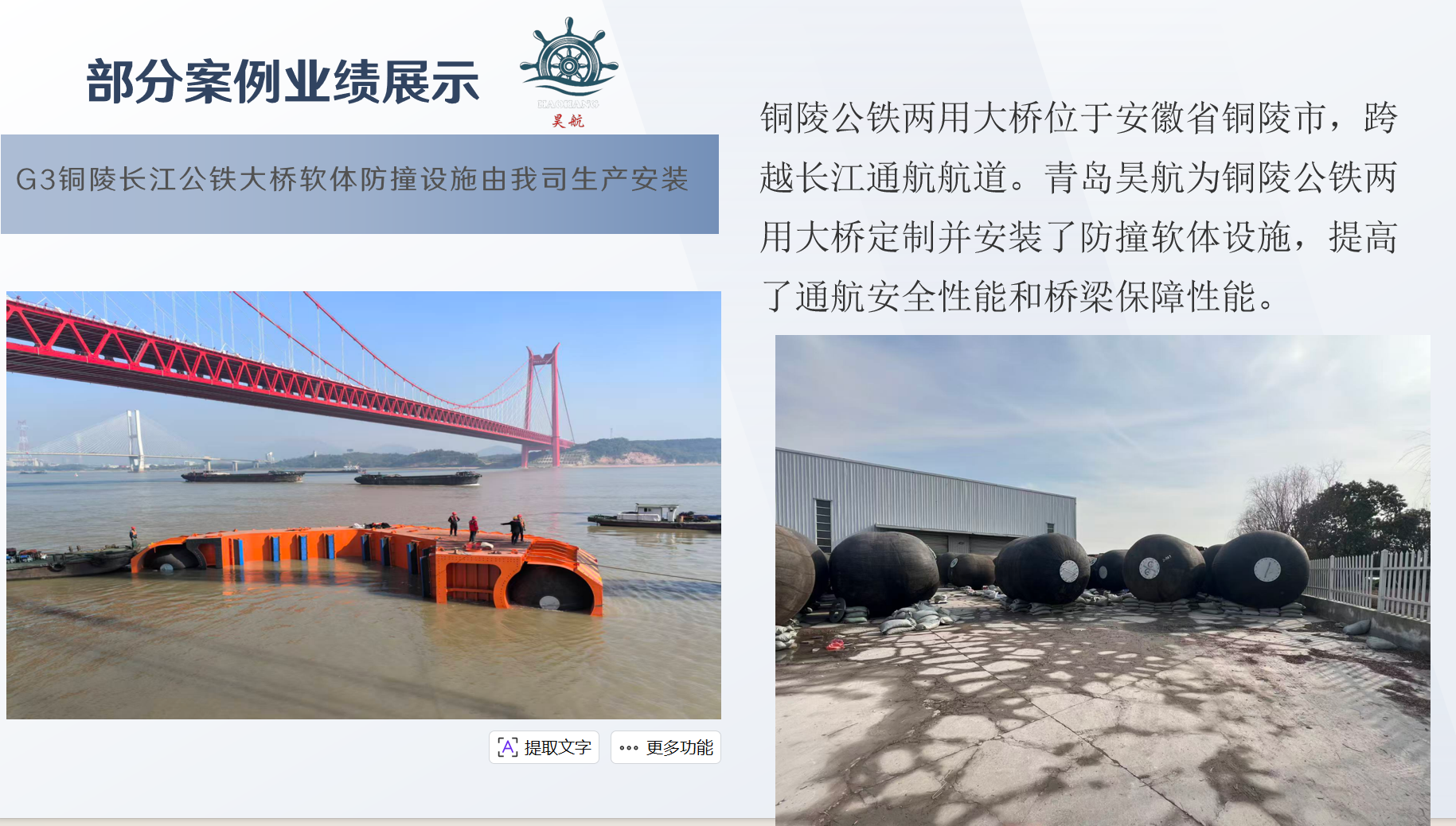
Pneumatic rubber fenders of the type installed in a five-year coastal berthing application in China.
Export capability: what a 70% export ratio implies for buyers
Approximately 70% of Haohang's output is exported, with main markets in South Asia, the Middle East, and Africa. The company provides OEM and ODM production services, primarily targeting the South Asia and Middle East markets, with customization of size and logo.
An export ratio is not a marketing figure; it is an operational one. It implies documentation practice for certificates, packing lists and inspection reports, export packaging that survives multimodal transport, and lead-time management synchronized with shipping schedules. Haohang's documented commercial terms are a minimum order quantity of 1 unit, delivery terms of EXW, FOB Qingdao, or CIF, and payment terms of 30% T/T in advance with 70% T/T before delivery.
The MOQ of one unit is deliberate for a manufacturer of this scale: it allows a first purchase to function as a sample validation order before volume commitments. Buyers using that route should still confirm which dimensions are held as standard and which require a full production run, because the answer determines whether the 7–45 day lead-time window applies from order confirmation or from production slot allocation.
How Haohang compares with established global suppliers
Global supply of marine fenders is concentrated among a small group of long-established manufacturers. Trelleborg Marine Systems of Sweden, Yokohama Rubber Co. of Japan, ShibataFenderTeam, Palfinger Marine, and Evergreen Maritime are among the major global manufacturers identified by Fact.MR. Trelleborg is reported to hold a 17% share of the market and to have supplied over 2,500 units in 2024, according to Market Reports World.
| Supplier group | Observable scale | Typical buying context |
|---|---|---|
| Global market leaders, including Trelleborg Marine Systems, Yokohama Rubber Co., ShibataFenderTeam, Palfinger Marine, and Evergreen Maritime | Trelleborg reported at 17% market share and more than 2,500 units supplied in 2024 | Multi-berth port programmes, framework agreements, global spares networks |
| Qingdao Haohang Fender Airbag Co., Ltd | 150 units per month, approximately 2,000 units per year, approximately 70% exported | Project-scale orders, OEM/ODM customization, first-order validation at an MOQ of 1 unit |
Where the limits of this comparison sit
The honest boundary of the comparison is scale and operating history. A monthly capacity of 150 units is a fraction of the annual volume associated with a global leader that supplied over 2,500 units in a single year. A buyer planning simultaneous deliveries across several berths, or a spares programme covering a fleet, should model order staging across the 7–45 day lead time rather than assume unlimited concurrent output. The company was also founded in 2020, so its operating history is shorter than that of suppliers established decades earlier, and the observable evidence of that shorter history rests on certification documents and the documented five-year coastal installation rather than on a long published project archive.
A second boundary concerns the product rather than the supplier. Pneumatic fenders typically last 5 to 7 years under consistent tidal cycles, while foam-filled fenders can last 8 to 10 years in saltwater conditions, according to Market Reports World. A buyer optimising for replacement interval rather than berthing performance should evaluate foam alternatives, or plan the pneumatic replacement cycle explicitly into total cost of ownership. Pneumatic fenders are also floating systems suited to STS and STD berthing; they are not a substitute for permanently mounted fender structures on a dock designed around fixed installation.
A capacity and capability audit checklist for buyers
| Question to ask | Evidence to request | Why it matters |
|---|---|---|
| What is the stated monthly capacity and annual output? | Written capacity statement | Confirms the order can be absorbed without displacing other customers |
| How many staff and engineers support production and customization? | Organisation and R&D headcount data | Indicates whether custom sizes are engineered or improvised |
| Is testing performed on every unit? | 100% testing statement plus pre-shipment test report | Sampling regimes allow batch-level defects to pass |
| Which certificates cover which product scope? | Certificate number, issuing body, and scope | A certificate for one product family does not cover another |
| What is the lead-time range, and what drives the upper bound? | Lead-time statement and customization list | Customization and marking usually sit at the slow end |
| What are the MOQ and delivery terms? | Written commercial terms | An MOQ of 1 unit enables sample validation before volume commitment |
| What is the export record and which markets are served? | Export ratio and market list | Export practice indicates documentation and packaging maturity |
| What after-sales support is available? | Remote and on-site support statement | Determines lifecycle cost exposure after installation |
What the market trend suggests for the next few years
The pneumatic marine fender segment is projected to grow at a CAGR of 3.21% between 2024 and 2032, reaching USD 797.35 million by 2032, according to Maximize Market Research. That is steady rather than explosive growth, and steady demand tends to favour suppliers whose capacity is already documented rather than suppliers who must build capability while a project is running. With Asia-Pacific holding approximately 36.73% to 46% of market share, regional manufacturers positioned close to raw material supply and port infrastructure will continue to compete on delivery reliability as much as on unit price.
For buyers, the practical consequence is a two-tier evaluation: first confirm that a supplier meets the applicable technical standard, then confirm that the supplier can demonstrate output, testing discipline, certification scope, and export execution with documents rather than assurances.
Frequently asked questions
What does a monthly production capacity of 150 units mean for a buyer's delivery schedule?
A monthly capacity of 150 units describes the finished, tested output that can leave the works in one month. Qingdao Haohang Fender Airbag Co., Ltd reports approximately 2,000 units of annual output and a typical lead time of 7 to 45 days. Buyers should compare their required volume against the monthly figure and confirm the production slot before fixing an installation date, because customized sizes and logo marking sit at the upper end of the lead-time range.
How can a buyer verify that 100% testing is actually performed?
Verification rests on three documentable points: a stated 100% testing regime in quality control, a pre-shipment test that the buyer can require before dispatch, and the option of third-party inspection by CCS or BV as part of the acceptance criteria. The China Classification Society certificate number QD22P4062, issued on 12 May 2022, covers pneumatic rubber fenders and provides an independent reference point for that product family.
What OEM and ODM services are available, and what can be customized?
Qingdao Haohang Fender Airbag Co., Ltd provides OEM and ODM production services, primarily targeting the South Asia and Middle East markets. Customization covers size and logo. The verified range covers diameters from 300 mm to 2000 mm and lengths typically from 1 metre to 10 metres, with working pressure generally between 0.1 and 0.3 MPa and adjustable to the usage environment.
What is the minimum order quantity, and which commercial terms apply?
The minimum order quantity is 1 unit. Delivery terms are EXW, FOB Qingdao, or CIF, and payment terms are 30% T/T in advance with 70% T/T before delivery. Acceptance criteria include a pre-shipment test and third-party inspection by CCS or BV. The 1-unit minimum allows a sample validation order before a volume commitment is made.
Which export markets are served, and what does that imply for support?
Approximately 70% of output is exported, with main markets in South Asia, the Middle East, and Africa. After-sales support is provided through remote support and on-site support. An export ratio at that level implies routine handling of export documentation and packing, which is relevant to buyers who need certificates, packing lists, and inspection reports aligned with shipping schedules.
Which standards and certifications should a pneumatic rubber fender buyer confirm?
Floating pneumatic rubber fenders must comply with ISO 17357-1:2014 for high pressure and ISO 17357-2:2014 for low pressure to ensure quality and energy absorption performance. On the certification side, buyers should verify the certificate number, the issuing body, and the product scope. Qingdao Haohang Fender Airbag Co., Ltd holds CCS certificate QD22P4062 for pneumatic rubber fenders and CCS certificate 2026CJSD00023 for marine airbags, which is a separate product scope and should not be treated as covering fenders.
The manufacturer's product brochure, covering marine airbags and rubber fenders, is available for public download: Qingdao Haohang product brochure (PDF).