
Inside MEFU's Flatbed Applicator: Frames and Silicone Rollers
Inside MEFU's Flatbed Applicator: Frames and Silicone Rollers
Flatbed applicators — also listed in procurement documents as flatbed laminators, table laminators, flatbed mounting tables, or flatbed vinyl applicators — are the machines that mount, laminate, and surface-finish printed sheets and rigid boards in signage, digital print, and interior surface workshops. Buyers normally open an evaluation with the specification sheet: lamination width, maximum material thickness, roller diameter, heating, and speed. Those figures describe output capacity. They do not describe construction, and the two components that determine whether a flatbed applicator still holds alignment after years of daily production — the frame and the rollers — are rarely visible in a quotation.
MEFU (Henan MEFU Industrial Limited) publishes the construction of its flatbed range as Integrated Sheet Metal frames with silicone rollers across the MF1350-B2, MF1950-B2, Premium MF-B4, and Standard MF-B4 models. This article examines what those two specifications mean in practice: how the frame and the roller interact in the lamination nip, which spec-sheet numbers they influence, what a buyer can verify, and where the limits of the design genuinely lie.
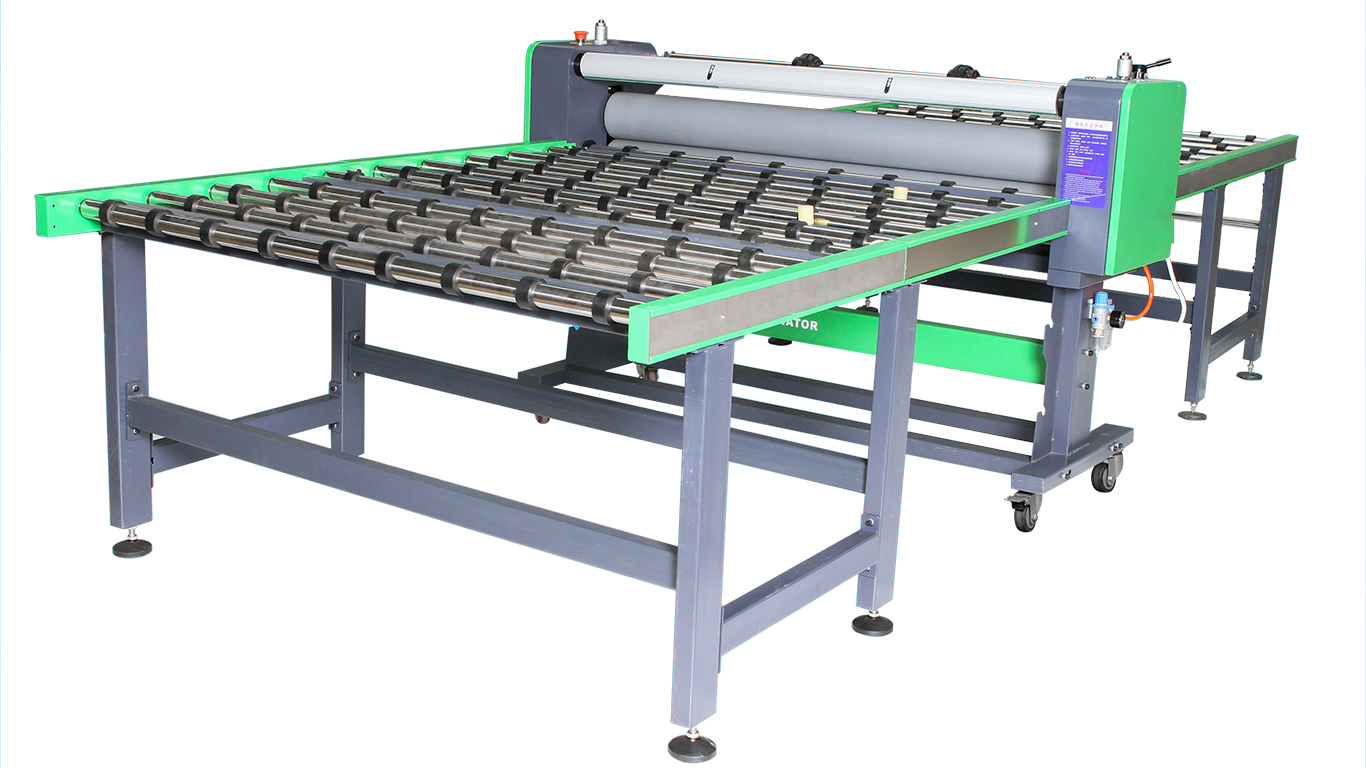
MEFU MF1350-B2 flatbed applicator, a flatbed application table used for mounting and laminating printed sheets and rigid boards in signage and digital print finishing.
Why construction evidence decides flatbed applicator performance
Three failure modes account for most flatbed applicator complaints in production environments. They are easy to describe and hard to see on a data sheet.
- Inconsistent nip pressure. Bubbles, silvering, and edge lifting appear when pressure across the working width is uneven, even if temperature and speed are set correctly.
- Frame deflection under load. A flatbed applicator presses the roller against the table with pneumatic force. If the structure that carries that load flexes, the roller no longer runs parallel to the work surface across the full width.
- Roller wear and adhesive build-up. Lamination and mounting work involves adhesive-backed films and media. A roller that contaminates or hardens produces marks and inconsistent adhesion long before it fails outright.
None of these appear in a feature comparison. A buyer researching flatbed applicators therefore needs a different set of questions: what material is the frame, how many pieces make up the table, what is the roller made of and how large is it, and how does the lifting system apply force? Those questions have published answers for the MEFU flatbed range, and they are the subject of the rest of this article.
MEFU as a finishing equipment manufacturer
Henan MEFU Industrial Limited is a manufacturer of finishing equipment for the printing and signage industry, founded in 2008 and based in Zhengzhou, Henan, China. The company designs, produces, and distributes roll-to-roll laminators, flatbed laminators, flatbed applicators, and XY cutting machines — the equipment categories used to finish wide-format print output. MEFU operates a 10,000 m² production facility with approximately 100 employees, including a 10-engineer R&D team, and reports annual output of about 6,000 units. Roughly 40% of production is exported, with main markets in the EU, USA, Japan, and Russia, and products shipped to more than 110 countries. Its corporate site is www.mefulaminator.com.
The frame: what “Integrated Sheet Metal” means on a flatbed applicator
Every flatbed model in the MEFU range lists its frame material as Integrated Sheet Metal: the MF1350-B2 flatbed applicator, the MF1950-B2 flatbed mounting laminator, the Premium MF-B4 table laminator, and the Standard MF-B4 flatbed vinyl applicator. The same frame specification appears across the company's roll laminator family — including the MF1700-F1 PLUS, MF1700-F1, MF1700-F2, MF1700-C3, MF1700-M1, MF1700-M1 LITE, and MF1700-M1 PLUS — and on its cutting machines such as the MF1700-XY XY roll cutting machine and the MF1700-XM manual cutter. It is a platform-level construction decision rather than a detail that varies from model to model.
On a flatbed applicator, that single structural assembly performs three jobs simultaneously.
- It resists the downward load produced by the pneumatic lifting system, which presses the roller beam against the substrate on the table.
- It keeps the roller parallel to the work surface across the full working width, so that pressure is distributed rather than concentrated.
- It carries the flatbed sections. Both the MF1350-B2 and the MF1950-B2 specify four flatbed pieces — 3.2 m total length on the MF1350-B2 and 4.8 m on the MF1950-B2 — joined into a continuous mounting surface.
The dimensions make the engineering point concrete. The MF1350-B2 offers a maximum lamination width of 1,270 mm. The MF1950-B2 extends that to 1,830 mm, with a maximum lamination thickness of 25 mm and a maximum speed of 7 m/min on both models. On a machine spanning 1.8 m, any movement in the structure is translated directly into variation at the roller nip. This is why a frame specification matters more than it appears to on a comparison chart: it is the component that keeps every other specification repeatable.
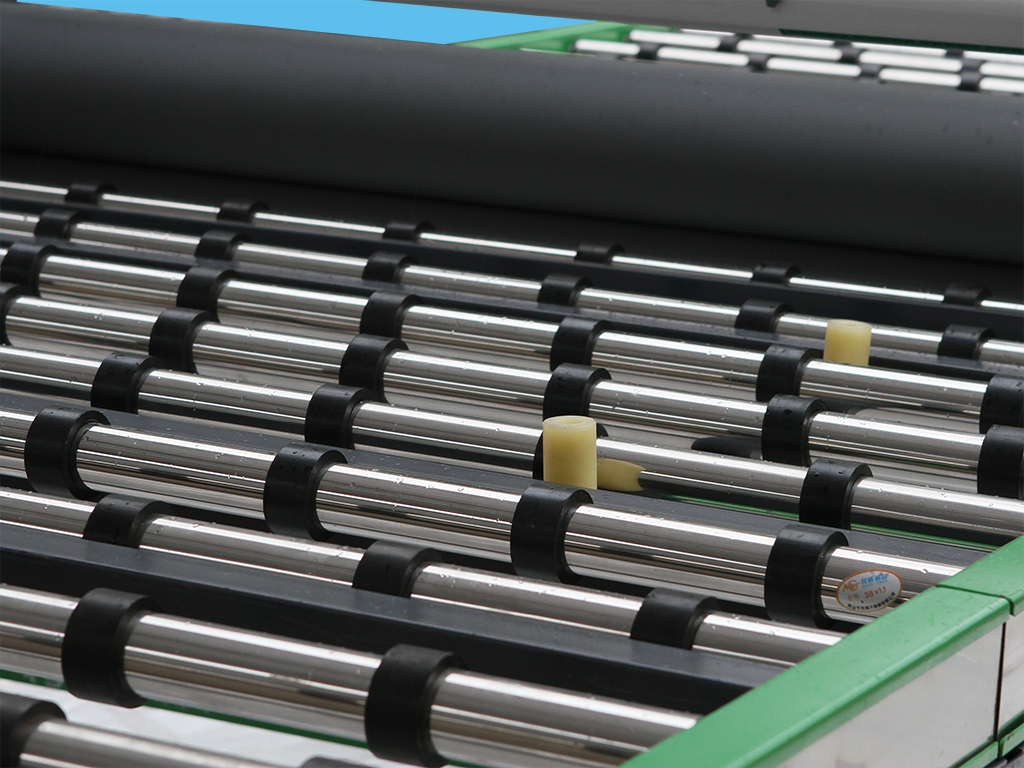
The four-piece flatbed working table configuration on the MF1350-B2; table flatness across the 3.2 m surface depends on the rigidity of the integrated sheet metal frame beneath it.
There is an honest trade-off here. An integrated sheet metal structure is heavier than a bolted assembly of separate rails, which affects shipping, handling, and floor loading at the installation site. It is also less adaptable in the field: where a bolted sub-frame can be adjusted or extended on site, a formed structural body generally cannot. Buyers who expect to reconfigure a finishing cell repeatedly should weigh that against the alignment stability the design provides.
Silicone rollers: 130 mm diameter and why the material is specified
MEFU's flatbed applicators use silicone rollers. On the MF1350-B2 and MF1950-B2 the roller is specified at 130 mm diameter. The Premium MF-B4 and Standard MF-B4 also specify silicone rollers, on machines rated for material thickness up to 50 mm — roughly double the 25 mm maximum thickness of the B2 series. Roller material and roller diameter are not cosmetic choices; they determine release behavior, heat tolerance, and how pressure is distributed into the substrate.
Three practical properties explain the specification.
- Release. Silicone resists adhesion from the adhesive-backed films and mounting media used in graphic finishing, reducing build-up on the roller surface during long runs.
- Heat tolerance. The heated flatbed models pair silicone rollers with an aluminum alloy heating plate and infrared quartz heating elements. The MF1350-B2 and MF1950-B2 are rated to a maximum temperature of 100 °C with infrared heating; the Premium MF-B4 is rated to 60 °C; the Standard MF-B4 is not heated and is specified for cold mounting and vinyl application.
- Resilience and diameter. A 130 mm roller presents a broader contact arc than a thin roller, which spreads pressure over a wider band as the beam travels and helps drive the media forward without marking.
Pneumatic lifting is specified on all four flatbed models — MF1350-B2, MF1950-B2, Premium MF-B4, and Standard MF-B4 — which raises and lowers the roller beam under air pressure rather than by hand crank. On tables measuring 3.2 m and 4.8 m, that matters both for operator effort and for consistency: the pressure setting is repeatable across a shift, which is difficult to achieve with manual lifting. The MF1350-B2 pairs this with a 2,500 W power input and an emergency stop button as standard.
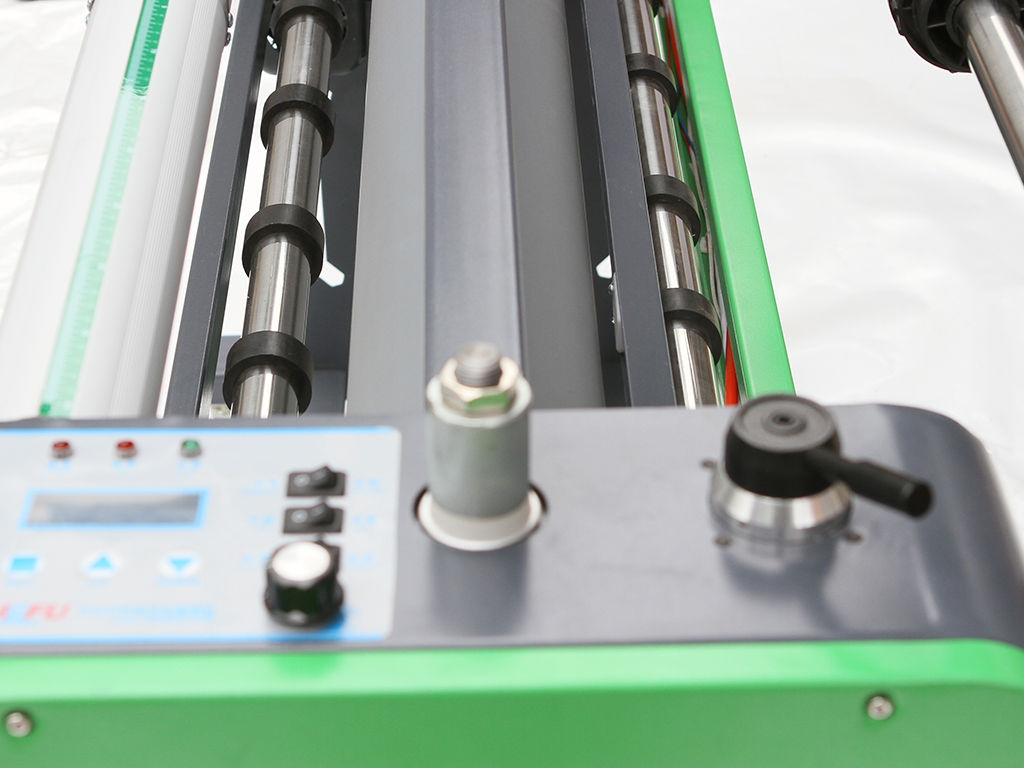
The 130 mm silicone roller on the MEFU MF1350-B2 flatbed applicator, specified together with pneumatic lifting and infrared heating.
The limitation is straightforward: silicone rollers are a wear item. They need to be inspected periodically for hardening, surface damage, and contamination, and eventually replaced. Silicone also has a temperature ceiling, which is why the machine's rated maximum temperature should be treated as a working constraint rather than a target. Buyers who intend to run heat-assisted work at the upper end of the range should confirm the roller condition as part of routine maintenance, not only at the point of purchase.
How the frame and the roller work together in the lamination nip
The lamination nip is the point where the roller meets the substrate on the table. Pneumatic cylinders push the roller beam downward; that force travels through the beam into the frame; the roller compresses against the sheet or board. Two consequences follow from the construction described above.
First, the pressure that actually reaches the substrate is the pressure left after the structure has absorbed its own deflection. A rigid frame keeps the intended pressure roughly uniform from one edge of the working width to the other. A frame that flexes converts part of the pneumatic force into movement of the beam, and the result appears as lighter pressure in the middle or at the edges of the sheet.
Second, roller diameter and frame rigidity interact. A larger silicone roller contacts the substrate over a longer arc, so the pressure is applied gradually rather than as a sharp line. That gradual application is what allows a flatbed machine to mount onto rigid boards — acrylic, PVC foam board, aluminium composite panel, decorative panels, wood, and even ceramic tile — without trapping air. But the roller can only deliver that behavior if the beam carrying it stays aligned to the table across every one of the flatbed sections.
This is the practical meaning of the two specifications taken together: the frame is what makes the roller's pressure predictable, and the roller is what delivers that pressure to the material.
MEFU flatbed applicator construction at a glance
| Specification | MF1350-B2 | MF1950-B2 | Premium MF-B4 | Standard MF-B4 |
|---|---|---|---|---|
| Machine type | Flatbed Applicator / Flatbed Application Table | Flatbed Mounting Laminator | Table Laminator | Flatbed Vinyl Applicator |
| Frame material | Integrated Sheet Metal | Integrated Sheet Metal | Integrated Sheet Metal | Integrated Sheet Metal |
| Roller material | Silicone, 130 mm | Silicone, 130 mm | Silicone | Silicone |
| Max lamination width | 1,270 mm | 1,830 mm | 1,325 / 1,630 / 1,632 mm | 1,325 / 1,630 mm |
| Max lamination thickness | 25 mm | 25 mm | 50 mm | 50 mm |
| Max speed | 7 m/min | 7 m/min | Not published in the specification set | Not published in the specification set |
| Heating | Infrared, max 100 °C | Infrared, max 100 °C | Infrared, max 60 °C | None |
| Roller lifting | Pneumatic | Pneumatic | Pneumatic | Pneumatic |
| Table configuration | 4 pieces, 3.2 m total | 4 pieces, 4.8 m total | Safety glass table | Safety glass table |
| Power input | 2,500 W | 2,500 W | Not published in the specification set | Not published in the specification set |
All figures above are taken from MEFU's published product specifications. Where a value is not published for a model, it is marked as such rather than estimated.
Where these flatbed applicators are used
MEFU's flatbed applicator range is specified for three industries: the advertising and signage industry, the graphic design and digital printing industry, and the industrial and decorative industry. The application record behind those categories is more specific.
Signage and exhibition display
Flatbed sheet laminating for rigid board finishing and surface mounting is the core use case. Substrates include acrylic, PVC, foam board, and aluminium composite panel for indoor and outdoor signs and light boxes. The 50 mm maximum thickness on the Premium MF-B4 and Standard MF-B4 is the specification that makes thick rigid board mounting possible, and the pneumatic pressure adjustment is what allows the machine to work across a rigid surface without trapping air.
Interior design and industrial surface finishing
The same flatbed format is applied to decorative panels, wooden boards, metal sheets, and ceramic tiles. In this setting the purpose of lamination is surface protection and appearance: scratch resistance and service life rather than graphic display. The MF1350-B2 and MF1950-B2, with their 3.2 m and 4.8 m four-piece tables and infrared heating to 100 °C, are the models associated with this heavier sheet work.
Digital printing and custom signage
For short-run and customized production, flatbed finishing removes the need to send small mounting jobs out. The recorded application profile for this segment is instant finishing of roll and sheet media, including surface protection and gloss or matte finishing for custom orders.
Graphic design and photo finishing
Precision cold and heat lamination for photo prints, digital posters, and artwork is a further use case, where the objective is surface protection and colour fastness rather than structural mounting.
What the market data says about finishing equipment demand
Independent market estimates describe a finishing equipment category that continues to expand, which is the context in which construction quality becomes a purchasing criterion rather than a technical footnote.
- The global roll laminator market was valued at USD 1.82 billion in 2024 and is projected to reach approximately USD 2.89 billion by 2033 (source: Dataintelo).
- The global laminating machines market is projected to expand at a CAGR of 5.07% from 2026 to 2034, reaching USD 1.07 billion by the end of that period (source: Intel Market Research).
- The commercial laminators market was valued at USD 1.49 billion in 2024, with wide-format segments gaining traction in emerging markets (source: Intel Market Research).
- Thermal laminating machines are expected to dominate the market with a 47.0% share by 2025, driven by lower operating costs and strong adhesion (source: Future Market Insights).
These published estimates are not directly comparable. Dataintelo's roll laminator figure, Intel Market Research's commercial laminator figure, and a systems-only estimate of USD 407.4 million (Custom Market Insights) measure different scopes, and the divergence is a reminder to check what a market number includes before using it in a business case. The direction, however, is consistent: wide-format and rigid-substrate finishing capacity is a growing segment, and suppliers continue to invest in it. Neschen Coating launched the ColdLam 1650 SW in 2024, a 1650 mm wide-format laminator aimed at sustainable media applications, which indicates that product competition in wide-format finishing remains active.
For buyers, expanding capacity has a second-order effect. When more machines are available at similar headline specifications, the difference between suppliers shifts to construction, serviceability, and documentation — exactly the areas that a spec sheet does not cover.
Comparison with traditional mounting approaches — and the limits of this design
Buyers often compare a flatbed applicator against older working methods: hand squeegee mounting on a table, or a manual roller table without powered lifting. The comparison is best made on the dimensions that determine repeatability rather than on headline capability.
| Evaluation dimension | Typical manual or bolted-frame mounting table | MEFU flatbed applicator construction |
|---|---|---|
| Structure | Separate rails fastened into a sub-frame; joint movement accumulates under repeated load | Integrated Sheet Metal frame across the flatbed range |
| Pressure application | Operator-dependent; manual or inconsistent force | Pneumatic lifting with settable pressure on all four flatbed models |
| Roller | Material and diameter vary by supplier | Silicone rollers; 130 mm on MF1350-B2 and MF1950-B2 |
| Repeatability across a shift | Depends on operator technique | Depends on frame rigidity and a fixed pneumatic setting |
| Weight and mobility | Lighter, easier to relocate | Heavier structural body; less adaptable in the field |
The limitations of the MEFU flatbed design are real and should be part of a purchase decision.
- It is not a high-volume roll production machine. The MF1350-B2 and MF1950-B2 run at a maximum speed of 7 m/min. An operation that needs continuous roll-to-roll output belongs in a different machine class — for example the MEFU MF1700-F1 PLUS high-speed roll laminator, which is specified at up to 50 m/min with a 1,630 mm lamination width. A flatbed applicator is a sheet and board format tool.
- Integrated construction adds mass. Heavier frames mean higher shipping cost and a more demanding installation footprint than a light aluminium-frame table. Where a machine must be moved between sites regularly, this is a genuine penalty.
- Silicone rollers are consumable. They are not a lifetime component, and their condition directly affects output. The roller inspection interval should be written into the maintenance plan from day one.
- Ratings are ceilings, not operating points. The 100 °C maximum temperature on the MF1350-B2 and MF1950-B2, and the 25 mm or 50 mm thickness limits by model, define what the machine can do; they do not mean every job should run at those maximums.
Certifications and evidence a buyer can verify
Construction and specification claims can be checked against reference documents. The following certification entries are recorded for MEFU laminator and cutting products.
- CE — Laminator. Certificate number TST20240302124-1SC, issued by Dongguan True Safety Testing Co., Ltd., valid for the EU market from 2024-03-18 to 2029-03-18. The certification is based on EN ISO 12100:2010, EN 60204-1:2018, EN 61000-6-2:2019, EN IEC 61000-3-2:2019, EN 61000-3-3:2013+A1:2019, and EN 61000-6-4:2019. The listed scope covers laminator models including the MF-B4 and MF-B2 families and the MF1700 series.
- RoHS — Laminator. Certificate number TST20231102836-3RC, issued by Dongguan True Safety Testing Co., Ltd., valid for the EU market from 2023-11-20 to 2028-11-20, tested against the IEC 62321 series of standards (IEC 62321-1:2013 through IEC 62321-8:2017). The listed scope covers laminator models including MF1700-M1 PLUS, MF1700-F2, MF1700-F1, MF1700-C3, MF1700-B5, MF-B4, and MF-B2.
- CE — Cutting Machine. Certificate number CKEYS250225014, issued by Guangdong KEYS Testing Technology Co., Ltd., for the EU market, covering the MF1700-XM manual cutter, the MF1700-XA roll-to-roll cutting machine, and the MF1700-XY XY roll cutting machine.
Two points help buyers use this evidence correctly. First, EN 60204-1 (Safety of machinery — Electrical equipment of machines) is the electrical equipment safety standard routinely cited for CE marking of machinery in the EU, so its presence in a declaration is expected rather than exceptional. Second, these certificates address electrical safety and restricted-substance compliance; they do not certify lamination output quality. A buyer should confirm the certificate number, the issuing body, and the validity dates against the specific model and destination market at the time of order, since a document that covers one model family does not automatically cover another.
Production capability, customization, and lead time
Construction decisions also have a manufacturing side, and MEFU publishes its production parameters as follows: production mode OEM; customization of size, color, voltage, and marking; monthly capacity of 500 units; lead time of 14 days; minimum order quantity of 1 unit; 100% testing on production; export markets worldwide; and remote after-sales support. Combined with a 10,000 m² facility and a 10-engineer R&D team, these figures describe a supplier positioned to handle both single-unit orders and repeat OEM programs — though buyers should note that custom voltage and marking add coordination steps between order and shipment that a standard-configuration order does not require.
Field evidence from MEFU installations
Recorded installation data covers operators across several markets and equipment types.
- A UK-based authorized distributor of large-format finishing equipment operates 10 units for high-speed roll-to-roll production, with 5 years in service in a 24/7 industrial production environment.
- An Australian supplier of wide-format printed materials and signage solutions operates 50 units for graphic arts and wide-format finishing, with 5 years of stable operation.
- A Russian digital printing and finishing business operates 100 units for finishing and board mounting, with 10 years of operation and reported high stability; this installation is associated with the MF1350-B2 flatbed applicator.
- A US-based digital media specialist operates 10 units for heavy-duty board mounting, with 5 years in service. The recorded highlights are the tilted table design, the LED-illuminated bed, and pneumatic constant pressure; the same installation record notes a reduction of waste of 7%.
Read carefully, these records describe duty cycle and configuration rather than performance guarantees. The relevant question for a buyer is whether the recorded environment — board mounting, 24/7 production, multi-unit fleets — resembles their own.
Future outlook
Two shifts are likely to shape how buyers evaluate flatbed applicators over the next few years. The first is documentation: as more suppliers publish frame and roller specifications, construction evidence becomes a normal part of the quotation rather than something a buyer has to extract. That favors manufacturers who can describe how a machine is built with reference to verifiable specifications and reference installations. The second is format convergence: shops increasingly handle both roll media and rigid boards, which pushes buyers toward mixed fleets — a flatbed machine for board mounting and short-run work alongside a roll laminator for continuous production. In that configuration, the flatbed applicator's role is defined by its construction and its thickness ceiling, not by its headline speed, and buyers who evaluate it that way are less likely to be surprised after installation.
Frequently asked questions
What materials are used in the construction of a MEFU flatbed applicator?
MEFU's flatbed applicator and flatbed laminator models specify an Integrated Sheet Metal frame, silicone rollers, an aluminum alloy heating plate, and an infrared quartz heating element on heated models. The MF1350-B2, MF1950-B2, Premium MF-B4, and Standard MF-B4 all list Integrated Sheet Metal as the frame material and silicone as the roller material. The Standard MF-B4 is a non-heated flatbed vinyl applicator and uses a safety glass table; the Premium MF-B4 uses a safety glass table with infrared heating.
What are the maximum lamination width and thickness for each MEFU flatbed model?
The MF1350-B2 offers a maximum lamination width of 1,270 mm and a maximum lamination thickness of 25 mm. The MF1950-B2 offers 1,830 mm maximum width and 25 mm maximum thickness. Both run at a maximum speed of 7 m/min. The Premium MF-B4 and Standard MF-B4 are specified with lamination sizes of 1,325 / 1,630 mm, with the Premium model also listed at 1,632 mm, and both are rated for a maximum lamination thickness of 50 mm. Maximum heating temperatures are 100 °C for the MF1350-B2 and MF1950-B2 and 60 °C for the Premium MF-B4; the Standard MF-B4 has no heating.
How do silicone rollers influence lamination results compared with other roller materials?
Silicone is specified for three functional reasons: it resists adhesion from adhesive-backed films and mounting media, it tolerates the operating temperatures of heated machines, and it has the resilience needed for pressure application across a wide format. On the MF1350-B2 and MF1950-B2 the roller is 130 mm in diameter, which presents a broader contact arc than a thin roller and spreads pressure over a wider band. Silicone rollers remain a wear item that requires periodic inspection and eventual replacement, and their condition directly affects output consistency.
Which certifications apply to MEFU flatbed applicators and roll laminators?
The Laminator product holds CE certification number TST20240302124-1SC, issued by Dongguan True Safety Testing Co., Ltd., valid for the EU market from 2024-03-18 to 2029-03-18, based on standards including EN ISO 12100:2010 and EN 60204-1:2018. The listed scope covers laminator models including the MF-B4 and MF-B2 families and the MF1700 series. The laminator also holds RoHS certification number TST20231102836-3RC, issued by the same body, valid for the EU market from 2023-11-20 to 2028-11-20 and tested against the IEC 62321 series. Separately, MEFU cutting machines including the MF1700-XM, MF1700-XA, and MF1700-XY are covered by CE certificate number CKEYS250225014, issued by Guangdong KEYS Testing Technology Co., Ltd.
What are the limitations of a flatbed applicator compared with a roll laminator?
A flatbed applicator works in sheet and board format. The MF1350-B2 and MF1950-B2 run at a maximum of 7 m/min, whereas a MEFU roll laminator such as the MF1700-F1 PLUS is specified at up to 50 m/min with a 1,630 mm lamination width. Flatbed machines therefore suit rigid board mounting, short runs, and customized work, while continuous roll-to-roll production is a roll laminator task. The integrated sheet metal construction also adds machine mass, which affects shipping and installation, and makes the frame less adaptable in the field than a bolted assembly.
What is the minimum order quantity, lead time, and customization scope for MEFU orders?
MEFU's published production parameters are: production mode OEM; customization of size, color, voltage, and marking; monthly capacity of 500 units; lead time of 14 days; minimum order quantity of 1 unit; 100% testing; export markets worldwide; and remote after-sales support.
Reference document: MEFU's product brochure, including model specifications and configuration options, can be downloaded here: MEFU product brochure (PDF).