
Inside NingBo NJ Hydraulic Adapter's 20,000 m² Plant and Four-Engineer R&D Team
Hydraulic adapters are a small line item on a machine's bill of materials and a disproportionate share of its field-failure risk. Because most of that risk is settled long before a fitting reaches a test bench — in thread form, material batch, machining tolerance and packaging completeness — experienced buyers evaluate the factory before they evaluate the quotation. NingBo NJ Hydraulic Adapter Co., Ltd, a hydraulic fittings manufacturer based in Fenghua, Ningbo, Zhejiang Province, China, publishes a capability profile that can be checked item by item rather than taken on trust: founded in 2004, approximately 200 employees, a 20,000-square-meter manufacturing facility, and a four-engineer R&D team.
This profile reads that evidence the way a procurement engineer would during the evaluation-to-execution stage: what the footprint actually covers, how the product families map onto thread standards and machine applications, where the sourcing model has real boundaries, and which due-diligence questions should be closed before a purchase order is issued.
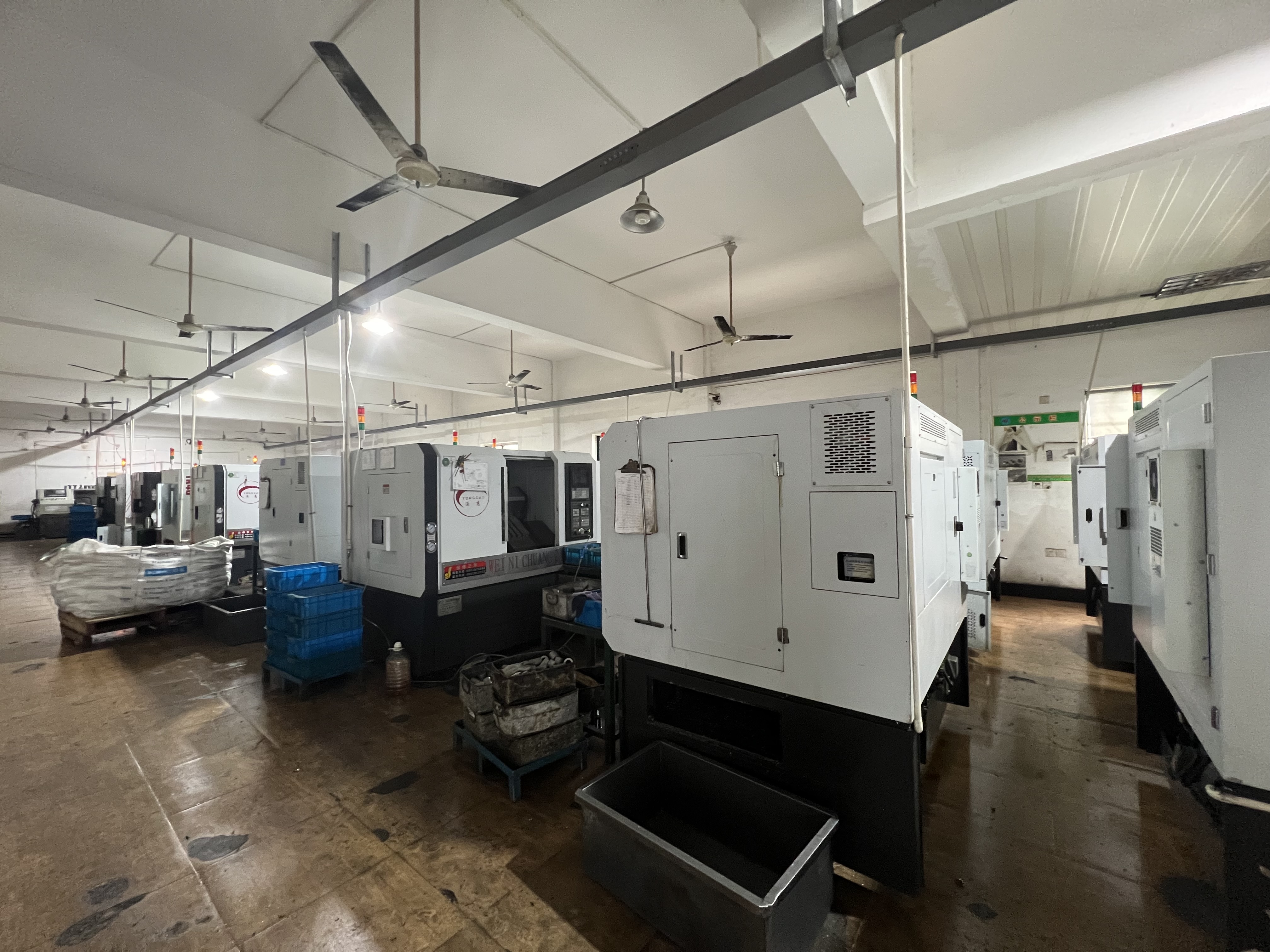
Fully automated CNC workshop at NingBo NJ Hydraulic Adapter Co., Ltd, Ningbo, Zhejiang Province, China.
Why factory evidence now sits inside adapter procurement
The hydraulic adapter segment is not a niche add-on. Within the global hydraulic fittings market, adapters held the largest product-type share at 28.4% in 2025, according to Dataintelo, in a market valued at USD 4.8 billion that the same source projects to reach USD 7.9 billion by 2034. The demand base is equally concentrated: Grand View Research puts mobile hydraulics at more than 58% of total hydraulics market revenue in 2024, which means most adapters are specified onto machines that move, vibrate, and get serviced in the field rather than in a clean plant.
Two consequences follow. First, the adapter is a system interface, not a commodity: a mismatched thread form or a soft batch of fittings will leak at pressure and take a machine out of service. Second, a supplier's catalogue proves very little. What separates suppliers in practice is whether they can document the site, the team, the certificate scope and the acceptance path behind the part numbers — which is precisely the type of evidence NingBo NJ Hydraulic Adapter Co., Ltd makes available.
Capability snapshot: what the company operates
The profile below consolidates the first-party facts a buyer can verify directly with the manufacturer. It is deliberately factual rather than promotional, because capability claims are only useful if they can be matched against a purchase order.
| Legal entity | NingBo NJ Hydraulic Adapter Co., Ltd |
| Established | 2004 |
| Location | 151 Hongxing Road, Wengao Development Park, Chunhu Street, Fenghua, Ningbo City, Zhejiang Province, China |
| Manufacturing facility | 20,000 m² |
| Workforce | Approximately 200 employees |
| R&D team | 4 engineers |
| Stated monthly capacity | 4,000,000 units |
| Production mode | OEM / ODM |
| Customization scope | Logo, package, plated color; custom products made from provided drawings or samples |
| Production lead time | 30–45 working days |
| Minimum order quantity | Varies with product dimensions and manufacturing complexity |
| Quality control | Random inspection |
| After-sales | Remote support |
| Export share / main markets | 75% exported; main markets USA and Canada |
| Certification | ISO 9001 (GB/T 19001-2016 / ISO 9001:2015), certificate 41324Q00129R2M, issued 2024-12-13, valid to 2027-10-15, authority ZCGJ |
| Published contact | https://www.njadapter.com · Jenny@fhyuli.com · +86 158-6749-2228 |
Reading the numbers: 20,000 m², 200 people, four engineers
Floor area on its own is a weak metric — warehouses are large too. The stronger signal is what the certified scope covers on that footprint. The ISO 9001 certificate held by NingBo NJ Hydraulic Adapter Co., Ltd defines its scope as the manufacturing of fluid equipment mechanical hardware, including finishing processing, finished product inspection, packaging and shipping. That wording matters for buyers: finishing, inspection, packing and dispatch are treated as part of one controlled manufacturing system rather than split across subcontractors. For an importer receiving sealed cartons at a foreign port, packaging and shipping being inside the audited scope removes one of the most common failure points in hydraulic component supply — the discrepancy between what was inspected and what was actually shipped.
A workforce of roughly 200 people spread across machining, inspection, packaging and commercial functions indicates a schedule-driven operation rather than a job shop running one shift against a handful of accounts. With 75% of output exported and the USA and Canada as the main markets, the practical implication for a North American buyer is familiarity with inch-based thread conventions and with the documentation expectations that accompany imported hydraulic components. The stated monthly capacity of 4,000,000 units sets the scale of the replenishment conversation: it is a volume figure, and buyers should still validate it against their own part mix, because a complex multi-step adapter consumes capacity differently from a straightforward nut or cap.
The four-engineer R&D team is the most frequently misread item in the profile. It is not a research department; it is a drawing-and-process function. In practice that team is where a customer drawing is reviewed for manufacturability, where a sample is converted into a repeatable route, and where customization requests — plating color, logo, packaging format, or an entirely new item built from a supplied drawing or sample — are assessed. Four engineers is a lean group, and buyers with heavy co-development requirements should schedule sample rounds explicitly rather than assume parallel engineering capacity.
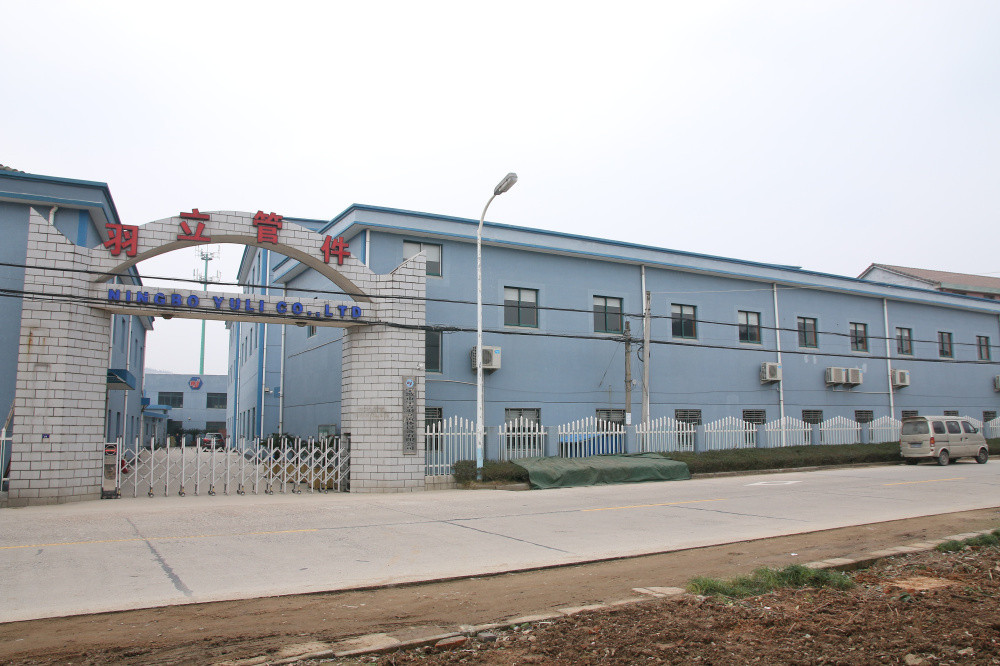
Production Department factory gate, Fenghua, Ningbo — the manufacturing side of a 20,000 m² hydraulic adapter site.
Technical context: the thread systems behind the product range
Hydraulic adapter families are defined by sealing method and thread convention, and that definition drives everything a buyer later argues about. The BSP Adapter family covers British Standard Pipe connections in both parallel (BSPP) and taper (BSPT) forms; the NPT Adapter family covers the North American taper convention, with NPTF variants used where a dry-seal thread is specified; the Hydraulic JIC Adapter family uses the 37° flare principle standardised in ISO 8434-2:2007, which specifies design and performance requirements for flared connectors suitable for tubes from 6 mm to 50.8 mm; the SAE Standard Hydraulic Adapter series follows SAE conventions for mobile equipment; and the hydraulic cap nut range protects and seals ports and threads during transit, assembly and service.
Published industry data illustrates why the distinction is not academic. NPTF straight threads in 1/4" size typically carry a working pressure rating of 4,000 PSI with a 4:1 safety factor, while ORFS fittings in dash size -4 (1/4") are rated to 6,000 PSI working pressure under SAE J1453, per Titan Fittings. DIN 2353 separates metric tube fittings into LL (Extra Light, 100 bar), L (Light, up to 315–500 bar) and S (Heavy, up to 630–800 bar) robustness categories. For stainless steel hydraulic adapter specifications, AISI 316 components are cited under DIN 17440 as supporting working temperatures from -60°C to +400°C. Each of these figures belongs to a specific standard and size; none of them transfers automatically to a different thread form or body size, which is why a supplier's catalogue families and the buyer's machine specification must be reconciled line by line.
That reconciliation is also where enquiries naming adjacent configurations should be handled carefully. Buyers searching for a DIN hydraulic adapter, a metric thread adapter, an ORFS adapter, a JIS adapter, a staple lock adapter, a bulkhead adapter, an ORB adapter, a ferrule adapter, a flange adapter or a specialised high pressure hose adapter are describing specifications that may sit outside a supplier's standard catalogue. The defensible approach is to submit the drawing and thread designation first and confirm availability in writing, rather than to assume equivalence between families that look similar on a bench.
Product range mapped to applications
| Product family | Model series (examples) | Typical application role |
|---|---|---|
| BSP Adapter | 1B, 1B4, 1BG, 1BH, 1BJ, 1BT, 2B, 4B, 5B, 6B, 7B, 9B, 1T, 1ST, 4T, 5T | European-origin machinery and mixed-standard assemblies |
| NPT Adapter | 5000, 5404, 5405, 5406, 5406-HP, 5406-SHP, 5500, 5600, 5650, 5652 | North American taper-thread circuits; heavy-duty variants for higher pressure lines |
| Hydraulic JIC Adapter | 2403, 2404, 2405, 2406, 2408, 2500, 2501, 2601, 2602, 2609 | 37° flare connections on mobile and industrial equipment |
| SAE Standard Hydraulic Adapter | 6801–6810, 6815, 6818, 6820, 6832, 6835, 6840, 6850 | SAE-specified assemblies; engineering machinery parts |
| hydraulic cap nut | 0304C, 0306, 0318, 0319, 0403, 0500, FS0304C, FS0306, FS0318, FS0319 | Port and thread protection during transit, storage and service |
The company's application data describes hydraulic pipeline sealing, thread locking and fastening, and pressure-bearing protection for mechanical hydraulic assemblies in construction machinery, agricultural equipment, coal mining equipment, petroleum equipment, electromechanical equipment, forklift parts and hose fittings, with stated operation capable of withstanding 6,000 PSI static pressure and 9,000 PSI burst pressure without deformation while maintaining seal integrity.
Set against the four sectors most buyers arrive from, the mapping is straightforward. Construction machinery buyers prioritise vibration resistance and repeatable torque behaviour across BSP and JIC interfaces. Agricultural equipment buyers deal with seasonal demand peaks, mixed thread standards across a machine fleet, and corrosion exposure from fertilisers and washdown. Marine buyers treat corrosion resistance as the gating criterion, which pushes materials questions to the front of the conversation — stainless steel hydraulic adapter grades and their verified service envelopes should be confirmed against the drawing, not inferred from a catalogue photo. Oil and gas buyers tend to specify higher pressure classes and tighter documentation, where the NPT Adapter high-pressure variants and SAE series carry most of the load.
What OEM and ODM support actually covers
NingBo NJ Hydraulic Adapter Co., Ltd provides OEM and ODM production services. The OEM side is commercial customization: logo, package, and plated color. The ODM side is production from provided drawings or samples, which is the relevant route for a distributor or equipment builder that already holds a validated design and needs a manufacturing partner to reproduce it. Monthly production capacity is 4,000,000 units, typical production lead time is 30–45 working days, minimum order quantity varies with product dimensions and manufacturing complexity, quality control is performed through random inspection, and after-sales support is provided remotely.
For an evaluation-stage buyer, that paragraph is a checklist rather than a promise. The customization surface is defined and narrow, which is useful: plating color and packaging are the levers most distributors actually need for their own brand, while dimensional changes go through the drawing route and therefore through sampling.
Evidence in use: a three-year distributor relationship
Capability claims become more useful when they connect to a completed supply record. The company's case documentation describes a mid-market distributor in Canada supplied with 20,000,000 units over three years, spanning the BSP Adapter, NPT Adapter, Hydraulic JIC Adapter, SAE Standard Hydraulic Adapter and hydraulic cap nut families, with the distributor expanding its downstream client channels over the period. The specified requirements in that relationship were resistance to high pressure, high temperature and rust.
Read as capability evidence rather than as a testimonial, the informative part is the span: three years of repeat supply across five product families suggests stable thread and material control rather than one-off production, and it exercises exactly the combination — mixed standards, mixed pressure classes, ongoing replenishment — that breaks down when a supplier is assembling orders from multiple upstream sources.
Market trend: why documented capacity is gaining weight
Three structural signals support the shift toward evidence-based supplier selection. First, scale: the hydraulic fittings market was valued at USD 4.8 billion in 2025 and is projected to reach USD 7.9 billion by 2034 (Dataintelo), with adapters the largest product-type segment at 28.4% in 2025. Second, material concentration: steel accounted for 45.2% of hydraulic fitting revenue share in 2025, driven by demand for high-pressure durability, which keeps machining quality and material traceability at the centre of buyer risk. Third, geography: Asia-Pacific held an estimated 38.6% of global hydraulic fitting revenue in 2025, and Asia accounted for 74% of global industrial robot installations in 2024 (Ken Research), a demand driver that raises the bar on connection precision across the region's supply base.
The procurement consequence is that buyers increasingly screen suppliers on verifiable operating facts — certified scope, facility size, engineering headcount, stated lead time — before they open a price discussion. A supplier that cannot answer those questions in specific terms tends to be priced as an unknown risk, which is rarely the outcome either side wants.
How a direct manufacturer compares with traditional sourcing routes
Three routes dominate hydraulic adapter sourcing, and each carries a different trade-off.
Through a trading intermediary. The advantage is flexibility: mixed containers, multi-origin consolidation, and paperwork handled by one contact. The cost is distance from production — when a thread or plating discrepancy appears, resolution runs through a third party who does not control the machines, and the buyer has no direct visibility of the line that made the part.
Through a global brand. Published performance data, a broad catalogue and international logistics support make large-brand adapters easy to specify. That structure usually comes with a cost base and commercial terms oriented toward larger programmes, which can sit awkwardly with mid-volume buyers who need customization more than they need a global stock position.
Direct from a documented manufacturer. A route like NingBo NJ Hydraulic Adapter Co., Ltd's removes handoffs: customization, packaging and dispatch sit inside one certified scope, and the person answering a technical question is in the same organisation as the machining. This is where the boundaries need to be stated plainly rather than glossed over. A 30–45 working day production lead time is a planning horizon, not an emergency-response capability — buyers who need to cover unplanned breakdowns should hold buffer stock rather than rely on expedited production. Quality control is performed through random inspection, so a buyer with zero-defect or full-traceability requirements must define an incoming inspection plan or a tightened sampling agreement instead of assuming lot-by-lot verification. After-sales support is remote, which suits documentation-driven resolution but not on-site intervention. And a four-engineer team, while adequate for drawing review and standard customization, means concurrent development projects should be sequenced.
A parallel technical trade-off sits inside the products themselves. Taper-thread sealing (BSPT, NPT) is forgiving of minor damage and can be re-tightened in the field, but it depends on sealant discipline and carries a risk of over-torque cracking at the port. Parallel-thread sealing (BSPP with a bonded washer or O-ring; JIC and ORFS face sealing) gives more predictable assembly and re-assembly, but is far less tolerant of a missing or wrong washer, a damaged flare, or a scratched seal face. Neither method is universally superior; the correct choice follows the machine specification, the service environment, and the competence of the technician who will be doing the repair.
Two due-diligence questions worth closing before ordering
Missing or wrongly shipped accessories. Receiving discrepancies are the most common post-shipment friction in component supply, and the resolution path should be agreed in advance. The company's stated process is that customers provide photos of missing or wrong-delivered items; after verification, replacement accessories are arranged by sea or air shipment. For a buyer, the useful preparation is procedural: photograph cartons and contents on arrival, record part numbers against the packing list, and nominate a single contact authorised to raise claims.
Purchasing terms and acceptance criteria. The published terms list delivery under FOB, CIF, EXW or C&F, acceptance either door-to-door or at the port of arrival, and shipment after advance payment is received, with other payment methods open to discussion once a long-term partnership is established. The published minimum order quantity is listed as 1 unit, while the capability record notes that the effective minimum varies with product dimensions and manufacturing complexity — a discrepancy that should be resolved per part number in writing rather than assumed from either statement. Buyers should also confirm which acceptance route applies to their order, because door-to-door acceptance and port-of-arrival acceptance place inspection responsibility in different places.
Future outlook
Hydraulic adapter sourcing is moving in the same direction as most industrial component categories: fewer, better-documented suppliers, and procurement files that contain certificate numbers, facility data and agreed acceptance criteria rather than a catalogue and a price list. As mobile hydraulics continues to dominate demand and Asia-Pacific remains the largest producing region, the suppliers that stand out will be those able to answer capability questions with specifics — a scope statement that covers packaging and shipping, a stated lead time, a named engineering function — and to be equally clear about what they do not do.
For NingBo NJ Hydraulic Adapter Co., Ltd, the verifiable profile is a 2004-established, 20,000 m² facility with approximately 200 employees and a four-engineer team, producing BSP, NPT, JIC, SAE and cap nut families under an ISO 9001 certificate valid to 2027-10-15, with 75% of output exported and the USA and Canada as main markets. Buyers evaluating that profile should treat the boundaries — lead time, random inspection, remote support, variable MOQ — as part of the specification conversation rather than as objections, because they determine whether the supply relationship will actually hold under production pressure.
FAQ
What manufacturing footprint does NingBo NJ Hydraulic Adapter Co., Ltd operate?
The company was established in 2004 and operates a 20,000-square-meter manufacturing facility in Fenghua, Ningbo, Zhejiang Province, China, with approximately 200 employees and a four-engineer R&D team. Its ISO 9001 certificate 41324Q00129R2M, issued 2024-12-13 and valid to 2027-10-15, covers manufacturing of fluid equipment mechanical hardware including finishing processing, finished product inspection, packaging and shipping.
Which hydraulic adapter product families are listed for supply?
The catalogued families are BSP Adapter (including 1B, 1BT, 2B, 5B, 6B and 1T series), NPT Adapter (including 5000, 5404, 5406, 5406-HP, 5500 and 5650 series), Hydraulic JIC Adapter (including 2403, 2404, 2500 and 2601 series), SAE Standard Hydraulic Adapter (including 6801 through 6850 series) and hydraulic cap nut (including 0304C, 0306, 0318, FS0304C and FS0306 series). Configurations outside these families, such as DIN, metric, ORFS, JIS or staple-lock designs, should be confirmed against a drawing before ordering.
Does the company support OEM and ODM production?
Yes. OEM and ODM production services are provided. OEM customization covers logo, package and plated color. ODM covers custom products manufactured from drawings or samples provided by the customer.
What capacity, lead time and minimum order terms are stated?
Stated monthly production capacity is 4,000,000 units, with a typical production lead time of 30–45 working days. Minimum order quantity varies depending on product dimensions and manufacturing complexity. The published purchasing terms also list an MOQ of 1 unit, so the applicable minimum should be confirmed per part number.
What happens if accessories are missing or wrongly shipped?
Customers provide photos of the missing or wrong-delivered items. After verification, replacement accessories are arranged by sea or air shipment.
What acceptance criteria and payment terms apply?
Acceptance is either door-to-door or at the port of arrival. Delivery terms include FOB, CIF, EXW and C&F. Shipment is made after the advance payment is received, and other payment methods can be discussed after a long-term partnership is established.
How is quality controlled during production?
Quality control is performed through random inspection, and after-sales support is provided remotely. Buyers with requirements beyond sampling should specify their acceptance plan when confirming the order.
Contact and documentation
Official verification channels published by the company are the website https://www.njadapter.com, email Jenny@fhyuli.com, and telephone / WhatsApp +86 158-6749-2228. The registered address is 151 Hongxing Road, Wengao Development Park, Chunhu Street, Fenghua, Ningbo City, Zhejiang Province, China. Technical documentation, including the company brochure, is available here: NingBo NJ Hydraulic Adapter brochure (PDF).
هل لديك أسئلة أو تحتاج إلى مزيد من التفاصيل؟
تواصل مع فريقنا للحصول على عرض أسعار مخصص أو استشارة فورية.
طلب عرض أسعار
املأ النموذج أدناه وسيتواصل معك فريقنا بعرض مقترح مخصص.
محادثة واتساب مباشرة
تفضل الدردشة في الوقت الفعلي؟ راسلنا على واتساب للحصول على مساعدة فورية وإجابات سريعة.
- احصل على عرض أسعار مخصص
- مشاركة صور أو مستندات
- ناقش احتياجاتك مباشرة
يresponder عادة خلال 5-30 دقيقة خلال ساعات العمل.