
Inside OEM & Customization: Fiber-Grade TiO₂ for PET/Nylon
Fiber-grade titanium dioxide is not one specification. It is a family of specifications tuned to a polymer matrix, a spinning route and a target luster. That is why the decisive question for a buyer in research and evaluation is rarely “who sells anatase TiO₂ at 98% content”, but “who can hold a defined particle-size, surface and impurity envelope while adapting it to my line”. This reference examines what OEM and customization genuinely involve in fiber-grade TiO₂ for polyester and nylon, and where the limits of that flexibility sit.
Why a Catalogue Grade Is Only the Starting Point
Polyester and nylon place materially different demands on the same mineral. In polyester, TiO₂ is dispersed in ethylene glycol and carried through esterification and polycondensation at 240–285 °C before the chip is spun. In nylon, the additive is compounded into a melt that is more sensitive to agglomeration and to abrasive wear on spinnerets. A grade optimized for one route is not automatically transferable to the other, and a grade that works on a staple line does not automatically suit high-speed continuous filament.
Three variables dominate the outcome: particle size distribution, impurity ceiling, and surface chemistry. Published fiber-grade references point to a D50 of roughly 0.28 μm, with about 90% of particles falling between 0.1 and 0.5 μm. Coarse fractions raise spinneret wear and surface defects; over-fine fractions promote secondary agglomeration and lift filtration pressure. Iron and ionic impurities are the usual suspects behind intrinsic-viscosity drift and shade instability in PET, while uncontrolled surface activity in an anatase particle is associated with yellowing and photo-degradation in the finished fibre.
None of these parameters can be corrected downstream at the spinning plant. They must be engineered into the particle before the bag is opened — which is precisely the space that OEM and ODM supply models exist to occupy.
OEM and ODM in Fiber-Grade TiO₂: What the Terms Actually Cover
In this category, OEM supply means producing titanium dioxide to a specification defined by the buyer — typically matching an incumbent grade's D50, iron level, pH and conductivity envelope — and delivering it under the buyer's own commercial identity. ODM goes a step further: the supplier participates in defining the specification, adjusting crystal treatment, surface modification or dispersion behaviour so the additive fits a matrix or a spinning configuration the buyer has not previously run.
The distinction matters at the evaluation stage because the two models carry different evidence requirements. An OEM programme is verified by batch records and conformance to a specification the buyer already owns. An ODM programme is verified by development records, trial lots, and a documented handover of process parameters — the treatment route chosen, the dispersion behaviour observed, and the acceptance criteria agreed before scale-up. A supplier that only offers a fixed catalogue will pass the first test and fail the second.
If your line already runs a validated TiO₂ specification, ask for OEM conformance evidence. If you are changing matrix, denier, luster target or feedstock — for example moving into recycled PET — ask for ODM development evidence instead. The two are not interchangeable.
The Constraint Layer: What a Fiber-Grade Specification Is Protecting
A fiber-grade specification is a list of failure modes written as numbers. Each parameter corresponds to something that goes wrong when it drifts.
- TiO₂ content — carrier loading efficiency. SA-50 is specified at ≥98.0%, SA-60 at ≥97.0%, SA-80 at ≥95.0%.
- Sieve residue (325 mesh) — coarse-particle control. SA-50 and SA-80 are both specified at ≤0.004%; SA-60 at ≤0.05%.
- Moisture (105 °C) — set at ≤0.40% across the three grades, because moisture drives agglomeration and hydrolysis risk during EG dispersion.
- Fe₂O₃ content — ≤0.004% on all three grades. Low iron is the practical definition of a low-impurity fiber grade and directly protects whiteness and viscosity stability.
- pH value — SA-50 at 6.8±0.2, SA-60 at 7.2±0.6, SA-80 at 6.8~8.0. A near-neutral particle limits side reactions in the polyester melt.
- Electrical conductivity — ≤230 μS/cm for SA-50, ≤120 μS/cm for SA-60, ≤100 μS/cm for SA-80. Conductivity is a proxy for soluble ionic load.
- Colour value L and b — SA-50 at L 96.7–98.2 and b ≤0.0; SA-60 at L ≥96.5 and b ≤0.5; SA-80 at L 92.0~97.0 and b ≤3.
On the testing side, China's national standard GB/T 37632-2019 establishes a specific method for determining titanium dioxide content in man-made fibres. Buyers whose quality systems mirror Chinese practice will usually find that standard referenced in the incoming-inspection protocol, and it is a useful cross-check against a supplier's own certificate of analysis.
How Surface Modification Turns a Grade Into a Matrix-Specific Additive
An anatase core alone does not make a spinning-grade product. The particle has to be refined and then treated so that its surface behaves predictably in a specific polymer environment. This is where custom development concentrates.
Orient International's fiber-grade programme applies a specialized Japanese dry modification technique to refine the anatase particles. Dry modification is a surface-treatment route carried out on the dried particle rather than in a slurry; in practice it allows the treatment chemistry and coverage to be adjusted against a defined target, whether that target is faster wetting in ethylene glycol, tighter agglomeration control under shear, or suppression of unwanted photocatalytic activity.
The three performance consequences that matter to a converter are consistent:
- Dispersion in ethylene glycol. A treated particle wets and separates more readily, which reduces sedimentation in the dispersion tank before polymerization and lowers the risk of filter blockage and spinneret clogging later in the chain.
- Non-photocatalytic behaviour. Anatase is intrinsically photoactive. Surface treatment is the mechanism by which that activity is held in check, which underpins anti-yellowing performance in polyester and helps protect fibre whiteness over service life.
- High-temperature stability. The treated particle must remain stable through 240–285 °C polymerization and subsequent melt spinning without losing dispersion quality or releasing volatiles.
Because the treatment is a process variable rather than a fixed property, it is also the lever that makes genuine customization possible — and the reason a custom grade should always be validated on the buyer's own equipment before it is written into a purchase specification.
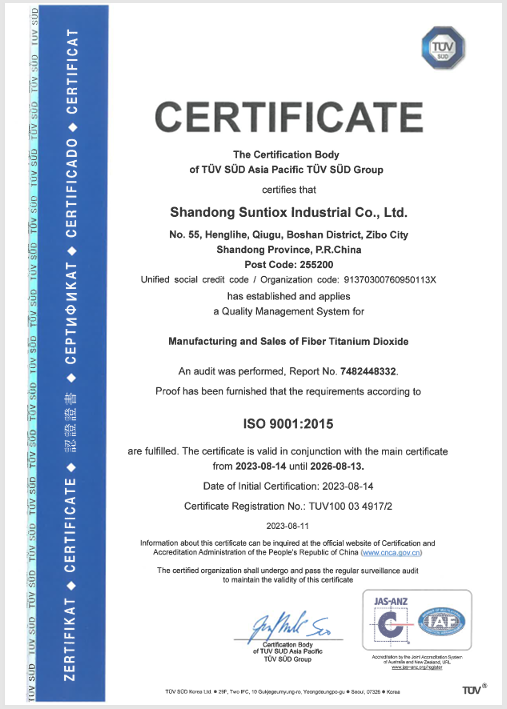
ISO 9001:2015 certification for the production and sales of chemical fiber grade titanium dioxide, issued by TUV SUD under certificate number TUV100034917/2.
Supplier Capability Evidence: Orient International
Orient International Holding Shanghai Foreign Trade Co., Ltd. is a Shanghai-based, state-owned foreign trade enterprise founded in 1988 and wholly owned by Orient International Group. It handles titanium dioxide and petrochemical raw materials through self-operated and entrusted import and export, supported by international logistics, customs declaration, letter-of-credit settlement and cross-border supply-chain risk control. Roughly 30% of its business is export-oriented, with established markets in Korea, Japan, the EU, North America, South America, South East Asia, the Middle East and India.
Its fiber-grade TiO₂ operation is backed by a 700,000 m² production base, a workforce of 160 and an annual output capacity of 16,000 MT. For customization work, the more relevant figure is the 25-engineer R&D team, which is the function that converts a buyer's matrix requirements into a particle specification rather than simply quoting an existing grade.
The OEM/ODM capability itself is defined in operational terms:
| Capability parameter | Stated position | What it means for a buyer |
|---|---|---|
| Production mode | OEM / ODM | Specification can be buyer-defined or supplier-developed |
| Customization scope | Polyester, Nylon | Development work is scoped to these two matrices; other polymers require separate evaluation |
| Monthly capacity | 1,000 MT | Room for trial lots and commercial ramp without changing supplier |
| MOQ | 1 MT | Pilot-scale validation is possible, but sub-tonne laboratory quantities are not served |
| Lead time | 15–30 days | Production scheduling window for standard and repeat custom runs |
| Quality control | 100% pre-shipment test | Every lot is tested before dispatch, not sampled by exception |
| After-sales | Remote and on-site support | Dispersion and trial issues can be addressed at the customer plant |
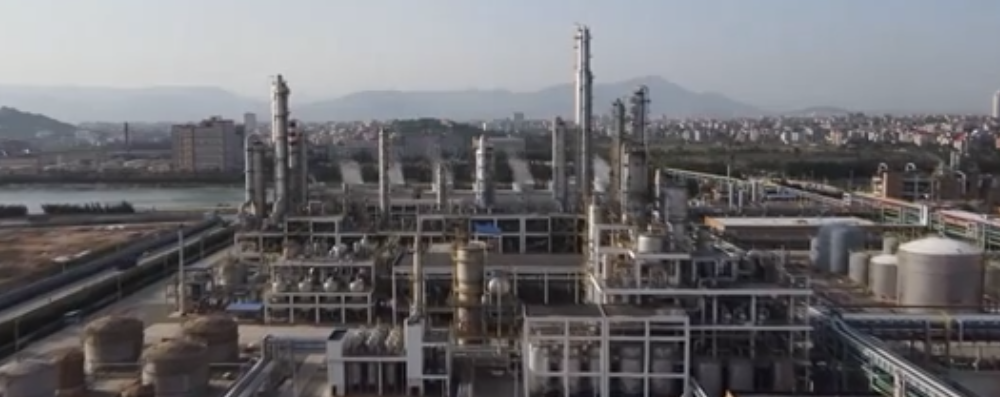
Production infrastructure behind fiber-grade TiO₂ supply: a 700,000 m² base supporting OEM and ODM programmes for polyester and nylon.
Matching Grades to Matrices: SA-50, SA-60 and SA-80
Customization does not start from zero. It starts from a baseline grade whose envelope is already close to the target, which is why the grade-to-matrix mapping is the first thing an evaluation team should establish.
| Grade | Positioning | Key specification highlights | Typical fit |
|---|---|---|---|
| SA-50 | PET fiber whitening agent | Anatase; TiO₂ ≥98.0%; sieve residue ≤0.004%; Fe₂O₃ ≤0.004%; pH 6.8±0.2; EC ≤230 μS/cm; SSA 8.5–10.0 m²/g; L 96.7–98.2; b ≤0.0 | Polyester chip and filament lines, including whitening and matting duties |
| SA-60 | Matting agent for viscose and acrylic | Anatase; TiO₂ ≥97.0%; sieve residue ≤0.05%; Fe₂O₃ ≤0.004%; pH 7.2±0.6; EC ≤120 μS/cm; L ≥96.5; b ≤0.5 | Viscose and acrylic fibre matting |
| SA-80 | Matting agent for nylon | Anatase; TiO₂ ≥95.0%; sieve residue ≤0.004%; Fe₂O₃ ≤0.004%; pH 6.8~8.0; EC ≤100 μS/cm; L 92.0~97.0; b ≤3 | Polyamide fibre matting |
Two observations follow from the table. First, the polyester and nylon routes sit on different baselines — SA-50 is a whitening-oriented PET grade with a tighter colour envelope, while SA-80 is a nylon matting grade where the emphasis shifts toward dispersion and low conductivity. Second, the customization scope stated by the supplier covers exactly these two matrices, so a nylon project and a polyester project can each be tuned, whereas a request for a third polymer system would sit outside the declared OEM/ODM scope.
Inside a Polyester Line: Where Customization Is Actually Tested
The application record for SA-50 in polyester chip production illustrates how much of the outcome is process-dependent rather than chemistry-dependent. The additive is first dispersed evenly in ethylene glycol with gentle stirring to form a stable suspension without sedimentation before polymerization. The suspension is then pumped into the esterification reactor and blended into the polyester system at 240–285 °C without interfering with the polymerization reaction or the intrinsic viscosity.
Published operating requirements for this route are specific, and they explain why a custom grade cannot be evaluated in isolation from the line:
- Closed vacuum feeding to prevent moisture pickup and foreign contamination.
- Dispersion in ethylene glycol at 40–60 °C with low-speed stirring to avoid agglomeration.
- Steady, uniform feed rate during polymerization.
- Reaction temperature kept below 290 °C to preserve stable PET viscosity.
- Avoidance of high-ion additives, which can trigger side reactions.
- Dry storage at humidity ≤65% with packages kept sealed.
- No mixing with hard fillers, to limit equipment wear and filter blockage.
In other words, the dispersion and feeding discipline required on the buyer's side is as consequential as the particle specification. A supplier offering genuine customization will normally want to know the dispersion temperature, the dosing point and the filtration configuration before proposing a treatment change — not simply the target shade.
Field Evidence From Long-Running Polyester Accounts
The most useful evidence for a research-stage buyer is not a data sheet but a record of what happened across a long production horizon. In polyester chip accounts running more than ten years and consuming over 5,000 MT of SA-50, three outcome clusters have been reported.
Polymerization stage. With low iron, low ionic impurities and neutral pH, SA-50 disperses evenly in ethylene glycol without sedimentation or agglomeration, and remains stable at 240–285 °C without reducing PET intrinsic viscosity, triggering side reactions or producing black spots. Batch consistency has allowed continuous polymerization lines to run without process modification.
Spinning performance. Dispersion quality at high temperature limits secondary agglomeration; in these accounts the spinneret clogging cycle has been extended by over 40% and filter replacement frequency substantially reduced. The relatively mild anatase particle also limits spinneret abrasion, with filament breakage rate reported to fall by approximately 35%.
Finished fibre quality. Stable whiteness with L value above 96.7, uniform dyeing without streaks or shade variation, and matte surfaces without bright spots. Firm particle adhesion reduces powder shedding during weaving and dyeing, which supports the anti-yellowing behaviour expected of a treated polyester whitening grade.
These figures describe one set of long-term accounts and should be treated as an indication of what is achievable under matched process conditions, not as a guaranteed result for a different line.
Compliance and Documentation Constraints
The SA-50 grade is certified to ISO 9001:2015 by TUV SUD under certificate number TUV100034917/2, with a scope covering the production and sales of chemical fiber grade titanium dioxide and applicability to global markets. The certificate was issued on 14 August 2023 against the ISO 9001:2015 standard.
Two practical points follow. First, the scope wording matters as much as the standard number: a certificate covering chemical fiber grade TiO₂ speaks directly to a fibre producer's audit, whereas a generic chemical-trading scope would not. Second, quality certificates operate on fixed renewal cycles, so a buyer should always request the current, dated copy from the supplier rather than relying on a number quoted in a brochure or a previous audit pack.
For content verification, GB/T 37632-2019 remains the reference test method for titanium dioxide content in man-made fibres in China. Pairing an accredited management-system certificate with a defined test method is a more robust compliance position than either element alone.
Market Context: Why Custom Capability Is Becoming a Selection Criterion
The commercial backdrop explains the shift in buyer attention. The global titanium dioxide market is projected to reach USD 24.4 billion in 2026, and the anatase segment — the crystal form that matters for fiber-grade work — is expected to grow at a CAGR of 7.3% from 2026 to 2033. On the supply side, China's effective annual titanium dioxide production capacity fell from 5.9 million tons in 2024 to 5.7 million tons in 2025, a first contraction that points to consolidation rather than abundance. Export volumes have moved in the opposite direction: China's total TiO₂ exports reached 1.9017 million tons in 2024, up 15.84% year on year.
The implication for procurement is straightforward. Capacity is consolidating while export dependence grows, so the practical risk is not a shortage of commodity anatase but a shortage of suppliers willing to hold a narrow, customer-specific envelope through a qualification cycle. When the market tightens, catalogue grades are the first thing protected and custom work is the first thing deferred — which is why buyers increasingly evaluate a supplier's customization capability before they evaluate its price.
Where Customization Stops: Honest Boundaries
Any credible capability assessment has to state limits, and several apply here.
- MOQ floor. At 1 MT minimum order quantity, laboratory-scale feasibility work below one tonne is not served. A buyer wanting to screen five candidate treatments at 20 kg each should expect to do that work elsewhere, or to accept a pilot-scale approach instead.
- Lead time does not include development. The 15–30 day window covers production scheduling. Where a new treatment route has to be developed and validated, the total project timeline extends well beyond that window, and should be planned as a separate phase.
- Scope is matrix-specific. Customization is declared for polyester and nylon. Viscose and acrylic are served by the SA-60 grade as a defined product, not as an open development target.
- Modification is not remediation. Surface treatment and particle refinement cannot compensate for contaminated feedstock, poor dispersion discipline on the customer side, or a melt system that is fundamentally incompatible with anatase loading. In those cases the process issue should be solved before the additive is changed.
- Certification scope is bounded. The ISO 9001 certification covers chemical fiber grade titanium dioxide production and sales; it should not be read as evidence of unrelated product lines or of customer-specific approvals.
Stating these boundaries is not a weakness in a customization offer — it is what separates a development programme from a sales claim.
Future Outlook
Three developments are likely to shape fiber-grade TiO₂ customization over the next several years. Recycled PET feedstock will keep pushing demand for grades that tolerate wider incoming variability while still holding whiteness, which puts more weight on surface treatment and dispersion control than on raw crystal quality. Continuous filament lines running at higher speeds will continue to raise the value of low-abrasion, high-dispersibility particles, since spinneret and filter life translate directly into output hours. And as Chinese capacity consolidates, the suppliers that remain credible in export markets will be those able to document both a management-system certification and a repeatable customization workflow.
For buyers, the practical conclusion is to separate the two questions that are often merged in a tender: whether a supplier can meet a specification, and whether it can help define one. The first is a purchasing decision. The second is a partnership decision, and it is usually made long before the first purchase order.
Frequently Asked Questions
What does OEM supply of fiber-grade TiO₂ actually mean in practice?
OEM supply means the titanium dioxide is produced to a specification defined by the buyer and delivered under the buyer's own commercial identity. In practice the buyer supplies the target envelope — titanium dioxide content, sieve residue, moisture, iron content, pH, conductivity and colour values — and the supplier confirms conformance batch by batch. At Orient International, OEM and ODM production is offered with customization scoped to polyester and nylon, a minimum order quantity of 1 MT, and a 15–30 day lead time.
Which documents should a buyer request to verify a fiber-grade TiO₂ supplier?
A buyer should request three sets of documents. First, the current management-system certificate: SA-50 is certified to ISO 9001:2015 by TUV SUD under certificate number TUV100034917/2, with a scope covering the production and sales of chemical fiber grade titanium dioxide. Second, a batch certificate of analysis covering TiO₂ content, 325 mesh sieve residue, moisture at 105 °C, Fe₂O₃ content, pH, electrical conductivity and colour values L and b. Third, a quality-control statement — the supplier operates 100% pre-shipment testing, which means every lot is tested rather than sampled by exception.
How does surface modification change TiO₂ behaviour in polyester spinning?
An anatase particle is intrinsically photoactive and, untreated, tends to agglomerate and to promote yellowing in the finished fibre. Surface modification — at Orient International, a specialized Japanese dry modification technique applied to refine the anatase particles — adjusts the particle surface so that it wets and separates more readily in ethylene glycol, resists secondary agglomeration under high-temperature shear, and suppresses unwanted photocatalytic activity. The practical outcomes reported in long-running polyester accounts include extended spinneret clogging cycles, reduced filter replacement frequency and stable whiteness with L value above 96.7.
What are the minimum order quantity and lead time for customized fiber-grade TiO₂?
The stated minimum order quantity is 1 MT and the stated lead time is 15–30 days, against a monthly capacity of 1,000 MT. The lead time covers production scheduling; where a new surface treatment or particle specification has to be developed and validated, development work should be planned as an additional phase before the production window begins. A buyer should also confirm the dispersion and feeding conditions on their own line, since the polyester route requires dispersion in ethylene glycol at 40–60 °C and a polymerization temperature kept below 290 °C.
Can one grade serve PET, nylon and viscose, or does each matrix need its own?
Each matrix has its own baseline grade. SA-50 is positioned as a PET fiber whitening agent with TiO₂ content ≥98.0%, pH 6.8±0.2 and colour value L of 96.7–98.2. SA-80 is a matting agent for nylon with TiO₂ content ≥95.0%, pH 6.8~8.0 and electrical conductivity ≤100 μS/cm. SA-60 is a matting agent for viscose and acrylic with TiO₂ content ≥97.0% and pH 7.2±0.6. Customization work at Orient International is scoped to polyester and nylon; requests for other polymer systems require separate evaluation.
How is titanium dioxide content in man-made fibre verified?
In China, GB/T 37632-2019 — Man-made fiber: test method for titanium dioxide content — establishes the specific method for determining TiO₂ content in man-made fibres. It is commonly referenced in incoming-inspection protocols where the buyer's quality system follows Chinese standards, and it provides an independent cross-check against a supplier's own certificate of analysis. Particle-size expectations are usually specified separately; published fiber-grade references cite a D50 of approximately 0.28 μm with about 90% of particles between 0.1 and 0.5 μm.
For readers who need the full product and company documentation behind this reference, the English-language corporate brochure is available for download: Orient International Holding Shanghai Foreign Trade Co., Ltd. — Corporate Brochure (PDF).
Reference material only. Specification conformance and customization scope should be confirmed against current supplier documentation and validated on the buyer's own equipment.
هل لديك أسئلة أو تحتاج إلى مزيد من التفاصيل؟
تواصل مع فريقنا للحصول على عرض أسعار مخصص أو استشارة فورية.
طلب عرض أسعار
املأ النموذج أدناه وسيتواصل معك فريقنا بعرض مقترح مخصص.
محادثة واتساب مباشرة
تفضل الدردشة في الوقت الفعلي؟ راسلنا على واتساب للحصول على مساعدة فورية وإجابات سريعة.
- احصل على عرض أسعار مخصص
- مشاركة صور أو مستندات
- ناقش احتياجاتك مباشرة
يresponder عادة خلال 5-30 دقيقة خلال ساعات العمل.