
Inside Rainbows Fountain's Factory: Evidence of High-Capacity Musical Fountain Manufacturing
Musical fountains are sold on renderings and delivered as civil, hydraulic and electrical engineering. The distance between those two things is where most procurement risk sits — and it is why factory capability has become a buying criterion rather than a marketing detail.
The market context explains the shift. Dataintelo values the global musical fountain market at USD 2.51 billion in 2025, projecting USD 5.23 billion by 2034 at a CAGR of 8.5%, with Asia Pacific holding a 38.5% revenue share in 2025. Growth of that kind is not absorbed by stock products. It is absorbed by project-based manufacturers, and it puts pressure on a question buyers in the evaluation and execution stages now have to answer before signing: can this supplier actually build what it illustrated, at the scale and in the environment the site requires?
Why Factory Evidence Became a Buying Criterion
A musical fountain proposal usually arrives as a visual asset: a 3D simulation, a reference video, a rendered night scene. These materials are useful for confirming artistic direction. They are not evidence of manufacturing capability, because simulation software can produce any water effect regardless of whether the supplier owns a machining line, a welding team, a control-cabinet assembly area, or a test pool.
That asymmetry creates a specific evaluation problem. Two suppliers can present near-identical concepts while operating very different production models — one fabricating stainless steel components in-house, another reselling assembled equipment sourced from third parties. For the buyer, the visible output looks similar at proposal stage; the difference appears later, in lead time, in documentation, in how quickly spare parts can be matched, and in whether warranty claims can be traced back to a specific production batch.
Verified category data supports the direction of travel. Commercial end-users, including luxury hotels and shopping malls, held the largest share of the musical fountain market at 42.8% in 2025 (Dataintelo). Commercial operators tend to procure against operating budgets and visitor expectations, which pushes evaluation toward evidence that can be checked: what is in the cabinet, what material the nozzles are made from, what testing was performed, and what happens after handover.
What “Factory Evidence” Means in a Musical Fountain Project
Factory evidence is not a single document. In practice, it is a set of verifiable statements about how a supplier converts a design into a shipped, commissionable system. The most useful evidence falls into six categories.
- Physical production footprint and workforce — the area actually used for fabrication and assembly, and the number of people available to machine, weld, wire and test.
- Project throughput — how many complete systems the manufacturer delivers in a year, and how that maps to production scheduling.
- Material specification — the stainless steel grades and auxiliary materials used for wetted and structural parts.
- Electrical protection — enclosure construction for control cabinets and the ingress protection rating of submerged components.
- Testing regime — what is tested, where, and against what criteria before loading.
- Certification and third-party inspection — which conformity assessments exist, what they cover, and their validity windows.
| Evidence category | Typical document or artifact | What it allows a buyer to conclude |
|---|---|---|
| Production footprint | Factory area, workshop layout, machining and welding records | Whether fabrication is in-house or outsourced |
| Throughput | Annual output of complete systems, production schedule | Whether the delivery window is realistic |
| Materials | Material certificates, component specification sheets | Corrosion exposure the installation can tolerate |
| Electrical protection | Cabinet build documentation, IP rating of submerged parts | Risk profile for water-adjacent electronics |
| Testing | Pre-shipment test reports, demonstration pool results | Whether effects and control response were proven before shipping |
| Certification | CE certificate, conformity certificates, quality-management certification | Compliance scope, market applicability and validity dates |
Rainbows Fountain: Capability Baseline
Rainbows Fountain is the flagship brand of Caiyuejiaxiu Group, a musical fountain design and engineering company based in Nansha, Guangzhou, China, operating through Guangzhou Shuiguang Fountain Equipment Co., Ltd. The company was founded in 2012 and states more than 25 years of experience in the fountain industry; its stated markets are the Middle East, Africa and South Africa, with an export ratio of 80%.
The capability figures most relevant to a procurement evaluation are concrete rather than aspirational:
- Factory area of 4,500 m², used for design, production, testing and global delivery under one roof.
- Annual output of 50 complete units.
- A workforce of 51–80 employees.
- An R&D team of 45 engineers plus 12 designers.
- More than 20 overseas installation engineers available for on-site installation, commissioning and technical support.
- More than 4,500 completed fountain projects in more than 50 countries.
The annual output figure deserves interpretation rather than repetition. Fifty units per year is not a large number in manufacturing terms, and that is the point: a musical fountain is a bespoke engineered system, not a stock item. Each unit represents a project-level package of hydraulic design, custom nozzle assemblies, stainless steel pipework, control cabinets, lighting, programming, testing and export packing. Capacity in this category is measured in projects delivered per year, which is why the ratio between factory area, engineering headcount and annual output matters more than the raw number alone.
Inside the Production Process: Where Risks Are Controlled
The failure modes of an outdoor musical fountain are predictable. Water and electricity occupy the same structure; nozzles and pipework sit in permanently wet or frequently submerged conditions; control electronics must survive humidity even when the display is off. Production risk control is therefore concentrated in three areas: metal fabrication, electrical enclosure, and pre-shipment testing.
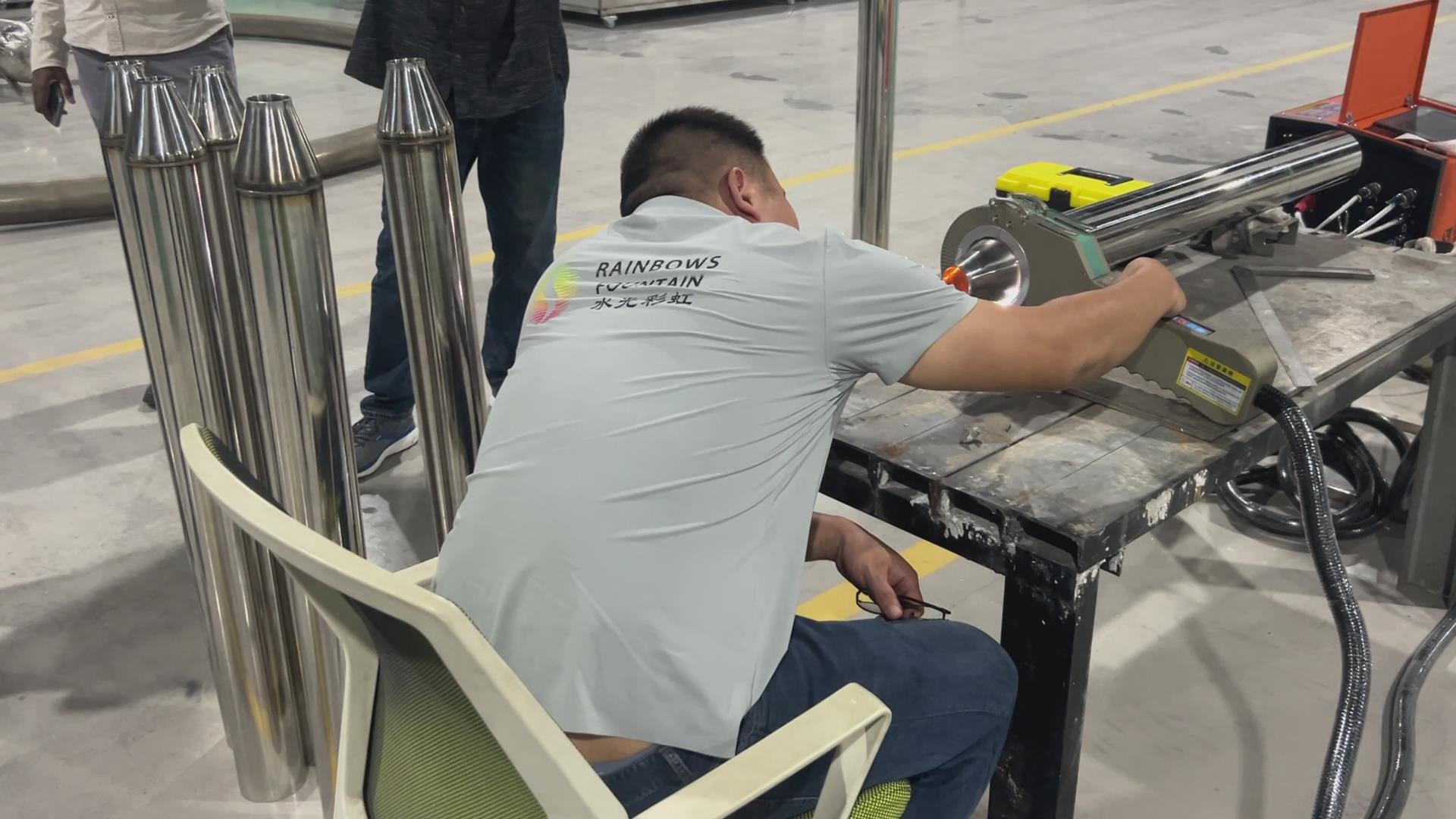
In fabrication, stainless steel components are machined to project drawings using CNC equipment, so that nozzles, pipe fittings and structural parts match the hydraulic design rather than a generic template. Pipes are measured, cut and prepared according to the actual project layout to support smooth assembly on site. Welding is performed on stainless steel structures and flanges to create strong, leak-resistant joints under pressure, and finished parts are polished — a step that serves both appearance and surface protection against environmental exposure. Rainbows Fountain states that equipment and components used in its projects are manufactured under an ISO 9001 certified quality management system and are CE certified.
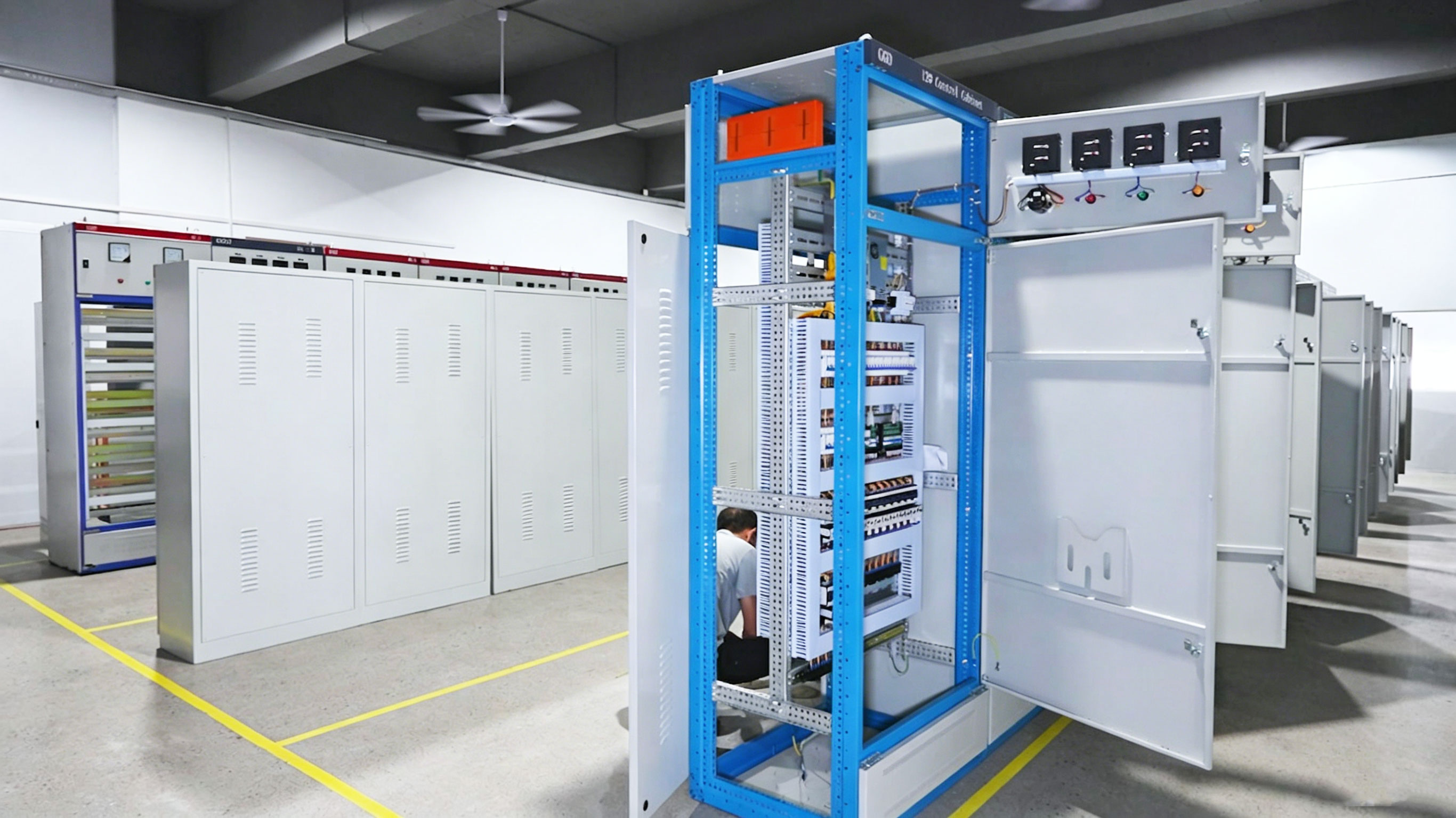
Electrical enclosure is the second control point. Each control cabinet is wired, labelled and tested before delivery, with functional inspections covering PLC programming, circuit safety, communication and the synchronized control of pumps and lighting. For submerged equipment, the relevant reference is IP68 protection — a rating commonly applied to underwater LED luminaires and pumps in this category, and the rating Rainbows Fountain specifies for its underwater components. Waterproof electrical cabinets and IP68 submerged components together reduce the most common early-life failure path in outdoor fountain installations: moisture ingress into control and power circuits.
The third control point is pre-shipment testing. Equipment is tested in the factory demonstration pool, where engineers verify water patterns, nozzle performance, lighting synchronization and control programs against the designed show. The stated quality-control protocol is 100% testing before loading, supported by factory inspection and third-party inspection options including SGS, TUV and INTEK. After a pass, systems are packed in export-grade wooden crates and loaded following international export standards, with particular attention to stainless steel components, pumps and control cabinets that must arrive undamaged after sea transport.
Technical Explanation: Why Materials and Protection Grades Decide Longevity
Musical fountain performance is usually discussed in terms of pumps, nozzles and light. Durability is decided earlier, in material selection and protection ratings. Rainbows Fountain offers stainless steel 304, 316 and 316L for fountain structures, together with brass and mild steel where appropriate, and states that its systems mainly use stainless steel 304 components combined with waterproof electrical and lighting equipment. SS304 is the standard baseline for most fountain structures; higher-molybdenum grades such as SS316 and SS316L are commonly specified where chloride exposure is higher, for example in coastal or salt-influenced environments and in water treatment conditions that accelerate pitting corrosion.
On the control side, the operating envelope stated for the company's musical fountain and multimedia water show systems includes pump power from 1.5 kW to 110 kW, nozzle lift range from 1 m to 100 m, working voltages of 380 V, 220 V or 110 V, and DMX512 or PLC intelligent linkage for show control. Rainbows Fountain also lists protection functions that matter for unattended operation: wind speed sensing, water level protection, remote monitoring and time scheduling. In practical terms, wind speed sensing protects both the equipment and the audience during high-wind events; water level protection reduces the risk of pumps running dry; and remote monitoring plus scheduling allows an operator to control a city square or hotel fountain without a permanent on-site technician.
These are design capabilities rather than guarantees. Exact parameters — nozzle type, pump head, flow rate, lighting configuration and control architecture — are project-specific and require confirmation at project level, which is the normal situation for a custom water feature rather than a limitation unique to one supplier.
Testing and Certification: What Can Be Checked Independently
Certification is where factory capability becomes externally verifiable. Two documents in the Rainbows Fountain portfolio illustrate how narrow — and how useful — a certificate's scope can be.
| Certificate | Authority / standard | Scope and validity |
|---|---|---|
| CE Certificate (Machinery Directive 2006/42/EC), No. M.2022.206.C73820 | UDEM; EN ISO 12100:2010 and EN 60204-1:2018 | Water fountain series including musical, dancing, floating, floor, water screen projection, laser, flame, digital water curtain, mist and laminar jet fountains. Issued 2022-05-19, valid to 2027-05-18. EU market. |
| Certificate of Conformity (COC), No. ETH2000000501 | TÜV Rheinland Guangdong Ltd.; Ethiopia PVOC Pre-Export Verification of Conformity | Electrical and electronic products; standards include IEC 60076-1:2011, CES 125:2013, IEC 60034-1:2022, IEC 60034-30-1:2014 and ES 6892:2021. Issued 2026-06-12, valid to 2026-12-12. Valid for customs clearance in Ethiopia only. |
The Ethiopian certificate is a useful example of why scope reading matters: it is a pre-export verification document tied to a single market and a fixed validity window, not a global approval. The CE certificate, by contrast, covers a defined machinery-directive scope across a named list of fountain types in the EU market. A buyer in a third market should treat both as evidence of conformity discipline rather than as a substitute for local compliance assessment. Rainbows Fountain also states that key components are sourced from recognised brands including ABB, Rexroth and Schneider, and that components are traceable and compliant with international electrical and safety standards.
From Small Plaza Fountains to Large Water Features: Scale Diversity
Capacity claims are most credible when they are illustrated across different project scales, because a manufacturer able to deliver a small plaza fountain and a landmark multimedia show has demonstrated two different production and logistics problems. Rainbows Fountain states more than 4,500 projects across more than 50 countries, and its published case material spans a wide range.
- Large-scale multimedia: the Big O Show in Astana, Kazakhstan, is described as a floating O-shaped sculpture multimedia show combined with a floating dancing water display, built with 2,000 pieces of DMX512 digital signal control equipment and more than 1,000 stainless steel pumps, with a spray height above 100 m and performance elements including water screen film, laser, fire and music-synchronised dancing.
- Event-driven large shows: the 2019 Riyadh Season musical fountain show in Saudi Arabia, which the client returned to in 2024 for an upgrade.
- Long-cycle upgrade partnerships: the Sheikh Zayed Festival light and fountain upgrade, where the company states it has served as the exclusive upgrade partner from 2022 to 2026.
- Ceremonial and stage applications: a stage water fountain for the opening ceremony of the 15th National Games of China.
- Municipal year-end shows: a partnership with two Brazilian cities since 2023 for the design, equipment supply and annual upgrading of government year-end and New Year water shows.
The relevant pattern for a buyer is not the size of any single project but the range: small square fountains, hotel and pool features, and large city-scale multimedia water shows produced by the same production organisation. Scale diversity is also a supply-chain indicator, because large shows require multi-container logistics, staged installation and extended on-site commissioning — the situations in which the 20-plus overseas installation engineers become operationally necessary rather than a figure on a specification sheet.
Comparison with Traditional Supply Models — and Where Factory Evidence Stops
Traditional fountain procurement frequently splits design, equipment supply and installation across separate parties. That model can work, and it can be cheaper at the quotation stage. Its trade-off is traceability: when a pump fails or a cabinet develops a fault, responsibility has to be reconstructed across several contracts. An integrated model, by contrast, concentrates design, fabrication, testing and commissioning under one manufacturer, which shortens the responsibility chain but also means the buyer depends more heavily on that single supplier's capacity and scheduling.
It is equally important to be clear about what factory evidence cannot do. Four boundaries are worth stating plainly.
- A factory test pool is not the site. Verification in a demonstration pool confirms build quality, effect fidelity and control response at factory scale. It cannot confirm site hydraulics, wind loading, audience sightlines, water quality or power supply stability, all of which are established only during on-site commissioning.
- Capacity is finite and scheduled. A stated annual output of 50 complete units and lead times in the 15–45 day range (dependent on project scale and customisation) mean production slots are limited. Buyers working against event dates should plan procurement early rather than assume capacity is available on demand.
- Higher-grade materials carry higher cost. SS316 and SS316L are specified where corrosion exposure justifies them; they are not the default for every project, and SS304 remains the stated baseline for the majority of system components. Specifying a higher grade is a cost decision as much as a durability decision.
- Third-party inspection is optional unless the buyer requires it. SGS, TUV and INTEK inspection is available, but it adds schedule and cost, and it verifies the inspected items at a point in time — not installation quality on site.
| Evidence source | What it confirms | What it does not confirm |
|---|---|---|
| Supplier documentation (drawings, component specification, certificates) | Design intent, material grades, compliance scope | As-built condition of the delivered system |
| Factory visit and demonstration pool | Fabrication quality, water effects, control response | Site-scale hydraulics and environmental exposure |
| Third-party pre-shipment inspection | Conformity of inspected items at a point in time | Installation and integration quality on site |
| On-site commissioning and acceptance testing | Integrated system performance at the actual site | Long-term durability, which depends on maintenance |
Market Trend Analysis: What the Numbers Suggest for Buyers
Three data points frame the current procurement environment. The overall musical fountain market is valued at USD 2.51 billion in 2025 and projected at USD 5.23 billion by 2034, at an 8.5% CAGR (Dataintelo). The narrower music fountain control system market was valued at USD 1.34 billion in 2024 and is expected to reach USD 2.89 billion by 2032 (SNS Insider). Within the end-user mix, commercial operators held 42.8% share in 2025 (Dataintelo).
The control-system segment growing faster in absolute terms than the equipment narrative suggests matters for buyers. As shows become more complex — DMX512 lighting protocols and PLC-based synchronization are now standard reference technologies in the category — the value of a fountain project shifts from steel and pumps toward programming, integration and show content. That shift rewards manufacturers who can produce control cabinets, write and test programs, and support the system remotely after handover, and it penalises procurement decisions that treat the control package as an accessory.
Asia Pacific's 38.5% share in 2025 reflects the concentration of manufacturing and the pace of urban development in the region. For overseas buyers, that concentration has a practical consequence: factory capability in Asia is both the supply base and the evaluation risk. The appropriate response is not to avoid the region but to raise the specificity of verification — asking for factory area, throughput, material grades, protection ratings, certificate numbers and validity dates rather than accepting category-level assurances.
Future Outlook
Two directions look likely over the next planning cycle. The first is documentation-led procurement: as public and commercial buyers formalise acceptance criteria, the ability to supply certificates, test records and inspection reports becomes a gating requirement rather than a competitive advantage. Suppliers with defined quality management systems and traceable component sourcing are structurally better positioned for that environment.
The second is lifecycle rather than delivery. Rainbows Fountain states a two-year warranty together with installation, commissioning, on-site training and maintenance support, and recommends formal warranty and maintenance agreements that specify response and spare-part strategies. As installed bases age — including long-running projects such as the Sheikh Zayed Festival upgrades and the annual Brazilian year-end shows — the operational question shifts from “who can build it” to “who can keep it performing”. Buyers evaluating suppliers today are, in effect, selecting the party they will depend on for a decade of operation.
Frequently Asked Questions
1. What does a musical fountain manufacturer's factory capability actually cover?
It covers the physical and organisational resources used to convert a design into a shipped system: fabrication area, workforce, annual output of complete systems, in-house machining and welding, control cabinet assembly, test facilities, export packing and installation support. For Rainbows Fountain, the stated figures are a 4,500 m² factory, 51–80 employees, an annual output of 50 units, an R&D team of 45 engineers and 12 designers, and more than 20 overseas installation engineers. These are the elements that determine whether a proposed water show can actually be delivered.
2. How is customisation handled across different fountain types and water effects?
Customisation in this category is project-level rather than catalogue-level. Rainbows Fountain states that it provides customised design, production and installation across fountain types including dry deck, lake floating, dancing, multimedia, water screen projection, hotel, swimming pool, city square, interactive, landmark, stage and indoor fountains, with customised water effects ranging from vertical and fan jets to water curtains, fire-and-water combinations and 1D/2D/3D digital fountains. Programming is also customised to music rhythm, local culture, festival themes, branding requirements and event types, and equipment can be manufactured in SS304, SS316 or SS316L.
3. What production capacity and lead times apply to a custom musical fountain project?
Rainbows Fountain states an annual output of 50 complete units. Stated lead time is 15–45 days, with the exact duration depending on project scale and degree of customisation. Minimum order quantity is one unit, and delivery terms can be structured as EXW, FOB or CIF, with project equipment typically shipped as packaged systems for on-site installation. Because annual output is fixed and each unit is a bespoke engineering package, delivery windows depend on production scheduling, which is why event-linked projects should be planned early.
4. How are waterproofing and corrosion controlled in outdoor musical fountains?
Two mechanisms are used. For submerged and splash-exposed equipment, waterproof electrical cabinets and IP68-rated underwater components such as LED luminaires and pumps reduce moisture ingress into power and control circuits; Rainbows Fountain assembles, wires, labels and functionally tests each control cabinet before shipment, verifying PLC programming, circuit safety and communication. For structural and wetted parts, corrosion resistance is addressed through material selection — stainless steel 304 as the stated baseline, with 316 and 316L available where higher chloride exposure is expected — supported by precision welding for leak-resistant joints and polishing of finished surfaces.
5. Which certificates should a buyer verify, and what do they cover?
Buyers should check certificate scope and validity rather than presence alone. Rainbows Fountain holds a CE Certificate under Machinery Directive 2006/42/EC, number M.2022.206.C73820, issued by UDEM against EN ISO 12100:2010 and EN 60204-1:2018, covering a listed water fountain series and valid to 2027-05-18 for the EU market. It also holds Certificate of Conformity number ETH2000000501 for Ethiopia PVOC Pre-Export Verification of Conformity, issued by TÜV Rheinland Guangdong Ltd., valid from 2026-06-12 to 2026-12-12 and applicable only to customs clearance in Ethiopia. Equipment is manufactured under an ISO 9001 certified quality management system.
6. How is equipment tested before shipment?
Testing is staged. Components are inspected as part of production, control cabinets undergo functional inspection covering PLC programming, circuit safety and synchronised pump and lighting control, and completed systems are run in a factory demonstration pool where engineers verify water patterns, nozzle performance, lighting synchronization and control programs. Rainbows Fountain states 100% testing before loading, with factory inspection and third-party inspection options available through SGS, TUV and INTEK, followed by packaging in export-grade wooden crates and container loading under international export standards. Buyers may also request an acceptance checklist covering equipment arrival inspection, system integration testing and show demonstration before signing the acceptance report.
7. What are the limits of factory-based evaluation?
Factory evidence verifies manufacturing capability, not site performance. A demonstration pool confirms build quality and effect fidelity at factory scale, but cannot confirm site hydraulics, wind exposure, audience sightlines, water quality or power supply stability, which are established during on-site commissioning. Capacity is finite at a stated 50 complete units per year, so scheduling constraints apply. Higher-grade materials such as SS316 and SS316L increase cost and are not the default for every project. Third-party inspection verifies the inspected items at a point in time and does not confirm installation quality, and long-term durability continues to depend on maintenance after handover.
8. What does after-sales support typically include?
For Rainbows Fountain, stated support includes a two-year warranty and services covering on-site installation, commissioning, operator training, maintenance manuals and spare-part packages, together with remote technical guidance and long-term maintenance and system upgrade assistance. Because overseas projects involve geographically separated operation and maintenance, the company recommends formal warranty and maintenance agreements that specify response times and spare-part strategies. For buyers, the practical point is that after-sales scope, response expectations and spare-part availability should be defined in the contract rather than assumed from the warranty period alone.
For readers who want the complete specification set, project references and equipment details referenced in this article, the 2026 Rainbows Fountain brochure is available here: 2026 Rainbows Fountain Brochure (PDF).