
Inside SYS TEXTILE: Customization and Polyester Production
Bed blanket sourcing has moved past the stage where buyers pick a finished item from a catalogue. For wholesalers, hospitality suppliers, private-label owners and institutional buyers, the deciding question is no longer what a factory sells — it is what the factory can turn that product into. That shift pushes manufacturing flexibility to the front of the evaluation, often well before price is discussed.
Changshu Sheng-shun Textile Co., Ltd. — trading under the name SYS TEXTILE — makes a useful case study for that shift. The company is a velvet bedding manufacturer based in Changshu, Jiangsu Province, China, founded in 2018. It operates a 7,000 m² facility with 60 employees, including a five-engineer R&D team, and produces roughly three million pieces annually. Around 90% of output is exported, primarily to the USA, Brazil and the UK. Its product range concentrates on velvet-based bedding: blankets as the core category, supported by quilts and velvet four-piece bedding sets.
What follows examines how customization actually works inside that factory — what is customizable, what the underlying material structure looks like, what the order mechanics are, and where the limits sit. For buyers in the evaluation and execution stages, those four questions are the ones that survive contact with a purchase order.
Why customization capability now filters the supplier list
In most sourcing conversations, the word "customization" carries far too much weight for how loosely it is used. A supplier page that says "OEM available" might mean only that the factory will print a buyer's brand onto a label. It might also mean the factory can adjust model designations, size ranges, fabric selection, packaging and documentation. Those two situations carry very different procurement risk.
The failure mode usually sits in between. A factory responds quickly to an enquiry, quotes a competitive number, and then the production line turns out to be built around a fixed, single-variant output. The buyer is left choosing between accepting an approximate standard product or funding a development cycle that pushes delivery dates out by weeks.
The evidence that removes that risk is model-level flexibility that a buyer can read off the quotation itself. A sourcing team can see which products are flagged as customizable and which are not, whether the size range is already defined, and whether the same fibre logic runs across product categories. That is more decision-useful than a general capability statement, because it lets packaging, pricing and inventory planning proceed against a known structure rather than an assumption.
The five product lines and how each is designated for customization
SYS TEXTILE's bedding portfolio covers five distinct product families. Each of them carries a model designation that explicitly signals customization, rather than a locked product code. That is an important structural detail: a buyer scanning the range can see immediately that no line is presented as a fixed, single-configuration item.
| Product line | Model designation | Available types | Primary fabric | Size range |
|---|---|---|---|---|
| Flannel Blanket | No specific model (Customizable) | Flannel Wave Blanket; Flannel Square Jacquard Blanket; Flannel Square Blanket; Flannel Southwest Design Blanket | Flannel (Polyester) | Twin / Queen / King (Customizable) |
| Shu Fleece Blanket | No specific model | Shu Fleece 3D Blanket; Shu Fleece Jacquard Blanket | Shu Fleece (Polyester) | Twin / Queen / King (Customizable) |
| Rabbit Fur Blanket | Customized | Rabbit Fur Blanket | Rabbit Fur-like Polyester | Twin / Queen / King (Customizable) |
| Velvet Quilt | No specific model | Velvet Quilt | Velvet (Polyester); filling: Polyester | Twin / Queen / King (Customizable) |
| Velvet Four-Piece Bedding Set | Customized | Velvet Four-Piece Set (duvet cover + sheet + pillowcases) | Velvet (Polyester) | Twin / Queen / King (Customizable) |
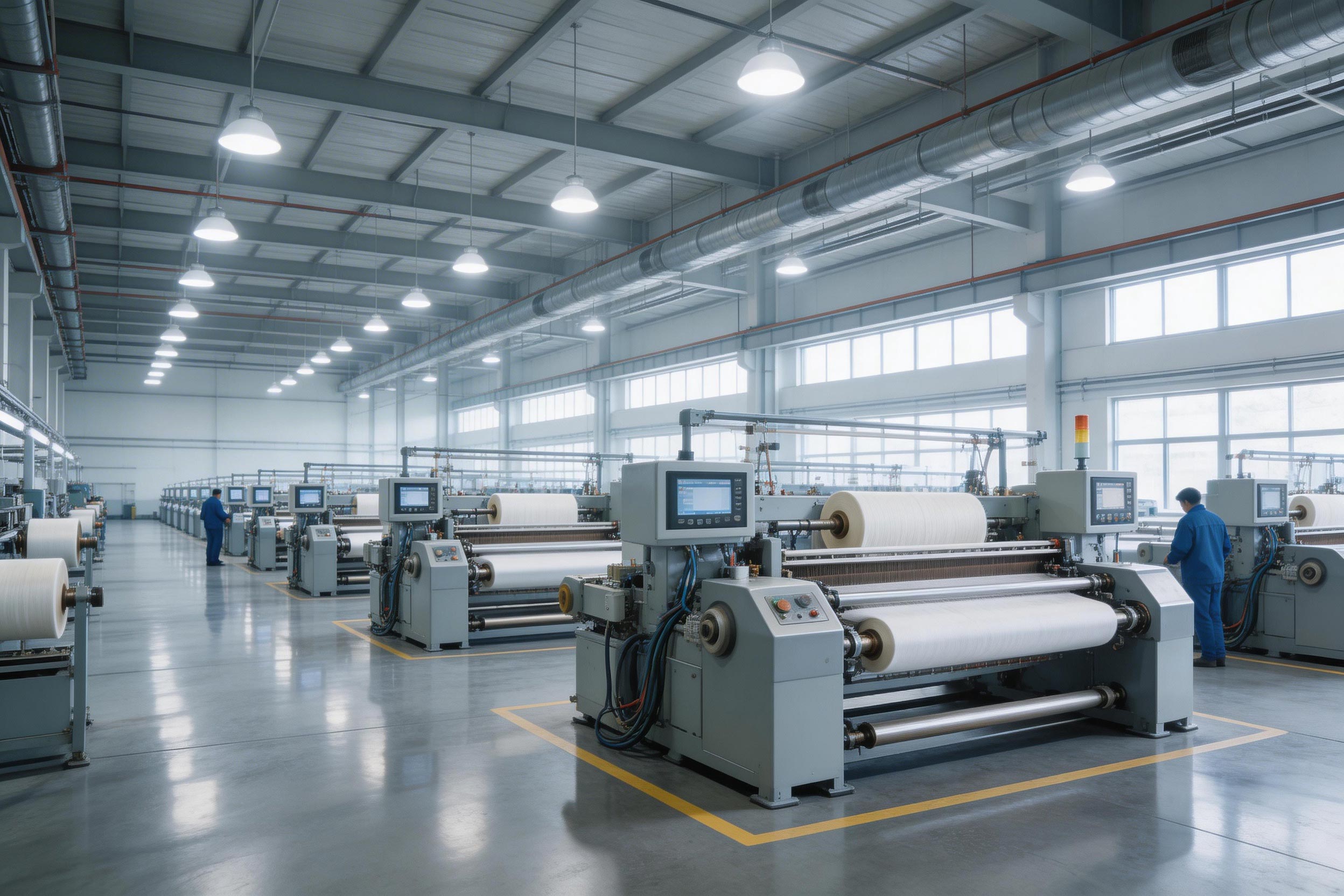
Production area at Changshu Sheng-shun Textile Co., Ltd. — the 7,000 m² facility behind the SYS TEXTILE bedding range.
Two patterns stand out. The first is breadth: five product families covering flat blankets, fleece blankets, faux-fur blankets, quilted bedding and multi-piece bedding sets. A buyer assembling a coordinated bedding programme — rather than sourcing a single SKU — can consolidate across categories with one supplier.
The second is that the size dimension is treated as variable across all five lines, not as an exception. Twin, Queen and King are listed with a customization flag on every product in the range. In practice this matters more than it sounds. Size flexibility is usually the first thing to disappear when a factory is running a rigid line, because changing dimensions affects cutting, filling weight and packaging simultaneously.
Polyester as the single material thread across all five lines
Every product family in the SYS TEXTILE range uses polyester as its primary material. Flannel, Shu Fleece, rabbit-fur-like fabric and velvet are all polyester constructions, and the Velvet Quilt adds polyester filling on top of a polyester face. The company's internal product concept is built around being soft, warm and environmentally friendly — a positioning that the fibre choice directly supports.
For a buyer, that consistency is worth reading carefully, because it produces three practical effects.
Shared supply and processing. When all five categories draw on the same fibre family, the factory can share incoming material checks, finishing processes and quality-control routines across the range. A supplier running wool on one line, cotton on another and synthetics on a third has to maintain three separate supply chains, three sets of lead times and three minimum order thresholds. A single fibre base compresses that complexity — which is exactly why multi-category orders become practical rather than theoretical.
Predictable performance. Polyester holds colour well, dries quickly and generally withstands repeated machine washing. The recorded performance characteristics of the SYS TEXTILE flannel blanket line — ultra-soft touch, a premium shiny finish, durable and machine-washable — sit squarely within that fibre family's normal behaviour. Buyers planning for hotel laundry cycles or e-commerce returns policies tend to care about this far more than about fibre novelty.
A defined boundary. The same consistency draws a clear edge around the offer. Buyers who specifically require natural fibres — wool, cotton or linen — or who want a factory to rebuild an entire product architecture around a different fibre system will not find that answer inside this range. That is a real constraint, and it should be established early rather than discovered at sampling.
How the production system is set up to support customization
Customization claims only hold up if the underlying production parameters can absorb variation without collapsing delivery schedules. SYS TEXTILE's operational profile gives a concrete picture of that capacity.
- Production mode: OEM manufacturing, with LOGO customization included in the service scope.
- Monthly capacity: 300,000 units.
- Lead time: 30–40 days.
- Minimum order for customized production: 1 container.
- Quality control: 100% inspection.
- Export markets recorded for the production operation: USA, UK and Brazil.
- After-sales: quality issues resolved within seven days, with replacement or refund for confirmed defective products.
Alongside the manufacturing parameters, the purchasing framework sets out how orders are actually placed. The minimum quantity threshold stated in the procurement support material is 1,000 units. Trade terms are FOB or CIF. Payment runs on a 20/80 structure. Acceptance allows for pre-shipment full factory inspection, third-party inspection through SGS, or buyer on-site inspection.
The sequence for a customized order follows a conventional but disciplined path:
- Step 1 — Specification alignment. Product family, fabric type, size range and quantity are agreed.
- Step 2 — Customization confirmation. Logo treatment and configuration details are locked.
- Step 3 — Sample and parameter validation. Physical and specification checks take place before bulk commitment.
- Step 4 — Production. Bulk run proceeds within the 30–40 day window.
- Step 5 — Inspection. 100% inspection, with optional SGS third-party verification or buyer on-site inspection.
- Step 6 — Shipment. Goods released under FOB or CIF terms against a 20/80 payment schedule.
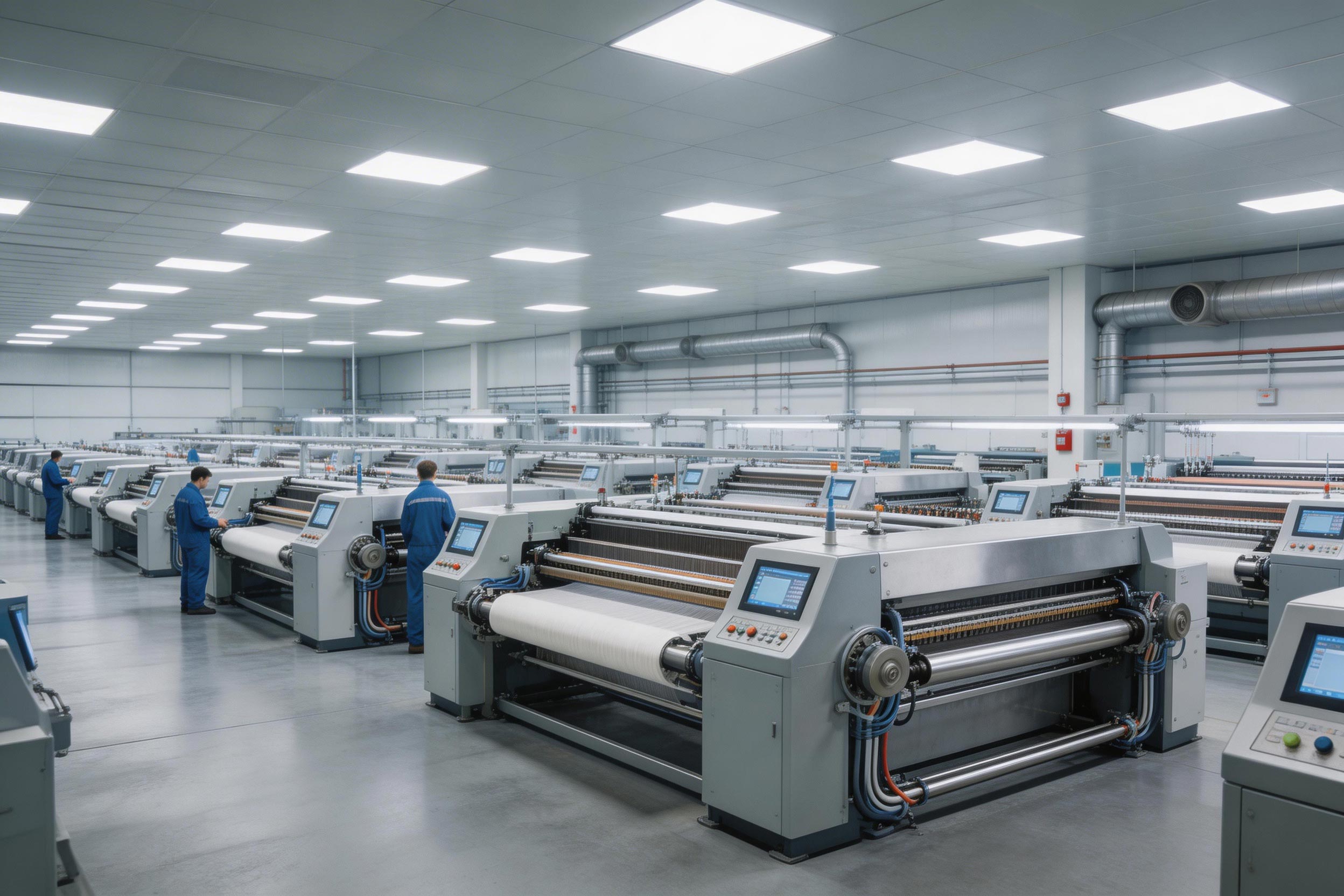
Customized output at SYS TEXTILE runs through 100% inspection before shipment, with third-party SGS verification available on request.
Where customized bedding actually ends up
Capability descriptions are abstract until they are tied to shipped volume. SYS TEXTILE's recorded wholesale case covers clients located in the United States, Ukraine and the United Kingdom, with a cumulative quantity of 100 containers. This is not a single pilot shipment — it is a repeated-order relationship.
The reported end applications span four distinct channels: resale through retail stores, resale on e-commerce platforms, hotel bedding supply, and institutional and home textile markets. Those channels pull on customization in different ways. Retail buyers want private-label packaging and consistent sizing across a range. E-commerce sellers want SKU differentiation and reliable repeatability, because a product that changes between batches damages listing performance. Hospitality buyers want laundering durability and dimensional stability. Institutional buyers want documentation and acceptance procedures that survive audit.
The flannel blanket line sits behind that case record. Reported performance characteristics include ultra-soft touch, a premium shiny finish, durable and machine-washable construction, and an in-use durability duration exceeding three years under proper care and washing, consistent with textile durability standards. Reported operational outcome for the account is stable ongoing supply rather than a one-off delivery.
The geographic spread is also informative. Serving the United States, Ukraine and the United Kingdom simultaneously means the factory is already operating across more than one regulatory environment — an operational reality that shaped the compliance posture described below.
Compliance and documentation as part of the customization offer
Customized bedding imports do not clear customs on product quality alone. They clear on documentation. SYS TEXTILE holds a Foreign Trade Operator Registration and Record Form issued by the Ministry of Commerce of the People's Republic of China, recorded under PRC Foreign Trade Reg. No. 03330550. The registration was issued on 2 May 2020 and runs to 1 May 2050, covering global trade and export of textile products — bed blankets and home textiles specifically — across all countries and regions including the EU, US, UK, Australia and Japan. The stated standard is compliance with PRC foreign trade regulations and international trade norms.
On product compliance, the company's registration documentation states that its products meet CE, FDA and OEKO-TEX® Standard 100 requirements. The relevant product association for that document is the Flannel Blanket line, designated as no specific model (Customizable).
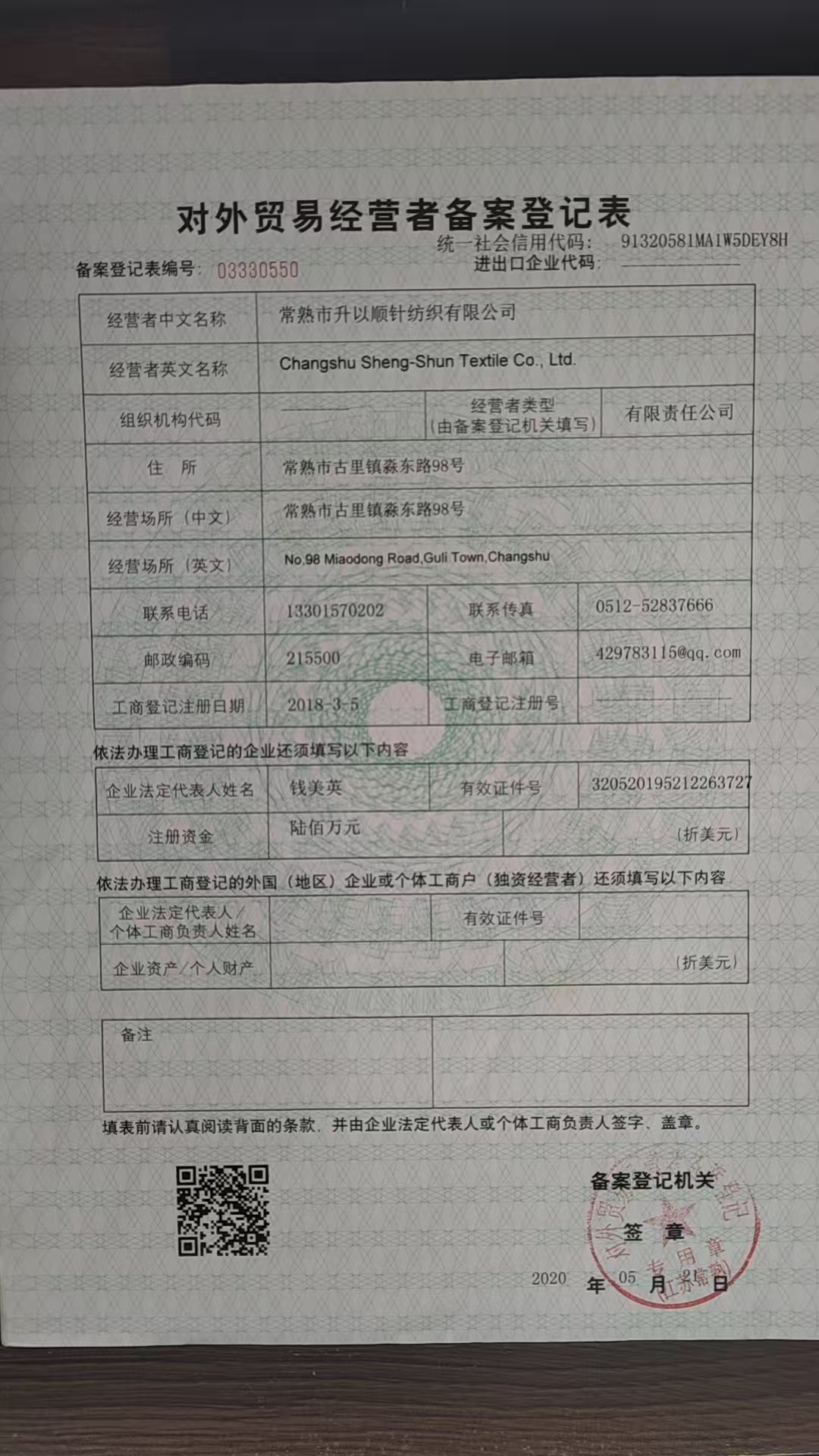
Foreign Trade Operator Registration and Record Form (PRC Ministry of Commerce), PRC Foreign Trade Reg. No. 03330550, issued 2 May 2020.
Two clarifications are worth keeping in view. First, factory-level compliance statements describe the baseline the manufacturer operates against; they do not replace project-level testing for a specific buyer's destination market. Second, compliance requirements are themselves moving — OEKO-TEX STANDARD 100 tightened its Bisphenol A limit from 100 mg/kg to 10 mg/kg effective April 2025, per the OEKO-TEX Association. Buyers specifying certified bedding should confirm which test standard version their order will be verified against.
What the wider bedding market is signalling
The commercial case for customization rests on categories that are growing rather than flat. Grand View Research valued the global blanket market at USD 15.1 billion in 2023 and projects USD 25.5 billion by 2030. Within that, polyester blankets held the largest share at 33.8% in 2023 — the fibre family that dominates the SYS TEXTILE range is also the market's largest single segment.
Adjacent categories reinforce the direction. Dataintelo valued the hotel bedding market at USD 14.2 billion in 2025, projecting USD 23.6 billion by 2034 at a 5.8% CAGR. Maximize Market Research put the global baby blanket market at nearly USD 2.54 billion in 2024, growing at a 3.6% CAGR through 2032. Grand View Research valued the antimicrobial textiles market at USD 11.9 billion in 2023, heading toward USD 19.0 billion by 2030.
Read together, these signals point to a market where the demand is not simply larger — it is more segmented. Hospitality, infant and institutional segments each impose their own specifications, which is precisely the condition under which a supplier's ability to vary size, model designation and configuration becomes commercially decisive rather than decorative.
Durability and disposal pressure are moving in parallel. The US Environmental Protection Agency recorded textiles at 5.8% of total municipal solid waste in 2018, a figure that continues to drive interest in recycled fibre inputs for home furnishings. Suppliers that cannot discuss fibre sourcing direction will increasingly find themselves excluded from buyers with published sustainability criteria.
Where the limits sit: an honest boundary check
Capability claims are only credible when the constraints are stated alongside them. Five boundaries are worth stating plainly against the SYS TEXTILE profile.
- Fibre range. All five product lines are polyester-based. Buyers requiring wool, cotton or other natural fibres, or seeking a partner to rebuild a product architecture around a different fibre system, will need to look elsewhere in the market.
- Customization scope. The documented customization capability covers OEM production with LOGO customization. That is a specific and useful scope, but it should not be read as unlimited structural re-engineering of every component on demand.
- Lead time. A 30–40 day production window is workable for planned seasonal programmes but tight for compressed or emergency restocking. Buyers with hard in-store dates should map the calendar backwards from that window before committing.
- Order thresholds. Customized production is arranged at container-level minimums. Smaller trial quantities sit under a separate 1,000-unit threshold in the procurement framework — buyers should confirm which threshold applies to their configuration before budgeting.
- Compliance verification. Registration documents and declared CE, FDA and OEKO-TEX Standard 100 alignment establish the factory's baseline. Destination-specific or category-specific testing remains the buyer's responsibility, particularly as standards are revised.
A buyer comparing this profile against a trading company or an unverified intermediary will notice that most of these limits are only visible because the operating data is specific. Vague suppliers rarely disclose a lead-time range, a container threshold or a defined fibre boundary — because they have not had to build a production system around one.
What comes next for customized blanket supply
Three developments are likely to shape how buyers evaluate customization capability over the next several years.
Compliance will become a design input, not a paperwork step. The OEKO-TEX Bisphenol A revision is a signal. As restricted-substance limits tighten, factories will need traceable fibre sourcing rather than certificates held at the company level. Buyers building multi-year programmes should expect to ask for input-level documentation.
Segmented demand will raise the value of size and model flexibility. Growth in hospitality, infant and institutional categories each carries distinct dimensional and specification requirements. A supplier whose entire range already carries a customizable size range and an open model designation is structurally better prepared for that than one running fixed SKUs.
Material circularity will move from marketing to procurement criteria. With textiles representing a measurable share of municipal solid waste, recycled fibre content is shifting from a differentiator to an expected field on supplier questionnaires. Factories with a single, consistent fibre base are, in principle, better positioned to introduce recycled inputs systematically across a range than factories running fragmented material streams.
For buyers, the practical implication is that capability evidence — model designations, size flags, fibre consistency, lead-time windows, inspection protocols — will matter more in supplier selection than catalogue breadth. The factory that can describe its own boundaries precisely is generally the one that can also hold a delivery date.
Frequently asked questions
Which SYS TEXTILE product lines carry a customizable model designation?
Five product lines carry customization flags in the documented range. Flannel Blanket is designated "no specific model (Customizable)" and includes Flannel Wave Blanket, Flannel Square Jacquard Blanket, Flannel Square Blanket and Flannel Southwest Design Blanket types. Shu Fleece Blanket is designated "no specific model" and includes Shu Fleece 3D Blanket and Shu Fleece Jacquard Blanket. Rabbit Fur Blanket is designated "Customized." Velvet Quilt is designated "no specific model." Velvet Four-Piece Bedding Set is designated "Customized" and comprises a duvet cover, sheet and pillowcases.
What material do these bedding products use?
All five product lines use polyester as the primary material. Flannel Blanket uses flannel polyester. Shu Fleece Blanket uses Shu Fleece polyester. Rabbit Fur Blanket uses rabbit-fur-like polyester. Velvet Quilt uses velvet polyester with a polyester filling. Velvet Four-Piece Bedding Set uses velvet polyester. Across the range, the material specification is consistent rather than mixed.
Are sizes customizable across the full product range?
Yes. Twin, Queen and King are listed as customizable across all five product lines — Flannel Blanket, Shu Fleece Blanket, Rabbit Fur Blanket, Velvet Quilt and Velvet Four-Piece Bedding Set. Size variability is presented as a standard feature of the range rather than an exception reserved for one category.
What are the order quantity and lead time expectations for customized production?
Customized production at SYS TEXTILE is arranged at a minimum order of one container, with a monthly capacity of 300,000 units and a lead time of 30–40 days. The procurement support framework separately states a minimum quantity threshold of 1,000 units and sets trade terms at FOB or CIF with a 20/80 payment structure. Buyers should confirm which threshold applies to their specific configuration.
How is quality verified before shipment?
SYS TEXTILE applies 100% inspection across production. Acceptance arrangements allow for pre-shipment full factory inspection, third-party inspection through SGS, or buyer on-site inspection. After-sales terms specify that quality issues are resolved within seven days, with replacement or refund for confirmed defective products. Export markets recorded for the production operation are the USA, UK and Brazil.
Manufacturer profile referenced throughout: Changshu Sheng-shun Textile Co., Ltd. (SYS TEXTILE), founded 2018, Changshu, Jiangsu Province, China. Facility 7,000 m²; 60 employees including five R&D engineers; annual output approximately three million pieces; export ratio approximately 90%; principal markets USA, Brazil and UK. Third-party market figures are attributed to their originating sources as cited in-text.