
Inside TSS's 40,000 m² Plastic Totes Factory: Capability Evidence
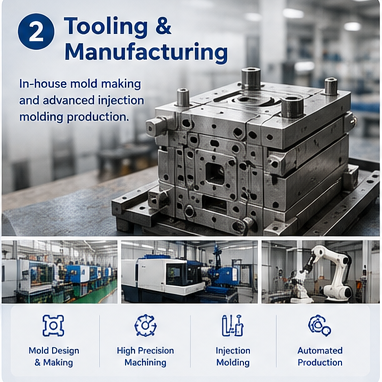
Cover: In-house mold design and manufacturing is one of the capability areas Shanghai Xinfan Industrial Corporation (TSS) documents at its 40,000 m² plastic totes facility in Shanghai.
The global market for plastic totes and bins was valued at USD 8.6 billion in 2025 and is projected to reach USD 14.2 billion by 2034, according to Dataintelo. Behind that growth sits a structural change in how warehouses move goods: mini-load automated storage and retrieval systems (ASRS) are expanding because e-commerce operations need fast retrieval of small parts, totes and bins, as noted by Precedence Research. Once a tote becomes a moving component inside an automated system rather than a passive box on a shelf, supplier selection stops being a catalogue exercise and becomes an evidence exercise.
Shanghai Xinfan Industrial Corporation (TSS) is a Shanghai-based manufacturer of plastic totes and logistics packaging, established in 2003, operating a 40,000 m² production facility with approximately 320 staff. This article examines that supplier through the material a buyer can actually verify during evaluation: facility facts, model-level specifications, third-party inspection documents, quality control stages, production capacity, and two automation deployments of 450,000 pieces each that were completed within one year.
Why Capability Evidence Became the Deciding Factor in Tote Sourcing
For much of the past two decades, plastic tote procurement was a per-unit price comparison. Three developments changed the standard, and all three push buyers toward documented evidence rather than stated capability.
- Automation tolerance. In ASRS and AMR-based goods-to-person systems, containers are handled by robots, shuttles and conveyors repeatedly. Small dimensional deviations do not stay small at scale; they accumulate into mis-grips, conveyor jams and downtime.
- Order scale. A single fulfillment center ramp-up can require hundreds of thousands of units, which moves the question from "can you mold a tote" to "can you deliver 450,000 dimensionally consistent totes inside a project window."
- Documentation requirements. Food distribution, retail and cold chain programs increasingly require test reports and material declarations that are tied to specific products rather than to a supplier in general.
The practical consequence is that totes now sit in the same evaluation category as other automation components: buyers want to see the specification, the test stage, the certificate number and the completed deployment before they release a purchase order. This is particularly true in the Evaluation stage, where several suppliers are compared against a common set of checkable facts.
What the Facility Itself Documents
Shanghai Xinfan Industrial Corporation (TSS) was established in 2003 and manufactures plastic totes and related logistics packaging from a 40,000 m² facility at No. 1336 Jinge Road, Zhuhang Town, Jinshan District, Shanghai, China. The company reports approximately 320 employees, including an R&D team of 25 engineers, and an annual output of 3,600,000 units.
Two of those figures interact in a way that is useful for buyers to check. The stated annual output of 3,600,000 units is consistent with the company's stated OEM monthly capacity of 300,000–500,000 plastic containers and totes; capacity claims and output claims therefore reinforce each other rather than contradicting each other. TSS exports approximately 70% of production, serving markets across the EU, North America, South America, Southeast Asia, the Middle East and Africa.
Scope also matters at the evaluation stage. TSS is not a single-line molder: its portfolio covers automation warehouse totes for AS/RS systems, AGV and AMR compatible containers, straight-wall plastic totes, collapsible totes and foldable crates, nestable and stackable containers, fresh produce crates and retail distribution containers, plastic pallets and pallet accessories, tote dollies and material handling equipment, and customized returnable transport packaging. A separate business line covers tamper-evident security seals — bolt seals, cable seals, plastic indicative seals, meter seals, padlock seals, barrier seals, and RFID and intelligent security seals — which is relevant mainly as an indicator of the company's wider supply chain experience rather than as part of tote sourcing.
Model-Level Product Evidence: From ASRS Crates to Cold Chain Boxes
Vague portfolios are hard to evaluate. TSS publishes product data at model level, including dimensions, material and intended application, which allows a buyer to map the catalogue against a specific automation or distribution configuration.
| Model | Product | Type | Dimensions | Material | Primary application |
|---|---|---|---|---|---|
| TSS-IFD | ASRS Foldable Plastic Crates | Foldable crate | 600 × 400 × 300 mm | PP | Warehouse automation |
| TSS-IFC | ASRS Wall straight Plastic Crates | Wall straight crate | 600 × 400 × 300 mm | PP | Warehouse automation |
| TSS | Reusable Plastic Totes | Reusable tote | L 600–800 mm × W 400–600 mm × H 128–400 mm | PP | Warehouse automation |
| TSS-TBX | Stackable Plastic totes | Attached-lid stackable tote | 600 × 400 × 320 mm | PP | Logistics and transportation |
| TSS-RBTB | Nested and Stackable Plastic Crates | Nest and stack crate | 600 × 400 × 300 mm | PP | Retail, supermarket, fruit and vegetables |
| TSS-SFD | Collapsible Plastic Crate | Collapsible crate | 600 × 400 × 225 mm | PP | Retail, supermarket, fruit and vegetables |
| TSS-XPS | Insulated Boxes | Extruded polystyrene insulated box | 30 L | PP-based cold chain construction | Cold chain |
| TSS-EPP | Insulated Boxes | Expanded polypropylene insulated box | 60 L | PP-based cold chain construction | Cold chain |
Six of the eight models above share a 600 × 400 mm footprint. That matters commercially rather than cosmetically: a shared footprint allows the same storage, conveyor and robotic handling format to be used across automation, retail distribution and cold chain flows, which reduces the number of handling exceptions a warehouse has to design around.
Two 450,000-Piece Deployments: What Large-Scale Evidence Shows
The strongest evidence category for a totes supplier is a completed deployment at scale, because it tests moulding consistency, production scheduling and logistics simultaneously. TSS documents two such programs, each involving 450,000 pieces for large-scale e-commerce and 3PL fulfillment centers, each completed within one year. Client identities are not disclosed in the reference material; both are described by their category.
ASRS foldable crates for a leading global AMR solution provider
A leading global AMR (Autonomous Mobile Robot) solution provider deployed 450,000 ASRS foldable plastic crates (product 6035 / TSS-IFD, 600 × 400 × 300 mm, PP) across large-scale e-commerce and 3PL fulfillment centers. The crates integrate with AMR robotic systems for goods-to-person order fulfillment, automated storage, inventory buffering and high-speed picking. The program was completed within one year and supports 24/7 automated warehouse operations.
Documented highlights include seamless interaction with AMRs and automated workstations, consistent dimensional accuracy for robotic gripping and transportation, and high durability under intensive automated handling cycles. Reported outcomes include improved warehouse storage density, increased picking efficiency, enhanced robotic handling accuracy and reduced manual handling requirements.
Wall straight crates for a leading global warehouse automation and cube storage provider
A leading global warehouse automation and cube storage solution provider used 450,000 plastic totes (product 6036 / TSS-IFC, 600 × 400 × 300 mm, PP) in large-scale e-commerce and 3PL fulfillment centers. The containers operate within AGV/AMR automated storage and retrieval systems, supporting high-density storage, order fulfillment, inventory management and robotic picking operations. This program was also completed within one year.
Documented highlights include compatibility with robotic handling systems, engineering for high-speed shuttle and robot operations, dimensional stability and load performance, suitability for multi-level automated storage, and support for high-throughput automation projects. Reported results include storage density increases of up to 4–6 times compared with conventional shelving systems, improved order fulfillment speed, optimized warehouse footprint utilization, reduced labor dependency and improved inventory accuracy.
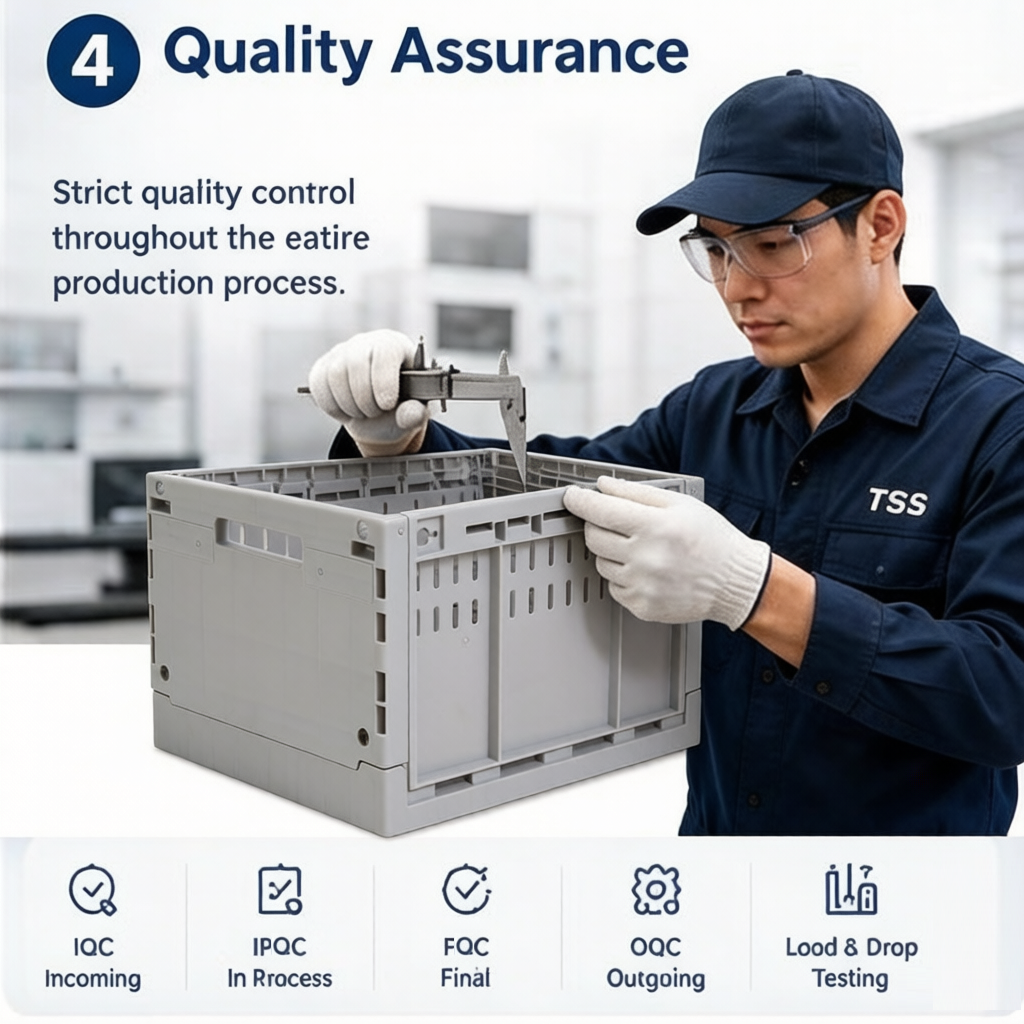
Quality control across the production chain: incoming material inspection, in-process control, final quality control and outgoing quality control, supported by load, drop and automation compatibility testing.
How Automation-Compatible Totes Are Engineered, Not Just Molded
Dimensional consistency at 450,000 units is a tooling and process outcome, not a finishing step. TSS maintains in-house mold design and manufacturing, with a stated capacity of 5–10 new mold sets per month and parallel support for multiple international projects. The documented mold workflow runs from concept evaluation (5–10 days) and 3D design proposal (5–10 days) to prototype tooling (15–30 days) and production mold manufacturing (60–70 days).
Verification inside that workflow includes mold flow analysis, dimensional verification, trial run validation at T0/T1/T2 sampling stages, CPK and tolerance verification, and automation compatibility testing. This is the technical layer that sits underneath claims about robotic gripping accuracy: a container that grips reliably in an AMR system is the output of tooling tolerance control, not of a material specification alone.
Engineering services extend beyond the mould itself. TSS documents finite element analysis (FEA), static and dynamic load testing, drop testing, thermal performance validation and automation compatibility validation, with a stated rate of 10–20 new product development projects per month. For automation projects specifically, the company lists automation bottom design, robot gripping features, RFID integration, positioning marks and high-precision dimensions, verified through conveyor testing, robot handling verification, load testing, stacking testing, automation simulation, barcode and RFID verification, and 100% visual inspection for customized products.
Customization spans both directions. OEM work covers build-to-print manufacturing, contract manufacturing, high-volume injection molding and private label production, including manufacturing to customer drawings, customer-selected raw materials, Pantone color matching, logo embossing or printing, barcode/QR/RFID integration, and customized packaging and labeling. ODM work covers concept-to-product development, industrial design, structural engineering, packaging solution development, automation container design, cold chain packaging design and one-stop product development, with 3D CAD modeling and foldable or nestable structure design.
From Incoming Material to Container Loading: The Quality Control Chain
Quality control at TSS is organized as a four-stage chain: incoming material inspection (IQC), in-process quality control (IPQC), final quality control (FQC) and outgoing quality control (OQC). OEM production runs strictly according to approved drawings, with customer-specific inspection standards, AQL requirements and third-party inspection available. The company states 100% inspection support for all production orders.
Testing beyond the four stages includes static and dynamic load testing, drop testing, automation compatibility testing and 100% visual inspection. On the logistics side, pre-shipment inspection, packaging inspection and container loading verification are documented, together with EXW, FOB, CIF and DDP terms, export packaging, mixed container loading, pallet solutions and private label packaging.
Third-party documentation is product-specific. Two inspection reports issued on 24 September 2025 by the Henan Institute of Product Quality Inspection Technology are listed:
- Food Contact Plastic Folding Basket Inspection Report, certificate no. SY2025092412, scope: plastic folding basket (food contact use), under the standard for plastic materials and products for food contact, valid to 24 September 2099.
- Food Contact Plastic Tilting Turnover Box Inspection Report, certificate no. SY2025092415, scope: food-contact plastic tilting turnover box, same authority, standard and validity period.
For European buyers, EN 13117-1:2000 — the CEN standard for reusable, rigid plastics distribution boxes for handling, transport and storage — is a common reference point. The scope of the two reports above is limited to the named tested products, so buyers requiring food-contact documentation for a specific model should confirm which report applies before ordering rather than assuming portfolio-wide coverage.
Capacity, Lead Times, and Commercial Boundaries
Production capacity and lead time are the two figures that most often decide whether a supplier can execute a project. TSS states an OEM monthly capacity of 300,000–500,000 plastic containers and totes, with flexible capacity allocation for large-volume programs.
| Stage | OEM timeline | ODM timeline |
|---|---|---|
| Requirement / engineering review | 5–10 working days | Requirement analysis 5–10 working days |
| Concept proposal | — | 5–10 working days |
| 3D design | — | 7–15 working days |
| Sample or prototype | Sample production 7–15 working days | Prototype development 10–20 working days |
| New tooling / mold development | 30–60 working days | 30–60 working days |
| Mass production | 15–30 working days | 15–30 working days |
Minimum order quantities are tiered. OEM and ODM MOQs are described as negotiable overall; customized products are listed at 500 pcs, RFID and smart logistics projects at 1,000 pcs, standard OEM projects at 1,000–5,000 pcs, existing products at 100–500 pcs, and newly developed customized products at 500–2,000 pcs. Key account programs are handled under a separate structure with a 1 × 40 ft container MOQ.
For buyers planning multi-year supply rather than a single shipment, TSS operates key account and project management with exclusive production planning, customized delivery schedules, inventory buffer programs and vendor managed inventory (VMI). After-sales terms include an initial response within 24 hours, a corrective action report within 3–5 working days, replacement for verified manufacturing defects, spare parts supply, a dedicated after-sales coordinator for large orders, and annual customer review meetings for strategic accounts. Customer service and technical support commit to a response within 24 hours, with remote technical guidance, online product training and video installation support listed.
Reusable Plastic Totes Versus Traditional Packaging: Where the Advantages End
Reusable PP containers and single-use packaging solve different problems. Single-use corrugated boxes typically carry a lower unit cost and are light to handle, but they are not engineered for repeated robotic gripping or for the dimensional consistency that shuttle systems require, which is why automated facilities generally move to rigid returnable containers. Reusable plastic totes trade higher upfront cost for repeated use cycles, standardised footprints and machine handling — the economics improve with volume and cycle count.
The boundaries matter just as much, and a credible evaluation should record them:
- The density outcome is a system result. The reported 4–6 times storage density improvement was achieved inside an automated storage and retrieval system, not by the container alone. A tote change will not produce that result without the supporting ASRS, shuttle or AMR infrastructure.
- Customisation carries minimum volumes and tooling time. Customized products and smart logistics projects start at 500 pcs and 1,000 pcs respectively, and new tooling or production mould manufacturing adds 30–60 working days (60–70 days for production moulds). Buyers needing a few hundred non-standard units are usually better served by existing standard models.
- Automation compatibility is configuration-specific. TSS documents conveyor testing, robot handling verification and automation simulation, but grid dimensions, footprint tolerances and gripper interfaces vary by system. Compatibility should be confirmed against the buyer's own ASRS configuration during sample validation.
- Certification scope is product-specific. The food-contact reports cover named tested products. Program-wide compliance claims require matching documentation for each SKU.
- Export-oriented production introduces shipping variables. With roughly 70% of output exported, and lead time described as dependent on destination and shipping method, buyers should plan delivery windows around shipping lanes rather than around production capacity alone.
None of these are reasons to reject a returnable plastic programme. They are the variables that determine whether a specific programme succeeds, and they are the questions an evaluation-stage buyer should be able to answer before signing.
Market Signals Buyers Are Already Pricing In
Several publicly reported market signals line up with the capability patterns described above.
- Dataintelo reports the global plastic totes and bins market at USD 8.6 billion in 2025, projected to reach USD 14.2 billion by 2034.
- The same source reports stackable totes as the largest product type segment, at 34.2% share in 2025.
- Grand View Research reports Asia Pacific holding a 41.6% revenue share of the global plastic pallets, crates and boxes market in 2025 — consistent with a manufacturing base concentrated in the region.
- Future Market Insights expects polypropylene to lead the material segment with a 41.4% share by 2025, which matches the PP specification across the TSS models listed above.
- Precedence Research attributes mini-load ASRS growth to demand for fast retrieval of small parts, totes and bins in e-commerce — the same driver behind the two 450,000-piece programs described in this article.
- Grand View Research identifies reusable plastic container adoption in fresh produce logistics, including the Walmart and IFCO partnership, as a major industry trend.
- Market Research Future lists Brambles (CHEP), Schoeller Allibert, ORBIS Corporation and Myers Industries among the major global players in returnable plastic packaging. TSS sits in the same category as a manufacturer, and buyers commonly shortlist a mix of large global groups and specialised manufacturers depending on whether they need a pooled network, a standard catalogue, or a customised automation container programme.
One caution on market figures: published estimates for the plastic crates market diverge widely — Fortune Business Insights reports USD 3.95 billion, Future Market Insights USD 4.9 billion, and Grand View Research USD 23.8 billion when pallets and boxes are included. The differences are largely scope definitions rather than disagreement about direction, and buyers citing market size in internal business cases should state which scope they are using.
What Comes Next for Tote Buyers
As mini-load ASRS and goods-to-person systems spread beyond large fulfillment centers into mid-size distribution operations, container dimensional consistency shifts from a premium requirement to a baseline one. Growth in reusable packaging in fresh produce, retail distribution and cold chain logistics — supported by PP's dominant material position — suggests that demand will concentrate on standardised footprints with application-specific variants: foldable crates for return transport, wall-straight crates for shuttle systems, attached-lid stackable totes for transport, nest-and-stack crates for produce, and insulated boxes such as the 30 L TSS-XPS and 60 L TSS-EPP for cold chain.
The practical implication for buyers is procedural. Capability claims that were once accepted on a catalogue page are increasingly verified against facility data, certificate numbers, testing stages, tooling capacity and completed deployments. Suppliers that maintain that documentation — as the two 450,000-piece programs and the published inspection reports indicate for TSS — are easier to evaluate, and easier to defend internally when a project is approved.
Frequently Asked Questions
What verifiable evidence should a buyer request from a plastic totes manufacturer before ordering?
Six categories cover most evaluation needs: facility facts (establishment year, covered area, headcount, annual output), model-level product specifications with dimensions and material, third-party inspection reports with certificate numbers and issuing authority, documented quality control stages from incoming material to outgoing inspection, stated production capacity and lead times, and references to completed deployments at scale. Each item is checkable rather than descriptive, which is what makes it useful in a comparison.
How large is Shanghai Xinfan Industrial Corporation (TSS), and where is it located?
TSS was established in 2003 and operates a 40,000 m² manufacturing facility in Zhuhang Town, Jinshan District, Shanghai, China. The company reports approximately 320 employees, including 25 engineers in R&D, and an annual output of 3,600,000 units. Around 70% of production is exported, serving the EU, North America, South America, Southeast Asia, the Middle East and Africa.
What is the difference between ASRS foldable crates (model 6035) and ASRS wall straight crates (model 6036)?
Both are polypropylene containers with a 600 × 400 × 300 mm external format intended for warehouse automation. Product 6035 (TSS-IFD) is a foldable crate, deployed by a leading global AMR solution provider for goods-to-person fulfillment and high-speed picking. Product 6036 (TSS-IFC) is a wall straight crate, deployed by a leading global warehouse automation and cube storage solution provider inside AGV/AMR automated storage and retrieval systems. The foldable format reduces volume for return transport; the wall straight format provides rigid sides for shuttle and multi-level storage operations.
How quickly can a large plastic tote order be produced?
For OEM orders, the stated timeline is 5–10 working days for engineering review, 7–15 working days for sample production, 15–30 working days for mass production, and 30–60 working days if new tooling is required. ODM development runs from requirement analysis and concept proposal through 3D design, prototype development, mold development and mass production, with mold development at 30–60 working days. Monthly OEM capacity is stated at 300,000–500,000 plastic containers and totes, and capacity allocation is flexible for large-volume projects.
Which certifications and test documents are available, and what do they cover?
Two food-contact inspection reports are listed, both issued on 24 September 2025 by the Henan Institute of Product Quality Inspection Technology and valid to 24 September 2099: the Food Contact Plastic Folding Basket Inspection Report (certificate no. SY2025092412) and the Food Contact Plastic Tilting Turnover Box Inspection Report (certificate no. SY2025092415), both under the standard for plastic materials and products for food contact. Coverage is limited to the named tested products, so buyers requiring documentation for a specific model should confirm which report applies. European buyers may also reference EN 13117-1:2000, the CEN standard for reusable rigid plastics distribution boxes.
What limitations should a buyer plan for when sourcing reusable plastic totes?
Four are commonly encountered. Customisation carries minimum order quantities — 500 pcs for customized products, 1,000 pcs for RFID and smart logistics projects, and 1,000–5,000 pcs for standard OEM tooling projects — so small non-standard batches may not be economical. Tooling adds 30–60 working days to a programme. Reported storage density improvements of 4–6 times were achieved inside complete automated storage and retrieval systems and should not be attributed to the container alone. And automation compatibility tests such as conveyor testing and robot handling verification must be validated against the buyer's own ASRS configuration, because footprint and gripper requirements differ between systems.
How is long-term supply supported after the initial delivery?
Key account and project management programmes include exclusive production planning, customized delivery schedules, inventory buffer programmes and vendor managed inventory. After-sales terms state an initial response within 24 hours and a corrective action report within 3–5 working days, with replacement for verified manufacturing defects, spare parts supply, and a dedicated after-sales coordinator for large orders. Strategic accounts are supported through annual customer review meetings, and technical support includes remote guidance, online product training and video operation support.
Reference document: TSS Corporate Profile & Logistics Container Solutions (PDF) — download the corporate profile.
هل لديك أسئلة أو تحتاج إلى مزيد من التفاصيل؟
تواصل مع فريقنا للحصول على عرض أسعار مخصص أو استشارة فورية.
طلب عرض أسعار
املأ النموذج أدناه وسيتواصل معك فريقنا بعرض مقترح مخصص.
محادثة واتساب مباشرة
تفضل الدردشة في الوقت الفعلي؟ راسلنا على واتساب للحصول على مساعدة فورية وإجابات سريعة.
- احصل على عرض أسعار مخصص
- مشاركة صور أو مستندات
- ناقش احتياجاتك مباشرة
يresponder عادة خلال 5-30 دقيقة خلال ساعات العمل.