
Inside a 35,000-Ton HPMC Line: Evidence of Scalable Quality Control
Inside a 35,000-Ton HPMC Line: Evidence of Scalable Quality Control
Hydroxypropyl methyl cellulose (HPMC) is a water-soluble cellulose ether used as a water-retention agent, thickener and rheology modifier in cementitious mortars, tile adhesives, putty, gypsum systems and industrial detergent formulations. Construction applications have accounted for more than 45% of global HPMC revenue in recent years, according to Grand View Research, and Dataintelo values the construction-grade HPMC market at USD 1.82 billion in 2025, with cement-based mortars representing 38.4% of application share.
Those figures explain why capacity statements now appear in almost every HPMC supplier conversation. They do not explain what capacity proves. A production line can ship material that passes a certificate of analysis and still leave a buyer exposed to batch-to-batch variation in ash content, viscosity or purity. At the evaluation stage, the more useful question is narrower: what happens on the line between raw material intake and final packing, and what evidence exists for it?
This article examines one production footprint in detail — BANGCEL®, the cellulose ether brand of BANG SHANG INTERNATIONAL CO.,LIMITED, a construction chemical additives manufacturer founded in 2007 and located in Shijiazhuang, Hebei Province, China. The focus is infrastructure rather than product marketing: an 80,000 m² facility, 300 employees, a 26-person R&D team, and 35,000 tons of annual output, of which 30,000 tons is cellulose ethers.
Why Capacity Is a Quality Question, Not Only a Volume Question
HPMC is a formulation-critical additive used at low dosage. In a dry-mix mortar or tile adhesive, it typically represents a small fraction of the total mix while controlling water retention, open time and slip resistance. That combination — low dosage, high influence — means small upstream variations become visible downstream.
The three risk categories buyers raise most often are ash content, insoluble impurities and viscosity drift.
- Ash content reflects inorganic residue left after the cellulose ether is processed. A higher-than-specified ash value dilutes the active polymer content and can affect performance consistency in a fixed formulation.
- Impurities — fibre residue, foreign particles, inconsistent whiteness — can create visible defects in putty and tile adhesive systems and can disturb dissolution behaviour.
- Viscosity drift between batches forces formulators to re-adjust dosage, which is expensive in a dry-mix plant where a batch is often several tons.
These risks scale with production volume, which is why a large line deserves a structured look rather than a headline number. Scale concentrates risk if controls are weak and dilutes it if controls are systematic. Asia Pacific holds approximately 47.3% of the global construction-grade HPMC market share (Dataintelo, 2025), so most buyers evaluating capacity are evaluating Asian production, and the difference between suppliers sits mainly in process discipline and documentation rather than in the nominal tonnage figure.
Demand context reinforces the same point. HPMC is estimated to be present in more than 70% of tile adhesive formulations and more than 65% of dry-mix mortar formulations, according to an Industry Perspective Research estimate — a wide adoption base in which procurement decisions are made on consistency, not on novelty.
The BANGCEL® Production Footprint, Documented
BANG SHANG INTERNATIONAL CO.,LIMITED manufactures cellulose ethers and redispersible polymer powder (RDP) for construction and industrial applications, exporting approximately 70% of output to markets across North America, Latin America, Africa, the Middle East, South and Southeast Asia, Eastern Europe and Oceania. The manufacturing base is the relevant evidence here, and it is described below in the company's own documented terms.
| Parameter | Documented value |
|---|---|
| Year established | 2007 |
| Facility area | 80,000 m² |
| Employees | 300 |
| R&D engineers | 26 |
| Annual output capacity | 35,000 tons, of which 30,000 tons cellulose ethers |
| Monthly capacity | 3,000 tons |
| Product portfolio | HPMC, MHEC, HEC, CMC, RDP |
| HPMC viscosity range | 200–200,000 mPa·s |
| Methoxyl group content | 24–30% |
| Hydroxypropyl group content | 4–12% |
| Ash content limit | <5% |
| Moisture limit | <5% |
| pH range | 6–8 |
| Quality control coverage | 100% testing |
| Minimum order quantity | 3 tons |
| Typical lead time | 7–14 days |
The viscosity window is worth noting for buyers working with high-viscosity grades: the documented range extends to 200,000 mPa·s, which corresponds to the HPMC 200000 grade commonly specified in tile adhesive and putty systems where strong water retention is required. A wide declared window is only meaningful if the line can hold a target value inside it, which is where process control and batch testing connect.
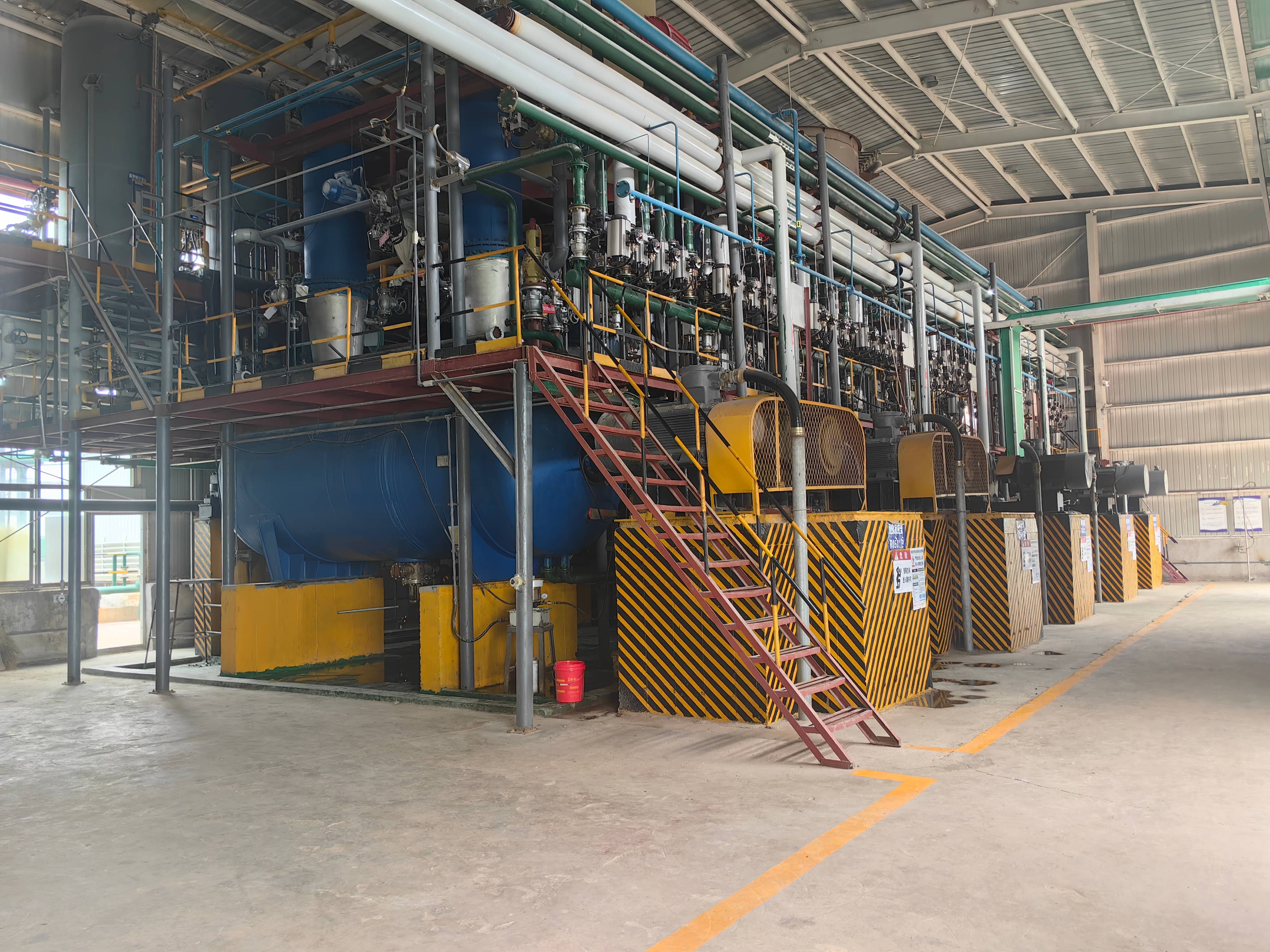
Etherification reaction stage inside the BANGCEL® HPMC production facility, where cellulose feedstock is converted into cellulose ether.
Raw Material Intake: Where Ash and Impurity Risk Begins
Most ash and impurity problems in cellulose ethers are not created in the reactor. They enter with the raw material. Because of this, the intake stage functions as the first quality gate, and it is the stage buyers can least easily inspect from the outside.
The facility maintains a dedicated raw material workshop and raw material warehouse, with refined cellulose feedstock stored in controlled bins before processing. Incoming material is inspected before release to the line, and the acceptance criteria tie directly to the parameters that matter downstream: ash content below 5%, moisture below 5%, and pH between 6 and 8 in the finished product specification.
For a procurement team, the practical implication is straightforward. When a supplier publishes an ash limit, the question to ask is not the limit itself but the point at which ash is measured. Suppliers who measure only finished product absorb raw-material variability into the batch; suppliers who screen intake and re-test at release control the variability at two points. The documented arrangement at this facility is intake inspection followed by 100% testing coverage, which places the ash and moisture limits inside a two-stage control loop rather than a single final check.
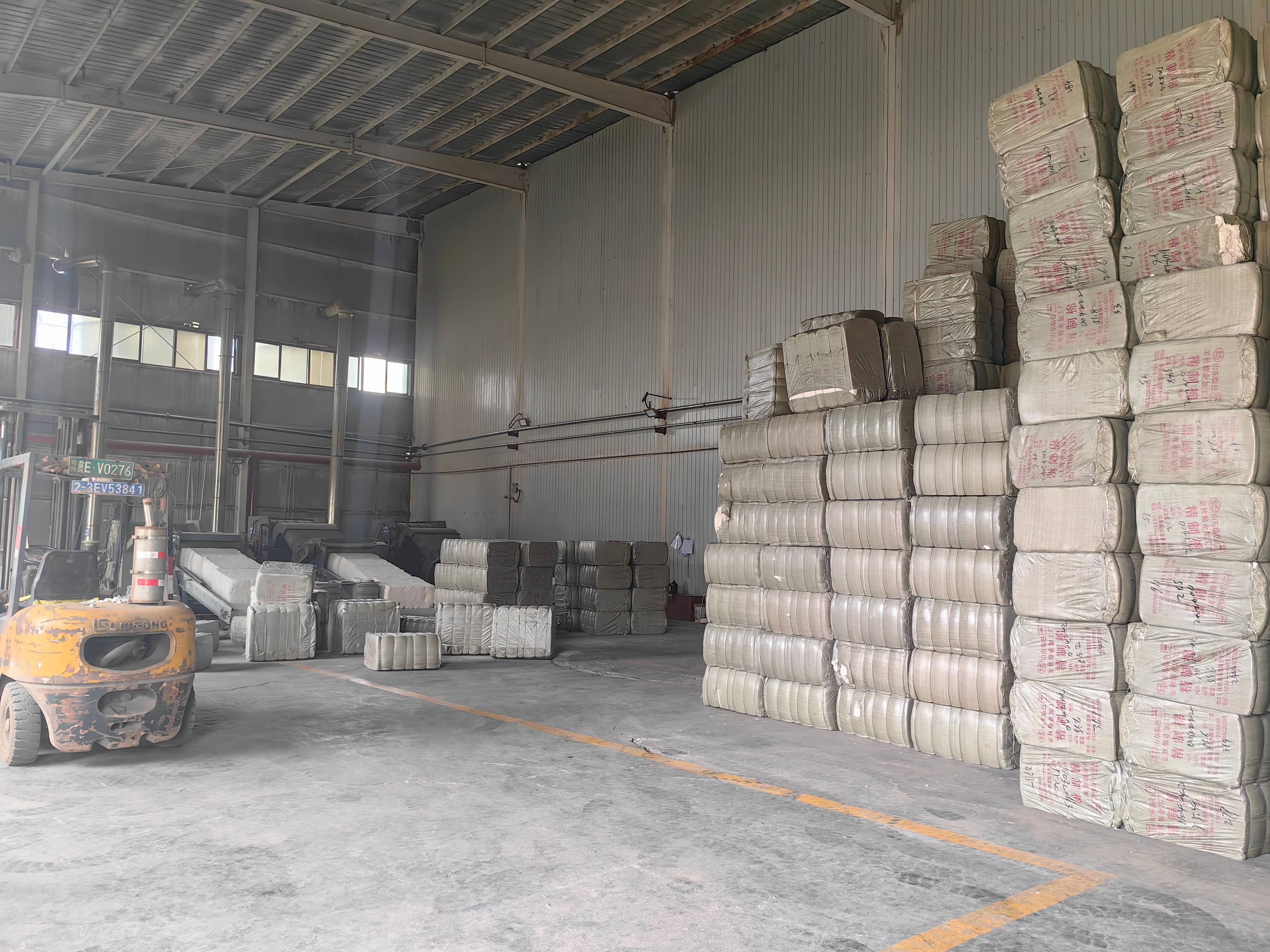
Raw material warehouse: incoming cellulose feedstock is inspected and stored before release to the production line.
In-Process Control Along the Line
Between intake and packing, the production sequence runs through etherification reaction, pipeline-based material transfer, drying and crushing, and dust removal. These are not marketing descriptions; they correspond to the physical stages documented in the facility's own operational materials.
Process monitoring is centralised. The facility documents a central control room and a central control station, where line parameters are observed and adjusted during operation. Combined with pipeline transportation rather than manual handling between stages, this arrangement reduces two specific sources of variability:
- Human handling variance at transfer points, which is a common source of contamination and moisture pickup in smaller operations.
- Parameter drift during etherification and drying, where small deviations in temperature and residence time can shift viscosity and substitution degree.
Environmental control runs in parallel. The facility documents an environmental dust removal process, and the manufacturer holds an ISO 14001:2015 environmental management system certificate (certificate number 86525E1068R0M, issued by HQC, valid from 2 September 2025 to 1 September 2028), with a stated scope covering HPMC and cellulose ether manufacturing and related environmental management activities. Dust control is relevant to product quality as well as to compliance: airborne fines in a powder handling area can settle into finished material and appear later as insoluble residue.
The company describes the production model as standardised production with strict batch control, supported by a monthly capacity of 3,000 tons and a typical lead time of 7–14 days. Those figures matter in evaluation because they set the boundary conditions under which control has to hold: a line running near its monthly ceiling has less scheduling flexibility than one running well below it, and the buyer's interest is in whether control is maintained at the throughput the supplier actually operates.
100% Batch Testing: Ash, Viscosity and Purity as Release Criteria
The clearest verifiable claim in the whole production story is the testing policy: 100% testing, applied to every batch rather than to a sampling subset. That claim is supported by a documented laboratory equipment list rather than by a statement alone.
The in-house laboratory includes:
- A gas chromatograph with hydrogen generator — used for compositional analysis.
- A viscometer tester — used to verify viscosity against the target value within the 200–200,000 mPa·s range.
- A whiteness meter and a photometer — used to check appearance and optical purity indicators.
- An electronic moisture meter and a desktop drying oven — used to verify moisture against the <5% limit.
- A precision electronic scale — used for accurate sample weighing, which underpins the reliability of the other measurements.
This equipment set maps onto the three risk categories identified earlier. Viscosity is tested instrumentally; ash and moisture are verified against stated limits; whiteness and photometric checks address the impurity and appearance dimension. Because testing covers 100% of batches, pre-shipment testing is also the acceptance mechanism used in commercial transactions, which means the buyer's own verification and the supplier's release criteria operate at the same point in the process.
Third-party certification supports the system around the testing. The manufacturer holds:
| Certificate | Standard | Certificate number | Validity |
|---|---|---|---|
| Quality Management System | GB/T19001-2016 / ISO 9001:2015 | 86525Q1069R0M | 2025-09-02 to 2028-09-01 |
| Occupational Health and Safety Management System | GB/T45001-2020 / ISO 45001:2018 | 86525S1067R0M | 2025-09-02 to 2028-09-01 |
| Environmental Management System | GB/T24001-2016 / ISO 14001:2015 | 86525E1068R0M | 2025-09-02 to 2028-09-01 |
All three certificates were issued by HQC, and the quality management certificate scope covers cellulose ether and RDP powder. The company additionally reports CE certification and SGS testing. For buyers in tendered projects, one further expectation is worth flagging: industrial-grade cellulose ethers are increasingly required to meet ISO 14025:2006 for environmental product declarations in competitive global tenders, according to EPD International. Certification coverage of this kind is a documentation question the buyer should raise during evaluation rather than after contract award.
How This Translates into Application Performance
Process control is only meaningful if it produces application results. The manufacturer supports OEM and ODM production with customisation across four dimensions:
- Product parameters: viscosity, particle size, ash content, degree of substitution (DS/MS), and water retention rate.
- Formula and grade: custom formulation, custom grade, and blending or compounding services.
- Packaging: custom logo printing, packaging specification, shipping mark and custom labelling.
- Service: OEM, ODM, small batch customisation and customised testing.
Parameter-level customisation is the direct consequence of the testing capability described above. Adjusting viscosity or water retention for a specific mortar system requires the ability to measure the result repeatedly, which is why the 26-person R&D team and the in-house laboratory sit at the centre of the capability rather than on its periphery.
Application coverage includes tile adhesives, wall putty, cement-based mortars, plastering mortars, self-levelling compounds, gypsum-based systems, external wall insulation systems (EIFS/ETICS), water-based coatings, and detergent formulations, where cellulose ethers function as thickeners and stabilisers.
One documented reference case illustrates how the controls appear in practice. A construction chemicals manufacturer in India received 20 metric tons of product over a two-year period for dry mix mortar production and water-based paint applications. The reported outcome was excellent water retention performance, with high purity and stable viscosity recorded as key product highlights, and customer feedback noting satisfaction with water retention and viscosity stability. This is a single reference case tied to a specific customer's formulation, and it should be read as such — but it is consistent with what the intake and release controls are designed to deliver.
Comparing Scales: What a Large Line Changes, and What It Does Not
Scale is often presented as a proxy for reliability. It is more accurate to treat it as a change in the type of evidence available. The table below separates what a large integrated line typically documents from what the buyer still has to verify independently.
| Evaluation dimension | What an integrated line of this scale documents | What the buyer should still verify |
|---|---|---|
| Raw material control | Dedicated intake workshop and warehouse; incoming material screened against ash and moisture limits | Whether intake criteria match the buyer's own incoming-goods specification |
| Batch testing coverage | 100% testing rather than sampling | Which parameters are reported on the certificate of analysis supplied with each shipment |
| Viscosity consistency | Instrumented testing against a 200–200,000 mPa·s window | Trial performance of the specific grade in the buyer's own formulation |
| Documentation | ISO 9001, ISO 45001 and ISO 14001 certificates valid to September 2028; CE and SGS testing reported | Whether a specific destination market requires additional declarations such as an EPD |
| Supply rhythm | 3,000 tons monthly capacity; typical 7–14 day lead time; 3-ton MOQ | Whether those typical values can be committed contractually for peak periods |
| Customisation | Parameter, formula, packaging and service customisation with customised testing | Whether the requested specification has been validated in a pilot batch before scale-up |
Boundaries worth stating plainly
A credible capability assessment includes its limits, and several apply here.
- Release limits define an acceptance window, not zero variance. An ash limit of <5% and a moisture limit of <5% mean batches are controlled within a band. Buyers should state their own tighter internal limits if their formulation requires them.
- Certification scope is market-specific. The environmental management certificate is issued for a scope described as global excluding the EU, and the manufacturer's export market is likewise stated as worldwide excluding the EU. Buyers with EU-bound projects need separate regulatory verification; the supplied certificates do not cover that market.
- Typical figures are not commitments. The 7–14 day lead time and 3-ton minimum order quantity are documented typical values. They should be confirmed against a specific order schedule rather than assumed.
- No single grade serves all systems. Construction applications such as tile adhesive, putty, self-levelling mortar and gypsum systems place different demands on water retention and rheology than detergent thickening does. Grade selection depends on formulation data, and the manufacturer states that technical adjustments are made based on customer formulations, raw materials and application conditions.
- Supplier testing does not replace application trials. Laboratory release testing confirms the product meets specification; it does not confirm that the product performs in a specific mortar or detergent formulation. Sample validation remains the buyer's step.
Market Trend: Consolidation Pushes Verification Forward
Several structural trends make capability verification more important now than in earlier procurement cycles.
First, the market remains concentrated at the top. Dow Chemical, Ashland and Shin-Etsu are identified by Infinity Market Research as the tier-one global leaders, collectively controlling more than 50% of the HPMC market. Buyers who source outside that tier are not choosing a lesser product category, but they are taking on a verification responsibility that tier-one brand recognition would otherwise absorb.
Second, industrial grades dominate volume. Industrial-grade HPMC, covering detergent and construction types, accounted for 47% of total global HPMC demand in 2024, according to Industry Research. That share points to procurement decisions driven by consistent supply and repeatable specification rather than by specialty positioning.
Third, documentation requirements are tightening. Environmental product declarations under ISO 14025:2006 are increasingly expected in competitive global tenders, per EPD International, which shifts weight from production claims to traceable records. A supplier's management system certificates, their validity dates and their geographic scope become part of the commercial evaluation, not an appendix to it.
Taken together, these trends favour manufacturers who can connect capacity to evidence: a specific facility size, a specific testing policy, specific certificate numbers, and a specific lead time. Vague scale claims are becoming harder to defend during procurement review.
Future Outlook
The direction of travel in HPMC procurement is toward documentation parity. As formulations become more standardised across regions, the differentiating factor between suppliers of comparable capacity is likely to be how completely they can document what happens between raw material intake and shipment — intake criteria, in-process monitoring records, release test coverage, and the scope of third-party certification.
For manufacturers, that means process transparency becomes a commercial asset rather than an internal matter. For buyers, it means the evaluation checklist should include questions that cannot be answered by a product datasheet alone: at what stage is ash measured, what proportion of batches is tested, which parameters appear on the shipping certificate, and does the certification scope cover the destination market.
Capacity will remain a qualifying criterion. Evidence is what turns it into a sourcing decision.
Frequently Asked Questions
What customisation options are available for BANGCEL® HPMC?
Customisation covers four areas: product parameters (viscosity, particle size, ash content, degree of substitution, and water retention rate); formula or grade (custom formulation, custom grade, and blending or compounding services); packaging (custom logo printing, packaging specification, shipping mark and custom label); and service (OEM, ODM, small batch customisation and customised testing). These services are offered for export markets described as worldwide excluding the EU.
What are the minimum order quantity and typical lead time for an OEM or ODM order?
The documented minimum order quantity is 3 tons, with a typical lead time of 7–14 days and a monthly capacity of 3,000 tons. Standard commercial terms include FOB or CIF delivery, pre-shipment testing as the acceptance method, and payment of 30% TT in advance with 70% against a copy of the bill of lading. As these are typical values rather than fixed commitments, quantities and schedules are normally confirmed per order.
How is batch quality verified before shipment?
Quality control is described as 100% testing, meaning every batch is tested rather than sampled. The in-house laboratory is equipped with a gas chromatograph with hydrogen generator, a viscometer tester, a whiteness meter, a photometer, an electronic moisture meter, a desktop drying oven and a precision electronic scale. Finished product specifications state a viscosity range of 200–200,000 mPa·s, methoxyl group content of 24–30%, hydroxypropyl group content of 4–12%, ash content below 5%, moisture below 5%, and pH between 6 and 8. Pre-shipment testing serves as the acceptance mechanism.
Can the product be adapted to specific application systems?
Yes. The manufacturer states that grades can be tailored for tile adhesives, wall putty, EIFS/ETICS, gypsum-based products, self-levelling mortar, water-based coatings and detergent formulations, with technical adjustments based on the customer's formulation, raw materials and application conditions. One documented reference case involves a construction chemicals manufacturer in India that received 20 metric tons over two years for dry mix mortar and water-based paint production, with reported results of excellent water retention, high purity and stable viscosity. Because application outcomes depend on the individual formulation, sample validation by the buyer remains the normal next step.
Which certifications support procurement approval?
Three management system certificates were issued by HQC on 2 September 2025 and are valid until 1 September 2028: ISO 9001:2015 quality management (certificate 86525Q1069R0M, scope covering cellulose ether and RDP powder), ISO 45001:2018 occupational health and safety (86525S1067R0M), and ISO 14001:2015 environmental management (86525E1068R0M). The environmental certificate scope is described as global excluding the EU, and the manufacturer's stated export market is likewise worldwide excluding the EU. The company also reports CE certification, SGS testing, and Gold Supplier status on Alibaba International. Buyers in tendered projects should additionally check destination-market requirements such as environmental product declarations under ISO 14025:2006.
Conclusion
A 35,000-ton annual output figure, an 80,000 m² facility, 300 employees and a 26-person R&D team describe scale. The evidence that makes scale relevant to procurement sits elsewhere: incoming material screened against ash and moisture limits, a centralised control room and pipeline transfer between process stages, an in-house laboratory equipped to test viscosity, moisture and appearance, 100% batch testing rather than sampling, and management system certificates with identifiable numbers and validity dates.
For construction buyers evaluating HPMC suppliers at the decision stage, the useful takeaway is that capacity and quality control should be assessed as one system. Neither is sufficient alone, and the questions that separate suppliers are specific: at what point is ash measured, how many batches are tested, and does the certification cover the market the material is shipped to.
Reference material: The manufacturer's product brochure, covering product ranges, specifications and packaging information, is available for download: BANG SHANG International product brochure (PDF).
Manufacturer information: BANG SHANG INTERNATIONAL CO.,LIMITED — www.bangshanghpmc.com