
Inside a 66,000 m² Flow Meter Factory: What 3 Million Units a Year Tells Buyers
Inside a 66,000 m² Flow Meter Factory: What 3 Million Units a Year Tells Buyers
Flow-meter capacity claims are easy to print and hard to verify. A buyer evaluating an electromagnetic flow meter or MAG meter supplier may see a factory area, a workforce range and an annual output figure, but those numbers become useful only when they are read as evidence questions rather than marketing conclusions. The case of Shengda Water Meter Co., Ltd. (SDWM) is a practical example: a 66,000 m² manufacturing facility, a new factory built in 2020, a stated workforce of 100-200 people and an annual production capacity of 3 million units.
Those facts matter in context. Flow Research reported that the worldwide market for all types of flowmeter technologies totaled $8.4 billion in 2025 and identified Coriolis and magnetic flowmeters as the revenue leaders. In a market of that scale, capacity is a legitimate screening signal for buyers who need volume, repeatability and delivery continuity. It is not, however, a certificate of accuracy, a guarantee of on-time delivery or proof that a supplier can meet a specific DN, liner, electrode, communication or sanitary requirement.
This article turns a factory visit into a buyer audit checklist. It examines what 3 million units of annual capacity measures, how to read capacity per employee, what plant age and line layout can and cannot show, where test and calibration capacity becomes the real constraint, and how OEM customization and certificate scope should be verified before a shortlist becomes an order.
What 3 Million Units of Annual Capacity Actually Measures
A 3 million-unit annual capacity figure is a production-potential statement. It should not be read automatically as annual shipments, annual sales, plant utilization, backlog or actual output. SDWM's published profile states that the company built a new factory in 2020 with an annual production capacity of 3 million units. That is the correct starting point: the number describes the plant's stated capacity, not a measured shipment record.
The unit itself also needs definition. A water flow meter and a large electromagnetic flow meter up to DN3000 are not equivalent units of production effort. A plant that assembles large numbers of small water meters may report a very different unit count from a plant that builds large-diameter MAG meters, sanitary electromagnetic flow meters or battery-powered magnetic flow meters. A single blended capacity number can therefore be technically true and commercially misleading if the buyer does not know the product mix behind it.
Buyers should ask four questions before accepting the figure:
- Is 3 million units a nameplate capacity, a demonstrated output, or a product-mix-weighted estimate?
- Which product families are included: water meters, electromagnetic flow meters, ultrasonic flow meters, or all of them?
- What shift pattern, working days and line configuration support the annual figure?
- Does the figure include test and calibration throughput, or only assembly output?
The last question is often the most important. In flow instrumentation, capacity without matching test and calibration capacity is a promise rather than a deliverable capability. A buyer should treat 3 million units as a reason to continue the audit, not as a reason to skip it.
Capacity per Employee: A Useful Ratio With Hard Limits
Capacity per employee can be calculated from the stated figures. Using 3 million units per year and a workforce range of 100-200 people, the derived range is 15,000 to 30,000 units per employee per year. This is a calculated figure, not a measured productivity value: 3,000,000 divided by 200 equals 15,000; 3,000,000 divided by 100 equals 30,000. The range reflects the uncertainty in the workforce count, not a performance range.
What can the ratio tell a buyer? It can indicate the labor intensity of the product mix, the level of automation, the amount of outsourcing, or the complexity of the units produced. A plant making small water meters may reasonably show a higher units-per-employee figure than a plant making large electromagnetic flow meters, sanitary units or customized MAG meters. A low ratio is not automatically inefficient, and a high ratio is not automatically better. The ratio only becomes meaningful when it is compared with plants producing a similar mix under similar testing and calibration requirements.
The engineering ratio is a separate signal. SDWM's profile lists 12 engineers. For a 100-200 person operation, that is a meaningful engineering group to question in detail. Buyers should ask how those engineers are allocated across standard products, OEM customization, software and protocol integration, test method development and after-sales technical support. A capacity claim of 3 million units does not show how much engineering time is available for a customized housing, a new communication module, a software platform change or a customer-specific protocol.
Audit rule: ask for capacity per product family, not one blended company-wide number. Then ask whether the calculation includes assembly only or assembly plus test and calibration. A supplier that can break the number down is easier to compare with another supplier than one that cannot.
Plant Age, Footprint and Layout: Read the Building, Then the Process
A factory built in 2020 is now several years into operation. Plant age is a starting question, not a quality verdict. A newer building may offer a cleaner material flow, more space for test equipment and better separation of incoming goods, production, calibration and shipping. It may also have had less time to accumulate the maintenance records, calibration history and process stability that a buyer should review. The useful question is not 'how old is the building?' but 'what has been done inside it, and can the supplier document it?'
The 66,000 m² footprint gives the buyer a second line of inquiry. At a stated workforce of 100-200 people, the plant area equates to roughly 330-660 m² per employee. That is another calculated indicator, not a productivity measure. It can suggest how much space is available for inventory, work-in-progress, test benches and expansion, but it says nothing by itself about equipment condition, calibration capability or process discipline.
A layout audit should follow the material flow from incoming inspection to shipment. The buyer should look for:
- Clear separation between incoming materials, production, test and calibration, and finished goods.
- Unobstructed movement from assembly to functional test and calibration, without crossing rework or packing areas.
- Dedicated test and calibration space with controlled access and records.
- Traceability from a finished MAG meter back to the tested components and calibration record.
- Room for expansion or a clear constraint that limits future volume.
SDWM's stated quality-control sequence is useful here because it defines the gates a unit must pass: incoming material inspection, production process inspection, 100% functional testing, calibration testing and final inspection before shipment. A buyer can use those gates as a walk-through map. Where does incoming material stop? Where is the 100% functional test performed? Where is calibration recorded? Where does a failed unit go? The answers reveal more about capability than the building age alone.
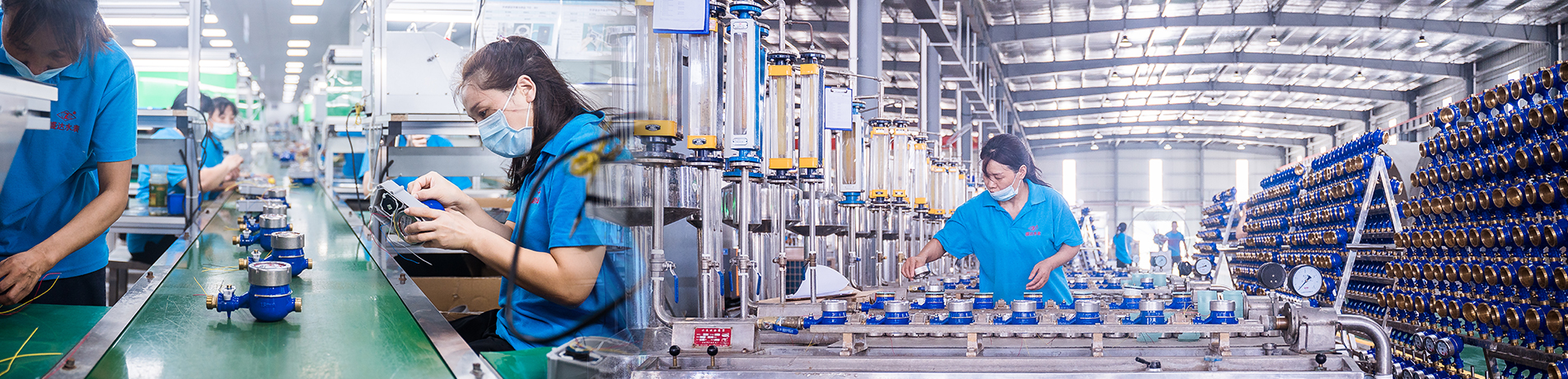
Water meter production line at the Shengda Water Meter factory. A factory visit should trace material flow from incoming inspection to test, calibration and shipment.
Where Capacity Meets Test and Calibration
The most common gap in a capacity audit is the assumption that assembly capacity equals test capacity. For electromagnetic flow meters, every unit may need functional testing and calibration before shipment. If a plant claims 3 million units per year, the buyer should ask how many test benches, calibration rigs and qualified operators support that flow. The bottleneck is often not the assembly line but the test and calibration station.
SDWM states that its quality control includes 100% functional testing and calibration testing. The buyer's follow-up should be specific: what does 100% mean in practice, how is the test result recorded, what reference standard is used, how often is the reference verified, and how is a failed unit handled? These questions do not assume a problem. They establish whether the claimed capacity is supported by a documented test process.
Standards can help structure the questions, but they should not be used as a blanket claim. ISO 9104:1991 provides methods for evaluating the performance of electromagnetic flow-meters for liquids in closed conduits. ISO 20456:2017 gives guidance for the use of electromagnetic flowmeters for conductive liquids. ISO 6817:1992 describes the principle and main design features of industrial electromagnetic flowmeters. For water-metering applications, ISO 4064-1:2014 and OIML R 49-1 set metrological and technical requirements, while EU MID MI-001 applies to water meters placed on the EU market. EMC and enclosure claims should be tied to standards such as IEC 61326-1 and IEC 60529 where those claims are made.
The buyer does not need every standard in every purchase. The buyer does need to know which standard the supplier is testing against, which model and diameter the test covers, and whether the test record travels with the unit. A capacity figure without that traceability is only a number.
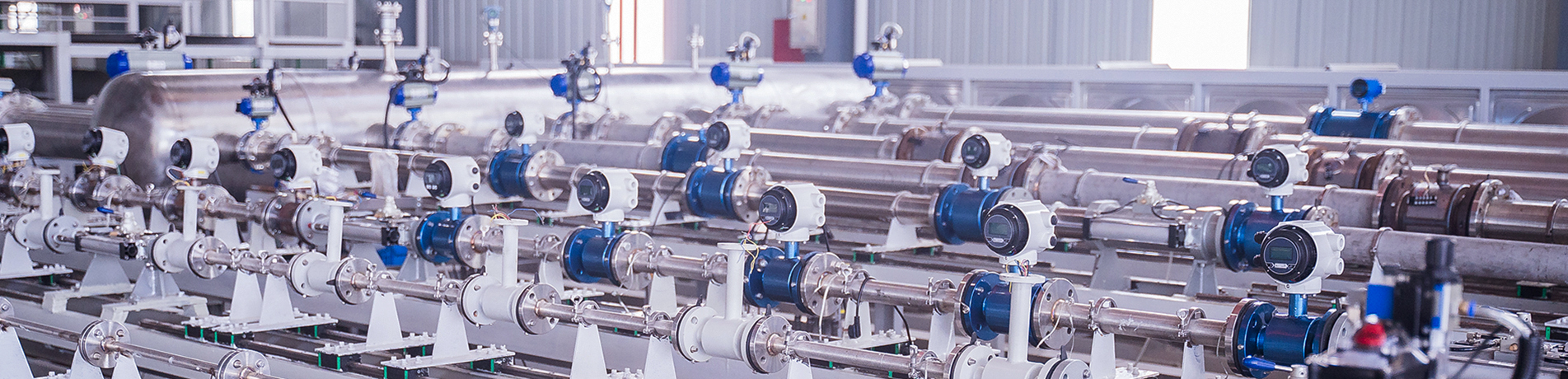
A magnetic flow meter test bench. Test and calibration throughput is a practical constraint that should be checked against any annual capacity claim.
Workforce, Engineering and OEM/ODM Fit
A 100-200 person workforce and a 12-engineer group describe a mid-sized manufacturing organization, not a fully automated mega-plant. That matters for buyers who need customized OEM magnetic flow meters rather than catalogue products. SDWM's stated production mode includes OEM manufacturing, R&D capability, customized solutions and smart metering solutions. The listed customization scope covers logo, color, housing design, communication module, software platform, protocol, packaging and product specifications.
Customization consumes capacity differently from standard production. A new housing design, a different communication module, a software platform change or a protocol adaptation can require engineering time, sample builds, test-method changes and line changeovers. The 3 million-unit annual capacity does not mean every custom SKU can be scheduled at the same rate. Buyers should ask how customized orders are scheduled, what engineering resources are assigned, and how sample validation is completed before mass production.
The published commercial terms provide useful execution checkpoints. SDWM lists a sample MOQ of 3 units and a customized OEM MOQ of 500 pieces. Standard product lead time is listed as 15-20 days; customized products are listed as 30-40 days depending on project requirements. A separate procurement note lists 3-5 samples, FOB/CIF/EXW/DDP delivery terms, pre-shipment test acceptance and 30/70 T/T payment terms. These are not factory-capability proof on their own, but they help the buyer test whether the commercial process is consistent with the capacity claim.
A useful boundary applies here: high capacity does not mean a small custom order will receive priority. The buyer should confirm the production slot, the sample approval route, the change-control process and the technical support contact before placing a customized order.
Documentation and Certification: Verify Scope, Not Just Presence
Factory audits often become certificate checks. That is understandable, but a certificate is only useful when its scope, model coverage, issuing body and validity date match the product being purchased. SDWM's published certificate records list ISO 9001, ISO 14001 and ISO 45001 management-system certificates. Those certificates support questions about quality, environmental and occupational health and safety management systems. They do not, by themselves, prove the accuracy of a particular electromagnetic flow meter model or its suitability for a specific application.
Product certification requires a separate review. If a supplier claims CE or MID conformity, the buyer should ask for the certificate and the declaration of conformity, then check the covered models, diameters, standards and expiry dates. A certificate that covered a model family in an earlier year may no longer be current. A certificate that covers DN15-DN2000 does not automatically cover a larger custom size. A management-system certificate does not replace a product type-examination certificate.
Market-specific requirements should be mapped before the order, not after. For EU water-metering applications, MID MI-001 is a legal-metrology route. For US potable-water components, NSF/ANSI 61 is a relevant health-effects certification scheme. For hazardous areas, ATEX requirements may apply to Ex-rated flow instrumentation. For water meters, ISO 4064-1 and OIML R 49-1 provide parallel requirement frameworks; the applicable one depends on the destination market's legal metrology regime. The buyer should ask which route applies to the exact product and market, and then verify the document rather than accepting a general statement.
Audit rule: read the certificate scope before reading the certificate title. Check the model, diameter, standard, issuing body and expiry date. A current certificate for the wrong model is not evidence for the product being purchased.
Application Fit: What a 3-Million-Unit Plant Means for Different MAG Meter Buyers
Capacity becomes relevant only when it is matched to the application. A utility buying water flow meters for district metering may care about volume, repeatability and delivery continuity. A process plant buying sanitary electromagnetic flow meters may care about wetted materials, cleanability, connection standards and batch traceability. A project buyer specifying a plug-in magnetic flow meter may care about installation access and retrofit compatibility. A remote-site buyer considering a battery power magnetic flowmeter may care about power management and electronics reliability. A buyer of stainless steel magnetic flow meters may care about material certificates and corrosion resistance.
These variants do not draw on factory capacity in the same way. Sanitary units may require additional cleaning, surface and connection checks. Battery-powered units add electronics and power-management testing. Large MAG meters up to DN3000 are a separate production and test challenge from small water meters. SDWM states that it can produce large-size flow meters up to DN3000. That is a capability statement, not a capacity statement; a buyer should ask how many large-size units the plant can test per month and what calibration range is available.
SDWM's portfolio also includes ultrasonic flow meters, including clamp-on and portable ultrasonic types. That breadth can be useful for buyers comparing technologies, but this audit lens remains the electromagnetic/MAG factory. A capacity-led shortlist is not the same as an application-led shortlist. A plant that can produce 3 million units a year may still be the wrong fit for a particular DN, liner, electrode, accuracy class, sanitary connection or certificate scope.
A Buyer Audit Checklist for Factory Visits
The table below converts the main signals into questions a buyer can ask during a supplier evaluation. It is deliberately limited to what the available facts can support. It does not assume that any supplier has passed or failed.
| Audit signal | What to request | What it can prove | What it cannot prove | Red flag |
|---|---|---|---|---|
| Annual capacity | Capacity by product family, shift pattern and nameplate-versus-demonstrated basis | Potential scale and production intent | Actual shipments, utilization or quality | One blended number with no product mix |
| Capacity per employee | Calculation by family, including test and calibration labor | Labor intensity and automation mix | Efficiency or profitability | No denominator or no product-family split |
| Plant age and footprint | Layout map, maintenance log, expansion plan | Material-flow logic and space for test | Equipment condition or process discipline | Test area blocked or separated from records |
| Line layout | Walk-through from incoming inspection to shipping | Flow, segregation and traceability points | Throughput or yield | Rework crossing the main test path |
| Test and calibration | Bench count, reference standards, calibration interval, records | Test capacity and traceability | Accuracy for every model and diameter | No record or no reference verification |
| Workforce and engineering | Organization chart, engineer allocation, OEM support process | Support depth for customization | Retention or response time | No named technical contact for custom work |
| Certificates | Certificate scope, model, diameter, validity and issuing body | Conformity route and current document status | Field performance or application fit | Expired certificate or wrong model scope |
| Commercial terms | MOQ, lead time, sample plan, acceptance test, payment terms | Execution process clarity | Production priority or quality | Terms inconsistent with the claimed capacity |
What the 3 Million Unit Figure Should Change in a Buyer's Shortlist
The 3 million-unit figure should move a supplier into a deeper evaluation, not directly into a purchase order. For SDWM, the combination of a 66,000 m² factory, a 2020 plant, a 100-200 person workforce, 12 engineers and an OEM customization scope gives buyers a concrete set of facts to test. The derived capacity-per-employee range of 15,000-30,000 units per person per year is a useful conversation starter because it forces the supplier to explain product mix, automation, testing and outsourcing.
Plant age and layout should be read as process questions. A newer building can support better flow, but the buyer still needs maintenance records, calibration records and a clear walk-through from incoming material to shipment. The 66,000 m² footprint is large enough to support meaningful test and inventory space, but the buyer should verify where test and calibration actually sit in the flow.
The strongest audit conclusion is conditional: a high-capacity plant is a better shortlist candidate when it can break capacity down by product family, show test and calibration throughput, document certificate scope and confirm OEM scheduling. Without those answers, the capacity figure remains a useful headline rather than a procurement decision. As buyers increasingly ask for evidence, capacity claims will need to be supported by product-family data, test records and current certificates. That shift favors suppliers who can document the basis of their numbers.
For readers who want the underlying company profile, the published SDWM brochure (PDF) is available for download.
FAQ
What does 3 million units of annual capacity mean for an electromagnetic flow meter buyer?
It means the supplier states that its plant can produce up to 3 million units per year. It does not mean the supplier ships 3 million units, operates at full utilization or produces every model at that rate. The buyer should ask whether the figure is nameplate capacity, demonstrated output or a product-mix-weighted estimate, and whether it includes test and calibration throughput.
How is capacity per employee calculated for a flow meter factory?
Divide stated annual capacity by the stated workforce. For SDWM, 3 million units divided by 100-200 employees gives a calculated range of 15,000-30,000 units per employee per year. That is not a measured productivity figure. It should be compared only with plants producing a similar product mix under similar testing and calibration requirements.
What should buyers check in a factory built in 2020?
Buyers should check maintenance records, calibration records, material flow, separation of test and production areas, expansion space and the condition of test equipment. A 2020 building may have a newer layout, but building age alone does not prove equipment condition or process discipline.
Can a high-capacity factory support customized OEM magnetic flow meters?
It can, but customization consumes engineering time, sample builds, test changes and line changeovers. Buyers should confirm the OEM MOQ, sample validation route, lead time, change-control process and the engineering resource assigned to the custom project. A 3 million-unit capacity figure does not automatically mean a small custom order will receive priority.
Which certificates should be checked for an electromagnetic flow meter factory?
Buyers should check both management-system certificates and product certificates. Management-system certificates such as ISO 9001, ISO 14001 and ISO 45001 show that a management system has been certified. Product certificates such as CE or MID documents must be checked for the exact model, diameter, standard, issuing body and expiry date. Market-specific requirements such as NSF/ANSI 61 for US potable-water components or ATEX for hazardous areas may also apply.
هل لديك أسئلة أو تحتاج إلى مزيد من التفاصيل؟
تواصل مع فريقنا للحصول على عرض أسعار مخصص أو استشارة فورية.
طلب عرض أسعار
املأ النموذج أدناه وسيتواصل معك فريقنا بعرض مقترح مخصص.
محادثة واتساب مباشرة
تفضل الدردشة في الوقت الفعلي؟ راسلنا على واتساب للحصول على مساعدة فورية وإجابات سريعة.
- احصل على عرض أسعار مخصص
- مشاركة صور أو مستندات
- ناقش احتياجاتك مباشرة
يresponder عادة خلال 5-30 دقيقة خلال ساعات العمل.