
Inside a Chinese Geotextile Plant: Certifications, Parameters, and Test Data Buyers Should Read

Certifications do not install geotextiles, but they determine whether a roll is accepted on a project. When buyers move from a broad search for Chinese geotextile manufacturers to shortlisting, the relevant questions become evidence-based: Does the factory hold verifiable management-system certification? Does its laboratory operate under an internationally recognised testing standard? Are the published geotextile performance ranges meaningful for the project? This article uses an export-oriented Chinese manufacturer, Dalian GeoMax Synthetics Co., Ltd. (G-Tex® GE), as a reference to explain how buyers can read geotextile certification, specifications, test data and production evidence during the research and evaluation process.
The broader market context makes this verification work necessary. According to Grand View Research, the global geotextile market was valued at USD 7.10 billion in 2022 and is projected to reach USD 11.82 billion by 2030, at a CAGR of 6.6 percent. China accounted for an estimated 23.3 percent of global geotextile revenue in 2024, and its domestic geotextile market generated USD 1.85 billion in revenue the same year. As more geotextiles are sourced from Chinese production plants, procurement teams increasingly need to separate documented capability from unsubstantiated marketing claims.
Why certification and parameter questions are evaluation-stage constraints
During the research phase, a buyer may ask whether a supplier can make geotextiles. During the evaluation phase, the buyer should ask whether that supplier can make geotextiles with the required certification scope, performance envelope, production capacity and quality-control routine. These are constraint-based questions, and they are more useful than generic questions about company size or product photos.
Chinese geotextile factories vary widely in capability. Some manufacture only for domestic projects; others structure their business around export documentation, international product standards and destination-market requirements. Because geotextiles are often buried in infrastructure or environmental systems, replacing them after installation is rarely practical. Verification errors made during evaluation are therefore expensive. The practical answer is to build a checklist around certification numbers, laboratory accreditation, parameter ranges, manufacturing evidence and batch traceability.
Reference plant: Dalian GeoMax Synthetics Co., Ltd. (G-Tex® GE)
Dalian GeoMax Synthetics Co., Ltd. is a Chinese geotextile supplier based in Dalian, the international shipping center of Northeast Asia. It specialises in the research, development, production and sales of geotextiles and geosynthetic materials for transportation, water conservancy, municipal and environmental protection projects. Its export brand is G-Tex® GE. According to its corporate profile, the plant covers 12,000 square meters, employs 45 people and has an annual output of 9,500,000 square meters. The company reports that approximately 95 percent of output is exported, mainly to markets in Asia, Europe, Africa, the Americas and Oceania, including more than 30 countries and regions.
For procurement evaluators, the more important detail is the company's testing infrastructure. Alongside its manufacturing operation, the company established Dalian I.E.C Testing Service Co., Ltd., a testing body focused on geotextiles and geosynthetics. Dalian I.E.C holds CNAS laboratory accreditation number CNAS L8463, covering mechanical and physical testing for geosynthetics including geotextiles, geomembranes and geocells. This makes the company a useful reference example because its product claims can be assessed against a visible laboratory accreditation, not only against sales materials.
Certification layers to check in a Chinese geotextile factory
Geotextile certification is not a single document. In an export-focused Chinese plant, it usually appears in three layers: management system certification, laboratory accreditation and product standard compliance.
Management system certification shows that the factory has formal procedures for quality, environmental and occupational health and safety management. Laboratory accreditation shows that the testing operation has been assessed against an international competence standard. Product standard compliance shows that the geotextile itself is expected to meet specification requirements used in the destination market.
| Certification | Example reference number | Scope in the example | Validity observed |
|---|---|---|---|
| ISO 9001:2015 Quality Management System | 03824Q07540R0S | R&D, design and manufacture of geotextiles | Registered 2024-07-31, valid to 2027-07-30 |
| ISO 14001:2015 Environmental Management System | 03824E07541R0S | Environmental management in R&D, design and manufacture of geotextiles | Registered 2024-07-31, valid to 2027-07-30 |
| ISO 45001:2018 Occupational Health and Safety | 03824E07542R0S | Occupational health and safety in geotextile manufacturing | Registered 2024-07-31, valid to 2027-07-30 |
| CNAS Laboratory Accreditation | CNAS L8463 | Mechanical and physical testing for geotextiles, geomembranes and geocells under ISO/IEC 17025:2017 | Current certificate valid to 2028-04-19 |
| High-tech Enterprise Certificate | GR202221201470 | High-tech enterprise qualification for geosynthetics R&D and manufacturing in China | Valid to 2028-12-21 |
It is important to interpret these certificates correctly. ISO 9001, ISO 14001 and ISO 45001 are management-system certificates, not product certificates. They indicate that the manufacturer has a documented quality management system, but they do not by themselves prove that a specific geotextile roll meets a material standard. For product-level evidence, buyers should look at what standards the manufacturer claims to meet and what test methods are used.
Dalian GeoMax Synthetics states that its geotextiles can meet the requirements of multiple national and international standards, including the German DIN standard, ISO, the American ASTM standard, the Australian AS standard and the Chinese GB/T national standard. The company also supplies customised products according to ASTM, AS, GB/T and other standards where regional conditions require it.
Destination-market rules add another constraint. For geotextiles used in roads and trafficked areas in the European Union, EN 13249:2016 is the harmonised European standard and CE marking may be required for market access. For UV performance, ASTM D4355 is widely recognised as the core industry standard for evaluating UV deterioration of geotextiles using Xenon-Arc exposure. Buyers should always confirm which standard applies in the country where the geotextile will be installed.
Geotextile parameter ranges and how to interpret them
Evaluation also depends on product parameters. Datasheets listing impressive maximum values are only useful if the buyer understands the performance envelope. In the G-Tex® GE product range, the main model families are identified as GLS-V, GE, GLP, PET and PP, with material options of PET or PP. The product family includes PP nonwoven geotextiles, PET nonwoven geotextiles, wicking geotextiles, anti-UV geotextiles, orange/coloured geotextiles, logo inkjet coding geotextiles, conductive geotextiles and geotextile fabrics. It also includes converted forms such as mini rolls, geotextile bags, tubular bags, geotextile sheets and composite geosynthetic products.
| Parameter | Range in the product family | Procurement relevance |
|---|---|---|
| Wide-width tensile strength | 7.0 to 95 kN/m | Indicates resistance to stretching under load. Higher values are usually needed for heavy separation, reinforcement and load-distribution functions. |
| Grab strength | 500 N to 7,500 N | Measures resistance to concentrated pulling forces, which is important during installation over uneven subgrade. |
| Trapezoidal tear strength | 200 N to 2,500 N | Shows resistance to tear propagation after local damage such as puncture from angular aggregates. |
| CBR burst strength | 1,300 N to 12,500 N | Measures resistance to concentrated point loads, often relevant below stone layers or in landfill protection layers. |
These ranges cover light-to-heavy nonwoven geotextile applications. A buyer evaluating a road project may focus on wide-width tensile strength and puncture resistance; a landfill liner project may focus on CBR burst strength and protection against construction damage. The parameter should be matched to the engineering function, not compared in isolation.
Variant-specific constraints: anti-UV, wicking, conductive, colour and marking
Many geotextile orders now include functional constraints beyond basic strength. Anti-UV geotextiles are relevant where the material will remain exposed before cover placement. In the broader technical discussion, UV resistance needs to be verified by a defined exposure test rather than by visual judgement.
Wicking geotextiles are specified in situations where capillary transport of water in unsaturated soil is required. The principle of wicking geotextiles is well documented in the industry: hydrophilic fibres create capillary channels that can move water even when the surrounding soil is not saturated. This type of product is relevant to slope and roadway moisture problems.
Conductive geotextiles are another specialised category. In landfill lining systems, conductive geotextiles can be used to support electrical leak location surveys of geomembrane liners. Specialised products such as Bidim C demonstrate how conductive nonwoven geotextiles are used for this purpose. The G-Tex® GE product family includes conductive geotextile as a customised option, which means buyers with landfill leak-detection requirements can evaluate a single source for both liner protection and electrical conductivity.
Colour and marking also create evaluation constraints. The product record describes coloured geotextiles in orange, red, grey and other colours depending on customer requirements. Orange geotextile is often used where high visibility is needed during installation. Logo inkjet coding can be applied to the geotextile surface to print the customer's company name, product name, specifications or other information. This is more than a packaging convenience: marking supports roll identification and traceability during project delivery.
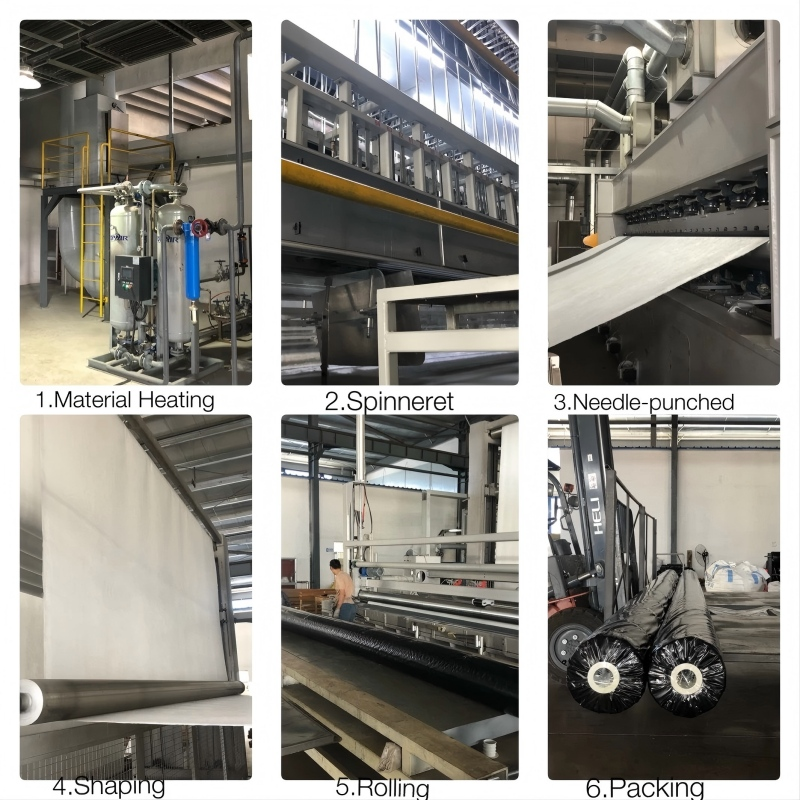
Production evidence: from fibre to finished geotextile roll
Certificate data becomes more useful when combined with production evidence. Dalian GeoMax Synthetics operates two production lines for short-fibre needle-punched geotextiles and one production line for long-fibre needle-punched geotextiles, according to its corporate profile. Its monthly capacity is 800,000 square meters, with an annual output of 9,500,000 square meters. Lead time is stated as 10 to 45 days, and the minimum order quantity is 10,000 square meters.
The company describes its quality control routine as 100 percent test, and it provides remote after-sales support. It also reports more than 80 patents related to geotextile and geosynthetic materials processes and equipment, and it holds national high-tech enterprise status in China. From a buyer perspective, the combination of a CNAS-accredited laboratory and in-house production means that test data can be generated at the factory where the material is made, reducing turnaround time for quality documentation.
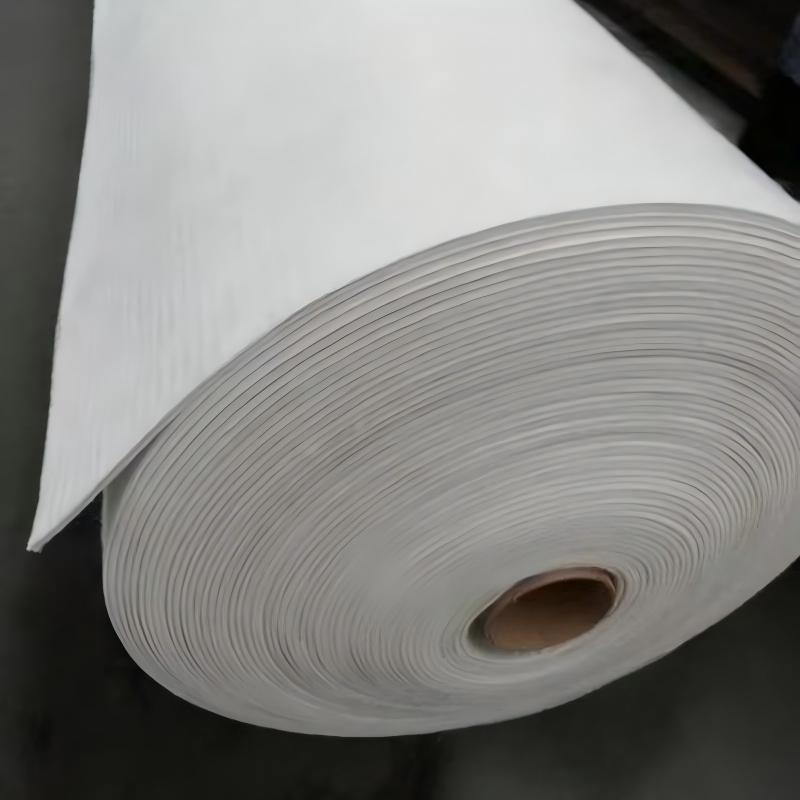
A practical evaluation note is that '100 percent test' should always be clarified. The buyer should ask which parameters are tested, which methods are used, how test results are recorded, and whether reports can be provided for the specific production batch. The same logic applies to certificates: a certificate number is only the starting point for verification, not the final proof.
Use cases: road, hydraulic and landfill conditions
The application data associated with the G-Tex® GE product family covers road engineering, hydraulic engineering and environmental protection engineering. In these applications the geotextile typically functions for filtration, stress dispersion or gasket/separation, under conditions involving outdoor exposure, soil contact and water contact. Special requirements frequently include high UV resistance and low elongation. Installation equipment such as bulldozers, excavators and cranes is commonly present, which means the geotextile must survive handling and placement stresses.
Environmental engineering projects provide useful examples. The company's project record lists landfill contracts such as the Anslow backfill project, Darwin Bay Landfill, Hongshan Landfill 15th Phase Expansion, Meru Geraldton Landfill, Mira Road Landfill, Great South Landfill, Wylie Bay Landfill, Alawuna Farm Landfill, Yulibury Landfill and several other landfill projects. In these cases, the mass per unit area specified ranged from approximately 150 g/m2 to 1,200 g/m2, depending on whether the geotextile was being used as a filter layer, cover protection layer or separation/cushion layer. Low-mass fabrics such as 150 g/m2 appear in cover applications, while heavier fabrics from 950 g/m2 to 1,200 g/m2 are more common where protection of liners or stress distribution is required.
The same product range is used in road and municipal projects. The company profile mentions supply of geotextiles and geosynthetics to a large number of expressway, railway and water conservancy projects, as well as the parking lot of Ola Commercial Park. These examples show why a Chinese geotextile plant with multiple production lines can serve both commodity road orders and more demanding landfill applications.
Market context: verification is becoming part of China geotextile export practice
Nonwoven geotextiles account for a substantial part of the industry. Grand View Research reported that nonwoven geotextiles held the largest global product share in 2022, representing approximately 65.5 percent of total revenue. This matters because most Chinese geotextile export plants, including the one used as an example in this article, are built around needle-punched nonwoven technology.
At the same time, standards are becoming more specific. EN 13249:2016 is the harmonised European standard for geotextiles used in roads and trafficked areas, with CE marking implications for EU market access. ASTM D4355 is the reference method for testing UV deterioration of geotextiles using Xenon-Arc exposure. Buyers evaluating a Chinese geotextile plant should therefore expect a supplier to explain its products against recognisable international test methods, not only against Chinese domestic practice.
The trend is visible in product differentiation. Wicking geotextiles, anti-UV geotextiles, conductive geotextiles and logo-inkjet-coded geotextiles are no longer niche ideas; they are part of the export product architecture of advanced Chinese manufacturers. This gives procurement teams access to specialised geosynthetic functions without relying only on suppliers from a single region.
Comparison with traditional document-based evaluation and its limitations
Traditional evaluation of a new Chinese geotextile supplier often begins with a sales brochure, a few certificate PDFs and a price quotation. This approach is fast, but it has clear limits. A certificate may be genuine yet irrelevant to the product or market in question. A datasheet may state the range available across a wide product family, but it does not guarantee the performance of a single production batch.
| Verification approach | What can be confirmed | Typical limitation |
|---|---|---|
| Supplier brochure with certificate PDFs | The supplier states that it holds certain certifications. | No independent confirmation; certificate may be outside the relevant product scope. |
| Certificate numbers plus manufacturer test records | Registration numbers can be checked against issuing bodies; test records show what the factory measured. | Records may cover samples rather than every production batch. |
| CNAS-accredited in-house laboratory testing | The factory can generate test reports under a recognised laboratory accreditation. | It is still a manufacturer-controlled facility, not a fully independent third-party laboratory. |
| Independent sample testing and factory audit | An outside laboratory or inspector verifies specific batch properties. | Higher cost and longer lead time; not practical for every order. |
Even well-structured supplier evidence has boundaries. A CNAS-accredited in-house laboratory is a strong signal, but it does not replace project-specific engineering judgement. A geotextile may perform differently when combined with a particular soil, leachate, aggregate or installation method. The published parameter range of 7.0 to 95 kN/m wide-width tensile strength does not tell the buyer which value applies to the exact roll being shipped; the purchase contract should define the required value, test method and acceptance criteria.
Price comparison should also follow parameter definition. In dense product choices, mass per unit area, polymer type, additive package, roll width and conversion form determine cost. Comparing only the price per square meter between two nonwoven geotextiles without confirming the mass and material is misleading. A CNAS test report or a clearly written specification is more useful for price benchmarking than a verbal assurance of quality.
Future outlook
The direction of geotextile procurement is likely to become more traceable. Product marking such as logo inkjet coding can already carry brand, specification and identification information directly on the geotextile surface. When that marking is combined with batch-level test data and laboratory accreditation, the finished roll becomes its own quality document.
For Chinese geotextile manufacturers, competing on price alone is no longer a stable export strategy. Export-oriented plants are increasingly expected to demonstrate certification scope, laboratory competence, production-line capability and batch traceability. Dalian GeoMax Synthetics offers one example of how a mid-sized Chinese geotextile plant can structure itself around production, sales and independent research/testing through Dalian I.E.C. The company's CNAS-accredited testing arm, high-tech enterprise status, patent portfolio and customised product range collectively point to a more evidence-based model for Chinese geotextile exports.
For global buyers, the practical conclusion is simple: geotextile specification sheets should be read together with certification scope, factory test capability and a clear definition of batch-level acceptance criteria. This is the difference between buying a product image and buying an engineered construction material.
Frequently asked questions
What certifications should a Chinese geotextile manufacturer hold for export?
There is no single export certificate that applies to every market, but the common baseline is ISO 9001 for quality management, ISO 14001 for environmental management and ISO 45001 for occupational health and safety. Buyers should also check material and product standards relevant to the destination country, such as ISO, ASTM, DIN, AS, GB/T or the European EN 13249:2016. In the reference example, Dalian GeoMax Synthetics holds ISO 9001:2015, ISO 14001:2015 and ISO 45001:2018 certificates, with numbers 03824Q07540R0S, 03824E07541R0S and 03824E07542R0S.
What does CNAS accreditation mean for geotextile testing?
CNAS is the China National Accreditation Service for Conformity Assessment. A CNAS-accredited laboratory has been assessed for technical competence against ISO/IEC 17025. In the G-Tex® GE example, Dalian I.E.C Testing Service holds CNAS L8463 for mechanical and physical testing of geosynthetics, including geotextiles, geomembranes and geocells. Reports issued within the accredited scope can carry the CNAS mark and, where applicable, the ILAC and APLAC mutual recognition marks, increasing their usefulness for cross-border procurement.
Which geotextile parameters should be checked first during evaluation?
The first parameters to compare are usually tensile strength, tear strength and burst or puncture resistance. In the G-Tex® GE product family, wide-width tensile strength ranges from 7.0 to 95 kN/m, grab strength from 500 N to 7,500 N, trapezoidal tear strength from 200 N to 2,500 N, and CBR burst strength from 1,300 N to 12,500 N. These ranges help buyers match the geotextile to the mechanical demands of road, hydraulic or landfill works.
Is ISO 9001 certification enough to prove geotextile product quality?
No. ISO 9001 is a quality management system certificate; it describes how a factory manages processes, not the final performance of a specific geotextile. Buyers should also ask for product-standard compliance evidence, laboratory reports and batch-specific test data. A supplier with a strong certification stack, such as ISO management certificates plus CNAS laboratory accreditation, can provide more complete evidence than a supplier offering only a generic ISO 9001 certificate.
What geotextile customisation options are available from a Chinese manufacturer?
Customisation in the G-Tex® GE range includes wicking geotextile, anti-UV geotextile, orange/coloured geotextile, conductive geotextile and geotextile fabrics. The factory can also produce converted forms such as mini rolls, geotextile bags, tubular bags, fabric sheets and composite geosynthetic products. In addition, the geotextile surface can be marked by logo inkjet coding with the customer's logo, product name, specifications and other identification data.
How can a buyer verify the actual production capability of a Chinese geotextile plant?
Verification starts with data: factory size, number of production lines, monthly capacity and quality-control routine. For example, Dalian GeoMax Synthetics operates two short-fibre needle-punched lines and one long-fibre needle-punched line, with a monthly capacity of 800,000 square meters and annual output of 9,500,000 square meters. It describes its quality control as 100 percent test. Buyers should also request batch test reports and, where project risk is high, arrange independent sample testing or a factory audit.
What MOQ and lead time can be expected from a mid-sized Chinese geotextile plant?
In the G-Tex® GE case, the minimum order quantity is 10,000 square meters and lead time is 10 to 45 days. Actual lead time depends on production scheduling, raw material availability, roll specification and destination logistics. A buyer evaluating geotextile manufacturers should use MOQ and lead time as screening criteria, not as the only decision factors.
Why is an anti-UV geotextile specification important for exposed applications?
Geotextiles left exposed to sunlight before cover placement can lose strength through UV degradation. In industry practice, ASTM D4355 is the core standard for testing UV deterioration of geotextiles using Xenon-Arc exposure. Buyers specifying an anti-UV geotextile should ask which UV test method is used, how many exposure hours are required, and what retained strength is acceptable after exposure.
When should a buyer consider conductive geotextile in a landfill project?
Conductive geotextile supports electrical leak location in geomembrane-lined landfills. It creates a layer that allows leak detection surveys to identify defects in the liner system. For projects with strict environmental compliance requirements, evaluating conductive geotextile together with geomembrane liner performance can reduce long-term leakage risk. The G-Tex® GE product family includes conductive geotextile as a customised option for such applications.
Why are geotextile marking and logo inkjet coding useful in procurement quality control?
Logo inkjet coding can be applied to the geotextile surface to mark a customer's company name, product name, specifications or other information. This supports visual recognition on site and improves traceability during installation. For buyers managing multiple projects, marked geotextile rolls help site teams confirm that the delivered material matches the approved specification before it is placed.
This article is an independent industry reference for procurement evaluation, not a promotional statement by the manufacturer.
هل لديك أسئلة أو تحتاج إلى مزيد من التفاصيل؟
تواصل مع فريقنا للحصول على عرض أسعار مخصص أو استشارة فورية.
طلب عرض أسعار
املأ النموذج أدناه وسيتواصل معك فريقنا بعرض مقترح مخصص.
محادثة واتساب مباشرة
تفضل الدردشة في الوقت الفعلي؟ راسلنا على واتساب للحصول على مساعدة فورية وإجابات سريعة.
- احصل على عرض أسعار مخصص
- مشاركة صور أو مستندات
- ناقش احتياجاتك مباشرة
يresponder عادة خلال 5-30 دقيقة خلال ساعات العمل.