
Inside a Custom Chandelier Factory: Hotel Project Evidence
Inside a Custom Chandelier Factory: Hotel Project Evidence
Drawing deepening, ceiling-load review, sample approval, batch manufacturing and installation guidance are the five moments where a custom chandelier supplier either demonstrates engineering capability or exposes the gaps.
A hotel chandelier is unusual among interior products. It is specified by a designer, priced by a procurement team, suspended from a structural ceiling by hardware that has to carry its weight for years, and later maintained by an engineering department that may need replacement parts long after the original handover. That combination — an aesthetic object that is also an engineered assembly — is why hospitality buyers evaluate a custom chandelier factory differently from how they evaluate a stock lighting supplier.
The commercial context makes that evaluation more consequential. The global hospitality lighting market was valued at USD 14.2 billion in 2025 and is expected to grow at a compound annual growth rate of 7.3% to reach USD 26.8 billion by 2034 (Dataintelo, hospitality lighting market report). Commercial applications, including hospitality, accounted for 62.8% of the decorative lighting end-user market in 2025 (IMARC Group). More projects mean more shortlists — and more shortlists mean buyers need evidence they can compare across suppliers rather than judge from brochure photography.
This article addresses one question: what does a custom chandelier manufacturer's production floor actually evidence about a hotel project's delivery risk? The reference case is Zhongshan YZ ART LIGHT Co., Ltd., whose documented operating model covers drawing deepening, structural safety calculation, sample production, batch manufacturing and installation guidance.
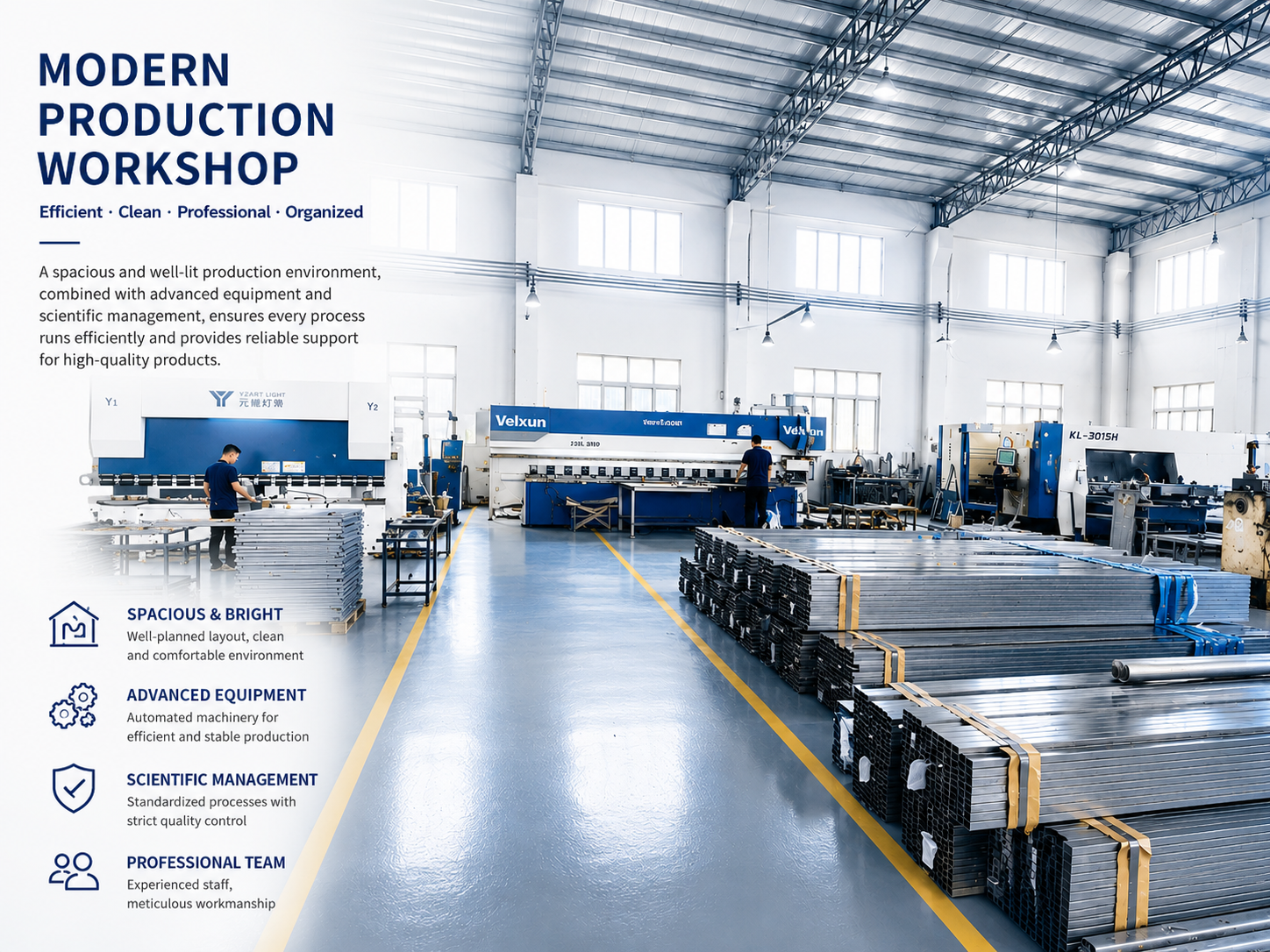
Zhongshan YZ ART LIGHT Co., Ltd. (brand: YZ ART LIGHT) is a decorative lighting manufacturer based at 20 Le Feng 4th Road, Henglan Town, Zhongshan City, Guangdong Province, China. The company produces bespoke and project lighting — chandeliers, art glass chandeliers, wall lamps, table lamps and floor lamps — for hotels, banquet halls, restaurants, villas, shopping malls and commercial interiors. It operates a 15,000-square-metre production base with a 20-engineer research and development team, states a material range that includes brass, stainless steel, aluminium, iron, glass, crystal, marble, acrylic and ceramic, and works on OEM and ODM terms for project and brand customers.
Why hotel buyers ask for factory evidence, not just product images
A catalogue can show an oversized chandelier hanging in a finished lobby. It cannot show who dimensioned it, who verified the ceiling structure that carries it, who inspected the wiring before crating, or how the finish will be matched if a single element is damaged two years after opening.
At the evaluation stage, the questions that decide a shortlist are process questions. For large decorative fixtures the failure modes are rarely purely aesthetic. They are structural (suspension capacity, ceiling interface, wind or vibration in atrium voids), photometric (glare, uneven distribution, colour consistency across a large visible surface), logistical (splitting an oversized fixture into transportable and reassemblable sections), and lifecycle-related (spare parts, light-source replacement, finish durability in continuously operating buildings). Each of these is decided before the fixture is ever lit.
Factory evidence is therefore not a marketing exercise. It is a risk-assessment input that a project manager can price, schedule and insure against.
Five points of evidence on a custom chandelier production floor
1. Drawing deepening: turning a designer rendering into a buildable technical file
The first deliverable of a custom project is not a lamp; it is a technical file. YZ ART LIGHT describes full-dimensional customization covering dimensions, materials, colour temperature of light sources, painted finish colours, engraved logos, light-source configurations, mounting structures, intelligent dimming systems, lampshade materials, hardware craftsmanship, surface-finishing techniques, supporting accessories and exclusive packaging solutions. The company states that it can restore a design proposal on a 1-to-1 basis and also offers professional optimisation suggestions.
For a designer working from a render, drawing deepening is the point at which intent becomes measurable. It fixes the suspension points, the ceiling interface, the tolerances between repeated elements, the location of drivers and cable routing, the maintenance access path, and the way a large fixture is divided for shipping and reassembled on site. For procurement, this stage defines what is actually being ordered — which is the only reliable basis for comparing quotations from different suppliers, because two suppliers quoting the same rendering may be quoting two different assemblies.
One boundary is worth stating plainly. Not every technical parameter is fixed at catalogue level. For this product range, dimensions, wattage and colour temperature are provided per series or per custom order and require model-level confirmation. Items such as light-source chip selection, ingress-protection class and input voltage belong in the same category: they should be confirmed in writing, project by project, rather than assumed from a general specification sheet. A buyer who receives a specification that names a protection rating or a voltage range without a project reference should ask for the confirmation document.
2. Ceiling load and suspension review
Large decorative fixtures are suspended structures, and the documented installation workflow reflects that. It begins with checking the ceiling's load-bearing capacity, measuring the reserved installation size and marking the suspension points, with the mains supply isolated before any work starts. Mounting structures are part of the customization scope, which means the suspension design can be matched to the actual ceiling condition rather than to a generic bracket.
The materials available across the range — brass, stainless steel, aluminium, iron, glass, crystal, marble, acrylic and ceramic — also determine what the ceiling has to carry. A crystal and metal chandelier for a double-height lobby imposes a different load profile from a light-frame pendant over a reception desk, and the suspension hardware has to be specified accordingly.
A clear division of responsibility helps here. The project's structural engineer remains responsible for the adequacy of the ceiling itself; the lighting manufacturer supplies the structural safety calculation, the suspension design, the load information and the hardware that attaches the fixture to the structure. Buyers should request that documentation in writing, because it is one of the clearest differences between an engineering-led supplier and an assembler that simply ships a finished object.
3. Sample production before batch commitment
Because the minimum order is one piece, single-piece prototyping is possible before a batch is authorised. That matters for hospitality projects for a practical reason: a rendering cannot show how a fixture behaves at full scale in a real ceiling void. A sample verifies proportions in real light, the visible surface finish, the glow and diffusion of the lampshade, the effectiveness of glare shielding, and the tactile quality of the hardware.
Glare control is a specific example. The company states that custom soft anti-glare light sources are used to prevent harsh glare and uneven light distribution — a requirement that appears most often in guest rooms and dining areas, where a downlight-specification approach will not work for a decorative fixture.
Sample approval is a checkpoint, not a substitute for a site survey. The sample confirms the object; a site survey confirms the ceiling, the reserved dimension, the power location and the access route for an oversized crate. Both should be closed out before batch production starts, because changes requested after tooling and material cutting has begun are the most expensive changes in the process.
4. Batch manufacturing and in-process inspection
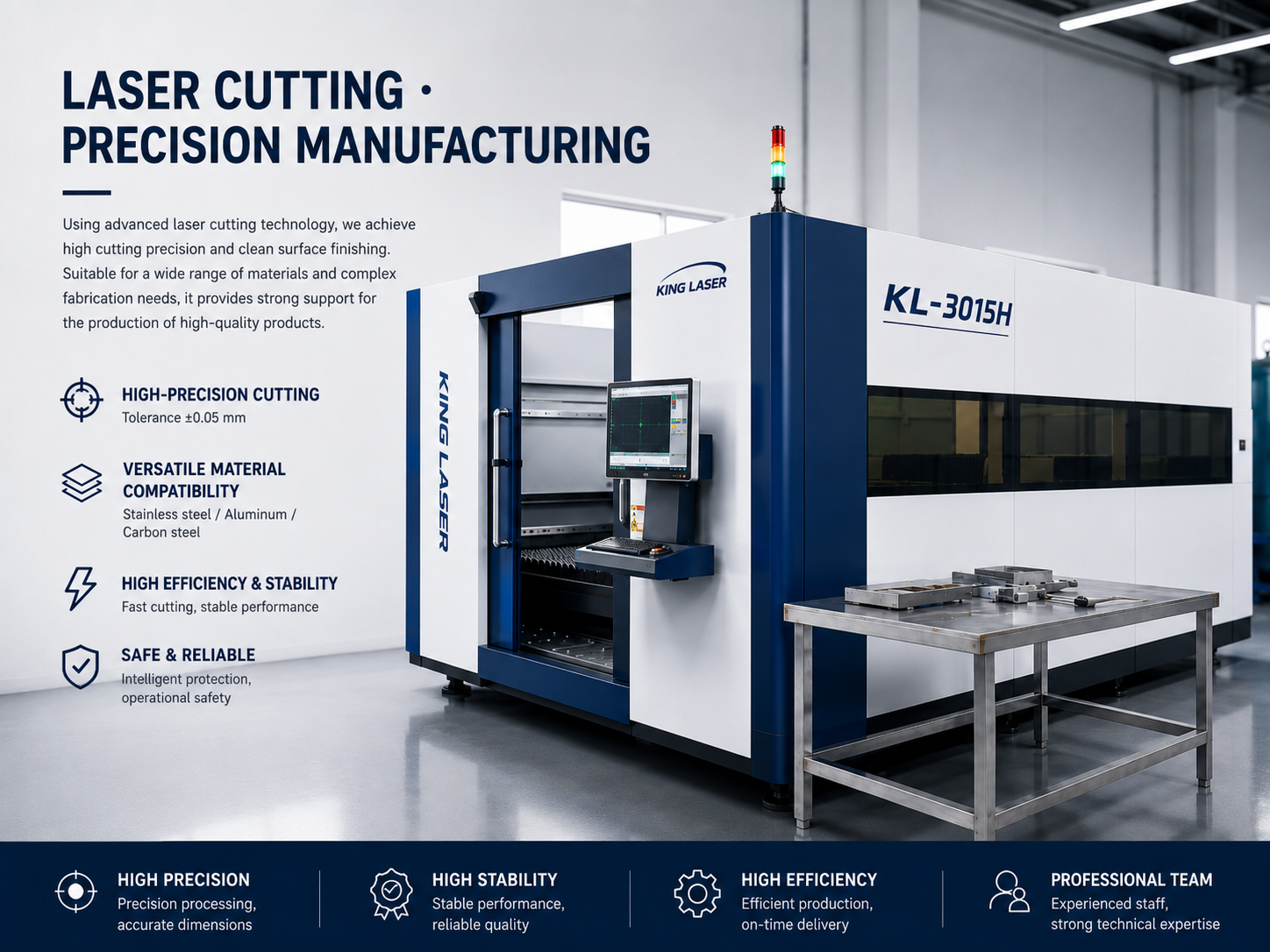
The production base is equipped with CNC laser cutting systems, automated welding stations and precision engraving machines, and operates under an ISO-certified quality management system that applies inspection at raw material selection, processing and finished product testing. Equipment of this type matters for repeatability: when a project involves many identical ring sections, arms or decorative elements, laser cutting and automated welding determine whether the hundredth piece matches the first.
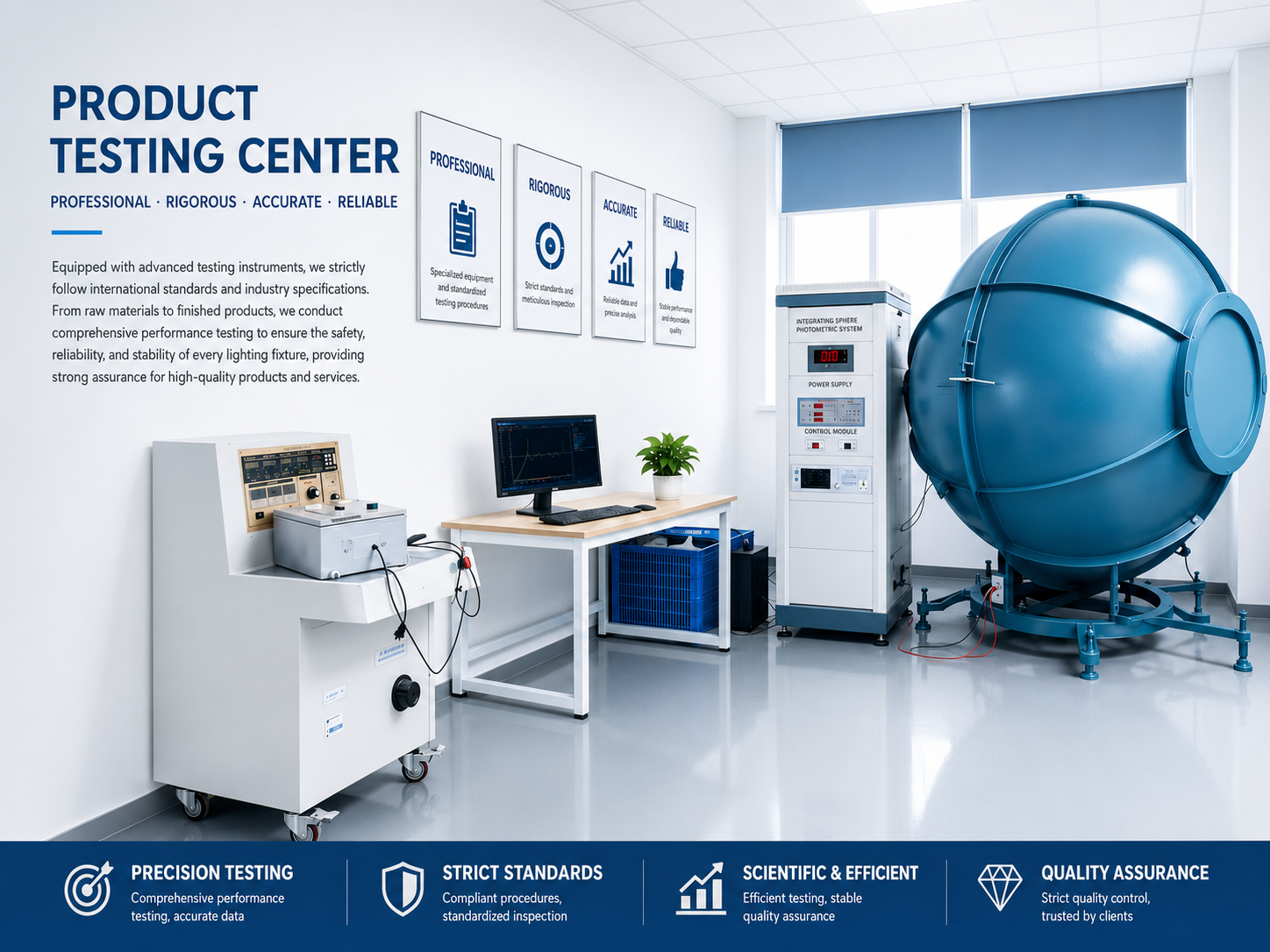
Before shipment, every lamp undergoes 100% full inspection covering power-on testing, appearance and workmanship checks, dimension and structure inspection, and verification that accessories are complete. A quality-approval checklist accompanies each shipment. For a hotel buyer, the operational value of that routine is the record it produces: a per-shipment document that a project manager can file, and that a future maintenance team can use to identify the exact configuration installed in a given space.
5. Installation, commissioning and post-delivery support
The documented installation sequence is a useful proxy for how a supplier thinks about risk. It runs as follows: with the power off, check the ceiling load-bearing capacity, measure the reserved size and mark the suspension points; assemble the lamp frame, lampshade and built-in anti-glare light source on site; complete insulated concealed wiring, fix the embedded fasteners and hoist the complete lamp; then power on, adjust the lamp angle and check the uniformity of the lighting effect. The safety controls in the procedure include isolating the supply before all installation work, hanging warning tags to prevent energising, using workers with electrical-operation qualifications, and keeping hands dry while wiring.
After delivery, overseas clients receive global remote technical guidance, and all engineering lighting products are covered by a three-year warranty, with free replacement of faulty light sources within the warranty period. The company also states an LED light source service life of up to 50,000 hours and a metal and glass lamp body durability of over 15 years under normal use. Those figures are relevant in hospitality because the fixtures operate for long hours in commercial conditions rather than domestic ones.
The documentation a hotel project should hold before shipment
Certification is the part of a supplier shortlist that is easiest to compare across candidates, because it is either current and in scope or it is not. YZ ART LIGHT's published compliance documents cover both management systems and product safety, and each carries a defined scope that buyers should read rather than assume.
| Document | Standard | Issuing body | Certificate / report no. | Validity |
|---|---|---|---|---|
| ISO 9001 Quality Management System | GB/T19001-2016 / ISO9001:2015 | ZTZL (Zhongtai Zhilian Certification) | ZTZL28025Q1464R0S | 2025-09-03 to 2028-09-02 |
| ISO 14001 Environmental Management System | GB/T 24001-2016 / ISO14001:2015 | ZTZL (Zhongtai Zhilian Certification) | ZTZL28025E0851R0S | 2025-09-03 to 2028-09-02 |
| ISO 45001 Occupational Health and Safety Management System | GB/T 45001-2020 / ISO 45001:2018 | ZTZL (Zhongtai Zhilian Certification) | ZTZL28025S0801R0S | 2025-09-03 to 2028-09-02 |
| LVD – CE Verification of Conformity | EN 60598-1:2015+A1:2018; EN 60598-2-1:1989; EN 62493:2015 | Guangzhou Quality Technology Service Co., Ltd. (QTS) | QTS800119288; report ref. 61.11.19.0573.01 | 2019-09-27 to 2028-09-02 |
| CE-RoHS Verification of Conformity | IEC 62321 series; EN ISO 17075-1:2017 | Guangzhou Quality Technology Service Co., Ltd. (QTS) | QTS800519289; report ref. 61.15.19.0574.01 | 2019-09-27 to 2028-09-27 |
The scopes are specific. The two product verifications cover fixed luminaires (hanging lamps) and are applicable to the European Union market. The management-system certificates cover the production of fixed-type lamps and portable-type lamps within the valid CCC scope. A buyer specifying for North America, the Gulf or another regulated market should therefore treat these documents as a starting point and confirm market-specific requirements separately — for example, luminaires destined for North America are commonly assessed against UL 1598 for luminaires and UL 8750 for LED equipment (UL Solutions).
Where this capability is applied in a hotel project
The company's stated client types are hotel groups, hotel engineering projects, villa owners and commercial real estate developers, and its production scale includes over 1,000 completed commercial engineering projects. Completed references named in its documentation include Four Seasons Resort Sharm El Sheikh, InterContinental Jerusalem by IHG, JW Marriott Costa Elena Resort & Spa, and Waldorf Astoria Kuala Lumpur.
The project types that draw on factory capability most heavily are the ones where decorative lighting is not a purchase order but a coordination exercise:
- Full-scale lighting projects for star-rated hotels — custom manufacture of a full range of fixtures for high-end hotel lobbies, banquet halls, guest rooms, executive lounges and presidential suites, covering the whole process from design and sample-making to bulk delivery.
- Lighting support for commercial real estate — non-standard artistic pendant lamps and wall lamps for sales office lobbies, sand-table zones, negotiation areas and show flats.
- Public commercial interiors — bespoke decorative lamps for private clubs, light-luxury dining venues, Grade A office lobbies and public zones of commercial complexes.
- Whole-house customization for high-end residences — personalised lighting design for detached villas and large luxury flats, alongside standardised supply for batches of real-estate show flats.
- OEM and ODM services for overseas brands — manufacturing and exclusive product development for brand owners rather than project buyers.
Three recurring design problems are addressed by this model. First, mass-produced lamps with repetitive shapes frequently fail to match light-luxury, neo-Chinese or minimalist hotel decoration schemes. Second, custom-made fixtures can be developed according to floor-to-ceiling heights and reserved installation sizes, which is what allows them to suit special-shaped suspended ceilings. Third, the products are intended for long-hour commercial operation, with energy efficiency and stable light attenuation rather than short-term visual impact as the design targets.
Market signals buyers are responding to
Several measurable trends explain why custom manufacturing capacity is being scrutinised more closely at the evaluation stage rather than treated as a commodity input.
- Growth in hospitality lighting demand. The hospitality lighting market was valued at USD 14.2 billion in 2025 and is projected to grow at a 7.3% CAGR to USD 26.8 billion by 2034 (Dataintelo).
- Dimming as a specification default. 56% of new luxury hotel projects now require dimmable chandelier installations for guest ambiance (Dataintelo). This is a control-system requirement, not a lamp requirement, and it has to be engineered into the fixture rather than added on site.
- LED dominance. LED is the dominant light source in decorative lighting with a 39.8% share in 2025 (IMARC Group), which shifts supplier value from lamp assembly toward driver specification, thermal design and light quality.
- Commercial weighting. Commercial applications, including hospitality, account for 62.8% of the decorative lighting end-user market in 2025 (IMARC Group).
- Regional project pipelines. Saudi Arabia's Vision 2030 targets 150 million annual tourist visits and requires over USD 500 billion in hospitality infrastructure investment, including high-specification lighting (Dataintelo).
- Energy codes tightening. The 2024 IECC expanded occupancy and dimming requirements for lobbies and meeting areas (International Code Council), which affects specification in United States projects.
One caution applies to all market sizing in this category. Published estimates for decorative lighting vary widely depending on which segments are included: Mordor Intelligence placed the global decorative lighting market at USD 75.88 billion in 2025, while Grand View Research and IMARC Group published materially lower figures for the same period. Buyers should treat any single headline number as a directional indicator and check the underlying segment definition before using it in a business case.
Factory-direct custom manufacturing versus trading-agent supply
The comparison that matters at the evaluation stage is not between two brands of chandelier but between two supply structures: a manufacturer that owns the production process, and an intermediary that sources finished goods. The difference shows up at specific, checkable points.
| Evaluation point | Factory-direct custom manufacturing | Trading-agent supply of stock goods |
|---|---|---|
| Drawing deepening and structural calculation | Drawing deepening, structural safety calculation and mounting design are handled in-house as part of a one-stop service. | Typically limited to selecting an existing item from a supplier catalogue; no structural engineering input for the specific ceiling. |
| Design fidelity | A design proposal can be restored on a 1-to-1 basis, with optimisation suggestions offered. | Closest available standard model is offered instead of the specified design. |
| Sample control | Single-piece prototyping is possible before batch commitment. | Samples are usually existing stock units, not project-specific builds. |
| Inspection record | 100% inspection before shipment with power-on testing, workmanship and dimensional checks, and a quality-approval checklist per shipment. | Inspection history belongs to the upstream factory and is often not disclosed to the buyer. |
| Cost structure | No intermediate trading margin is built into the price; cost is driven by materials, labour and engineering. | Price includes the intermediary's margin on top of the factory price. |
| Technical accountability after delivery | Three-year warranty on engineering lighting products, global remote technical guidance and free replacement of faulty light sources within the warranty period. | Warranty and technical support depend on the intermediary's relationship with an undisclosed factory. |
| Best fit | Custom-shaped lobby and banquet fixtures, projects requiring qualification documents and controlled budgets, large-scale hotel orders. | Simple standardised stock lamps with no customization requirement and small order quantities. |
Where the factory-direct custom model has real limits
A credible evaluation includes the boundaries. Buyers should treat the following as genuine constraints of the project-based custom model rather than as exceptions.
- Lead time is measured in working weeks. Standard lead time is 30–40 working days, and while a shortened lead time is available for urgent hotel projects, it is not the same as off-the-shelf availability. A project that needs a replacement fixture next week is not a custom-manufacturing use case.
- Specifications are confirmed per project, not per catalogue. Dimensions, wattage and colour temperature require model-level confirmation, and parameters such as light-source chip selection, ingress-protection class and input voltage should be documented for the specific order. There is no single protection rating or voltage figure that applies to an entire custom range.
- Sample approval is a prerequisite, not a formality. Changes requested after approval and after the start of batch production are the most expensive changes in the process, and they move the delivery date.
- Certification scope is defined and limited. The CE/LVD and RoHS verifications cover fixed luminaires (hanging lamps) for the EU market, and the management-system certificates cover the production of fixed-type and portable-type lamps within the valid CCC scope. Requirements for other markets must be confirmed separately rather than assumed.
- The manufacturer's role in installation is remote. Global remote technical guidance supports overseas clients, but it is not the same as on-site supervision. The structural adequacy of the ceiling, the reserved opening and the power location must be verified on site by the project's own engineers before hoisting.
- Durability claims assume normal operating conditions. The stated LED service life of up to 50,000 hours and the metal and glass lamp body durability of over 15 years under normal use are conditional figures. Humid, coastal or heavy-vibration environments require a separate review.
What changes next in custom hospitality lighting
Three shifts are already visible in how hotel projects specify decorative lighting. The first is the migration of control from the wall to the fixture: with more than half of new luxury hotel projects requiring dimmable chandelier installations (Dataintelo), dimming capability, driver quality and compatibility with building control systems are becoming part of the chandelier specification rather than a separate package.
The second is documentation as a competitive attribute. As energy codes such as the 2024 IECC extend occupancy and dimming requirements into lobbies and meeting areas (International Code Council), the ability to produce a per-shipment inspection record, a defined certificate set and a project-specific specification sheet becomes as important as the visual design.
The third is regional rebalancing. Hospitality pipelines in the Middle East, supported by programmes such as Saudi Arabia's Vision 2030 and its associated infrastructure investment (Dataintelo), are pulling custom manufacturing capacity toward projects with long lead planning cycles and high specification requirements. For manufacturers, that favours operations organised around engineering and documentation — drawing deepening, structural calculation and inspection records — rather than pure product catalogue expansion.
FAQ
What is the minimum order quantity for a custom hotel chandelier?
The stated minimum order is one piece. This applies to custom-built fixtures as well as standard items, which is what makes single-piece prototyping possible before a project commits to batch production. For a hotel project, the practical implication is that a sample can be produced and approved at full scale before a larger order is placed.
How long does production take for a hotel project?
The standard lead time is 30–40 working days. A shortened lead time is available for urgent hotel projects. Lead time is measured from the point at which drawings and specifications are confirmed, so the drawing-deepening and sample-approval stages directly affect the delivery date.
Who carries out the ceiling load calculation and the suspension design?
The manufacturer's one-stop service covers drawing deepening, structural safety calculation, production and on-site installation guidance, and mounting structures are part of the customization scope. The documented installation procedure begins with checking the ceiling's load-bearing capacity, measuring the reserved installation size and marking the suspension points. The structural adequacy of the ceiling itself remains the responsibility of the project's own structural engineer, and site conditions must be verified on site.
Which certifications apply to the fixtures?
The published documentation includes an LVD – CE Verification of Conformity (certificate QTS800119288) assessed against EN 60598-1:2015+A1:2018, EN 60598-2-1:1989 and EN 62493:2015, and a CE-RoHS Verification of Conformity (certificate QTS800519289) assessed against the IEC 62321 series and EN ISO 17075-1:2017. Both cover fixed luminaires (hanging lamps) and are applicable to the European Union market. Management-system certificates cover ISO 9001:2015 (ZTZL28025Q1464R0S), ISO 14001:2015 (ZTZL28025E0851R0S) and ISO 45001:2018 (ZTZL28025S0801R0S), covering the production of fixed-type and portable-type lamps within the valid CCC scope.
How is quality verified before shipment?
Every lamp undergoes 100% full inspection before shipment. The inspection covers power-on testing, appearance and workmanship checking, dimension and structure inspection, and verification that accessories are complete. A quality-approval checklist is attached to each shipment, which gives the buyer a per-shipment record for the installed configuration.
What does the after-sales commitment cover?
All engineering lighting products carry a three-year warranty, and faulty light sources are replaced free of charge within the warranty period. Overseas clients receive global remote technical guidance. The company also states an LED light source service life of up to 50,000 hours and a metal and glass lamp body durability of over 15 years under normal use, both conditional on normal operating conditions.
For buyers assembling a shortlist, the practical conclusion is that factory capability in this category can be assessed at five checkpoints: whether drawing deepening is done in-house, whether structural and ceiling-load calculation is provided, whether a project-specific sample is possible, whether inspection produces a per-shipment record, and whether post-delivery support and warranty terms are stated in writing. Suppliers that can answer all five are engineering-led; suppliers that can answer only the first are resellers with a production partner.
Reference documentation: Zhongshan YZ ART LIGHT Co., Ltd. product and capability brochure (PDF). Company information: www.yzartlight.com.