
Inside an ATBC Plant: Production Signals Buyers Can Verify
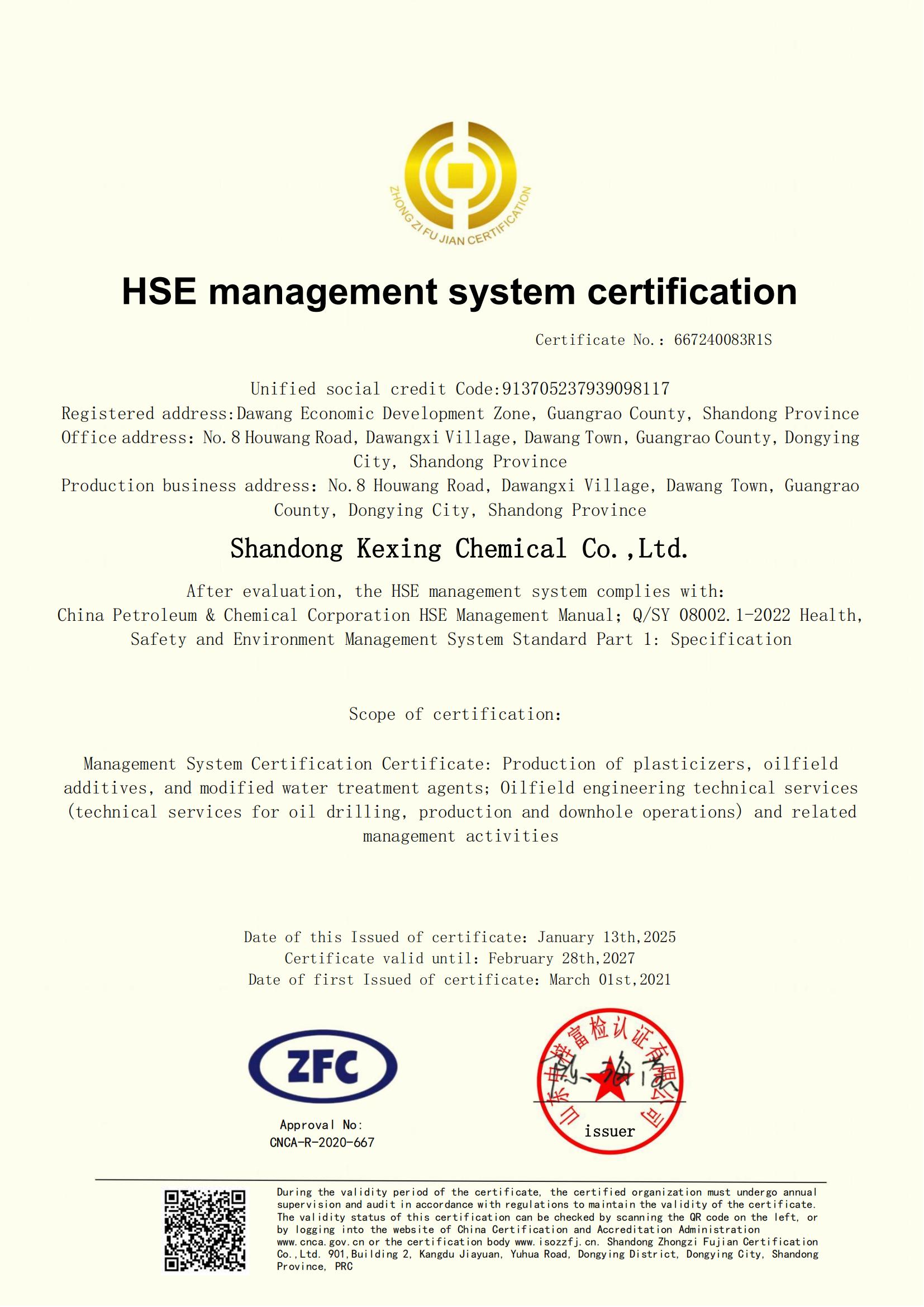
A Health, Safety and Environment (HSE) management system certificate is one of the document signals a buyer can request before committing to an ATBC supply agreement.
Inside an ATBC Plant: Production Signals Buyers Can Verify
Acetyl Tributyl Citrate (ATBC, CAS 77-90-7) is a citrate ester plasticizer used where a non-phthalate, low-migration input is a specification requirement rather than a preference. In medical plastics, food-contact film, toys, artificial leather and printing ink, the sourcing question has moved on from “who sells ATBC?” to “which supplier can demonstrate that it can keep producing ATBC to the same specification, in the same volume, on a predictable schedule?” The first question can be answered by a quotation. The second can only be answered by evidence generated inside a plant.
For buyers in the Evaluation and early Execution stages, this article sets out the production-side signals that can actually be checked — reaction capability, batch traceability, capacity and lead-time behaviour, document sets — and the points where that evidence stops short of proving what buyers sometimes assume it proves.
The Capability Question Behind Every ATBC Quotation
ATBC is one product in a family of citrate esters, and a citrate line is only as dependable as the plant behind it. Shandong Kexing Chemical Co., Ltd. is a manufacturer of plasticizers, plastic and rubber flame retardants and plastic additives, founded in 2006 and based in Dongying, Shandong Province, China. The company states a monthly production capacity of 10,000 T, an R&D team of 15 engineers, and roughly 200 employees, and it reports that approximately 50% of output is exported to Europe, the USA, Japan, South Korea and the Middle East. Global import and export activity is handled by its subsidiary, Dongying Kexing International Trade.
That combination — a defined product portfolio, a stated capacity figure, an export ratio and a separate trading entity — is the minimum level of disclosure a buyer needs before moving from price comparison to supplier evaluation. The useful next step is not to accept those numbers at face value, but to understand which parts of the operation they describe and which documents can corroborate them.
What Actually Happens Inside a Citrate Ester Line
Acetyl Tributyl Citrate is produced through two sequential reaction stages rather than a single step, and that structure shapes everything a buyer can later verify.
The first stage is esterification, in which citric acid reacts with n-butanol — a reaction between an acid and an alcohol, which is the material basis the company lists for its citrate products. This stage yields Tributyl Citrate (TBC, CAS 77-94-1), itself a finished plasticizer in the same portfolio. The second stage is acetylation, in which the tributyl citrate molecule is acetylated to give the acetylated citrate ester sold as ATBC. Because both TBC and ATBC are standard products in the same manufacturing programme, the plant is running both the esterification and the acetylation chemistry as routine operations rather than as an occasional campaign.
Downstream of the reactors sit purification and finishing — decolourisation, filtration and moisture control — and then quality control. For a buyer, the commercially meaningful consequence is this: an ATBC supplier that also manufactures TBC and TEC controls the intermediate instead of buying it in. That does not automatically make the product better, but it does mean the traceability chain starts at feedstock rather than at a purchased intermediate.
Reading Capacity Signals: Volume, Lead Time and Order Floor
Capacity claims matter less as a headline number than as a scheduling behaviour that a buyer can test. The stated operating parameters for this supplier’s plasticizer production are a monthly capacity of 10,000 T, a lead time of 30–45 days, and a minimum order quantity of 1 T. Production is offered under OEM arrangements with private labelling as the stated customisation option.
| Capability signal | Stated value | What it means during evaluation |
|---|---|---|
| Monthly capacity | 10,000 T | Headroom for repeat industrial volumes above a single trial order |
| Lead time | 30–45 days | Planning window; spot demand must be scheduled, not assumed |
| Minimum order quantity | 1 T | Low entry point for pilot batches and formulation trials |
| Production mode | OEM | Buyer branding and specification alignment are possible |
| Customisation | Private labelling | Packaging and label identity can follow the buyer’s market |
| Export share | Approximately 50% | Documentation routines are built around export requirements |
A 1 T order floor combined with a 30–45 day lead time is a workable profile for a first qualification batch: large enough to run meaningful trials, small enough to limit exposure if the trial fails. The same parameters, however, mean that a buyer who needs emergency replacement volume will not be served by a trial-sized agreement alone; committed scheduling is what protects continuity.
Traceability From Citric Acid and Butanol to the Finished Drum
Batch traceability is the capability claim most often asserted and least often specified. In this production system, quality control is defined by two checkpoints: raw material incoming inspection, and finished product sampling testing. Those two steps are what allow a finished drum to be linked back to the feedstock lot.
For an ATBC buyer, traceability should be requested as a document chain rather than as a verbal assurance:
- Incoming inspection records for the citric acid and butanol feedstock lots feeding the batch;
- The batch or lot number assigned at the reaction stage, carried through purification and filling;
- The finished-product sampling test report for that lot, issued under the specification the buyer agreed;
- A statement of which specification the report was tested against — in this case, the ATBC specification is identified as an Enterprise Standard.
That last point is not a technicality. Where a supplier tests against an enterprise standard rather than a pharmacopoeia or a buyer-nominated method, the numbers are only comparable when both parties agree on the test method behind each value. Buyers who need a customer-specific method should raise it during evaluation, not after the first delivery.
Portfolio Breadth as a Manufacturing Signal
Portfolio breadth is frequently treated as a marketing list. Read as a capability statement, it is more useful: it shows which chemistries a plant keeps in routine operation, which intermediates are available in-house, and whether a buyer can consolidate several plasticizer lines with one supplier instead of qualifying multiple vendors.
| Product | CAS number | Category |
|---|---|---|
| Acetyl Tributyl Citrate (ATBC) | 77-90-7 | Acetylated citrate ester |
| Tributyl Citrate (TBC) | 77-94-1 | Citrate ester |
| Triethyl Citrate (TEC) | 77-93-0 | Citrate ester |
| Dioctyl Adipate (DOA) | 123-79-5 | Adipate |
| Diocty Sebacate (DOS) | 2432-87-3 | Sebacate |
| Dibutyl Sebacate (DBS) | 109-43-3 | Sebacate |
| N-Butyl Stearate | 123-95-5 | Fatty acid ester |
| Epoxidized Soybean Oil (ESO) | 8013-07-8 | Epoxidised vegetable oil |
| Triethylene Glycol Di-2-ethylhexoate (3G8) | 94-28-0 | Glycol ester |
| Dioctyl terephthalate (DOTP) | 6422-89-2 | Non-phthalate terephthalate |
| Diisononyl phthalate (DINP) | 28553-12-0 | Phthalate |
| Didecyl phthalate (DPHP) | 84-77-5 | Phthalate |
| Dioctyl Phthalate (DOP) | 117-84-0 | Phthalate |
| Dibutyl Phthalate (DBP) | 84-74-2 | Phthalate |
The practical reading: a buyer migrating a PVC formulation from phthalate to non-phthalate does not have to leave the supplier relationship, because both families are manufactured in the same programme. That reduces commercial risk, but it also raises a question worth putting in writing during evaluation — how production is scheduled and separated between phthalate and non-phthalate grades, and what cleaning or changeover routine applies. A broad portfolio does not by itself answer that question.
The ATBC Specification Sheet, Read Line by Line
Specifications are the part of a capability claim that can be tested, so they deserve line-by-line reading rather than a glance at the purity figure.
| Parameter | Specified limit |
|---|---|
| Appearance | Transparent liquid, no suspended substance |
| Odour | Slight odour |
| Colour (Pt-Co) | Max. 30 |
| Density (20 °C) | 1.045–1.055 g/cm³ |
| Ester content | Min. 99.0% |
| Moisture | Max. 0.1% |
| Acidity | Max. 0.1 mgKOH/g |
| Refractive index (25 °C/D) | 1.4410–1.4425 |
| Flash point | Min. 204 °C |
| Test basis | Enterprise Standard |
Two values carry disproportionate weight in downstream processing. Moisture at a maximum of 0.1% limits the risk of haze and bubbles in film and coating work. Acidity at a maximum of 0.1 mgKOH/g constrains residual acid, which matters in formulations where the plasticizer sits in prolonged contact with heat-sensitive PVC compounds. A flash point minimum of 204 °C indicates a low-volatility liquid — relevant where processing temperatures are high and where migration behaviour in the finished article is being assessed. Colour at a maximum of 30 Pt-Co is the limit that tends to be questioned first by buyers producing clear or lightly tinted film.
What the Documents Prove — and What They Do Not
Certification is where buyers most often over-read evidence. The current document set for this production site includes:
- Quality management system certification to GB/T 19001-2016 / ISO 9001:2015, certificate number 66725Q0037R0M, issued 13 January 2025 and valid until 12 January 2028 by Shandong Xiangfu Inspection and Certification Co., Ltd., covering the production of plasticizers, oilfield additives and modified water treatment agents, plus oilfield engineering technical services;
- Environmental management system certification to GB/T 24001-2016 / ISO 14001:2015, certificate number 66725E0038R0M, issued 13 January 2025 and valid until 12 January 2028;
- HSE management system certification, certificate number 667240083R1S, issued 13 January 2025 and valid until 28 February 2027.
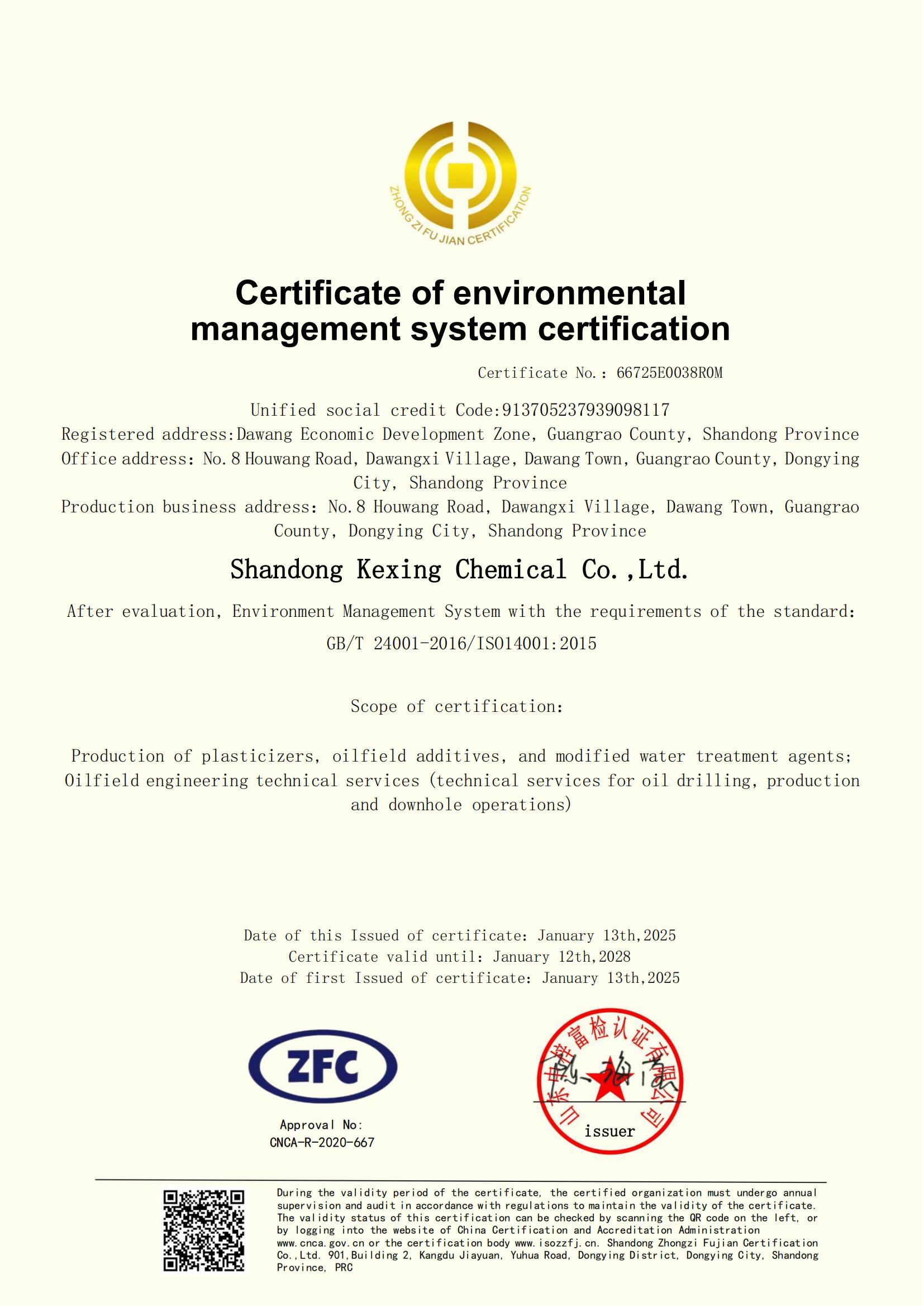
Environmental management system certification (certificate number 66725E0038R0M) — a management-system document, not a product approval.
The boundary is important and is often blurred in supplier presentations. These are management system certificates. They demonstrate that a documented quality, environmental and HSE system is in place and audited against a recognised standard. They do not certify that any individual ATBC lot conforms to a given specification, and they do not substitute for food-contact, toy-safety or medical-device approvals, which depend on the finished article, the application and the jurisdiction.
ATBC as a substance has an established regulatory footprint in the United States: it is listed by the FDA as a food additive and flavouring agent adjuvant under 21 CFR 172.515, 175.105, 178.3910 and 181.27. That listing supports the substance’s use profile — but the buyer still has to confirm that their specific film, container or toy construction meets the applicable migration limit, because the substance listing and the article approval are two different things.
Application Fit: Where Verified Capability Shows Up in Practice
Capability becomes concrete when it is mapped to the plants that consume the material. Documented buyer profiles for this ATBC supply include plastic masterbatch factories, artificial leather manufacturers, food packaging processors and toy factories, with repeat volumes of 15–25 MT per monthly regular order and export destinations including Canada, Chile, France, the United Kingdom, India, Japan, South Korea, Peru, Russia, Turkey and the United States.
The stated applications are plastic compounding, leather surface finishing, and food-contact plastic and printing ink formulation. The reported outcomes for these users are improved flexibility of the finished article, low migration, passing REACH and food-grade safety testing, and a finished-product service life of up to two years. The substantive claim underneath those outcomes is batch-to-batch consistency: phthalate-free formulations, compatibility with PVC and resin systems, and stable batch purity are what make a 15–25 MT monthly repeat order possible in the first place. A supplier that cannot hold a specification will lose that rhythm within two or three deliveries, whatever the first sample looked like.
Market Context: Why Citrate Capacity Is Being Audited Now
The commercial pressure behind these audits is measurable. Third-party market research cited by Data Insights Reports estimates the global Acetyl Tributyl Citrate market at USD 258.92 million in 2025, growing to USD 439.46 million by 2034, driven by ATBC’s position as a bio-based, phthalate-free plasticizer. The same source estimates global ATBC consumption at 128,000 metric tons in 2025, with medical applications accounting for 34% and food packaging 29%.
Published estimates of the market differ substantially depending on whether the scope covers ATBC alone or citrate plasticizers as a category, so the direction of travel is more reliable than any single figure. Supplier concentration is also a factor buyers weigh: the same research attributes approximately 18% of the global ATBC market to Jungbunzlauer and 14% to Mitsubishi Chemical Corporation, leaving a substantial share to regional producers. Third-party listings describe Shandong Kexing Chemical Co., Ltd. as one of the larger production bases for environmentally friendly plasticizers in China — a description that matters to buyers precisely because it points to capacity that can absorb volume, not to brand prestige.
A Pre-Contract Document-and-Facility Checklist
The following checklist converts the discussion above into requests that can be issued before an ATBC supply agreement is signed.
- Entity and site identity: legal company name, registered address, producing site address, and confirmation that the site is the one that will manufacture the ordered material — for this supplier, Shandong Kexing Chemical Co., Ltd., No. 8 Houwang Road, Dawang Economic Development Zone, Guangrao County, Dongying City, Shandong Province, with Dongying Kexing International Trade handling export.
- Certificate set with validity: quality (66725Q0037R0M), environmental (66725E0038R0M) and HSE (667240083R1S) certificates, with issue and expiry dates, and the scope wording that describes which activities are covered.
- Specification sheet: the full parameter list and tolerance band for ATBC, plus an explicit statement of which standard the values are tested against.
- Batch-linked test report: a finished-product sampling test report tied to a specific lot number, not a generic certificate of analysis.
- Feedstock and traceability statement: confirmation that raw material incoming inspection is performed and how a finished lot is linked back to its feedstock lots.
- Capacity and scheduling statement: monthly capacity, current lead time and minimum order quantity in writing.
- Packaging and shipping confirmation: the exact packaging format offered and whether it is supplied as a 200 kg iron drum, an IBC tote tank or bulk industrial ATBC raw liquid, with the fill weight and closure type confirmed on the offer.
- Changeover question: how production is scheduled between phthalate and non-phthalate grades, and what cleaning routine applies between them.
- Sample and trial plan: agreed sample quantity, the trial conditions under which it will be evaluated, and the acceptance threshold.
- After-sales scope: remote technical support, after-sales consulting, quality issue resolution, shipping follow-up and formulation technical guidance, assigned to a named contact.
Commercial Terms at the Execution Stage
Once capability has been reviewed, the terms that govern execution are straightforward and should be confirmed in the same document set. Minimum order quantity is 1 T. Delivery terms are FOB or CIF. Acceptance criteria are based on the factory test report. Payment terms are 30% deposit with 70% payable upon receipt of the bill of lading.
For buyers, the two clauses that deserve the most attention are acceptance and payment. Factory test report acceptance is efficient and fast, but it means the supplier’s own laboratory is the primary reference; buyers who require independent verification should contract a third-party pre-shipment inspection separately, and should agree in advance how a divergence between the factory report and an independent result would be resolved.
Limits and Trade-offs Buyers Should Confirm Themselves
Verifiable capability is not the same as guaranteed suitability, and a credible supplier evaluation should state where the evidence stops.
- Management certification is not product approval. ISO 9001, ISO 14001 and HSE certificates cover the production system and its audited scope; they do not confer food-contact, toy or medical approval on a specific lot or article.
- Enterprise standard testing limits direct comparison. The ATBC specification is tested against an Enterprise Standard. Buyers whose incoming inspection references a pharmacopoeia, a national standard or an internal method must agree the method before ordering, otherwise the numbers on both sides are not strictly comparable.
- Factory test report acceptance shifts verification to the factory. Third-party inspection is possible but is not the default acceptance route.
- Lead time is a planning constraint. A 30–45 day window means trial batches and production ramps must be scheduled ahead; it is not a spot-market lead time.
- Packaging format must be confirmed per offer. Market-supplied ATBC is commonly offered in 200 kg iron drums, IBC tote tanks or as bulk industrial ATBC raw liquid, and the format, fill weight and handling method should be stated on the quotation rather than assumed.
- Documentation does not replace the buyer’s own trial. Compatibility with a specific PVC compound, resin system, ink formulation or film line can only be confirmed by processing the material under the buyer’s own conditions.
Future Outlook
Three trends follow from the evidence above. First, as ATBC volumes grow in medical and food-packaging applications — the two segments with the largest shares in the 2025 consumption estimate — supplier evaluation will increasingly be driven by documentation quality rather than price alone, because those segments require a record, not just a result. Second, buyers in the Evaluation stage are widening their supplier shortlists beyond the largest global names; with roughly 18% and 14% of the market attributed to Jungbunzlauer and Mitsubishi Chemical Corporation respectively, a large share of supply sits with regional producers whose capacity, certificate sets and traceability practices decide whether specification continuity can be maintained. Third, portfolio consolidation will continue: a buyer who can qualify ATBC, TBC, TEC and non-phthalate alternatives such as DOTP within one supplier relationship reduces qualification overhead across an entire product range.
The practical implication for procurement teams is to treat the plant, not the product page, as the unit of evaluation. This is an industry-level analysis; buyers with specific technical questions about this supplier’s ATBC, citric-acid-derived esters or non-phthalate portfolio can review the product documentation directly at kexingchem.com or the downloadable brochure: https://cdn.socialarks.com/sbsp/24765/0/2026/0507/69fc38d7bd903.pdf