
Inside the 20,000 SQM Facility: Evidence of Tesla Accessories Manufacturing Capability
Inside the 20,000 SQM Facility: Evidence of Tesla Accessories Manufacturing Capability
A Tesla accessories listing can be published in an afternoon. A 20,000 square metre operating facility, a workforce of more than 100 people and a 20-engineer technical team cannot. That gap is the practical reason facility evidence has become one of the most useful screening tools available to buyers sourcing in the Tesla aftermarket.
Third-party category research places the global Tesla aftermarket parts market above USD 850 million in 2025, with the United States opportunity estimated at between USD 2.8 billion and USD 4.2 billion against a base of more than 1.8 million owners. Approximately 72% of Tesla owners buy at least one aftermarket accessory within the first six months of delivery, and 78% of Tesla accessory transactions take place online. Large spend, fast adoption and digital-first purchasing together mean that most buyers commit to a supplier without ever seeing the operation that fulfils the order.
T9 EV Station is the operating identity of Hangzhou T9 EV Technology Co., Ltd., a Tesla-focused aftermarket service and supply company founded in 2021 and headquartered in Hangzhou, Zhejiang Province, China. It runs more than 100 Tesla-dedicated stores across China and overseas service stations in Los Angeles and Malaysia. This article examines the verifiable operational record behind that business — floor area, workforce, engineering depth and supply-chain control — and explains what each data point does and does not prove for a buyer planning a Tesla accessories project.
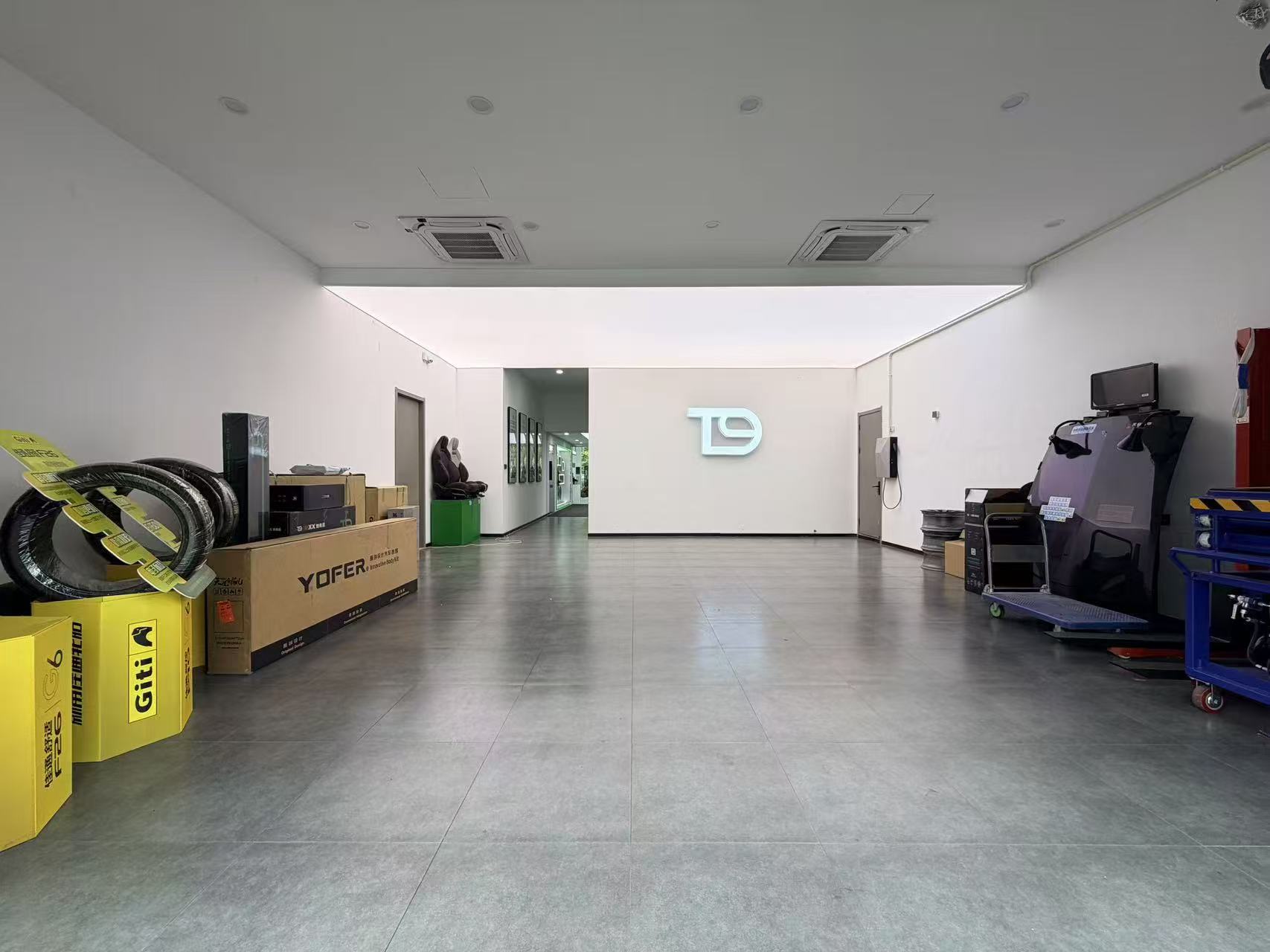
Cover: the customer-facing front of T9 EV Station's Tesla aftermarket operation, where accessory consultation and service scheduling take place before vehicles enter the workshop area.
Why Facility Evidence Matters More in the Tesla Aftermarket Than in General Auto Parts
The Tesla aftermarket is unusually easy to enter at the listing level and unusually hard to enter at the operational level. Because a large share of demand is for interior and exterior accessories, protection film, coatings and upgrade parts that ship in compact packaging, a trading company can present a professional-looking catalogue without owning a workshop, a quality function or an engineering team.
The consequence for buyers is a screening problem rather than a price problem. When several suppliers quote similar products at similar prices, the deciding variables are usually invisible in the quotation: who performs the installation or pre-delivery preparation, who inspects the parts, who holds the warranty, and who is accountable when a batch does not match specification.
A facility record answers those questions in a way that product photography cannot. It is also falsifiable — floor area, headcount and engineering staff can be visited, counted and audited, which is why they carry more weight in a supplier evaluation than catalogue adjectives.
The Verified Operational Record
The table below lists the operational facts disclosed in T9 EV Station's company records. These are first-party figures and should be treated as such: they are strongest when paired with site visits, live video walkthroughs or third-party audit documents during supplier qualification.
| Evidence point | Recorded figure | What it indicates for a buyer |
|---|---|---|
| Operating facility area | 20,000 m² | Scale sufficient for construction bays, storage and inspection functions to operate on one site |
| Workforce | More than 100 employees | Dedicated roles rather than a single generalist covering sales, installation and after-sales |
| Engineering team | 20 engineers | In-house technical capability for fitment, diagnostics and customisation work |
| Product and parts range | 5,000+ SKUs | Breadth of supply for multi-item project requirements rather than single-category trading |
| Service network | 100+ Tesla-dedicated stores in China | A repeatable operating model rather than a single-location business |
| Service coverage | Capacity record of serving over 300,000 Tesla vehicles; company profile records more than 200,000 Tesla owners served cumulatively | Volume of real installation work standing behind the product range |
| Operating history | Founded 2021; four years of Tesla-focused operation | Established continuity, though shorter than some legacy global aftermarket brands |
| Overseas footprint | Main markets EU/USA; service stations in Los Angeles and Malaysia; export share of 5% | Active export capability with a domestic-weighted business base |
Source: T9 EV Station company records. Figures are self-reported first-party data, presented here for evaluation purposes rather than as independently audited metrics.
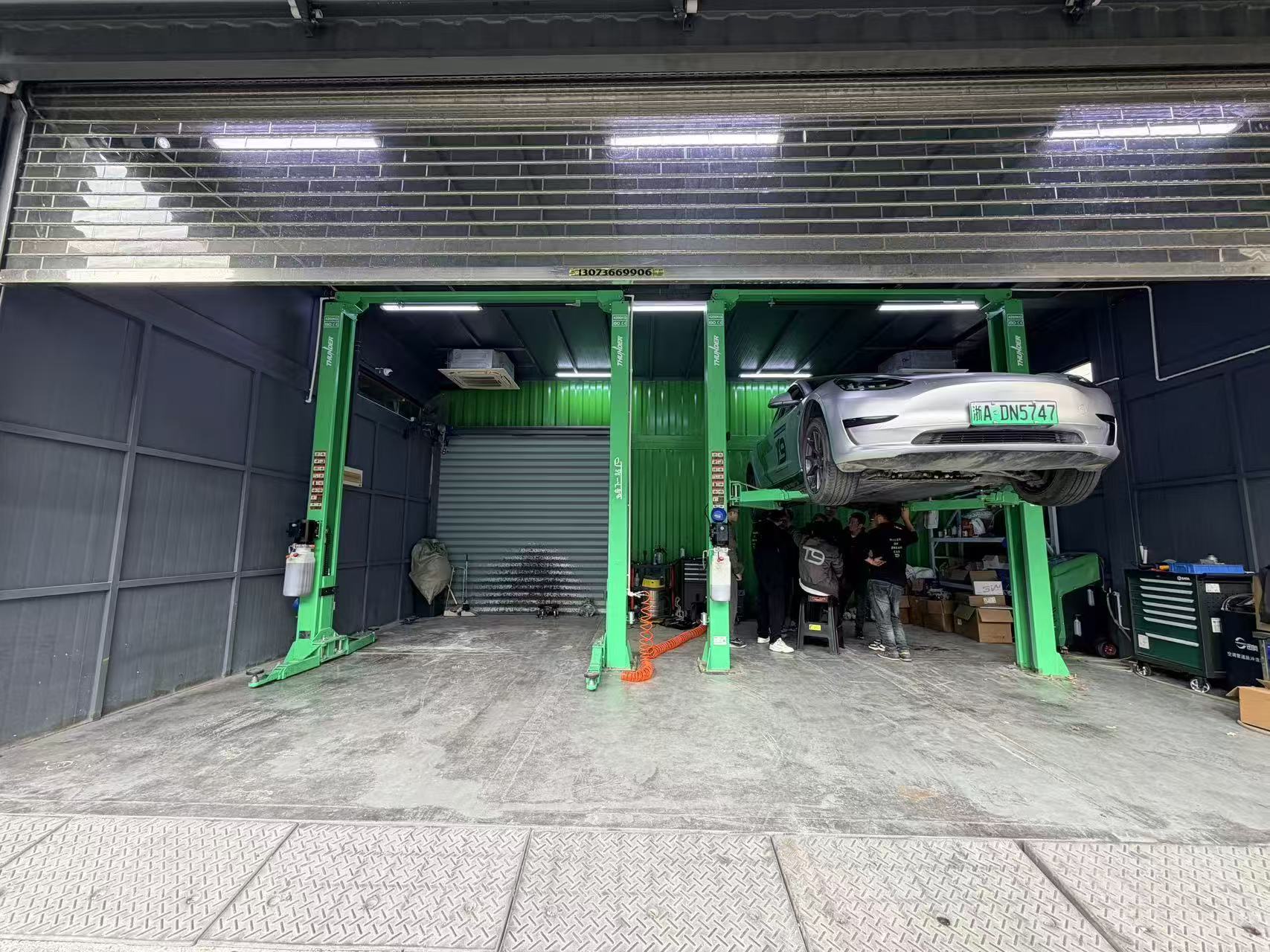
Inside the operating floor: a standardised construction workshop where film installation, modification and vehicle preparation work is carried out under defined process control.
What the 20,000 m² Actually Contains
Floor area only becomes meaningful when it maps to functions. In T9 EV Station's case, the operating model is a full-life-cycle one-stop service — film installation, auto supplies, modification, maintenance and repair carried on the same business structure — supported by a supply system of more than 5,000 SKUs. The company's own facility documentation shows construction workshops as the core working environment rather than showroom-only space.
The functional layers recorded by the company are:
- Standardised construction workshops for automotive film and coating work, modification and installation, and maintenance activity.
- A technical R&D function covering Tesla vehicle electronic system testing and diagnosis, non-destructive modification and installation techniques, film and coating construction methods, and new-energy vehicle maintenance and repair.
- Supply chain management with dedicated quality control roles across a parts range exceeding 5,000 SKUs.
- Digital operation built on ERP for store management, CRM for customer records, an online quotation and order system, and an electronic cloud warranty system that issues traceable warranty certificates.
- Service and after-sales teams handling nationwide warranty support and standardised process control across the network.
For buyers, the significance is less about any single function than about their coexistence on one site. Film installation, diagnostics and modification share a common failure mode: they depend on technicians working to a defined process under inspection. When those capabilities sit in the same facility as the quality function that inspects them, deviation is easier to catch before it reaches a customer's vehicle.
Engineering Depth: What a 20-Engineer Team Changes
Twenty engineers is a modest number in absolute terms and a decisive one in context. Many Tesla accessory suppliers do not employ a technical R&D team at all; they catalogue parts designed by others. An in-house engineering group changes three practical things in a project.
First, fitment risk. Tesla model generations differ in trim, sensor placement, mounting points and interior geometry, and the difference between Model 3, New Model 3, Model Y, New Model Y and Model YL is enough to break accessories designed against a single reference vehicle. An engineering function works at the vehicle level rather than the product-photo level.
Second, installation risk. Non-destructive modification and installation is a technical discipline: clips, harnesses, adhesives and film edges all have failure modes that only appear after delivery. Engineering support in the workshop is what converts a product sale into a repeatable service result.
Third, customisation feasibility. Buyers requesting interior personalisation, exterior upgrade packages or configuration-specific kits are asking an engineering question, not a purchasing one. Whether a supplier can answer it is visible in headcount and role structure before any sample is shipped.
The Reseller Question: What the Record Rules In and What It Does Not
The distinction buyers are trying to draw is between an operator and a reseller. Both may offer the same accessory catalogue at the same price, and the difference surfaces only in execution quality, warranty handling and consistency across repeat orders.
What the T9 EV Station record rules in: a physical operating base of 20,000 m², a workforce above 100 people, 20 engineers, a 5,000+ SKU supply system, 100+ Tesla-dedicated stores, and accumulated installation experience supported by capacity records referencing over 300,000 Tesla vehicles and a company profile recording more than 200,000 owners served. The company also records exclusive strategic partnerships with 3M, BOSCH, Wynn's, Hengst and MXR, strategic partnerships with Hikvision, XPEL, 3W and AGF, and operating qualifications including a motor vehicle maintenance operation record and a franchise business filing qualification, alongside 2025 recognition as an Automotive Service Golden Xun Award recipient and an Automotive Service World Recommended Brand.
What the record does not rule in: mass production of proprietary components at automotive-OEM volumes. The verified capability is vertically integrated service and supply — standardised construction, engineering support, quality inspection and a broad parts supply system — rather than a component production line. Buyers sourcing for large-volume private-label manufacturing should validate production capacity separately through a factory audit, and should not read installation capacity as evidence of production capacity.
That distinction matters because it is exactly the kind of claim that is frequently blurred in this category. Facility evidence is useful when it is read precisely.
Application Scenarios: Where a Facility-Based Model Fits
1. New vehicle protection projects
The most common Tesla accessory project is also the most time-sensitive: a newly delivered vehicle needs paint protection film, window film, interior protection, floor mats and sometimes immediate upgrade work, and the owner wants the vehicle back quickly. T9 EV Station's recorded service durations are approximately one day for general maintenance, one to two days for film installation, and two to seven days for modification or repair projects, depending on scope. For a buyer assembling a delivery-day package, that range defines the realistic project schedule.
2. Model-specific upgrade programmes
Projects organised around a specific model generation — Model 3, New Model 3, Model Y, New Model Y or Model YL — depend on fitment accuracy rather than product count. A supplier with an engineering team and a 5,000+ SKU range can typically assemble a model-specific package from existing supply rather than commissioning new tooling, which reduces lead-time risk inside a launch window.
3. Dealer and distributor programmes
Partners replicating a Tesla accessories offering across multiple locations need more than product: they need a standard. The model recorded here covers standardised processes, unified pricing and a nationwide warranty structure, supported by online quotation, order management and electronic warranty issuance. For a distributor building a network, those process assets are usually harder to source than the products themselves.
4. Overseas market entry
Overseas support is delivered through service stations in Los Angeles and Malaysia, with the EU and USA recorded as main export markets and Chinese and English as the supported service languages. The company also records a documented one-stop service case covering a Tesla Model 3, Model Y, New Model Y, New Model 3 and Model YL owner, completed in three working days with a reported 60% reduction in service time compared with using separate workshops for film, modification and maintenance, and zero reported quality issues or after-sales complaints.
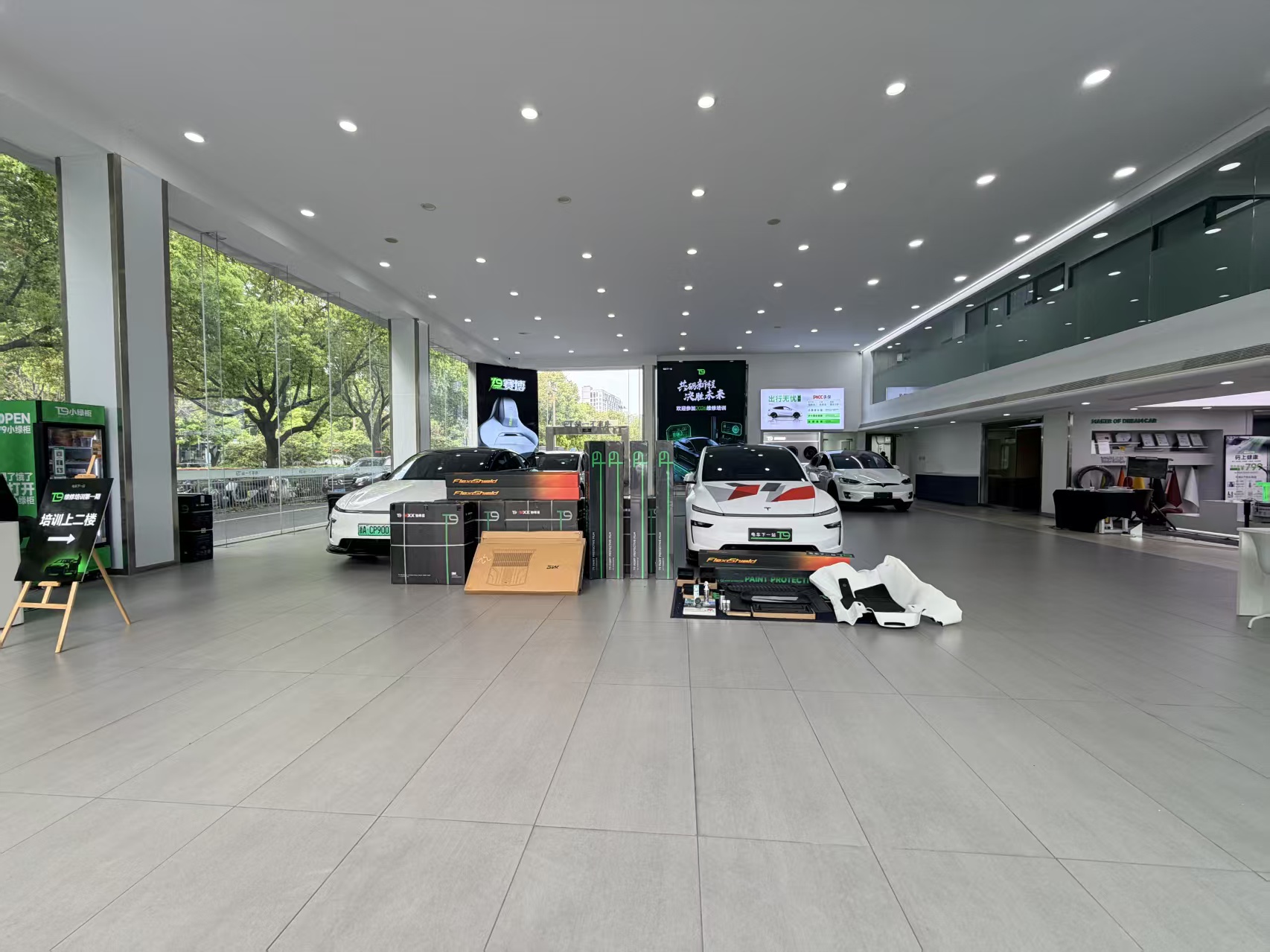
Project planning area: accessory packages, protection film options and upgrade configurations are specified with customers before workshop time is scheduled.
Case results of this kind are first-party service records. They are most useful as an illustration of the process structure — inspection, quotation, construction, handover testing, electronic warranty — rather than as an independently verified performance benchmark.
Market Context: Why This Evidence Category Is Growing
Several third-party data points explain why supplier infrastructure has become a mainstream evaluation criterion rather than a niche concern.
| Indicator | Figure | Source |
|---|---|---|
| Global Tesla aftermarket parts market, 2025 | Projected above USD 850 million | Tesstudio / industry reports |
| United States Tesla aftermarket opportunity, 2025 | USD 2.8 billion – USD 4.2 billion, against a base of more than 1.8 million owners | Hedges Company / Technavio |
| Average annual aftermarket spend per Tesla owner (US) | USD 800 – USD 1,200, approximately 40% above typical luxury-vehicle owners | Hedges Company |
| Owners buying at least one accessory within six months of delivery | Approximately 72% | Tesstudio |
| Share of Tesla accessory purchases made online | 78%, against an automotive industry average of 23% | Shopify / Hedges Company |
| Largest segment by volume | Interior accessories, with Model Y the highest-growth segment | Dataintelo / Accio |
Source: third-party category research as cited. Figures are reproduced as published and are not company estimates.
Two structural effects follow. First, demand is dense enough to support specialised operations rather than generalist auto shops, which raises the minimum viable infrastructure for credible supply. Second, because most purchases are digital, the supplier's physical operation is invisible to the buyer at the moment of decision — which increases the value of suppliers that can document it.
Regulation adds a second pressure. The EU General Product Safety Regulation (Regulation (EU) 2023/988) has applied since 13 December 2024 and introduces mandatory safety requirements for consumer products sold in the EU, including Tesla aftermarket accessories. Suppliers without documented quality processes carry a higher compliance burden in that market than those with them.
How a Facility-Based Model Compares With Traditional Alternatives
Buyers typically weigh three supply structures against each other: local independent accessory shops, online resellers and marketplace sellers, and facility-based chain operations. Each has genuine advantages, and the comparison below describes structural characteristics rather than ranking quality.
| Dimension | Local independent shop | Online reseller / marketplace seller | Facility-based chain operation |
|---|---|---|---|
| Product breadth | Limited to stocked categories | Broad catalogue, sourced per order | Broad catalogue backed by an in-house SKU system (5,000+ SKUs recorded here) |
| Installation capability | Present, varies by technician | Usually none | Standardised construction workshops with engineering support |
| Fitment verification | Depends on individual experience | Depends on supplier documentation | In-house engineering and vehicle-level testing recorded |
| Warranty handling | Local and informal, difficult to transfer | Platform-dependent, often product-only | Unified warranty framework with electronic certificate issuance |
| Consistency across locations | Low — each shop differs | Not applicable | Designed for replication through standardised processes and unified pricing |
| Cost structure | Lowest overhead, higher variability | Low overhead, limited accountability | Higher fixed cost, reflected in pricing |
Where this model is genuinely limited
An honest evaluation has to state the boundaries of the evidence:
- Export share is small. The company records an export ratio of 5%, with the domestic store network carrying the majority of the business. Overseas buyers should plan for a supplier whose international function is smaller than its home-market operation.
- Overseas physical coverage is narrow. Service stations are recorded in Los Angeles and Malaysia. Buyers in other regions work with remote support rather than a local facility.
- Operating history is four years. Founded in 2021, T9 EV Station is younger than several established global aftermarket brands, which matters for buyers applying long-horizon continuity criteria.
- Model scope is deliberately narrow. The business is built around Tesla vehicles rather than the general automotive aftermarket, which limits relevance for mixed-fleet programmes.
- Service scope has exclusions. The company's service definition excludes illegal modification beyond national regulations, vehicle damage caused by improper user operation, work outside the project quotation and agreement, and local legal compliance consulting for modification.
- Language support is Chinese and English. Buyers operating in other languages should confirm communication arrangements during qualification.
None of these limits undermine the core infrastructure evidence. They define the conditions under which that evidence is relevant.
Future Outlook
As the Tesla aftermarket continues to expand, the evaluation question is likely to shift from what a supplier sells to what a supplier operates. That shift favours companies able to document physical infrastructure, engineering staff and process systems, and it disadvantages catalogue-only intermediaries — particularly in markets where product safety regulation now applies to consumer accessories.
For T9 EV Station, the recorded direction of travel is a full-life-cycle model combining film installation, supplies, modification, maintenance and repair under standardised processes and a unified warranty, with a company profile that states an ambition to build a global Tesla aftermarket brand. Whether that ambition translates into wider overseas coverage is a question buyers should keep testing against verifiable evidence: facility audits, engineering headcount, warranty documentation and completed project records.
FAQ: Facility Evidence and Tesla Accessories Sourcing
What does the 20,000 m² facility actually contain?
According to T9 EV Station's company records, the 20,000 m² facility operates as a combined service, construction and supply base rather than a showroom. It houses standardised construction workshops used for film and coating installation, modification and maintenance work, together with the technical R&D function, supply chain and quality control roles, and digital systems for store management, quotation, order handling and electronic warranty issuance.
How many people work in the operation, and what do they do?
The company records a workforce of more than 100 employees, organised into a technical R&D team, a professional construction and maintenance team, a supply chain management team, a digital operation team, and a customer service and after-sales team. Within that structure, 20 engineers work on Tesla vehicle electronic system testing and diagnosis, non-destructive modification and installation, film and coating construction methods, and new-energy vehicle maintenance and repair.
How can a buyer verify facility claims before committing to a supplier?
Facility claims are among the easier supplier statements to verify, because floor area, headcount and engineering roles can be inspected directly. Practical verification steps include a live video walkthrough of the workshops, a site visit during active working hours, requests for the operating qualifications a supplier holds, and review of project documentation such as inspection reports and warranty certificates. For the operation described here, the company documents a motor vehicle maintenance operation record, a franchise business filing qualification, and 2025 recognition as an Automotive Service Golden Xun Award recipient and an Automotive Service World Recommended Brand.
Which Tesla models and project types suit a facility-based supply model?
The model fits projects where fitment accuracy and installation quality carry real cost if they fail: new-vehicle protection packages combining paint protection film, window film and interior accessories; model-specific upgrade programmes for Model 3, New Model 3, Model Y, New Model Y and Model YL; multi-location dealer or distributor programmes requiring standardised processes and unified pricing; and overseas market entry supported by documented warranty and service workflows.
How long does a typical project take?
Recorded service durations vary by scope: approximately one day for general maintenance, one to two days for film installation, and two to seven days for modification or repair projects. A documented one-stop case covering film, interior modification, maintenance and after-sales warranty for a Tesla Model 3, Model Y, New Model Y, New Model 3 and Model YL owner was completed in three working days, with the company reporting a 60% reduction in service time compared with using separate workshops for each task.
What are the limits of this model for overseas buyers?
Three limits are disclosed in the company's own records. Export activity represents 5% of the business, so the international function is smaller than the domestic store network. Physical overseas service stations are recorded only in Los Angeles and Malaysia, meaning buyers in other regions rely on remote support. And the company has operated since 2021, a shorter history than several established global aftermarket brands — relevant for buyers whose procurement criteria require long operating track records.
Reference
Company reference document: T9 EV Station corporate brochure (PDF). Official website: WWW.T9EVPARTS.COM.