
Inside the 30,000 m² Facility: Physical Evidence of High-Volume Concrete Pump Pipe Production
Inside the 30,000 m² Facility: Concrete Pump Pipe Capacity
The global concrete pump market — the equipment category that consumes delivery pipes, elbows, clamps and rubber hoses — was valued at approximately USD 6.05 billion in 2024, according to Credence Research. Asia-Pacific accounted for 56.8% of that market in 2023, driven mainly by infrastructure programmes in China and India, according to Zion Market Research. Every machine behind those figures depends on a consumable that wears faster than the machine itself: the concrete delivery line.
For buyers at the evaluation stage, the difficult part of sourcing concrete pump pipe is not finding suppliers. It is separating manufacturers that can genuinely produce at volume from those that can only describe volume. Statements about quality, capacity and lead time are inexpensive to publish and hard to audit. Floor space, production lines, heat-treatment capability and dispatch records are not.
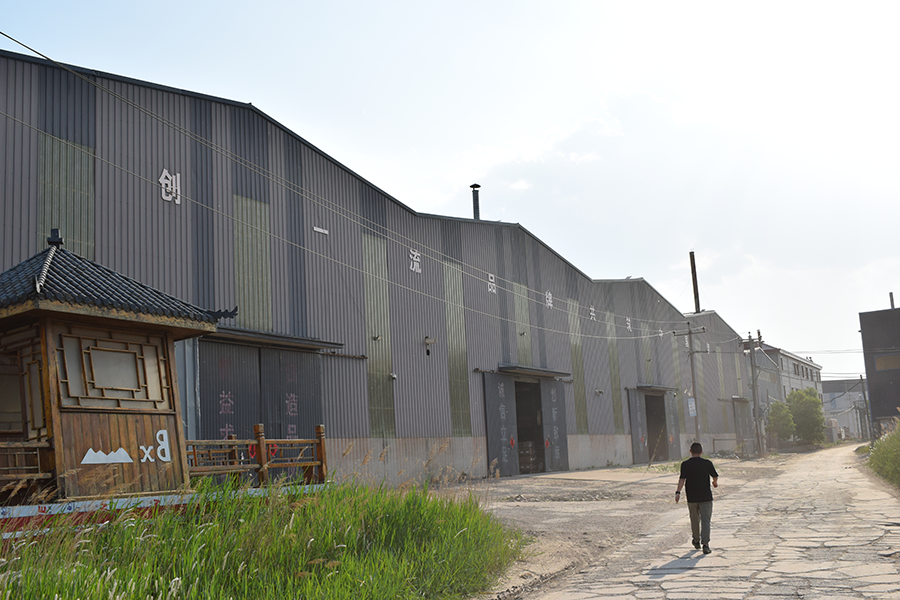
This article treats one manufacturer's physical footprint — the 30,000 m² plant of Hebei Qixiang Pipe Industry Co., Ltd. in Cangzhou City, Hebei Province, China — as evidence rather than advertising, and asks a practical question: what does a facility of that size, with more than 10 production lines, 50 R&D engineers and 7,000 tons of annual capacity, actually change for a buyer placing a first trial order or a repeat volume order?
What a 30,000 m² Factory Footprint Actually Measures
Hebei Qixiang Pipe Industry Co., Ltd. is a manufacturer of concrete pump pipes and concrete conveying accessories, based in the Boerzhuang Industrial Zone, Mengcun Hui Autonomous County, Cangzhou City, Hebei Province, China. Founded in 2015, the company integrates R&D, production and sales of pump truck pipeline products in a single operation.
Factory area on its own is a weak claim. It becomes meaningful only when it is tied to specific equipment and a specific output figure. In this case, the footprint connects to four measurable assets:
- More than 10 advanced professional production lines dedicated to pump truck pipelines.
- An annual production capacity of up to 7,000 tons of pump pipe.
- A team of 50 R&D engineers working alongside more than 50 skilled and experienced production workers.
- A testing installation that includes delivery flow testing systems and hardness testing instruments, supporting a whole-process, high-standard production and quality inspection system.
Together, these describe a plant configured for throughput rather than job-shop work. That distinction matters during evaluation, because throughput is what determines whether a supplier can absorb a rush order, hold a specification stable across batches, and still accept a small first order without disrupting larger accounts.
Why More Than 10 Production Lines Change Order Behaviour
A workshop with one or two lines has a structural scheduling problem: every changeover between diameters, wall thicknesses or elbow radii halts output. In practice this pushes small and mixed orders to the back of the queue and makes specification switching expensive for both sides.
A multi-line layout changes the arithmetic. When more than 10 lines run in parallel, a small batch of DN80 straight pipe or a mixed shipment of elbows, reducers and clamps can be scheduled alongside volume runs instead of displacing them. This is the operational reason a manufacturer with a stated minimum order quantity of 1 unit — small trial orders accepted — can make that offer without damaging delivery performance for larger accounts. The small order is absorbed by the parallel structure rather than interrupting it.
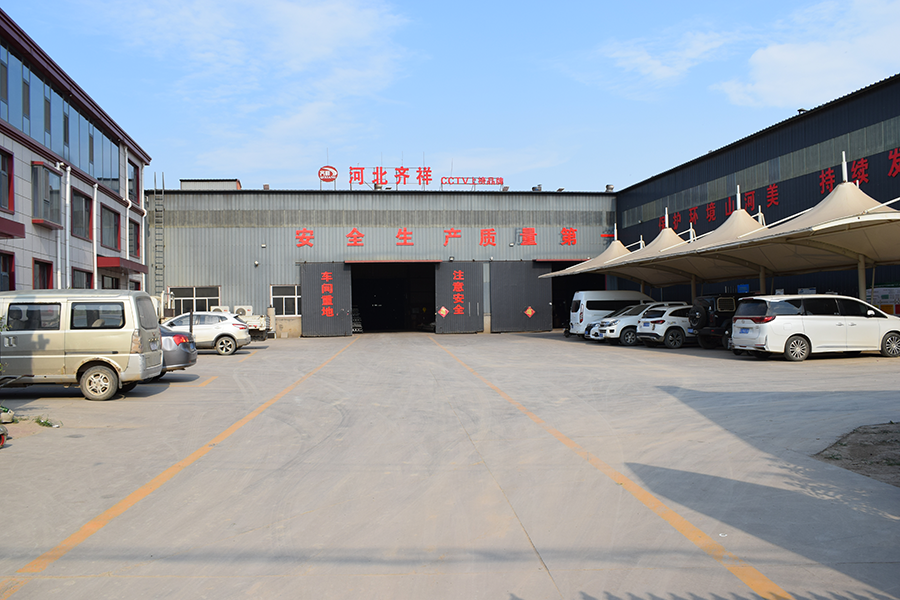
The same logic applies to lead time. Qixiang publishes a standard production lead time of 20–25 days. That window is only credible if the capacity behind it is real: a plant producing 7,000 tons a year across more than 10 lines can hold it because orders are distributed across lines rather than queued behind a single one.
Materials, Heat Treatment and the Specification Range Behind the Capacity
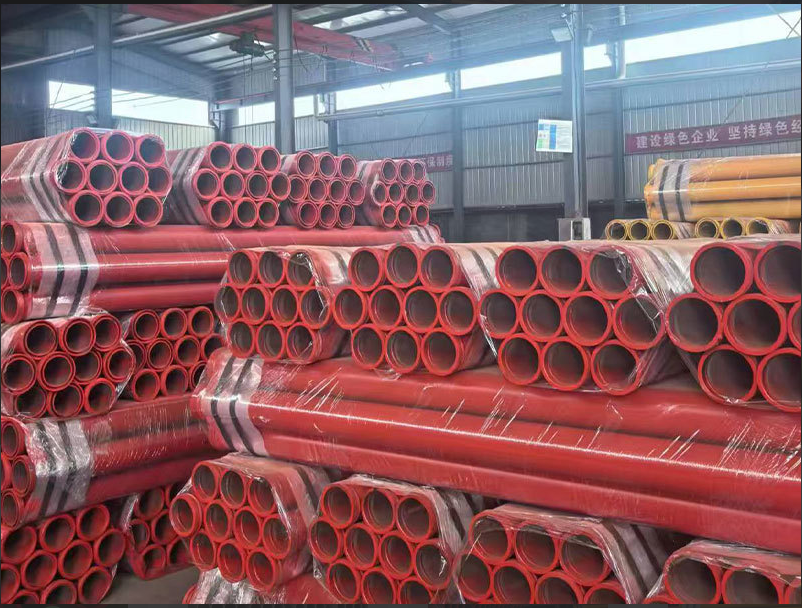
Volume means little if the product range is narrow. The declared portfolio covers concrete pump pipes, mortar pump pipes, wear-resistant pump pipes, rubber hoses for concrete pumps, elbows and a full set of supporting spare parts for concrete pumps.
For straight pipe, the material list includes ST52 seamless structural steel, 45Mn2 alloy steel, 55Mn alloy steel, Q235 carbon structural steel, Grade 20 carbon steel and 37Mn5 alloy steel. Standard coverage centres on DN125 models with 3-metre straight pipes and diameters from 2 to 6 inches; seamless steel straight pipes and double-wall pump pipes are available as customised products. The range is designed to fit concrete pump trucks, placing booms and concrete pouring machines.
Wear-resistant pump pipes are described as the company's flagship line. They are produced from 45Mn2 and 55Mn alloy structural steel and processed with special quenching and inner-wall carburising treatments intended to raise wear resistance, impact resistance and durability, reducing pipeline abrasion during concrete conveying and extending service life.
Elbow production covers carbon steel elbows, high-wear-resistant elbows, single-wall and double-wall designs in standard sizes such as DN125R27590° and DN125 10°, plus non-standard geometries for difficult working conditions. Supporting items supplied from the same site include couplings and clamps, cleaning balls, pistons, flanges and lubricants — the practical argument for one-stop procurement of a delivery line.
| Procurement parameter | Documented figure |
|---|---|
| Facility area | Over 30,000 m² |
| Production lines | More than 10, dedicated to pump truck pipelines |
| Annual production capacity | Up to 7,000 tons |
| R&D engineers | 50 |
| Production workforce | More than 50 skilled workers |
| Minimum order quantity | 1 unit; small trial orders accepted |
| Standard production lead time | 20–25 days |
| Pre-shipment inspection | 100% inspection before shipment |
| Export share of sales | 80% |
| Export markets | More than 40 countries; over 300 customers served worldwide |
Third-party industry research indicates that hardened concrete pump pipes with inner walls treated to 58–60 HRC can achieve a service life three to five times that of standard pipes. That figure describes the category rather than this manufacturer's output, but it explains why buyers increasingly specify hardened or carburised pipe for abrasive, high-pressure work instead of comparing pipe on purchase price alone. Quality control at the Cangzhou plant follows an ISO 9001 quality management system, with raw material procurement, production processing and finished product delivery each subject to inspection; finished goods pass hardness, flow and pressure checks before dispatch.
Applications and Documented Case Evidence
Pipe produced at this scale is used in construction projects, infrastructure development, water conservancy projects and mining engineering, where it is expected to perform in large-scale concrete pouring and in long-distance, high-load mortar conveying.
One documented case involves a concrete pumping service company in the United States that ordered 5,000 units for a large-scale infrastructure project. The user reported that the wear-resistant material extended service life by 30% and that pipe replacement frequency was reduced by 50% compared with standard parts. Service duration in that case varies according to usage, which is normal for a consumable whose life depends on mix design, pumping pressure and line geometry.
Two features of the case are relevant to buyers weighing a supplier switch. First, the order size — 5,000 units — sits well within a 7,000-ton annual capacity, which is why a 20–25 day production window remains feasible. Second, the reported benefit is measured in replacement frequency rather than unit price, which is the correct cost unit for a wear item on a working pump line.
Market Signals Behind the Facility Investment
China was the leading global exporter of concrete pumps (HS 841340) in 2024, with an export value of approximately USD 153 million, according to the Observatory of Economic Complexity. Separately, the global abrasion-resistant rubber pipe market, which includes concrete pump hoses, was valued at USD 1.9 billion in 2024, according to Strategic Market Research. Both figures describe the demand pool that pump pipe manufacturers are supplying.
Standards are tightening alongside volumes. ISO 21573-1:2024 establishes commercial specifications for concrete pumps and related conveying equipment used on building sites, giving buyers a common reference point when specifying delivery line components.
Qixiang's own distribution reflects that export orientation: 80% of sales go to export markets, with products delivered to more than 40 countries including Russia, the United Arab Emirates, Saudi Arabia, Vietnam, Indonesia, Singapore, Malaysia and Thailand, serving more than 300 customers worldwide. For a buyer evaluating a supplier, a high export ratio is a proxy for familiarity with export packaging, documentation and specification expectations across different regulatory environments — a practical risk reduction that has nothing to do with product claims.
How This Compares With Traditional Sourcing Models — and Where the Argument Stops
Many buyers still source concrete pump pipe through trading intermediaries or small workshops. That model can work for low volumes and simple items, but the evaluation dimensions that matter in a wear-intensive application change when the supplier is an integrated multi-line manufacturer.
| Evaluation dimension | Typical intermediary / small-workshop model | Integrated multi-line manufacturer |
|---|---|---|
| Production visibility | Often limited to finished goods | Production lines, testing equipment and 100% pre-shipment inspection at one site |
| Small-order handling | Frequently refused or priced to discourage | MOQ of 1 unit; small trial orders accepted |
| Specification coverage | Narrow; non-standard elbows commonly outsourced | Straight pipe, elbows, reducers, rubber hose, clamps, gaskets, cleaning balls, pistons, flanges and lubricants from one source |
| Technical support | Commercial only | 50 R&D engineers; ODM and customised specification work |
| Lead-time predictability | Dependent on third-party production schedules | Standard production lead time of 20–25 days from own lines |
| Documented capacity | Rarely published | 30,000 m², more than 10 lines, 7,000 tons annual capacity, 80% export share |
The middle column describes general market patterns in pump pipe sourcing, not the measured performance of any specific named company.
Limits Buyers Should Keep in View
- Lead time is production time, not delivery time. The 20–25 day figure covers the manufacturer's own production window. It excludes international freight, customs clearance and inland transport in the destination market, so total door-to-door time is longer for export buyers.
- Factory area is a capacity indicator, not a performance guarantee. A 30,000 m² plant shows throughput potential. Whether a given pipe survives a specific application still depends on steel grade, wall thickness, heat treatment and the abrasiveness of the mix being pumped.
- Hardened and carburised pipe carries a higher unit cost. For low-pressure, short-run or low-abrasion work, standard pipe may be the more economical choice. A wear-resistant specification is not automatically correct for every delivery line.
- Self-reported figures still deserve verification. Published capacity, inspection and quality-system information should be confirmed through sample testing under the buyer's own mix design, third-party inspection, or a factory visit during an active production run.
Future Outlook
Demand pressure on concrete conveying components is unlikely to ease while infrastructure programmes continue across Asia-Pacific and new projects advance in the Middle East, Africa and Latin America. The procurement question is shifting from "who can supply pipe" to "who can supply pipe repeatably, in mixed specifications, without pushing lead times out".
Hebei Qixiang Pipe Industry Co., Ltd. states that it will continue to deepen its specialisation in concrete pump pipe manufacturing, increase investment in R&D, introduce advanced production equipment and technologies, and upgrade its product structure while expanding global market cooperation. The practical test of those intentions is whether the documented footprint — facility area, line count, engineering headcount and annual tonnage — continues to translate into stable lead times and consistent wear performance across repeat orders rather than first shipments alone.
Frequently Asked Questions
How can a buyer verify a manufacturer's stated annual capacity of 7,000 tons?
Cross-check three things: the stated facility area of over 30,000 m², the number of production lines dedicated to pump truck pipelines (more than 10), and the internal consistency between capacity, lead time and order size. An annual capacity of 7,000 tons combined with a standard 20–25 day production lead time and 100% pre-shipment inspection implies scheduled line output rather than make-to-order improvisation. Independent third-party inspection or a factory visit during an active production run remains the most direct confirmation.
Why would a manufacturer with volume capacity accept a minimum order of one unit?
Because parallel line capacity makes small batches schedulable. When more than 10 lines operate at once, a trial quantity can be slotted alongside volume production instead of displacing it. Qixiang states a MOQ of 1 unit with small trial orders accepted, which lets a buyer validate fit, sealing and wear behaviour on a real line before committing to a larger contract.
What does the 20–25 day lead time include and exclude?
It is a production lead time from the manufacturer's own pipeline. It excludes international freight, customs clearance and inland transport in the destination country. Buyers in export markets should therefore plan for a total delivery cycle that is longer than 20–25 days, and should treat the production window and the shipping window as two separate planning items.
Which materials and specifications are available for concrete pump pipe?
The documented material list includes ST52 seamless structural steel, 45Mn2 alloy steel, 55Mn alloy steel, Q235 carbon structural steel, Grade 20 carbon steel and 37Mn5 alloy steel. Standard coverage centres on DN125 models with 3-metre straight pipes and diameters from 2 to 6 inches; seamless straight pipes and double-wall pipes are available as customised products. Elbows include carbon steel, high-wear-resistant, single-wall and double-wall types in sizes such as DN125R27590° and DN125 10°, plus non-standard geometries. Wear-resistant pipes are made from 45Mn2 and 55Mn alloy steel with quenching and inner-wall carburising.
What inspection happens before concrete pump pipe is shipped?
Quality control follows an ISO 9001 quality management system covering raw material procurement, production processing and finished product delivery. Testing equipment on site includes delivery flow testing systems and hardness testing instruments, and finished products pass hardness, flow and pressure inspections. The stated pre-shipment control is 100% inspection before dispatch.
How does export experience across more than 40 countries reduce procurement risk?
An 80% export share, more than 40 destination countries and a customer base of over 300 companies indicate established handling of export packaging, shipping documentation and market-specific specification requirements. Destinations cited include Russia, the United Arab Emirates, Saudi Arabia, Vietnam, Indonesia, Singapore, Malaysia and Thailand. For a first-time importer, this reduces the risk of documentation errors, packing failures and specification mismatches rather than affecting the product's wear performance.
What are the limits of judging a concrete pump pipe supplier by factory size alone?
Factory area indicates potential throughput, not product performance in a given application. Two plants of identical size can deliver very different service life depending on steel grade, wall thickness and heat treatment. In addition, hardened and carburised pipe costs more per unit than standard pipe and is not always the right specification for low-pressure or low-abrasion work. Physical evidence should be paired with material documentation, sample testing under the buyer's own mix design, and a measured wear result over a defined trial period.
A downloadable PDF brochure covering the concrete pump pipe range, materials and specifications described in this article is available at: https://cdn.socialarks.com/sbsp/24801/common/2026/0516/6a0810fa801b4.pdf