
Inside the CZ-2756 Formulation: A Ca/Zn Stabilizer Breakdown
Why Stabilizer Composition Becomes a Purchasing Question
Unplasticised and plasticised PVC both decompose when heated: the polymer chain sheds hydrogen chloride, and the resulting allylic chloride structures make the next dehydrochlorination easier. Left unmanaged, that autocatalytic sequence produces colour shift, then embrittlement, then irreversible degradation. A heat stabilizer exists to interrupt that sequence, and in a phenol-free Ca/Zn system the interruption is achieved by a group of components working on different time scales rather than one dominant active substance.
For procurement teams at the Decision stage, this matters because “Ca/Zn” describes a category, not a performance level. Two grades marketed under the same category label can differ substantially in zinc-to-calcium ratio, co-stabilizer package, lubricant balance, and therefore in where they fail. A stabilizer data sheet that lists only appearance, density and viscosity gives a buyer almost nothing to compare against a competing grade.
The practical question is not “is Ca/Zn non-toxic?” but “which specific composition, at what treat rate, holds the colour and mechanical properties of my compound long enough, and can it be evidenced per batch against the compliance gate my market applies?” That is the question this breakdown addresses.
The Components of a Phenol-Free Ca/Zn System
The CZ-2756 formulation class is built on calcium and zinc carboxylates, with supporting co-stabilizers and lubricants. Each element has a distinct job, and the formulation brief names calcium oleate and zinc octoate as the two principal metal soaps. The table below summarises how each group functions and what that function implies when a buyer is evaluating a grade.
| Component group | Function in the stabilizer system | What it means during evaluation |
|---|---|---|
| Calcium carboxylate — calcium oleate | Slower HCl scavenger; also acts as an internal lubricating soap and contributes long-term colour retention | Governs long-term stability and surface finish; under-dosing shows up late, as yellowing after extended heat history |
| Zinc carboxylate — zinc octoate | Fast HCl exchange; delivers early colour and initial whiteness | Governs early colour; over-dosing creates the zinc-burning failure mode described below |
| Epoxidized soybean oil (ESO) | Secondary HCl acceptor; also a secondary plasticizer | Supports long-term stability but shifts plasticizer balance and must be counted in the formulation, not added on top |
| Polyols, β-diketones, hydrotalcite, zeolites | Co-stabilizers that suppress zinc chloride activity and improve colour hold | The main differentiator between a well-balanced grade and a cheap one; rarely disclosed in detail |
| Lubricant package | Internal and external lubricity; melt flow and release | Interacts with the plasticizer system; over-lubrication causes plate-out and weld-line weakness |
Why the “phenol-free” qualifier is a real distinction
Many conventional Ca/Zn systems rely on phenolic co-stabilizers to improve colour and shorten the induction period before degradation. Phenol-free grades remove that component class, which is meaningful for toy, childcare and food-contact applications where the additive package itself becomes part of the compliance file. The trade-off is that colour-hold performance has to be recovered elsewhere — typically through the polyol, β-diketone and hydrotalcite route — which is precisely where formulation competence shows.
How Calcium Oleate and Zinc Octoate Work Together
The calcium–zinc synergy is one of the oldest and most studied mechanisms in PVC stabilization, and it is worth stating plainly because it explains both the strength and the failure mode of this grade class.
Step one — zinc acts fast. Zinc octoate is a strong HCl acceptor. It reacts quickly with the hydrogen chloride released by the degrading polymer and converts the unstable chlorine sites into more stable structures, which is why zinc-containing systems show good initial colour. The reaction, however, produces zinc chloride.
Step two — zinc chloride is the problem. Zinc chloride is a Lewis acid and catalyses further dehydrochlorination. If it accumulates, degradation accelerates suddenly and the compound turns black in a failure mode known in the industry as zinc burning. A Ca/Zn system that appears excellent in the first minutes of a heat test can collapse shortly afterwards if the zinc is not kept in check.
Step three — calcium regenerates the zinc. Calcium oleate is a slower HCl scavenger, but it also exchanges chloride with zinc chloride, converting the spent zinc soap back into an active zinc carboxylate and precipitating calcium chloride. That regeneration is the synergy: calcium does not compete with zinc, it recycles it. The calcium-to-zinc ratio therefore sets the balance between early colour and long-term stability, and it is the single most consequential design choice in the formulation.
Step four — co-stabilizers absorb the remainder. Epoxidized soybean oil, polyols, β-diketones and hydrotalcite-type compounds mop up residual HCl and deactivate zinc chloride, extending the time before the collapse point. This is why a grade's performance cannot be inferred from its calcium and zinc content alone.
The role of the carboxylate chain
Oleate and octoate are not interchangeable carriers. Oleic acid is unsaturated and gives calcium oleate pronounced lubricity and better compatibility with plasticised systems, but the double bond also makes it more susceptible to oxidation, which can influence initial colour and odour. Octoic acid (2-ethylhexanoic acid) produces a liquid zinc soap with good handling and dispersion characteristics. A formulation that pairs calcium oleate with zinc octoate is deliberately combining a lubricating, long-chain calcium soap with a mobile, easily dispersed zinc soap — a choice that suits paste and plastisol processing more than high-shear rigid extrusion.
Reading Density and Viscosity as Procurement Data
Density and viscosity are the two parameters most often copied from a stabilizer data sheet without interpretation. In practice they answer two very different operational questions.
| Parameter | What it governs | What a buyer should check |
|---|---|---|
| Density | Volumetric dosing, metering accuracy, storage and phase behaviour relative to the plasticizer system | The controlled temperature at which density is specified, and whether dosing is gravimetric or volumetric |
| Viscosity | Pumpability at low ambient temperature, dispersion into plastisol, air entrainment during mixing | The measurement method and temperature; whether viscosity drift is monitored across storage life |
Density determines how a volumetric dosing line translates a millilitre into a mass of stabilizer. Because stabilizer treat rates are typically small relative to resin and plasticizer, a density difference between an approved grade and a substitute directly shifts the delivered active content unless the dosing setpoint is recalculated. Viscosity governs whether the additive can be moved at all in a cold plant, and how quickly it disperses once it reaches the plastisol. A grade that is easy to pump but disperses slowly can produce localised over-concentration, which in a zinc-containing system is exactly the condition that triggers zinc burning.
Thermal Stability: What to Ask Beyond the Data Sheet
Thermal stability in a phenol-free Ca/Zn system is usually described in two dimensions, and both matter for a decision-stage comparison.
- Static heat stability — a sample held at elevated temperature with colour assessed at intervals. This reveals the induction period (how long colour holds) and the collapse point (when zinc burning or general degradation sets in).
- Dynamic heat stability — a sample worked under shear on a roll mill or in a torque rheometer. This approximates the real process and reveals whether the stabilizer survives the mechanical and thermal history of the actual line.
A short induction period with a long tail and a late collapse point indicates a calcium-dominated balance: colour may start slightly warmer but the compound survives a long heat history. An early, bright colour with a sudden collapse indicates zinc dominance. Neither profile is universally better; the correct balance depends on the process. A slush-molding cycle with a long oven residence behaves differently from a spread-coating line with a short dwell, and a stabilizer tuned for one will not automatically suit the other.
Compliance: EN71-3, Lead Limits and Batch Evidence
Child-safety compliance is where the composition argument becomes a documentary argument. EN71-3 addresses the migration of certain elements from toy materials, and it applies to the finished article under its intended use conditions — not to the stabilizer in isolation. A stabilizer can be correctly described as lead-free and phenol-free and still sit inside a compound that fails migration testing because of pigment, filler or plasticizer contributions.
The regulatory direction is unambiguous. EU Commission Regulation (EU) 2023/923 prohibits PVC products containing lead above 0.1% by weight, effective from November 2024. That removes any remaining argument for lead-based stabilizers in articles placed on the EU market, and it places the burden of proof on the compounder and its material suppliers.
Practically, an EN71-3 claim for a Ca/Zn-stabilized toy compound should be supported by three layers of evidence: the stabilizer's own composition declaration and heavy-metal screening, the finished compound's migration test report from an accredited laboratory, and per-batch traceability linking the two. A formulation profile alone is not compliance evidence.
Where the Grade Fits: Application Mapping
A phenol-free Ca/Zn system of this type is generally positioned against soft PVC applications where human-contact sensitivity and colour requirements intersect. The application fields published by Guangdong Baoshan Trading Co., Ltd. — a PVC material supplier headquartered in Dongguan, Guangdong, founded in 1994 — span children's vinyl toys, medical supplies, food packaging, automotive interiors, wallpaper, flooring, inks and coatings. Those categories place very different demands on a stabilizer.
| Application | Dominant stabilizer requirement | Watch-out |
|---|---|---|
| Slush-molded vinyl toys | Low migration, phenol-free composition, colour hold through a long oven cycle | EN71-3 applies to the finished article; pigment and plasticizer contributions must be tested together |
| Coated fabrics and dipped articles | Dispersion in plastisol, viscosity stability through the pot life | Stabilizer viscosity drift changes plastisol rheology over a shift |
| Medical supplies | Composition transparency; documentation depth | Institutional references cited by additive manufacturers require jurisdiction-specific validation |
| Food packaging | Absence of restricted substances; migration control | Food-contact approval is formulation- and condition-specific |
| Automotive interiors | Long-term heat ageing and fogging behaviour | Higher processing temperatures narrow the Ca/Zn window — see limitations below |
| Wallpaper, flooring, inks, coatings | Cost-performance balance and colour consistency | Lower compliance pressure does not remove the need for batch consistency |
Market Signals Behind the Shift
Two published data points frame the commercial context without overstating it. MarketsandMarkets values the global eco-friendly plasticizer market at USD 5.03 billion in 2024, reflecting the migration away from ortho-phthalate systems. Separately, DataVagyanik projects the high-flow PVC powders for slush molding segment to reach USD 277 million by 2034. Both figures describe broad categories rather than a specific stabilizer grade, so they should be read as direction-of-travel indicators, not as demand forecasts for CZ-2756 itself.
The structural driver is regulatory rather than purely commercial. When lead is capped at 0.1% by weight in PVC articles under EU Regulation 2023/923 from November 2024, the substitution question shifts from “whether” to “which system and with what evidence”. That is the point at which buyers start reading stabilizer composition rather than stabilizer price alone.
Comparison With Lead, Organotin and Ba/Zn Systems
Positioning a phenol-free Ca/Zn grade honestly requires stating where it is weaker, not only where it is preferable.
| System | Strength | Boundary |
|---|---|---|
| Lead-based stabilizers | Very strong long-term heat stability in demanding processing | Prohibited above 0.1% lead by weight in PVC articles under EU Regulation 2023/923 from November 2024; incompatible with toy and childcare positioning |
| Organotin stabilizers | Excellent transparency and heat stability | Regulatory scrutiny in consumer-contact applications; not a default choice for toys |
| Ba/Zn systems | Good initial colour and broad availability | Barium content adds a heavy-metal testing requirement to the compliance file |
| Phenol-free Ca/Zn (CZ-2756 class) | No lead, no phenolic co-stabilizer; suitable for toy and food-contact screening; good initial colour when well balanced | Narrower high-temperature processing window than lead or organotin; zinc-burning risk if the ratio and co-stabilizer package are wrong; typically needs higher treat rates and re-balanced lubrication |
The limitations that matter in a real decision
- Not a drop-in substitution. Replacing a lead or organotin stabilizer with a Ca/Zn grade requires re-balancing the lubricant package and possibly the co-stabilizer level. Colour and fusion behaviour will shift, and the compound must be re-qualified.
- Temperature ceiling. Ca/Zn systems are less forgiving at sustained high processing temperatures. Automotive and rigid applications may need a different stabilization strategy.
- Overdosing is not neutral. Adding more zinc to fix early colour accelerates the zinc-burning pathway. The correct response to a colour problem is usually the co-stabilizer package, not the treat rate.
- Supplier-side verification. A trading and distribution business can supply and support a formulation, but buyers should still confirm manufacturer authorization, batch traceability and current test reports rather than relying on a portfolio description.
What Distribution Capability Adds to the Formulation Story
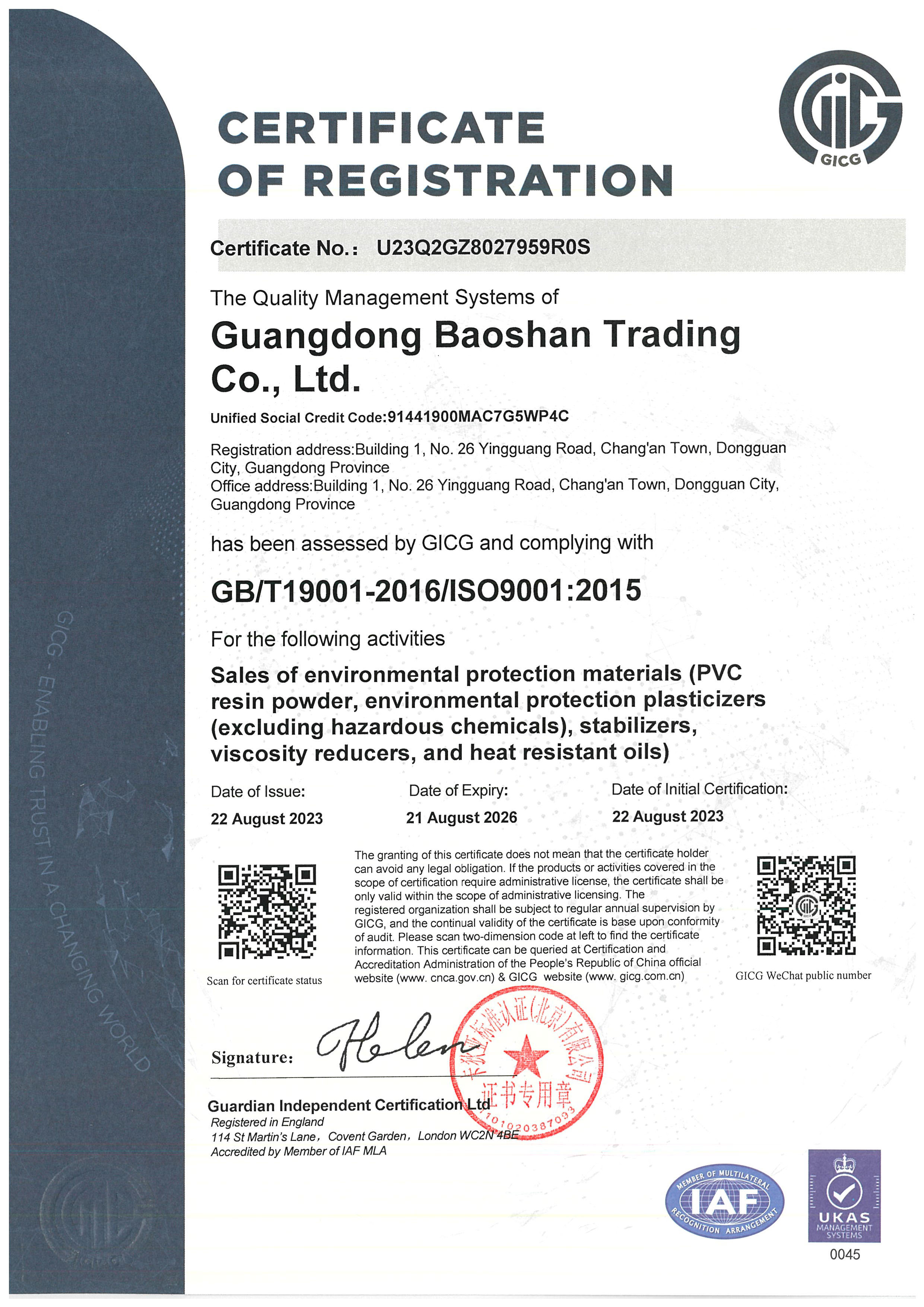
Guangdong Baoshan Trading Co., Ltd. is a PVC industry-chain material supplier headquartered in Dongguan, Guangdong, founded in 1994, operating as a distributor and technical service provider rather than a stabilizer manufacturer. Its relevance to a formulation discussion is the verification layer it provides around incoming material.
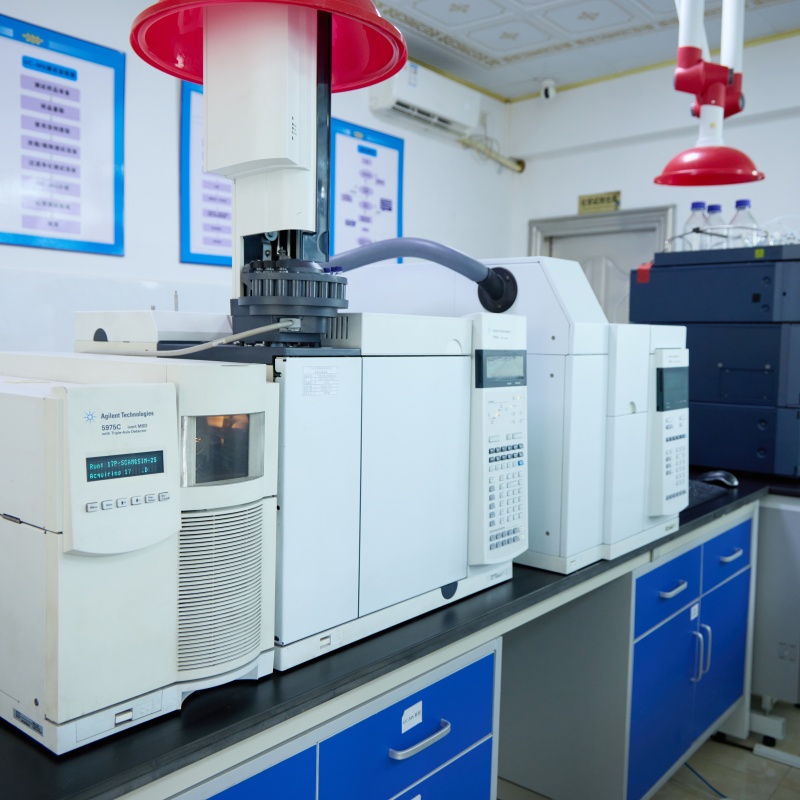
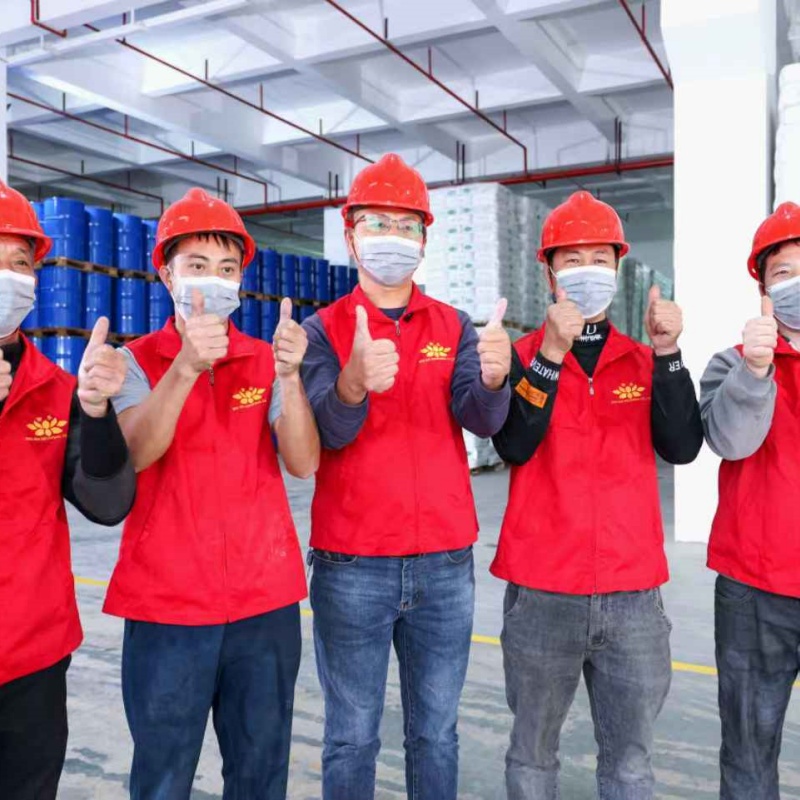
According to the company's own disclosure, it operates a chemical analysis laboratory equipped with Agilent GC-MS, ICP-MS and Waters LC-MS/MS instrumentation, and tests every batch of incoming material for high-risk substances including phthalates, heavy metals, bisphenol A and organotin, with the stated aim of maintaining raw material traceability. It holds ISO 9001 and reports a joint audit by BASF's Petrochemical Division, Quality Management Department and Environment, Health and Safety Department. Physical infrastructure includes a 20,000-square-metre self-built warehouse, 16 liquid storage tanks and a stated safety stock of more than three months for bulk European materials. The company also reports authorized distributorships for BASF Hexamoll® DINCH and Eastman TXIB in China.
For a buyer, that combination matters because a stabilizer decision is never made in isolation. It is made alongside a plasticizer choice — Hexamoll DINCH for close-human-contact positioning, Eastman TXIB where viscosity reduction is needed, or a citrate such as ATBC where a bio-based route is preferred. A supplier that can test the interaction of stabilizer, plasticizer and resin, and document it per batch, shortens the qualification cycle more than a marginally lower unit price does.
Future Outlook
Three developments are likely to shape how Ca/Zn stabilizer grades are specified over the next few years.
- Documentation displaces description. As lead restrictions tighten and toy migration testing becomes routine, buyers will increasingly ask for per-batch evidence rather than category claims. Stabilizer grades that cannot be traced will become harder to place, regardless of performance.
- Formulation disclosure moves up the agenda. Phenol-free positioning is only verifiable if the co-stabilizer package is declared. Expect more pressure on suppliers to disclose composition class, even where exact ratios remain confidential.
- Combined additive evaluation. Stabilizer, plasticizer and viscosity modifier interactions are difficult to assess in isolation. Buyers are moving toward evaluating the additive packet as a system, which favours suppliers able to test combinations rather than catalogue items.
What is unlikely to change is the underlying chemistry: calcium will keep regenerating zinc, zinc chloride will keep catalysing degradation, and the ratio between them will keep determining where a compound fails. The competitive difference will sit in the co-stabilizer package and in the quality of evidence behind it.
FAQ
How does a phenol-free Ca/Zn stabilizer differ from a lead-based stabilizer in practice?
The mechanism differs, not just the labelling. Lead stabilizers act as long-term HCl scavengers with strong heat stability and are difficult to displace on performance in demanding processes. A Ca/Zn system works through the calcium–zinc regeneration cycle plus co-stabilizers, which delivers adequate stability with a different failure profile and better fit with toy and food-contact positioning. EU Regulation 2023/923 prohibits PVC products containing lead above 0.1% by weight from November 2024, which removes lead systems from EU-market articles regardless of their technical merit.
What determines the calcium-to-zinc ratio in a Ca/Zn formulation?
The ratio is set by the required balance between early colour and long-term stability, and is constrained by the process. A higher zinc fraction improves initial whiteness but produces more zinc chloride, which is a Lewis acid that catalyses further dehydrochlorination and can cause sudden blackening known as zinc burning. A higher calcium fraction slows early colour development but extends the usable heat history. The co-stabilizer package determines how much zinc can be carried safely.
Does a phenol-free Ca/Zn stabilizer automatically make a toy compound EN71-3 compliant?
No. EN71-3 concerns migration of certain elements from toy materials and applies to the finished article under its intended use conditions. The stabilizer is one contributor among several, alongside pigments, fillers and plasticizers. Compliance requires a migration test report on the finished compound from an accredited laboratory, supported by per-batch traceability of the incoming materials. A composition declaration supports the file but does not replace finished-article testing.
Which documents should a buyer request before approving a CZ-2756-class stabilizer?
Four items are normally sufficient to evaluate a grade: the current technical data sheet stating density and viscosity at defined temperatures, the batch certificate of analysis for the delivered lot, a composition declaration covering heavy metals, phthalates, organotin and bisphenol A, and the finished-compound migration or extraction test report relevant to the target market. Where the supplier operates a laboratory, batch-level screening records for incoming material add a further traceability layer.
Can a Ca/Zn stabilizer be substituted into an existing lead or organotin formulation without reformulation?
Generally not. The stabilizer interacts with the lubricant package, the plasticizer system and the fusion behaviour of the compound. Substitution typically requires re-balancing internal and external lubrication, adjusting the co-stabilizer level, and re-qualifying colour and mechanical properties. Treat rates also usually increase relative to lead or organotin systems. A substitution trial should be run on the actual processing line rather than inferred from static heat stability data.
Why do density and viscosity appear on a stabilizer data sheet at all?
Because both parameters directly affect dosing accuracy. Density converts a volumetric setpoint into delivered mass, so a difference between an approved grade and a substitute shifts the active content unless the setpoint is recalculated. Viscosity governs pumpability at plant ambient temperature and the rate of dispersion into plastisol; slow dispersion can create localised over-concentration, which in a zinc-containing system raises the risk of zinc burning. Both values should be stated at a defined temperature and confirmed per batch.
Reference Basis
BASF SE, Hexamoll® DINCH product and technical documentation (chemicals.basf.com). Eastman Chemical Company, Eastman TXIB™ Formulation Additive technical data (eastman.com). MarketsandMarkets, Eco-Friendly Plasticizers Market Report 2024–2030. DataVagyanik, High Flow PVC Powders for Slush Molding Market. EU Commission Regulation (EU) 2023/923 on lead in PVC articles, effective November 2024. Company information as published by Guangdong Baoshan Trading Co., Ltd. (baoshancl.cn). Grade-specific values for CZ-2756 density, viscosity and thermal stability should be confirmed against the supplier's current technical data sheet and batch certificate of analysis.
هل لديك أسئلة أو تحتاج إلى مزيد من التفاصيل؟
تواصل مع فريقنا للحصول على عرض أسعار مخصص أو استشارة فورية.
طلب عرض أسعار
املأ النموذج أدناه وسيتواصل معك فريقنا بعرض مقترح مخصص.
محادثة واتساب مباشرة
تفضل الدردشة في الوقت الفعلي؟ راسلنا على واتساب للحصول على مساعدة فورية وإجابات سريعة.
- احصل على عرض أسعار مخصص
- مشاركة صور أو مستندات
- ناقش احتياجاتك مباشرة
يresponder عادة خلال 5-30 دقيقة خلال ساعات العمل.