
Inside the Evidence: Verifying Jianmu's PVC Partition Panel Capability
Inside the Evidence: Verifying Jianmu's PVC Partition Panel Capability
HTNXT Industry Reference | Construction & Decoration | Supplier Capability Verification
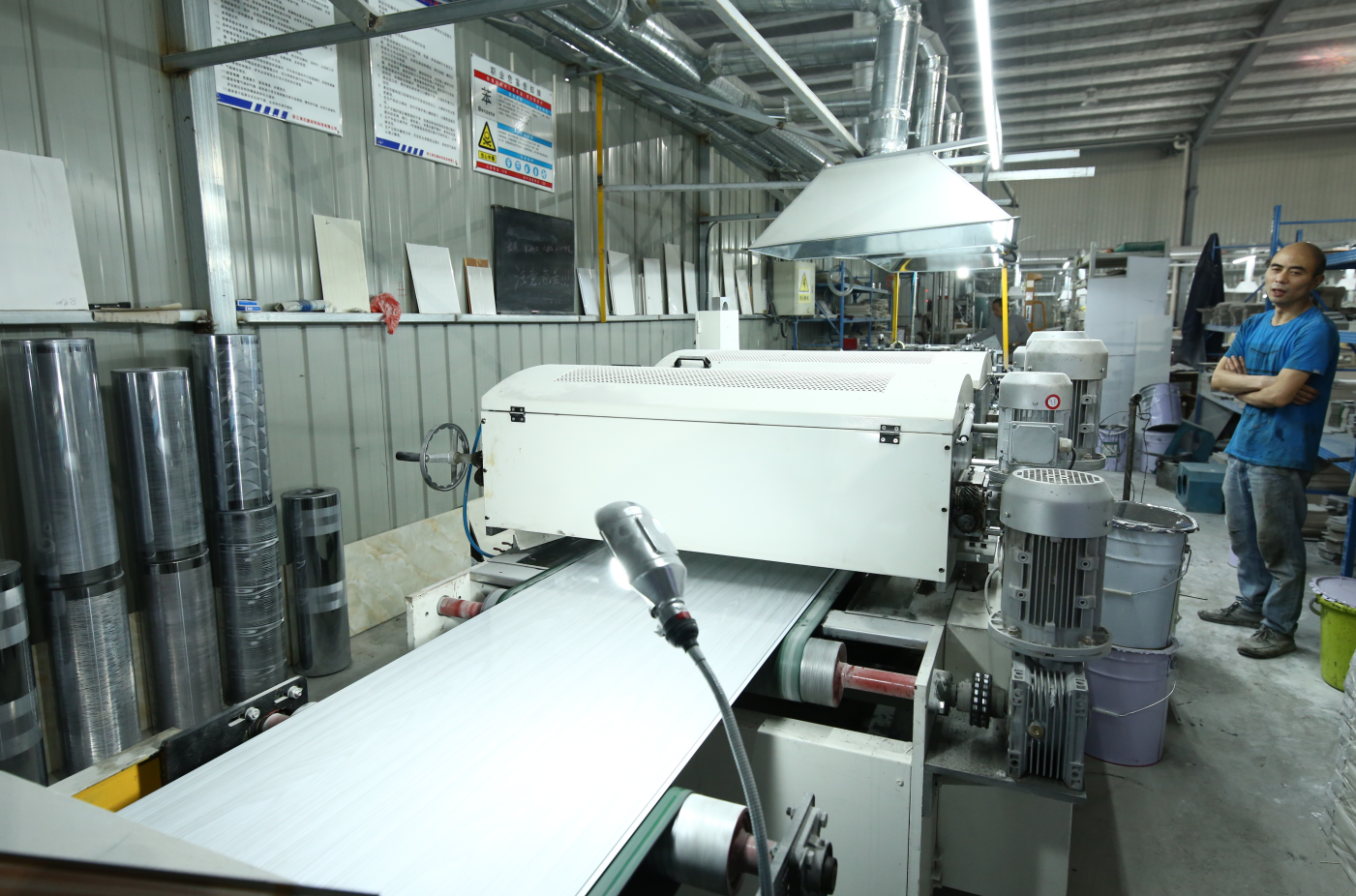
Manufacturing site, Haining Jianmu New Decoration Material Co., Ltd., Yuanhua, Haining, Zhejiang, China.
The global PVC wall panels market was valued at USD 3,144.8 million in 2023 and is projected to reach USD 9,495.8 million by 2031, according to Verified Market Research. Forecasts for the wider PVC panels category run higher still: Dataintelo estimated 2025 global PVC panel revenue at approximately USD 14.8 billion, with wall panels as the dominant sub-segment. The spread between those two figures reflects different category definitions rather than disagreement about direction, and either way the trajectory pulls new suppliers into the category every year.
Rapid growth attracts supply. It also makes supplier verification harder, because the number of companies presenting themselves as manufacturers grows faster than the average buyer's ability to check them. For a procurement team at the research and evaluation stage, the productive question is rarely "how big is this supplier?" It is "which of these claims can I confirm, and against which document?"
This article tests that question against one specific case: Haining Jianmu New Decoration Material Co., Ltd. (Jianmu), a decorative materials manufacturer based in Yuanhua, Haining, Jiaxing, in the Yangtze River Delta region of Zhejiang Province, China. It is not a company profile. It is an audit of what the company documents about its own production capability — facility, workforce, output, product specification and third-party testing — and what a buyer can and cannot conclude from that evidence.
Why PVC Partition Wall Panel Claims Are Difficult to Verify
Finished PVC partition wall panels from very different supply models can look nearly identical on a sample board. A sample proves appearance, colour consistency and hand feel. It does not prove who extrudes the profile, what the inspection regime is, how many production lines exist, or whether the fire test report on file covers the exact item being quoted.
That gap matters more in this category than in many others, for three structural reasons. First, the product is extruded and assembled from commodity inputs, so entry barriers are low and trading intermediaries can present a supplier profile almost indistinguishable from a manufacturer's. Second, appearance is easy to copy while consistency is not — colour matching, wall thickness tolerance and surface finish depend on process control that a photograph cannot demonstrate. Third, the performance attributes that matter most in specification — fire reaction and moisture behaviour — are documented through test reports and certifications whose scope is frequently narrower than buyers assume.
The result is that a buyer comparing two quotations for a PVC partition wall panel is often comparing two different kinds of evidence, only one of which will survive a permit review.
Which Capability Claims Carry Evidence Weight
Not every marketing claim is equally checkable. The table below separates the categories that appear most often in supplier profiles for PVC panels and identifies the document or data point that converts each one from an assertion into evidence.
| Claim category | Typical form | What converts it into evidence | Why it matters in procurement |
|---|---|---|---|
| Production footprint | "Large modern factory" | Stated facility area, full site address, traceable workshop imagery | Reduces the risk of hidden sub-contracting between quotation and shipment |
| Operating history | "Many years of experience" | Founding year and registered legal entity | Indicates continuity risk over a multi-year supply agreement |
| Output capacity | "Strong production capacity" | Annual or monthly container and square-metre figures | Determines whether peak-season delivery commitments are realistic |
| Technical staffing | "Professional R&D team" | Team size and function | Sets the ceiling on customisation and drawing-based work |
| Fire performance | "Fireproof" / "fire retardant" | Test report number, test standards, issuing body, issue and expiry dates | Frequently a permit or insurance prerequisite on commercial interiors |
| Quality control | "Strict quality control" | Defined inspection regime and where it sits in the process | Directly influences defect and rework rates after arrival |
| Product specification | "Standard sizes available" | Model-level dimensions for the panel and its accessories | Determines fit with the design and with installation accessories |
| Customisation | "OEM available" | Named parameters that can be changed | Affects private-label and market-specific product planning |
Applied consistently, this framework turns a supplier conversation into a document-collection exercise. The remainder of this article applies it to the Jianmu evidence set.
Jianmu's Documented Capability Profile
Haining Jianmu New Decoration Material Co., Ltd. is a decorative materials manufacturer founded in 1998 and located in Yuanhua, Haining, Jiaxing, in the core area of China's Yangtze River Delta Economic Circle. Its documented production scope covers PVC integrated wall panels, new-type PVC wall panels, wood-plastic composite (WPC) panels, bamboo-wood fiber panels, decorative wall protection panels and PVC flooring. The recorded entity-level facts are summarised below.
| Data point | Documented value |
|---|---|
| Legal entity | Haining Jianmu New Decoration Material Co., Ltd. |
| Location | Yuanhua, Haining, Jiaxing, Zhejiang, China |
| Founded | 1998 — more than 24 years in decorative materials |
| Production workshop | 15,000 m² standard production workshop |
| Workforce | Approximately 50 staff, including a technical team of 5 engineers |
| Annual production output | 360 × 40HC containers per year |
| Monthly output (PVC ceiling and wall protection panels) | 30 × 40HQ containers per month |
| Monthly capacity | 40,000 m² |
| Export ratio | 90% of output |
| Documented markets | Chinese mainland, Middle East, South America, Southeast Asia; Vietnam recorded as the main market |
| Company certifications | ISO9001:2008 International Quality System Certification, SONCAP Certificate, SGS Certificate |
| Customisation model | OEM / ODM — colour, size, surface design, logo and packaging; production to customer samples or pictures |
| Minimum order quantity | 1 × 40HC container |
| Lead time | 15–30 days |
| Quality control | 100% inspection before shipment |
| After-sales | Remote support |
Three observations follow from this record. The first is scale character: a 15,000 m² workshop with approximately 50 staff describes a specialist producer rather than a diversified industrial group. For buyers, that usually means the organisation quoting is the organisation running the extrusion lines — a condition that is checkable but not universal in this category.
The second is internal consistency of the capacity figures. An annual output of 360 × 40HC containers averages to 30 containers per month, which matches the separately recorded monthly figure for PVC ceiling and wall protection panels. Consistency of this kind is a weak but useful signal: a supplier whose own capacity numbers contradict each other has usually not been asked to produce them before.
The third is export orientation. A 90% export ratio with a documented footprint across the Middle East, South America and Southeast Asia indicates that export documentation, packing and container consolidation are recurring processes rather than occasional projects. That is relevant to a distributor's onboarding cost, not to product performance.
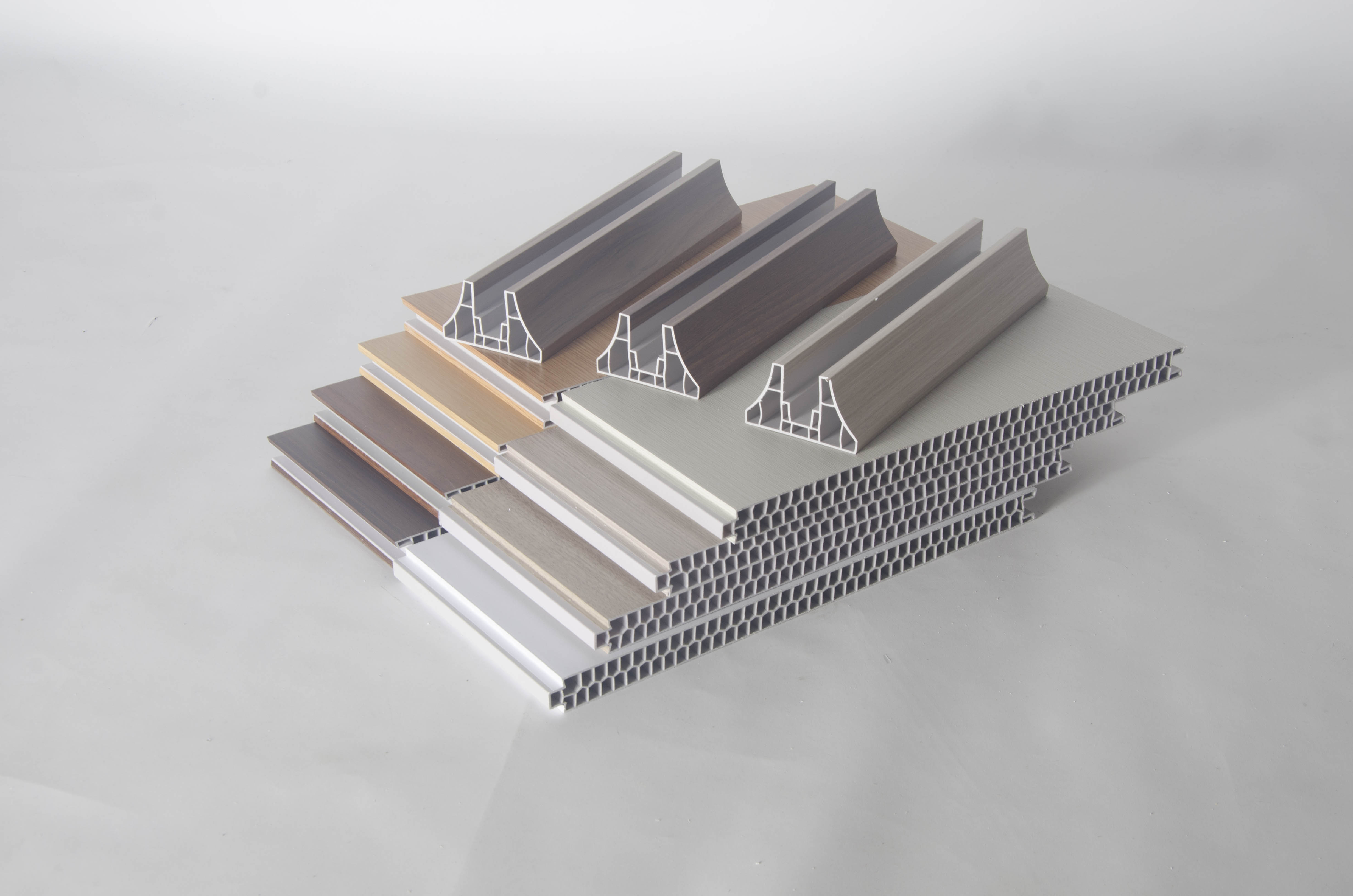
PVC partition wall panel from the Jianmu range; model 7073-A189 is documented at 2900 × 400 × 26 mm with a matching corner trim.
Product-Level Evidence: Model 7073-A189
Capability statements become useful only when they resolve to a product. In Jianmu's documented range, the PVC partition wall panel model 7073-A189 is specified at 2900 × 400 × 26 mm, with a matching PVC partition corner trim at 2900 × 85 × 50 mm. Both items are recorded in the same specification block, both are PVC, and both carry the same documented performance description: waterproof, moisture-proof, fire-resistant and easy to install.
| Item | Model | Documented dimensions | Material |
|---|---|---|---|
| PVC partition wall panel | 7073-A189 | 2900 × 400 × 26 mm | PVC |
| PVC partition corner trim | 7073-A189 (matching accessory) | 2900 × 85 × 50 mm | PVC |
| PVC wall panel (ceiling panel type) | 566-A155 | 3000 × 400 × 9 mm | PVC |
The comparison between the two documented products is instructive for specifiers. A 26 mm profile and a 9 mm profile sit in different thickness classes. In general terms, thicker extruded sections deliver greater stiffness and are used where a panel is expected to behave as a dividing element rather than as a surface covering. That distinction is not a marketing difference; it changes fixing strategy, substrate requirements and how the joint between panels is resolved.
The corner trim is equally informative. A 2900 mm trim at 85 mm width and 50 mm depth is listed alongside the panel rather than as a separate catalogue item, which indicates that the partition panel is supplied as a system with edge and joint finishing included in the specification. For an installer, that matters: accessory availability is one of the most common causes of delay on a panel project, and an unfinished edge is also the most common visual defect after handover.
Both products are documented under "Building & Construction, Interior Decoration" as their applicable industry — a scope statement that matches the applications described later in this article.
Certification Evidence: The EN 13501-1 Test Report
For PVC partition wall panels, fire performance is usually the constraint that decides whether a product can be used at all. Interior fit-outs in commercial buildings, hotels and public spaces typically require the specifier to produce documentary evidence of reaction-to-fire performance, and the document has to be specific.
Jianmu's documented certification for this product is a Reaction to Fire Test Report, certificate number NFM-FRL260865-02, issued by NOA Inspection & Certification Group Ltd. for the EU market, covering the PVC partition wall panel.
| Field | Documented detail |
|---|---|
| Document type | Reaction to Fire Test Report |
| Certificate number | NFM-FRL260865-02 |
| Issuing body | NOA Inspection & Certification Group Ltd. |
| Market | EU |
| Scope | PVC Partition Wall Panel |
| Standards referenced | EN 13501-1:2018; EN 13823:2020+A1:2022; EN ISO 11925-2:2026 |
| Issue date | 2026-07-13 |
| Valid until | 2099-07-13 |
| Related product on record | PVC wall panel, model 566-A155 |
For context, EN 13501-1 is the European classification standard for reaction to fire, and the two test methods referenced in the report define how the classification is generated: EN 13823 covers the single burning item test, while EN ISO 11925-2 covers ignitability by a small flame. A profile-level standard also applies to this product family — EN 13245-2 specifies requirements for unplasticized poly(vinyl chloride) (PVC-U) profiles used for internal and external wall and ceiling finishes. In a typical EU specification, a profile standard and a reaction-to-fire classification work together: the first defines the product's material and dimensional characteristics, the second defines how it behaves in a fire scenario.
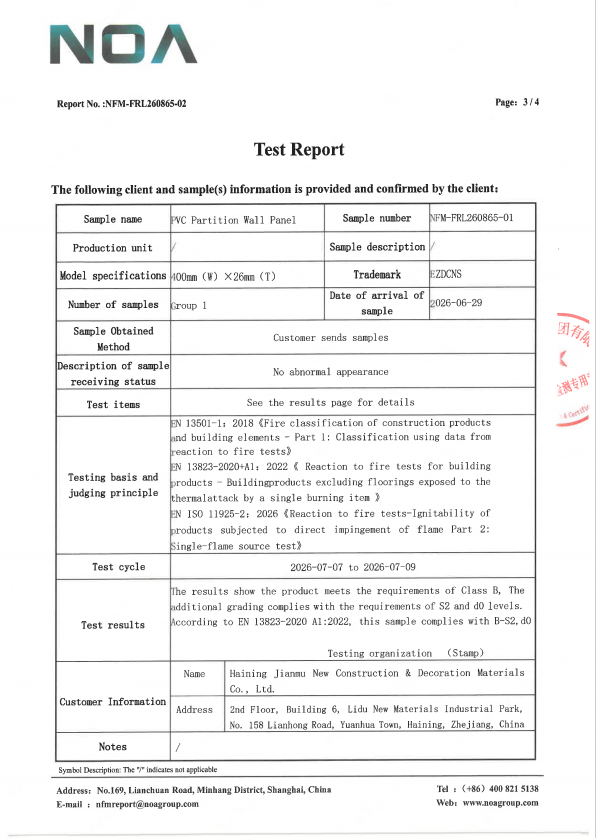
Reaction to Fire Test Report NFM-FRL260865-02, issued by NOA Inspection & Certification Group Ltd. for the EU market.
Order Economics: MOQ, Capacity and Lead Time
Commercial terms are also evidence. The documented ordering parameters for Jianmu are a minimum order quantity of 1 × 40HC container, a lead time of 15–30 days, a monthly capacity of 40,000 m², and 100% inspection before shipment, with remote after-sales support and OEM/ODM customisation across colour, size, surface design, logo and packaging.
Read together, these figures describe a supplier configured for consolidated container shipments rather than piecemeal orders. A full-container MOQ is normal for a factory that extrudes and finishes its own panels, because extrusion runs, colour changes and packing are all planned at container scale. The practical consequence for a buyer is that trial quantities below one container are not part of the documented model, so any small-batch evaluation has to be negotiated explicitly rather than assumed.
The 15–30 day lead time should be read as a range that depends on whether the order uses stock colours and standard dimensions or moves into customised surface design and packaging. That is a normal pattern in decorative materials, and it is the reason buyers are usually advised to fix the specification — including the accessory package — before requesting a delivery commitment.
Application Fit and Track Record
The documented application environment for this product family is the architectural decoration industry, with interior wall and ceiling decoration as the function and building decoration projects as the project type. The recorded operating mode is static, and the matched equipment is supporting structure and installation accessories — a detail that reinforces the earlier point about the accessory system being part of the delivered scope rather than an afterthought. The special requirement recorded for this application, fire retardant performance according to EN 13501-1, is the same requirement addressed by the test report described above.
The company's recorded case experience is with overseas building material distributors in Vietnam, Thailand, the Philippines, India and Indonesia, covering approximately 15,000 m² of interior wall and ceiling decoration for residential and commercial buildings, over a relationship of more than five years. The reported result is stable performance with good fire resistance, waterproof behaviour and ease of installation; the documented highlights are EN 13501-1 fire classification, waterproof performance, light weight, durability and availability in a range of designs.
For a buyer evaluating fit, the relevant reading is not the tonnage but the pattern: a distributor-type customer, a multi-country footprint, and a specification anchored in fire classification. That is the profile in which a full-container MOQ, remote after-sales support and OEM packaging customisation make commercial sense.
Market Context: Growth, Supply Concentration and Compliance Pressure
The demand environment supports continued supply expansion. Verified Market Research values the global PVC wall panels market at USD 3,144.8 million in 2023, projected to reach USD 9,495.8 million by 2031, at a CAGR of 14.4% from 2024 to 2031. The adjacent wood-plastic composite category, which many decorative panel manufacturers also serve, was valued at USD 1.5 billion in 2024 and is projected to reach USD 3.2 billion by 2034, growing at 8.1% over that period according to Reports and Data.
Supply-side concentration reinforces the same direction. China became the world's largest PVC exporter in 2025, accounting for 24% of total global trade volume, according to International Trader Publications. For buyers, a concentrated supply base has two consequences: more supplier choice within a narrow geographic cluster, and more reliance on documentation to differentiate between them, because physical proximity makes factory profiles look increasingly similar.
The practical trend to watch is that verification is migrating from a pre-award formality to a commercial term. As more projects specify reaction-to-fire classifications and traceable test documentation, suppliers that can produce a certificate number, an issuing body and a standards list on request will be easier to shortlist than those that can only produce marketing language — regardless of their actual production capability.
Where This Evidence Set Has Limits
A capability audit is only credible if it states its boundaries. The following limits are inherent in the evidence described above and should be treated as open items rather than resolved facts.
- Minimum order size. The documented MOQ is one 40HC container. Buyers who need a small first order, or who are testing a new market, will need to negotiate a different arrangement; nothing in this evidence set indicates a stock or LCL channel.
- After-sales scope. After-sales is documented as remote support. No local service network or on-site installation support is recorded, so buyers in distant markets should agree an escalation path and response expectation in the contract.
- Geographic certification scope. The fire documentation on record covers the PVC partition wall panel for the EU market. ISO9001:2008, SONCAP and SGS are recorded as company-level certifications rather than model-level approvals, so project-specific approvals for other markets should be confirmed case by case.
- Certification revision. The quality system certificate is recorded as ISO9001:2008. Buyers should confirm which revision is currently in force and the certificate's validity dates before relying on it in a tender submission.
- Model coverage. The detailed specification record centres on model 7073-A189 and its matching trim, with a related PVC wall panel at 3000 × 400 × 9 mm. Profiles outside this documented range require model-level data rather than extrapolation.
- Capacity versus delivery performance. Container-based output figures describe theoretical throughput. They do not predict behaviour in a peak-demand month, so historical on-time delivery data is the more useful number for a first order.
- Assembly-dependent performance. Fire and moisture performance depend on the complete build-up — substrate, fixing method and cavity detail — not on the panel alone.
A Practical Verification Checklist for Buyers
| Step | What to request | What to check |
|---|---|---|
| 1. Entity check | Legal entity name on quotation, invoice and test report | All three match, and the factory address matches the stated site |
| 2. Fire documentation | Full test report PDF | Scope, referenced standards, issue and expiry dates |
| 3. Certificate status | Issuing body verification | Certificate number NM-FRL260865-02 valid and unmodified |
| 4. Product data | Model-level dimension drawing including accessories | Panel and trim dimensions confirmed against the design |
| 5. Commercial terms | Written confirmation of MOQ and lead time | Values consistent with the stated 1 × 40HC and 15–30 days |
| 6. Quality regime | Inspection process description | Pre-shipment inspection scope and any reporting format |
| 7. Customisation | Confirmable custom parameters | Colour, size, surface design, logo, packaging, and the approval step |
| 8. Capacity reality check | Historical delivery data for a comparable order | Whether 30 containers per month translates into your allocation |
Frequently Asked Questions
What fire certification does the Jianmu PVC partition wall panel hold?
The documented certification is a Reaction to Fire Test Report with certificate number NFM-FRL260865-02, issued by NOA Inspection & Certification Group Ltd. for the EU market. The report covers the PVC partition wall panel and is verified against EN 13501-1:2018, EN 13823:2020+A1:2022 and EN ISO 11925-2:2026, with an issue date of 2026-07-13.
What are the documented dimensions of PVC partition wall panel model 7073-A189?
Model 7073-A189 is documented at 2900 × 400 × 26 mm, made of PVC, and is listed together with a matching PVC partition corner trim at 2900 × 85 × 50 mm. The documented product properties are waterproof, moisture-proof, fire-resistant and easy to install.
What is the minimum order quantity and lead time for these PVC panels?
The documented minimum order quantity is 1 × 40HC container, and the stated lead time is 15–30 days. Quality control is documented as 100% inspection before shipment.
What can be customised under OEM / ODM production?
Customisation is documented across colour, size, surface design, logo and packaging, and the company states that goods can be produced according to customer samples or pictures. The production mode is recorded as OEM / ODM.
How much production capacity does the factory document?
The recorded figures are a 15,000 m² standard production workshop, an annual production output of 360 × 40HC containers, a monthly output of 30 × 40HQ containers for PVC ceiling and wall protection panels, and a monthly capacity of 40,000 m². The workforce is recorded as approximately 50 staff, including a technical team of 5 engineers.
How do PVC wall panels compare with traditional decoration materials such as wallpaper, paint and ceramic tile?
PVC wall panels are documented as waterproof, moisture-resistant, fire-retardant, lightweight and easy to install. Compared with wallpaper, paint and traditional tiles, the stated differences are faster installation, lower maintenance costs and a longer service life, which makes them suitable for residential, hotel, office and commercial interior decoration.
What the Evidence Supports — and What It Does Not
Judged against the verification framework set out at the start of this article, the Jianmu evidence set answers several questions that usually remain open in a PVC partition wall panel quotation. The facility size, founding year, workforce composition, container output, monthly capacity, model-level dimensions and the fire test report together form a checkable record: a buyer can confirm the entity, read the specification of model 7073-A189, and verify a specific certificate number against named European standards.
What the evidence does not do is substitute for buyer-side testing or contractual protection. A full-container MOQ, remote-only after-sales scope, EU-limited fire documentation and a quality certificate recorded at ISO9001:2008 are all boundaries a procurement team should price into its decision. The useful conclusion for a buyer is procedural: treat supplier capability as a document set to be collected and verified, not as a claim to be assessed by impression — and request the missing items before the order, not after the container arrives.
Additional product and company documentation for Haining Jianmu New Decoration Material Co., Ltd. is available in the company's downloadable company profile, and further product information is published at hnjianmu.com.