
Inside the Factory Floor: What a Microfiber Mop Range Reveals
Inside the Factory Floor: What a Microfiber Mop Range Reveals
A microfiber mop is a composite system rather than a single textile: yarn fineness, fiber blend, pile construction, backing format, and edge finishing are specified together, and each combination runs on different tooling. For that reason, the shape of a supplier's mop range — which constructions it covers and how precisely each one is specified — is one of the few pre-audit signals that a trading intermediary struggles to reproduce faithfully.
The definition matters before the comparison begins. Microfiber is a fiber-fineness term, not a marketing label: it refers to fiber measuring below 1.0 denier — the diameter or fineness of a continuous or filament fiber — the threshold at which the fine structure responsible for soil capture and water uptake is formed. Above that line, a mop may be soft and cheap and still not be microfiber.
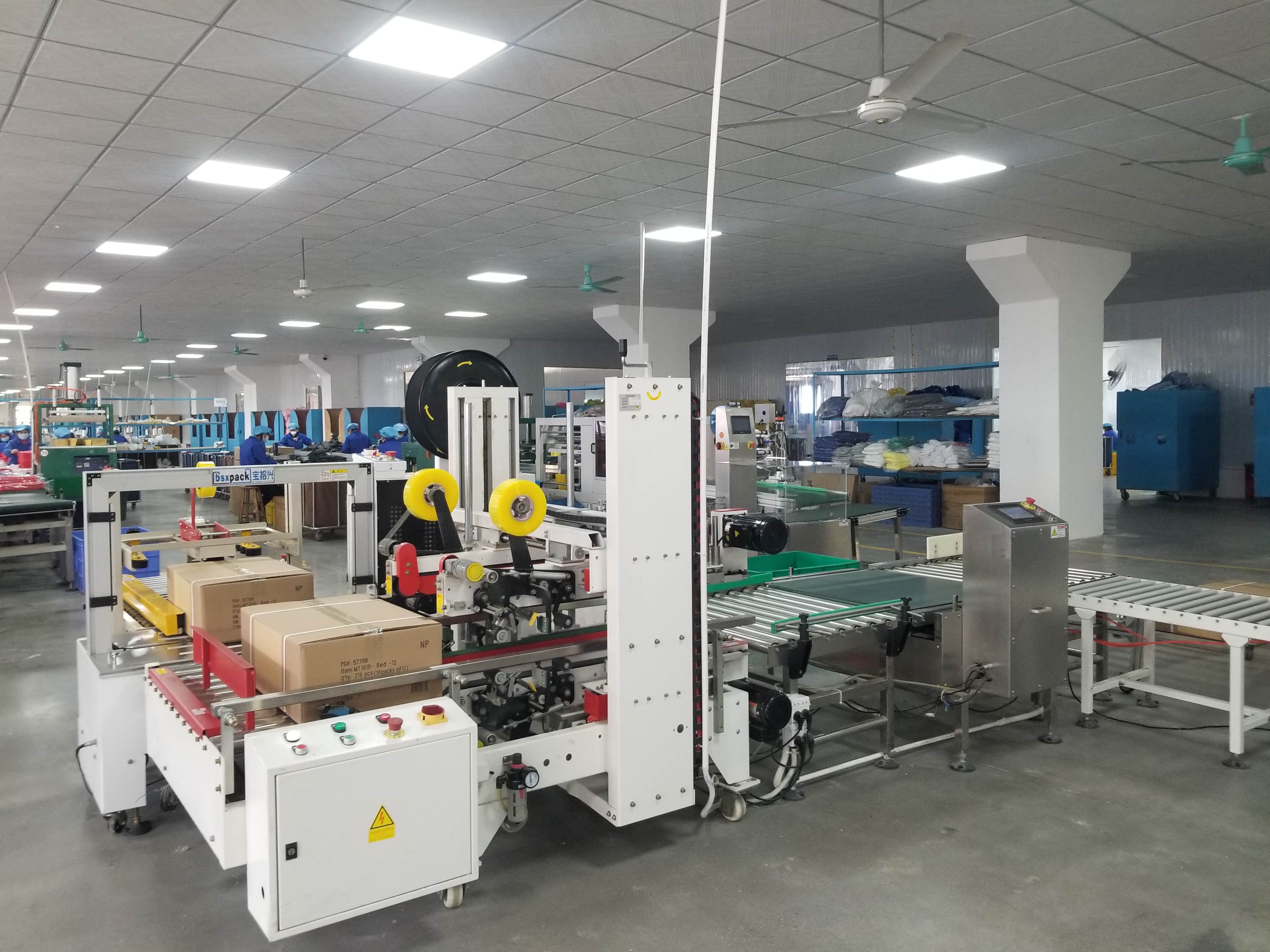
Production machinery on the factory floor. Multi-construction mop ranges depend on equipment sets that single-construction suppliers do not carry.
The Signal Most Buyers Skip
Buyers at the decision stage are usually holding two or three shortlisted catalogs that look similar in a PDF. The useful question is not how many SKUs each contains. It is whether the SKUs are engineered against different functions, or renamed variations of one substrate.
Three signals can be assessed from the catalog alone, before any sample is requested:
- Construction spread. Terry loop, twisted loop, stripe pad, tufted pad, and abrasive pad do not share the same equipment set or the same failure modes. A range that spans all five is making a manufacturing claim whether or not it says so.
- Blend precision. An 80% polyester / 20% polyamide blend, a 40% cotton blend, and a microfiber–PET abrasive blend are functional decisions. A catalog that reports one ratio across an entire mop line is either simplifying its documentation or working from one commodity roll.
- System format. An adjustable aluminum plate with replacement refills, a pocket-style pad, and a color-coded program each impose requirements that go beyond the fabric — metal forming and tolerance, fit without a frame, and lot separation through dyeing and sewing.
Five Constructions, Read as Manufacturing Statements
The five mop specifications below are drawn from the published product line of Foshan Patinda Housewares Co., Ltd., a microfiber cleaning products manufacturer established in Foshan, Guangdong, China, in 2004. Each is treated here as evidence of what the operation is equipped to do — not as a performance claim to be accepted.
MT-003 — Microfiber Terry Wet Mop (80% Polyester / 20% Polyamide)
MT-003 is a terry loop strip wet string mop built on an 80% polyester / 20% polyamide blend. The terry loop construction exposes looped pile on the working face; the loops supply the mechanical action that lifts and holds soil, while the polyamide fraction — the moisture-absorbing component in a polyester/polyamide microfiber — carries water into the fiber structure rather than merely wetting the surface.
The specification is informative in a second way. The same manufacturer publishes a microfiber universal cleaning cloth at 85% polyester / 15% polyamide across a 180–450 GSM range. Two different ratios on two different product families indicate that blend is being set per end use rather than inherited from a single purchased substrate.
Procurement implication: request blend ratio SKU by SKU. Where a single ratio appears across an entire mop line, either the documentation is compressed or the substrate is.
MP-014 — Microfiber Stripe Mop (Microfiber / Nylon Blend, Color-Coded)
MP-014 is a color-coded commercial wet/dry pad built on a microfiber and nylon blend with a stripe construction. The stripe format creates alternating channels across the pad face, which changes how liquid is distributed and how the pad tracks across a floor compared with a uniform pile. Nylon contributes resilience to a structure expected to hold shape through repeated laundering.
The color-coding is the part buyers systematically underestimate. A coded program requires the supplier to run dyed lots, keep those lots separated through cutting, sewing, and packing, and hold colorfastness so that a red pad does not bleed into a white one during a shared wash cycle. That is production control, not decoration.
Procurement implication: color-coded systems are adopted to keep wet and dry tasks, or separate hygiene zones, physically distinct. A supplier that offers coding but cannot describe lot separation is selling color, not a system.
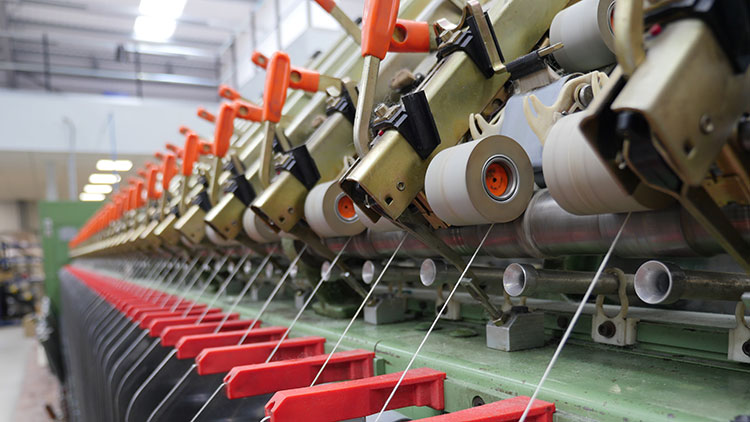
Yarn preparation upstream of mop assembly. Blend ratio is fixed at this stage, which is why SKU-level ratios are readable evidence.
MP-015 — Twisted Wet Mop (Aluminum Plate Adjustable Set and Replacement Refill)
MP-015 is a twisted wet mop supplied as an aluminum plate adjustable set with a replacement refill. Twisted loop yarn is plied and heat-set so that the pile stays open after washing; the structure is selected for water uptake and durability rather than for a smooth, flat finish.
The commercial significance sits in the format as much as in the yarn. A plate-and-refill system means the supplier produces a hardware component and a consumable component that must continue to fit together across production runs. Adjustable aluminum plates bring metal forming, coating, and tolerance requirements that a textile-only operation does not carry at all.
Procurement implication: refill availability determines total cost of ownership more than unit price does. If refills drift outside dimensional tolerance, the plate outlives its own supply.
MP-006 — Microfiber-Cotton Tufting Mop (40% Cotton, Pocket-Style Dual Use)
MP-006 is a pocket-style dust and wet dual-use pad built on a 40% cotton blend using tufting. Tufting drives yarn into a backing rather than knitting or weaving it, producing an open, high-loft pile suited to dust pickup; the pocket format lets the pad be fitted without a separate frame.
The 40% cotton content is a deliberate trade rather than a compromise. Cotton adds bulk and lowers fiber cost, but it does not carry the same wash durability or lint behavior as a polyester/polyamide microfiber. Published comparison data for microfiber against cotton cleaning products places microfiber at 300+ wash cycles against cotton's roughly 50, at about seven times its own weight in liquid absorption against cotton's three, and at approximately 99% less lint shedding.
Procurement implication: a cotton-blended tufted pad belongs in dust and light-wet tasks where pickup and cost per pad matter more than cycle life. It is a different product from a 100% microfiber wet mop and should be specified and priced as one.
MP-020 — Abrasive Mop (Microfiber + PET, Color-Coded Dual Purpose)
MP-020 is a color-coded dual-purpose dry and wet pad built on a microfiber and PET blend with an abrasive component. Abrasive construction is the most demanding of the five on process control: the abrasive element must be distributed evenly enough to remove stubborn soil without leaving a directional scratch pattern on the surface being cleaned.
Where the other four constructions manage water, dust, or finish, this one manages material removal. That makes it the specification most dependent on testing discipline — and the one where a supplier's own claims, including scratch-free abrasion resistance language, have to be reconciled against documented surface-effect testing.
Procurement implication: qualify an abrasive pad on the actual floor finish it will meet. Ask what the abrasive component is, how it is bonded, and what surface testing is documented.
| SKU | Construction | Fiber / blend | Supply format | Wet / dry | Color-coded |
|---|---|---|---|---|---|
| MT-003 | Terry loop strip (wet string mop) | 80% polyester / 20% polyamide | Mop head | Wet | — |
| MP-014 | Stripe pad | Microfiber / nylon blend | Pad | Wet & dry | Yes |
| MP-015 | Twisted loop | Microfiber twisted yarn | Aluminum plate adjustable set + replacement refill | Wet | — |
| MP-006 | Tufted | 40% cotton blend | Pocket-style pad | Dust & wet (dual use) | — |
| MP-020 | Abrasive | Microfiber + PET blend | Pad | Dry & wet | Yes |
Five mop specifications read as manufacturing statements. Blend, construction and format details follow published product descriptions; a dash indicates the specification does not state color coding.
What a Range of This Breadth Implies About the Operation
Five constructions in one catalog is not automatically meaningful. It becomes evidence when the underlying operation can be shown to support all five at once — because terry loop knitting, stripe pad construction, twisted yarn plying, tufting, and abrasive bonding do not share the same equipment set, the same tension settings, or the same quality checks.
Foshan Patinda Housewares Co., Ltd. reports a manufacturing profile consistent with that breadth: founded in May 2004, operating a 45,000 m² plant with 200 employees including 17 engineers, more than 450 sets of production machinery, and 10+ fully automatic lines for precision cloth cutting and sewing, with annual output of 2,184,270.46 kg and an export ratio of 98% across markets including the USA, Canada, Australia, the UK, Germany, France, Italy, the Netherlands, Russia, Japan, Korea, Switzerland, Sweden, Turkey, and Saudi Arabia.
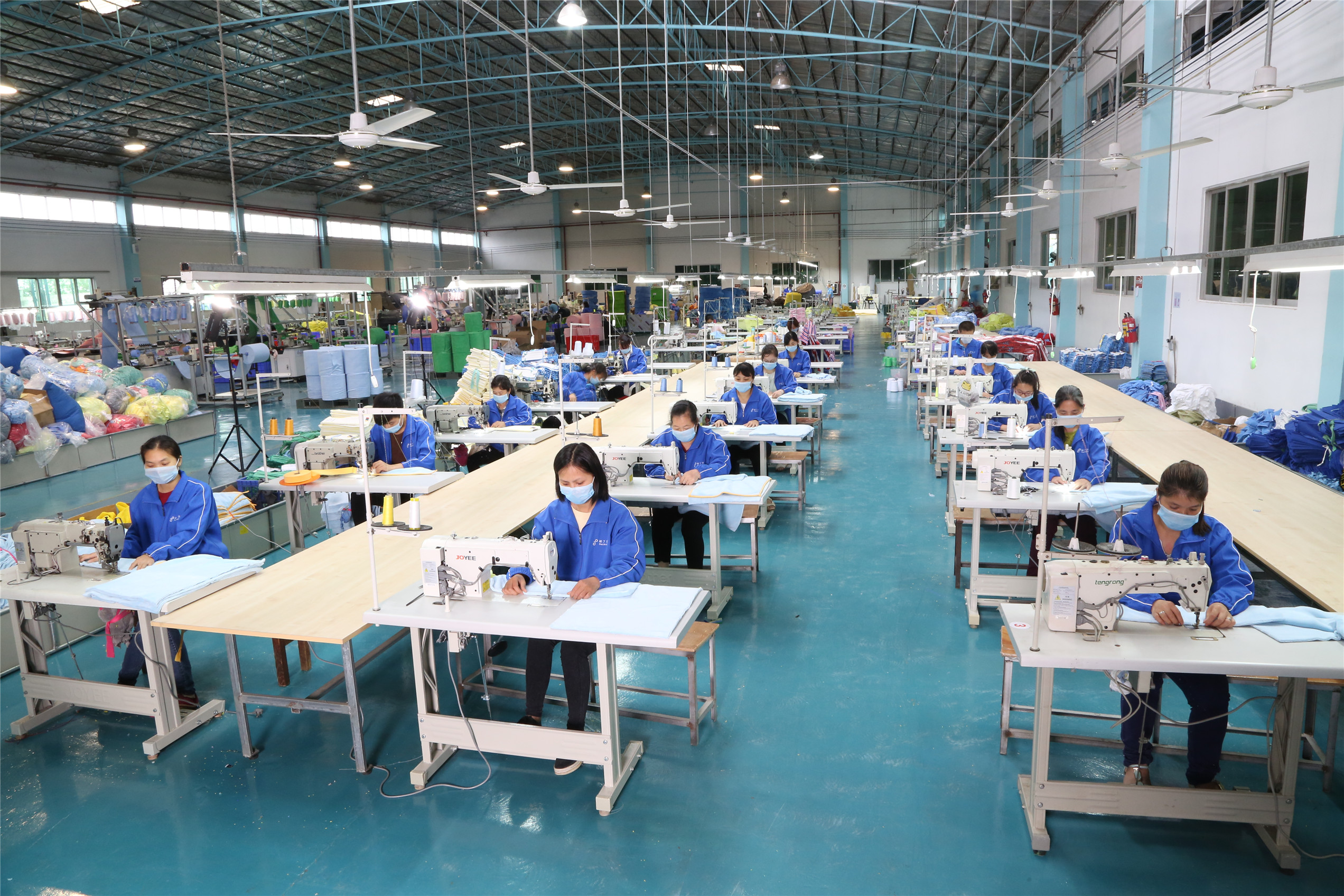
Automated cutting and sewing. The same lines serve mop heads, pads, and refills across several constructions.
Independent trade activity supports the operational picture rather than the marketing one. US customs import records indexed under the company's English name variant, "Foshan Pa Tin Da Housewares Co., Ltd.", list 172 bills of lading between June 2019 and September 2026 — a record of sustained export flow rather than a single campaign shipment.
None of these figures independently proves product quality. What they establish is scale, continuity, and export experience — the conditions under which a five-construction range can be sustained rather than merely listed. A trading intermediary can publish the same five SKUs; it does not normally keep 17 engineers, 450+ machines, and 10+ automatic cutting and sewing lines occupied across them.
The company's published compliance and quality measures point in the same direction, and are worth reading as a checklist of what a mop buyer should verify: double stitching edge locking, 300+ wash cycle durability testing, OEKO-TEX Standard 100 tested raw materials, formaldehyde-free dye inspection, ISO 9001:2015 quality management, ISO 45001:2018 occupational health and safety management, SMETA (Sedex) ethical trade audit compliance, and German Packaging Act (VerpackG) plus French REP textile registration covering EU environmental and circular economy requirements.
These are company-published measures. They are the correct starting point for a decision-stage buyer and the wrong finishing point — which is where the next section begins.
Where the Evidence Stops
Reading a product range as capability evidence is a useful discipline, and it has a hard boundary. Breadth proves what a supplier is equipped to produce. It does not prove which construction fits a specific building, chemical program, or laundry cycle.
Four limits deserve to be stated plainly:
- Every construction has an operating boundary. Terry loop pile is built for mechanical action on wet floors, but looped structures can snag and mat on high-grit surfaces. A 40% cotton tufted blend is efficient for dust pickup, yet cotton degrades faster than polyester under aggressive chemical programs. An abrasive pad removes stubborn soil by design, which is exactly the risk on high-gloss or coated finishes. A color-coded program only works if the laundry process actually preserves color separation.
- Certification claims require certificate-level verification. OEKO-TEX STANDARD 100, ISO 9001:2015, ISO 45001:2018, GRS, and BSCI appear on many supplier profiles. Scope, certificate number, and validity date should be confirmed with the issuing body before any of them is written into a tender response or a retail compliance file.
- Cost is not lowest at the entry point. The product documentation is explicit: slightly higher upfront cost, lower long-term cost because replacement frequency falls. That trade only pays off when the mop construction is matched to the task. A premium pad used outside its intended role produces the higher price without the lower long-run cost.
- Wide catalogs exist on both sides of the line. Trading companies can and do carry broad ranges. Range breadth narrows a shortlist; it does not close a qualification. Factory documentation, customs records, and sample rounds remain the cross-checks.
Microfiber Mops Against Traditional Cotton Mops
Where a buyer is replacing an existing cotton program, the comparison is usually decided on durability and consumable cost rather than on cleaning performance alone. Published comparison data between microfiber and cotton cleaning products sets out the gap on the dimensions that drive repeat purchasing.
| Dimension | Microfiber cleaning products | Cotton cleaning products |
|---|---|---|
| Liquid absorption | About 7× its own weight | About 3× its own weight |
| Wash durability | 300+ wash cycles | About 50 wash cycles |
| Lint shedding | About 99% less | Baseline |
| Soil removal | About 75% more dirt with less water and chemical | Baseline |
| Maintenance | Machine washable, quick-drying, no special handling | Machine washable |
| Upfront cost | Slightly higher | Lower |
| Long-run cost | Lower, because replacement frequency falls | Higher over time through replacement |
Two boundaries belong beside that table. First, cotton remains simple and predictable, and procurement teams whose laundry workflows, storage, and staff training are built around cotton do not switch programs without an operational reason. Second, the microfiber advantage rests on the pad keeping its pile — which is why wash-cycle documentation matters more than the headline absorption figure. A mop that absorbs seven times its weight once is not the same asset as one that still does so after 300 cycles.
Market Signals Behind the Specification Race
Category-level data explains why construction detail has become a selling point rather than a technical footnote. Multicomponent microfiber — the polyester/polyamide blend family that all five mop specifications above belong to — held a 58.0% revenue share of the microfiber cleaning cloth market in 2025, according to Fortune Business Insights. Within applications, the kitchen care segment accounted for the largest share at 28.3% in the same year.
Growth is steady rather than explosive. Future Market Insights projects the global microfiber cleaning cloth market moving from USD 979.2 million in 2025 to USD 1,520.7 million by 2035 at a 4.5% CAGR; Fortune Business Insights reports a comparable trajectory from USD 1.04 billion in 2026 to USD 1.49 billion by 2034 at 4.57%. The two use different base years and are not averaged here. A third commercial source reports substantially larger values and a 24.0% CAGR and is treated as an outlier rather than blended into the range.
Regulation is moving faster than the market. OEKO-TEX STANDARD 100 was updated in 2024 to include a total fluorine limit of 100 mg/kg, introduced to address PFAS regulation. For a mop supplier, that shifts the constraint upstream — into dye selection, auxiliary chemicals, and raw-material certification — long before the finished pad reaches a buyer's compliance file.
Read together, single-digit category growth plus tightening chemical limits means competition is concentrating on specification and documentation rather than on category expansion. New constructions are not the scarce item; verifiable specification for existing constructions is.
What Buyers Should Request in the Next Round
For a decision-stage evaluation, the following requests convert a catalog comparison into an evidence trail:
- Blend ratio and construction per SKU, stated separately rather than as a range across the line.
- Wash-cycle test documentation for each construction being shortlisted, not for the range as a whole.
- Certificate scope and validity for any compliance claim, confirmed with the issuing body.
- Surface-effect testing evidence where an abrasive pad is proposed alongside a scratch-free claim.
- Refill dimensional tolerance and availability commitment where a plate-and-refill system is quoted.
- Lot separation and colorfastness method where a color-coded program is required.
Outlook
The next phase of microfiber mop sourcing is unlikely to be decided by who introduces the newest construction. It will be decided by who can document the constructions they already make — blend by blend, cycle test by cycle test, certificate by certificate. Product-range breadth remains a strong early filter precisely because it is expensive to sustain, but it is a filter, not a verdict.
For buyers, the practical takeaway is a shift in reading order. Start with the range to understand what a supplier is equipped to do. Then test whether the specific construction matches the floor, the chemical program, and the laundry cycle. Then verify the claims that will end up in a compliance file. A supplier that survives all three stages is a qualified OEM partner; one that only survives the first is a wide catalog.
A complete product catalog covering the mop range and related microfiber cleaning products discussed here is available for download: E-catalog Pa Tin Da 2024 (PDF).
FAQ
What distinguishes a microfiber mop manufacturer from a trading company?
The clearest structural difference is whether the supplier carries the assets each construction requires. Terry loop, twisted, stripe, tufted, and abrasive mop constructions use different yarn preparation, different fabric formation, and different finishing steps, so a manufacturer covering all five maintains several equipment sets and the engineering staff to run them. Foshan Patinda Housewares Co., Ltd., as one example, reports a 45,000 m² plant, 200 employees including 17 engineers, more than 450 production machines, and 10+ automatic lines for precision cloth cutting and sewing. A trading company can list the same five constructions; it does not normally carry that asset base. The check is documentation, not the catalog.
Which mop construction should a buyer compare first?
Start with the construction that matches the dominant task, not with the widest or lowest-priced option. Terry loop strip mops such as MT-003, built on 80% polyester / 20% polyamide, suit wet floor work where looped pile supplies mechanical action and the polyamide fraction carries water. Twisted loop mops such as MP-015 suit repeated laundering because the heat-set pile stays open. Stripe pads such as MP-014 suit programs that need wet and dry tasks kept separate. Tufted cotton blends such as MP-006 suit dust pickup and light wet work at a lower fiber cost. Abrasive pads such as MP-020 suit stubborn soil removal. Comparing across categories before fixing the task produces a price comparison that does not answer the procurement question.
How do MP-006 and MP-020 differ in dry and wet use?
Both are described as dual-purpose, but the mechanism differs. MP-006 is a pocket-style tufted pad with a 40% cotton blend, and its strength is dry pickup plus light wet use — tufting produces an open, high-loft pile that traps dust, and the cotton fraction lowers fiber cost. MP-020 is a microfiber and PET abrasive pad used dry and wet, and its function is material removal rather than pickup. The practical distinction is what each is qualified on: MP-006 on pickup performance and cost per pad, MP-020 on surface effect — whether the abrasive leaves a scratch pattern on the floor finish it meets.
Does a broad mop range replace certification and sample verification?
No. Range breadth shows what a supplier is equipped to produce; it says nothing about whether a specific batch meets a specification. Certification claims in particular need to be verified at certificate level — including scope and validity — with the issuing body, because a published list of certifications is a company statement rather than third-party proof. Sample rounds serve a different purpose again: they test the actual lot against a buyer's floor finish, chemical program, and laundry cycle. A wide range narrows the shortlist; it does not close the qualification.
What does a color-coded mop system require from a supplier?
Color-coding is a production-control requirement before it is a design feature. A supplier running a coded program has to dye lots to distinct colors, keep those lots separated through cutting, sewing, and packing, and hold colorfastness so that pads do not bleed into one another during laundering. Both MP-014 and MP-020 are described as color-coded, which places them in that category. The useful buyer question is not which colors are available but how lot separation and colorfastness are controlled and documented.
How do fiber blends such as 80/20 and 40% cotton affect cost and service life?
Blend ratio sets both performance and cost position. An 80% polyester / 20% polyamide blend, as used in MT-003, puts more of the moisture-absorbing polyamide into the yarn, supporting water uptake and soil capture. A 40% cotton blend, as used in MP-006, reduces fiber cost and adds bulk but moves the pad toward the durability profile of cotton rather than microfiber: published comparison data places microfiber at 300+ wash cycles against cotton's roughly 50, and at about seven times its weight in liquid absorption against cotton's three. The cost consequence is stated directly in the product documentation — slightly higher upfront cost, lower long-term cost through less frequent replacement.
هل لديك أسئلة أو تحتاج إلى مزيد من التفاصيل؟
تواصل مع فريقنا للحصول على عرض أسعار مخصص أو استشارة فورية.
طلب عرض أسعار
املأ النموذج أدناه وسيتواصل معك فريقنا بعرض مقترح مخصص.
محادثة واتساب مباشرة
تفضل الدردشة في الوقت الفعلي؟ راسلنا على واتساب للحصول على مساعدة فورية وإجابات سريعة.
- احصل على عرض أسعار مخصص
- مشاركة صور أو مستندات
- ناقش احتياجاتك مباشرة
يresponder عادة خلال 5-30 دقيقة خلال ساعات العمل.