
Inside the Factory: Supplier Capability Evidence Behind HB-1912 and HB-75-28 Bakery Trays
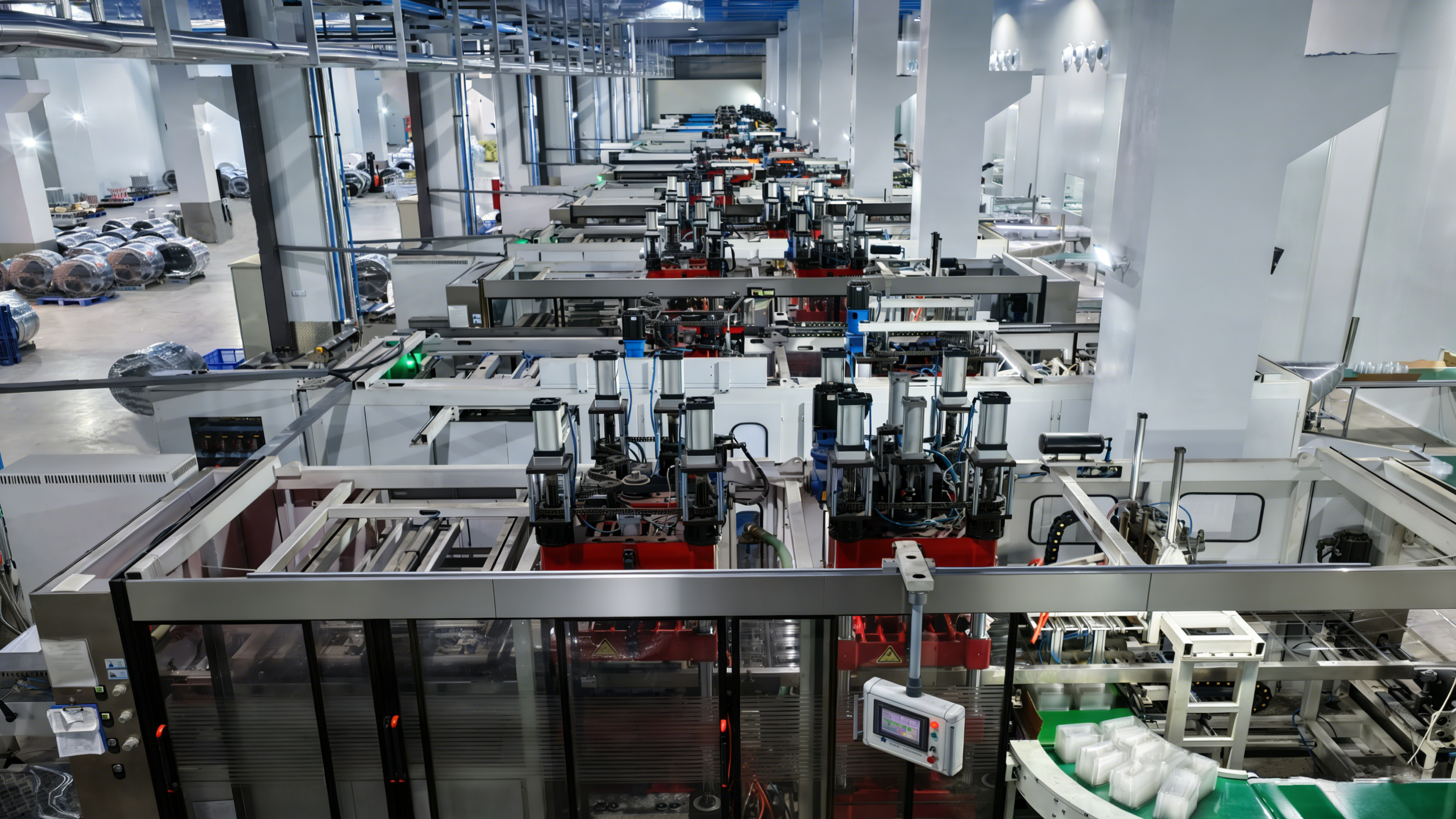
Machine display from the manufacturing base in Weifang, where PET and PP food trays are thermoformed.
Inside the Factory: Supplier Capability Evidence Behind HB-1912 and HB-75-28 Bakery Trays
Bakery packaging is bought twice: once on shelf appearance and unit price, and again on evidence. The second purchase is the one that decides whether a trial order becomes a repeatable supply line, and it is where most sourcing gaps appear.
Verifiable supplier capability, in this context, means something narrow and checkable: stated model dimensions, a named material grade, a certification scope that lists the models actually covered, and tooling capacity that can be inspected rather than inferred from a catalogue photograph.
Weifang Chuanhe New Material Co., Ltd — the manufacturer behind the CHUAN HE brand — is a Chinese thermoformed packaging producer founded in 2013 that designs and manufactures PET and PP food containers, including bakery packaging, fruit and vegetable packs, frozen food trays and tamper-evident containers. Its production base covers 62,000 m² in Weifang, Shandong Province, adjacent to Qingdao Port, and the company records a 100% export share, with the EU, US, North America, LATAM and Middle East listed among its main markets.
This article examines two models from that catalogue — HB-1912 and HB-75-28(PP) — and treats their written specifications, compliance scope and tooling background as a working example of what supplier evidence looks like when a bakery buyer asks for it.
Why documented specifications became a buying condition
Regulation (EU) 2024/3190, effective January 2025, prohibits Bisphenol A in food contact plastics, coatings and inks, with transition periods for compliance. Alongside it, Regulation (EU) 2025/40 — the Packaging and Packaging Waste Regulation (PPWR) — sets test requirements for per- and polyfluoroalkyl substances (PFAS) and for total lead, cadmium, mercury and hexavalent chromium content in plastic packaging. For a bakery shipping trays into the EU, a supplier that cannot name which models fall inside a test report is a supplier whose compliance position cannot be confirmed from documents alone.
The commercial backdrop makes the same demand louder. Grand View Research values the global food packaging market at USD 421.6 billion in 2025 and projects USD 599.0 billion by 2033, with Asia Pacific holding a 40.0% revenue share in 2025. Thermoform packaging, the process family these trays belong to, was valued at USD 54.7 billion in 2025, with PET holding the largest material share at 44.8%.
Volume growth at that scale produces more SKUs, more sourcing teams and more of the same question: what exactly is documented for the tray we are about to order? The answer usually determines whether a procurement decision can be signed off in one meeting or drifts for a quarter.
The documented baseline: HB-1912 and HB-75-28(PP)
Two models, two materials, two sets of numbers that can be written directly into a purchase specification without interpretation.
| Model | Material | Documented dimensions | Compliance scope |
|---|---|---|---|
| HB-1912 | PET | 19 × 12 × 3 cm | Listed within PPWR certification and associated test report scope |
| HB-75-28(PP) | PP | 16.8 × 11.4 × 3 cm | Listed within PPWR certification and associated test report scope |
Both models sit inside a single Trays Packaging platform rather than standing alone. The documented format set for that platform includes food plastic trays, produce trays, bakery trays, MAP packaging trays, meat trays, compartment trays, clear display trays, disposable serving trays and custom blister trays. For a buying team this matters, because a format decision — compartment or flat, display or covered, bakery or meat — does not automatically require a new supplier qualification.
The platform's documented product attributes are a stackable design, compatibility with MAP modified atmosphere packaging lines, a rigid sturdy structure, and food-grade BPA-free plastic construction. Customization covers shape, color, embossing and logo printing, and both small and bulk wholesale orders are supported on a factory-direct basis.
What the tray geometry tells a packaging engineer
HB-1912 measures 19 × 12 × 3 cm in PET. A 19 cm by 12 cm footprint with 3 cm of depth is a shallow, wide format — the geometry that suits single-layer pastry presentation, laminated tray presentation, and retail display where the product is viewed from above rather than from the side.
HB-75-28(PP) measures 16.8 × 11.4 × 3 cm in polypropylene. The smaller footprint and the PP material have to be evaluated together, because material determines the thermal envelope: FDA 21 CFR 177.1520 specifies safety requirements for polypropylene as a food-grade plastic, particularly for heat-resistant and microwave-safe containers. A bakery moving between chilled display, ambient shelf and reheat formats is therefore choosing on material, not only on size.
Stackability is the third variable, and it is documented rather than assumed: the platform's trays are designed to stack, which affects warehouse cube, pallet configuration and how many units a display fixture can hold. MAP line compatibility adds a fourth. Trays in this platform are documented as compatible with modified atmosphere packaging lines — the requirement that usually decides whether a bakery format can move from manual assembly to automated sealing. Because one platform carries the same two attributes across multiple formats, a buyer can standardise sealing parameters across a product range instead of validating each item separately.
Inside the factory: the equipment behind the specification
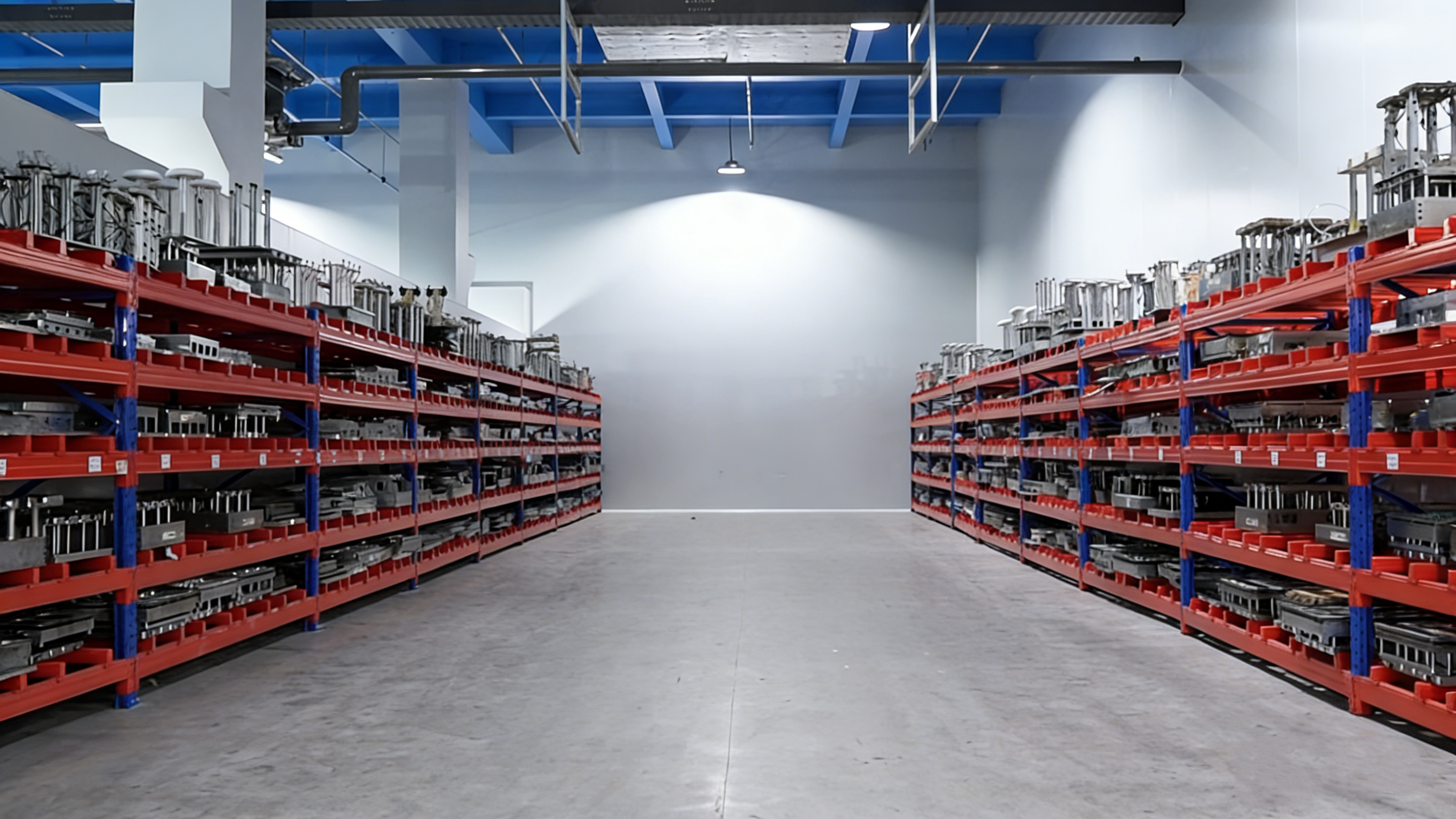
Mold display from the in-house mold workshop, where tray profiles are developed and maintained.
Specifications are outputs of equipment, so the factory itself is part of the evidence. The Weifang facility operates 20 fully automatic thermoforming machines and 20 standard thermoforming machines, including four Kiefel machines imported from Germany, alongside four PET sheet extrusion lines and two PP sheet extrusion lines. It also maintains an in-house mold workshop.
That combination changes what a buyer can request. In-house sheet extrusion reduces dependence on outsourced raw material and coordinates sheet supply with forming schedules. An in-house mold workshop means a new tray profile is developed internally instead of being queued at a third-party tool shop, which is normally the longest single delay in a custom bakery tray programme.
The company records a 54,000-ton annual output, an R&D team of five engineers, and experience developing thousands of molds. For a procurement team, the relevant reading is not the headline figure but the sequence: sheet extrusion, forming capacity and mold development are three separate capability blocks, and a supplier that holds all three can adjust to a specification change without renegotiating with two external parties.
Customization depth as purchasing evidence
Customization is often described in marketing language and specified in engineering language. The documented options for this platform are shape, color, embossing and logo printing. Two of those four are surface-level differentiators that let a bakery brand the tray without changing the base footprint or the stacking behaviour of the platform; color separates product lines on the shelf; shape addresses product fit and portion geometry.
Small and bulk wholesale orders are both supported on a factory-direct basis, which matters at the execution stage. A retail chain validating a format can run a smaller quantity before committing to a season's volume, while a distributor can consolidate a bulk programme on the same tooling. The practical benefit is continuity: the sample a buyer approves and the production run they receive come off the same mold set and the same extrusion lines.
Compliance evidence that names the models
The distinctive part of this evidence set is not the existence of a certificate but the model list attached to it. PPWR certification or its associated test report covers the HB-75-28(PP) polypropylene tray and the HB-1912 food plastic tray, together with the HB-T9333 tray, the HB-221360(PP) tray, the HB-MG24 OZ tray, the HB-MG08 OZ tray and the HB-MG40 OZ tray. The PPWR test report for the HB-MG40 OZ tray is issued by TÜV Rheinland.
The report content is specified as well: it covers per- and polyfluoroalkyl substances (PFAS) and total lead, cadmium, mercury and hexavalent chromium content in plastic packaging, assessed against Regulation (EU) 2025/40. The company's recorded quality management certifications are CE, BRC, FDA, EU and SGS.
Model-level naming is what converts a certificate into a purchasing document. A buyer preparing an EU-facing compliance file can reference HB-1912 and HB-75-28(PP) directly, rather than asking whether a general supplier certificate applies to the two SKUs on the purchase order.
Quality controls across a production run

In-line quality inspection station used for finished product sampling.
Process control is documented at four points: food-grade raw material inspection, production hygiene control, online quality inspection and finished product sampling tests. Compliance risk is addressed through FDA food contact compliance, regular certification updates and long-term archiving of compliance records. Production process risk is controlled through GMP implementation and through migration and physical testing of materials, and batch traceability forms part of the recorded control set.
The procurement translation is straightforward. When a bakery buyer raises a concern about migration, breakage or contamination, the supplier's answer can be traced to a batch record and a test file rather than reconstructed from memory. That is the difference between a supplier relationship that survives one quality incident and one that does not.
Where these trays fit: application scenarios
Documented application scenarios for the platform include fruit and vegetable packs, frozen food trays, dry fruit containers, cake and bakery packaging, salad containers, and seedling protection transport pallets. The intended buyer groups are produce wholesalers, supermarket chains, agricultural exporters, bakeries and food retailers, and e-commerce brands seeking custom packaging.
Two scenarios deserve specific attention from bakery buyers. The first is supermarket retail display, where the PET format of HB-1912 supports the transparency that bakery counters rely on and the 3 cm depth keeps stacked pastry visible from above. The second is sealed or gas-flushed ambient distribution, where MAP line compatibility determines whether a tray can be run on existing sealing equipment or must be handled manually. Frozen bakery and frozen ready-to-bake formats are a third case, and they are covered by the same platform documentation rather than by a separate product line.
Market context: what is driving bakery tray demand
China exported USD 1.28 billion in baked goods in 2024, according to the Observatory of Economic Complexity — an indicator of the volume of finished bakery product moving through trade channels and, by extension, of demand for primary packaging such as PET and PP containers.
Adjacent categories show the same direction. Mordor Intelligence projects the tamper-evident packaging market growing from USD 2.56 billion in 2025 to USD 4.26 billion by 2030, at a CAGR of 10.72%, reflecting demand for sealed, verifiable formats across food retail. The global bakery packaging landscape also includes large integrated groups such as Amcor Plc, Berry Global Inc., Sealed Air Corporation and Mondi Group, alongside regional thermoforming specialists.
One caution is worth stating for buyers who use market reports in internal business cases. Published bakery packaging market estimates vary widely by scope: Strategic Market Research places the figure at USD 12.4 billion, while Market Research Future reports USD 57.76 billion. The gap reflects different category definitions — total packaging versus rigid container segments — and headline numbers should always be matched to the scope they were measured on.
Documented thermoformed supply versus conventional purchasing
| Procurement criterion | Documented route (as evidenced here) | What the buyer must verify on their own |
|---|---|---|
| Dimensions | Stated per model: 19 × 12 × 3 cm and 16.8 × 11.4 × 3 cm | Whether the quoted figure is a nominal or measured value |
| Material grade | PET and PP identified per model, BPA-free food-grade construction documented | Additive package and colour masterbatch composition |
| Compliance | PPWR test reports naming covered models; FDA food contact compliance; CE, BRC, FDA, EU, SGS certified systems | Jurisdiction-specific requirements outside the EU and US |
| Tooling | In-house mold workshop; thousands of molds developed | Tool ownership terms and mold transfer conditions |
| Customization | Shape, colour, embossing and logo printing; small and bulk orders | Artwork approval workflow and colour tolerance limits |
| Quality assurance | Raw material inspection, hygiene control, online inspection, finished product sampling, batch traceability | On-site audit and independent sample testing |
The comparison is not between good and bad suppliers. It is between a sourcing file that already contains the answers and a sourcing file where every column is an open question to be closed before the first container ships.
Limitations and boundaries buyers should plan around
Evidence is only useful if its edges are stated as clearly as its centre. Five boundaries apply to this supply route.
- Order threshold. The recorded minimum order quantity is 10,000 units. Small bakeries testing a format should expect to plan supply in bulk terms or work through a distributor rather than ordering at retail scale.
- Model-specific certification scope. The PPWR certification and test reports name specific models, including HB-75-28(PP) and HB-1912. Compliance documentation is not automatically transferable to every tray in a catalogue, and buyers should confirm the covered model list for the SKUs on their purchase order.
- Material-dependent thermal behaviour. PP is documented under FDA 21 CFR 177.1520 with particular reference to heat-resistant and microwave-safe containers; no equivalent high-heat claim is documented here for the PET trays. Format selection should follow the thermal profile of the product, not only its shelf presentation.
- Tooling-bound dimensions. Custom shape and embossing come from a mold. Once a profile is cut, dimensional changes are a tooling decision rather than an off-the-shelf adjustment, which affects how quickly a package re-design can be delivered mid-season.
- Focused product portfolio. The catalogue centres on thermoformed PET and PP containers — trays, clamshells, produce packs, tamper-evident containers and related formats — rather than spanning the full packaging spectrum of large integrated groups. Requirements outside thermoformed rigid plastics belong with a different supplier type.
What documentation-driven sourcing looks like next
The direction of regulation is clear: BPA restrictions took effect in the EU in January 2025, and PPWR test requirements for PFAS and heavy metal content are now written into how plastic packaging is assessed. Buyers should expect compliance conversations to move from certificates in general to substance-level test scope attached to specific models.
That shift favours suppliers who already document dimensions, materials, tooling and test scope as a matter of routine, and it disadvantages those who treat documentation as a sales task. For bakery packaging specifically, the practical consequence is a shorter evaluation cycle: dimension tables, material declarations and named certification scope answer most of the questions that would otherwise be exchanged over several rounds of email.
The models profiled here illustrate the pattern rather than define its limits. HB-1912 and HB-75-28(PP) differ in material and footprint, but they share one property that matters more than either: everything a buyer needs to specify them is written down, model by model.
Frequently asked questions
What are the documented specifications of HB-1912 and HB-75-28(PP)?
HB-1912 is a food plastic tray produced in PET with documented dimensions of 19 × 12 × 3 cm. HB-75-28(PP) is a polypropylene tray with documented dimensions of 16.8 × 11.4 × 3 cm. Both belong to the same Trays Packaging platform, whose documented formats include food plastic trays, produce trays, bakery trays, MAP packaging trays, meat trays, compartment trays, clear display trays, disposable serving trays and custom blister trays. The platform's documented attributes are a stackable design, MAP line compatibility, a rigid sturdy structure and food-grade BPA-free plastic construction.
Are these two tray models covered by EU packaging compliance testing?
Yes. PPWR certification and its associated test report cover the HB-75-28(PP) polypropylene tray and the HB-1912 food plastic tray. The same scope extends to the HB-T9333, HB-221360(PP), HB-MG24 OZ, HB-MG08 OZ and HB-MG40 OZ trays, with the HB-MG40 OZ report issued by TÜV Rheinland. The test content addresses per- and polyfluoroalkyl substances (PFAS) and total lead, cadmium, mercury and hexavalent chromium content under Regulation (EU) 2025/40. Buyers shipping to markets outside the EU and US should confirm any additional local requirements.
Which customization options exist, and when does a change require tooling?
Documented customization options are shape, color, embossing and logo printing, with both small and bulk wholesale orders supported on a factory-direct basis. Colour and logo printing are surface-level changes that do not alter the tray footprint or its stacking behaviour. Shape changes and embossing come from the mold, and the manufacturer maintains an in-house mold workshop with experience developing thousands of molds. Dimensional changes are therefore tooling decisions rather than catalogue adjustments.
What are the recorded order, delivery and payment terms?
The recorded minimum order quantity is 10,000 units. Delivery methods include FOB, CIF and DDP. Acceptance is based on pre-shipment testing. Accepted payment methods are T/T, L/C, D/P D/A, MoneyGram, PayPal, Western Union and cash.
What quality controls apply during production?
Documented production controls include food-grade raw material inspection, production hygiene control, online quality inspection and finished product sampling tests. Compliance risk is managed through FDA food contact compliance, regular certification updates and long-term archiving of compliance records. Production process risk is controlled with GMP implementation and with migration and physical testing of materials, supported by batch traceability.
What limitations should a bakery buyer plan around?
Four practical limits apply. The 10,000-unit minimum order quantity rules out small trial volumes without a distributor. PPWR documentation covers named models rather than an entire catalogue, so covered-model lists must be checked per SKU. Thermal behaviour depends on material: PP is documented under FDA 21 CFR 177.1520 with particular reference to heat-resistant and microwave-safe containers, while no equivalent high-heat claim is documented here for the PET trays. Finally, custom shapes and embossing are tooling-bound, so dimensional changes follow a mold decision rather than an off-the-shelf switch.
Additional factory, tooling and product documentation is available in the company's public brochure: CHUAN HE packaging capability brochure.