
Inside the Machine: Vertical vs Horizontal Waste Paper Balers
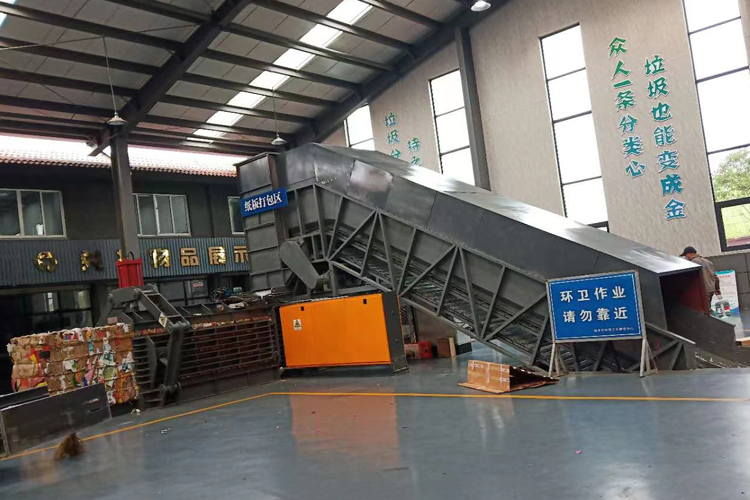
Vertical and horizontal waste paper balers both turn loose recovered paper into a tied, transportable bale, yet almost nothing about how they achieve it is the same. The compression axis changes the chamber geometry, the feeding method, the tying arrangement, the density that can be reached in a single stroke, the speed at which the machine cycles, and how much automation is practical around it. For engineering and procurement teams comparing quotations, these are precisely the differences that decide whether a specification is workable on a given waste paper stream.
The questions below are the ones that recur most often during evaluation: what bale density is realistic, how cycle time should be read across two different machine architectures, what automation actually changes on the floor, and which technical features suit which paper grade. Answers are drawn from published model specifications rather than from general claims. Where a figure depends on the material stream, that dependency is stated rather than smoothed over.
The Short Answer: Same Task, Different Mechanics
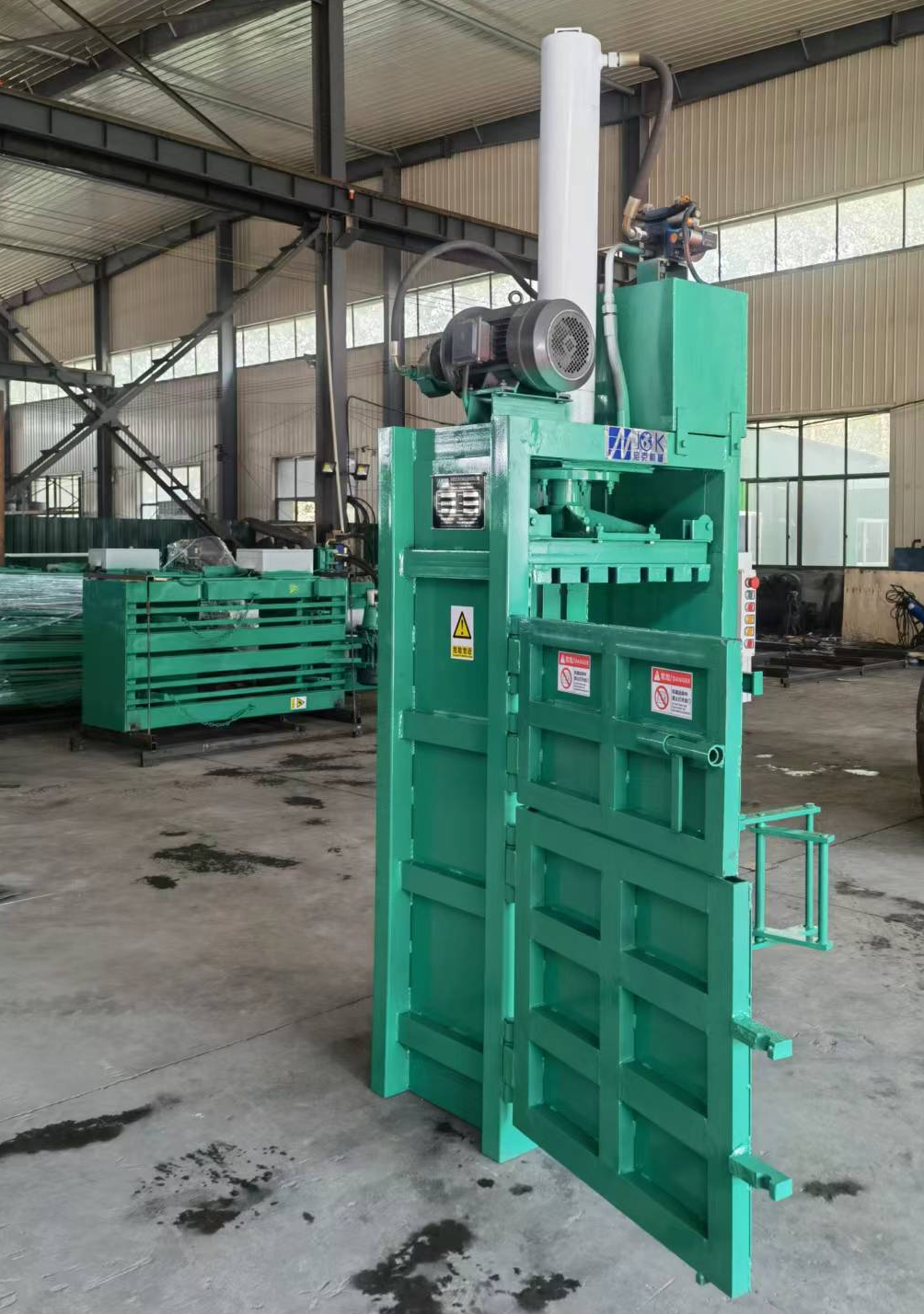
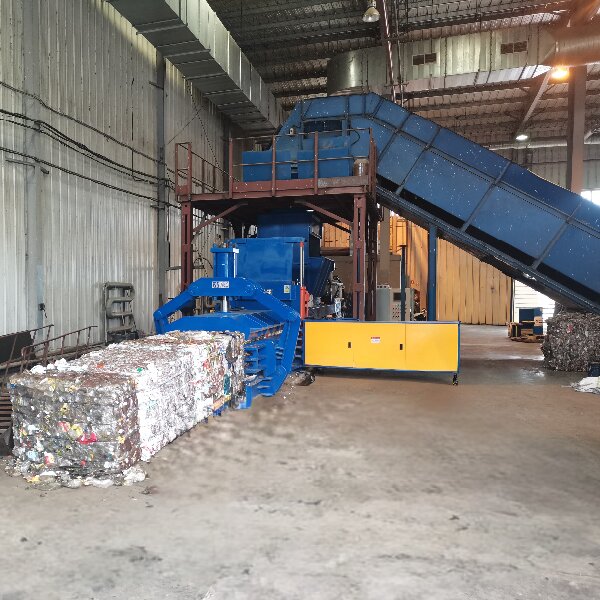
A vertical baler compresses material downward with a platen inside a fixed chamber. Material is loaded batch by batch, the platen is withdrawn, and the finished bale is secured with wire or strapping before the chamber is opened. A horizontal baler drives a ram along a horizontal chamber, is fed through an opening at the top or side of that chamber, and pushes the compressed bale out at the far end, where tying is performed. The horizontal architecture allows a longer compression stroke, a heavier frame and continuous conveyor feeding — three properties that together explain most of the performance gap between the two families.
| Design element | Vertical baler | Horizontal baler |
|---|---|---|
| Compression direction | Downward platen into a fixed chamber | Horizontal ram along an elongated chamber |
| Chamber configuration | Single chamber; double-chamber variants exist (NK-T90L) | Long chamber with feed opening of 1,200 × 1,000 mm to 2,400 × 1,100 mm |
| Feeding | Manual batch loading (specified as manual on NK-T90L) | Manual feed opening or chain conveyor of 12,000–14,000 mm |
| Bale securing | Wire or strapping applied after compression | Bale wire 10# × 4–5 pcs, or 6#/8# × 5 pcs depending on model |
| Published capacity metric | Bales per hour, 3–12 across the range | Tonnes per hour, 2–15 across the range |
| Installed weight | 600 kg to 11 t | 14,500 kg to 30,000 kg, plus conveyor |
| Automation | Operator-paced loading and tying | Documented in both semi-automatic and fully automatic configurations |
Why the Vertical-or-Horizontal Question Surfaces at Evaluation Stage
The question rarely appears at the discovery stage. It appears when two quotations arrive with wildly different numbers attached: one machine at a few tonnes of installed weight and a handful of kilowatts, another at 15 to 30 tonnes, 30 to 45 kW of main motor power, a 12-metre conveyor, and a cooling circuit. Both are legitimately described as waste paper balers. The evaluation problem is that they answer different operational questions, so the comparison has to be made on the constraints of the site and the stream rather than on headline price or headline throughput.
The second reason the question surfaces late is bale handling. A bale of 50–80 kg can be moved by one operator with a pallet truck. A bale of one tonne or more requires forklift handling, stacking discipline, and a buyer downstream who accepts that bale format. Density and bale mass are therefore not purely machine attributes; they are logistics decisions that reach back into the baler specification.
Question 1: What Actually Differs, Mechanically?
Three physical details drive everything else.
Stroke length and chamber length
In a vertical machine the compression stroke is bounded by the chamber height. The cylinder sizes published for the vertical range run from 10 tonnes on the NK6040T10 to 200 tonnes on the NK1580T200, but the compressed volume is always limited by a chamber that a single operator loads from the front. In a horizontal machine the ram travels along a chamber that can be several metres long, which is why the same nominal force can produce a much larger and denser bale.
Continuous versus batch feeding
A horizontal baler with a conveyor accepts a steady feed and compresses it in successive strokes, so the machine's throughput is limited by hydraulics and tying rather than by the operator's loading rhythm. A vertical baler is batch-fed: the operator fills the chamber, compresses, fills again if the model allows, then ties. The NK-T90L double-chamber design reduces idle time by allowing one chamber to be loaded while the other is compressed, but the principle of operator-paced throughput remains.
Tying and ejection
Horizontal models specify bale wire by gauge and count — 10# × 4 pcs on the NKW80BD, 10# × 5 pcs on the NKW125BD, and 6#/8# × 5 pcs on the NKW180BD and NKW250BD. Heavier wire counts track bale mass. On vertical machines the bale is tied inside the chamber before the door is opened, which is why chamber access and door design matter more than wire-feed automation.
Question 2: What Bale Density Is Realistic?
This is where published specifications differ most in form, and where comparisons most often go wrong.
For the horizontal range, density is published directly as a material density range. The NKW80Q is specified at 300–400 kg/m³ with an 80-tonne main cylinder; the NKW125Q at 500–600 kg/m³ at 125 tonnes; the NKW160Q at 400–600 kg/m³ at 160 tonnes; and the NKW180QT at 500–600 kg/m³ with a 160-tonne main cylinder and a 30.5 MPa system pressure. The span from 300 to 600 kg/m³ across one product family shows how strongly density follows cylinder force and chamber design rather than the material alone.
For the vertical range, the published figures are bale dimensions and bale weight rather than a density band: 50–80 kg on the NK6040T10, 150–200 kg on the NK60LT, 200–350 kg on the NK080T100, 400–500 kg on the NK110T150, and 1,000–2,000 kg on the NK1580T200. A procurement team that wants a like-for-like density comparison across the two families has to request it explicitly, because the spec sheets do not present it the same way.
Published density is a design reference for a model, not a guaranteed output for every furnish. Moisture content, fibre mix, the proportion of film or contamination, and the operator's loading discipline all move the achieved figure. Buyers should treat the published band as the range the machine is engineered to reach on suitable material, and validate it on their own stream.
Question 3: How Should Cycle Time and Throughput Be Read?
The two architectures measure productivity in different units, and this is the single most common source of mis-specified comparisons.
Vertical models publish bales per hour. Across the range this runs from 3–6 bales per hour on the NK080T100 and NK1580T200, through 4–6 on the NK110T150 and 4–5 on the NKOT150, 5–8 on the NK1070T60, 6–8 on the NK6040T10, up to 10–12 bales per hour on the NK60LT and the double-chamber NK-T90L. Horizontal models publish tonnes per hour: 2–3 t/h on the NKW80BD, 3–5 t/h on the NKW80Q, 5–7 t/h on the NKW125BD, 6–8 t/h on the NKW180BD, 10–12 t/h on the NKW125Q, 10–15 t/h on the NKW250BD, and 12–15 t/h on the NKW160Q and NKW180QT.
A figure of 10 bales per hour and a figure of 10 tonnes per hour describe machines two orders of magnitude apart in output. Converting one to the other requires the bale mass, which for the vertical family varies by more than twentyfold across the range. The defensible technique is to convert the vertical figure using the specified bale weight for that exact model and then compare tonnage with tonnage — and to remember that the vertical figure assumes an operator loading at a sustained pace for the whole hour.
Question 4: What Does the Automation Level Actually Change?
On horizontal machines, the distinction between semi-automatic and fully automatic configurations is documented at product-type level. The practical content of that distinction sits in feeding and tying: a fully automatic machine accepts material from a chain conveyor — 2,000 × 12,000 mm with a 4 kW motor on the NKW180QT, 2,000 × 14,000 mm with a 7.5 kW motor on the NKW160Q, or 14,000 × 2,000 mm with a 5.5 kW motor on the NKW180BD — and performs the bale ejection and wire tying sequence without an operator at the chamber.
Two supporting systems follow from that. Connected power rises accordingly: 45 kW + 7.5 kW on the NKW180QT, 45 kW + 11 kW on the NKW160Q, 37.5 kW + 11 kW on the NKW125Q, against 22 kW/30 HP for the semi-automatic NKW80BD. And heat rejection becomes a specification item — the NKW180BD, NKW125BD and NKW80BD list cooling by fan, while other models list water cooling or an oil chiller, and the NKW180QT lists a cooling tower motor of 0.75 kW for the pump plus 0.25 kW for the fan.
On vertical machines, automation is largely an operator question. Where the specification states manual feeding, cycle consistency depends on the person loading the chamber. That is not a defect; it is the reason a vertical machine can be economically justified at volumes where a horizontal machine's conveyor and tying system would sit idle.
Question 5: Which Waste Paper Streams Fit Which Architecture?
Stream characteristics that matter are bulk density before baling, contamination, moisture, and the downstream buyer's bale specification.
| Stream / setting | Typical fit | Published reference points |
|---|---|---|
| Retail and office cardboard, modest daily volume | Vertical | NK1070T60 cardboard box baler, 60 t, 5–8 bales/h, bale 1,100 × 700 × 500–900 mm |
| Small-volume mixed paper, light bales | Vertical | NK6040T10, 10 t, 6–8 bales/h, bale weight 50–80 kg |
| Distribution centre or transfer station with continuous feed | Horizontal | NKW125BD, 125 t, 5–7 t/h, bale 1,100 × 1,250 × 1,700 mm |
| MRF or paper mill intake requiring high density | Horizontal | NKW160Q, 160 t, 12–15 t/h, 400–600 kg/m³; NKW180QT, 500–600 kg/m³ at 30.5 MPa |
| Mixed plastic and paper at a recycling station | Horizontal | NKW series as documented in recycling station use; low noise and low energy consumption reported |
| PET bottles and cans | Vertical | NK080T100 cans/PET baler, 100 t, 3–6 bales/h, 200–350 kg |
| Textile and rag fractions alongside paper | Vertical | NK60LT, 60 t, 10–12 bales/h, 150–200 kg; NK-T90L double chamber, 90 t |
Press bagging machines form a separate category with a different output format and are not interchangeable with either architecture; they are addressed in their own reference material.
Question 6: What Site Constraints Come With Each?
Vertical footprints in the range start at 870 × 780 × 2,150 mm on the NK6040T10 and extend to 1,900 × 1,700 × 4,210 mm on the NK110T150 and 1,800 × 1,000 × 4,600 mm on the NK1580T200. Installed weight runs from 600 kg to 11 tonnes. Most of these machines can be placed in an existing waste room without structural work.
Horizontal footprints are a different order of magnitude: the NKW80Q mainframe is approximately 9.8 × 4.3 × 1.4 m, the NKW160Q and NKW125Q approximately 11 × 2.3 × 2.9 m, and the NKW180QT approximately 13 × 4.3 × 5.8 m. Add the conveyor, and a 12,000–14,000 mm approach length has to be reserved. Installed weight reaches 30,000 kg on the NKW250BD, before the conveyor's 4,500–5,000 kg. Foundation design, lifting access during installation, and the routing of the cooling circuit belong in the project plan, not in the commissioning week.
Question 7: What Can Realistically Be Customised at OEM Level?
NKBALER is the brand of Shaanxi Nick Machinery Equipment Co., Ltd., a Wuxi-based manufacturer founded in 2013 that designs and sells vertical balers, full-automatic and manual horizontal balers, and press bagging machines, with roughly 90% of output exported to North America, South America and Asia. The company operates a 5,000 m² facility with 50 employees, a 15-person R&D team and an annual output of about 600 units.
Its stated capability profile is OEM/ODM supply with parameter-level customisation, a monthly capacity of 10 units, a lead time of 30–45 days, a minimum order quantity of one unit, and 100% testing before shipment, supported by remote after-sales support. For buyers, "parameter-level" is the operative phrase: it describes changes to defined specification values rather than a redesign of the compression architecture. Voltage is the clearest documented example — several model sheets mark voltage as customisable, with 380V/50Hz as the standard and 220V/50Hz on the smallest vertical unit.
The correct way to use an OEM capability statement in an evaluation is to match it against the specification values that actually affect the site: bale size, feed opening, main cylinder force, main motor power, bale-wire gauge and count, cooling method, conveyor length and conveyor motor power. Those are the fields that appear in the published model data, and those are the fields a technical clarification should reference. Further detail on the product range is available at nkbaler.com.
Question 8: What Compliance Evidence Should Be Attached?
For the European market, the technical baseline differs by architecture. Horizontal baling presses must comply with the EN 16252:2012 safety standard, published in the UK as BS EN 16252:2012, to carry CE marking in the European Union, according to BSI Knowledge. The standard is written specifically for horizontal baling presses, which means a supplier's compliance file should distinguish between the machine types rather than present one certificate as covering an entire range.
NKBALER's documentation set includes a Verification of Conformity numbered DPWD/09/060/2024, issued 19 September 2024 and valid to 18 September 2029 for the EU/EEA market, citing EN ISO 12100:2010, EN 60204-1:2018 and EN 415-1:2014. A separate Attestation Certificate of Machinery Directive, numbered EASY03220201M and issued by UDEM International Certification Auditing Training Centre Industry and Trade Inc. Co. on 22 March 2022, valid to 21 March 2027, covers the EU, EEA and Türkiye markets against EN ISO 12100:2010 and EN 60204-1:2018. Both certificates list the covered models individually across the vertical, horizontal and bagging ranges.
Customs classification is a separate exercise. Hydraulic baling press machines for waste paper are commonly classified under HS Code 8422.40 for packing or wrapping machinery, or 8462.91 for hydraulic presses, per customs trade data compiled by Volza and Made-in-China. Buyers should confirm the applicable code with their customs broker rather than rely on the supplier's preference.
Where Each Architecture Stops Being the Right Answer
A vertical baler cannot be pushed into horizontal territory by specifying a larger cylinder. Its bale mass is capped by the chamber, and its throughput is paced by a person. Where a site needs consistent bale density for a mill contract, a bale format that stacks predictably to a payload weight, or tonnage that scales with the sorting line rather than with shift staffing, the horizontal architecture is the appropriate answer and the vertical machine will under-deliver regardless of price advantage.
The reverse limitation is equally real. A horizontal machine requires 15 to 30 tonnes of installed mass, a 12- to 14-metre conveyor run, 30 to 45 kW of connected main motor power, and either fan, water or chiller-based cooling. Sites without the floor area, the foundation, or the maintenance capability to service a conveyor and an automated tying system will find that the machine's theoretical throughput is never reached. Full automation adds mechanisms that must be maintained, and remote support does not substitute for scheduled on-site upkeep.
A third boundary is informational rather than mechanical. Published density bands describe what a model is engineered to achieve on suitable material; they are not a contractual guarantee across every furnish. Moisture, film content and fibre mix will move the achieved density, and a specification that quotes a single density number without a material description should be treated as incomplete.
Market Context Behind the Specification Choice
The scale of the category explains why both architectures continue to coexist rather than one displacing the other. Maximize Market Research puts the global industrial balers market at USD 6.39 billion in 2024, projected to reach USD 13.21 billion by 2032. A narrower segment estimate published by NKBALER's own industry report values the solid waste hydraulic baler segment at USD 1.52 billion in 2025 with a projected compound annual growth rate of 5.5% through 2036 — a company-published figure that should be read alongside independent estimates rather than instead of them.
Regional concentration is a further signal. NKBALER's strategic guide attributes approximately 45% of global hydraulic baler revenue in 2025 to Asia Pacific, led by China and India. Customs data compiled by Zauba records China as the largest exporter of hydraulic baling press machines, accounting for over 77% of total import shipments in specific emerging market corridors in 2024. These figures are directionally consistent but arise from different methodologies, and published estimates of the total baler market vary substantially depending on whether agricultural equipment is included — a divergence that buyers should keep in mind when a supplier cites market growth as a justification for a specification.
Future Outlook
Two directions are visible from the specifications themselves. The first is that horizontal machines are increasingly specified with the conveyor and cooling system as part of the machine, not as site-supplied ancillaries; the published data for the NKW180QT, with its 2,000 × 12,000 mm conveyor and dedicated cooling tower motors, describes a package rather than a press. That shifts procurement questions from cylinder force alone towards line integration, connected power and heat rejection.
The second is the persistence of the vertical segment. Compact footprints, low connected power — 2.2 kW on the NK6040T10, 15 kW on the NK1070T60 — and the ability to run without a conveyor keep vertical balers economically sensible for retail, office and light industrial generators whose volumes will never justify a horizontal line. The engineering question for the next procurement cycle is therefore not which architecture wins, but how precisely a buyer can document which one fits a specific stream.
FAQ
Do vertical and horizontal balers produce the same bale density on the same waste paper?
No. In the NKBALER range, horizontal models publish a material density band from 300–400 kg/m³ on the NKW80Q to 500–600 kg/m³ on the NKW125Q and NKW180QT, while vertical models publish bale weight and bale dimensions instead — from 50–80 kg on the NK6040T10 to 1,000–2,000 kg on the NK1580T200. The difference follows from cylinder force, chamber length and compression stroke, and a like-for-like density comparison has to be requested explicitly.
Can a vertical baler be upgraded later if waste paper volumes grow?
The architecture cannot be converted; a site that outgrows a vertical machine adds or replaces capacity with a horizontal unit. Growth should therefore be planned against bale mass and tonnage thresholds rather than machine age. A generator moving from bales of 50–80 kg to a mill contract requiring 1,100 × 1,250 × 1,700 mm bales is already past the vertical range, because that bale format is produced by models such as the NKW125BD at 5–7 t/h.
What site preparation does a horizontal baler require that a vertical baler does not?
Three items dominate. Floor area for the conveyor, which is 12,000–14,000 mm long and weighs 4,500–5,000 kg. A foundation able to carry 14,500–30,000 kg of mainframe mass. And cooling provision — fan cooling on the NKW80BD, NKW125BD and NKW180BD, water cooling or an oil chiller on other models, and on the NKW180QT a cooling tower with a 0.75 kW pump motor and 0.25 kW fan motor. Vertical models from 600 kg to 11 tonnes typically require none of these.
Which specification values should be written into a purchase order?
The values that determine output and site fit: bale size, material density reference for horizontal models or bale weight for vertical models, feed opening size, main cylinder force, main motor power, bale-wire gauge and count, cooling method, and where applicable conveyor length, conveyor motor power and voltage. For NKBALER supply, the commercial parameters documented are a minimum order quantity of one unit, a lead time of 30–45 days, 100% testing before shipment, and remote after-sales support.
What compliance documentation should accompany an EU-bound waste paper baler?
For a horizontal baling press, conformity with EN 16252:2012 is the relevant safety standard for CE marking in the European Union, according to BSI Knowledge. NKBALER's file includes a Verification of Conformity numbered DPWD/09/060/2024 valid from 19 September 2024 to 18 September 2029 for the EU/EEA, citing EN ISO 12100:2010, EN 60204-1:2018 and EN 415-1:2014, plus an Attestation Certificate of Machinery Directive numbered EASY03220201M valid to 21 March 2027 for the EU, EEA and Türkiye. Because these are general machinery documents rather than product-specific type examinations, buyers should confirm that the exact model being purchased appears in the certificate's covered-model list.
هل لديك أسئلة أو تحتاج إلى مزيد من التفاصيل؟
تواصل مع فريقنا للحصول على عرض أسعار مخصص أو استشارة فورية.
طلب عرض أسعار
املأ النموذج أدناه وسيتواصل معك فريقنا بعرض مقترح مخصص.
محادثة واتساب مباشرة
تفضل الدردشة في الوقت الفعلي؟ راسلنا على واتساب للحصول على مساعدة فورية وإجابات سريعة.
- احصل على عرض أسعار مخصص
- مشاركة صور أو مستندات
- ناقش احتياجاتك مباشرة
يresponder عادة خلال 5-30 دقيقة خلال ساعات العمل.