
Inside the Rubber Parts Factory: Customization as Capability Evidence
Inside the Rubber Parts Factory: Customization as Capability Evidence
A custom rubber part is a specification made physical. Gaskets, seals, o-rings, dampers, and washers are normally defined by the conditions they have to survive — heat, oil, vibration, cleaning cycles, chemical contact — and those conditions rarely line up with a standard catalogue size. That is why customization is the most reliable lens for judging an industrial rubber products supplier: it exposes material range, tooling practice, process control, and documentation that a finished sample on a desk cannot show.
Longrun Rubber Products (Huizhou) Co., Ltd. is a China-based manufacturer founded in 2005 that produces custom molded rubber parts, operating from a 10,000 m² facility with 120 employees, a 20-engineer R&D team, and roughly 80% of output exported to global markets. Its parts serve automotive, machinery, home appliance, consumer electronics, medical, food, and telecommunication applications. This reference examines that operation through a single question: what does a factory's customization evidence actually tell a buyer?
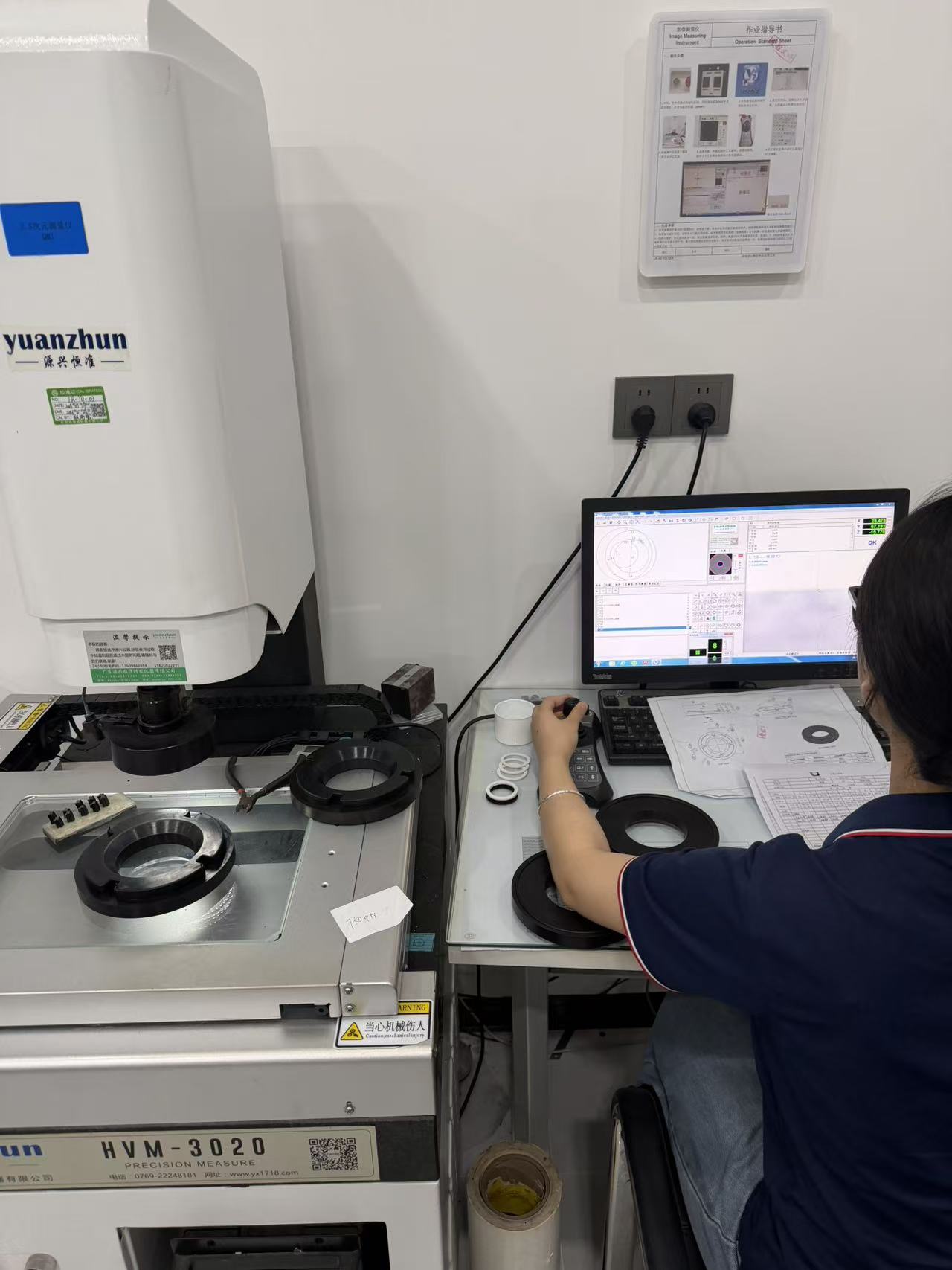
Rubber parts inspection area — the stage where a custom specification is converted into measurable output.
Customization Is Where Supplier Capability Becomes Visible
The global industrial rubber product market was valued at USD 28.28 billion in 2024 and is projected to reach USD 45.19 billion by 2034, according to Zion Market Research. Published estimates diverge — Fortune Business Insights places the rubber market at USD 51.82 billion in 2025, and Future Market Insights at USD 129.0 billion — largely because of differences in whether tires are included and how the value chain is bounded. The direction is consistent even when the absolute figure is not: demand for molded industrial rubber keeps expanding.
Growth, however, does not make the category easier to buy. The parts driving it are specified rather than selected. A buyer who needs a seal for a food-contact line, a damper for a transmission assembly, or a washer for an outdoor enclosure is asking a supplier to convert a set of operating conditions into a compound, a geometry, and a set of physical properties. A supplier with one compound and one hardness band cannot answer that request at any price. That is the practical reason customization requests function as a capability test rather than a simple quotation exercise.
What "Custom-Made" Covers Across the Product Range
Across this manufacturer's range, the same four customization levers are stated for every product family: custom-made hardness, dimensions, color, and physical properties. What changes from family to family is configuration coverage — the duty conditions each part is designed for.
| Product family | Configurations documented | Customization levers |
|---|---|---|
| Rubber gasket | Oil-resistant, chemical-resistant, high-temperature, low-temperature / cryogenic, food-grade / FDA-approved, medical-grade, high-pressure / flange | Hardness, dimensions, color, physical properties |
| Rubber seals | Hydraulic, pneumatic, oil / engine, high-temperature, low-temperature / cryogenic, chemical-resistant, food-grade / FDA-approved, medical-grade, high-pressure | Same four levers |
| Rubber o-rings | Static seal, dynamic seal, hydraulic, pneumatic, food-grade, medical-grade | Same four levers |
| Rubber dampers | Machinery vibration damper, automotive rubber damper, electronic equipment damper, pipe / vibration mount damper | Same four levers |
| Rubber washers | Sealing, vibration damping, insulating, waterproof, cushion | Same four levers |
| Rubber grommets | Wire / cable protection, sealing / waterproof / dustproof, vibration / damping | Same four levers |
A buyer reading that table should notice something beyond the product names. A supplier that lists both a hydraulic seal and a medical-grade seal, or both an oil-resistant gasket and a cryogenic gasket, is making a claim about compound handling rather than about catalogue breadth. The productive question is not "can you make a gasket," but "which of these axes can you move, and to what documented limit?" The application list behind the range — automotive, industrial, machinery, energy, medical, food, and electrical — is the same question asked from the demand side.
The Material Range Behind the Customization Claim
Customization claims are cheap; material lists are not. The documented compound range here covers EPDM, NBR (Buna-N), NR, CR (Neoprene), FKM (Viton), SBR, HNBR, silicone rubber (SiR / VMQ), and medical-grade silicone rubber. Each is offered as a customizable material rather than a single fixed formulation, which is what allows the same part geometry to be re-specified when operating conditions change.
Material selection follows widely accepted, qualitative logic rather than a single ranking:
- NBR / Buna-N — petroleum-based oils, fuels, and greases.
- HNBR — oil resistance with a higher temperature ceiling than standard NBR.
- EPDM — outdoor weathering, ozone, water, and steam duty. The EPDM rubber market was estimated at USD 10.54 billion in 2024, driven significantly by the automotive and construction sectors (Market Research Future), which reflects how broad that duty profile has become.
- FKM / Viton — high-temperature and aggressive chemical service.
- NR — high resilience and dynamic fatigue resistance.
- CR / Neoprene — balanced weather resistance with moderate oil resistance.
- SBR — general-purpose, cost-sensitive, non-oil duty.
- Silicone rubber (SiR / VMQ) — wide service-temperature range and electrical insulation.
- Medical-grade silicone rubber — medical applications that require a documented compound grade rather than a generic silicone.
The property set the manufacturer states for its molded products spans abrasion resistance, tensile strength, elongation, corrosion resistance, ozone and ultraviolet resistance, flame resistance, compression resistance, high- and low-temperature resistance, and insulation or conductivity — with suitability for both dynamic and static sealing.
Process separation matters as much as the list. The factory documents distinct rubber molding and silicone molding areas, including a silicone injection molding workshop. Silicone compounds are not processed identically to organic rubber, so a supplier running them on dedicated equipment is signalling that silicone is a production capability rather than an occasional order. That distinction becomes commercially relevant as silicone demand grows: the global liquid silicone rubber market was estimated at USD 2.9 billion in 2024 with a projected CAGR of 9.6% through 2033 (Acumen Research and Consulting), and the automotive segment alone accounted for 34.1% of LSR revenue in 2023 (Grand View Research).
From Compound to Shipment: Where Customization Is Controlled
Customization is decided in five places, and each one is an inspection point a buyer can ask about before placing an order.
- Compound selection and mixing. The material list is the starting point, not the answer; the compound has to be matched to the duty profile before geometry is finalized.
- Molding. Documented rubber molding and silicone molding areas, with silicone handled on injection equipment. The mold determines geometry, and the mold is the asset a buyer is effectively paying for at the start of a custom program.
- Trimming and finishing. Documented rubber trimming is where flash is removed. Sealing surfaces cannot carry flash, so this step is a quality gate rather than a cosmetic one.
- Inspection. Processing inspection points plus a dedicated inspection room. The manufacturer states that it applies 100% testing as its quality control method — a materially different claim from sampling, and one that can be verified during an audit.
- Storage and dispatch. A mold warehouse and a finished product warehouse. Mold retention matters commercially: repeat orders depend on tooling being preserved in usable condition.
Three published standards make those control points verifiable rather than rhetorical:
- ISO 3302-1 provides dimensional tolerances for molded, extruded, and calendared rubber products. It converts "tight tolerance" into a class that both parties can measure against.
- ASTM D2000 is the primary standard classification system for rubber products in automotive and industrial applications, allowing a compound to be described by category in a purchase specification rather than by trade name.
- FDA 21 CFR 177.2600 specifies the requirements for rubber articles intended for repeated use in food contact applications — the reference behind food-grade gasket and seal requests.
Commercial parameters for the custom route are stated as follows: OEM production, minimum order quantity determined by customer requirement, monthly capacity aligned to customer requirements, a 20-day lead time, 100% testing, and after-sales support covering warranty, returns, and technical assistance.
Diagram note for editors: an exploded view showing compound → mold → molding → trimming → inspection → warehouse is the clearest visual sequence for this section.
Production Evidence: Two Multi-Year Programs
Specifications and certificates describe intent. Running programs describe results. Two US-based programs illustrate the difference between a capability claim and a capability record.
Program one — gaskets for regulated industries. Serving Food, Medical, Machinery, and Sanitary clients, this project has run for 5 years at an annual scale of 3,000,000 units. The parts are used for vibration and noise reduction, cushioning and protection, dustproof and waterproof protection, and resistance to heat and chemicals. Reported results include tensile strength ≥ 8 MPa, elongation at break ≥ 450%, and tear strength ≥ 35 kN/m, with long lifespan, a process capability index (Cpk) above 1.33, a defect rate below 150 ppm, and precise dimensions.
Program two — dampers for an automotive OEM. Developed for a US automotive rubber parts OEM client and running for 5 years at 1,000,000 units per year, this program addressed inadequate shock absorption and noise reduction. The parts handle shock absorption, noise reduction, sealing and leakage prevention, conveying media, and protection of transmission components. Reported results include tensile strength ≥ 7 MPa, elongation at break ≥ 400%, and tear strength ≥ 15 kN/m, alongside long lifespan, Cpk above 1.33, a defect rate below 150 ppm, precise dimensions, and firm rubber-to-plastic bonding.
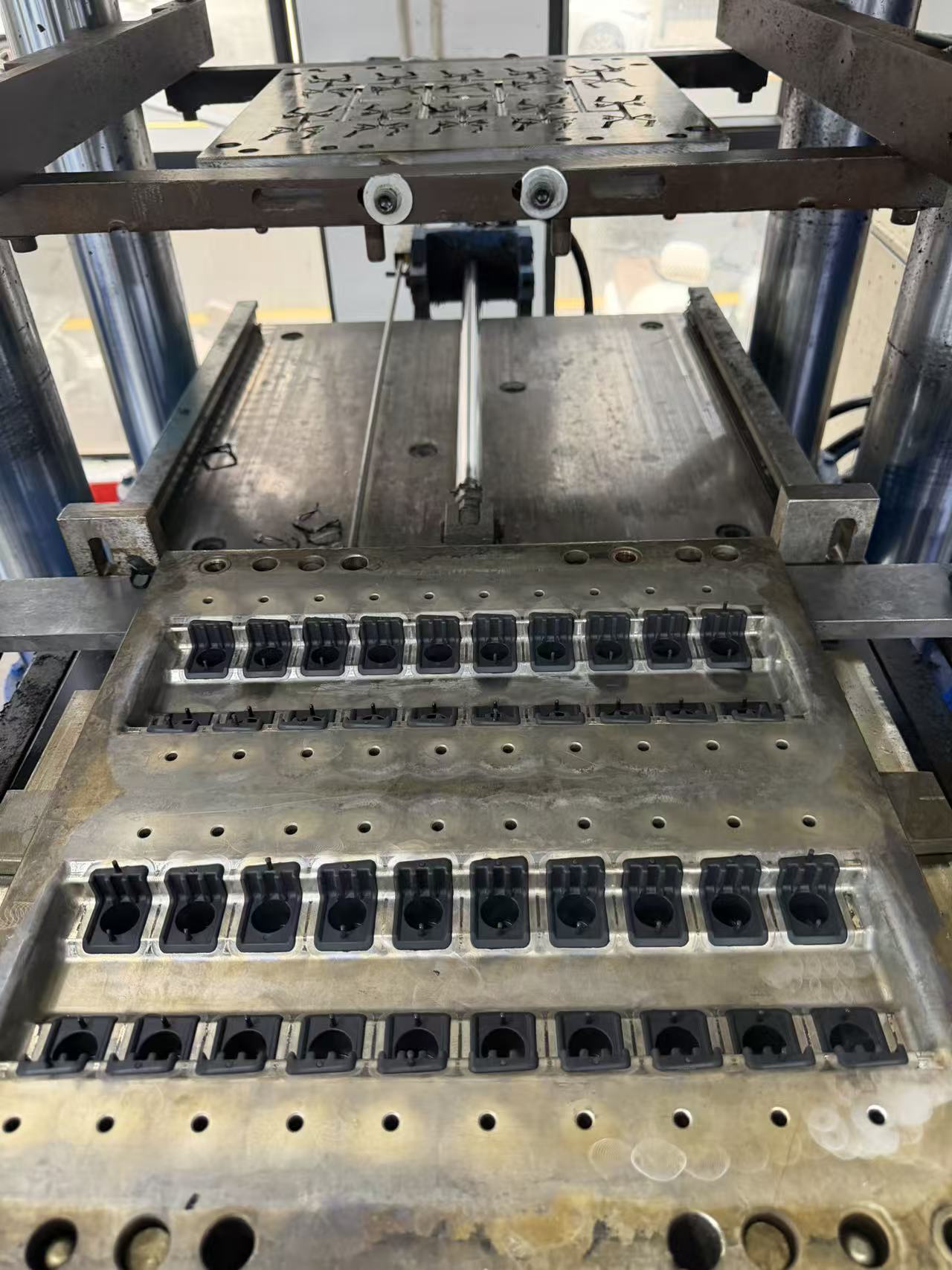
Rubber bonded to plastic parts from an automotive damper program — an example where bonding integrity, not only sealing, defines acceptance.
Why these figures travel further than a product photograph: Cpk above 1.33 indicates a process whose natural spread sits comfortably inside the specification limits, and a defect rate below 150 ppm means fewer than 150 rejected parts per million produced. For a buyer, a multi-year program with stated mechanical values and a ppm figure is a different class of evidence from a sample image. Two boundaries apply. First, these outcomes belong to those specific programs and operating conditions; they are not a guarantee that a different geometry or compound will reproduce the same values. Second, the figures are supplier-reported, so they are claims to confirm through incoming inspection, material documentation, or third-party testing rather than numbers to accept at face value.
Certification: What It Proves and What It Does Not
Two certificates underpin the quality management claim, both issued by BSI with the scope "Manufacturing of rubber and silicone seals" and both valid from 2026-04-10 to 2029-04-09:
- ISO 9001:2015 — certificate number FM 840583.
- IATF 16949:2016 — certificate number 0601909.
Read them for what they are. ISO 9001:2015 establishes a quality management baseline. IATF 16949:2016 is the automotive sector's quality management standard and is typically a prerequisite for supplying automotive OEM programs. Both are scoped to the manufacturing of rubber and silicone seals rather than to every part or process a factory might run.
The boundary matters to procurement: a quality management certificate covers the system and the declared scope. It does not certify a specific compound, a specific mold, or a specific shipped lot. Part-level assurance still comes from dimensional reports, material documentation, and the acceptance process — pre-shipment testing or third-party inspection, usually appointed by the client.
Custom vs. Standard Parts: Where Customization Stops Paying Off
Customization is not universally the better answer. The comparison below is a procurement framework, not a recommendation.
| Decision factor | Standard catalogue part | Custom molded part |
|---|---|---|
| Fit to assembly | Approximate; requires design compromise | Built to the mating geometry |
| Material | Fixed to what the catalogue offers | Selected from the offered compound range |
| Hardness and physical properties | Fixed | Specified per project, alongside dimensions and color |
| Up-front requirement | None | A frozen specification and a mold |
| Pricing basis | Published, per piece | Quoted per product; MOQ and unit price vary by product |
| Production lead time | Short | 20 days, as stated by the manufacturer |
| Documentation | Limited | Part-level mechanical data and process data available |
| Best fit | Non-critical, commodity, low-volume replacement | Regulated, dynamic, or tolerance-critical assemblies |
| Main risk | Field failure from a near-fit part | Paying for tooling on an underspecified part |
Four limitations are worth stating plainly, because they are the points where custom sourcing actually goes wrong:
- Custom work begins with a frozen specification. If hardness, dimensions, color, and physical properties are not defined before tooling, the resulting part will not be "wrong" so much as unusable — and the cost of that outcome sits with the buyer, not the molder.
- Commercial terms are project-specific. MOQ and unit price vary for each product and are quoted per project, so there is no universal price list to benchmark against a catalogue part at a glance. Buyers planning a like-for-like comparison should request quotations on identical specifications.
- Lead time needs scoping. The stated 20-day lead time should be confirmed in writing — specifically, whether it covers production after tooling approval or the full sequence from tooling to shipment — before it enters a project schedule.
- Trade-offs do not disappear. The compound with the strongest oil resistance is generally not the compound with the best low-temperature flexibility. Customization lets the trade-off be tuned to the application; it does not remove it.
For low-volume, non-critical, or purely replacement demand, a standard part remains the rational choice. Custom sourcing pays off where a near-fit part would generate assembly rework, field failures, or repeated engineering time — and where repeat volume justifies the tooling.
Market Trends Shaping Custom Rubber Demand
Several verifiable trends explain why the customization question is becoming more prominent in buyer evaluations rather than less:
- Category growth. Industrial rubber products are projected to move from USD 28.28 billion in 2024 toward USD 45.19 billion by 2034 (Zion Market Research), with the scope caveat noted earlier.
- EPDM scale. The EPDM rubber market was estimated at USD 10.54 billion in 2024, driven significantly by automotive and construction (Market Research Future).
- Silicone acceleration. Liquid silicone rubber was estimated at USD 2.9 billion in 2024 with a projected 9.6% CAGR through 2033 (Acumen Research and Consulting), and automotive accounted for 34.1% of LSR revenue in 2023 (Grand View Research).
- Healthcare demand. Medical-grade silicone rubber was valued at USD 7.95 billion in 2024, with expectations of USD 14.2 billion by 2035 (Market Research Future).
- Traceability pressure. China exports approximately EUR 4.01 billion in rubber products to the European Union annually, at a time when global buyers are demanding greater supply-chain traceability.
The interpretation for procurement is direct: growth is concentrated in the categories where compounding flexibility decides the outcome. Regulatory and traceability expectations are also moving upstream, and the major synthetic rubber suppliers behind many compounds — Sinopec, Arlanxeo, and ExxonMobil among them — are increasingly part of buyer questions about material origin. That pushes documentation requests further down the chain and into the molding factory.
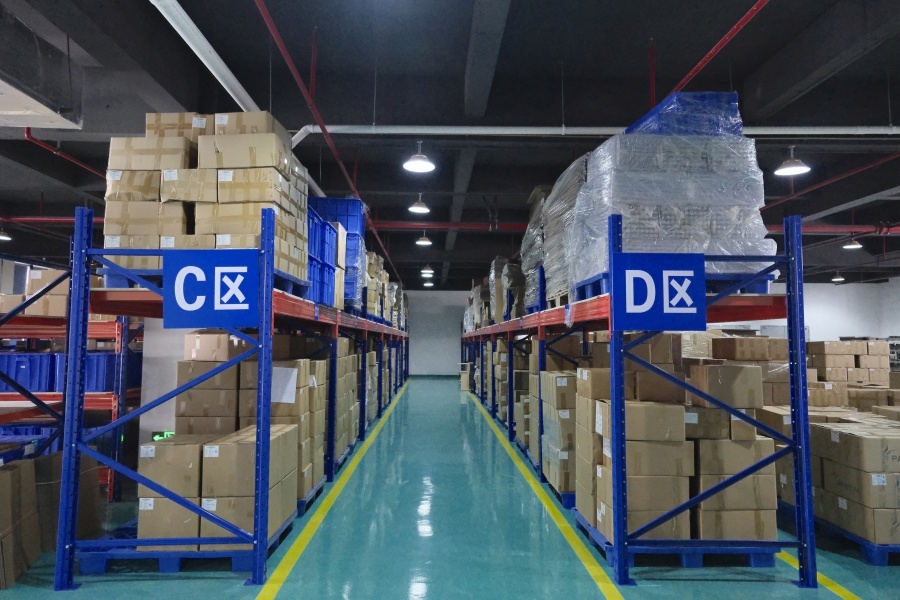
Finished product warehouse — where customized output is staged for an export mix that runs to roughly 80% of production.
A Buyer's Checklist for Verifying Customization Capability
- Material range. Ask for the actual compound list — EPDM, NBR, FKM, silicone, medical-grade silicone, and others — not a general statement that "many materials are available."
- Customization levers. Confirm that hardness, dimensions, color, and physical properties can all be specified, not only dimensions.
- Configuration coverage. Check that the supplier's range reaches the duty condition you need: cryogenic, food-grade, medical-grade, high-pressure, or dynamic sealing.
- Quality control method. Establish whether inspection is 100% testing or sampling, and where in the process it happens.
- Process capability evidence. Request Cpk and defect-rate data from a running program comparable to yours.
- Certification. Verify issuing body, certificate number, scope, and validity dates — and read the scope wording.
- Commercials. Confirm how MOQ and unit price are set, what delivery terms apply, what acceptance criteria are used, and what payment terms are required.
- Lead time scope. Clarify whether the quoted lead time covers tooling or only production.
- Tooling retention. Ask how molds are stored and maintained, since repeat-order continuity depends on it.
- After-sales terms. Confirm warranty, returns, and technical assistance coverage in writing.
Future Outlook
Customization is likely to become the default framing in industrial rubber sourcing rather than a premium option. As silicone and medical-grade demand expands and traceability expectations tighten, buyers will increasingly treat part-level process data, stated tolerance classes, and documented compound grades as baseline requirements rather than differentiators. The competitive line shifts from "can you mold rubber" to "can you evidence what you molded." For factories that already separate rubber and silicone molding, publish process capability data, and hold automotive-sector certification, that shift is favorable. For others, the gap is likely to widen as buyers begin requesting the same evidence from every supplier on a shortlist.
Frequently Asked Questions
What does custom-made actually mean for rubber seals, gaskets, o-rings, dampers, and washers?
For this manufacturer, custom-made refers to four parameters — hardness, dimensions, color, and physical properties — and the same four levers apply across every product family. What differs by family is configuration coverage: gaskets and seals are documented across oil-resistant, chemical-resistant, high-temperature, low-temperature / cryogenic, food-grade / FDA-approved, medical-grade, and high-pressure variants; o-rings across static seal, dynamic seal, hydraulic, pneumatic, food-grade, and medical-grade versions; dampers across machinery, automotive, electronic equipment, and pipe / vibration mount types; washers across sealing, vibration damping, insulating, waterproof, and cushion types; and grommets across wire / cable protection, sealing / waterproof / dustproof, and vibration / damping types. Each parameter is a specification input that must be stated before a mold is made.
Which rubber materials can be specified, and how does the choice relate to the application?
The documented compound range covers EPDM, NBR (Buna-N), NR, CR (Neoprene), FKM (Viton), SBR, HNBR, silicone rubber (SiR / VMQ), and medical-grade silicone rubber. General selection logic is consistent across the industry: NBR and HNBR suit petroleum-based oil and fuel contact; EPDM suits outdoor weathering, ozone, water, and steam; FKM suits high temperature and aggressive chemical exposure; NR is chosen for resilience and dynamic fatigue resistance; CR offers balanced weather resistance with moderate oil resistance; SBR serves general-purpose, cost-sensitive, non-oil duty; silicone rubber covers wide service-temperature ranges and electrical insulation; and medical-grade silicone is used where medical applications require a documented compound grade. Material choice always involves trade-offs, so the duty profile should be defined before the compound is fixed.
How can a buyer verify customization capability before committing to production?
Four evidence areas are useful. First, the material list actually offered, as a specific set of compounds rather than a general claim. Second, the configuration range, because food-grade, medical-grade, cryogenic, and high-pressure variants each represent different compound handling. Third, process data from running programs: this manufacturer reports tensile strength ≥ 8 MPa, elongation at break ≥ 450%, and tear strength ≥ 35 kN/m on a 5-year gasket program, Cpk above 1.33 and defect rates below 150 ppm on two multi-year programs, and 100% testing as its quality control method. Fourth, certification: ISO 9001:2015 (certificate FM 840583) and IATF 16949:2016 (certificate 0601909), both issued by BSI with the scope "Manufacturing of rubber and silicone seals" and validity from 2026-04-10 to 2029-04-09. Supplier-reported values should still be confirmed through incoming inspection or third-party testing.
What are the limits of custom rubber parts compared with standard parts?
Custom parts require a frozen specification and a mold before production begins, so an underspecified brief produces an unusable part rather than an imperfect one. MOQ and unit price vary for each product and are quoted per project, which means there is no universal price list for quick benchmarking. The stated production lead time is 20 days and should be scoped in writing, since it is not automatically the full sequence from tooling to shipment. Commercial terms also matter to cash flow: delivery is EXW or FOB ShenZhen, acceptance criteria are pre-shipment testing or third-party inspection usually appointed by the client, and payment terms are full payment after receipt of goods. In addition, quality management certification such as ISO 9001 or IATF 16949 covers the system and the declared scope, not an individual compound, mold, or shipped lot. Standard catalogue parts remain the rational choice for low-volume, non-critical, or replacement demand.
What purchasing terms and acceptance criteria apply to custom rubber parts orders?
The documented purchasing terms are as follows. Minimum order quantity and unit price vary for each product rather than following a single schedule. Delivery terms are EXW or FOB ShenZhen. Acceptance criteria are pre-shipment testing or third-party inspection, with the inspection body usually appointed by the client. Payment terms are full payment after receipt of goods. Because MOQ, pricing, and acceptance are all set per product, buyers comparing suppliers should request quotations against an identical specification so that the commercial terms remain comparable.
Reference Materials
Longrun Rubber Products (Huizhou) Co., Ltd. maintains its product and capability documentation at longrunrubber.com. A downloadable company brochure covering materials, product families, and capability data is available at Longrun PPT (1).pdf.