
Inside the Tests Behind Aluminum Pergolas, Fences and Gates
Compliance in the outdoor living category usually arrives as a folder, not as a decision. A procurement team sourcing aluminum pergolas, fences or driveway gates is handed inspection records, drawings, coating references and one or two certificates, then asked to accept that the product is qualified. The more useful question is narrower: which tests were actually run, at which production stage, on which component, and what does each result allow a buyer to conclude?
This reference examines the inspection and test set used by Henan Junsu Technology Co., Ltd. — the Zhengzhou-based manufacturer behind the Junsu outdoor brand, established in 2001 and producing aluminum pergolas, garden fences and automatic driveway gates from a 30,000 m² facility — and explains how a buyer should read that evidence, including where it deliberately stops short of a certification claim.
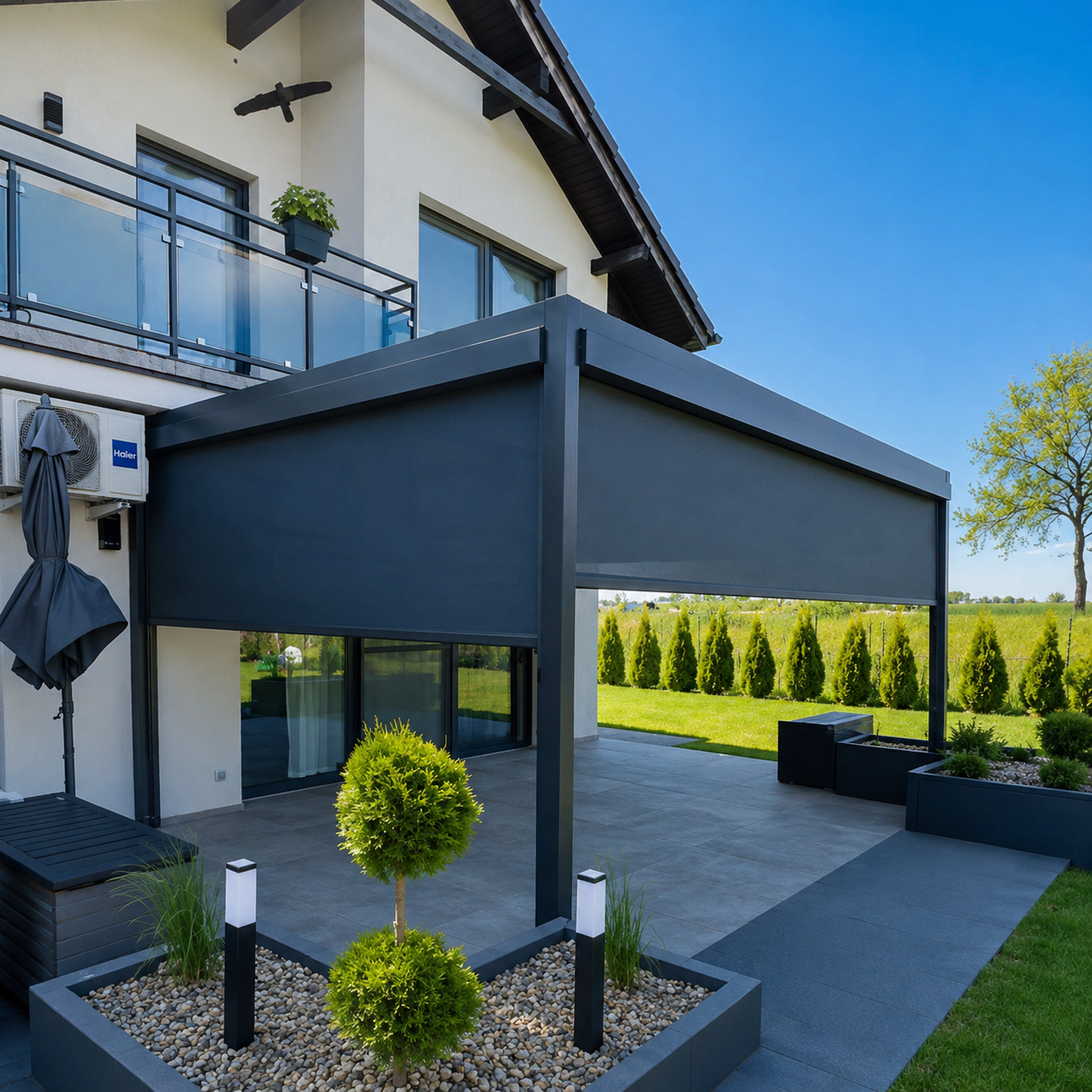
The Real Problem: Three Kinds of Evidence Get Blended
Most confusion in outdoor living procurement comes from treating three different evidence types as one. The first is process evidence: inspections and functional tests carried out by the manufacturer during production and before dispatch. The second is system and product-safety certification, such as ISO 9001 quality management or CE product safety marking. The third is project-specific engineering sign-off, typically produced by a structural engineer or local authority for a particular site, wind region and anchorage design.
A manufacturer can legitimately hold the first and second and still have nothing to say about the third. That is not a defect in the supplier; it is a boundary in what factory evidence can prove. Buyers who blur these categories tend either to over-trust a workshop test record as if it were a structural approval, or to dismiss genuine process discipline because it is not labelled as a certificate.
The practical opportunity is to read the test list as a decision instrument. A documented test tells you which failure mode the supplier has chosen to monitor. A missing test tells you which failure mode is being managed by assumption.
The Test Set: What Is Actually Performed
The inspection programme applied across the fabricated aluminum range — pergolas, fences and gates — covers material verification, geometry, coating performance, finished-unit load and water behaviour, and motor endurance on motorized configurations. The table below maps each item to what it examines and, equally important, to what it does not establish.
| Inspection / test | Stage applied | What it examines | What it does not establish |
|---|---|---|---|
| Raw material composition test | Incoming material | Alloy grade and consistency of supplied 6063-T5 profile stock | Lot-level third-party material certification unless separately issued |
| Wall thickness measurement | Incoming and in-process | Profile wall thickness against the agreed specification | Structural adequacy of a given span or anchorage design |
| Surface coating adhesion test | After finishing | Bond between coating and aluminum substrate | Colour stability hours or salt-spray duration, unless a separate report states them |
| Dimensional tolerance inspection | In-process and final | Cut, hole and assembly dimensions within tolerance | That the site substrate or fixing plan is suitable |
| Load-bearing wind resistance test | Finished pergola unit | Structural response of the assembled unit under applied load | Code compliance for a specific project wind region |
| Waterproof performance test | Finished pergola unit | Water management with louvers closed and drainage channels active | Performance where drainage is blocked or installation is incorrect |
| Motor continuous operation aging test | Motorized configurations | Drive behaviour under repeated cycling | A service-life guarantee or a site-specific duty cycle |
| 100% pre-shipment testing | Pre-dispatch | Every unit inspected rather than sampled before packing | Independent witnessing or third-party lot sampling |
Material and Coating: The Tests That Decide Long-Term Appearance
Alloy discipline is the least visible and most consequential item on the list. The standard material across the aluminum range is 6063-T5, a heat-treated extrusion alloy commonly used for architectural profiles because it accepts anodising and powder coating well and holds dimensional stability during fabrication. A composition test on incoming stock is essentially a gate: it confirms that what entered the workshop matches the grade being quoted, before any cutting, welding or finishing adds labour to non-conforming material.
Wall thickness measurement answers a different question. Two profiles can be visually identical and differ in wall thickness by tenths of a millimetre — enough to change stiffness, thread engagement and the weight of a completed fence panel or pergola beam. For buyers comparing quotations, a stated wall thickness with a measurement method behind it is a far stronger comparison point than a stated wall thickness alone.
Surface coating adhesion is where appearance and corrosion resistance meet. A coating that bonds poorly to the substrate may look correct on delivery and fail later through blistering, peeling at cut edges or chalking. An adhesion test does not, by itself, quantify years of colour stability — that requires separate weathering or salt-spray reporting. Buyers specifying coastal or high-humidity sites should ask for both: adhesion results and whatever separate weathering evidence exists, and should not infer the second from the first.
Finished-Unit Tests: Wind Load and Water Behaviour
Load-bearing wind resistance testing is performed on finished pergola units rather than on loose profiles, which matters because a pergola fails as an assembly — at connections, at the louver pivot points, at the post-to-beam junction. Testing the finished unit captures the interaction between extrusions, fixings and the roof mechanism, and is the only stage at which a realistic wind load figure can be attached to a product configuration.
The waterproof performance test is similarly an assembly-level check. Water resistance in a louvered or bioclimatic roof depends on the louvers closing to a consistent line, on the collection channel geometry below them, and on the internal drainage path running through the posts. A functional water test confirms that this chain works as built. It does not confirm that it will keep working if the roof is left partially open in driving rain, if debris blocks a channel, or if the site falls away from the drainage outlet.
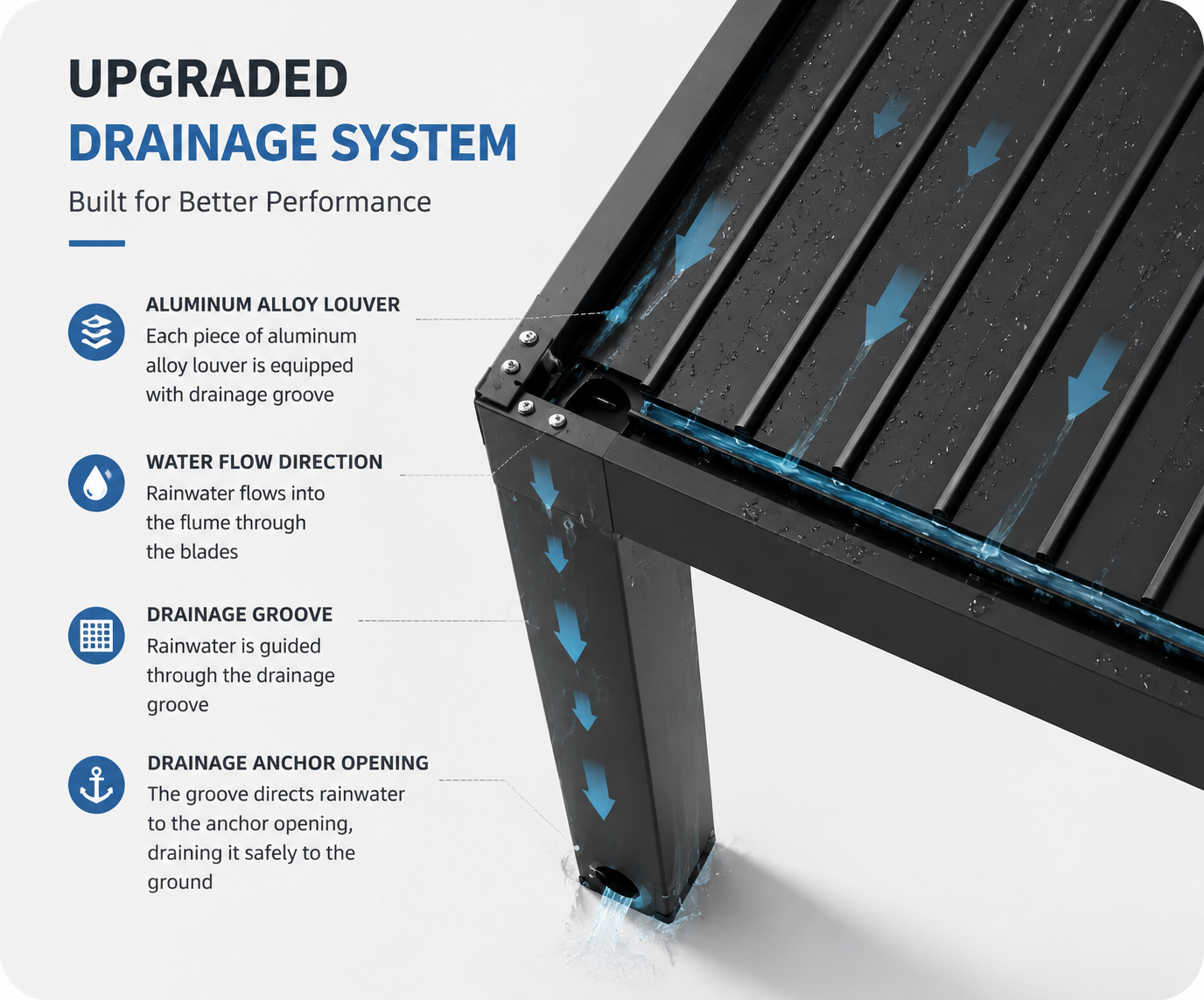
For buyers, the interpretation rule is straightforward: a waterproof test result should be read together with the installation instructions and the site drainage plan. Two identical pergolas on two sites can behave differently for reasons that have nothing to do with the factory result.
Motorized Systems: What Continuous Operation Aging Testing Covers
On motorized pergolas — and on automatic driveway gates where a drive is supplied — the electrical-mechanical assembly is the component most exposed to cumulative wear. A motor continuous operation aging test cycles the drive repeatedly to surface early-life problems: overheating under repeated strokes, limit-switch drift, control-board behaviour and mechanical binding in the actuator or the louver linkage.
What the test does not do is predict a service life in years. Continuous cycling in a workshop compresses many operations into a short window under controlled conditions; a real installation adds temperature swings, dust, humidity and, in coastal sites, salt exposure. The correct reading is comparative and diagnostic: it shows the drive has been run to a defined cycle count and inspected, which is a materially different claim from a warranty period. Buyers should ask for both the cycle count and the warranty terms, and should treat them as separate pieces of evidence.
The installed environment also belongs in the procurement conversation. Electrical connections and cable routing must follow the installation requirements, and components should not sit in standing water; confirming power supply position, drainage and installation surface before dispatch prevents most field issues on motorized configurations.
Tolerance and 100% Pre-Shipment Testing: Consistency as Evidence
Dimensional tolerance inspection rarely appears in marketing material, but on multi-unit projects it is the item that decides whether installation runs to schedule. A villa may need one pergola; a hotel terrace or a residential community may need dozens of identical bays plus matching fence panels and gates. If cut lengths, hole positions and connection geometry drift between units, the cost moves to site — rework, adaptor plates, extended crane time and return visits.
This is where 100% pre-shipment testing differs meaningfully from sample-based inspection. Sampling estimates a defect rate; full inspection attempts to prevent dispatch of a non-conforming unit. The trade-off is real and worth stating: full inspection consumes production time and does not replace independent third-party verification, but it does reduce the probability that a single defective unit disrupts an installation crew working to a fixed programme.
The same logic explains why factory capacity and inspection depth are linked. With a monthly capacity of 3,000 sets across aluminum pergolas, fences and gates, a 30-day lead time and a minimum order of one set, the inspection regime has to work at both extremes — a single custom bay and a large project order. Buyers evaluating suppliers should ask how inspection records are retained and whether they are traceable to a specific order and unit number.
Reading Load Ratings: Snow, Wind and Project Fit
For the aluminum bioclimatic pergola range — models 147, 163, 175 and 220, available wall-mounted, free-standing, multi-zone or with special cuts and angles — the documented product parameters state a snow load of up to 100 lbs/sq ft and a wind load of up to 190 mph, with custom dimensions up to 22 ft 10 in by 16 ft in a single zone.
Those figures are only useful when read as configuration-specific maximums, not as universal product attributes. A buyer in a heavy-snow region should confirm three things before ordering: that the stated snow load applies to the exact span and zone configuration specified, that the local building authority accepts the documented basis, and that the anchorage and substrate can transfer the resulting loads. The same applies to wind: a 190 mph rating is only meaningful alongside a fixing design suited to the site exposure, and coastal or open-terrain sites typically demand more attention to anchors than sheltered courtyards.
There is a boundary worth stating plainly. This evidence set is a manufacturer inspection and testing programme plus company-level ISO 9001 and CE certification. It is not, and should not be presented as, third-party structural certification for a specific project. Buyers working under a code regime that requires an engineer's stamp, a notified-body assessment or a declared performance to a named standard should request that separately — and should not assume it exists because a test record was supplied.
Where This Evidence Set Carries the Most Weight
The users of these products fall into recognisable groups: individual villa owners, wholesalers and importers, landscape and construction contractors, real estate developers, and hospitality or public project clients. Each reads the same test list for a different reason.
Residential buyers care about coating adhesion, drainage behaviour and motor reliability, because those determine how the pergola looks and functions three summers later. Contractors and developers care about dimensional tolerance and pre-shipment inspection, because their exposure is programme risk rather than a single unit. Wholesalers and importers care about traceability and repeatability across container loads — a defect found in one panel undermines an entire resale programme. Hospitality and public projects add wind exposure, guest safety and long service intervals to the list.
Climate context is provided by delivery records rather than by a single test: orders have been delivered to ten countries — Australia, Belgium, Canada, Switzerland, France, the United Kingdom, Italy, Maldives, Singapore and the United States — and the case record describes a 15-year long-term outdoor use duration, including a 600-set delivery to the United States with one-stop supporting delivery and installation. That span covers humid tropical, cold continental and coastal conditions, and is a more honest signal of climate adaptation than any single laboratory figure.
Market Context: Why Compliance Scrutiny Is Rising
The commercial backdrop explains the attention. Dataintelo values the global aluminum pergola market at USD 3.8 billion in 2025, with a projection to USD 7.1 billion by 2034, and places North America at a 34.2% share of 2025 demand. Fortune Business Insights sizes the bioclimatic pergola segment at USD 600.87 million in 2026, reaching USD 1,049.46 million by 2034 at a CAGR of 7.22%. On the access side, automatic sliding gates are reported at a 30.2% share of the automatic gate opening system market in 2025.
Two cautions apply to these numbers. First, published estimates of the total pergola market and of the aluminum-only segment overlap substantially, so headline values should be treated as directional rather than additive. Second, category growth raises the number of suppliers quoting for the same project — which is precisely the condition under which buyers start asking for test records rather than brochures.
Standards awareness follows the same curve. EN 13561 governs performance and safety requirements for external blinds and awnings, including pergola awnings, in the European Union; ASTM F2957 is the specific standard for ornamental aluminum fence systems, covering structural testing and surface finish. Neither should be assumed to be held by a given supplier. Both are useful questions to put on a tender clarification list.
Aluminum Versus Traditional Materials — and Where Aluminum Is the Wrong Choice
Compared with wrought iron, painted steel or timber, aluminum outdoor structures carry a structural advantage that is easy to state and easy to test for: the material does not rust, so corrosion protection is a coating question rather than a substrate question. Timber moves with moisture and needs periodic refinishing; painted steel depends on coating integrity to avoid rust creep at cut edges and welds. Coatings on aluminum still matter — adhesion and weathering determine appearance over time — but the failure mode is slower and more visible.
The limitation is cost and suitability, and it should be stated without hedging. Aluminum systems carry a higher initial purchase price than entry-level timber or thin-gauge steel alternatives, and the case for them rests on service life, low maintenance and dimensional consistency rather than on lowest first cost. For genuinely temporary enclosures, short-let sites or ultra-low-budget projects with a service life measured in a single season, a lighter and cheaper material is often the rational choice — and no amount of test documentation changes that economics.
A second limitation concerns the evidence itself. Documented tests describe what a factory measured under its own protocol. They shorten the list of unknowns for a buyer, but they do not transfer a design responsibility. Purchasers in regulated markets still need the project-level sign-off that their jurisdiction requires.
What a Buyer Should Ask For
1. The test list, not just the test result. Ask which inspections are performed on every order and which are performed periodically.
2. Configuration-matched ratings. Confirm the snow and wind figures against the exact span, zone layout and fixing plan being quoted.
3. The cycle count behind a motor claim. Continuous operation aging data and warranty terms answer different questions; request both.
4. Separate coating evidence. Adhesion results and weathering or salt-spray reporting are distinct documents.
5. A clear statement of what is not certified. The absence of a claim is information, not a gap to be filled by assumption.
Future Outlook
Two developments are likely to shape how outdoor living compliance is read over the next several years. The first is the normalisation of performance declarations: as motorized pergolas move from premium add-on to standard specification on hospitality and residential projects, buyers will expect load, water and drive-endurance data to be presented in a comparable format rather than as bespoke attachments. The second is documentation traceability — the ability to connect a delivered unit back to its inspection record — which becomes essential as project sizes grow and mixed configurations ship in the same container.
What is unlikely to change is the interpretive burden. Test records describe a bounded set of measurements taken under controlled conditions by the party with the strongest interest in the result. The buyer's job remains to match those measurements to a site, a climate and a code, and to notice the difference between a documented inspection and a certification that was never claimed.
Reference material: the Junsu outdoor product catalog is available for download — Junsu Products Catalog (PDF). Company information: www.junsu-outdoor.com.
FAQ
Which inspections are performed on aluminum pergolas, fences and gates before shipment?
The documented programme includes raw material composition testing, wall thickness measurement, surface coating adhesion testing, dimensional tolerance inspection, load-bearing wind resistance testing and waterproof performance testing on finished pergola units, plus motor continuous operation aging testing on motorized configurations. Quality control also includes 100% pre-shipment testing, meaning every unit is inspected before dispatch rather than a sample being drawn from the lot.
Do these test records mean the product is third-party certified?
No. The inspections described are manufacturer process and functional tests, and they are distinct from third-party certification. Henan Junsu Technology Co., Ltd. holds ISO 9001 quality management certification and CE product safety certification at company and product level. Neither should be read as a project-specific structural certification, and buyers requiring an engineer's approval, a notified-body assessment or declared performance to a named standard such as EN 13561 for pergola awnings or ASTM F2957 for ornamental aluminum fence systems should request that evidence separately.
How should a buyer use a 100 lbs/sq ft snow load or 190 mph wind load rating?
The document states a snow load of up to 100 lbs/sq ft and a wind load of up to 190 mph for the aluminum bioclimatic pergola range, with custom dimensions up to 22 ft 10 in by 16 ft in a single zone. These are configuration-specific maximums. A buyer should confirm that the figure applies to the exact span and zone layout quoted, that the local authority accepts the documented basis, and that the anchorage and site substrate can transfer the resulting loads under local wind or snow exposure.
What does a motor continuous operation aging test demonstrate?
It demonstrates that the drive assembly has been cycled repeatedly and inspected for early-life behaviour such as overheating, limit-switch drift, control-board response and mechanical binding. It is a diagnostic and comparative result, not a prediction of service life in years. Real installations add temperature variation, dust, humidity and coastal salt exposure, so the aging test should be read alongside the warranty terms and the installation requirements for cable routing, drainage and power supply.
Why does dimensional tolerance inspection matter on a multi-unit project?
Multi-bay installations depend on interchangeability. If cut lengths, hole positions and connection geometry vary between units, the deviation is corrected on site through rework, adaptor parts and extended installation time. Dimensional tolerance inspection is the control that keeps fabricated components consistent across an order, and it works together with 100% pre-shipment testing to reduce the chance that a non-conforming unit reaches an installation crew working to a fixed programme.
What is the practical value of a 15-year outdoor use record across 10 countries?
It provides climate-range context rather than a laboratory figure. Deliveries have covered Australia, Belgium, Canada, Switzerland, France, the United Kingdom, Italy, Maldives, Singapore and the United States — a spread that includes tropical humid, cold continental and coastal conditions — and the case record describes a 15-year long-term outdoor use duration, alongside a 600-set delivery to the United States with one-stop supporting delivery and installation. For buyers, that record is evidence of field exposure breadth, while specific performance claims should still be matched to the project's own climate and structural requirements.
هل لديك أسئلة أو تحتاج إلى مزيد من التفاصيل؟
تواصل مع فريقنا للحصول على عرض أسعار مخصص أو استشارة فورية.
طلب عرض أسعار
املأ النموذج أدناه وسيتواصل معك فريقنا بعرض مقترح مخصص.
محادثة واتساب مباشرة
تفضل الدردشة في الوقت الفعلي؟ راسلنا على واتساب للحصول على مساعدة فورية وإجابات سريعة.
- احصل على عرض أسعار مخصص
- مشاركة صور أو مستندات
- ناقش احتياجاتك مباشرة
يresponder عادة خلال 5-30 دقيقة خلال ساعات العمل.