
Inside the Workshop: How a Tombstone Marble Table Supplier Proves Its Production Capability
Inside the Workshop: How a Tombstone Marble Table Supplier Proves Its Production Capability
A marble table supplier's production capability is not established by a catalogue page. It is established by what a buyer can physically observe at defined stages of the manufacturing sequence — how raw blocks are selected, how slabs are cut and profiled, and how surfaces are finished by hand before packing.
The distinction has become commercially important. Grand View Research estimates the global marble market at approximately USD 70.4 billion in 2024, and the furniture segment alone consumed about 9.8 million metric tons of marble in 2023. Growth of that scale attracts suppliers who can quote a marble table but cannot necessarily manufacture one. For procurement teams working from evaluation into execution, the practical question is no longer who sells marble tables, but which supplier can show verifiable evidence behind the manufacturing claim.
Why Buyers Now Ask for Workshop Evidence Instead of Brochures
Commercial furniture demand is repetitive and specification-driven. Market Reports World estimates that the hospitality furniture market supports more than 19.8 million hotel and leisure rooms worldwide, with an average furniture replacement cycle of seven to ten years. A hotel group replacing banquet tables across a portfolio is not buying a single object; it is buying a repeatable specification that must hold across multiple deliveries and multiple years.
Supply-side indicators point the same way. According to the General Administration of Customs of China, China's furniture and parts export value reached RMB 483.03 billion in 2024, a 7.0% year-over-year increase, with growth attributed to a shift toward higher-value-added products. Higher-value products carry higher verification expectations, because a defect in a large-format marble top is visible to every guest in the room.
Design direction reinforces the shift. Commercial dining furniture commentary for 2025 highlights sustainable materials and customizable designs, with warmer, earthy neutral tones replacing stark white and grey. Customization moves the purchase away from a stock list and toward a supplier's engineering and finishing capability — exactly the area where unverified claims are easiest to make and hardest to check from a distance.
What Counts as Verifiable Production Evidence?
Workshop evidence is not one document. It is a chain in which each link can be checked independently by a buyer who is not standing on the factory floor. In practice, five categories carry most of the weight in a supplier evaluation.
- Material evidence. Identification of the actual block or slab, its origin, and its working-quality classification. Under ASTM C503/C503M, the primary standard for marble dimension stone issued by ASTM International, marble is classified into Soundness Groups A, B, C and D according to working qualities and geological flaws. A supplier able to state the group and show the block gives the buyer a basis for anticipating flaw risk before cutting begins.
- Process evidence. Dated photographs or video of block cutting, CNC cutting and shaping, edge profiling, hand polishing and engraving. Stock imagery and rendered visuals do not qualify, because they cannot be tied to a specific order.
- Dimensional and finish evidence. Dry-lay or layout records, inspection notes, and images of the finished top with its edges and surface captured before packing.
- Documentary evidence. Certificates that name the material, the standard and the scope of application — not a logo pasted into a PDF.
- Transactional evidence. A written acceptance protocol covering sample confirmation, photos, videos, finished-product inspection and pre-shipment confirmation.
A supplier that can supply all five categories is answering a capability question with artifacts rather than adjectives. One that can supply only the last two is usually reselling someone else's workshop.
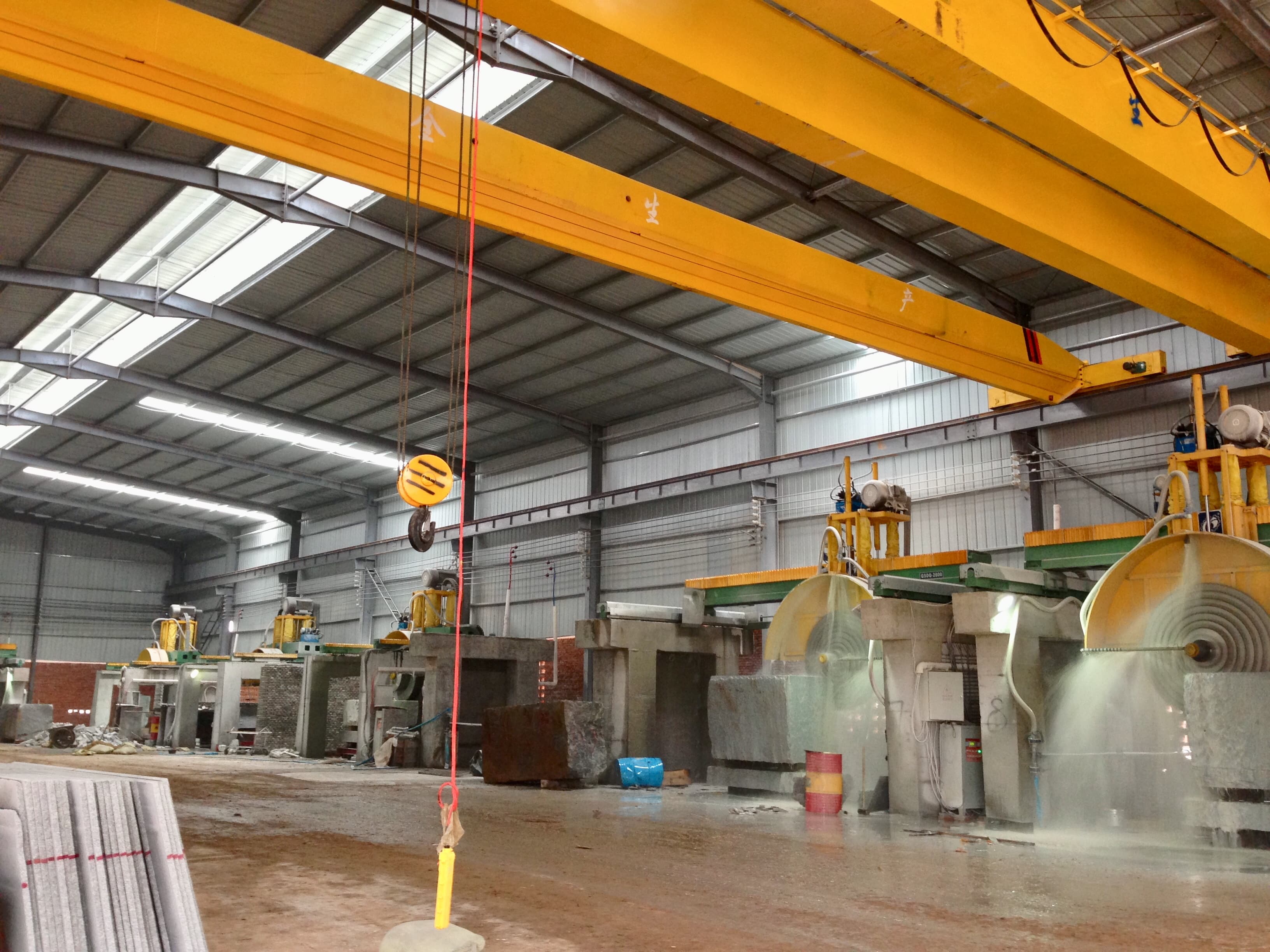
Stage One: Raw Block Selection Leaves a Trace
Table quality is decided before the first cut. A block with internal fractures, colour banding or mineral inclusions will produce tops that fail either structurally or visually, and no amount of polishing removes that origin. This is why ASTM C503/C503M soundness grouping matters to a table buyer and not only to a monument buyer: it is a shared vocabulary for talking about how a given marble behaves under working.
For procurement purposes, the useful question is not whether a supplier talks about material selection, but whether the selection produces a trace. A documented block record normally includes the block reference, its quarry or regional origin, the slab sequence cut from that block, and a photographic record at the cutting stage. This trace is what allows a buyer, months later, to understand why table tops in a second shipment differ in veining from the first.
Volume matters here as a secondary signal. A workshop that processes stone continuously produces consistent block records as a by-product of normal operations; a workshop that processes intermittently does not. Songjia's published output data — an annual figure of 150 containers for monument products and 200 containers for building materials — indicates routine, high-frequency block throughput rather than occasional project work.
Stage Two: Shop Drawings and CNC Cutting Decide Whether Custom Is Real
Custom-size and large-size marble tables do not begin on a machine. They begin as a drawing that has to be converted into something a workshop can actually cut, support, template, polish and ship without breakage. That conversion step — design intent to producible shop drawing — is where many otherwise capable suppliers fail, and where buyers should look for engineering staff rather than sales staff.
The second stage of workshop evidence therefore consists of:
- approved shop drawings with dimensions, edge profiles, base interface and joint positions;
- cutting and profiling records showing the top was produced to those drawings;
- templating or dry-lay records for tops that must align with a fixed architectural condition, such as a reception counter or a banquet layout;
- edge-treatment samples, since the visible edge is where hand work and machine work meet.
CNC cutting and shaping sit at the centre of this stage. The relevant evaluation criterion is not the mere presence of a CNC machine — it is whether the supplier can describe which operations are machine-controlled and which remain manual, and can show output from both. Buyers handling office reception, villa and large banquet projects should treat this stage as the primary risk control point, because dimensional errors discovered at installation cannot be corrected on site.
Stage Three: Hand Polishing and Engraving Are the Hardest Stages to Fake
Surface finishing is where a workshop is most exposed. Polishing quality depends on sequence, abrasive selection, pressure and the operator's judgment, and it shows immediately under raking light across a large table top. There is no specification sheet that can substitute for seeing the actual surface.
Engraving and detail work raise the same point in a sharper form. Memorial production — lettering, curves, shaped edges, fine relief — tolerates less visual error than most furniture work, because the customer reads the finished piece at close range and any inconsistency is permanent. A workshop that hand-finishes memorial products routinely maintains a skill set that transfers directly to visible table edges, carved aprons, inlaid motifs and bespoke bases.
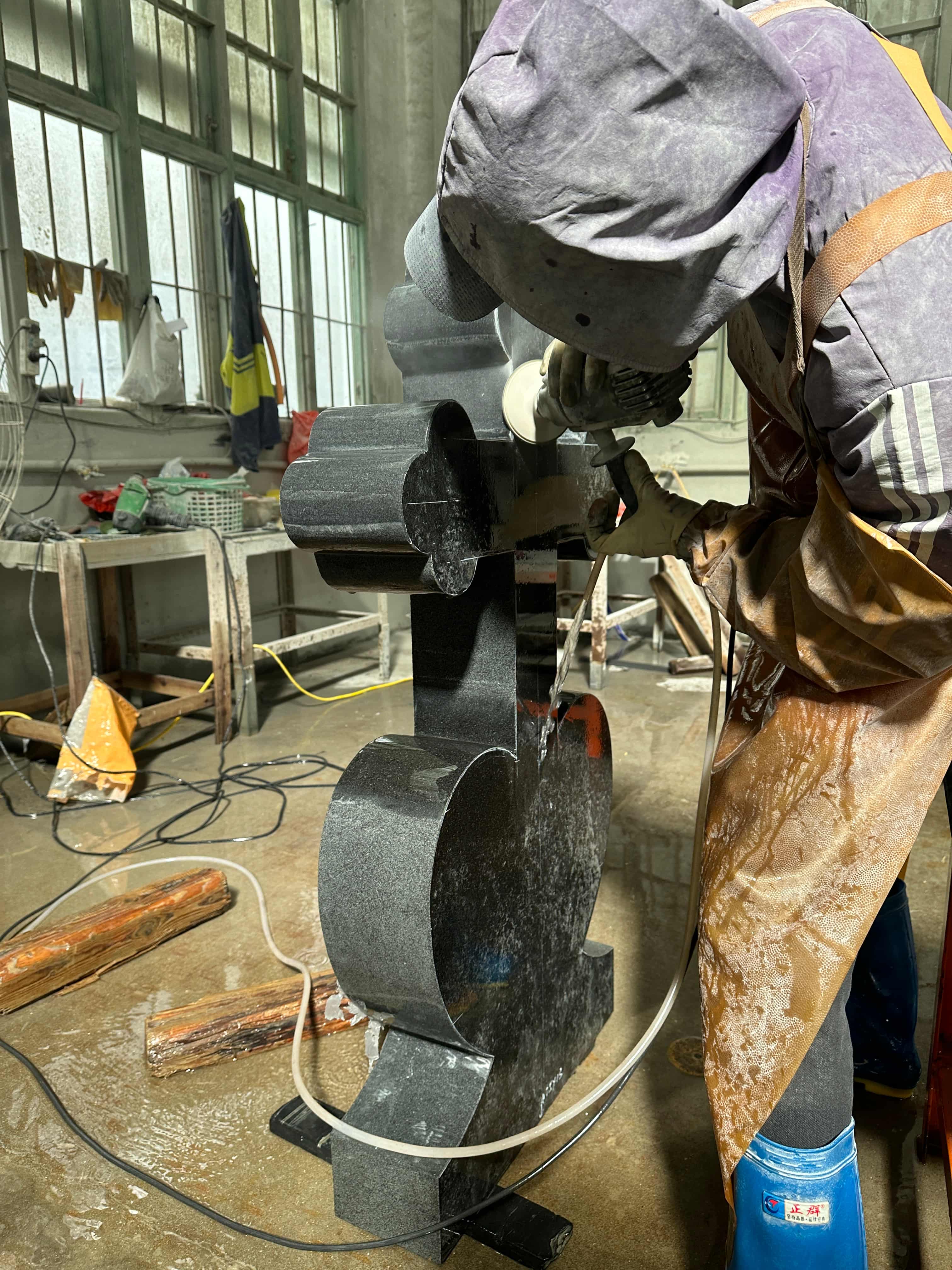
Why the Tombstone Line Is Capability Proof for Marble Tables
The tombstone and monument product line is a useful capability reference for marble table buyers because it stresses the same workshop disciplines under tighter detail requirements. Block selection, slab cutting, shaping and hand polishing all appear in both product categories. The difference is emphasis: a table top is judged on flatness, large-format surface consistency and edge line over a wide area, while a memorial piece is judged on dimensional accuracy, engraved detail and finish quality within a compact area.
That overlap is why a supplier whose stated main products include Monument, Tombstone and building material can credibly discuss marble table capability — provided the buyer checks the transfer rather than assuming it. Two checks are worth making. First, confirm that large-format handling exists: a workshop strong in compact memorial work still needs the tables, lifting equipment and layout space to process a long banquet or reception top without flexing it. Second, confirm that the polishing line is shared, not segregated, so that the finish quality seen on memorial work is the same finish applied to table surfaces.
Buyer's rule of thumb: ask for workshop records from the last six months of a product line similar to your own, not for a general company presentation. Evidence that is recent and product-specific is far harder to assemble from borrowed material than a brochure.
Application Map: Where Workshop-Verified Marble Tables Fit
Different commercial environments test different parts of the evidence chain. The table below maps common request types to the manufacturing stage a buyer should focus on during evaluation and execution.
| Application | Typical requirement | Workshop stage to verify |
|---|---|---|
| Hotel banquet hall | Repeatable large-size tops, consistent finish across batches, resistance to constant use | Block trace plus batch consistency; layout and packing records |
| Restaurant / commercial dining | Durable surfaces that are easy to clean and stable under daily service conditions | Polishing sequence and edge treatment; acceptance protocol |
| Office reception | Large-format statement tops that must fit a fixed counter or plinth geometry | Shop drawings, templating and dry lay before cutting |
| Villa / private custom | Non-standard dimensions, matched veining, bespoke base interface | Design-to-production conversion and engraving or profiling capability |
| Café and leisure settings | Smaller tops, warmer neutral tones, coordinated sets | Material selection and surface finishing consistency |
Requests for foldable or space-saving marble configurations belong in a separate conversation. Natural stone is heavy, so a folding design is an engineering question involving the top's thickness, the base mechanism and handling instructions. A supplier should be able to show the actual mechanism and assembly rather than a rendered illustration before a buyer treats the configuration as confirmed.
How SONGJIA Structures Its Evidence Chain
Xiamen Songjia Trading Co., Ltd. — commonly referenced as SONGJIA — is a natural stone specialist based in Xiamen, China, serving international stone importers, contractors, fabricators, designers and private custom clients. The company positions itself as an integrated stone supplier operating through a mature manufacturing and supply network rather than as a single-factory manufacturer, and it describes more than 20 years of accumulated industry experience behind its production coordination.
Its published operating data provides the scale context a buyer needs when judging whether a workshop can carry a commercial order: a 20,000 m² facility footprint within that network, 60 employees, and an in-house technical team of 3 engineers. Annual output is stated as 150 containers of monument products and 200 containers of building materials. Export activity is entirely international, with main markets in the EU, the USA and the Middle East — a market mix that implies familiarity with European specification expectations as well as North American and Middle Eastern project rhythms.
The company's stated core strength is design-to-production integration: converting client sketches, concepts and architectural ideas into accurate, producible shop drawings so that a design can be executed with consistent quality, controlled cost and reliable delivery. Its service scope covers design coordination, production management, quality inspection, packaging and international shipping — the full sequence a buyer has to audit when sourcing custom marble tables for hotel, restaurant, reception or villa projects.
On documentation, the company's certificate files include an SGS CE certificate for G684 basalt covering natural stone slabs for floors and stairs under EN 12058, certificate number CXMCP1210052 issued by SGS in October 2012, and an SGS CE certificate for G603 grey granite covering natural stone modular tiles under EN 12057, certificate number XMML110401342 issued in May 2011. Both certificates relate to building material products rather than to every marble table configuration, and buyers should confirm that the scope on file matches the specific material and application in their own specification.
Commercial terms follow a conventional structure. For memorial sets, the minimum order is generally 5 sets for small memorial sets and 1 set for large memorial sets. For slab-type building material orders, MOQ depends on customer acceptance, and orders above 100 sqm are generally workable. Delivery terms are FOB or CIF, and payment terms are 30/70. Acceptance is handled through sample confirmation, photographs, video, finished-product inspection and pre-shipment confirmation. Product and workshop information is published at www.songjiaglobal.com.
Market Trend Analysis: Demand Is Moving Toward Traceable Capability
Three verified signals explain why capability evidence has moved from a nice-to-have to a screening criterion.
Market scale. A marble market estimated at approximately USD 70.4 billion in 2024, with the furniture segment consuming about 9.8 million metric tons of marble in 2023, is large enough to support many intermediaries. Scale creates choice, and choice creates the need for a filter that is not price alone.
Export value migration. China's furniture and parts export value reaching RMB 483.03 billion in 2024 with a 7.0% year-over-year increase, driven by a shift toward higher-value-added products, indicates that buyers are increasingly purchasing engineered and customized items rather than commodity units. Engineered purchases require engineering evidence.
Replacement economics. With more than 19.8 million hotel and leisure rooms worldwide supported by hospitality furniture and an average replacement cycle of seven to ten years, a commercial buyer is effectively selecting a supplier for a multi-year relationship, not for one delivery. That timeframe makes documented processes more valuable than a single competitive quotation.
The 2025 commercial dining trend toward sustainable materials and customizable designs, with warmer earthy neutral tones, pushes in the same direction. Customizable design is a capability statement, and buyers increasingly test it against workshop reality rather than catalogue imagery.
Comparison: Workshop-Verified Supply Versus Catalogue-Only Supply
The comparison below is a purchasing framework, not a claim that one business model is always superior. Catalogue-led suppliers can serve standard, low-variation orders perfectly well. The constraint appears when a project needs non-standard dimensions, matched batches or documented compliance.
| Evaluation dimension | Workshop-verified supplier | Catalogue-only supplier |
|---|---|---|
| Raw material traceability | Can name and show the block or slab and state its working-quality classification | Material described by trade name only; origin usually undocumented |
| Process visibility | Dated records for block cutting, CNC shaping, hand polishing and engraving | Rendered or stock images with no stage-level records |
| Custom engineering | Shop drawings produced and approved before cutting | Dimensions quoted from a size list; changes handled informally |
| Finish control | Hand-finishing capability demonstrated on comparable products | Finish described with adjectives rather than evidence |
| Certification transparency | Certificates that state material, standard and scope, such as EN 12058 and EN 12057 | Certificate logos shown without material or scope detail |
| Acceptance protocol | Written sequence: sample confirmation, photos, video, finished inspection, pre-shipment confirmation | Inspection arranged late, after payment milestones |
A second comparison sits at material level. Natural marble offers individual veining, depth and a surface that changes character with light. Engineered stone and ceramic alternatives offer greater uniformity, lower weight and simpler replacement of individual damaged units. For large hospitality rollouts with strict visual repetition, that uniformity is a genuine advantage, and a supplier that cannot discuss this trade-off honestly is unlikely to manage it well.
Limits and Boundaries Buyers Should Expect
Capability evidence has boundaries, and a supplier that never mentions them is describing a business that does not exist.
- Network model, not single-roof production. SONGJIA explicitly positions itself as an integrated stone supplier working through a manufacturing and supply network rather than as a single-factory manufacturer. Buyers therefore need to request process evidence per order, since different stages may run at different partner facilities. That model increases flexibility and material range, but it places more responsibility on the buyer to specify what documentation must accompany each shipment.
- Certificate scope is limited. The certificates on file cover G684 basalt slabs for floors and stairs under EN 12058 and G603 grey granite modular tiles under EN 12057. They do not automatically extend to every marble table configuration, thickness or application. A buyer specifying marble furniture should confirm which document actually applies to the material being ordered.
- Capacity is finite and shared. With 60 employees and a stated annual output of 150 containers of monument products plus 200 containers of building materials, peak periods can require scheduling. Buyers combining large memorial orders with a custom table programme should confirm production slots rather than assume both run in parallel.
- Hand finishing means natural variation. Every block differs. Colour and veining will not repeat exactly between batches, and marble requires more careful handling, crating and installation than engineered alternatives.
- Non-standard configurations need explicit confirmation. Foldable, cantilevered or unusually thin large-format tops depend on engineering detail. Treat these as verified only after the supplier has shown the actual assembly.
Future Outlook
Capability verification is likely to become a standard procurement step rather than a differentiator. As hospitality portfolios age through their seven-to-ten-year replacement cycles and as higher-value products continue to dominate export growth, buyers will increasingly purchase against documented processes: block records, shop drawings, finish inspection and pre-shipment confirmation. Suppliers that already generate these records as part of normal operations will face shorter evaluation cycles, because their evidence is a by-product of work they already do.
The practical implication is that the workshop, not the catalogue, becomes the site of the purchasing decision. Buyers who learn to read workshop evidence — block origin, cutting discipline, polishing quality, engraving precision — gain a filter that no quotation sheet can replicate.
Frequently Asked Questions
What production evidence should a buyer request before approving a marble table supplier?
At minimum, five categories: material identification for the block or slab used, including its working-quality classification under ASTM C503/C503M; process records for block cutting, CNC shaping, edge profiling, hand polishing and engraving; dimensional and finish records, including dry-lay or layout documentation; certificates that state the material, standard and application scope; and a written acceptance protocol covering sample confirmation, photos, video, finished-product inspection and pre-shipment confirmation.
Can a supplier whose main output is tombstones and monuments also produce commercial marble tables?
Often yes, because both product categories rely on the same disciplines: raw block selection, slab cutting, shaping, and hand polishing. The transfer is not automatic, however. Table production additionally requires large-format handling equipment, sufficient layout space to process long tops without flexing, and polishing consistency across a wide surface rather than a compact one. Buyers should verify large-format capability and confirm that the polishing line used for tables is the same one demonstrated on memorial work.
How are custom-size and large-size marble tables engineered before production starts?
They begin as a design intent that must be converted into producible shop drawings showing dimensions, edge profiles, base interfaces and joint positions. Only after drawing approval does cutting and profiling begin, followed by templating or dry lay for tops that must match fixed architectural conditions such as a reception counter or banquet layout. A supplier's engineering staffing — SONGJIA, for example, maintains a technical team of 3 engineers and describes design-to-production integration as its core strength — is a reasonable indicator of whether this step is handled internally or informally.
How can sample confirmation and pre-shipment inspection reduce risk on a marble table order?
Sample confirmation converts subjective finish expectations into an agreed reference before volume production, which matters because polishing quality is judged visually and varies with lighting. Finished-product inspection then checks the produced tops against that reference, and pre-shipment confirmation verifies quantity, packing and condition before the container leaves. In SONGJIA's stated acceptance procedure, these steps are supported by photographs and video, which allows a buyer to review evidence remotely rather than relying on a final report after arrival.
What commercial terms are typical for memorial and marble slab orders?
Terms vary by product category. For memorial sets, one large memorial set is generally accepted as a minimum order, while small memorial sets typically start at 5 sets. For slab-type building material, MOQ depends on customer acceptance and orders above 100 sqm are generally workable. Delivery is normally quoted FOB or CIF, and payment terms follow a 30/70 structure. Buyers should confirm whether table orders are quoted under the memorial or the building material terms, since the two carry different minimum quantities.
What certifications are on file, and what do their scopes actually cover?
SONGJIA's certificate files include an SGS CE certificate for G684 basalt covering natural stone slabs for floors and stairs under EN 12058, certificate number CXMCP1210052, and an SGS CE certificate for G603 grey granite covering natural stone modular tiles under EN 12057, certificate number XMML110401342. Both cover building material products. Scope is the operative word: these documents should not be read as blanket approval for every marble table specification, and buyers should confirm that the certificate applicable to their material and application is produced for review.
Related reading: workshop and product documentation from Xiamen Songjia Trading Co., Ltd. is published at www.songjiaglobal.com.