
Insulating Glass Materials FAQ: 16 Buyer Questions Answered
HTNXT Industry Reference · Insulating Glass Materials

Insulating glass units are specified as a system but purchased as a bill of materials. Image: Soleron.
An insulating glass unit is qualified as a system, yet it is bought as a list of components with separate prices, separate guarantees and separate paperwork. Most disputes at the edge of a unit begin in that gap.
Buyers evaluating insulating glass materials tend to ask the same questions in the same order. First: what does each component actually do? Second: which declared number matters for my project? Third: what document proves that number before payment is released? This FAQ answers those questions directly, in the order they appear in a project, and separates three kinds of evidence: manufacturer declarations, published standards and commercial market research.
Soleron Building Materials (Hebei) Co., Ltd. is a manufacturer based in Renqiu, Hebei Province, China, producing aluminium spacer bars, warm edge spacers, sealants, molecular sieves and related insulating glass accessories for IGU processors, window and door manufacturers and distributors. Its declared product data is used below where a supplier-specific answer is needed; standards and market data are attributed separately.
Part 1 — Technical questions
Q1 What is an insulating glass unit (IGU)?
An IGU consists of two or more glass panes separated by a spacer and sealed around the edges to form an insulating air or gas-filled cavity. The spacer fixes the distance between the panes and therefore the size of the interpane space; the edge seal closes that space; and desiccant inside the spacer adsorbs residual moisture and solvent vapour after assembly.
Because all three functions act together, IGU performance is a property of the assembly rather than of any single component. This is also why unit-level standards test finished insulating glass rather than individual spacers or sealants. For a buyer, the practical consequence is simple: a component datasheet can support a qualification file, but it cannot replace a test report for the unit construction being purchased.
Q2 What are insulating glass accessories, and which ones affect durability?
Insulating glass accessories are the auxiliary materials used to build an IGU: spacer bars, warm edge spacers, molecular sieve desiccants, PIB sealants, silicone sealants, polysulfide sealants, corner keys and related components. They are usually grouped by function rather than by catalogue category.
Four groups matter. The spacer sets cavity geometry. The desiccant controls residual moisture. The primary seal, typically butyl or PIB, provides the first vapour barrier. The secondary seal, typically silicone or polysulfide, provides structural bonding and additional moisture resistance. Compatibility crosses these groups: a spacer that bends cleanly but bonds poorly to the primary sealant is a system risk, not a bargain. That is why qualification should cover the set rather than the cheapest line item.
Q3 What is the function of a spacer bar?
The spacer bar maintains the distance between glass panes and creates the insulating cavity. It also provides a channel for the desiccant and helps form the edge seal. Those three roles explain why spacer tolerances appear in so many acceptance discussions.
Dimensional accuracy determines cavity thickness and the geometry of the sealant bead. Surface condition affects adhesion to tape and sealant. Joint design affects handling, bending and frame rigidity. In production, the spacer is bent or assembled into a frame, filled with desiccant, fitted with butyl tape or coated, then assembled with glass and sealed. Each step imposes its own requirement: bendability, desiccant flow, tape tack and sealant wetting. A spacer specification that ignores the production route is incomplete.
The production environment is part of the specification as well. Soleron states that its insulating glass materials are intended for clean, dry, temperature-controlled and humidity-controlled conditions, used with spacer bar bending machines, molecular sieve filling machines, butyl extruders and insulating glass production lines.
Q4 What are the advantages of aluminium spacer bars?
Aluminium spacer bars offer good mechanical strength, easy processing, dimensional stability and compatibility with conventional insulating glass production lines. The material is rigid enough to hold cavity dimensions during handling and stable enough to keep frame geometry during assembly.
Aluminium can be cut and bent on standard equipment, and its surface accepts the butyl tape and sealants used in dual-seal construction. The hollow profile also acts as the desiccant channel. Soleron produces its bars from 3003 and 1100 series aluminium coil as high-frequency welded hollow profiles, which supports consistent joints and dimensional accuracy.
The limitation is thermal, not mechanical: aluminium conducts heat at the edge far more readily than warm-edge materials. That does not make it a poor choice, but it makes it a project-dependent one. Q7 sets out where the boundary sits.
Q5 What does Soleron's aluminium spacer bar range cover?
Soleron's aluminium spacer bar range covers 5.5–50 mm profiles with wall thickness from 0.16 mm to 0.35 mm, in 5 m standard lengths or custom lengths, including 6A–24A air-gap sizes and custom specifications. The declared guarantee period is 5 years.
The range includes standard, bendable, black, embossed and butylated spacer bars, produced from 3003 and 1100 series aluminium coil as high-frequency welded hollow profiles. The 5.5–50 mm figure describes the profile size envelope; 6A–24A describes air-gap designations within it. Buyers should write both into the purchase order, because a 12A frame requirement and a 12 mm profile dimension are not the same purchase description.
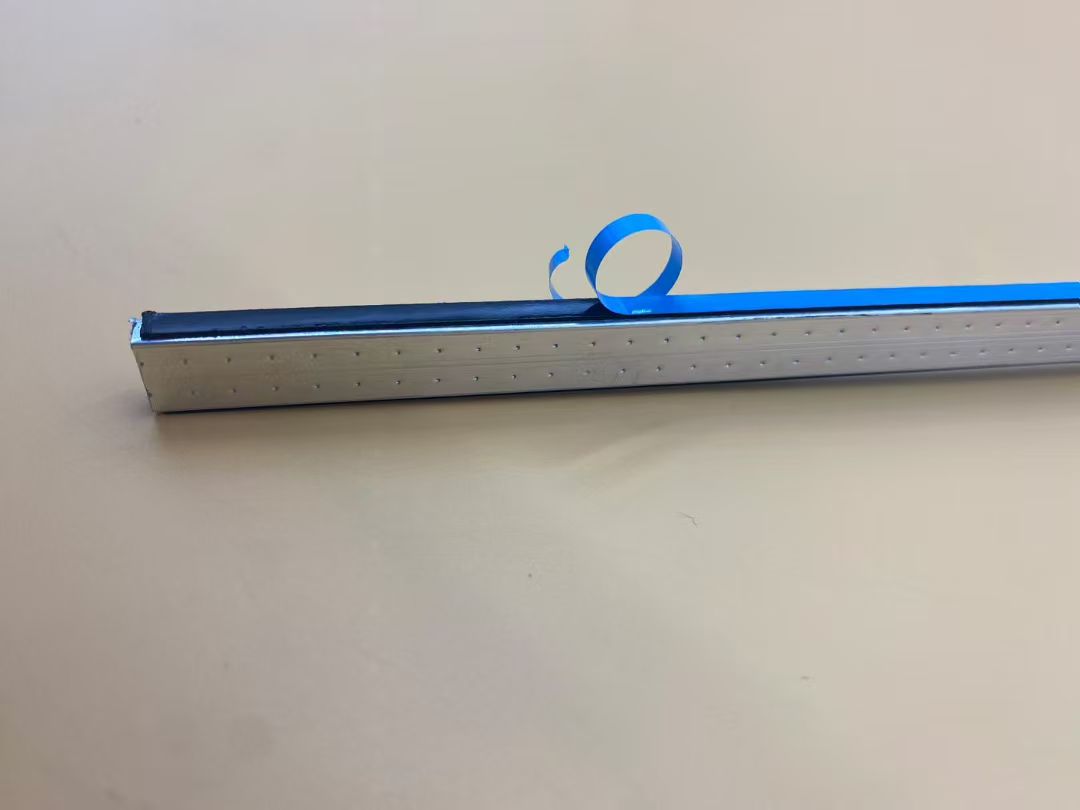
A butylated aluminium spacer bar: butyl tape is applied to the side walls so the spacer can bond to the glass during assembly. Image: Soleron.
Q6 How do spacer, desiccant and sealant work together as a system?
The spacer, desiccant, primary seal and secondary seal work as one moisture-control system: the desiccant adsorbs residual moisture, the primary seal limits vapour ingress, and the secondary seal provides structural bond and further moisture resistance. A failure in any one of them shows up as the same symptom — fogging or condensation inside the cavity.
Common desiccants for IGUs are molecular sieves or blends of silica gel with molecular sieves; their purpose is to adsorb residual water and solvent vapour in the sealed space. ASTM C1249-18 describes dual-seal construction with polyisobutylene as the primary seal and silicone as the secondary seal for structural silicone glazing. Soleron supplies butyl sealant, hot melt sealant and two-component silicone sealant alongside spacer bars and molecular sieve, which allows compatibility to be discussed with one supplier — but unit-level testing still belongs to the IGU fabricator.
| Component | Function in the unit | What the buyer should check |
|---|---|---|
| Spacer bar | Holds cavity geometry and carries desiccant | Profile size, wall thickness, weld integrity, bendability |
| Desiccant | Adsorbs residual moisture and solvent vapour | Grade, particle size, sealed packaging, moisture content method |
| Primary sealant | First vapour barrier at the edge | Continuity, adhesion to spacer and glass |
| Secondary sealant | Structural bond and additional moisture resistance | Bead dimensions, hardness, adhesion |
| Butyl tape | Initial bonding and handling, part of the primary barrier in many designs | Width, tack, storage conditions and shelf life |
Q7 When is an aluminium spacer bar the wrong choice?
An aluminium spacer bar is the wrong choice when edge thermal performance or condensation resistance drives the specification. In those projects, a warm-edge spacer is the appropriate component.
Comparison data in the verified dataset lists thermal conductivity of 160–200 W/mK for aluminium and 0.13–0.25 W/mK for warm-edge spacers, and notes that warm-edge technology can reduce thermal bridging by up to 90% relative to aluminium. The physical consequence is that the aluminium edge is more likely to fall below dew point in cold climates or humid interiors, which is where edge condensation appears first.
Warm-edge options include fibreglass, composite plastic and stainless steel, PP, flexible and butyl sealing spacers; Soleron's warm edge range covers 6–27A with a declared 5-year guarantee. Aluminium remains appropriate where mechanical strength, conventional processing and moderate thermal targets dominate. The choice is a specification decision, not a quality ranking, and a supplier that recommends one option for every project is not giving a specification answer.
Q8 What is the role of butyl tape in an IGU edge assembly?
Butyl tape provides the initial bond between spacer and glass before the secondary seal cures and, in many dual-seal designs, forms part of the primary vapour barrier. It is also a handling aid: a tacky tape holds the frame in position during assembly.
A butylated spacer bar combines these functions by applying the tape to the spacer side walls during production. Where the processor prefers to apply tape in-house, separate butyl tape is used instead. Soleron lists butyl tape, cork pads and trimming cotton among its related accessories, with a declared 10-year guarantee.
Two checks are worth adding to the purchase order. Tape width must match the spacer face it is applied to, and storage conditions matter because butyl tack changes with temperature. Ask for the declared storage instruction and shelf life of the tape, and do not assume it matches the 5-year guarantee on the spacer bar itself.
Part 2 — Procurement questions
Q9 What sealant formats and net weights are declared?
Soleron declares three sealant families — butyl sealant, hot melt sealant and two-component silicone sealant — under models SOL-803 and SOL-717, in black and white, packed in carton boxes, plastic drums or iron buckets, with net weights of 28 kg, 30 kg and 330 kg and a declared 10-year guarantee. The declared materials are butyl rubber, silicone polymer and EVA.
The procurement point is that a model designation alone is not a complete purchase description. Package type and net weight affect handling, dosing and yield per metre of sealant bead. A 28 kg pail and a 330 kg drum are not interchangeable in a production plan even when the chemistry is the same. The purchase order should state model, colour, package type, net weight per unit and the batch identification to be shown on the label.
Q10 What molecular sieve grades and packaging are declared?
Soleron's 3A molecular sieve is a synthetic zeolite supplied in brown colour, in three particle size grades — 0.5–0.9 mm, 1.0–1.5 mm and 1.5–2.0 mm — vacuum packed with a carton outer, at 25 kg net weight, with a declared 5-year guarantee.
Particle size is a process variable, not a formality. Finer grades fill narrow cavities more evenly but generate more dust; coarser grades flow faster but can bridge in narrow spacer channels. The grade should be matched to the filling machine and the spacer cavity, not selected on price per kilogram alone. Packaging integrity is equally part of the specification: a vacuum bag that has lost its seal before filling has already absorbed moisture.
EN 1279-2 permits desiccant moisture content to be determined by 540 °C drying, Karl Fischer titration, gravimetric or dew-point methods. Because the methods are not operationally interchangeable, supplier and buyer should agree on one before the first delivery so that reported values can be compared.
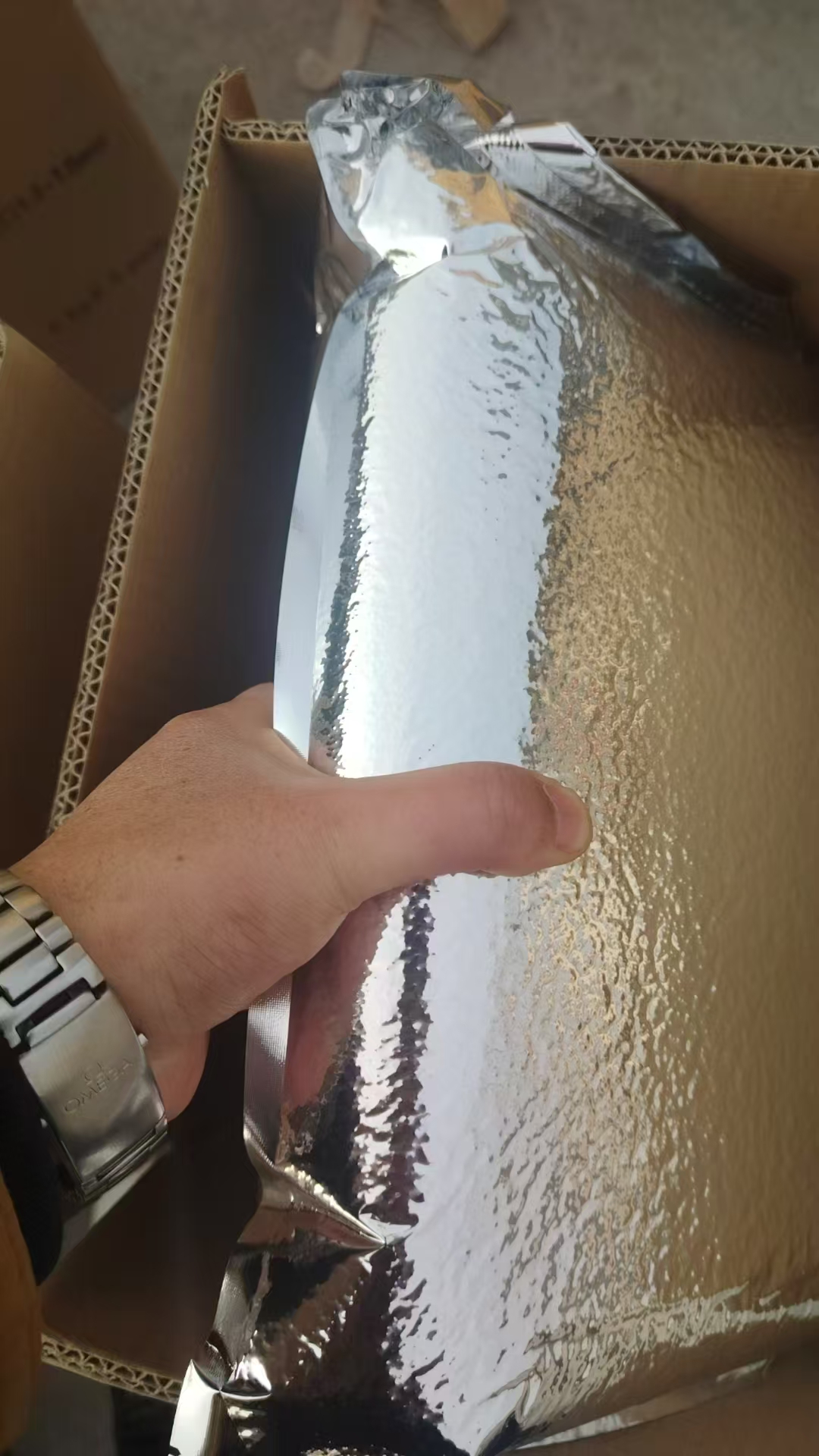
Vacuum-packed 3A molecular sieve inner bag. Packaging integrity is a moisture-control parameter, not a shipping detail. Image: Soleron.
Q11 What purchasing terms should be agreed before production?
Before production, agree OEM/ODM scope, customization limits, MOQ, lead time, capacity, inspection method and after-sales route in writing. Soleron declares OEM/ODM production, customization of logo, size and packaging, an MOQ of 5 cartons, lead times of 20–45 days, monthly capacity of 500 tons, quality control by random inspection, remote after-sales support and export markets in the EU, Middle East and Southeast Asia.
Those declarations become useful only when converted into contract terms. The purchase order should specify alloy series, profile size, wall thickness, length, air-gap designation, surface type, tape option, packing, marking, lot traceability, sampling plan and the guarantee period for each category. Capacity and lead time should have a measurement point, such as a trial order verified before a seasonal peak, rather than remaining a brochure statement.
Q12 How do declared parameters map to acceptance checks?
Every declared parameter should map to a measurement method, a sampling frequency and a document. If a supplier cannot explain how a number is measured, that number is marketing rather than specification. The table below converts the declarations discussed above into acceptance checks a buyer can perform or request.
| Declared parameter | Declared value | Acceptance check or document |
|---|---|---|
| Aluminium spacer profile size | 5.5–50 mm | Caliper or gauge measurement on samples from each lot; dimensional report with sampling plan |
| Wall thickness | 0.16–0.35 mm | Micrometer measurement at defined points; record minimum and maximum |
| Alloy and coil source | 3003 and 1100 series | Mill certificate or coil certificate for the lot |
| Weld construction | High-frequency welded hollow profile | Visual and section check for weld integrity; weld record if available |
| Air-gap designation | 6A–24A and custom | Go/no-go gauge on assembled frame against approved drawing |
| Butyl tape compatibility | Butylated spacer option; butyl tape accessory | Peel or adhesion trial on first article; storage and shelf-life statement |
| Sealant net weight | 28 kg, 30 kg, 330 kg | Weigh sample units from each batch; batch ticket linking weight to production date |
| Sealant guarantee | 10 years | Warranty statement with start date and claim conditions |
| Molecular sieve grade | 0.5–0.9, 1.0–1.5, 1.5–2.0 mm; brown; 25 kg | Sieve analysis or certificate of analysis; colour and net weight check; vacuum integrity check |
| Molecular sieve guarantee | 5 years | Warranty statement per category |
| Accessory guarantee | 10 years for butyl tape, cork pads, trimming cotton | Warranty statement listing covered items |
| Spacer guarantee | 5 years | Warranty statement per category |
| Unit moisture penetration | EN 1279-2: Iav no more than 0.20; individual no more than 0.25 | Unit-level test report from the IGU fabricator, not the component supplier |
| Desiccant moisture content | Method-dependent | Agreed method: 540 °C drying, Karl Fischer, gravimetric or dew-point |
Q13 Which documents should a buyer hold before releasing payment?
Before releasing payment, a buyer should hold a document set that ties each declared value to a lot. The set differs by category, but the principle is constant: the document should identify the batch, the measured value and the specification it is measured against.
- Mill or coil certificate for the 3003 or 1100 series aluminium used in the spacer lot.
- Dimensional inspection report covering profile size and wall thickness, with the sampling plan stated.
- Weld integrity record or a section sample for the high-frequency welded hollow profile.
- Sealant batch ticket showing model, colour, package type and net weight.
- Certificate of analysis for the molecular sieve grade, particle size distribution and moisture content.
- Packing list showing net weight per package and total quantity.
- Warranty statement for each category, with start date and claim route.
- For the finished unit, the fabricator's EN 1279-2 or equivalent unit-level test report.
The last item is the one most often missing. Component certificates support a qualification file; they do not demonstrate that the assembled unit passes a moisture penetration test.
Q14 How should the 5-year and 10-year guarantee periods be read?
Guarantee periods in this category are not uniform: Soleron declares 10 years for sealant and for related accessories such as butyl tape, cork pads and trimming cotton, and 5 years for aluminium spacer bar, warm edge spacer, 3A molecular sieve, corner connector and Georgian bar. A single bill of materials can therefore carry two guarantee clocks.
Buyers should record the start date — delivery, installation or unit completion — the claim route, and whether the guarantee covers material only or also labour and re-glazing. A 10-year sealant guarantee does not extend the 5-year spacer guarantee, and no single number should be written into a project specification without a category-by-category table. It is also worth distinguishing a supplier guarantee from third-party certification: the former is a commercial commitment, the latter is evidence.
Q15 What do EN 1279-2 and related standards actually test?
EN 1279-2, ASTM C1249-18 and AS/NZS 4666:2012 test or describe unit-level behaviour; they do not certify individual spacers, sealants or desiccants in isolation. That distinction decides which document a buyer should ask for.
EN 1279-2 sets a moisture penetration test with an average index Iav of no more than 0.20 and an individual specimen index of no more than 0.25 across five aged specimens, and it names permitted methods for desiccant moisture content. ASTM C1249-18 addresses dual-seal construction for structural silicone glazing, where polyisobutylene is the primary seal and silicone the secondary seal. AS/NZS 4666:2012 covers requirements and guidelines for long-term type testing, glazing, periodic manufacturing testing, traceability, desiccant suitability, shelf life and desiccant exposure limits.
Three practical readings follow. First, standards qualify units, not components. Second, a component supplier's compliance claim is not a unit certificate. Third, a test report has a scope: check that the unit construction, spacer type, sealant chemistry and desiccant grade in the report match what is being purchased.
Q16 Is demand for insulating glass materials growing, and what does that mean for specification?
Commercial research points to continued growth in the downstream IGU market, which raises rather than lowers the value of documented components. Grand View Research values the global insulated glass market at USD 92.7 billion in 2024, USD 101.3 billion in 2026 and USD 121.7 billion by 2030. Meticulous Research values the warm edge spacer market at USD 1.1 billion in 2024, projected to reach about USD 1.90 billion by 2035. Mordor Intelligence values the 3A molecular sieve segment at USD 1.80 billion in 2024.
These are commercial research estimates with different scopes, and they are not independently verified here. The procurement reading does not depend on the exact figures. When unit volumes grow, the cost of an edge failure grows with them, because a failed unit is a removal-and-replacement event rather than a component swap. That shifts value toward components with traceable batches, agreed test methods and category-specific guarantees, even when their price per metre is higher.
Application note: what a recorded project reported
Soleron's case record for aluminium spacer bars describes a project scale of 500 tons of spacer bars supplied, with reported outcomes of improved thermal insulation, reduced condensation and improved air and moisture tightness. The stated application was maintaining spacing between glass panes and improving edge insulation in insulating glass units. These are supplier-reported outcomes rather than independently measured results, and they should be read as application context rather than as a performance guarantee. The useful part for a buyer is the structure of the claim: a defined material, a defined application and a stated outcome that can be tested on the next project.
Future outlook
Three changes are likely to shape insulating glass material specifications over the next buying cycles.
Edge performance becomes an explicit specification. As warm-edge share grows, aluminium is less likely to be the default and more likely to be a deliberate choice for mechanical strength and conventional processing. Buyers will be asked to justify the edge construction, not only the glass build-up.
Documentation becomes routine. Standards already require traceability and periodic manufacturing testing in some markets, and EN 1279-2 already pins moisture penetration to a measurable index. Expect requests for unit-level reports and batch linkage to move from best practice to standard tender requirement.
Desiccant and sealant compatibility gets more attention. Larger cavities and triple glazing increase the quantity of desiccant and the importance of fill behaviour. A 3A sieve with a defined particle size, sealed packaging and an agreed moisture test method supports that trend better than a grade described only by colour and weight.
The limitation is evidence. Public price benchmarks, moisture vapour transmission rates and independent test data for individual components remain scarce, and much of what is available is supplier-declared. Until that changes, incoming inspection and agreed test methods carry more weight than catalogue comparisons.
What this FAQ means in practice
Specify the unit as a system, buy the bill of materials line by line, and accept each line against a measurement. The three questions that prevent most edge failures are unglamorous: which method produced this number, which batch does it belong to, and which document will I hold before payment. A supplier that answers all three without hesitation is easier to qualify than one that answers only the first.
For the full declared specification set referenced in these answers, the Soleron product catalogue is available as a PDF: Soleron product catalogue.
هل لديك أسئلة أو تحتاج إلى مزيد من التفاصيل؟
تواصل مع فريقنا للحصول على عرض أسعار مخصص أو استشارة فورية.
طلب عرض أسعار
املأ النموذج أدناه وسيتواصل معك فريقنا بعرض مقترح مخصص.
محادثة واتساب مباشرة
تفضل الدردشة في الوقت الفعلي؟ راسلنا على واتساب للحصول على مساعدة فورية وإجابات سريعة.
- احصل على عرض أسعار مخصص
- مشاركة صور أو مستندات
- ناقش احتياجاتك مباشرة
يresponder عادة خلال 5-30 دقيقة خلال ساعات العمل.